


Report Overview
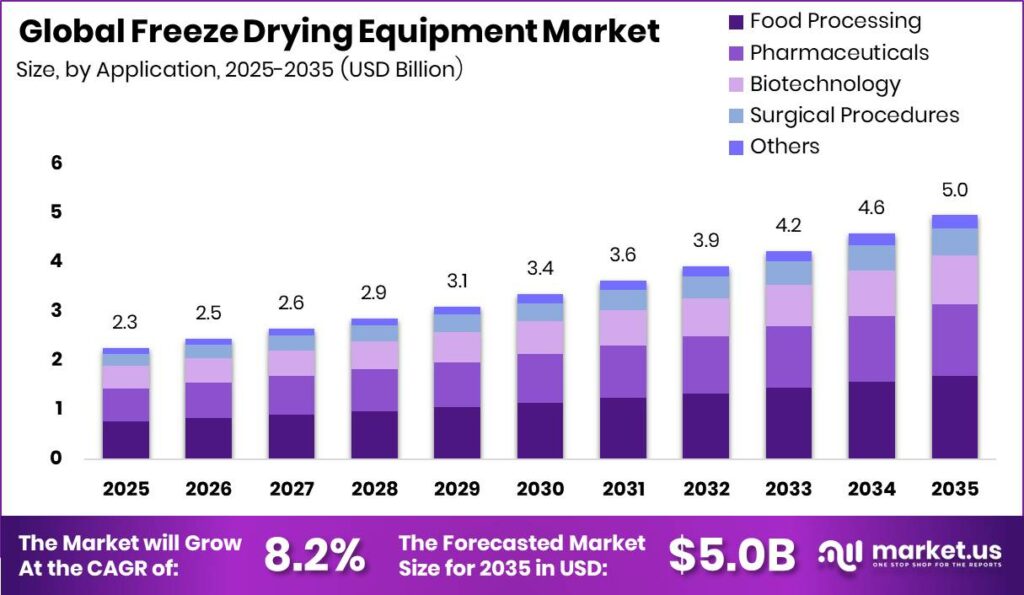
Global Freeze Drying Equipment Market size is expected to be worth around USD 5.0 Billion by 2035 from USD 2.3 Billion in 2025, growing at a CAGR of 8.2% during the forecast period 2026 to 2035. This growth reflects rising pharmaceutical and food-processing demand for stable, shelf-stable output. Buyers should treat lyophilisation capacity as a long-cycle capital investment rather than a short-term procurement decision.
Freeze drying equipment removes water from products through sublimation under vacuum and low temperature. The market splits across product type, installation type, and application. Therefore, vendors must position units for distinct buyer groups, from laboratory researchers to industrial pharmaceutical and food producers. This structure creates clear entry points for suppliers who match equipment scale to end-use requirements.
Key Takeaways
- Global Freeze Drying Equipment Market will reach USD 5.0 Billion by 2035 from USD 2.3 Billion in 2025.
- The market grows at a CAGR of 8.2% during 2026 to 2035.
- Industrial Freeze Dryers lead the By Product Type segment with a 35.2% share.
- Tray Style dominates the By Installation Type segment with a 44.2% share.
- Food Processing holds a 34.2% share within the By Application segment.
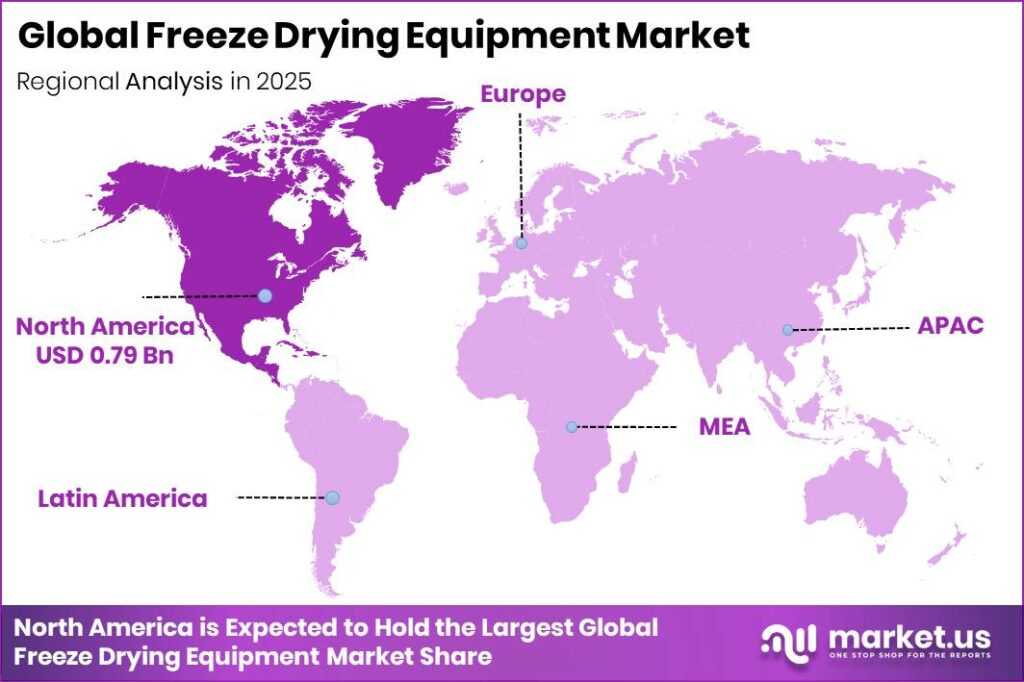
- North America leads globally with a 35.0% share, valued at USD 0.79 Billion.
Government agencies shape this market through drug approval pipelines and quality mandates. This creates predictable procurement demand for lyophilisers that meet regulatory presentation standards. Companies aligning equipment validation with FDA and EU GMP requirements will win pharmaceutical clients faster. As a result, regulatory readiness becomes a direct sales advantage for OEMs targeting injectable drug producers.
Lyophilization Equipment Market demand ties closely to biologics output. According to Springer research, 162 regulatory submissions involving lyophilised products were analyzed in one FDA-based study. This volume signals steady approval flow for freeze-dried drugs. Therefore, equipment suppliers can forecast commercial fill-finish orders as these approved products scale from clinical to full production.
Energy performance now drives buyer decisions in food lyophilisation equipment . Data from Frontiers in Sustainable Food Systems shows energy efficiency of 36.9% to 41.1% in 30-hour process scenarios, lower than shorter cycles. This means longer cycles waste more energy during prolonged sublimation. Consequently, food processors favor equipment that shortens cycle time to protect operating margins.
Product Type Analysis
Industrial Freeze Dryers dominate with 35.2% due to high-volume commercial production capacity.
In 2025, Industrial Freeze Dryers held a dominant market position in the By Product Type segment of Freeze Drying Equipment Market, with a 35.2% share. As reported by ADVA Lab, freeze-drying cycle stages split into freezing at 2 to 6 hours, primary drying at 12 to 48 hours, and secondary drying at 4 to 12 hours. This long duration favors large industrial units that spread cost across bigger batches. Therefore, buyers investing in industrial scale gain lower per-unit processing cost.
Laboratory Freeze Dryers serve research and formulation development teams that need precise, small-batch control. Based on BUCHI equipment guidance, standard aqueous systems require condenser temperatures near -55°C for reliable moisture capture. This precision suits academic and biotech users testing new formulations. As a result, laboratory units act as the entry point that later drives industrial equipment purchases once processes scale.
Mobile Freeze Dryers, General Purpose Freeze Dryers, Bench Top Freeze Dryers, and Others hold the remaining share collectively. Each serves niche buyers seeking portability, flexibility, or low upfront cost. Mobile and bench top units suit field labs and small producers. This creates a fragmented lower tier where suppliers compete on price, footprint, and ease of operation rather than throughput.
Installation Type Analysis
Tray Style dominates with 44.2% due to large flat-surface batch loading capacity.
In 2025, Tray Style held a dominant market position in the By Installation Type segment of Freeze Drying Equipment Market, with a 44.2% share. According to WAVE pharmaceutical data, industrial freeze-drying cycles run 12 to 72 hours total, with primary drying as the most energy-intensive phase. Tray systems maximize product surface per cycle. Therefore, producers choose tray style to raise output within these long fixed cycle windows.
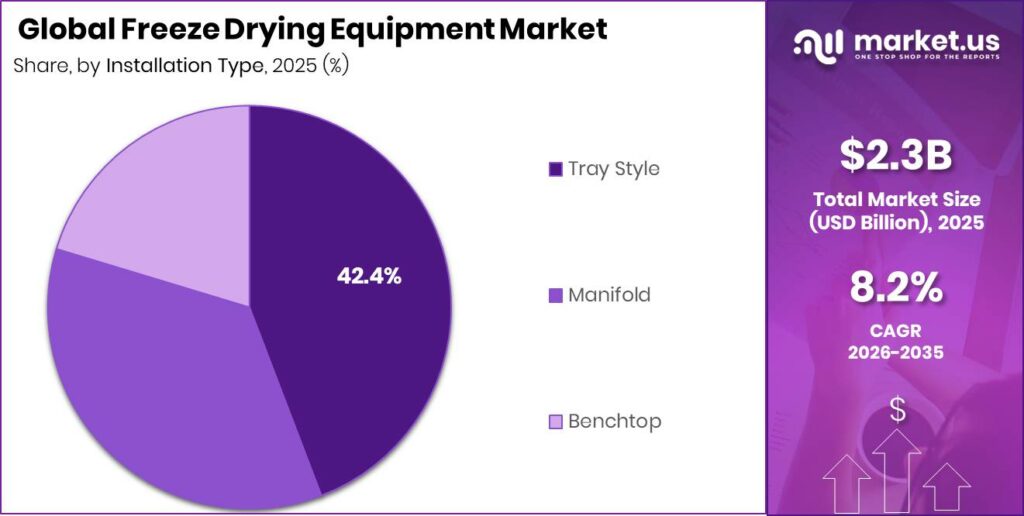
Manifold systems attach flasks directly to a central drying array for small-batch flexibility. Figures from Freeze Driers KPI analysis show that cutting cycle time from 48 hours to 42 hours lifts annual production capacity by roughly 14%. This gain matters most where manifold users run frequent short cycles. Consequently, buyers prioritize cycle optimization tools to protect throughput on flexible manifold setups.
Benchtop installations serve compact laboratory environments where space and budget stay limited. These units support formulation trials and low-volume production for academic and biotech users. Their smaller footprint suits crowded research settings. This creates steady replacement demand as labs upgrade aging equipment while keeping capital outlay contained within tight research budgets.
Application Analysis
Food Processing dominates with 34.2% due to premium shelf-stable food demand growth.
In 2025, Food Processing held a dominant market position in the By Application segment of Freeze Drying Equipment Market, with a 34.2% share. Data from Frontiers in Sustainable Food Systems shows energy efficiency of 38.7% to 43.1% across 24-hour process scenarios in meat lyophilisation research. This efficiency shapes food processor economics. Therefore, equipment that sustains higher efficiency at shorter cycles wins food industry buyers.
Pharmaceuticals ranks as the fastest-growing application, driven by injectable biologics needing stable presentation. As reported by WAVE, industrial pharmaceutical cycles span 12 to 72 hours depending on product load and formulation. This wide range demands precise process control. Consequently, drug makers invest in validated, high-accuracy lyophilisers to meet strict regulatory moisture and stability targets.
Biotechnology applications rely on tight thermal control during sensitive drying phases. Based on NCBI pilot-scale research, heat flux during primary drying measured 250 to 570 W/m² in fruit lyophilisation monitoring. This shows how heat transfer varies across products and phases. As a result, biotech buyers demand real-time monitoring to protect fragile biological material.
Surgical Procedures, Bakery and Dairy, Vegetables and Fruits, Seafood and Meat, and Others hold the remaining share collectively. Each serves a focused end use from tissue preservation to specialty food output. These smaller applications diversify demand. This spreads supplier risk across multiple sectors rather than concentrating it in a single volatile category.
Key Market Segments
By Product Type
- Mobile Freeze Dryers
- Laboratory Freeze Dryers
- Industrial Freeze Dryers
- General Purpose Freeze Dryers
- Bench Top Freeze Dryers
- Others
By Installation Type
- Tray Style
- Manifold
- Benchtop
By Application
- Surgical Procedures
- Pharmaceuticals
- Biotechnology
- Food Processing
- Bakery & Dairy
- Vegetables & Fruits
- Seafood and Meat
- Others
- Others
Regional Analysis
North America Dominates the Freeze Drying Equipment Market with a Market Share of 35.0%, Valued at USD 0.79 Billion
North America leads the Freeze Drying Equipment Market with a 35.0% share, valued at USD 0.79 Billion in 2025. The region hosts a dense pharmaceutical and biologics manufacturing base needing lyophilised injectable output. This concentration drives steady equipment procurement. Therefore, suppliers with strong North American service networks capture recurring validation and maintenance revenue across a large installed fleet.
Asia Pacific stands as the fastest-growing region, led by expanding generic drug and vaccine production. In 2025, Optima Packaging Group expanded freeze-drying offerings to support aseptic fill-finish and pharmaceutical-grade lyophilisation lines with automated integration. This move targets rising Asian manufacturing demand. As a result, OEMs building local capacity gain first access to fast-scaling pharmaceutical and food producers across the region.
Key Regions and Countries
North America
- US
- Canada
Europe
- Germany
- France
- The UK
- Spain
- Italy
- Rest of Europe
Asia Pacific
- China
- Japan
- South Korea
- India
- Australia
- Rest of APAC
Latin America
- Brazil
- Mexico
- Rest of Latin America
Middle East and Africa
- GCC
- South Africa
- Rest of MEA
Market Dynamics
Market Opportunity Analysis - Underserved emerging markets and untapped product applications open entry points for new players
The Laboratory Freeze Dryers segment sits underexploited across Asia Pacific research hubs. This sub-segment feeds later industrial purchases, yet suppliers underserve academic and biotech buyers in fast-growing markets. New entrants can build early relationships at the lab stage. Therefore, capturing researchers now creates a pipeline toward larger industrial equipment sales as those users scale production.
The Manifold installation type remains a niche entry point for smaller producers. This segment suits low-volume, flexible operations that larger tray-focused vendors often ignore. New players can target flexible cycle users with compact, affordable systems. Consequently, suppliers who serve this underexploited group build loyal customer bases before those buyers upgrade to higher-value equipment.
The Biotechnology application group offers room for specialised entrants. This sub-segment demands precise thermal control that generalist suppliers rarely optimise fully. New firms can differentiate through monitoring and product-specific cycle expertise. As a result, focused biotech suppliers can command premium pricing in a segment where broad players compete mainly on general capability.
Technology and Innovation Landscape - Energy efficiency, cycle control, and automated fill-finish reshape competitive advantage
Energy efficiency defines the current innovation front in food and industrial lyophilisation. Suppliers now design cycles that limit energy loss during extended sublimation phases. This lets processors cut operating cost per batch. Therefore, manufacturers who lead on efficiency messaging win cost-sensitive food and industrial buyers ahead of rivals competing only on capacity.
Automated fill-finish integration marks a second innovation shift. In 2025, Optima Packaging Group expanded offerings to support aseptic fill-finish and pharmaceutical-grade lyophilisation lines with automated production integration. This links lyophilisers directly into sterile drug workflows. As a result, buyers favor suppliers who deliver integrated systems rather than standalone chambers needing separate line engineering.
Precision cycle control drives the third innovation wave. Upgraded systems improve chamber performance and thermal uniformity for sensitive pharmaceutical and food products. This raises batch consistency and reduces failed runs. Consequently, manufacturers offering tighter control and monitoring gain an edge with regulated buyers who prioritize reproducible, validated output over lower upfront price.
Drivers
The main driver is the expanding global biologics manufacturing base, anchored by oncology pipelines and post-pandemic vaccine infrastructure. According to Market.us, the U.S. FDA approved 55 novel drugs in 2023 and 50 in 2024, with roughly 35 to 45% of new injectable biologic license applications requiring lyophilised presentation. This links approvals directly to equipment demand. Therefore, OEMs gain predictable commercial fill-finish orders within 12 to 36 months of each approval.
A single commercial lyophiliser with 20 to 50 m² shelf area carries a capital cost of USD 1.5 Million to USD 6 Million including validation, with lead times of 12 to 24 months. Indian pharmaceutical makers, handling near 20% of global generic exports, grew lyophiliser procurement 18 to 25% yearly through 2025. This shifts vendors toward long-term supply agreements. As a result, framework deals worth USD 10 Million to USD 60 Million improve OEM revenue visibility.
| Driver | (~) % Impact on CAGR Forecast | Geographic Relevance | Impact Timeline |
|---|---|---|---|
| Pharmaceutical & Biologics Manufacturing Expansion Driving Lyophiliser Capacity Investment for Injectable Drug & Vaccine Production | +2.70% | United States, European Union, India, China, South Korea, Japan, Switzerland | Short term (≤ 2 years) |
| Freeze-Dried Food & Emergency Preparedness Demand Growth Driving Industrial Food Lyophilisation Equipment Procurement | +1.50% | United States, Europe, China, Japan, Australia, South Korea, Canada | Short term (≤ 2 years) |
| mRNA & Cell & Gene Therapy Pipeline Commercialisation Requiring Ultra-Low Temperature Lyophilisation Capability | +1.10% | United States, Germany, United Kingdom, Japan, South Korea, Singapore | Medium term (2–4 years) |
| Nutraceutical & Dietary Supplement Premiumisation Driving Freeze-Dried Ingredient Processing Equipment Demand | +0.72% | United States, Europe, China, Japan, India, Australia | Short term (≤ 2 years) |
| Veterinary Biologics & Animal Vaccine Lyophilisation Capacity Buildout in Emerging Markets | +0.48% | India, Brazil, China, Southeast Asia, Latin America, Africa | Medium term (2–4 years) |
| Contract Development & Manufacturing Organisation (CDMO) Capacity Expansion Requiring Multi-Product Lyophiliser Fleets | +0.38% | United States, Europe, India, South Korea, Singapore, China | Short term (≤ 2 years) |
Restraints
The root cause is the engineering complexity of pharmaceutical-grade freeze dryers, which need 316L stainless steel surfaces, validated CIP/SIP systems, and condenser control to -70°C to -85°C. According to Market.us, pilot units start at USD 150,000 to USD 400,000, while commercial units reach USD 1.5 Million to USD 8 Million. This price threshold blocks smaller buyers. Therefore, many emerging-market producers delay entry into freeze-dried categories.
In India, roughly 80% of pharmaceutical makers are SMEs with revenue below USD 30 Million, so one lyophiliser can equal 7 to 17% of annual revenue. This forces external finance at 10 to 14% rates and stretches payback to 7 to 12 years. Consequently, an estimated 40 to 55% of identifiable demand goes unconverted, signalling strong potential for lease and financing models.
| Restraint | (~) % Impact on CAGR Forecast | Geographic Relevance | Impact Timeline |
|---|---|---|---|
| Prohibitive Capital Cost of Industrial & Pharmaceutical-Grade Lyophilisers Suppressing SME & Emerging Market Procurement | -1.50% | India, Southeast Asia, Latin America, Eastern Europe, Sub-Saharan Africa | Short term (≤ 2 years) |
| High Energy Consumption of Lyophilisation Process Versus Alternative Drying Technologies Creating CapEx Diversion to Spray Drying | -0.80% | Europe, United States, Japan, Australia — high energy cost & ESG-scrutinised markets | Short term (≤ 2 years) |
| Extended Process Cycle Times (24–72 Hours Per Batch) Limiting Throughput & Manufacturing Scalability | -0.55% | Global — most acute for high-volume commercial pharmaceutical & food production | Short term (≤ 2 years) |
| Concentrated Lyophiliser OEM Supply Base Creating Long Lead Times & Pricing Power Compression for Buyers | -0.38% | Global — supply base concentrated in Germany, United States, Sweden, Italy | Short term (≤ 2 years) |
Challenges
The structural vulnerability is the non-linear link between shelf area and cycle behaviour, since heat and mass transfer shift as batches scale from pilot to commercial size. According to Market.us, equipment-specific cycle development costs USD 200,000 to USD 800,000 per product per lyophiliser model, targeting residual moisture of 0.5 to 2.0%. This raises the cost of every scale-up. Therefore, buyers face real friction moving from clinical to commercial output.
Technology transfer between CDMO sites adds further cost, requiring 3 to 6 validation batches and adding 6 to 18 months plus USD 1.5 Million to USD 4 Million per transfer. Digital twin platforms costing USD 3 Million to USD 12 Million can predict cycle performance at 85 to 92% accuracy. This creates a new engineering services revenue stream. As a result, OEMs offering simulation tools capture recurring high-margin income.
| Challenge | (~) % CAGR Friction Drag | Geographic Relevance | Mitigation Horizon |
|---|---|---|---|
| Lyophilisation Process Scale-Up & Technology Transfer Complexity | -0.95% | Global — most acute for pharma CDMOs & clinical-to-commercial scale transfers | Long term (≥ 4 years) |
| Skilled Validation & GMP Process Engineering Talent Deficit | -0.72% | United States, Europe, India, South Korea — advanced pharmaceutical manufacturing hubs | Long term (≥ 4 years) |
| Refrigerant Regulation & HFC Phase-Down Compliance for Condenser Systems | -0.55% | European Union, United States, Japan, Australia — Kigali Amendment signatory markets | Medium term (2–4 years) |
| Spare Parts & Field Service Network Gaps in Rapid-Growth Emerging Markets | -0.38% | India, Southeast Asia, Latin America, Sub-Saharan Africa, Middle East | Long term (≥ 4 years) |
| Continuous Freeze Drying Technology Adoption Uncertainty Disrupting Batch Equipment Investment Decisions | -0.28% | United States, Europe, Japan — advanced pharmaceutical manufacturing markets | Long term (≥ 4 years) |
Opportunities
This opportunity is untapped white space, since continuous lyophilisation stayed at pilot stage through 2025 with no major manufacturer running it in routine GMP production. According to Market.us, batch systems hit a ceiling of 1 to 4 batches per week at cycle times of 24 to 72 hours. This leaves throughput demand unmet. Therefore, early continuous-technology movers can define a new production standard.
Continuous systems could lift utilisation from 45 to 60% in batch mode toward 80 to 92%, cutting per-unit cost by 20 to 35%. First commercial lines could price at USD 8 Million to USD 20 Million at margin premiums of 35 to 50%. This rewards OEMs investing USD 25 Million to USD 80 Million in platform development. As a result, first movers gain outsized pricing power before competitors qualify.
| Opportunity | (~) % Potential CAGR Upside | Geographic Relevance | Execution Window |
|---|---|---|---|
| Continuous Lyophilisation Technology Commercialisation for High-Volume Pharmaceutical Fill-Finish Lines | +1.80% | United States, Germany, Switzerland, Japan, South Korea, Singapore | Long term (≥ 4 years) |
| Lyophilisation Equipment-as-a-Service & Shared Capacity Models for Emerging Market Pharmaceutical SMEs | +1.10% | India, Southeast Asia, Latin America, Sub-Saharan Africa, Eastern Europe | Medium term (2–4 years) |
| Precision Fermentation & Alternative Protein Ingredient Freeze Drying Processing Equipment Demand | +0.85% | United States, Netherlands, Singapore, Germany, Australia, Israel | Long term (≥ 4 years) |
| Space & Military Field Nutrition Programmes Driving Specialised Freeze-Drying Equipment Procurement | +0.55% | United States, Japan, European Union, India, South Korea, Israel | Long term (≥ 4 years) |
| Microbiome & Live Biotherapeutic Product (LBP) Lyophilisation for Oral Drug Delivery Stability | +0.42% | United States, European Union, Japan, Canada, Australia | Long term (≥ 4 years) |
Key Company Insights
Zirbus Technology GmbH positions itself around precision German engineering for laboratory and industrial lyophilisers. This focus attracts pharmaceutical and research buyers who value validated thermal control and reliability. Its strength in mid-scale equipment creates an advantage in Europe. However, its narrower service footprint outside core markets leaves a gap that broader global rivals can exploit through faster field support.
Syntegon builds advantage through integrated pharmaceutical fill-finish and lyophilisation systems. In March 2025, GEA Group expanded upgraded industrial lyophilisation systems for higher energy efficiency, raising competitive pressure across this space. Based on Springer data, one FDA study covered 24 NDAs, 118 ANDAs, and 20 BLAs. This deep injectable pipeline rewards Syntegon’s automation focus. Therefore, its systems suit high-throughput regulated production.
Key Players
- Zirbus Technology GmbH
- Syntegon
- Senovatec
- Optima Packaging Group GmbH
- Millrock Technology Inc.
- Martin Christ Gefriertrocknungsanlagen GmbH
- Labconco
- IMA SpA
- IBK Industriebedarf GmbH
- Hosokawa Micron BV
- Genevac Ltd.
- GEA Group
- Cuddon Freeze Dry
- BUCHI Corporation
- Azbil Corporation
Recent Developments
- 2025: Labconco updated its benchtop freeze-dryer range to improve cycle control precision and energy efficiency, supporting academic and biotechnology laboratory applications.
- 2025: Tofflon Science and Technology Group increased production capacity for large-scale pharmaceutical freeze dryers, targeting biologics and vaccine manufacturing demand in Asia-Pacific and North America markets.
- 2025: SP Industries broadened its freeze-drying product line by adding enhanced laboratory and pilot-scale lyophilizers, targeting biotech R&D and pharmaceutical formulation development.
Geopolitical Impact Analysis
According to the WTO, global merchandise trade growth slowed to near 2.7% in recent forecasts, while shipping reroutes around the Red Sea added transit times of 10 to 14 days on Asia-Europe lanes per World Shipping Council data. These delays lengthen lyophiliser component delivery, since specialized condensers and vacuum systems ship from concentrated European and Asian suppliers. Therefore, buyers face longer equipment lead times and higher inventory holding costs.
Based on IEA data, industrial electricity prices in parts of Europe rose more than 30% above pre-crisis levels during recent energy volatility. As reported by the World Bank, elevated steel and metal input costs pushed capital equipment prices higher across manufacturing. This raises production cost for stainless-steel-intensive lyophilisers. Consequently, OEMs pass higher material and energy costs to buyers, pressuring emerging-market procurement budgets further.
Report Scope
| Report Features | Description |
|---|---|
| Market Value (2025) | USD 2.3 Billion |
| Forecast Revenue (2035) | USD 5.0 Billion |
| CAGR (2026-2035) | 8.2% |
| Base Year for Estimation | 2025 |
| Historic Period | 2020-2024 |
| Forecast Period | 2026-2035 |
| Report Coverage | Revenue Forecast, Market Dynamics, Market Opportunity Analysis, Technology and Innovation Landscape, Competitive Landscape, Recent Developments |
| Segments Covered | By Product Type (Mobile Freeze Dryers, Laboratory Freeze Dryers, Industrial Freeze Dryers, General Purpose Freeze Dryers, Bench Top Freeze Dryers, Others), By Installation Type (Tray Style, Manifold, Benchtop), By Application (Surgical Procedures, Pharmaceuticals, Biotechnology, Food Processing, Bakery & Dairy, Vegetables & Fruits, Seafood and Meat, Others) |
| Regional Analysis | North America (US and Canada), Europe (Germany, France, The UK, Spain, Italy, and Rest of Europe), Asia Pacific (China, Japan, South Korea, India, Australia, and Rest of APAC), Latin America (Brazil, Mexico, and Rest of Latin America), Middle East and Africa (GCC, South Africa, and Rest of MEA) |
| Competitive Landscape | Zirbus Technology GmbH, Syntegon, Senovatec, Optima Packaging Group GmbH, Millrock Technology Inc., Martin Christ Gefriertrocknungsanlagen GmbH, Labconco, IMA SpA, IBK Industriebedarf GmbH, Hosokawa Micron BV, Genevac Ltd., GEA Group, Cuddon Freeze Dry, BUCHI Corporation, Azbil Corporation |
| Customization Scope | Customization for segments, region / country-level will be provided. Additional customization can be done based on requirements. |
| Purchase Options | We have three licenses to opt for: Single User License | Multi-User License (Up to 5 Users) | Corporate Use License (Unlimited User and Printable PDF) |





































