


Global Flavoring Agents Market Size, Share, And Industry Analysis Report By Type (Natural Flavoring Agent, Artificial Flavoring Agent), By Application (Beverages, Bakery, Dairy, Savoury and Convenience Foods, Confectionery, Meat, Oral Hygiene or Pharmaceutical Snacks), By Region and Companies - Industry Segment Outlook, Market Assessment, Competition Scenario, Statistics, Trends and Forecast 2026-2035
- Published date: April 2026
- Report ID: 183496
- Number of Pages: 271
- Format:
-
keyboard_arrow_up
Quick Navigation
Report Overview
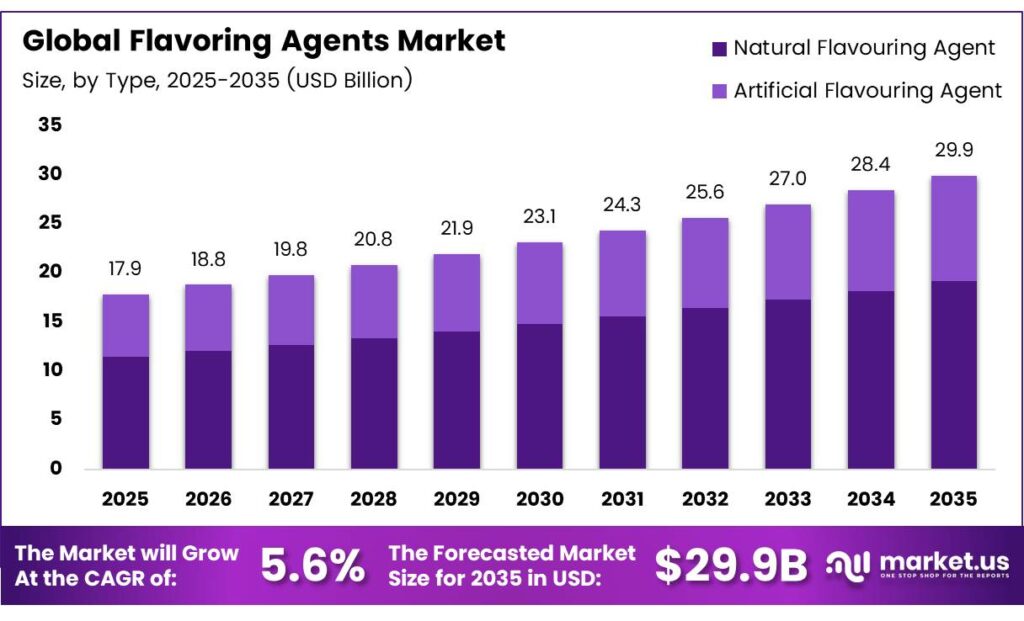
The Global Flavoring Agents Market size is expected to be worth around USD 29.9 billion by 2035 from USD 17.9 billion in 2025, growing at a CAGR of 5.6% during the forecast period 2026 to 2035.
Flavoring agents are substances added to food, beverages, and pharmaceutical products to enhance or modify taste and aroma. They include natural extracts, botanical concentrates, and synthetic compounds. Consequently, manufacturers across the food processing, dairy, and beverage industries rely on these ingredients to deliver consistent sensory appeal at a commercial scale.
Givaudan recorded revenue of CHF 7.41 billion ($8.19 billion) in FY2024, with Taste and Wellbeing sales growth of 10.7%, confirming flavoring ingredients as the group’s largest earnings stream. This performance signals sustained institutional confidence in the global flavor industry’s growth trajectory.
IFF maintained full-year 2024 net sales guidance of $10.8–$11.1 billion, with its Nourish segment contributing 52.8% of group sales. This underscores how flavoring and food ingredient divisions remain the commercial anchor for the world’s largest flavor and fragrance companies.
Clean-label regulations and consumer transparency mandates are reshaping ingredient sourcing strategies. Food brands now prioritize naturally derived flavor compounds to meet label declarations. Additionally, international trade frameworks increasingly influence how flavor concentrates move across supply chains, creating both compliance burdens and export opportunities for producers.
Key Takeaways
- The Global Flavoring Agents Market was valued at USD 17.9 billion in 2025 and is projected to reach USD 29.9 billion by 2035 at a CAGR of 5.6% during the forecast period, 2026 to 2035.
- Natural Flavoring Agents dominate with a 65.3% market share in 2025.
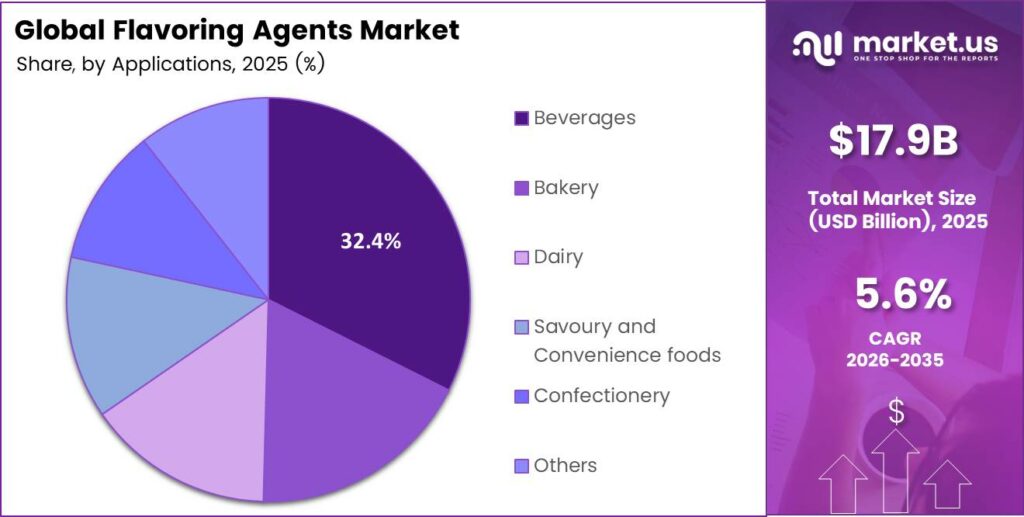
- Beverages lead the segment with a 32.4% share in 2025.
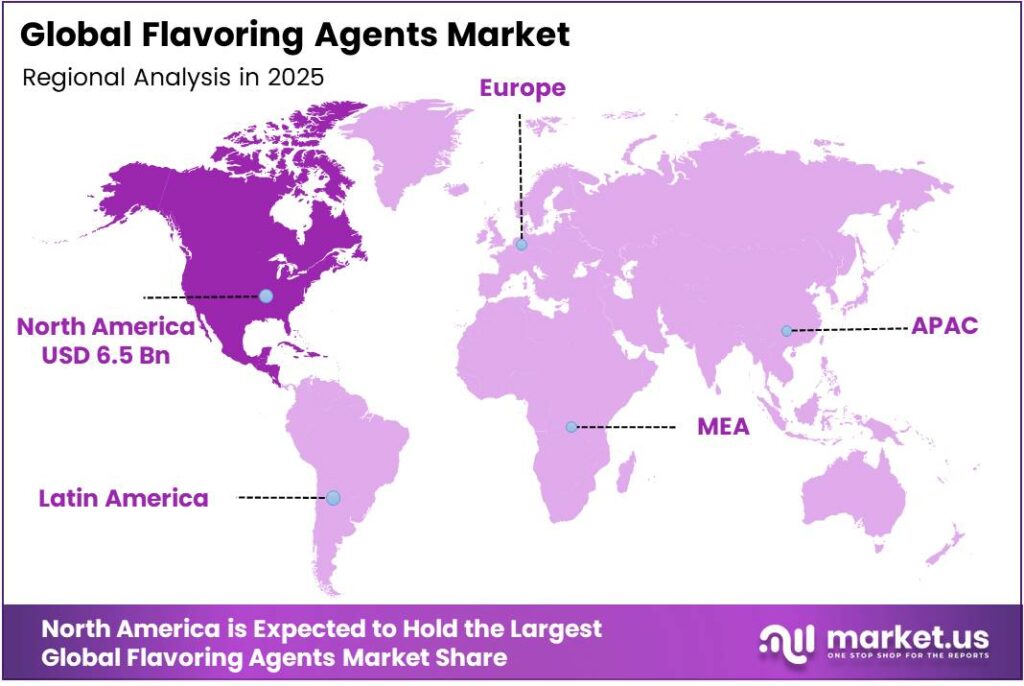
- North America holds the dominant regional position with a 36.7% market share, valued at approximately USD 6.5 billion in 2025.
By Type Analysis
Natural Flavoring Agent dominates with 65.3% due to rising clean-label consumer demand and regulatory support for naturally derived ingredients.
In 2025, Natural Flavoring Agent held a dominant market position in the By Type segment of the Flavoring Agents Market, with a 65.3% share. Consumers increasingly prefer ingredient labels featuring recognizable, plant-derived sources. Moreover, global regulatory bodies actively support the transition toward naturally extracted compounds, reinforcing manufacturer investment in botanical flavor technologies.
Artificial Flavoring Agent continues to serve cost-sensitive and industrial food processing applications. These synthetic compounds deliver consistent taste profiles at lower production costs. However, growing consumer skepticism toward lab-derived additives is gradually shifting formulation strategies. Food brands now use artificial agents primarily in price-competitive product lines where natural alternatives remain economically prohibitive.
By Application Analysis
Beverages dominate with 32.4% due to high volume consumption and continuous product innovation in functional and flavored drink categories.
In 2025, Beverages held a dominant market position in the By Application segment of the Flavoring Agents Market, with a 32.4% share. Soft drinks, functional beverages, energy drinks, and ready-to-drink teas drive massive flavor ingredient consumption. Additionally, premiumization trends push beverage brands to adopt complex and exotic flavor profiles to differentiate offerings in crowded markets.
Bakery products represent a significant flavoring application, particularly for vanilla, butter, fruit, and spice-based compounds. Artisan bakery expansion and in-store bakery growth in retail chains sustain steady demand. Consequently, flavor suppliers develop heat-stable compounds designed to maintain sensory integrity through baking processes at commercial production temperatures.
Dairy applications include ice cream, flavored yogurt, cheese spreads, and dairy beverages. Plant-based dairy substitutes are creating new formulation requirements for natural masking and taste-enhancement systems. Therefore, flavor developers now invest heavily in specialized solutions that replicate the full-fat, creamy sensory profiles consumers expect from conventional dairy products.
Key Market Segments
By Type
- Natural Flavoring Agent
- Artificial Flavoring Agent
By Application
- Beverages
- Bakery
- Dairy
- Savoury and Convenience Foods
- Confectionery
- Meat
- Oral Hygiene or Pharmaceutical Snacks
Emerging Trends
Wellness Botanicals and Functional Flavors Reshape Consumer Preference
Consumers now actively seek low-sugar, wellness-oriented flavor profiles featuring botanicals, floral notes, and functional herb extracts. Ireland exported $11.82 billion worth of flavoring mixtures globally in 2024, reflecting how specialized botanical flavor manufacturing scales rapidly to meet wellness-driven market demand across developed economies.
AI-Powered Discovery and Sustainable Sourcing Drive Industry Innovation
Flavor companies integrate artificial intelligence tools to accelerate predictive flavor discovery and deliver hyper-personalized consumer experiences at scale. Additionally, the restaurant and foodservice sector influence continues to accelerate global culinary fusion launches. Heightened industry emphasis on sustainable sourcing and traceable ethical practices now shapes procurement decisions across natural flavor supply chains worldwide.
Drivers
Consumer Shift Toward Natural Ingredients and Clean Labels Fuels Market Expansion
Food and beverage manufacturers face escalating consumer pressure to adopt natural and clean-label flavoring ingredients across all product categories. Consequently, brand owners reformulate legacy products to eliminate artificial additives. Additionally, the explosive growth of processed convenience foods and ready-to-eat meals creates sustained demand for enhanced sensory appeal through sophisticated flavoring systems at commercial production volumes.
Rising Incomes and Flavor Technology Breakthroughs Accelerate Demand
Rising global disposable incomes and expanding international travel spark a growing consumer appetite for exotic and multicultural flavor profiles. Moreover, breakthroughs in flavor extraction technologies enable manufacturers to develop complex taste systems rapidly and at lower cost. These technological advancements give producers the ability to serve premium, mid-market, and value segments simultaneously with differentiated flavor solutions.
Restraints
Strict Global Regulations Limit Synthetic Additive Usage and Increase Compliance Costs
Stringent regulatory compliance and safety mandates from agencies such as the FDA, EFSA, and Codex Alimentarius significantly limit synthetic additive usage in food and beverage manufacturing. Consequently, manufacturers bear substantial costs to reformulate, test, and certify products across multiple regulatory jurisdictions. Small and mid-scale producers face disproportionately high compliance burdens that restrict market entry and product expansion.
Raw Material Volatility and Supply Chain Disruptions Constrain Production Economics
Persistent volatility in natural raw material costs directly affects production margins for flavoring ingredient manufacturers. Climate events, agricultural disruptions, and geopolitical tensions regularly interrupt the supply of key botanical and essential oil inputs. Therefore, producers must maintain complex and costly inventory strategies to buffer against unpredictable input price fluctuations and ensure uninterrupted supply to food and beverage clients.
Growth Factors
Functional Foods, Plant-Based Dairy, and Premium Snacks Unlock High-Margin Flavor Demand
The proliferation of functional foods and beverages integrating health-promoting botanical flavor innovations creates significant new revenue opportunities for flavor suppliers. Moreover, the surge in plant-based dairy alternatives generates specialized demand for natural taste-masking and enhancement systems. Nutrition and Health sales growth of 11.3% in Q3 2024, confirming robust institutional appetite for health-aligned flavor portfolios.
Asia-Pacific Urbanization and Emerging Market Penetration Expand the Global Flavor Footprint
Expanding urbanization across Asia-Pacific and Latin America fuels rising middle-class demand for flavored processed foods and premium consumer products. DSM-Firmenich invests €700 million annually in research and development, supporting biotechnology-based aroma molecule innovation and natural flavor extraction capacity expansion. This investment level confirms that global flavor leaders are positioning aggressively to capture emerging market growth.
Regional Analysis
North America Dominates the Flavoring Agents Market with a Market Share of 36.7%, Valued at USD 6.5 Billion
North America holds a commanding position in the global flavoring agents market, capturing a 36.7% share valued at approximately USD 6.5 billion in 2025. The region benefits from a mature food processing industry, strong clean-label consumer demand, and significant investment in flavor research and development. The United States functions as a leading global exporter of flavoring mixtures, sustaining high domestic production capacity and broad application coverage across beverage, dairy, and savory sectors.
Europe represents a sophisticated and regulation-intensive flavoring market driven by EFSA oversight, clean-label mandates, and strong demand for premium natural ingredients. Germany, France, and the United Kingdom lead regional consumption. Additionally, the European Union collectively exports substantial volumes of raw flavoring mixtures globally, maintaining Europe’s position as a critical origin source for high-value flavor concentrates serving global food manufacturers.
Asia Pacific delivers the fastest market growth momentum, supported by rapid urbanization, expanding middle-class populations, and growing appetite for processed and convenience foods. China, India, and Southeast Asia represent the largest demand centers. Furthermore, Singapore functions as a regional blending and re-export hub for flavor concentrates sourced from both European and Chinese producers, reinforcing the Asia Pacific’s strategic importance in global flavor trade flows.
The Middle East and Africa region shows steady market development, driven by expanding food manufacturing sectors in the GCC and South Africa. Halal-certified flavoring solutions command strong demand across the region’s Muslim-majority markets. Moreover, rising food import activity and growing investment in domestic food processing infrastructure create expanding opportunities for international flavor ingredient suppliers entering this developing market landscape.
Key Regions and Countries
North America
- US
- Canada
Europe
- Germany
- France
- The UK
- Spain
- Italy
- Rest of Europe
Asia Pacific
- China
- Japan
- South Korea
- India
- Australia
- Rest of APAC
Latin America
- Brazil
- Mexico
- Rest of Latin America
Middle East & Africa
- GCC
- South Africa
- Rest of MEA
Key Players Analysis
Cargill Incorporated operates as one of the world’s largest privately held food ingredient companies, with a substantial footprint in natural flavor solutions and sweetener systems. The company leverages its global agricultural sourcing network to supply consistent, traceable flavor inputs to food and beverage manufacturers. Moreover, Cargill’s investment in fermentation-based and biotechnology-derived flavor compounds positions it strongly within the clean-label ingredient transition shaping the global market.
ADM (Archer Daniels Midland Company) maintains a diversified portfolio of flavor and specialty ingredient solutions spanning natural extracts, botanical compounds, and savory flavor systems. The company serves food, beverage, and animal nutrition markets across more than 170 countries. Furthermore, ADM’s integrated supply chain capabilities and significant processing infrastructure allow it to deliver customized flavor formulations at scale, supporting multinational food brands as well as regional manufacturers across emerging markets.
Givaudan holds a leading global position in the flavor and fragrance industry, driven by continuous investment in consumer sensory research and high-value taste technology. The company’s Taste and Wellbeing division focuses on natural flavor development, savory solutions, and health-oriented ingredient systems. Additionally, Givaudan’s collaborative approach to co-creation with food brand clients accelerates new product development timelines and supports premium flavor differentiation in competitive consumer markets worldwide.
IFF (International Flavors and Fragrances, Inc.) combines deep expertise in flavor science, fragrance, and food ingredient solutions across its integrated business platform. The company’s Nourish segment anchors its commercial performance, delivering flavor, texture, and functional ingredient solutions to global food and beverage manufacturers. Consequently, IFF’s substantial research capabilities and broad geographic presence allow it to serve both multinational clients and rapidly growing regional food markets across the Asia Pacific and Latin America.
Top Key Players in the Market
- Cargill Incorporated
- ADM (Archer Daniels Midland Company)
- Givaudan
- IFF (International Flavors and Fragrances, Inc.)
- Sensient Technologies Corporation
- Kerry Inc.
- Tate and Lyle
- Firmenich SA
- MANE
- Takasago International Corporation
- Flavorchem Corporation
- Frutarom Health
- Symrise
Recent Developments
- In September 2025, Cargill Incorporated is active in flavoring agents, including sweeteners, specialty fats, cocoa powders, sensory innovations, and fermentation-based ingredients such as stevia, for taste enhancement and sugar reduction. EverSweet stevia sweetener (a zero-calorie, fermentation-derived sweetener from the joint venture Avansya). It addresses consumer demand for reduced-sugar products while maintaining taste.
- In 2025, ADM (Archer Daniels Midland Company) is active in flavors, colors, and taste solutions, including natural flavor modulation, reformulation tools, and trend-driven innovations) It’s the 2026 Flavor and Color Trends report, highlighting wellness-associated flavors, mindful indulgence, global-local authenticity, novel/bold pairings, newstalgia classics, and soothing/indulgent tastes with color inspirations like vibrant reds/pinks/purples.
Report Scope
Report Features Description Market Value (2025) USD 17.9 Billion Forecast Revenue (2035) USD 29.9 Billion CAGR (2026-2035) 5.6% Base Year for Estimation 2025 Historic Period 2020-2024 Forecast Period 2026-2035 Report Coverage Revenue Forecast, Market Dynamics, Competitive Landscape, Recent Developments Segments Covered By Type (Natural Flavoring Agent, Artificial Flavoring Agent), By Application (Beverages, Bakery, Dairy, Savoury and Convenience Foods, Confectionery, Meat, Oral Hygiene or Pharmaceutical Snacks) Regional Analysis North America (US and Canada), Europe (Germany, France, The UK, Spain, Italy, and Rest of Europe), Asia Pacific (China, Japan, South Korea, India, Australia, and Rest of APAC), Latin America (Brazil, Mexico, and Rest of Latin America), Middle East & Africa (GCC, South Africa, and Rest of MEA) Competitive Landscape Cargill Incorporated, ADM (Archer Daniels Midland Company), Givaudan, IFF (International Flavors and Fragrances, Inc.), Sensient Technologies Corporation, Kerry Inc., Tate and Lyle, Firmenich SA, MANE, Takasago International Corporation, Flavorchem Corporation, Frutarom Health, Symrise Customization Scope Customization for segments, region/country-level will be provided. Moreover, additional customization can be done based on the requirements. Purchase Options We have three licenses to opt for: Single User License, Multi-User License (Up to 5 Users), Corporate Use License (Unlimited Users and Printable PDF) 
-
-
- Cargill Incorporated
- ADM (Archer Daniels Midland Company)
- Givaudan
- IFF (International Flavors and Fragrances, Inc.)
- Sensient Technologies Corporation
- Kerry Inc.
- Tate and Lyle
- Firmenich SA
- MANE
- Takasago International Corporation
- Flavorchem Corporation
- Frutarom Health
- Symrise
Our Clients

- 183496
- April 2026






