Report Overview
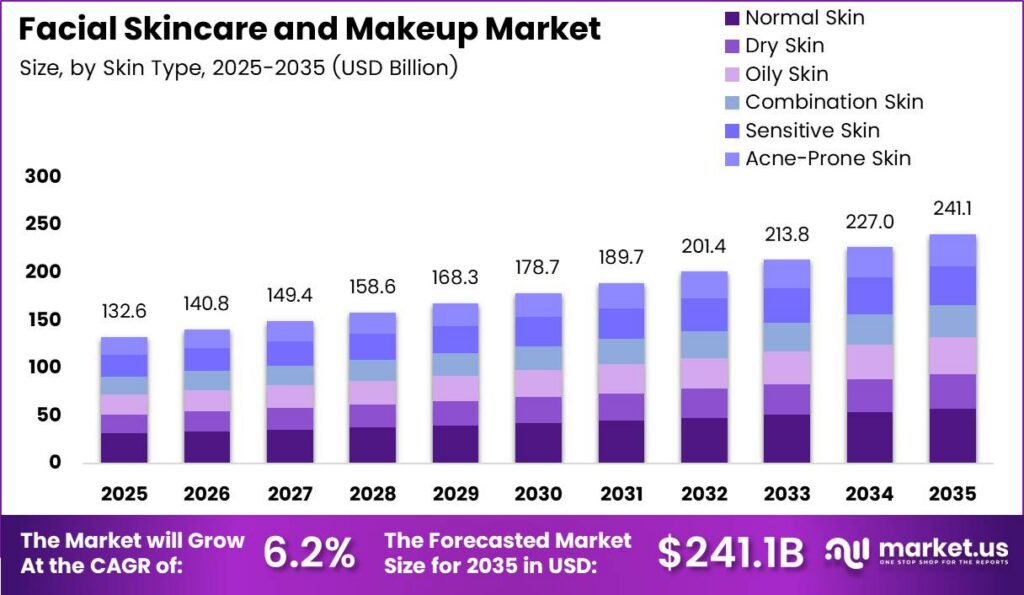
Global Facial Skincare and Makeup Market size is expected to be worth around USD 241.1 Billion by 2035 from USD 132.6 Billion in 2025, growing at a CAGR of 6.2% during the forecast period 2026 to 2035. Facial skincare and makeup products include topical creams, cleansers, serums, sunscreens, foundations, and color emulsions engineered to hydrate epidermal tissue, repair skin barriers, and enhance facial aesthetics.
The market structure connects specialty chemical suppliers and bioactive fermentation labs with dermatology clinics, pharmacies, and omnichannel retailers. According to Cosmetics Europe, European cosmetics and personal care retail sales reached EUR 110 Billion in 2025, up from EUR 104 Billion in 2024, supporting over 3.6 million jobs. Therefore, high consumer spending insulates premium skincare and hybrid makeup lines from macroeconomic downturns and secures stable retail cash flows.
Key Takeaways
- The global Facial Skincare and Makeup Market was valued at USD 132.6 Billion in 2025 and is forecast to reach USD 241.1 Billion by 2035.
- The market expands at a compound annual growth rate (CAGR) of 6.2% during the forecast period from 2026 to 2035.
- Within the Product Type segment, Facial Moisturizers and Creams led the market with a 24.00% share in 2025.
- By Skin Type, the Normal Skin segment captured the largest share at 24.00% in 2025.
- Across the Consumer Group segment, Women accounted for the dominant share of 63.00% in 2025.
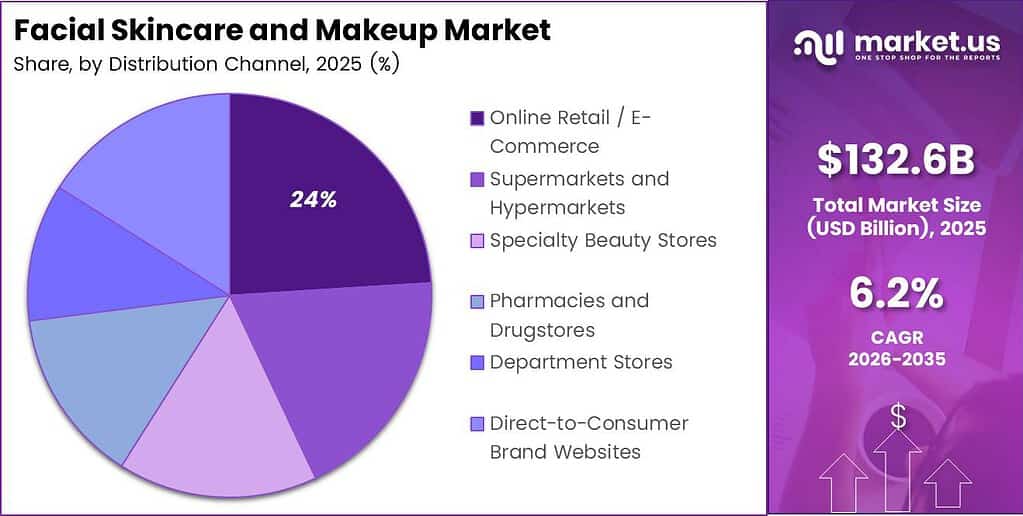
- Under Distribution Channel, Online Retail / E-Commerce held a leading 24.00% market share in 2025.
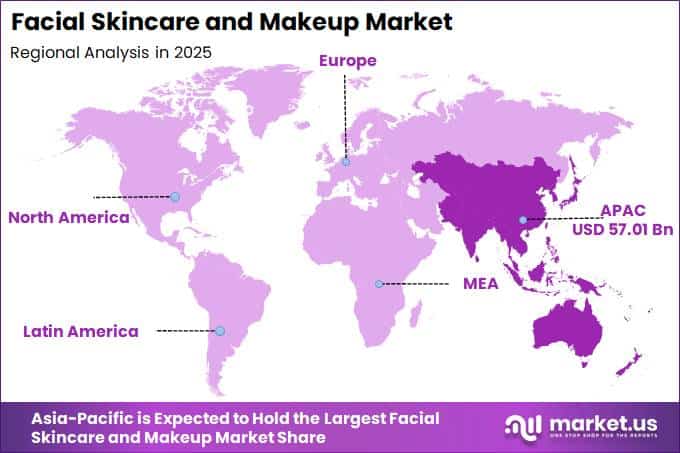
- Asia-Pacific dominated regional demand in 2025, capturing a 43.00% market share valued at USD 57.01 Billion.
Federal regulatory enforcement now dictates market access and contract manufacturing compliance across global beauty supply chains. Data from the U.S. Food and Drug Administration (FDA) shows that mandatory Modernization of Cosmetics Regulation Act (MoCRA) active facility registrations reached 16,398 and product listings hit 1,298,361 as of June 30, 2026 . Consequently, strict federal safety tracking raises compliance barriers for small importers and consolidates retail shelf space among audited manufacturers.
Strategic mergers and acquisitions are accelerating portfolio shifts toward physician-dispensed skincare and ultra-luxury color licensing. In October 2026, clinical dermatology leader Galderma Group AG signed a definitive agreement to acquire 100% of physician-dispensed facial skincare brand ZO Skin Health for USD 1.5 Billion in cash. Earlier in March 2026, L’Oréal S.A. completed a EUR 4.0 Billion buyout of Kering Beauté, securing 50-year exclusive beauty licenses .
Asia-Pacific dominates the global landscape with a 43.00% market share in 2025, valued at USD 57.01 Billion. Dense urban populations, multistep facial care regimens, and rapid social commerce adoption across China, South Korea, Japan, and India drive this regional lead. By contrast, North America anchors high-margin clinical demand; as reported by the Personal Care Products Council (PCPC), the U.S. personal care sector generated USD 495.6 Billion in economic output and USD 242.4 Billion in GDP across 2.6 million jobs .
Product Type Analysis
Facial Moisturizers and Creams dominates with 24.00% share in 2025 due to daily epidermal barrier hydration requirements.
In 2025, Facial Moisturizers and Creams held a 24.00% share in the Product Type segment of the Facial Skincare and Makeup Market. Figures from Cosmetics Europe show that skin care represents Europe’s largest cosmetics category at EUR 32.3 Billion or 29.4% of retail demand in 2025, surpassing decorative cosmetics at EUR 13.6 Billion or 12.4%. Daily transepidermal water loss requires occlusive lipid and humectant emulsions to maintain stratum corneum integrity prior to color application. Therefore, formulators prioritize ceramide-rich moisturizers to lock in recurring subscription revenue.
Facial Cleansers serve as the foundational surfactant step in consumer morning and evening skincare regimens to remove sebum, particulate pollution, and long-wear pigments. Based on European Chemicals Agency (ECHA) data, intentionally added microplastics in rinse-off cleansers and cosmetics release 42,000 tonnes annually across Europe out of 145,000 tonnes used, prompting REACH bans to prevent 500,000 tonnes of emissions over 20 years . Replacing synthetic polyethylene microbeads requires biodegradable cellulose, jojoba esters, and polyhydroxy acid exfoliants. Consequently, chemical suppliers command higher margins on eco-certified surfactant blends.
Sunscreen and Sun Care Products bridge preventative medical dermatology and daily color cosmetics through tinted mineral and chemical ultraviolet filters. According to the U.S. Food and Drug Administration (FDA), a final administrative order on June 9, 2026 added bemotrizinol at concentrations up to 6% as a safe and effective sunscreen active ingredient for users aged 6 months and older, marking the first new UV filter approved in nearly 30 years. Broad-spectrum photostability prevents UVA-induced collagen degradation without leaving a white cast. This creates immediate reformulation upside for U.S. hybrid SPF makeup brands.
Skin Type Analysis
Normal Skin dominates with 24.00% share in 2025 due to broad mass-market consumer compatibility.
In 2025, Normal Skin held a 24.00% share in the Skin Type segment of the Facial Skincare and Makeup Market. As reported by Galderma Group AG, its consumer Dermatological Skincare division, anchored by flagship daily barrier brands Cetaphil and Alastin, generated record net sales of USD 1,449 Million in 2025, up 9.3% year-on-year at constant currency from USD 1,331 Million in 2024 . Balanced sebum production and intact pH levels allow normal skin types to tolerate versatile water-in-oil foundations and preventative antioxidant serums. This means mass-stige brands achieve maximum manufacturing scale by targeting normal skin baselines.
Dry Skin formulations target lipid-depleted epidermis suffering from flaking, tightness, and accelerated fine-line formation in arid or aging demographics. Data from Beiersdorf AG shows that its Derma business segment, led by dry skin repair lines Eucerin and Aquaphor, achieved 11.7% organic sales growth in 2025 to reach EUR 1.5 Billion, up from EUR 1,372 Million in 2024 across 5 consecutive years of double-digit expansion . Restoring compromised intercellular lipid bilayers requires high concentrations of urea, panthenol, and shea butter. Therefore, pharmacy-backed dermo-cosmetic brands capture superior pricing power over basic mass lotions.
Oily Skin products regulate excess sebaceous gland activity, shine, and comedone formation through non-comedogenic fluid emulsions and keratolytic acids. The U.S. Food and Drug Administration (FDA) found that during March 2025 testing of 95 benzoyl peroxide acne treatment products for oily and acne-prone skin, over 90% met safety standards while 6 contaminated product lots required retail recalls due to elevated benzene . Thermal degradation of benzoyl peroxide into benzene forces formulators to adopt encapsulated salicylic acid, niacinamide, and cold-processed azelaic acid alternatives. Consequently, contract manufacturers investing in temperature-controlled stability testing win major retail accounts.
Consumer Group Analysis
Women dominates with 63.00% share in 2025 due to multi-step daily beauty routines.
In 2025, Women held a 63.00% share in the Consumer Group segment of the Facial Skincare and Makeup Market. Cosmetics Europe indicates that European consumers use an average of more than 8 different cosmetics products daily and nearly 14 products weekly across 6 categories, with 91% maintaining a personal care routine and 76% rating cosmetics as important. Female consumers layer primers, color-correcting foundations, retinoid serums, and peptide eye creams to address hormonal skin shifts and photoaging. This signals that multi-product regimen bundling remains the primary driver of customer lifetime value.
Men represent a fast-expanding commercial demographic as younger male cohorts adopt daily facial cleansers, oil-control moisturizers, and tinted concealers. Figures from Coty Inc. show that in fiscal 2025, the company recorded 9% like-for-like sales growth in Ultra-Premium formulations and 8% like-for-like growth in Consumer Beauty lines, supported by blockbuster male-targeted rollouts led by Boss Bottled Beyond . Thicker male dermal collagen and higher androgen-driven sebum output require lightweight, fast-absorbing gel vehicles rather than heavy creams. As a result, brands engineering shine-free male skincare capture high-margin incremental household spending.
Unisex facial skincare and makeup lines appeal to Gen Z and clinical beauty buyers who prioritize active ingredient percentages over gendered packaging. According to Unilever PLC, its Beauty and Wellbeing division, spanning gender-neutral facial care and prestige wellbeing across 56% emerging and 44% developed market shares, delivered EUR 12.8 Billion in 2025 turnover with 4.3% underlying sales growth and a 19.2% operating margin . Shared household bottles of hyaluronic acid serums and mineral sunscreens streamline SKU counts and reduce packaging overhead. This means beauty conglomerates can consolidate global marketing campaigns to expand operating margins.
Distribution Channel Analysis
Online Retail / E-Commerce dominates with 24.00% share in 2025 due to algorithmic social commerce conversion.
In 2025, Online Retail / E-Commerce held a 24.00% share in the Distribution Channel segment of the Facial Skincare and Makeup Market. Based on Eurostat data, 74% of European Union individuals aged 16 to 74 purchased goods online in 2025, with cosmetics and wellness products bought by 20% of online shoppers as the 3rd most popular retail category . Augmented reality shade-matching tools and algorithmic livestream demonstrations eliminate physical trial friction for foundations and serums. Therefore, beauty brands allocating capital to digital fulfillment achieve faster inventory turnover than brick-and-mortar peers.
Specialty Beauty Stores and health-focused personal care outlets anchor physical discovery through high-touch beauty advisor consultations and exclusive brand launches. Data from the U.S. Census Bureau shows that U.S. Health and Personal Care Stores (NAICS 446), covering 112,734 establishments and 1,052,600 employees, generated USD 475.6 Billion in 2025 retail sales alongside USD 1,233.7 Billion in national e-commerce sales, which rose 5.4% year-over-year. Complex color-matching and sensory texture testing require physical testers and diagnostic skin scanners inside specialty stores. Consequently, prestige brands rely on specialty retail chains to validate premium pricing before scaling online.
Pharmacies and Drugstores serve as trusted clinical gatekeepers where dermatologists and pharmacists guide consumers toward hypoallergenic and active-ingredient skincare. As reported by L’Oréal S.A., its pharmacy-anchored Dermatological Beauty division grew 5.5% like-for-like to reach EUR 7.2 Billion in 2025 or 16% of group sales, while total group e-commerce surpassed 30% of revenue at EUR 13 Billion . Consumers treating compromised skin barriers or rosacea demand pharmacist validation and clinical efficacy data at the point of sale. This reflects why medical-grade presentation inside drugstores insulates dermo-cosmetic brands from mass retail discounting.
Key Market Segments
By Product Type
- Facial Moisturizers and Creams
- Facial Cleansers
- Face Masks
- Sunscreen and Sun Care Products
- Anti-Aging Skincare Products
- Acne Treatment Products
- Primers and Setting Products
- BB Creams and CC Creams
- Other Facial Skincare and Makeup Products
By Skin Type
- Normal Skin
- Dry Skin
- Oily Skin
- Combination Skin
- Sensitive Skin
- Acne-Prone Skin
By Consumer Group
- Women
- Men
- Unisex
- Children and Teenagers
By Distribution Channel
- Online Retail / E-Commerce
- Supermarkets and Hypermarkets
- Specialty Beauty Stores
- Pharmacies and Drugstores
- Department Stores
- Direct-to-Consumer Brand Websites
- Other Distribution Channels
Regional Analysis
Asia-Pacific Dominates the Facial Skincare and Makeup Market with a Market Share of 43.00% in 2025, Valued at USD 57.01 Billion
Asia-Pacific holds a dominant 43.00% share of the global market in 2025, valued at USD 57.01 Billion, fueled by massive contract manufacturing capacity and export-led K-beauty and J-beauty innovation. The U.S. Food and Drug Administration (FDA) found that as of January 1, 2025, Asian manufacturing hubs led foreign MoCRA compliance, with China registering 4,260 cosmetic facilities or 44.71% of all global registrations, South Korea registering 617 facilities, and India registering 309 facilities . This concentration of FDA-compliant factories allows Asian brands to scale rapid formulation cycles for global export.
Europe represents the premier global hub for luxury facial cosmetics, clinical dermo-cosmetics, and cross-border regulatory standard setting. Cosmetics Europe indicates that intra-European cosmetic product trade exceeded EUR 57.4 Billion in 2025, up from EUR 52.3 Billion in 2024, while extra-European exports reached EUR 29.8 Billion, with France and Spain generating nearly 50% of exports at over EUR 14.7 Billion. Strict European Union chemical safety standards strengthen international buyer trust in European serums and foundations. Therefore, European producers capture dominant market share in global duty-free and prestige department store channels.
North America commands high per-capita spending driven by domestic R&D infrastructure, biotechnology integration, and prestige beauty retail networks. Figures from the Personal Care Products Council (PCPC) show that U.S. cosmetics and personal care manufacturing directly generated USD 133.3 Billion in economic output, contributed USD 50.0 Billion to U.S. GDP, and supported 298,600 direct manufacturing jobs paying an average annual salary of USD 83,000 . High domestic wage levels and advanced chemical compounding capabilities accelerate clinical product launches. Consequently, North American manufacturers lead global commercialization of high-margin peptide and longevity skincare lines.
Key Regions and Countries
North America
- US
- Canada
Europe
- Germany
- France
- The UK
- Spain
- Italy
- Rest of Europe
Asia Pacific
- China
- Japan
- South Korea
- India
- Australia
- Rest of APAC
Latin America
- Brazil
- Mexico
- Rest of Latin America
Middle East and Africa
- GCC
- South Africa
- Rest of MEA
Market Dynamics
Proprietary molecular patents and international trademark protection govern competitive moats across the global facial skincare and makeup industry. According to the World Intellectual Property Organization (WIPO), global Patent Cooperation Treaty (PCT) filings rose 0.5% to 273,900 applications and Madrid international trademark filings increased 1.2% to 65,000 applications in 2024, with L’Oréal S.A. ranking first globally across all industries at 244 Madrid filings . Aggressive intellectual property registration blocks generic copycats and protects premium retail margins for bioactive formulations.
Drivers
Consumer demand for clinically validated efficacy in daily color wear restructured facial makeup formulation and pricing between 2024 and 2026, adding +1.9% to the baseline 6.2% CAGR. Multinational manufacturers transitioned from pure pigment dispersion to active bases containing 2% to 5% niacinamide, polyglutamic acid, and encapsulated peptides. While clinical actives raise bulk formulation cost-per-unit by 14% to 18% and extend clinical testing from 4 weeks to 12 weeks, brands command retail price premiums of 22% to 35%.
This shift from seasonal fashion cycles to dermatological replenishment cut customer acquisition cost payback periods from 9 months to 5.5 months. Repeat purchase rates rose by 28% across direct-to-consumer channels, while vertically integrated manufacturers expanded gross margins by 340 to 480 basis points. For investors and sellers, hybrid dermocosmetic color lines convert volatile impulse makeup buyers into predictable, high-margin recurring revenue streams.
| Driver | (~) % Impact on CAGR Forecast | Geographic Relevance | Impact Timeline |
|---|---|---|---|
| Dermocosmetic Hybridization in Color Cosmetics | +1.9% | North America, Europe, Asia-Pacific | Short term (≤ 2 years) |
| Social Commerce Live-Selling Penetration | +1.5% | Asia-Pacific, North America | Short term (≤ 2 years) |
| Preventative Anti-Aging Adoption by Gen Z | +1.3% | Global | Medium term (2–4 years) |
| AI-Driven Virtual Try-On Conversion Lift | +1.1% | North America, Europe, East Asia | Short term (≤ 2 years) |
| Men Facial Grooming Routine Expansion | +0.8% | Asia-Pacific, Middle East, Europe | Medium term (2–4 years) |
Restraints
Statutory prohibitions under European Commission Regulation 2023/2055 on synthetic polymer microparticles and strict 0.1% weight limits on cyclic silicones D4, D5, and D6 taking effect by June 2026 deduct -1.4% from the baseline CAGR. Cyclic silicones and polymethyl methacrylate beads provide sensory slip and sebum absorption in over 42% of prestige liquid foundations, primers, and matte lipsticks. Consequently, mandatory removal forces immediate SKU rationalization across European and export-oriented beauty portfolios.
Substituting petro-derived polymers with biodegradable silica, C9 to C12 alkane emollients, or fermented squalane raises raw material costs by 28% to 45% per kilogram. Reformulated emulsions suffer a 15% batch failure rate during 40 degrees Celsius stability trials. As a result, mid-market contract manufacturers face gross margin compression of 250 to 390 basis points and are deferring up to 30% of automated filling line CapEx into 2027 and 2028.
| Restraint | (~) % Impact on CAGR Forecast | Geographic Relevance | Impact Timeline |
|---|---|---|---|
| Intentional Microplastics & Cyclic Silicone Bans | -1.4% | Europe, North America | Short term (≤ 2 years) |
| US MoCRA Facility Registration & Safety Holds | -1.1% | North America, Global Exporters | Short term (≤ 2 years) |
| UV Filter Approval Bottlenecks in Sun-Care Makeup | -0.9% | North America | Medium term (2–4 years) |
| PFAS Phase-Out Mandates in Long-Wear Cosmetics | -0.8% | Europe, North America, Oceania | Short term (≤ 2 years) |
| EU Retinoid Concentration Ceilings in Leave-On Care | -0.6% | Europe | Short term (≤ 2 years) |
Challenges
Capacity bottlenecks in precision fermentation bioreactors and downstream purification for bio-identical peptides, ectoin, and recombinant collagen impose a -1.2% friction drag on growth potential. Bioreactor utilization rates exceeded 88% in 2025 and early 2026, stretching lead times for high-purity (at least 98%) bioactives from 6 weeks to 18 to 24 weeks. Spot prices surged 19% to 32% during seasonal Q3 manufacturing peaks alongside cold-chain logistics surcharges of 12% to 16%.
Independent skincare brands suffer recurring out-of-stock rates of 11% to 14% on hero SKUs, forfeiting peak promotional sales velocity. Navigating this supply chain friction forces multinational formulators to sign 3-to-5-year take-or-pay off-take agreements and hold 90-day buffer inventories that tie up 8% to 12% more working capital. Market participants must co-invest in dual-sourced regional fermentation facilities across East Asia and Western Europe to protect product availability.
| Challenge | (~) % CAGR Friction Drag | Geographic Relevance | Mitigation Horizon |
|---|---|---|---|
| Bio-Fermented Active Supply Volatility | -1.2% | Global | Medium term (2–4 years) |
| PCR Cosmetic Packaging Resin Scarcity | -1.0% | Europe, North America | Medium term (2–4 years) |
| Cosmetic Toxicology Talent Deficit | -0.8% | North America, Europe, Asia-Pacific | Long term (≥ 4 years) |
| Paid Social CAC Inflation | -0.7% | North America, Europe | Short term (≤ 2 years) |
| Mica & Botanical Traceability Audits | -0.5% | Global | Long term (≥ 4 years) |
Opportunities
Commercializing shelf-stable, plant-derived and bio-synthesized extracellular vesicles (exosomes) alongside topical senolytic peptides offers +1.8% incremental CAGR upside above the 6.2% baseline over the next 2 to 4 years. First-generation mammalian exosomes required -20 degrees Celsius cryo-storage and faced strict bans on human-derived cell media, confining usage to clinics. However, tangential flow filtration and lyophilization breakthroughs in 2025 and 2026 cut biomimetic exosome cost-per-gram by 55% to 65%.
These stabilization advances extended ambient 25 degrees Celsius shelf life to 24 months, opening sizable unmet demand among non-invasive aesthetic consumers. Early movers capturing this medical-aesthetic model can price daily longevity serums at 3.5x to 4.2x standard prestige averages while lowering finished goods COGS to 11% to 15% of net sales. This unlocks gross margin expansion of 600 to 850 basis points and 40% higher annual customer lifetime value through 60-day auto-replenishment subscriptions.
| Opportunity | (~) % Potential CAGR Upside | Geographic Relevance | Execution Window |
|---|---|---|---|
| Topical Exosome & Senolytic Longevity Skincare | +1.8% | North America, East Asia, Europe | Medium term (2–4 years) |
| GLP-1 Facial Volume-Loss Dermocosmetics | +1.5% | North America, Europe | Short term (≤ 2 years) |
| Microbiome-Personalized Phage Blemish Care | +1.2% | North America, Europe, Asia-Pacific | Long term (≥ 4 years) |
| Standardized Refillable Prestige Makeup Systems | +0.9% | Europe, East Asia | Medium term (2–4 years) |
| Tier-2 & Tier-3 Emerging Market Clinical D2C | +0.8% | South Asia, Southeast Asia, Latin America | Medium term (2–4 years) |
Key Company Insights
L’Oréal S.A.
L’Oréal S.A. leads the global beauty industry with a balanced portfolio spanning mass color cosmetics, clinical dermatology, and prestige skincare across Europe, North America, and emerging markets. Based on L’Oréal S.A. 2025 Annual Results data, consolidated sales reached EUR 44.05 Billion in 2025, reflecting 4.0% like-for-like growth and an operating profit of EUR 8.89 Billion at a 20.2% margin, led by Consumer Products at EUR 16.1 Billion and L’Oréal Luxe at EUR 15.6 Billion . Multi-tier channel dominance shields the group from regional demand swings.
The company is aggressively localizing artificial intelligence and formulation R&D in high-growth Asian markets to accelerate product customization. As reported by Reuters and L’Oréal corporate disclosures in January 2026, L’Oréal S.A. announced an initial investment of over INR 35 Billion (USD 383.4 Million) to establish a global AI-driven Beauty Tech Hub in Hyderabad, India, creating 2,000 technology and formulation jobs through 2030 . Centralizing algorithmic skin diagnostics in India lowers digital development costs and speeds up regional product launches.
The Estée Lauder Companies Inc.
The Estée Lauder Companies Inc. operates across roughly 150 countries with a prestige portfolio anchored by Estée Lauder, Clinique, La Mer, M·A·C, and The Ordinary. Data from The Estée Lauder Companies Inc. Form 10-K shows that fiscal 2025 net sales totaled USD 14,326 Million (USD 14.33 Billion), with Skin Care generating USD 6,962 Million or 49% of sales, Makeup delivering USD 4,205 Million or 29% of sales, and online channels accounting for 31% . High skincare concentration provides strong gross margin leverage during commercial turnarounds.
Management is executing a structural overhaul to restore operating agility and capture fast-moving digital consumers across North America and Asia. According to Estée Lauder FY2026 filings and corporate releases in August 2026, the company concluded approvals for its Beauty Reimagined Profit Recovery and Growth Plan, eliminating 10,000 net positions (17.5% of its 57,000 workforce) to unlock USD 1.2 Billion in gross run-rate benefits while expanding TikTok Shop and Amazon storefronts from 3 to 11 brands .
Key Players
- L’Oréal S.A.
- The Estée Lauder Companies Inc.
- Unilever PLC
- Procter & Gamble Co.
- Shiseido Company, Limited
- Beiersdorf AG
- Kao Corporation
- LVMH Moët Hennessy Louis Vuitton SE
- Coty Inc.
- Amorepacific Corporation
- Natura &Co Holding S.A.
- Galderma Group AG
- Johnson & Johnson Services, Inc.
- Colgate-Palmolive Company
- Revlon, Inc.
- Others Key Players
Recent Developments
2026
- October 2026: Coty Inc. reached an agreement for an early buyout of its Gucci fragrance and cosmetics license to L’Oréal S.A. valued at approximately USD 400 Million with L’Oréal paying about 70% of the early termination fee to transition the brand in July 2027 while Coty generated USD 1.0 Billion in FY25 e-commerce revenue according to Coty corporate disclosures .
- September 2026: L’Oréal S.A. completed the acquisition of a majority stake in Indian digital-first skincare house Innovist, owner of Chemist at Play and Bare Anatomy, supporting L’Oréal’s 6.9% like-for-like sales growth and EUR 35.3 Billion revenue in the first 9 months of 2026 according to L’Oréal financial updates .
- April 2026: Amorepacific Corporation completed the market expansion of its Korean derma-skincare brand Aestura into 17 European countries and achieved triple-digit North American growth, lifting Q1 2026 group revenue 5.0% year-on-year to KRW 1.227 Trillion following FY2025 revenue of KRW 4.6 Trillion according to Amorepacific Group earnings releases .
2025
- December 2025: L’Oréal S.A. signed an investment agreement to acquire an additional 10% equity stake in Galderma Group AG from an EQT AB consortium, doubling its total shareholding from 10% initially acquired for USD 1.85 Billion in August 2024 to 20% according to L’Oréal financial releases .
- September 2025: Kao Corporation launched a strategic revamp of its Cosmetics Business across 6 core skincare and makeup brands including Curél, SENSAI, KANEBO, SOFINA, MOLTON BROWN, and KATE TOKYO, which achieved 113% growth in 2025 as Cosmetics sales rose 7.2% to JPY 261.6 Billion, targeting JPY 400 Billion in net sales and a 15% operating margin according to Kao Corporation official releases .
- August 2025: Beiersdorf AG announced a EUR 350 Million (USD 407.5 Million) capacity expansion investment at its manufacturing plant in Silao, Guanajuato, Mexico, where 70% of skincare output for NIVEA, Eucerin, and Labello is exported across the Americas according to Beiersdorf corporate releases .
- August 2025: Beiersdorf AG executed the global product launch of its NIVEA Cellular Epigenetics Rejuvenating Serum featuring patented active ingredient Epicelline developed over 15 years of research combined with 3 forms of hyaluronic acid across 30 countries according to Beiersdorf AG official press releases .
- June 2025: L’Oréal S.A. agreed to the acquisition of a majority stake in British clinical vitamin C and vitamin A anti-aging skincare brand Medik8 Limited from private equity firm Inflexion at an enterprise valuation of EUR 1.0 Billion according to L’Oréal and Reuters disclosures .
- June 2025: Beiersdorf AG inaugurated a EUR 300 Million capacity expansion at its Poznań, Poland skincare manufacturing plant, adding 6 automated production lines to double annual capacity to 500 Million units and create over 200 jobs according to Beiersdorf AG official press releases .
- February 2025: L’Oréal S.A. completed a USD 160 Million R&D expansion by opening its 250,000-square-foot North America Research and Innovation Center in Clark, New Jersey, employing over 600 scientists and testing products with 400 consumers daily in a 26,000-square-foot modular lab according to L’Oréal Groupe releases .
2024
- December 2024: L’Oréal S.A. signed a definitive acquisition agreement with Swiss retail group Migros to acquire South Korean dermatological facial skincare and sun care company Gowoonsesang Cosmetics Co., Ltd., owner of the Dr.G brand employing 200 staff in South Korea and 10 in China, according to L’Oréal and Reuters disclosures .
- February 2024: Shiseido Company, Limited completed the acquisition of dermatologist-led facial skincare brand Dr. Dennis Gross Skincare through Shiseido Americas Corporation in a transaction valued at USD 450 Million according to Shiseido official news releases .
Geopolitical Impact Analysis
Maritime chokepoint disruptions and bilateral tariff shifts directly inflate landed costs for cosmetic emollients, UV filters, and glass dropper packaging. According to the World Trade Organization (WTO), world merchandise trade grew 2.9% in volume and 2% in value to USD 24.43 Trillion in 2024 while global transport services rose 8% to USD 1.48 Trillion, before facing a projected 0.2% tariff-related volume contraction in 2025 despite 5.3% container throughput growth in early 2025 . Simultaneously, UN Trade and Development (UNCTAD) found that Red Sea security crises reduced Suez Canal cargo tonnage by 70% and Gulf of Aden vessel capacity by 76%, forcing container ships around the Cape of Good Hope and driving global seaborne ton-miles up 5.9% versus just 2.2% tonnage growth in 2024 . Extended sea transit adds 14 to 20 days to shipments of Asian airless pumps, mica pigments, and fermented peptides bound for European filling plants, forcing beauty manufacturers to carry higher buffer stocks.
Trade protectionism and regional energy shocks further pressure petrochemical cosmetic feedstocks and mass consumer purchasing power. Data from the International Monetary Fund (IMF) shows global real GDP growth at 3.3% in 2025 and 3.0% to 3.3% in 2026 as headline inflation eases from 4.1% to 3.8%, operating under an effective U.S. tariff rate of 18.5% following a 10 percentage-point reduction in U.S. tariffs on Chinese imports . However, the World Bank indicates that Middle East conflict risks slowing global growth to 2.5% in 2026 by driving up energy prices, while low-income economies grow 5.4% after a 0.3 percentage-point downward revision and developing per capita GDP grows 2.7% . Elevated crude oil and natural gas prices directly raise synthesis costs for propylene glycol humectants, synthetic waxes, and polypropylene jars, compelling multinational beauty brands to near-shore production in Mexico and Poland.
Report Scope
| Report Features | Description |
|---|---|
| Market Value (2025) | USD 132.6 Billion |
| Forecast Revenue (2035) | USD 241.1 Billion |
| CAGR (2026-2035) | 6.2% |
| Base Year for Estimation | 2025 |
| Historic Period | 2021-2025 |
| Forecast Period | 2026-2035 |
| Report Coverage | Revenue Forecast, Market Dynamics, Market Opportunity Analysis, Technology and Innovation Landscape, Competitive Landscape, Recent Developments |
| Segments Covered | By Product Type (Facial Moisturizers and Creams, Facial Cleansers, Face Masks, Sunscreen and Sun Care Products, Anti-Aging Skincare Products, Acne Treatment Products, Primers and Setting Products, BB Creams and CC Creams, Other Facial Skincare and Makeup Products), By Skin Type (Normal Skin, Dry Skin, Oily Skin, Combination Skin, Sensitive Skin, Acne-Prone Skin), By Consumer Group (Women, Men, Unisex, Children and Teenagers), By Distribution Channel (Online Retail / E-Commerce, Supermarkets and Hypermarkets, Specialty Beauty Stores, Pharmacies and Drugstores, Department Stores, Direct-to-Consumer Brand Websites, Other Distribution Channels) |
| Regional Analysis | North America (US and Canada), Europe (Germany, France, The UK, Spain, Italy, and Rest of Europe), Asia Pacific (China, Japan, South Korea, India, Australia, and Rest of APAC), Latin America (Brazil, Mexico, and Rest of Latin America), Middle East and Africa (GCC, South Africa, and Rest of MEA) |
| Competitive Landscape | L’Oréal S.A., The Estée Lauder Companies Inc., Unilever PLC, Procter & Gamble Co., Shiseido Company, Limited, Beiersdorf AG, Kao Corporation, LVMH Moët Hennessy Louis Vuitton SE, Coty Inc., Amorepacific Corporation, Natura &Co Holding S.A., Galderma Group AG, Johnson & Johnson Services, Inc., Colgate-Palmolive Company, Revlon, Inc., Others Key Players |
| Customization Scope | Customization for segments, region / country-level will be provided. Additional customization can be done based on requirements. |
| Purchase Options | We have three licenses to opt for: Single User License | Multi-User License (Up to 5 Users) | Corporate Use License (Unlimited User and Printable PDF) |