Report Overview
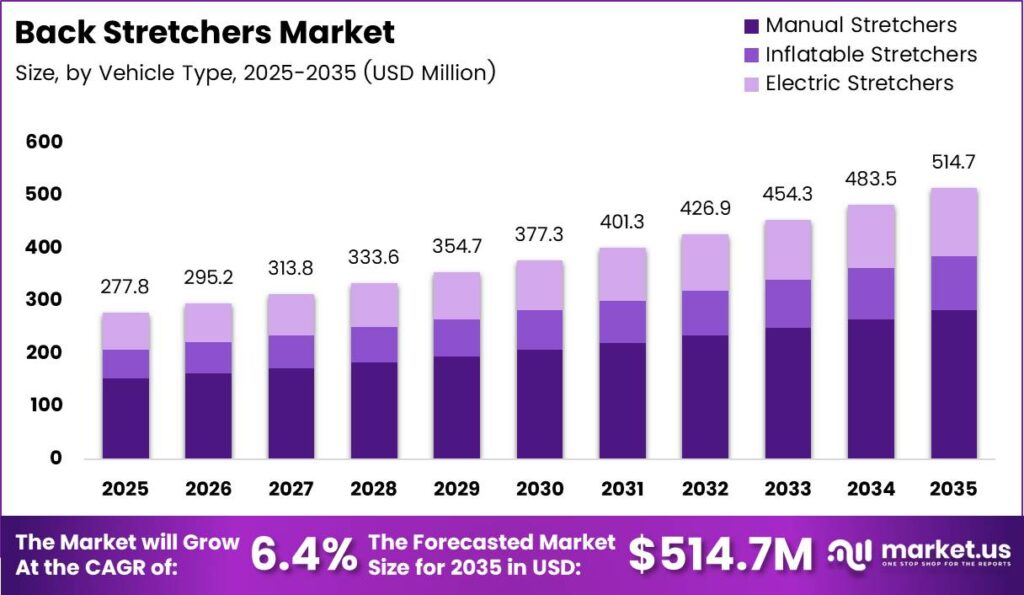
Global Back Stretchers Market size is expected to be worth around USD 514.7 Million by 2035 from USD 277.8 Million in 2025, growing at a CAGR of 6.4% during the forecast period 2026 to 2035.
The back stretchers market includes manual, inflatable, and electric devices designed to decompress the lumbar spine, relieve muscular tension, and support spinal mobility at home, in clinical settings, and in fitness environments. Products range from passive arched boards and roller wheels to powered units with heat and air-traction functions. This breadth of form factor enables vendors to address distinct buyer segments across price sensitivity, use intensity, and channel preference.
Key Takeaways
- The global back stretchers market is valued at USD 277.8 Million in 2025 and is forecast to reach USD 514.7 Million by 2035.
- The market grows at a CAGR of 6.4% during the forecast period 2026 to 2035.
- By Product Type, Manual Stretchers dominate with a 54.32% share in 2025.
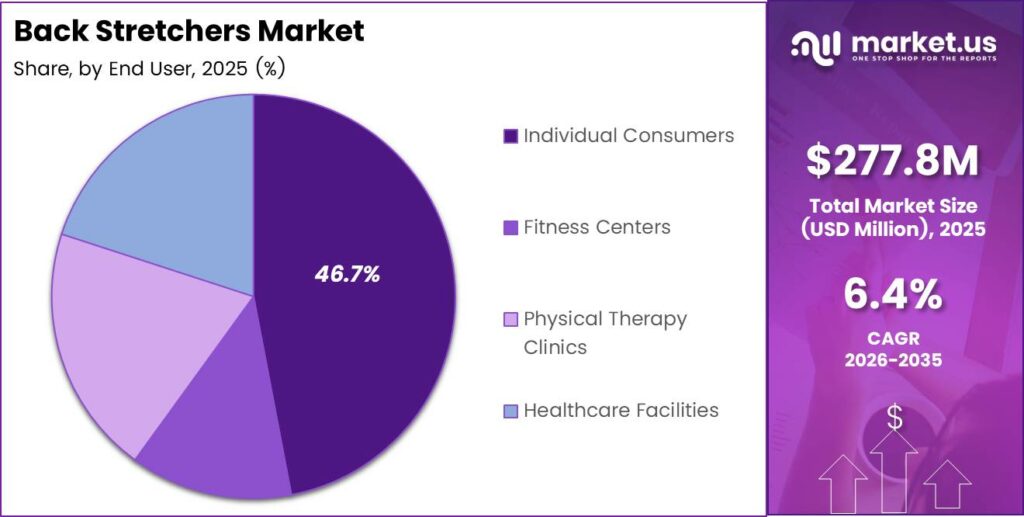
- By End User, Individual Consumers hold the leading share at 46.78% in 2025.
- By Distribution Channel, Offline Channels lead with a 61.23% share in 2025.
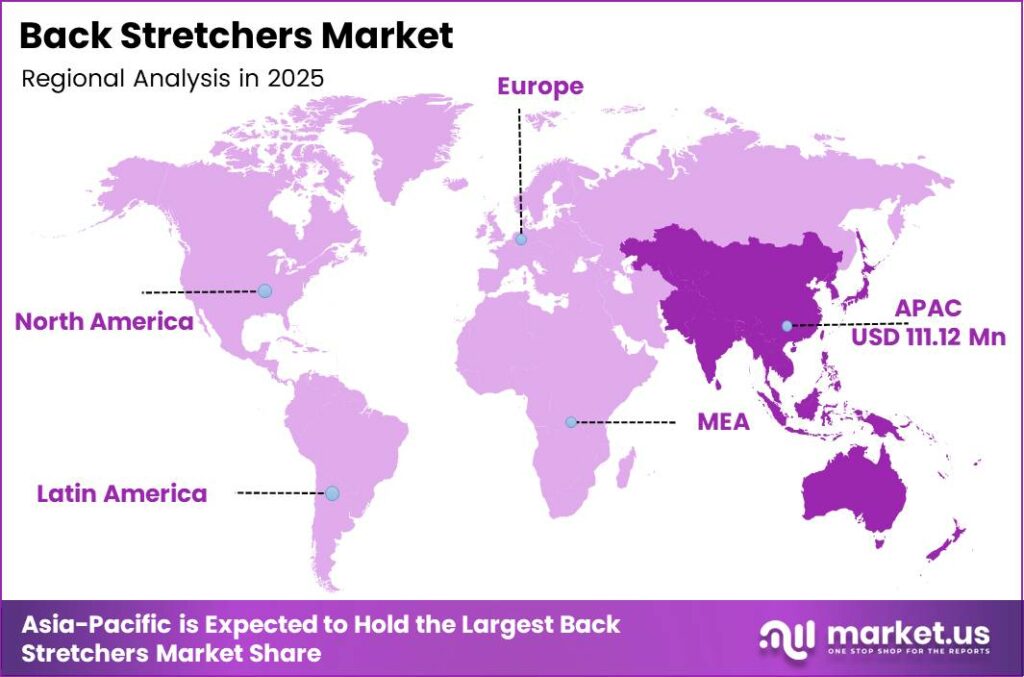
- Asia-Pacific is the dominant region with a 40.21% share, valued at USD 111.12 Million in 2025.
- Europe is the fastest-growing region in the back stretchers market.
- Electric Stretchers represent the fastest-growing product type segment.
- Fitness Centers are the fastest-growing end-user segment.
- Online Channels represent the fastest-growing distribution channel.
As per our research, physical inactivity affects a substantial share of the global adult population, creating a direct addressable audience for home-use mobility products. Sedentary work habits among urban populations in North America, Europe, and Asia-Pacific have expanded buyer awareness beyond clinical users. This structural shift means demand originates increasingly from wellness-oriented consumers rather than from patients following clinical referral, which changes both product positioning and the distribution channels that vendors must prioritize.
Government health agencies across multiple regions are channeling investment into preventive health and workplace wellness frameworks, which creates indirect tailwinds for the back stretchers category. Regulatory activity in the European Union and North America continues to define classification boundaries between general wellness accessories and medical devices. Vendors that position products within the wellness accessory category can avoid the compliance burden associated with regulated medical devices, reducing time-to-market and improving margin profiles across online retail channels.
Product Type Analysis
Manual Stretchers dominate with 54.32% due to low cost and universal consumer accessibility.
In 2025, Manual Stretchers held a dominant market position in the By Product Type segment of the Back Stretchers Market, with a 54.32% share. Everlasting Comfort’s 2026 product listing illustrates this segment’s design depth: its back stretcher offers 3 adjustable settings at arch angles of 15°, 30°, and 45°, along with 88 acupressure nodes and a maximum supported user weight of 350 pounds. This combination of configurability and physical feature density allows manual devices to address a wide range of user body types and comfort preferences without requiring power or connectivity.
Inflatable Stretchers serve buyers who prioritize portability over fixed structural rigidity. These devices allow pressure adjustment through controlled air inflation, enabling users to modify lumbar support intensity during a session. The inflatable format appeals to travelers and users with limited storage space, as the deflated unit occupies minimal volume. Vendors competing in this sub-segment face margin pressure from low-cost entrants, which makes differentiated inflation mechanisms and packaged accessories important tools for justifying premium pricing in direct-to-consumer channels.
Electric Stretchers represent the fastest-growing sub-segment within the product type category. Fitagon’s 2026 listing demonstrates how powered units consolidate multiple therapeutic functions: its device offers 2 automatic air-traction settings alongside manual inflation, 3 selectable heat levels, and 2 vibration massage motors. This multi-function architecture allows a single device to address lumbar decompression, thermal therapy, and soft-tissue stimulation simultaneously. Vendors in this sub-segment can command higher average selling prices, which improves per-unit revenue but requires stronger consumer education to justify the purchase decision.
End User Analysis
Individual Consumers dominate with 46.78% due to high direct-purchase volume through online channels.
In 2025, Individual Consumers held a dominant market position in the By End User segment of the Back Stretchers Market, with a 46.78% share. According to the World Health Organization, low back pain is the leading cause of disability globally, affecting an estimated 619 million people in 2020, with projections reaching 843 million by 2050. This scale of musculoskeletal burden translates into a self-directed purchasing population that actively seeks home-use solutions without clinical referral, creating a structurally large direct-to-consumer channel for back stretcher vendors.
Fitness Centers represent the fastest-growing end-user segment as recovery tools become standard equipment alongside strength and cardio apparatus. The Global Health and Fitness Association reported that gym membership reached 184 million globally in 2023, with facilities increasingly investing in recovery zones. Back stretchers placed in stretching and cool-down areas generate institutional repeat procurement cycles rather than single consumer purchases. This procurement pattern creates predictable volume orders for vendors that can supply durable, high-capacity units rated for continuous multi-user daily use.
Physical Therapy Clinics and Healthcare Facilities collectively address a more regulated buyer base that requires clinical-grade documentation and product classification compliance before purchase. These institutional buyers prioritize durability, liability limitation, and ease of patient instruction over price-per-unit. Vendors supplying this channel must invest in clinical evidence summaries, contraindication documentation, and staff training materials. However, successful institutional placement generates endorsement credibility that can flow back into consumer marketing, strengthening brand trust across all channels simultaneously.
Distribution Channel Analysis
Offline Channels dominate with 61.23% due to tactile trial preference among first-time buyers.
In 2025, Offline Channels held a dominant market position in the By Distribution Channel segment of the Back Stretchers Market, with a 61.23% share. The International Trade Administration reported that global retail foot traffic in health and wellness specialty stores recovered to pre-pandemic levels by late 2023, with physical retail accounting for the majority of first-purchase decisions in the personal care hardware category. Buyers purchasing back stretchers for the first time strongly prefer in-store trials, which validates the continued relevance of brick-and-mortar distribution despite e-commerce expansion.
Online Channels represent the fastest-growing distribution sub-segment, supported by expanding direct-to-consumer brand investment and marketplace algorithm visibility. The OECD Digital Economy Outlook reported that e-commerce penetration in health and wellness product categories grew by 18 percentage points between 2019 and 2023 across OECD member economies. Online platforms remove geographic distribution barriers for vendors without physical retail networks, enabling smaller brands to compete nationally and internationally. Vendors that invest in video content, user reviews, and structured product specifications can convert discovery traffic into first purchases more efficiently than through passive shelf placement.
Key Market Segments
By Product Type
- Manual Stretchers
- Inflatable Stretchers
- Electric Stretchers
By End User
- Individual Consumers
- Fitness Centers
- Physical Therapy Clinics
- Healthcare Facilities
By Distribution Channel
- Online Channels
- Offline Channels
Regional Analysis
Asia-Pacific Dominates the Back Stretchers Market with a Market Share of 40.21%, Valued at USD 111.12 Million
Asia-Pacific holds a 40.21% share of the global back stretchers market, valued at USD 111.12 Million in 2025. The region’s dominance reflects a combination of large manufacturing capacity, a cost-competitive production base in China, and a consumer health awareness shift across urban populations in Japan, South Korea, and India. As per our research, the concentration of both supply-side manufacturing and demand-side adoption within a single region creates structural pricing advantages that vendors operating primarily in Western markets cannot easily replicate without nearshoring or procurement realignment.
Europe is the fastest-growing regional market in the back stretchers category. The European region benefits from aging demographics, with Eurostat reporting that adults aged 65 and older represented 21.1% of the EU population in 2023, a share projected to reach 29.4% by 2050. This demographic trajectory directly expands the addressable base for spinal mobility products. Vendors entering European markets should prioritize regulatory classification as general wellness accessories rather than medical devices to reduce compliance timelines and distribute through established sports and pharmacy retail chains already serving this age group.
North America holds the second-largest regional share and benefits from established fitness culture and high per-capita spending on wellness products. Latin America and the Middle East and Africa represent smaller but developing markets where online retail expansion is gradually improving product accessibility. Vendors allocating early-stage distribution capital to these regions can establish brand presence at lower acquisition costs before larger competitors build dedicated regional infrastructure.
Key Regions and Countries
North America
- US
- Canada
Europe
- Germany
- France
- The UK
- Spain
- Italy
- Rest of Europe
Asia Pacific
- China
- Japan
- South Korea
- India
- Australia
- Rest of APAC
Latin America
- Brazil
- Mexico
- Rest of Latin America
Middle East and Africa
- GCC
- South Africa
- Rest of MEA
Market Dynamics
Market Opportunity Analysis - Underpenetrated institutional channels and fast-growing regional segments offer structured entry points for new players
Fitness Centers represent the fastest-growing end-user segment but currently account for a minority of total back stretcher purchases. Most vendors have built their distribution around individual consumer channels, leaving institutional fitness procurement underserved. Vendors that develop durable, high-capacity units with multi-user daily-use ratings can access gym procurement budgets that individual consumer marketing cannot reach, and institutional placement generates endorsement credibility that improves conversion in adjacent consumer channels simultaneously.
Europe’s position as the fastest-growing regional market creates a time-sensitive entry window for vendors not yet established there. The region’s ageing demographic profile, with adults aged 65 and older representing 21.1% of the EU population in 2023, creates a structurally expanding buyer base for spinal mobility products. Vendors entering now through pharmacy and sports retail chains can build brand recognition before category competition intensifies, as later entrants will face established players with existing shelf placement and retailer relationships.
Online Channels are the fastest-growing distribution sub-segment and remain structurally open to new entrants without physical retail networks. Direct-to-consumer online platforms remove the minimum-order and slotting-fee barriers that restrict smaller vendors in offline retail. Brands that invest early in structured product content, video instruction, and user review volume can build organic search visibility at lower acquisition costs than late entrants who must compete against established review-heavy product listings in the same marketplace categories.
The Electric Stretchers sub-segment remains underexploited relative to its growth trajectory. Manual Stretchers dominate with a 54.32% share, but powered units that consolidate heat, air-traction, and vibration functions represent a higher average selling price opportunity. Vendors that enter this sub-segment now can establish price anchors and review density before the segment attracts the volume competition currently concentrated in manual devices, where margin compression from low-cost entrants is already a structural constraint.
Technology and Innovation Landscape - Modular design, multi-function powered platforms, and digital assembly tools define the next competitive layer in back stretchers
Modular product architecture is emerging as a structural differentiator in the back stretchers category. Gorilla Sports’ 2026 product design demonstrates this approach: its device offers 5 stackable components and 2 interchangeable attachments covering spinal positioning and multidirectional stretching. This component-based design allows a single SKU to serve multiple stretching objectives, reducing the need for consumers to purchase separate devices. Vendors that adopt modular architecture can also build accessory and replacement revenue streams beyond the initial device sale, improving lifetime customer value.
Powered multi-function integration is redefining the ceiling price point in the electric stretcher sub-segment. Fitagon’s 2026 device combines 2 automatic air-traction settings, 3 selectable heat levels, and 2 vibration massage motors in a unit weighing 2.4 kg with dimensions of 44 cm × 31 cm × 10 cm, retailing at CHF 149. This compact, multi-function format demonstrates that powered back stretchers can achieve therapeutic feature density without sacrificing portability. Vendors that can match this specification at lower price points will apply direct margin pressure on premium-positioned incumbents.
Adjustable arch geometry is a core innovation lever in the manual stretcher segment. Everlasting Comfort’s 2026 specification of 3 discrete arch settings at 15°, 30°, and 45° allows users to progress through decompression intensity as tolerance improves. This graduated approach reduces injury risk from excessive initial arch depth and extends product utility across a wider range of user experience levels. Vendors that communicate angular specifications in product listings gain a concrete technical differentiator that price-only competitors cannot replicate without equivalent mechanical design investment.
Digital assembly and guidance tools are creating a new post-purchase engagement layer for back stretcher brands. Teeter’s BILT app integration provides interactive 3D instructions with rotatable and zoomable models, written directions, and optional voice guidance for its equipment range. This reduces onboarding friction, which is one of the identified challenges in direct-to-consumer channels. Vendors that invest in guided digital onboarding can lower return rates, improve user satisfaction scores, and generate review volume that feeds marketplace algorithm visibility over time.
Drivers
Physical inactivity affects a broad global population, creating a large addressable audience for home-use mobility products. WHO reported on June 26, 2024 that 31% of adults, approximately 1.8 billion people, were insufficiently active in 2022, an increase of approximately 5 percentage points since 2010. This positions back stretchers as accessible mobility tools for consumers seeking structured home routines, rather than clinical interventions. Vendors that lead with instructional content and accessible positioning will capture first-mover share before medically oriented competitors enter the wellness channel.
Population ageing in Europe, North America, and East Asia expands the base of consumers with chronic back discomfort who seek non-clinical self-management tools. Online retail access accelerates product discovery in Asia-Pacific and North America, removing the geographic constraints that once limited distribution to physical specialty stores. Existing fitness and recovery channels in developed markets create ready infrastructure for back stretcher placement, while the portable and non-powered format of manual devices broadens accessibility across income levels and living environments globally.
| Driver | (~) % Impact on CAGR Forecast | Geographic Relevance | Impact Timeline |
|---|---|---|---|
| Physical inactivity and home-mobility demand | +0.45% | Global; urban markets | Short term (≤ 2 years) |
| Population ageing and back-discomfort burden | +0.35% | Europe; North America; East Asia | Long term (≥ 4 years) |
| Online retail access and product discovery | +0.25% | Asia-Pacific; North America; Europe | Short term (≤ 2 years) |
| Existing fitness and recovery-channel adoption | +0.20% | North America; Europe; developed Asia-Pacific | Short term (≤ 2 years) |
| Portable, non-powered product convenience | +0.15% | Global | Medium term (2–4 years) |
Restraints
WHO’s guideline released on December 7, 2023 identified 14 interventions that should not be routinely offered for chronic low back pain, including traction and lumbar braces or supports. This clinical recommendation creates an immediate barrier for products marketed as lumbar traction treatments. Clinician endorsement in medically mediated channels becomes structurally inaccessible regardless of promotional spend. Vendors must narrow intended-use claims and clearly distinguish general mobility accessories from traction-oriented therapeutic equipment to protect institutional and clinical channel access.
Household discretionary spending constraints in price-sensitive global markets limit first-purchase conversion rates for mid-range and premium devices. Free substitutes such as stretching routines and exercise programs reduce the perceived necessity of a purchased product. Contraindication-related exclusions remove a measurable portion of the potential buyer base, particularly among medically vulnerable consumers. Durable product replacement limitations in mature consumer markets suppress repeat purchase frequency, which restricts revenue growth in regions where back stretcher penetration is already established.
| Restraint | (~) % Impact on CAGR Forecast | Geographic Relevance | Impact Timeline |
|---|---|---|---|
| Clinical recommendations against routine lumbar traction | -0.45% | Global; clinically mediated channels | Short term (≤ 2 years) |
| Household discretionary-spending constraints | -0.30% | Price-sensitive markets globally | Short term (≤ 2 years) |
| Free stretching and exercise substitutes | -0.25% | Global | Short term (≤ 2 years) |
| Contraindication-related buyer exclusions | -0.15% | Global; medically vulnerable consumers | Short term (≤ 2 years) |
| Durable-product replacement limitations | -0.10% | Mature consumer markets | Long term (≥ 4 years) |
Challenges
Maritime route disruption creates tangible operational friction for back stretcher suppliers dependent on Asia-based manufacturing. UNCTAD’s 2024 maritime review reported that Suez Canal transit tonnage fell by 70% and Gulf of Aden tonnage by 76% by mid-2024, while Cape of Good Hope arrivals rose by 89%. These longer routes increased container-ship demand by approximately 12%. Vendors that diversify sourcing and pre-position regional inventory can protect availability, but this requires working capital discipline rather than a reactive promotional response.
Polymer quality inconsistency across global manufacturing networks creates variance in product durability that generates warranty claims and return costs. Anatomical fit variability across diverse consumer body types limits universal product adoption and increases return rates in direct-to-consumer channels. Correct-use onboarding gaps in self-directed online purchase environments reduce satisfaction and discourage repeat purchase. Cross-border documentation complexity in the EU and North America extends product launch timelines and diverts resources from product development and channel investment.
| Challenge | (~) % CAGR Friction Drag | Geographic Relevance | Mitigation Horizon |
|---|---|---|---|
| Maritime Lead-Time Volatility | -0.25% | Asia–Europe; import-dependent markets | Short term (≤ 2 years) |
| Polymer Quality Consistency | -0.15% | Global manufacturing networks | Medium term (2–4 years) |
| Anatomical Fit Variability | -0.15% | Global; diverse user populations | Medium term (2–4 years) |
| Correct-Use Onboarding Gaps | -0.10% | Global direct-to-consumer channels | Short term (≤ 2 years) |
| Cross-Border Documentation Complexity | -0.10% | European Union; North America; export markets | Medium term (2–4 years) |
Opportunities
Employer-funded mobility accessory programs represent a conditional but high-volume channel beyond individual consumer purchases. WHO identifies low back pain as the leading cause of disability worldwide, establishing the relevance of workplace function as a legitimate procurement rationale. Organizations that integrate optional mobility accessories into broader workplace activity programs create repeat procurement cycles distinct from single consumer transactions. An illustrative unit-economic model shows that reducing acquisition costs from 20% to 10% of net revenue while adding employer servicing costs of 4% yields approximately 6 percentage points of contribution margin improvement before procurement discounts. This is an execution assumption, not a reported industry average.
Institutional private-label procurement partnerships in Europe, North America, and Gulf markets allow vendors to supply branded product lines directly to healthcare networks and corporate wellness programs at contracted volume prices. Modular accessory and replacement ecosystems in premium markets extend product lifetime value beyond the initial device purchase. Sensor-enabled mobility feedback subscriptions represent a long-term revenue layer in developed regions where connected wellness devices have demonstrated consumer acceptance. Hospitality mobility amenity partnerships offer additional placement volume in global hotel hubs where guest wellness programming creates institutional procurement demand.
| Opportunity | (~) % Potential CAGR Upside | Geographic Relevance | Execution Window |
|---|---|---|---|
| Employer-funded mobility-accessory programs | +0.40% | North America; Europe; urban Asia-Pacific | Medium term (2–4 years) |
| Institutional private-label procurement partnerships | +0.30% | Europe; North America; Gulf markets | Medium term (2–4 years) |
| Modular accessory and replacement ecosystems | +0.25% | Mature premium-product markets | Medium term (2–4 years) |
| Sensor-enabled mobility feedback subscriptions | +0.20% | North America; Europe; developed Asia-Pacific | Long term (≥ 4 years) |
| Hospitality mobility-amenity partnerships | +0.10% | Global hospitality hubs | Medium term (2–4 years) |
Key Company Insights
Chirp has built a product differentiation advantage through modular tread architecture. In September 2026, Chirp introduced its Relief Wheel Pro range with a patent-pending QuickTread system, offering three interchangeable treads for gentle stretching, targeted pressure, and thermal application. The range spans 3 models priced between $49.99 and $89.99, covering neck, mid-back, and deep-tissue use cases. This tiered pricing architecture allows Chirp to capture both entry-level and premium buyers within a single product family, reducing customer acquisition cost per revenue dollar.
Gorilla Sports competes on configurability and structural load capacity in the European direct-to-consumer segment. Its 2026 back-stretcher listing specifies 3 adjustable base heights, 5 stackable components, and 2 attachment options covering spinal positioning and multidirectional stretching. The device supports a maximum load of 300 kg and retails at £41.99 including tax in the UK. This combination of mechanical depth and competitive price point positions Gorilla Sports to capture buyers who prioritize functional versatility over brand prestige in an increasingly crowded mid-market segment.
Key Players
- Nubax
- Backbridge
- Nayoya Wellness
- Theraband
- Chirp
- LumbarTrac
- Teeter Hang Ups
- Zen Health
- DJO Global
- Fit for Life LLC
- OPTP
- Gaiam
- AmazonBasics
- ProsourceFit
- Other Key Players
Recent Developments
- September 2026: Chirp announced that its Contour Decompression and Massage Table received an Editor’s Pick designation in the Featured Favorites category of the inaugural Healthline Awards on September 29, 2026. The device integrates powered back-and-neck decompression, rolling massage, and heat therapy in a single unit.
- September 2026: Teeter published details of its existing BILT app assembly support, which provides free interactive 3D instructions for Teeter equipment, including rotatable and zoomable models, written directions, and optional voice guidance. The September 8 publication documented the service rather than announcing a new integration launch.
Geopolitical Impact Analysis
Trade friction between the United States and its major manufacturing partners directly affects landed costs for back stretcher components sourced from Asia. WTO data shows that average applied tariff rates on health and wellness consumer goods entering the US from China have exceeded 25% on select product lines since 2022, raising import costs meaningfully for vendors dependent on single-country sourcing. This margin compression forces vendors to either absorb cost increases or pass them to consumers, with both outcomes reducing demand conversion in price-sensitive segments of the North American market.
UNCTAD’s 2024 maritime review confirmed that Red Sea route disruptions extended average Asia-to-Europe container transit times by approximately 10 days per voyage, forcing rerouting around the Cape of Good Hope. This added transit distance increased fuel surcharges and elevated freight rates by an estimated 25% to 30% at peak disruption. For back stretcher vendors importing finished goods from Chinese or Southeast Asian manufacturers, this freight inflation erodes per-unit margins on low-to-mid price point products where freight represents a structurally significant share of total landed cost.
Report Scope
| Report Features | Description |
|---|---|
| Market Value (2025) | USD 277.8 Million |
| Forecast Revenue (2035) | USD 514.7 Million |
| CAGR (2026-2035) | 6.4% |
| Base Year for Estimation | 2025 |
| Historic Period | 2020-2024 |
| Forecast Period | 2026-2035 |
| Report Coverage | Revenue Forecast, Market Dynamics, Market Opportunity Analysis, Technology and Innovation Landscape, Competitive Landscape, Recent Developments |
| Segments Covered | By Product Type (Manual Stretchers, Inflatable Stretchers, Electric Stretchers), By End User (Individual Consumers, Fitness Centers, Physical Therapy Clinics, Healthcare Facilities), By Distribution Channel (Online Channels, Offline Channels) |
| Regional Analysis | North America (US and Canada), Europe (Germany, France, The UK, Spain, Italy, and Rest of Europe), Asia Pacific (China, Japan, South Korea, India, Australia, and Rest of APAC), Latin America (Brazil, Mexico, and Rest of Latin America), Middle East and Africa (GCC, South Africa, and Rest of MEA) |
| Competitive Landscape | Nubax, Backbridge, Nayoya Wellness, Theraband, Chirp, LumbarTrac, Teeter Hang Ups, Zen Health, DJO Global, Fit for Life LLC, OPTP, Gaiam, AmazonBasics, ProsourceFit, Other Key Players |
| Customization Scope | Customization for segments, region / country-level will be provided. Additional customization can be done based on requirements. |
| Purchase Options | We have three licenses to opt for: Single User License | Multi-User License (Up to 5 Users) | Corporate Use License (Unlimited User and Printable PDF) |