


Report Overview
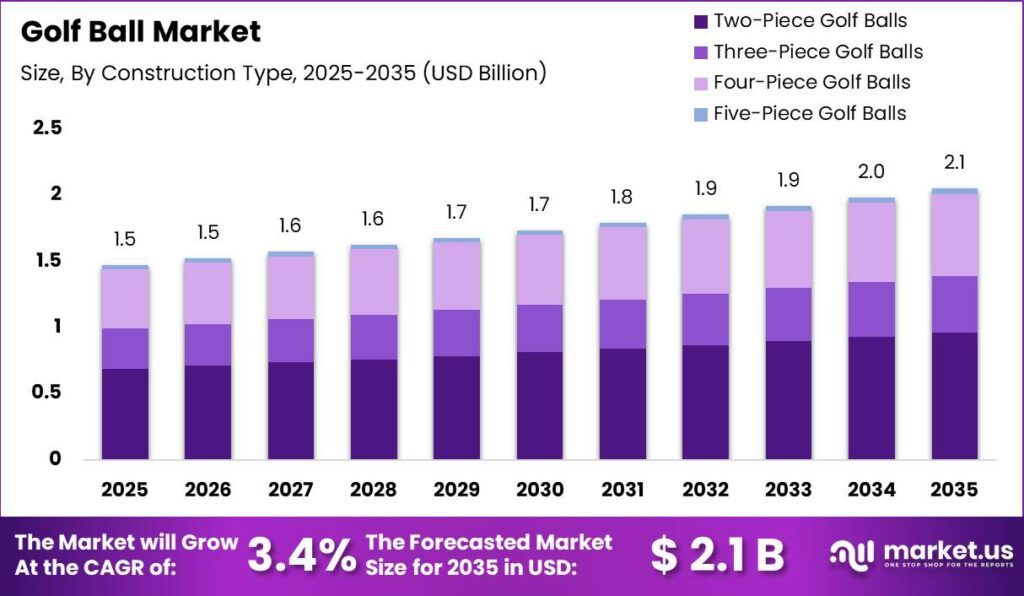
Global Golf Ball Market size is expected to be worth around USD 2.1 Billion by 2035 from USD 1.5 Billion in 2025, growing at a CAGR of 3.4% during the forecast period 2026 to 2035. This steady climb reflects a durable replacement-driven demand base. Manufacturers who protect shelf position now will hold pricing power as volumes expand.
The golf ball market covers balls sold by construction, cover material, and performance type across recreational and professional play. This structure splits demand between high-volume value tiers and premium tour products. Therefore, brands must balance scale manufacturing against margin-rich premium lines to capture both casual buyers and serious players.
Key Takeaways
- Global Golf Ball Market size is projected to reach USD 2.1 Billion by 2035 from USD 1.5 Billion in 2025 at a CAGR of 3.4%.
- Two-Piece Golf Balls led the Construction Type segment with a 46.80% share in 2025.
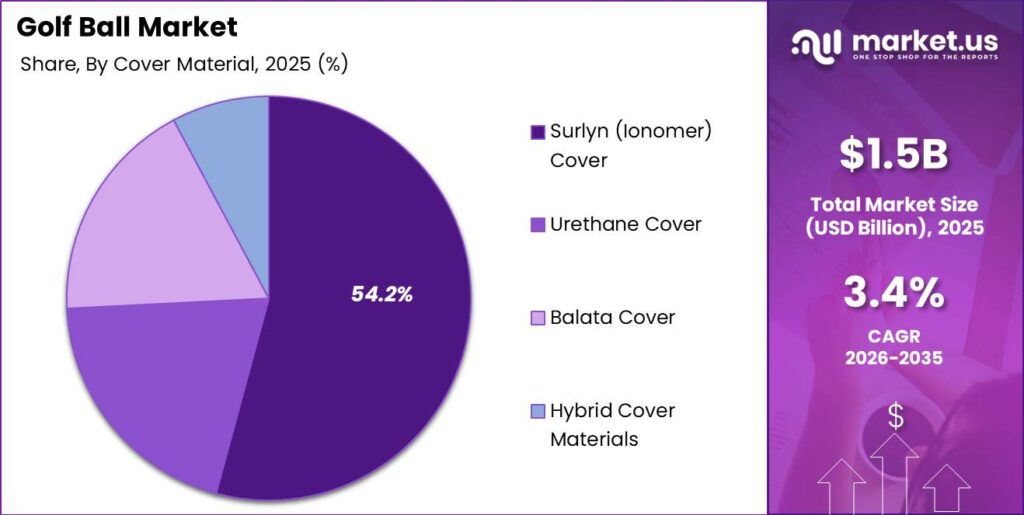
- Surlyn (Ionomer) Cover held 54.20% of the Cover Material segment.
- Recreational Golf dominated the Application segment with a 58.40% share.
- Offline Retail captured 63.10% of the Distribution Channel segment.
- Mid-Range Golf Balls held 43.60% of the Price Range segment.
- Amateur Golfers accounted for 61.70% of the End User segment.
- Distance Golf Balls led the Performance Type segment with 48.90%.
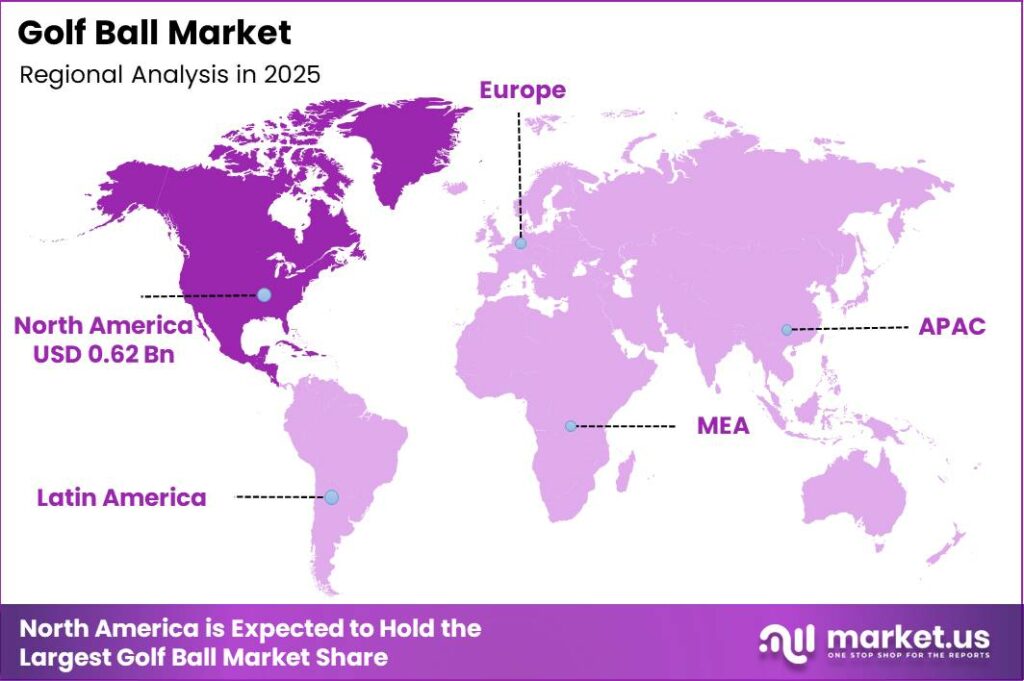
- North America dominated with a 41.50% share, valued at USD 0.62 Billion.
Government-linked bodies and sport regulators shape this market through participation programs and equipment standards. Public course funding and youth golf initiatives widen the player base each season. This creates a steady inflow of first-time buyers who anchor entry-level ball demand for retailers and manufacturers.
Data shows more than 82 million rounds were recorded in the U.S. in 2025, marking record-level consumption cycles per player. Higher round counts directly raise ball loss and replacement rates. As a result, brands with strong retail distribution capture repeat purchases faster than niche competitors.
As per our research, average participation growth over the past eight years lifted the on-course golfer base by more than 5 million players, ending in 2025. This larger base raises equipment turnover cycles. Therefore, manufacturers gain a widening demand floor that supports volume planning and inventory commitments. USGA data also shows more than 14.9 million 9-hole rounds in 2025, reflecting short-format play that increases ball turnover.
Construction Type Analysis
Two-Piece Golf Balls dominate with 46.80% due to durable low-cost recreational play appeal.
In 2025, Two-Piece Golf Balls held a dominant market position in the By Construction Type segment of Golf Ball Market, with a 46.80% share. China exported 370.3 million golf balls in 2024, with two-piece designs forming the bulk of value shipments. This scale keeps unit costs low for recreational buyers. Therefore, manufacturers of two-piece balls win high-volume retail contracts.
Three-Piece Golf Balls serve players seeking a balance of distance and greenside spin. UN Comtrade figures show U.S. golf ball imports reached USD 382.3 million in 2024, much of it mid-tier multilayer product. This import volume signals strong domestic appetite for step-up performance balls. As a result, brands positioning three-piece lines capture aspirational recreational upgraders.
Four-Piece Golf Balls target committed golfers wanting layered spin control across clubs. China shipped 177.6 million balls to the United States alone in 2024, feeding this premium multilayer demand. Higher construction complexity supports firmer margins. This means manufacturers use four-piece lines to lift blended profitability above value tiers.
Five-Piece Golf Balls anchor the top of the tour performance range for elite players. China’s golf ball exports were valued at USD 147.3 million in 2024, with premium multilayer balls commanding the highest per-unit prices. These balls hold the smallest but richest share collectively. Therefore, brands protect five-piece lines as flagship credibility drivers.
Cover Material Analysis
Surlyn (Ionomer) Cover dominates with 54.20% due to durable low-cost mass production.
In 2025, Surlyn (Ionomer) Cover held a dominant market position in the By Cover Material segment of Golf Ball Market, with a 54.20% share. Acushnet alone produces over 1 million golf balls daily, many using ionomer covers for value lines. This cover resists cuts and lowers cost. Therefore, ionomer stays the default choice for high-volume recreational products.
Urethane Cover serves premium tour balls prized for soft feel and greenside spin. Acushnet reported golf ball net sales rising toward USD 1,596.2 million in its latest annual report, driven by urethane Pro V1 lines. This premium mix lifts revenue faster than volume. As a result, urethane covers concentrate manufacturer profit pools.
Balata Cover retains a niche among traditionalists valuing classic soft feel. Global golf ball trade exceeded 370 million units from China in 2024, yet balata holds only a small legacy slice. Limited durability restricts wider adoption. This means balata remains a specialty offering rather than a growth channel.
Hybrid Cover Materials blend ionomer and urethane traits to bridge cost and performance. NGF data shows Acushnet maintains roughly 75% usage among committed golfers, pushing rivals toward hybrid innovation. These covers target value-conscious performance seekers. Therefore, challenger brands use hybrids to contest premium share without full urethane cost.
Application Analysis
Recreational Golf dominates with 58.40% due to broad casual player participation base.
In 2025, Recreational Golf held a dominant market position in the By Application segment of Golf Ball Market, with a 58.40% share. USGA figures confirm over 82 million rounds played in the U.S. in 2025, overwhelmingly recreational. This casual volume drives constant ball replacement. Therefore, brands prioritize recreational lines for predictable repeat revenue.
Professional Tournament Golf sets the performance benchmark that guides consumer purchases. World Bank trade data records U.S. golf ball imports at USD 382.3 million in 2024, partly premium tour product. Tour validation shapes retail demand. As a result, brands invest in tournament presence to sell premium balls at scale.
Driving Range and Practice consumes durable range balls in extremely high daily volumes. China exported 370.3 million balls in 2024, a share flowing into range and practice channels. High wear rates force frequent restocking. This means range operators represent a steady bulk-purchase institutional buyer.
Golf Training and Coaching drives analytics-linked ball use for swing optimization. World Bank data values China’s 2024 golf ball exports at USD 147.3 million, supplying coaching and academy demand. Data-driven practice raises consumption per learner. Therefore, training-focused balls open an adjacent institutional revenue stream.
Distribution Channel Analysis
Offline Retail dominates with 63.10% due to hands-on ball testing preference.
In 2025, Offline Retail held a dominant market position in the By Distribution Channel segment of Golf Ball Market, with a 63.10% share. Acushnet produces over 1 million balls daily, largely routed through pro shops and sports stores. Physical stores let buyers compare feel and price. Therefore, offline retail remains the primary volume gateway.
Online Retail expands reach through convenience and price comparison. U.S. golf ball imports of USD 382.3 million in 2024 increasingly flow through e-commerce fulfillment. Digital channels widen buyer access beyond store radius. As a result, brands build direct online storefronts to defend margin.
Direct-to-Consumer channels let brands own customer data and pricing. China’s 177.6 million balls shipped to the U.S. in 2024 include growing DTC-fulfilled orders. This model removes retailer margin capture. This means challenger brands like Vice grow fastest through DTC economics.
Specialty Golf Stores serve serious players seeking expert fitting and premium selection. World Bank data shows China’s golf ball exports at USD 147.3 million in 2024, feeding specialty premium demand. Expert service justifies higher price points. Therefore, specialty stores anchor premium ball sell-through.
Price Range Analysis
Mid-Range Golf Balls dominate with 43.60% due to balanced performance and affordability appeal.
In 2025, Mid-Range Golf Balls held a dominant market position in the By Price Range segment of Golf Ball Market, with a 43.60% share. China exported 370.3 million balls in 2024, with mid-tier product forming the largest slice. This price band matches aspirational casual buyers. Therefore, brands crowd the mid-range to capture the widest demand pool.
Premium Golf Balls target committed players prioritizing spin and feel. Acushnet golf ball net sales approached USD 1,596.2 million in its latest report, led by premium lines. Premium pricing lifts revenue per unit. As a result, manufacturers defend premium share to protect profit.
Economy Golf Balls serve price-sensitive and beginner golfers. China’s 2024 golf ball exports totaled USD 147.3 million, much of it economy volume. Low prices attract high-churn newcomers. This means economy balls act as an entry funnel toward higher tiers.
Ultra-Premium Golf Balls anchor the elite performance ceiling for demanding players. U.S. imports reached USD 382.3 million in 2024, including the richest per-unit tour product. These balls hold the smallest but highest-value slice. Therefore, brands use ultra-premium lines to signal engineering leadership.
End User Analysis
Amateur Golfers dominate with 61.70% due to large casual recreational player base.
In 2025, Amateur Golfers held a dominant market position in the By End User segment of Golf Ball Market, with a 61.70% share. USGA data shows more than 82 million rounds in the U.S. in 2025, driven mainly by amateurs. This base sustains constant ball replacement. Therefore, brands design most products around amateur needs.
Professional Golfers set performance standards that influence all buyers. World Bank trade data records USD 382.3 million in U.S. golf ball imports in 2024, partly elite tour balls. Pro endorsement shapes amateur purchasing. As a result, brands invest heavily in tour player contracts.
Golf Clubs and Academies buy in bulk for members and learners. Acushnet’s daily output of over 1 million balls supplies institutional accounts. Bulk buyers value consistent supply and pricing. This means academies represent a stable B2B revenue channel.
Corporate and Promotional Buyers purchase branded balls for events and gifting. China exported 370.3 million balls in 2024, a share flowing into promotional orders. Custom printing adds margin per unit. Therefore, corporate gifting offers a high-margin adjacent stream.
Performance Type Analysis
Distance Golf Balls dominate with 48.90% due to amateur demand for extra yardage.
In 2025, Distance Golf Balls held a dominant market position in the By Performance Type segment of Golf Ball Market, with a 48.90% share. China’s golf ball exports reached 370.3 million units in 2024, with distance models leading value volume. Amateurs prize extra yardage above spin. Therefore, distance balls capture the broadest recreational demand.
Tour Performance Golf Balls deliver full spin and control for skilled players. Acushnet golf ball net sales neared USD 1,596.2 million in its latest report, led by tour lines. Tour balls generate premium margins. As a result, brands protect this tier as their profit core.
Soft Feel Golf Balls appeal to players valuing comfort at moderate swing speeds. World Bank data values China’s 2024 exports at USD 147.3 million, including soft-compression product. Female participation reaching 8.1 million golfers widens this segment. Therefore, soft-feel lines address a fast-growing buyer group.
Spin Control Golf Balls target precision players focused on greenside stopping power. U.S. golf ball imports of USD 382.3 million in 2024 include spin-oriented premium balls. These hold the remaining share collectively alongside soft-feel. This means spin control anchors specialized premium demand.
Key Market Segments
By Construction Type
- Two-Piece Golf Balls
- Three-Piece Golf Balls
- Four-Piece Golf Balls
- Five-Piece Golf Balls
By Cover Material
- Surlyn (Ionomer) Cover
- Urethane Cover
- Balata Cover
- Hybrid Cover Materials
By Application
- Recreational Golf
- Professional Tournament Golf
- Driving Range and Practice
- Golf Training and Coaching
By Distribution Channel
- Offline Retail (Sports Stores, Pro Shops)
- Online Retail
- Direct-to-Consumer
- Specialty Golf Stores
By Price Range
- Mid-Range Golf Balls
- Premium Golf Balls
- Economy Golf Balls
- Ultra-Premium Golf Balls
By End User
- Amateur Golfers
- Professional Golfers
- Golf Clubs and Academies
- Corporate and Promotional Buyers
By Performance Type
- Distance Golf Balls
- Tour Performance Golf Balls
- Soft Feel Golf Balls
- Spin Control Golf Balls
Regional Analysis
North America Dominates the Golf Ball Market with a Market Share of 41.50%, Valued at USD 0.62 Billion
North America leads the golf ball market with a 41.50% share, valued at USD 0.62 Billion. The USGA recorded more than 82.0 million rounds in the U.S. in 2025, sustaining record replacement cycles. This dense play activity anchors regional demand. Therefore, brands treat North America as their primary volume and revenue base.
Asia-Pacific ranks as the fastest-growing region, driven by course expansion and first-time players. In April 2026, Srixon launched a refreshed 338-dimple aerodynamic design in its Z-Star lineup, targeting competitive Asian markets. New player entry lifts entry-level ball demand. As a result, early movers gain share before the market matures.
Europe, Latin America, and Middle East and Africa together hold the remaining share behind the two leaders. Rising course access and participation support gradual demand growth across these regions. Wider facility availability draws new golfers. This means manufacturers can build long-term distribution footholds in these emerging areas.
Key Regions and Countries
North America
- US
- Canada
Europe
- Germany
- France
- The UK
- Spain
- Italy
- Rest of Europe
Asia Pacific
- China
- Japan
- South Korea
- India
- Australia
- Rest of APAC
Latin America
- Brazil
- Mexico
- Rest of Latin America
Middle East and Africa
- GCC
- South Africa
- Rest of MEA
Market Dynamics
Market Opportunity Analysis - Underserved regions and low-share segments open entry points for new players
Asia-Pacific stays underexploited despite ranking as the fastest-growing region behind North America’s 41.50% lead. First-time players enter faster than premium supply matures there. This gap favors early distribution builders. Therefore, brands establishing footholds now capture loyalty before global rivals scale local presence.
Online Retail remains underpenetrated against Offline Retail’s 63.10% dominance. Digital channels reach golfers beyond store radius at lower cost. This means challenger brands can grow share without heavy retail investment. As a result, DTC-focused players like Vice find open runway online.
Economy and entry-level tiers sit beneath Mid-Range’s 43.60% share, yet newcomers start here. Soft Feel balls also serve the 8.1 million female golfers entering the game. This underserved beginner pool feeds future premium buyers. Therefore, brands treating economy lines as a funnel gain long-term customer value.
Corporate and Promotional buyers hold a small slice within the End User mix behind Amateurs at 61.70%. Custom printing lets brands charge premium prices to this channel. This creates a high-margin adjacent stream. Consequently, manufacturers building B2B gifting programs unlock underused revenue.
Technology and Innovation Landscape - Aerodynamics, core engineering, and material advances redefine competitive edges
Callaway’s new Tour Fast Mantle material raises ball speed by up to 16% over prior models in its 2026 Chrome lineup. Faster mantle response converts swing energy into distance. This performance claim strengthens premium positioning. Therefore, rivals must match mantle engineering to defend tour credibility.
Titleist advanced dimple architecture with 388 and 348 patterns on its updated Pro V1 and Pro V1x balls. Refined aerodynamics improve flight speed and spin control together. This dimple precision differentiates premium products. As a result, aerodynamic design becomes a core competitive battleground.
Bridgestone developed its VS Prototype series from over 240 prototypes, gaining 2.3 mph ball speed and up to 8.7 yards. Extensive prototyping shortens the path to measurable performance. This R&D depth signals engineering leadership. Consequently, brands investing in iterative testing widen the gap over smaller competitors.
Drivers
An outdoor recreation shift permanently lifted golf participation above pre-2020 levels instead of reverting after the pandemic. The National Golf Foundation reported U.S. golfer participation near 41.1 million combined players in 2023, up from about 34.2 million in 2019. This adds nearly 7 million players over four years. Therefore, ball consumption gains a structural demand floor.
On-course rounds exceeded 530 million in both 2022 and 2023, roughly 14% above the pre-pandemic average. Recreational players lose about 1.8 to 2.4 balls per round, generating steady replacement volume. This inelastic loss rate converts play into predictable sales. As a result, manufacturers plan volume against a reliable participation base.
| Driver | (~) % Impact on CAGR Forecast | Geographic Relevance | Impact Timeline |
|---|---|---|---|
| Post-Pandemic Golf Participation Surge Sustaining Structurally Elevated Round & Ball Consumption Volumes | +1.2% | United States, Canada, United Kingdom, Australia, South Korea, Japan | Short term (≤ 2 years) |
| Asia-Pacific Golf Course Expansion & First-Time Player Growth Driving New Ball Demand | +0.9% | South Korea, China, Japan, India, Vietnam, Thailand, Indonesia | Short term (≤ 2 years) |
| Premium & Tour-Grade Ball Premiumization Driven by Recreational Golfer Aspirational Purchasing | +0.7% | United States, South Korea, Japan, United Kingdom, Australia | Short term (≤ 2 years) |
| Women & Junior Golfer Participation Programs Expanding the Active Player Base | +0.4% | United States, United Kingdom, South Korea, Australia, Canada | Medium term (2–4 years) |
| Indoor Golf & Simulator Facility Growth Generating Year-Round Ball Purchase Demand in Cold-Climate Markets | +0.3% | South Korea, United States, United Kingdom, Canada, Nordic Countries, Japan | Short term (≤ 2 years) |
Restraints
The R&A and USGA adopted the Model Local Rule on ball performance, directing elite competition to adopt it from 1 January 2026. The rule cuts maximum permitted distance by about 13 to 15 yards at the test condition. This forces a split between conforming and recreational lines. Therefore, manufacturers carry higher tooling and development costs.
Building a new conforming line across 3 to 5 performance tiers costs roughly $8 million to $18 million per manufacturer, plus an 18 to 24 month timeline. Retailers must manage double the premium SKU count. This raises inventory carrying cost per shelf. As a result, margins compress through the transition window.
| Restraint | (~) % Impact on CAGR Forecast | Geographic Relevance | Impact Timeline |
|---|---|---|---|
| R&A & USGA Model Local Rule on Ball Rollback Mandating Bifurcated Product Lines from 2026 | -1.1% | Global — affecting all manufacturers supplying conforming ball markets in R&A and USGA jurisdictions | Short term (≤ 2 years) |
| High Golf Participation Cost & Course Access Barriers Suppressing New Player Retention Rates | -0.8% | United States, United Kingdom, Australia, Canada — markets with elevated greens fee & membership costs | Short term (≤ 2 years) |
| Saturated Premium Ball Category Competition Compressing Retail Margin & Promotional Cost Inflation | -0.5% | United States, South Korea, Japan, United Kingdom | Short term (≤ 2 years) |
| Refurbished & Lake Ball Market Growth Diverting Budget Golfer Spend from New Ball Purchases | -0.3% | United States, United Kingdom, Germany, France, Australia | Medium term (2–4 years) |
| Consumer Discretionary Spending Pressure Reducing Golf Equipment Budgets in Rate-Sensitive Household Segments | -0.2% | United States, United Kingdom, Canada, Australia | Short term (≤ 2 years) |
Challenges
Golf ball makers depend heavily on two petrochemical polymers, Surlyn ionomer and thermoplastic polyurethane, both linked to crude oil costs. Surlyn prices rose about 18% to 28% between 2021 and 2024 on cost pass-through and capacity limits. This lifts bill-of-materials cost per ball. Therefore, value-tier margins face direct pressure.
A $3 to $4 per dozen input increase cuts value-ball margins by 600 to 1,000 basis points, hard to recover in price-elastic segments. Only the 3 to 4 largest makers can secure price-cap supply deals. This widens the scale advantage gap. As a result, regional challengers face a structural cost disadvantage.
| Challenge | (~) % CAGR Friction Drag | Geographic Relevance | Mitigation Horizon |
|---|---|---|---|
| Surlyn & Urethane Raw Material Cost Volatility | -0.6% | Global — petrochemical-linked input costs impacting all major manufacturing hubs | Medium term (2–4 years) |
| Counterfeit Premium Ball Penetration in Asian Markets | -0.5% | China, Vietnam, Indonesia, Thailand, India — key counterfeit origin & consumption markets | Long term (≥ 4 years) |
| New Golfer Retention & Engagement Drop-Off | -0.4% | United States, United Kingdom, Australia, Canada — post-pandemic first-time buyer churn risk | Medium term (2–4 years) |
| Golf Course Water Usage Regulation & Closures | -0.3% | Spain, Portugal, California, Arizona, Australia — water-stressed markets with course attrition risk | Long term (≥ 4 years) |
| E-Commerce Price Transparency & Margin Compression for Specialty Retail | -0.2% | United States, United Kingdom, Germany, Australia, South Korea | Medium term (2–4 years) |
Opportunities
The custom golf ball segment stays untapped because traditional printing demands high minimums of 12 to 48 dozen and lead times of 10 to 21 business days. This structure excludes individual orders below 1 to 2 dozen. New UV inkjet printing runs at 800 to 2,000 balls per hour. Therefore, brands can serve single-dozen personalized orders profitably.
A personalized dozen priced near $55 carries manufacturing cost of about $8 to $12 plus $1.50 to $3.00 for printing, yielding 72% to 82% gross margin. This far exceeds the 35% to 52% on wholesale balls. Direct sales also cut retailer margin capture. As a result, early DTC personalization movers gain a defensible high-margin channel.
| Opportunity | (~) % Potential CAGR Upside | Geographic Relevance | Execution Window |
|---|---|---|---|
| Personalized & Custom-Printed Golf Ball DTC Platform as a High-Margin Adjacent Revenue Stream | +0.9% | United States, United Kingdom, Japan, South Korea, Australia, Germany | Short term (≤ 2 years) |
| India Golf Market Development as an Underpenetrated First-Time Player & Ball Consumption Growth Frontier | +0.7% | India — Metro & Tier-1 cities; defense & premium residential golf course expansion | Medium term (2–4 years) |
| Sustainable & Bio-Based Golf Ball Materials as a Premium ESG-Positioned Sub-Category | +0.5% | European Union, United States, United Kingdom, Australia — environmentally motivated golfer segment | Long term (≥ 4 years) |
| Smart Golf Ball with Embedded Tracking & Swing Data Feedback for the Performance Golfer Segment | +0.4% | United States, South Korea, Japan, United Kingdom, Australia | Long term (≥ 4 years) |
| Corporate & B2B Gifting Channel Expansion — Branded Ball Sets as Premium Corporate Merchandise | +0.2% | United States, United Kingdom, Japan, South Korea, UAE, India | Short term (≤ 2 years) |
Key Company Insights
Acushnet Holdings Corp. holds structural leadership through its Titleist brand, producing over 1 million balls daily and holding roughly 75% usage among committed golfers. Female participation reaching 8.1 million on-course players widens demand for its soft-compression lines. This scale creates a deep moat. However, heavy premium reliance exposes it to distance-rule shifts.
Callaway Golf Company competes through aggressive product innovation and broad recreational reach across its Chrome ball family. PGA Tour driving distance rising from 286.5 yards in 2004 to about 302.8 yards recently pressures its performance roadmap. This raises R&D urgency. Therefore, Callaway must sustain rapid launches to defend premium share against Titleist.
Key Players
- Acushnet Holdings Corp. (Titleist)
- Callaway Golf Company
- TaylorMade Golf Company
- Bridgestone Corporation
- Srixon
- Dunlop Sports Co. Ltd.
- Mizuno Corporation
- Wilson Sporting Goods
- Vice Golf
- Volvik Inc.
- PXG
- Snell Golf
- Seed Golf
- OnCore Golf
- Maxfli
Recent Developments
- January 2026: Callaway launched its updated Chrome Tour, Chrome Tour X, and Chrome Soft lineup featuring a new Tour Fast Mantle material that increases ball speed by up to 16% versus previous generation models.
- April 2026: Titleist released updated Pro V1 and Pro V1x golf balls with refined high-gradient core technology and improved aerodynamics using 388 and 348 dimple patterns respectively for enhanced speed and spin control.
- 2026: Bridgestone introduced its VS Prototype golf ball series developed from over 240 prototypes, achieving reported gains of 2.3 mph ball speed and up to 8.7 yards additional distance.
- January 2026: Callaway Golf completed the sale of a 60% stake in its Topgolf and Toptracer business, receiving approximately $800 million in net proceeds and shifting back to a pure-play golf equipment company.
Geopolitical Impact Analysis
According to the World Bank, China exported 370.3 million golf balls valued at USD 147.3 million in 2024, making U.S. supply chains sensitive to trade policy. New U.S. tariffs on Chinese sporting goods raise landed costs on imported balls and Surlyn-linked inputs. This lifts retail prices for value tiers. Therefore, manufacturers accelerate supplier diversification to protect margins.
As reported by the IEA, crude oil price swings directly affect petrochemical polymer costs for golf ball covers. Freight rerouting around Red Sea and Panama Canal chokepoints has added transit delays and lifted container rates well above pre-2023 norms. World Bank trade data shows U.S. golf ball imports reached USD 382.3 million in 2024. Consequently, longer lead times force higher safety-stock inventory across the supply chain.
Report Scope
| Report Features | Description |
|---|---|
| Market Value (2025) | USD 1.5 Billion |
| Forecast Revenue (2035) | USD 2.1 Billion |
| CAGR (2026-2035) | 3.4% |
| Base Year for Estimation | 2025 |
| Historic Period | 2020-2024 |
| Forecast Period | 2026-2035 |
| Report Coverage | Revenue Forecast, Market Dynamics, Market Opportunity Analysis, Technology and Innovation Landscape, Competitive Landscape, Recent Developments |
| Segments Covered | By Construction Type (Two-Piece, Three-Piece, Four-Piece, Five-Piece), By Cover Material (Surlyn/Ionomer, Urethane, Balata, Hybrid), By Application (Recreational, Professional Tournament, Driving Range and Practice, Training and Coaching), By Distribution Channel (Offline Retail, Online Retail, Direct-to-Consumer, Specialty Golf Stores), By Price Range (Mid-Range, Premium, Economy, Ultra-Premium), By End User (Amateur, Professional, Clubs and Academies, Corporate and Promotional), By Performance Type (Distance, Tour Performance, Soft Feel, Spin Control) |
| Regional Analysis | North America (US and Canada), Europe (Germany, France, The UK, Spain, Italy, and Rest of Europe), Asia Pacific (China, Japan, South Korea, India, Australia, and Rest of APAC), Latin America (Brazil, Mexico, and Rest of Latin America), Middle East and Africa (GCC, South Africa, and Rest of MEA) |
| Competitive Landscape | Acushnet Holdings Corp. (Titleist), Callaway Golf Company, TaylorMade Golf Company, Bridgestone Corporation, Srixon, Dunlop Sports Co. Ltd., Mizuno Corporation, Wilson Sporting Goods, Vice Golf, Volvik Inc., PXG, Snell Golf, Seed Golf, OnCore Golf, Maxfli |
| Customization Scope | Customization for segments, region / country-level will be provided. Additional customization can be done based on requirements. |
| Purchase Options | We have three licenses to opt for: Single User License | Multi-User License (Up to 5 Users) | Corporate Use License (Unlimited User and Printable PDF) |





































