Report Overview
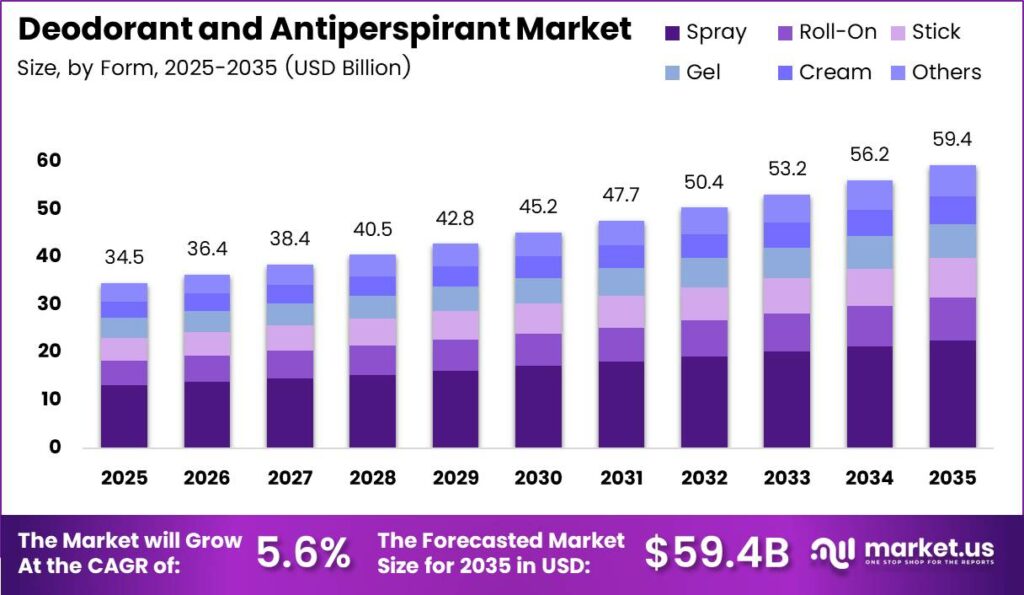
Global Deodorant and Antiperspirant Market size is expected to be worth around USD 59.4 Billion by 2035 from USD 34.5 Billion in 2025, growing at a CAGR of 5.6% during the forecast period 2026 to 2035.
The deodorant and antiperspirant market covers personal-care products formulated to control body odor, reduce perspiration, or both. The market spans deodorant formats that neutralize odor-causing bacteria and antiperspirant formats that use active ingredients to reduce sweat output. Products are sold across spray, roll-on, stick, gel, and cream forms through supermarkets, pharmacies, specialty beauty retailers, convenience stores, and online platforms worldwide.
Key Takeaways
- The global Deodorant and Antiperspirant Market was valued at USD 34.5 Billion in 2025 and is forecast to reach USD 59.4 Billion by 2035.
- The market is projected to grow at a CAGR of 5.6% during the forecast period 2026 to 2035.
- By Product Type, Deodorants dominate with a 64.90% share in 2025.
- By Fragrance, Floral leads with a 32.56% share and is the fastest-growing sub-segment.
- By Form, Spray holds the largest share at 37.54% and is also the fastest-growing format.
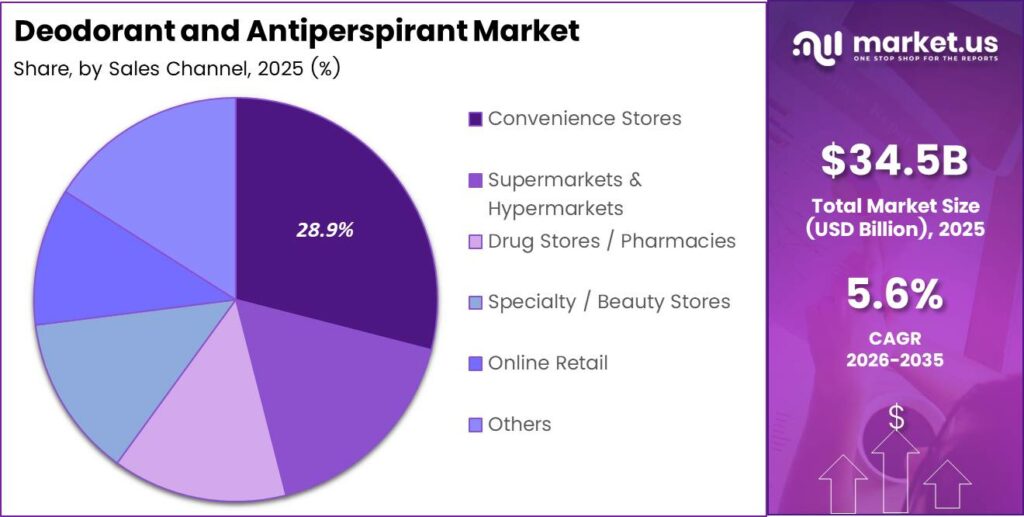
- By Sales Channel, Convenience Stores account for 28.90% of total market revenue.
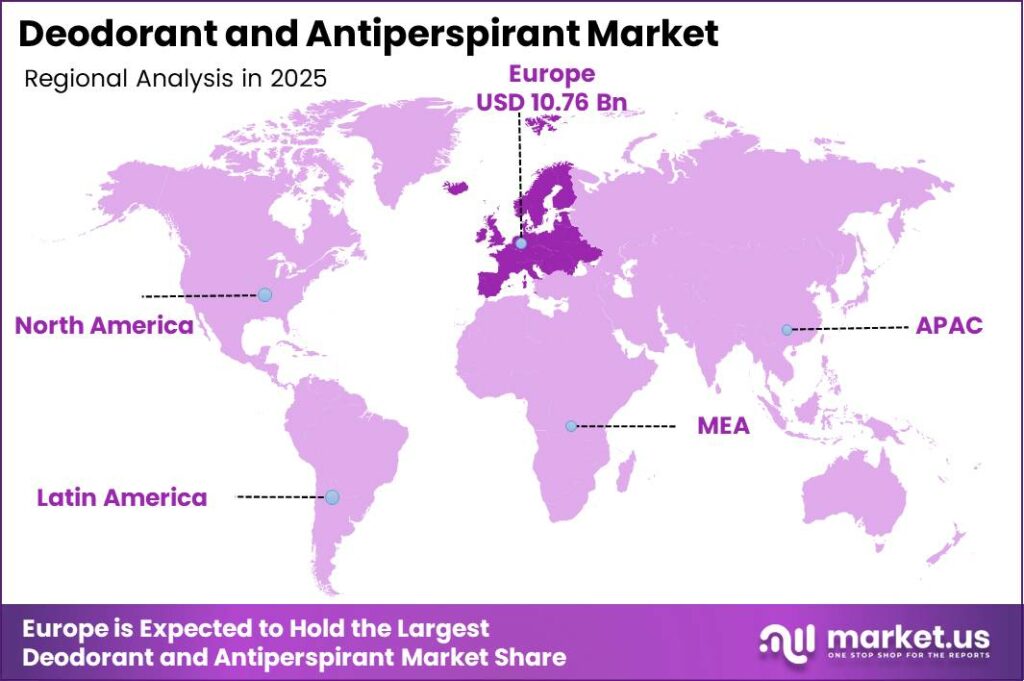
- Europe is the dominant region with a 31.23% share, valued at USD 10.76 Billion in 2025.
- Asia-Pacific is the fastest-growing regional market.
Government investment in fragrance infrastructure directly supports market expansion. In May 2025, Unilever committed an £80 million investment in UK fragrance capabilities, including a proposed Port Sunlight facility serving multiple categories. This level of capital commitment signals that leading manufacturers view fragrance development as a structural competitive asset, not a discretionary spend. Regulatory frameworks such as EU fragrance-allergen disclosure rules further push brands to invest in compliant formulation infrastructure ahead of market entry deadlines.
According to Cosmeticseurope.eu data, Europe’s cosmetics and personal-care retail sales totaled €110 billion in 2025, confirming the region as the single largest revenue pool for personal-care categories including deodorants. This scale creates shelf competition that rewards brands with proven compliance credentials and innovation pipelines. As reported by Unilever’s annual-report disclosures, its whole-body deodorant technology had expanded to 15 markets by 2025, reflecting how regulatory-ready innovations scale rapidly once a lead market validates them commercially.
In February 2026, Unilever launched Dove and Dove Men+Care whole-body deodorants across spray, stick, and cream formats in the UK, backed by a £5.5 million marketing campaign scheduled to run from April 2026. This launch confirms that product-use occasion expansion is now a primary revenue growth mechanism for incumbents. Brands that build regimen-based portfolio strategies across body areas will generate incremental per-consumer revenue rather than relying on category replacement cycles alone.
Product Type Analysis
Deodorants dominate with 64.90% due to broader aluminum-free consumer acceptance.
In 2025, Deodorants held a dominant market position in the By Product Type segment of the Deodorant and Antiperspirant Market, with a 64.90% share. Unilever’s April 2024 announcement cited Dove research showing that 2% of surveyed consumers already used whole-body deodorants, while 76% expressed interest in trying them. This latent demand confirms that deodorant volume will expand as brands launch body-area-specific SKUs. In January 2025, Unilever launched Sure Whole Body Deodorant and Lynx Lower Body Spray in the UK, backed by a combined £12.5 million advertising investment.
Antiperspirants represent the fastest-growing sub-segment within the By Product Type classification. The FDA OTC Monograph M019, published 23 November 2021, permits aluminum chlorohydrate at concentrations up to 25% in qualifying antiperspirant formulations, establishing a firm regulatory ceiling that brands must engineer within. Higher-performance antiperspirant formulations are gaining traction among consumers trading up from standard deodorants. Dove VitaminCare+ stick deodorants contain 3% facial-grade niacinamide, signaling that ingredient differentiation is now a competitive lever within this sub-segment.
Fragrance Analysis
Floral dominates with 32.56% due to broad cross-demographic fragrance appeal.
In 2025, Floral held a dominant market position in the By Fragrance segment of the Deodorant and Antiperspirant Market, with a 32.56% share. Floral profiles maintain leadership because they perform across female and unisex positioning without requiring complex scent education. This breadth of acceptance gives brands a lower-risk platform for new product introductions and line extensions. Floral’s simultaneous fastest-growing status confirms that the category is not just defending share but generating new buyer conversion.
Fruity fragrances represent a structurally distinct growth vector, driven by younger consumer cohorts seeking playful, non-traditional scent profiles. In January 2025, Native launched its Jarritos collaboration through Target, featuring four deodorant fragrances including Watermelon, Passion Fruit, Mandarin, and Pineapple, priced at $13 per unit on Native’s website. This collaboration demonstrates that licensed fruity fragrance partnerships generate retail exclusivity and media attention. Brands that align fruity scent development with food and beverage IP can access pre-built consumer communities that reduce launch marketing costs.
Citrus fragrances appeal to male and unisex segments where freshness cues drive purchase decisions, particularly in warm-climate markets. Woody and Oriental/Musk profiles serve premium positioning strategies and typically carry higher retail price points per unit. These sub-segments collectively address different consumer identity needs. Brands that build tiered fragrance architecture across Citrus, Woody, and Oriental/Musk can capture both the entry and premium ends of a single retail category without cannibalizing core Floral volume.
Form Analysis
Spray dominates with 37.54% due to fast-dry application preferred in humid climates.
In 2025, Spray held a dominant market position in the By Form segment of the Deodorant and Antiperspirant Market, with a 37.54% share. Spray formats are the fastest-growing form, driven by their no-contact application and perceived hygiene advantage in high-temperature markets. In April 2024, Unilever launched Dove Men+Care Whole Body Deo in the United States across spray, stick, and cream formats in two fragrance options: Aloe + Bamboo and Shea Butter + Cedar. Spray’s dual leadership in share and growth rate positions it as the primary investment priority for format innovation.
Roll-on formats retain significant share by offering targeted, controlled application with lower product waste per use. Beiersdorf reported in July 2024 that HIDROFUGAL FORTE ÜBER NACHT Roll-on performed twice as effectively when applied at night compared with morning application. This night-application positioning creates a new usage occasion that increases units consumed per consumer per year. Brands that invest in evidence-based usage occasion marketing for roll-on can grow per-household volume without launching new SKUs.
Stick formats are widely distributed and preferred in North American markets where solid formats dominate personal-care routines. Gel and Cream formats serve niche preferences including sensitive-skin consumers and users requiring specific dermatological benefits. These lower-share formats collectively address underserved buyer segments. Manufacturers that extend stick formulations with skin-care actives and position gel and cream variants for dermatologist-recommended channels can extract premium pricing without competing directly on mainstream shelf space.
Sales Channel Analysis
Convenience Stores dominate with 28.90% due to impulse-driven high-frequency footfall.
In 2025, Convenience Stores held a dominant market position in the By Sales Channel segment of the Deodorant and Antiperspirant Market, with a 28.90% share. As of 30 June 2026, 7-Eleven operated, franchised, or licensed more than 13,000 stores in the United States and Canada alone, illustrating the physical scale through which convenience channel deodorant distribution operates. This store density ensures near-universal product access for impulse and top-up purchases. Brands that secure primary shelf placement in convenience chains benefit from repeat low-consideration purchases that sustain baseline volume.
Supermarkets and Hypermarkets represent the second major channel, providing the broadest SKU range and promotional depth for deodorant and antiperspirant brands. Walmart reported more than 10,750 stores across 19 countries as of June 2025, confirming the scale of global hypermarket reach available to large personal-care suppliers. In May 2026, Native launched its limited-edition Boba Cafe collection exclusively at Walmart, demonstrating how exclusive retail partnerships convert mass-channel presence into differentiated marketing events. This channel rewards brands with strong trade marketing capability and efficient supply-chain execution.
Online Retail is the fastest-growing sales channel, reflecting structural shifts in personal-care purchasing behavior. The US Census Bureau’s August 2026 release estimated that e-commerce represented 16.4% of US retail sales on an unadjusted basis in the second quarter of 2026. This channel removes geographic shelf constraints and enables direct-to-consumer subscription models. Drug Stores, Specialty/Beauty Stores, and other channels address specific consumer need states including clinical recommendations and prestige positioning, rounding out a multi-channel distribution strategy for full-market coverage.
Key Market Segments
By Product Type
- Deodorants
- Antiperspirants
By Fragrance
- Floral
- Fruity
- Citrus
- Woody
- Oriental / Musk
- Others
By Form
- Spray
- Roll-On
- Stick
- Gel
- Cream
- Others
By Sales Channel
- Convenience Stores
- Supermarkets & Hypermarkets
- Drug Stores / Pharmacies
- Specialty / Beauty Stores
- Online Retail
- Others
Regional Analysis
Europe Dominates the Deodorant and Antiperspirant Market with a Market Share of 31.23%, Valued at USD 10.76 Billion
Europe holds the largest regional share at 31.23%, valued at USD 10.76 Billion in 2025, supported by mature retail infrastructure, high per-capita personal-care spending, and established regulatory frameworks that filter product quality. Data from Cosmeticseurope.eu shows European cosmetics exports totaled €29.8 billion in 2025, reflecting the region’s role as both a production and export hub for personal-care products including deodorants. In May 2025, Unilever committed an £80 million investment in UK fragrance capabilities, confirming continued capital allocation to European manufacturing. This scale of infrastructure investment reinforces Europe’s supply-side competitiveness and deepens barriers to entry for new regional challengers.
Asia-Pacific is the fastest-growing regional market, driven by rising household incomes, urbanization, and increasing personal-care category penetration across emerging economies. The World Bank’s April 2026 outlook projected South Asian economic growth of 6.3% in 2026, providing the income trajectory that supports discretionary personal-care spending upgrades. This growth rate signals that volume expansion in Asia-Pacific will outpace mature markets throughout the forecast period. Manufacturers entering or scaling in this region gain access to structurally growing consumer bases that are still building category habits.
North America is a high-value market anchored by advanced retail infrastructure and strong brand loyalty across both deodorant and antiperspirant formats. The US Census Bureau reported advance retail and food-services sales totaling $745.0 Billion in September 2026, reflecting the overall consumer spending environment in which deodorant and antiperspirant brands compete. Latin America and Middle East and Africa represent developing-market growth corridors where heat-related usage intensity and improving purchasing capacity support steady volume gains. Brands building distribution in these regions early establish shelf positioning before category competition intensifies.
Key Regions and Countries
North America
- US
- Canada
Europe
- Germany
- France
- The UK
- Spain
- Italy
- Rest of Europe
Asia Pacific
- China
- Japan
- South Korea
- India
- Australia
- Rest of APAC
Latin America
- Brazil
- Mexico
- Rest of Latin America
Middle East and Africa
- GCC
- South Africa
- Rest of MEA
Market Dynamics
Market Opportunity Analysis - Underpenetrated channels and usage occasions create addressable revenue gaps for focused entrants
Online Retail is the fastest-growing sales channel yet remains structurally underexploited by most mid-tier deodorant brands. The US Census Bureau reported e-commerce at 16.4% of US retail sales in Q2 2026, but the channel’s share of deodorant category revenue lags this headline figure. Brands that build direct-to-consumer subscription models on this channel capture recurring revenue with lower acquisition costs per repeat order. This creates an asymmetric entry advantage for leaner brands that can move faster than incumbent trade-marketing-dependent competitors.
Asia-Pacific is the fastest-growing regional market yet holds a smaller share of global revenue than its population and income trajectory justify. The World Bank projected South Asian economic growth of 6.3% in 2026, confirming the macro conditions for personal-care penetration gains. This means category conversion rates in Asia-Pacific still have structural runway that Europe and North America have already exhausted. Entrants that localize fragrance profiles and price-point architecture for specific sub-regional markets gain first-mover shelf positioning before category competition reaches European-market intensity.
Adaptive applicators for consumers with limited dexterity represent a long-horizon opportunity with near-zero current competition. This buyer segment is served by standard formats not designed for their needs, creating both a functional and commercial gap. Aging population trends across North America, Europe, and parts of Asia-Pacific expand the addressable base for this sub-segment throughout the forecast period. Brands that invest in ergonomic design and pharmacy-channel distribution for adaptive formats build a defensible niche before the segment becomes visible to category leaders.
Institutional hygiene procurement programs in hospitality and workforce channels remain a low-competition revenue stream relative to their potential scale. Drug Stores and Specialty/Beauty Stores are established channels for clinical and premium positioning, yet brands targeting clinician-recommended excessive-sweating regimens occupy only a fraction of the available shelf space in these outlets. This reflects a positioning gap rather than a demand gap. Brands that secure dermatologist endorsements and pharmacy placement for clinical-grade antiperspirant formats command price premiums that mass-channel competitors cannot replicate.
Technology and Innovation Landscape - Ingredient science, usage occasion design, and infrastructure automation define the next competitive cycle
Active-ingredient innovation is redefining performance benchmarks in both deodorant and antiperspirant formats. Dove VitaminCare+ aluminum-free stick deodorants, announced in May 2024, contain 3% facial-grade niacinamide alongside manufacturer-claimed odor protection of up to 72 hours across six US fragrance options. This formulation approach bridges personal-care actives with deodorant function, creating a dual-benefit product that competes on skin-health credentials rather than scent or duration alone. Brands that adopt evidence-based active-ingredient platforms build product claims that clinical-channel buyers and pharmacy buyers value more than standard efficacy language.
Night-application science represents a behavioral and formulation innovation that extends product utility beyond the standard morning routine. Beiersdorf reported in July 2024 that its HIDROFUGAL FORTE ÜBER NACHT Roll-on performed twice as effectively when applied at night compared with morning application. This manufacturer-reported evidence creates a distinct usage occasion that requires brands to develop new application instructions, packaging communication, and retail placement strategies. Brands that commercialize night-application positioning convert a single-SKU purchase into a regimen that can double per-consumer annual unit consumption.
Whole-body deodorant format innovation is the highest-profile technology shift currently reshaping portfolio architecture across the category. In April 2024, Dove Men+Care Whole Body Deo launched in the US in spray, stick, and cream formats with two dedicated fragrance options, covering distinct body-area application needs within a single product line. Each format variant requires separate efficacy validation, packaging design, and shelf communication. Manufacturers that invest in multi-format whole-body platforms early establish the technical IP and clinical evidence that makes their systems difficult for single-format competitors to replicate quickly.
Logistics automation is emerging as a technology investment that directly improves supply-chain resilience and output consistency for large personal-care manufacturers. Beiersdorf began construction of its Leipzig logistics center in July 2024, with investment exceeding €200 million, approximately 450 planned jobs, and around 125,000 automated pallet spaces, with completion scheduled for 2027. This level of automation investment reduces pick-and-pack error rates, improves order fulfillment speed, and builds the throughput capacity required to support large-scale retail partnerships. Brands that integrate automated distribution infrastructure gain a cost-per-unit shipping advantage that compounds across high-volume SKUs.
Drivers
Whole-body deodorant adoption is reshaping category economics by converting a single-product purchase occasion into a multi-area regimen. Unilever reported that search interest in whole-body deodorants increased by more than 1,000% over the year to March 2024, while its UK research found approximately one in three adults already applied deodorant beyond the underarms. This existing behavior, rather than speculative consumer education, underpins the commercial viability of body-area-specific portfolio expansion. Manufacturers who build these regimens now capture incremental per-household revenue before the format becomes a commodity.
Higher-performance antiperspirant trade-up adds a parallel revenue growth mechanism independent of volume expansion. Premium fragrance-led positioning is gaining ground across Europe, North America, and Latin America, creating a pricing opportunity that operates above the base category. Heat-related usage intensity in South Asia, the Middle East, and Latin America drives frequency of purchase, while improving household purchasing capacity in emerging Asia extends the addressable consumer base. These four drivers collectively create both an upward pricing path and a geographic volume expansion path that operate simultaneously.
| Driver | (~) % Impact on CAGR Forecast | Geographic Relevance | Impact Timeline |
|---|---|---|---|
| Whole-body deodorant adoption | +0.35% | North America; Western Europe | Short term (≤ 2 years) |
| Higher-performance antiperspirant trade-up | +0.25% | Global; developed-market emphasis | Short term (≤ 2 years) |
| Premium fragrance-led positioning | +0.20% | Europe; North America; Latin America | Medium term (2–4 years) |
| Heat-related usage intensity | +0.15% | South Asia; Middle East; Latin America | Short term (≤ 2 years) |
| Improving household purchasing capacity | +0.15% | Emerging Asia; selected developing economies | Medium term (2–4 years) |
Restraints
Commission Regulation (EU) 2023/1545 adds individual labeling requirements for 56 fragrance allergens, with disclosure thresholds above 0.001% in leave-on products. Since 31 July 2026, products failing these requirements may no longer be newly placed on the EU market. Qualifying inventory placed before that deadline remains available until 31 July 2028, but the rule creates an immediate commercial barrier for non-compliant products. Brands that fail compliance audits face artwork write-offs, expedited relabeling costs, and working-capital pressure that reduces promotional flexibility in the EU’s largest personal-care market.
Essential-spending affordability ceilings constrain volume growth in low-income households and developing economies, limiting how far category penetration can expand without accessible price-point products. Antiperspirant active-ingredient restrictions under the US regulatory framework create reformulation costs for brands dependent on higher-concentration active systems. VOC-based formulation restrictions in California and aerosol shipment rejections in air-freight-dependent lanes add compounding compliance costs. Brands operating across multiple regulatory jurisdictions must build formulation flexibility into their product architecture to avoid market exclusion costs that erode already-thin margins.
| Restraint | (~) % Impact on CAGR Forecast | Geographic Relevance | Impact Timeline |
|---|---|---|---|
| Noncompliant fragrance-label market exclusion | -0.25% | European Union; EU-bound exporters | Short term (≤ 2 years) |
| Essential-spending affordability ceiling | -0.20% | Low-income households; developing economies | Medium term (2–4 years) |
| Antiperspirant active-ingredient restrictions | -0.10% | United States; US-bound exporters | Medium term (2–4 years) |
| VOC-based formulation sales restrictions | -0.05% | California; California-serving portfolios | Short term (≤ 2 years) |
| Noncompliant aerosol shipment rejection | -0.05% | Air-freight-dependent distribution lanes | Short term (≤ 2 years) |
Challenges
Maritime input delivery volatility exposes manufacturers to replenishment delays even when consumer demand remains stable. UNCTAD documented an approximately 120% increase in the China Containerized Freight Index between October 2023 and June 2024, alongside disruption around the Red Sea and other maritime chokepoints. UNCTAD’s 2024 analysis modeled that sustained elevated shipping costs could raise global consumer prices by 0.6% by 2025 under a conditional scenario. Manufacturers absorbing freight cost increases on 3% landed-cost freight exposure at a 50% rate increase face approximately 1.5% landed-cost inflation, compressing gross margin without equivalent pricing power.
Formula efficacy reproducibility across multi-site manufacturing networks creates quality consistency costs that scale with portfolio complexity. Skin tolerability optimization for sensitive-skin product lines requires iterative clinical testing investment that lengthens development timelines. Component qualification bottlenecks in outsourced packaging supply chains delay new product launches and increase inventory risk. Variant proliferation forecasting errors generate overstock write-offs and promotional clearing costs. Brands that invest in demand sensing technology and streamlined SKU architecture reduce the compounding financial drag these operational challenges create across global distribution networks.
| Challenge | (~) % CAGR Friction Drag | Geographic Relevance | Mitigation Horizon |
|---|---|---|---|
| Maritime input delivery volatility | -0.20% | Asia-Europe lanes; import-dependent producers | Short term (≤ 2 years) |
| Formula efficacy reproducibility | -0.12% | Global; multi-site manufacturing networks | Medium term (2–4 years) |
| Skin tolerability optimization | -0.10% | Global; sensitive-skin product portfolios | Medium term (2–4 years) |
| Component qualification bottlenecks | -0.08% | Global; outsourced packaging supply chains | Medium term (2–4 years) |
| Variant proliferation forecasting errors | -0.05% | Global; broad multi-format portfolios | Short term (≤ 2 years) |
Opportunities
Closed-loop refill platform expansion offers a structurally differentiated revenue model for brands willing to invest in scalable infrastructure. In February 2026, Dove launched its first UK refillable antiperspirant collection, featuring three starter kits, six standalone refill fragrances, and manufacturer-claimed 72-hour protection, supported by a £7.5 million nationwide marketing campaign. Illustrative unit economics suggest that reducing disposable packaging costs by 40% on a 20% packaging-cost base produces an 8% recurring unit-cost reduction. Brands that generate genuine consumer retention through refill programs, rather than simple format migration, create the incremental purchasing volume that makes the economics compelling.
Clinician-linked excessive-sweating regimens unlock a medically validated revenue stream that commands higher price points and lower price sensitivity than mass-market deodorant formats. Institutional hygiene procurement programs serving hospitality and workforce channels provide predictable bulk-purchase volumes outside the competitive intensity of consumer retail. Adaptive applicators for consumers with limited dexterity and microbiome-guided formulations represent longer-horizon opportunities that address structurally underserved buyer segments. Early movers that establish clinical credibility or institutional supply contracts in these channels build switching-cost advantages that are difficult for late entrants to displace without equivalent investment in evidence and relationships.
| Opportunity | (~) % Potential CAGR Upside | Geographic Relevance | Execution Window |
|---|---|---|---|
| Closed-loop refill platform expansion | +0.30% | Europe; North America; affluent urban Asia | Medium term (2–4 years) |
| Clinician-linked excessive-sweating regimens | +0.18% | North America; Europe; specialist urban channels | Medium term (2–4 years) |
| Institutional hygiene procurement programs | +0.14% | Global; hospitality and workforce channels | Medium term (2–4 years) |
| Adaptive applicators for limited dexterity | +0.10% | Aging populations; assisted-living markets | Long term (≥ 4 years) |
| Locally validated microbiome-guided formulations | +0.08% | Specialist personal-care channels; global research hubs | Long term (≥ 4 years) |
Key Company Insights
Unilever holds a structural portfolio advantage through its whole-body deodorant expansion strategy. Its Personal Care business generated €13.2 billion in turnover in 2025 across multiple categories including deodorants. Unilever reported that 73% of Lynx Lower Body Spray sales were incremental to the category, citing Nielsen value-sales data for the moving annual total ending 27 December 2025. This incrementality rate confirms that usage occasion expansion is generating net-new category revenue rather than cannibalizing existing SKUs, a critical distinction for justifying continued portfolio investment.
Procter & Gamble competes through a differentiated brand architecture that spans mass and premium deodorant positioning. Its Beauty segment generated $14.964 billion in net sales in the fiscal year ended 30 June 2025. In March 2026, Kering and L’Oréal completed their strategic beauty alliance in a transaction valued at €4 billion, illustrating how adjacent premium fragrance consolidation reshapes competitive dynamics in categories that intersect with deodorant scent positioning. Beiersdorf’s July 2024 groundbreaking of its Leipzig logistics center, with investment exceeding €200 million and approximately 125,000 automated pallet spaces, signals that infrastructure scale is becoming a direct competitive advantage in personal-care distribution.
Key Players
- Unilever
- Procter & Gamble
- L’Oréal
- Beiersdorf AG
- Estée Lauder Companies Inc.
- Coty Inc.
- Shiseido Company, Limited
- Kao Corporation
- Lion Corporation
- Colgate-Palmolive Company
- Henkel AG & Co. KGaA
- Church & Dwight Co., Inc.
- Revlon, Inc.
- Avery Dennison Corporation
- Other Key Players
Recent Developments
- 25 June 2026: P&G announced reformulated Native stick and spray deodorants offering manufacturer-claimed odor protection of up to 72 hours, with suggested retail prices of $14 to $15.
- 12 May 2026: Native published its Global Flavors collection announcement featuring five fragrance inspirations, including aluminum-free deodorants with manufacturer-claimed 72-hour odor protection, with listed collection prices ranging from $3 to $14.
- 6 May 2026: Secret announced a partnership with Intern Queen and creator Corporate Natalie promoting Secret Clinical Strength with Hyaluronic Acid, with a company-stated claim of 100-hour sweat-and-odor protection.
- 4 February 2026: Old Spice announced the Spice Alchemist collection featuring four fragrance options across deodorants, body washes, and cologne mists, with suggested retail prices starting at $12.99.
- 16 May 2024: Dove announced its US whole-body deodorant collection in invisible cream and anti-friction stick formats, offering manufacturer-claimed 72-hour odor protection, at a suggested retail price of $11.99.
Geopolitical Impact Analysis
Trade policy uncertainty and maritime route disruptions are reshaping input cost structures for deodorant and antiperspirant manufacturers dependent on globally sourced packaging, fragrance compounds, and formulation chemicals. According to WTO’s March 2026 Global Trade Outlook, world merchandise-trade volume increased by 4.6% in 2025, but the WTO’s 2026 baseline forecast projected a deceleration to just 1.9% growth. This projected slowdown compresses the procurement efficiency gains that manufacturers rely on when sourcing specialty fragrance ingredients and aerosol components across Asia-Europe lanes. Brands with diversified supplier networks absorb these trade volume contractions with less operational disruption than single-source competitors.
As reported by UNCTAD’s Review of Maritime Transport 2024, more than 80% of world trade by volume moves by sea, making maritime route stability a direct determinant of raw-material delivery timelines for deodorant production. Red Sea disruptions in 2023 and 2024 added transit delays and rerouting costs to Asia-Europe freight lanes that carry packaging substrates and finished-goods shipments for personal-care categories. The IMF and World Bank have both flagged geopolitical fragmentation as a structural risk to global supply-chain efficiency through the forecast period. Manufacturers that invest in regional component qualification and safety-stock buffers above standard 30-day coverage levels reduce their exposure to single-chokepoint disruption events.
Report Scope
| Report Features | Description |
|---|---|
| Market Value (2025) | USD 34.5 Billion |
| Forecast Revenue (2035) | USD 59.4 Billion |
| CAGR (2026-2035) | 5.6% |
| Base Year for Estimation | 2025 |
| Historic Period | 2020-2024 |
| Forecast Period | 2026-2035 |
| Report Coverage | Revenue Forecast, Market Dynamics, Market Opportunity Analysis, Technology and Innovation Landscape, Competitive Landscape, Recent Developments |
| Segments Covered | By Product Type (Deodorants, Antiperspirants), By Fragrance (Floral, Fruity, Citrus, Woody, Oriental / Musk, Others), By Form (Spray, Roll-On, Stick, Gel, Cream, Others), By Sales Channel (Convenience Stores, Supermarkets & Hypermarkets, Drug Stores / Pharmacies, Specialty / Beauty Stores, Online Retail, Others) |
| Regional Analysis | North America (US and Canada), Europe (Germany, France, The UK, Spain, Italy, and Rest of Europe), Asia Pacific (China, Japan, South Korea, India, Australia, and Rest of APAC), Latin America (Brazil, Mexico, and Rest of Latin America), Middle East and Africa (GCC, South Africa, and Rest of MEA) |
| Competitive Landscape | Unilever, Procter & Gamble, L’Oréal, Beiersdorf AG, Estée Lauder Companies Inc., Coty Inc., Shiseido Company, Limited, Kao Corporation, Lion Corporation, Colgate-Palmolive Company, Henkel AG & Co. KGaA, Church & Dwight Co., Inc., Revlon, Inc., Avery Dennison Corporation, Other Key Players |
| Customization Scope | Customization for segments, region / country-level will be provided. Additional customization can be done based on requirements. |
| Purchase Options | We have three licenses to opt for: Single User License | Multi-User License (Up to 5 Users) | Corporate Use License (Unlimited User and Printable PDF) |