Report Overview
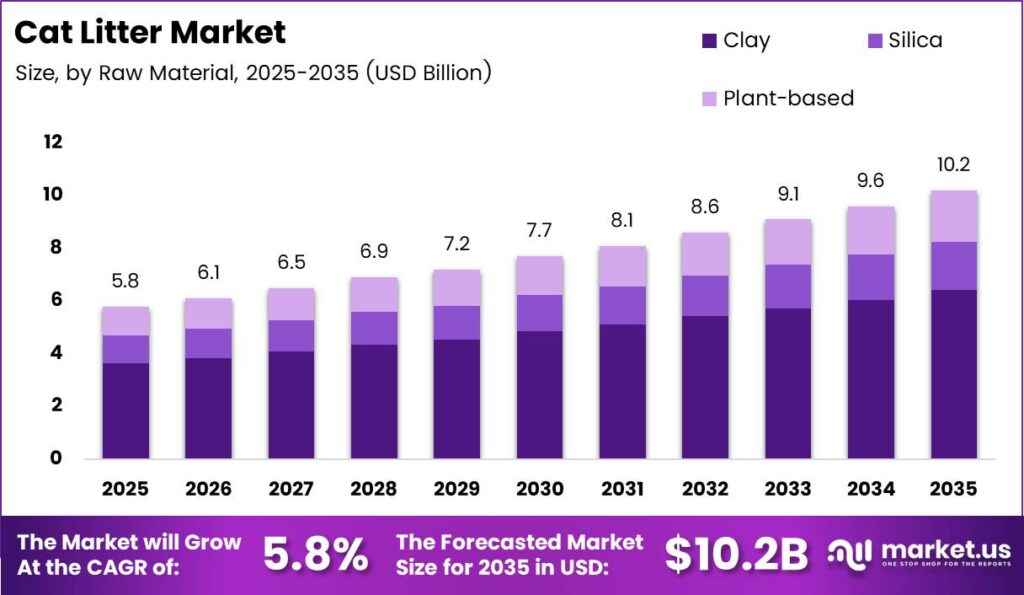
Global Cat Litter Market size is expected to be worth around USD 10.2 Billion by 2035 from USD 5.8 Billion in 2025, growing at a CAGR of 5.8% during the forecast period 2026 to 2035. Cat litter absorbs feline waste and controls odors through mineral, silica, or plant-derived materials, supporting recurring household purchases and specialized retail distribution across indoor pet-care settings.
The valuation, segment shares, and regional rankings represent planning assumptions rather than independently verified primary-source market measurements. According to APPA, U.S. pet expenditure reached USD 158 billion in 2025, establishing a substantial adjacent spending pool. Household cat care anchors litter consumption, while shelters and boarding facilities provide institutional outlets. Manufacturers must distinguish repeat-use category economics from broader pet spending before committing production capital.
Key Takeaways
- The Global Cat Litter Market was valued at USD 5.8 Billion in 2025 and is expected to reach USD 10.2 Billion by 2035, growing at a CAGR of 5.8% during 2026 to 2035.
- Clumping holds the leading product position at 67.89% in 2025.
- Clay holds the leading raw material position at 62.33% in 2025.
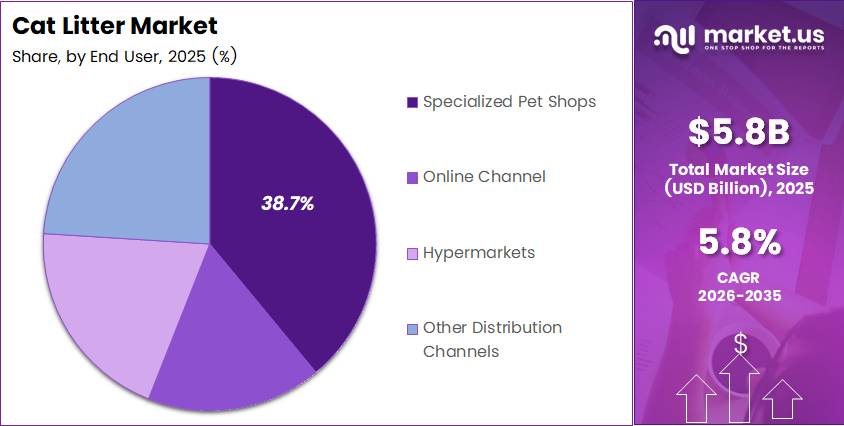
- Specialized Pet Shops hold the leading channel position at 38.78% in 2025.
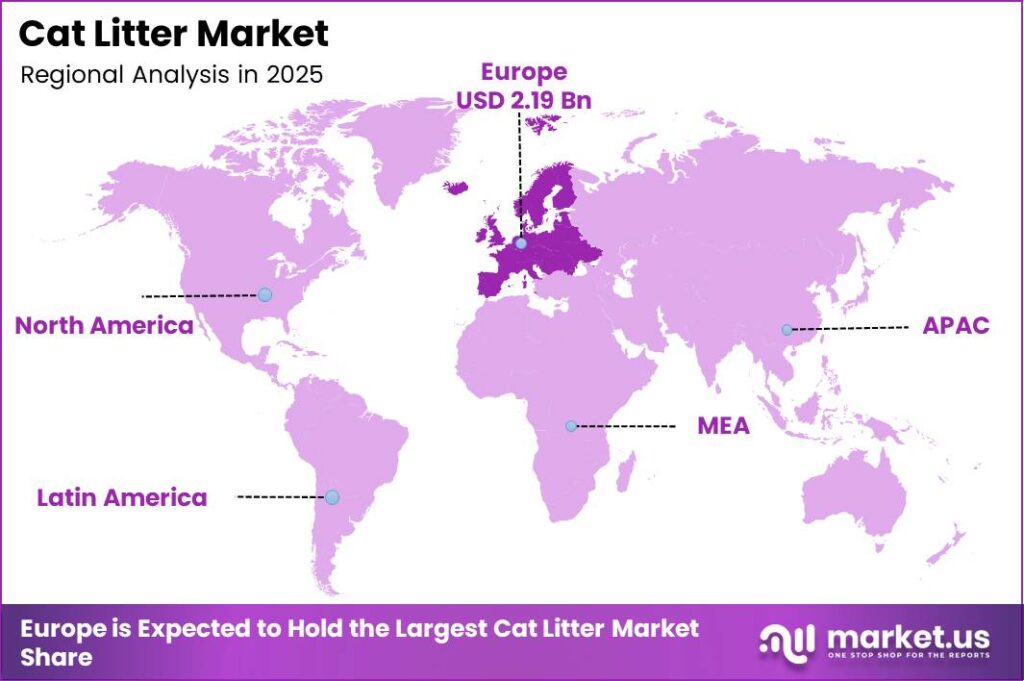
- Europe holds the leading regional position at 37.89%, valued at USD 2.19 Billion in 2025.
- North America carries the fastest-growing regional designation.
As reported by FEDIAF, approximately 140 million European households owned pets in its 2024 dataset, published in 2026. This household base provides policy and infrastructure context, not a measure of litter consumption. Public waste guidance, packaging obligations, and product labeling warrant country-level review before investment. Producers should validate local requirements before promoting disposal benefits or designing packaging for cross-border retail distribution.
A March 2026 corporate announcement documented a CHF 370 million wet pet food factory investment in Brazil. This adjacent PetCare project illustrates capital commitment to regional production rather than additional cat litter capacity. Investors should separate pet food expansion from absorbent-material economics. Litter investments require their own assessment of mineral access, drying costs, pack handling, and economical delivery distances before approval.
Europe leads the planning framework with a 37.89% market share in 2025, reflecting an assumed concentration of established household pet-care spending. That position requires independent market-share validation before external investment use. Suppliers should evaluate retail access, product acceptance, and transport economics country by country. Regional leadership alone does not establish attractive margins when pack weight, promotional spending, and distribution complexity absorb revenue.
A September 2024 corporate announcement committed more than GBP 150 million to a Wisbech pet food factory expansion. This project concerns food manufacturing, not litter processing, and its announcement does not establish completed capacity. The commercial lesson concerns regional supply planning rather than litter market size. Investors should require product-specific capacity evidence before treating broader PetCare expenditure as a signal to expand absorbent production.
Product Type Analysis
Clumping dominates with 67.89% share in 2025 due to convenient scooping and selective waste removal.
In 2025, Clumping held a 67.89% share in the Product Type segment of the Cat Litter Market. Oil-Dri indicates that its scoopable litter can weigh up to 40% less than traditional scoopable alternatives. Clump formation enables selective waste removal, while lower pack weight can ease handling. Suppliers should evaluate delivered cost and repeat-use performance together rather than compete through shelf price alone.
Non-Clumping products provide absorbent waste management without forming removable clumps, making full-tray maintenance part of the purchasing decision. Figures from CATSAN show its Hygiene Plus formulation uses 100% natural quartz and limestone raw materials. These porous mineral granules absorb liquid rather than binding it into scoopable masses. Manufacturers should explain replacement routines clearly, because product acceptance depends on maintenance expectations as much as material positioning.
Raw Material Analysis
Clay dominates with 62.33% share in 2025 due to familiar performance and established mineral sourcing.
In 2025, Clay held a 62.33% share in the Raw Material segment of the Cat Litter Market. According to USGS, pet waste absorbents represented an estimated 48% of U.S. bentonite uses in 2025. Bentonite connects absorbent mineral supply with clumping product manufacture, making deposit access commercially relevant. Producers should prioritize consistent mineral characteristics and economical transport rather than assume all clay feedstocks deliver equivalent performance.
Silica supports crystal litter formats that compete through moisture absorption and differentiated maintenance routines rather than clay-based clump formation. As reported by Capstone Partners, Ultra Pet generated approximately USD 24 million in annual sales at its transaction disclosure. This company-level figure illustrates commercial activity within crystal litter, not global segment size. Investors should test customer retention and sourcing economics before extrapolating a specialist supplier’s sales across the category.
Plant-based litter competes through renewable-feedstock positioning and product handling characteristics, with performance depending on the selected material and processing method. Sanicat indicates that its plant-based range uses 100% recycled raw materials. Feedstock consistency affects absorbency, pellet integrity, and manufacturing repeatability, linking sourcing discipline directly to customer experience. Suppliers should substantiate environmental claims and validate disposal instructions before using sustainability positioning to justify a price premium.
End User Analysis
Specialized Pet Shops dominate with 38.78% share in 2025 due to focused assortments and assisted product selection.
In 2025, Specialized Pet Shops held a 38.78% share in the End User segment of the Cat Litter Market. Figures from Petco show 1,382 stores at fiscal 2025 year-end, illustrating specialist retail access rather than litter-specific sales. Focused assortments let buyers compare substrate, scent, and maintenance characteristics directly. Manufacturers should support shelf education and dependable replenishment because retailer productivity determines continued access to this channel.
Online Channel sales organize litter purchases around search visibility, delivery convenience, and repeat ordering rather than physical shelf access. According to Chewy, fiscal 2025 ended with approximately 21.3 million active customers across its business. That audience demonstrates pet-retail reach, not a count of litter buyers. Suppliers should assess delivery expense and customer retention together because recurring orders create value only when shipping and promotional costs remain controlled.
Hypermarkets integrate litter into broader household shopping, making shelf placement, pack format, and availability central commercial decisions. As reported by Walmart, its U.S. network included 3,569 Supercenters as of July 2026. Large physical networks offer distribution reach, while heavy packs require practical shelf handling and replenishment. Manufacturers should secure reliable store-level execution before expanding assortments, because broad listings alone do not ensure profitable product movement.
Key Market Segments
By Product Type
- Clumping
- Non-Clumping
By Raw Material
- Clay
- Silica
- Plant-based
By End User
- Specialized Pet Shops
- Online Channel
- Hypermarkets
- Other Distribution Channels
Regional Analysis
Europe Dominates the Cat Litter Market with a Market Share of 37.89% in 2025, Valued at USD 2.19 Billion
Europe’s leading position remains a market-planning assumption rather than a primary-source regional sales measurement. FEDIAF indicates that its covered geography contained approximately 306 million pets in 2024, with results published in 2026. This all-pet population provides context rather than a cat-specific litter demand estimate. Manufacturers should assess country-level ownership patterns and retail economics before treating Europe as a single, uniform commercial market.
North America’s expansion case rests on household adoption and repeat purchasing, although its fastest-growing designation requires separate regional market verification. According to APPA, approximately 53 million U.S. households owned cats in 2025. This national estimate does not measure the entire region or litter volumes. Suppliers should translate household reach into local usage, pack preferences, and customer retention before committing regional production or distribution capital.
Key Regions and Countries
North America
- US
- Canada
Europe
- Germany
- France
- The UK
- Spain
- Italy
- Rest of Europe
Asia Pacific
- China
- Japan
- South Korea
- India
- Australia
- Rest of APAC
Latin America
- Brazil
- Mexico
- Rest of Latin America
Middle East and Africa
- GCC
- South Africa
- Rest of MEA
Market Dynamics
As reported by APPA, approximately 22% of U.S. pet owners reduced pet spending in 2025, signaling pressure on discretionary upgrades. This finding concerns total pet expenditure rather than a measured decline in litter purchases. Essential-use positioning can support repeat buying, while household budgets constrain premium conversion. Manufacturers should protect accessible pack options and measure realized margins before extending premium assortments or widening promotional commitments.
Drivers
Expanding cat ownership enlarges the recurring customer base rather than simply redistributing purchases among brands. According to APPA, U.S. cat-owning households reached 49 million in 2024, compared with 40 million in 2023. Single-cat households represented 58% in 2024, below 64% in 2018. These survey observations support a broader consumption base, while outdoor access and maintenance habits prevent direct conversion into equivalent litter-volume expansion.
The driver model assigns household expansion a 0.65 percentage-point contribution, reflecting an illustrative effective-household expansion assumption of 2% to 3% annually. Total driver contributions reach 1.70 percentage points, while restraints and challenges contribute negative 0.70 and 0.60 percentage points. These sensitivities remain embedded in the baseline rather than additive upgrades. Suppliers should prioritize customer retention and dependable replenishment instead of treating modeled contributions as independently observed forecasts.
| Driver | (~) % Impact on CAGR Forecast | Geographic Relevance | Impact Timeline |
|---|---|---|---|
| Expanding cat-owning household base | +0.65% | North America; Europe; urban Asia | Short term (≤ 2 years) |
| Indoor-only cat keeping | +0.35% | Urban markets globally | Medium term (2–4 years) |
| Premium odor-control formulations | +0.30% | North America; Western Europe; Japan | Short term (≤ 2 years) |
| Established online replenishment channels | +0.25% | Digitally mature consumer markets | Short term (≤ 2 years) |
| Higher hygiene-led replacement frequency | +0.15% | Developed urban markets | Medium term (2–4 years) |
Restraints
Household budget pressure constrains category revenue when buyers reduce quantities, abandon premium products, or substitute lower-cost materials. As reported by the Federal Reserve, 63% of U.S. adults could cover an emergency expense using cash or equivalent resources in 2024. The comparable figure reached 68% in 2021. This financial-resilience indicator does not establish litter-price elasticity, but it supports careful assessment of premium pricing and customer affordability.
An illustrative scenario exposes 20% of sales to a 5% reduction in realized unit revenue, producing approximately 1% revenue-level pressure before offsets. That level effect does not mechanically equal an annual CAGR deduction. The modeled restraint therefore applies a smaller 0.30 percentage-point drag. Manufacturers should protect entry-price access and target promotions carefully because indiscriminate discounts can sacrifice margin without preserving incremental category consumption.
| Restraint | (~) % Impact on CAGR Forecast | Geographic Relevance | Impact Timeline |
|---|---|---|---|
| Household affordability-driven purchase compression | −0.30% | Price-sensitive households globally | Short term (≤ 2 years) |
| Rental pet-ownership exclusions | −0.12% | Restrictive private rental markets | Medium term (2–4 years) |
| Foreign-exchange import financing constraints | −0.11% | Import-dependent emerging markets | Short term (≤ 2 years) |
| Retail assortment delisting barriers | −0.09% | Concentrated grocery and specialty retail | Short term (≤ 2 years) |
| Household rejection of unfamiliar substrates | −0.08% | Alternative-substrate conversion markets | Medium term (2–4 years) |
Challenges
Maritime disruption exposes imported litter to higher delivery costs because heavy packs carry substantial transport requirements relative to their selling value. UNCTAD found that Suez container tonnage fell 82% in early February 2024. Its route comparison showed a 29% distance advantage through Suez for Singapore to Rotterdam. These historical observations establish route vulnerability rather than identical operating conditions throughout the forecast period.
An illustrative freight share of 12% of delivered cost and a lane-specific rate increase of 30% produce approximately 3.6% delivered-cost pressure. Additional inventory cover of 10 to 15 days ties up roughly 2.7% to 4.1% of annual goods costs. The model assigns a 0.22 percentage-point global friction after mitigation. Manufacturers should compare local supply options with imported pricing before treating cheaper factory output as lower-cost supply.
| Challenge | (~) % CAGR Friction Drag | Geographic Relevance | Mitigation Horizon |
|---|---|---|---|
| Maritime route disruption exposure | −0.22% | Asia–Europe; intercontinental supply chains | Short term (≤ 2 years) |
| Feedstock moisture consistency control | −0.12% | Plant-based litter manufacturing regions | Medium term (2–4 years) |
| Dust suppression process variability | −0.10% | Mineral litter manufacturing globally | Medium term (2–4 years) |
| Thermal processing energy volatility | −0.09% | Energy-intensive drying and processing hubs | Medium term (2–4 years) |
| Heavy pack damage rates | −0.07% | Parcel-intensive distribution networks | Short term (≤ 2 years) |
Opportunities
Veterinary-linked monitoring programs offer a route beyond standalone color-changing litter through repeat sampling, interpretation protocols, and referral pathways. According to the American Chemical Society, health-monitoring litter concepts already existed in 2022. Veterinary-reviewed discussion in 2024 emphasized that color changes cannot replace diagnostic testing. Commercial progress therefore depends on validated usefulness and owner adherence. Early entrants should prove the referral model before positioning routine litter consumption as clinical monitoring.
The illustrative program targets an incremental 1% to 2% of eligible households, with consumable revenue 20% to 30% above standard alternatives. Successful conversion supports a conditional 0.30 percentage-point contribution rather than a guaranteed forecast uplift. The complete opportunity portfolio offers modeled upside of 1.00 percentage point. Investors should exclude cannibalized sales and deduct validation, acquisition, and interpretation costs before treating premium revenue as durable operating profit.
| Opportunity | (~) % Potential CAGR Upside | Geographic Relevance | Execution Window |
|---|---|---|---|
| Veterinary-linked monitoring consumable programs | +0.30% | North America; Western Europe; Japan | Medium term (2–4 years) |
| Verified spent-litter recovery services | +0.22% | Municipalities with suitable treatment infrastructure | Long term (≥ 4 years) |
| Contract-grade institutional litter systems | +0.18% | Shelters; boarding networks; veterinary groups | Medium term (2–4 years) |
| Automated-box consumable licensing partnerships | +0.16% | Premium connected-petcare markets | Medium term (2–4 years) |
| Regional producer consolidation platforms | +0.14% | Fragmented regional manufacturing markets | Long term (≥ 4 years) |
Key Company Insights
Nestle SA (Purina)
Nestlé participates in cat litter through Purina while managing a broader international PetCare portfolio that extends beyond absorbent products. Figures from Nestlé show PetCare sales of CHF 18,406 million in 2025. This category total establishes business scale rather than litter revenue or competitive share. Investors should assess litter-specific profitability separately because food manufacturing, mineral processing, and heavy-pack distribution involve different cost structures and capital requirements.
According to Nestlé, the company announced a CHF 520 million Mantova investment in July 2026, covering wet pet food production and logistics. The project strengthens broader PetCare manufacturing infrastructure rather than cat litter capacity, with production scheduled for 2029. Investors should avoid transferring those capacity expectations to absorbent products. Litter-related investment decisions still require independent evidence of processing equipment, feedstock availability, and distribution economics.
Church & Dwight Co. Inc.
Church & Dwight participates through ARM & HAMMER cat litter within a broader consumer-products portfolio, making brand economics distinct from consolidated performance. As reported by Church & Dwight, consolidated net sales reached USD 6,203.2 million in 2025. This total does not measure litter sales or category leadership. Investors should examine product-level innovation costs and retail execution before assuming company-wide scale translates directly into superior litter margins.
Church & Dwight indicates that its January 2026 disclosure introduced ARM & HAMMER Dual Defense with Microban, featuring two protection layers. The product combines odor-eliminating technology with antimicrobial product protection, according to the company’s description. This design targets buyer concerns about litter-box hygiene without establishing independently verified health outcomes. Manufacturers must support premium positioning through clear claim boundaries, repeat-purchase performance, and retail economics rather than technical language alone.
Key Players
- Nestle SA (Purina)
- Church & Dwight Co. Inc.
- The Clorox Company
- Oil-Dri Corporation of America
- Mars Inc.
- Kent Pet Group (Kent Corporation)
- Healthy Pet (J. Rettenmaier & Sohne Group)
- Targeted PetCare
- Dr. Elsey’s (Precious Cat Inc.)
- Zolux SAS
- Sanicat (Tolsa Group)
- Boxiecat LLC
- Other Key Players
Recent Developments
2026
- May 2026: Nestlé Purina product launch introduced Tidy Cats Performance+, including Power Clump with 33% more clumping agents than its stated comparator. According to Purina, the range targets distinct litter performance concerns, making repeat-purchase results central to premium positioning.
2025
- May 2025: Church & Dwight acquisition agreement covered Touchland for USD 700 million plus potential contingent consideration of USD 180 million. As reported by Church & Dwight, this transaction concerns hand sanitizer rather than litter, making its relevance parent-company capital allocation.
- April 2025: Whisker and Nestlé Purina partnership introduced Tidy Cats Designed for Litter-Robot in 20-pound and 22-pound formats. Figures from the official announcement show a product collaboration connecting litter formulation with automated-box use, supporting differentiated consumable positioning rather than generic compatibility claims.
- March 2025: Clorox product innovation introduced Fresh Step Heavy Duty with claimed 30-day odor control. According to Clorox, the campaign supported its strongest litter positioning, placing repeat-use performance and customer willingness to pay at the center of the commercial proposition.
- March 2025: Oil-Dri product innovation disclosure featured Cat’s Pride Micro Crystal litter with claimed odor control lasting up to 30 days. As reported by Oil-Dri, the crystal format expanded its product offering; the disclosure date does not establish the original first-sale date.
- March 2025: Oil-Dri product innovation disclosure featured Cat’s Pride Antibacterial Clumping Litter, claimed to kill 99.9% of odor-causing bacteria. Oil-Dri indicates that the product holds EPA approval; both regulatory and efficacy descriptions remain attributed to the company rather than independently checked registration records.
2024
- May 2024: Oil-Dri acquisition completed the Ultra Pet purchase for USD 46 million. According to Oil-Dri, the transaction strengthened its position in crystal cat litter, expanding material exposure beyond its existing mineral-based operations and creating an integration requirement across product development and distribution.
- May 2024: Fresh Step partnership connected a Garfield film promotion with a donation ceiling of one million pounds of litter. As reported by Clorox, qualifying purchases supported the campaign; the ceiling represents a commitment limit rather than verified delivered donation volume.
- April 2024: Nestlé Purina capacity expansion announced USD 195 million for Jefferson wet pet food production, including 35,000 square feet of additional space. Figures from Purina show a broader PetCare manufacturing project rather than litter capacity, so investors should not classify it as absorbent-production investment.
- February 2024: PetSafe product launch introduced ScoopFree Premium Natural Litter alongside a 1,000-bag promotional giveaway. According to PetSafe’s corporate-release search record, the promotion supported product trial; the evidence does not establish conversion rates, repeat purchasing, or independently measured performance.
Geopolitical Impact Analysis
According to UNCTAD, global maritime trade volumes expanded 2.2% in 2024, while Red Sea transits ran approximately 70% below their regular trend during disruption. These observations describe different measures and periods, but together show how route restrictions can constrain an expanding shipping system. Cat litter suppliers face exposure when bentonite, silica products, or finished packs cross affected shipping lanes. Heavy products make transport decisions commercially important because freight can absorb the apparent saving from low factory prices. Manufacturers should compare regional sourcing, sailing reliability, and inventory requirements before placing orders on price alone. Distributors should align replenishment commitments with realistic lead times rather than assume global shipping expansion guarantees reliable lane capacity.
As reported by UNCTAD, worldwide container-port throughput reached approximately 920 million TEUs in 2024, illustrating the scale of the logistics system. UNCTAD’s September 2025 publication forecast only 0.5% maritime trade growth for that year; this remains a historical forecast rather than a confirmed outcome. Broad throughput does not establish sufficient capacity on individual lanes serving bentonite processors, silica suppliers, or plant-based litter manufacturers. Buyers should distinguish worldwide trade activity from the reliability of their own routes, ports, and transport contracts. Manufacturers should test replenishment plans against delayed arrivals and uncertain delivery charges before fixing customer service commitments. Regional production options can reduce ocean exposure, but each alternative still requires competitive feedstock, processing, and inland delivery economics.
Report Scope
| Report Features | Description |
|---|---|
| Market Value (2025) | USD 5.8 Billion |
| Forecast Revenue (2035) | USD 10.2 Billion |
| CAGR (2026 to 2035) | 5.8% |
| Base Year for Estimation | 2025 |
| Historic Period | 2021 to 2025 |
| Forecast Period | 2026 to 2035 |
| Report Coverage | Revenue Forecast, Market Dynamics, Market Opportunity Analysis, Technology and Innovation Landscape, Competitive Landscape, Recent Developments |
| Segments Covered | Product Type: Clumping, Non-Clumping. Raw Material: Clay, Silica, Plant-based. End User: Specialized Pet Shops, Online Channel, Hypermarkets, Other Distribution Channels. |
| Regional Analysis | North America (US and Canada), Europe (Germany, France, The UK, Spain, Italy, and Rest of Europe), Asia Pacific (China, Japan, South Korea, India, Australia, and Rest of APAC), Latin America (Brazil, Mexico, and Rest of Latin America), Middle East and Africa (GCC, South Africa, and Rest of MEA) |
| Competitive Landscape | Nestle SA (Purina); Church & Dwight Co. Inc.; The Clorox Company; Oil-Dri Corporation of America; Mars Inc.; Kent Pet Group (Kent Corporation); Healthy Pet (J. Rettenmaier & Sohne Group); Targeted PetCare; Dr. Elsey’s (Precious Cat Inc.); Zolux SAS; Sanicat (Tolsa Group); Boxiecat LLC; Other Key Players. |
| Customization Scope | Customization for segments and region or country-level analysis will be provided. Further customization can be arranged according to requirements. |
| Purchase Options | Single User License | Multi-User License (Up to 5 Users) | Corporate Use License (Unlimited User and Printable PDF) |
| Forecast Interpretation | Market values, shares, regional leadership, and forecast sensitivities are planning assumptions. Primary-source contextual indicators do not independently verify those estimates. |