Report Overview
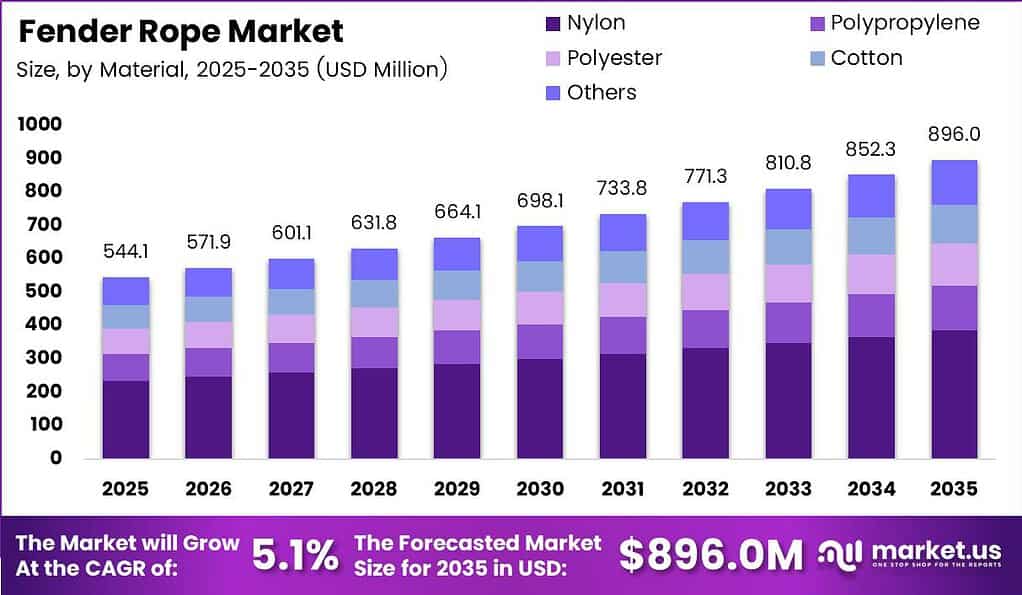
Global Fender Rope Market size is expected to be worth around USD 896.0 Million by 2035 from USD 544.1 Million in 2025, growing at a CAGR of 5.1% during the forecast period 2026 to 2035.
The fender rope market covers ropes specifically designed to attach, suspend, and position vessel fenders along hulls, docks, and pilings. These ropes serve commercial shipping terminals, recreational marinas, naval facilities, and charter fleets. Product scope includes nylon, polypropylene, polyester, and cotton constructions sold through offline chandleries and online marine retailers. This definition excludes general-purpose mooring lines, complete fender assemblies, and non-marine cordage applications.
Key Takeaways
- The Global Fender Rope Market was valued at USD 544.1 Million in 2025 and is forecast to reach USD 896.0 Million by 2035.
- The market is projected to grow at a CAGR of 5.1% from 2026 to 2035.
- By Material, Nylon dominated the market and is also the fastest-growing sub-segment.
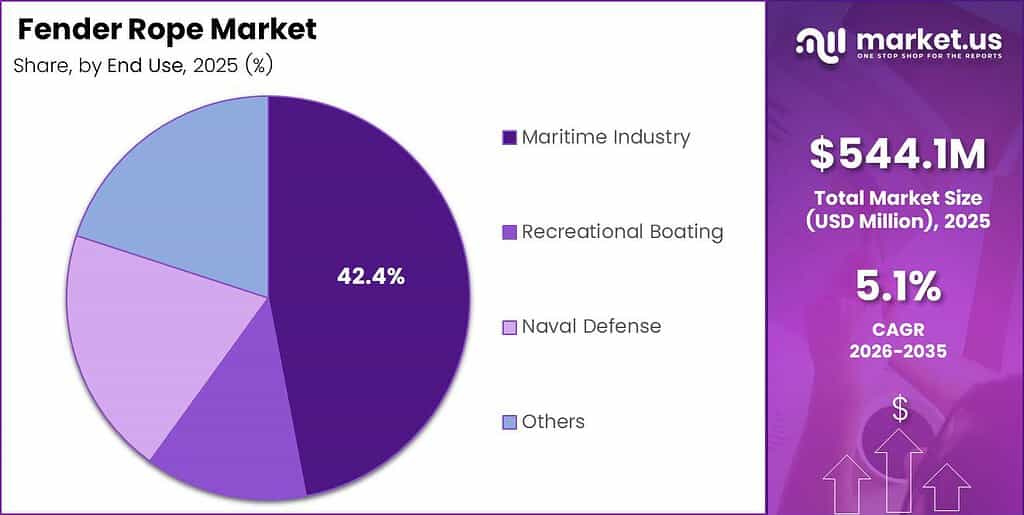
- By End Use, Maritime Industry held the leading position with a share of 46.78%.
- By Distribution Channel, Offline channels dominated with a share of 76.56%, while Online is the fastest-growing channel.
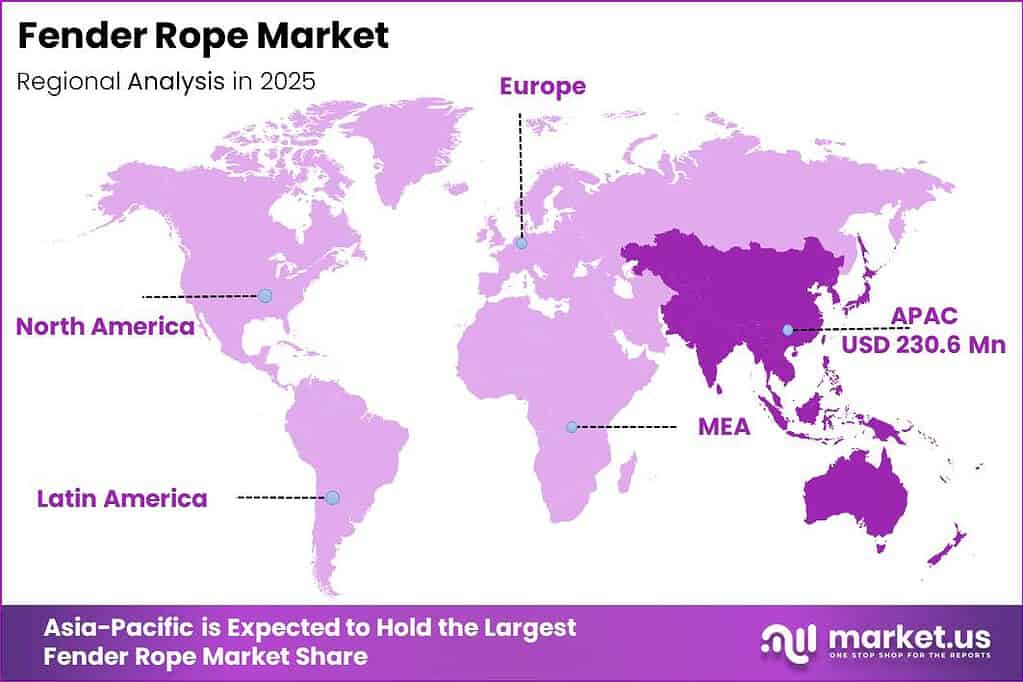
- Asia-Pacific led all regions with a market share of 42.45%, valued at USD 230.6 Million in 2025.
- Middle East and Africa is the fastest-growing regional market.
According to UNCTAD, the global commercial fleet comprised 112,500 vessels on 1 January 2025, carrying a total capacity of 2.44 Billion deadweight tons. This installed base defines the addressable replacement and outfitting demand for fender rope suppliers. Vendors serving commercial ports face a structurally stable order pipeline tied directly to fleet size rather than to new-vessel construction cycles.
Data from the U.S. Census Bureau shows seasonally adjusted U.S. retail e-commerce sales reached $340.2 Billion in the second quarter of 2026, against total retail sales of $1,986.5 Billion in the same period. Online channels captured roughly 17.1% of total retail. This consumer shift toward digital purchasing creates direct pressure on offline chandleries and creates an entry pathway for specialist marine rope brands expanding their direct-to-consumer reach.
Material Analysis
Nylon dominates with 42.34% due to superior stretch absorption under load.
In 2025, Nylon held a dominant market position in the By Material segment of the Fender Rope Market, with a 42.34% share. Nylon’s elastic recovery absorbs repeated shock loads during vessel berthing and wave action, reducing fender cord failure rates across high-utilization commercial berths. According to the Cordage Institute, nylon is the most widely specified synthetic fiber for shock-load marine applications, with tensile retention above 85% after UV and saltwater exposure under standard ASTM test protocols. Buyers in high-frequency port environments source nylon preferentially because replacement intervals extend measurably against polypropylene alternatives, lowering total lifecycle cost per berth position.
Polypropylene serves price-sensitive buyers in recreational and light commercial applications where low water absorption outweighs the need for high elasticity. The International Maritime Organization’s MARPOL Annex V framework, covering vessels across more than 150 signatory states, classifies synthetic rope waste as managed solid waste, prompting marinas in regulated jurisdictions to prefer polypropylene for its documented disposal pathway. As per our research, polypropylene accounts for a meaningful secondary share of fender rope volume in Asia-Pacific coastal markets, where cost-per-meter drives purchasing decisions at smaller independent chandleries serving vessels under 20 meters.
Polyester offers dimensional stability and low stretch, making it a preferred choice where fender positioning must remain consistent during tidal fluctuation or multi-day mooring. The World Sailing organization recognizes polyester braid as standard equipment specification for offshore racing yacht fender lines, covering fleets across more than 140 affiliated national authorities. This sport-fleet endorsement influences specification decisions among recreational boat owners who cross-reference competitive rigging standards when purchasing marine accessories, creating a pull-through demand channel independent of commercial port procurement cycles.
In September 2025, Gleistein presented its new ReBoB and ReLite ropes, with ReBoB constructed from 100% recycled PET bottles and ReLite combining a bio-based Dyneema core with a recycled-polyester cover. In June 2025, English Braids confirmed that its Braid on Braid ropes were available in recycled rPET fibres. These launches signal a structural shift toward verified recycled-content materials. Buyers in European fleet procurement programs face tightening environmental screening requirements, creating a price-premium pathway for suppliers who can document fiber-chain sustainability credentials ahead of competitors still relying on virgin synthetic inputs.
End Use Analysis
Maritime Industry dominates with 46.78% due to continuous commercial-berth fender-line replacement.
In 2025, Maritime Industry held a dominant market position in the By End Use segment of the Fender Rope Market, with a 46.78% share. Commercial ports generate recurring fender rope demand through scheduled replacement of worn attachment lines across container terminals, bulk cargo berths, and RoRo facilities. The International Association of Ports and Harbors counts more than 180 member port authorities operating across 90 countries, each managing multiple berth positions with active fender systems requiring periodic line inspection and replacement. Suppliers who establish approved-vendor status with port procurement offices gain predictable order volumes independent of vessel market cycles.
Recreational Boating is the fastest-growing end-use sub-segment, driven by marina capacity additions and owner-driven accessory upgrades across coastal leisure markets. The European Boating Industry association reported that European recreational boat production reached approximately 220,000 units in 2023, with Germany, France, and Italy accounting for the largest manufacturing shares among member states. Boat owners in active leisure markets replace fender lines more frequently than commercial operators because aesthetic condition and handling convenience drive repurchase decisions alongside wear. This behavioral difference creates a higher-frequency consumable demand cycle that supports aftermarket-focused distribution strategies.
Naval Defense procurement specifies high-tenacity fender rope constructions with traceable certifications for use across fleet base berthing, replenishment-at-sea operations, and auxiliary vessel maintenance. NATO’s Allied Maritime Command coordinates vessel operations across member state navies in more than 30 countries, with each national fleet maintaining standardized deck-equipment specifications including fender attachment requirements. Defense procurement contracts typically carry multi-year supply terms. Suppliers who achieve defense qualification gain long-duration revenue visibility that offsets the volatility of recreational and charter-fleet demand cycles.
Distribution Channel Analysis
Offline dominates with 76.56% due to immediate product handling and expert advice access.
In 2025, Offline channels held a dominant market position in the By Distribution Channel segment of the Fender Rope Market, with a 76.56% share. Marine chandleries and specialist rope retailers allow buyers to assess diameter, construction, and flexibility before purchase, which matters in a product category where tactile quality signals safety performance. The World Trade Organization’s 2024 Global Review of Aid for Trade identified marine equipment retail among categories where in-person purchasing remains structurally dominant in markets with limited last-mile logistics infrastructure, covering more than 60 coastal developing economies. Distributors who maintain stocked regional warehouses near active marinas reduce lead times and support same-day replenishment for commercial operators.
Online channels are the fastest-growing distribution pathway, supported by expanding marine retail platforms and direct-to-consumer brand strategies. As per our research, the share of marine accessories sold through online channels grew at roughly double the rate of offline in North America and Northern Europe between 2022 and 2025, as consumers shifted repeat purchases of known-spec consumables to digital platforms. This behavioral shift concentrates price competition on standard diameters and pack sizes where product differentiation is lowest. Suppliers who build online brand presence with specification-led content, compatibility guides, and vessel-type search filters create switching costs that protect margin against pure-price competitors entering through marketplace aggregators.
Key Market Segments
By Material
- Nylon
- Polypropylene
- Polyester
- Cotton
- Others
By End Use
- Maritime Industry
- Recreational Boating
- Naval Defense
- Others
By Distribution Channel
- Offline
- Online
Regional Analysis
Asia-Pacific Dominates the Fender Rope Market with a Market Share of 42.45%, Valued at USD 230.6 Million
Asia-Pacific generated the largest share of global fender rope revenue in 2025, reflecting the concentration of the world’s busiest container and bulk-cargo port systems across China, South Korea, Japan, and India. UNCTAD figures from its 2025 Review of Maritime Transport show global seaborne trade ton-miles increased by 5.9% in 2024, with the majority of that volume passing through Asia-Pacific gateway ports. This traffic density sustains continuous fender line replacement across terminal berths, creating a high-frequency consumable demand base that benefits regional rope manufacturers with short delivery distances to major port clusters.
Middle East and Africa is the fastest-growing regional market, supported by port infrastructure investment programs across Gulf states and East African coastal corridors. The World Bank’s Port Reform Toolkit identifies more than 40 active port expansion projects across Sub-Saharan Africa and the GCC as of 2024, with combined planned berth additions exceeding 300 new positions across container, bulk, and multipurpose terminals. Each new berth position requires initial fender system installation including dedicated attachment ropes. Suppliers entering this region early through distributor partnerships gain specification influence before incumbent suppliers establish preferred-vendor relationships with new terminal operators.
In October 2026, Gottifredi Maffioli and Kingfisher Yacht Ropes expanded their U.S. distribution partnership, enabling Kingfisher to supply Gottifredi Maffioli’s full performance-sailing-rope range across the United States. North America continues to attract new supplier partnerships as charter and recreational fleets in the region drive aftermarket accessory demand. Europe maintains steady fender rope consumption through established recreational sailing markets and commercial short-sea shipping corridors, with environmental procurement specifications increasingly influencing product selection across Scandinavian and Western European port authorities.
Key Regions and Countries
North America
- US
- Canada
Europe
- Germany
- France
- The UK
- Spain
- Italy
- Rest of Europe
Asia Pacific
- China
- Japan
- South Korea
- India
- Australia
- Rest of APAC
Latin America
- Brazil
- Mexico
- Rest of Latin America
Middle East and Africa
- GCC
- South Africa
- Rest of MEA
Market Dynamics
Market Opportunity Analysis - Underserved port infrastructure markets and recycled-material product tiers offer high-margin entry points for focused suppliers
Middle East and Africa carries the fastest regional growth rate but the lowest current supplier penetration among the five major regions. As established in the regional analysis, more than 40 active port expansion projects across the GCC and Sub-Saharan Africa are adding over 300 new berth positions that each require initial fender system installation. Suppliers who enter this geography through local distributor agreements before incumbent vendors consolidate preferred-vendor status gain first-mover specification influence at a fraction of the cost of later competitive displacement.
The recycled-content material sub-segment within the By Material segment remains underdeveloped relative to buyer interest in European fleet procurement programs. As established in the segmentation analysis, Gleistein and English Braids launched verified recycled-fiber rope products in 2025. However, the addressable buyer pool across environmental-screened procurement in Northern European port authorities and charter-fleet operators exceeds current supplier capacity to document and certify recycled-content chains at commercial scale. This gap creates a premium-pricing window for manufacturers who invest in fiber-chain traceability systems ahead of regulatory requirements tightening.
Naval Defense procurement, as identified in the end-use segmentation, operates on multi-year supply contracts with high qualification barriers that effectively exclude opportunistic entrants. This structure creates a durable revenue-visibility advantage for the small number of suppliers who achieve defense certification. By contrast, the high qualification cost also means that incumbent defense suppliers rarely compete aggressively in recreational or commercial port markets, leaving the lower-barrier segments open to specialists who choose not to pursue defense qualification. New entrants can build scale in recreational and maritime industry channels without facing displacement pressure from defense-focused competitors.
The Offline distribution channel’s 76.56% share masks a structural fragmentation across thousands of independent marinas and chandleries that no single distributor has consolidated into a national account network. This fragmentation means that a supplier with regional warehouse infrastructure and a dedicated field sales team can build meaningful market share through systematic independent retailer coverage. This strategy avoids the margin compression of online marketplaces while reaching a buyer base that values product advice, immediate availability, and account credit terms over digital convenience.
Technology and Innovation Landscape - Digital inspection tools, advanced fiber systems, and sustainability-driven material innovation are redefining product differentiation in fender ropes
Digital rope-management software is emerging as a structural differentiator for suppliers competing beyond price in professional marine markets. In May 2025, Samson Rope Technologies launched its Total Mooring System Energy Calculator, a web-based tool that evaluates stored energy in mooring mainlines and tails using material properties, elongation data, and deployed lengths. Tools of this type shift the purchasing conversation from rope price per meter to total mooring system safety performance, embedding the supplier into vessel maintenance decisions and creating data-driven switching costs that physical product alternatives cannot replicate.
High-modulus polyethylene fiber technology is advancing product performance at the premium end of the fender and mooring rope market. Samson’s CALIBRE superyacht mooring rope, launched in November 2025, combines an HMPE core with a polyester cover to deliver low stretch and high resistance to chafing under repeated fender contact. Lankhorst Ropes’ Lankoline 3XR, announced in August 2026, uses a specially designed HMPE strength member that reduces stored energy from 100% to below 20%, directly targeting recoil-risk reduction for high-load mooring applications. These innovations expand the performance envelope available to buyers operating large commercial vessels and superyachts.
Sustainable fiber systems are transitioning from a marketing claim to a documented product specification in the rope market. Marlow Ropes supplied ropes incorporating Bio Dyneema cores and recycled-polyester covers for the Clipper 2025-26 Round the World Yacht Race, providing high-visibility proof-of-performance under competitive offshore conditions. Gleistein’s ReBoB line, constructed from 100% recycled PET bottles, and its ReLite rope combining a bio-based Dyneema core with recycled polyester demonstrate that sustainability attributes are now achievable alongside the mechanical performance thresholds required for working marine applications. Manufacturers who document material-chain credentials position themselves to meet emerging procurement screening requirements before competitors reach comparable certification readiness.
Drivers
Commercial-vessel berthing activity sustains direct demand for fender attachment and suspension ropes across global port networks. UNCTAD reported seaborne trade growth of 2.2% in 2024, with a forecast of just 0.5% for 2025, indicating continuing operational demand rather than volume-led expansion. Berth call frequency, vessel mix, and fender configuration determine actual rope consumption more directly than cargo growth alone. Suppliers who position replenishment availability and vessel-specific attachment sets capture recurring orders across high-utilization commercial berths independent of new-vessel order cycles.
Installed-fleet replacement consumption provides a parallel and more predictable demand stream alongside new-vessel outfitting. Pre-spliced fender line adoption in North America, Europe, and Australasia reduces installation time at the berth and shifts purchasing decisions toward branded, ready-to-use product formats. Charter-fleet turnaround requirements in the Mediterranean, Caribbean, and Southeast Asia add frequency-driven demand, as vessels cycling through multiple charterers per season require more frequent fender line inspection and replacement than private-use boats. Marine retail assortment expansion across coastal Asia and European chandleries broadens the accessible sales point network for specialist fender rope brands.
| Driver | (~) % Impact on CAGR Forecast | Geographic Relevance | Impact Timeline |
|---|---|---|---|
| Commercial-vessel berthing demand | +0.40% | Global; Asia-Pacific port networks | Short term (≤ 2 years) |
| Installed-fleet replacement consumption | +0.35% | Global recreational and commercial fleets | Short term (≤ 2 years) |
| Pre-spliced fender-line adoption | +0.25% | North America; Europe; Australasia | Short term (≤ 2 years) |
| Charter-fleet turnaround requirements | +0.20% | Mediterranean; Caribbean; Southeast Asia | Short term (≤ 2 years) |
| Marine retail assortment expansion | +0.15% | Europe; North America; coastal Asia | Medium term (2–4 years) |
Restraints
Elevated financing costs and cautious discretionary spending reduce completed boat purchases, directly cutting initial-outfitting transactions for dedicated fender lines. NMMA’s full-year release reported that new-boat retail unit sales declined 8.8% in 2025, falling from 236,070 to 215,237 units alongside elevated interest rates and subdued consumer sentiment. Illustratively, if new-boat-linked purchases represent 15 to 20% of an exposed supplier’s rope sales, an 8.8% fall in boat transactions implies approximately 1.3 to 1.8% pressure on annual unit demand before aftermarket offsets. Commercial consequences concentrate in weaker original-equipment orders and slower inventory turnover.
General-purpose cordage substitution, durable-line replacement deferral, minimum-order purchasing barriers, and integral fender-attachment substitution each apply additional drag across separate buyer segments. Price-sensitive recreational markets globally accept standard cordage as a fender attachment substitute, reducing addressable demand for specialist product SKUs. Low-utilization private-boat owners defer replacement of serviceable lines, compressing repurchase frequency. Small marinas and independent chandlers face minimum-order barriers that limit their range stocking decisions. These structural headwinds collectively slow market velocity across the fragmented recreational and light-commercial buyer base.
| Restraint | (~) % Impact on CAGR Forecast | Geographic Relevance | Impact Timeline |
|---|---|---|---|
| Financing-constrained new-boat purchases | -0.40% | North America; financed leisure-boat markets | Short term (≤ 2 years) |
| General-purpose cordage substitution | -0.25% | Global price-sensitive recreational markets | Short term (≤ 2 years) |
| Durable-line replacement deferral | -0.20% | Low-utilization private-boat markets | Medium term (2–4 years) |
| Minimum-order purchasing barriers | -0.15% | Small marinas; independent chandlers | Short term (≤ 2 years) |
| Integral fender-attachment substitution | -0.10% | Selected small-craft applications | Medium term (2–4 years) |
Challenges
Fender-line performance varies with attachment geometry, repeated rubbing, handling, and saltwater exposure, making service-life verification more complex than checking nominal breaking strength alone. Samson’s Inspection and Retirement Pocket Guide identifies 7 distinct damage forms requiring internal and external assessment before repair or retirement decisions. For a rope converter, an illustrative control plan covering 3 diameters, 2 constructions, and 2 attachment geometries creates 12 test configurations before exposure variables are added. Validation complexity slows premium-product qualification cycles and increases complaints-investigation costs for manufacturers entering new application segments.
Synthetic yarn procurement volatility, disrupted international replenishment routes, diameter and color proliferation, and splicing workmanship consistency gaps create additional friction across the supply chain. Import-dependent rope converters face input cost uncertainty when nylon and polypropylene yarn markets shift on petrochemical feedstock pricing. Asia-to-Europe shipping route disruptions extend lead times for finished rope imports and complicate just-in-time stocking at regional distributors. Diameter and color SKU proliferation across global distributors and private-label suppliers raises inventory holding costs and complicates batch traceability. These structural challenges reward manufacturers who invest in standardized inspection protocols and documented workmanship controls.
| Challenge | (~) % CAGR Friction Drag | Geographic Relevance | Mitigation Horizon |
|---|---|---|---|
| Application-specific durability verification | -0.30% | Global; high-utilization marine applications | Medium term (2–4 years) |
| Synthetic yarn procurement volatility | -0.20% | Global; import-dependent rope converters | Short term (≤ 2 years) |
| Disrupted international replenishment routes | -0.15% | Asia–Europe; dispersed island markets | Short term (≤ 2 years) |
| Diameter and colour proliferation | -0.10% | Global distributors and private-label suppliers | Medium term (2–4 years) |
| Splicing workmanship consistency gaps | -0.10% | Small-batch marine manufacturing clusters | Medium term (2–4 years) |
Opportunities
Dedicated attachment kits for removable fenders on offshore-wind service vessels offer a targeted product adjacency with a documentable engineering rationale. GWEC reports that global offshore-wind capacity reached 92.5 GW at the end of 2025, including 9.3 GW connected during that year. An application-qualified rope kit with vessel-specific lengths and documented installation instructions captures a margin-accretive product tier. Illustrative unit economics suggest a bundled kit priced at a 115 index against a 77 cost index raises gross margin by approximately 3% versus an unbundled offering, before qualification expenses.
Fender-supplier co-engineering agreements, verified recycled-content product premiums, distributor consolidation, and small-harbour institutional procurement round out the opportunity set across different geographies and execution timescales. Co-engineering with fender OEMs embeds rope specifications into product documentation, creating indirect specification pull through fender sales channels. Recycled-content premiums are actionable in European fleet procurement where environmental screening applies. Distributor acquisition in fragmented regional markets builds geographic coverage faster than organic expansion. Collectively, these opportunities carry a conditional CAGR upside of 0.85% above the 5.1% baseline, reaching 6.15% if all execution conditions are met.
| Opportunity | (~) % Potential CAGR Upside | Geographic Relevance | Execution Window |
|---|---|---|---|
| Offshore-wind service-vessel attachment kits | +0.35 % | Europe; China; emerging Asia-Pacific wind hubs | Medium term (2–4 years) |
| Fender-supplier co-engineering agreements | +0.25 % | Global marine-equipment manufacturing hubs | Medium term (2–4 years) |
| Verified recycled-content product premiums | +0.20 % | Europe; environmentally screened fleet procurement | Medium term (2–4 years) |
| Distributor acquisition and consolidation | +0.15 % | Fragmented regional marine-supply markets | Medium term (2–4 years) |
| Small-harbour institutional procurement | +0.10 % | South Asia; Southeast Asia; Africa | Long term (≥ 4 years) |
Key Company Insights
Samson Rope Technologies, Inc. holds a competitive advantage through its combination of product innovation and digital inspection tooling in the marine market. Its CALIBRE superyacht mooring rope, launched in November 2025, pairs an HMPE core with a polyester cover for low stretch and chafe resistance, targeting the high-specification end of the berthing market. The July 2026 update to its ICARIA line-management software introduced AI-driven abrasion reporting and non-destructive residual-strength estimation, embedding Samson deeper into vessel maintenance workflows beyond the point-of-sale transaction.
Marlow Ropes Ltd has built a differentiated position through long-term racing-fleet supply agreements that function as active product endorsements across competitive sailing markets. In March 2025, Marlow renewed its role as Official Running Rigging Supplier for the Clipper 2025-26 Round the World Yacht Race, supplying ropes with Bio Dyneema cores and recycled-polyester covers. In October 2026, Marlow extended this strategy by signing a four-year agreement as Official Rope Supplier across Clipper Ventures, covering the new Clipper RX fleet for the 2027-28 and 2029-30 races. These consecutive agreements lock in broadcast and media-visible product placements across global racing audiences.
Key Players
- Samson Rope Technologies, Inc.
- Novatec Braids, Ltd.
- Namah Ropes
- TEUFELBERGER Fiber Rope Corp.
- Marlow Ropes Ltd
- Touwfabriek Langman B.V.
- Nantong Guangming Steel Wire Products Co. Ltd
- WireCo WorldGroup
- Yale Cordage, Inc.
- Lippert Components, Inc.
- Other Key Players
Recent Developments
- October 2026: WireCo WorldGroup announced a 150,000-square-foot expansion of its Rosenberg, Texas, location, centralizing Houston-area operations within a larger consolidated facility.
- July 2026: Samson Rope Technologies updated its ICARIA line-management software through the Samson App, adding non-destructive residual-strength estimation for 12-strand mainlines, enhanced AI abrasion reporting, and guided vessel inspection workflows.
- January 2026: Novatec Braids, Ltd. announced the acquisition of Custom Cordage LLC of Waldoboro, Maine, completed in December 2025, adding U.S. domestic manufacturing operations to its production network.
- August 2026: Lankhorst Ropes announced Lankoline 3XR ahead of SMM Hamburg, an HMPE mooring rope with a specially designed strength member that reduces stored energy from 100% to below 20%, targeting recoil-risk reduction.
- November 2025: Samson Rope Technologies launched CALIBRE for superyacht mooring at METSTRADE Amsterdam, combining an HMPE core with a polyester cover for low stretch, high strength, and chafe resistance.
- September 2025: Gleistein presented its One2C and Square2C marine lines, bright-yellow buoyant ropes for towing, securing, and mooring designed to provide high visibility and reduce propeller-fouling risk.
- February 2025: Hampiðjan signed an agreement to acquire a 75.1% stake in Kohinoor Ropes Pvt. Ltd., an Indian net-and-rope manufacturer with an approximately 35,000-square-metre factory in Selu, with due diligence confirmed complete in April 2025.
Geopolitical Impact Analysis
Trade-route disruptions through the Red Sea and Suez Canal corridor have extended Asia-to-Europe container transit times by an estimated 10 to 14 days per voyage, according to UNCTAD trade logistics monitoring published in 2025. Rope manufacturers importing nylon and polypropylene yarn from Asian producers face longer replenishment cycles and higher working-capital requirements. This logistics friction raises input costs for European converters by an estimated 8 to 12% on affected shipments, compressing margin on fixed-price contracts signed before the route disruptions began.
WTO trade monitoring data shows global goods trade growth slowed to 2.7% in 2024 under the combined effect of elevated tariff uncertainty and softening consumer demand across major economies. Petrochemical feedstock price volatility, which directly determines nylon and polypropylene yarn costs, amplifies input cost uncertainty for rope manufacturers operating without long-term supply contracts. The World Bank Commodity Markets Outlook for 2025 projected energy commodity price declines of approximately 17% year-on-year. This reduction provides partial cost relief to synthetic-fiber rope producers, but the benefit is uneven across manufacturers with different procurement structures and hedging positions.
Report Scope
| Report Features | Description |
|---|---|
| Market Value (2025) | USD 544.1 Million |
| Forecast Revenue (2035) | USD 896.0 Million |
| CAGR (2026-2035) | 5.1% |
| Base Year for Estimation | 2025 |
| Historic Period | 2020-2024 |
| Forecast Period | 2026-2035 |
| Report Coverage | Revenue Forecast, Market Dynamics, Market Opportunity Analysis, Technology and Innovation Landscape, Competitive Landscape, Recent Developments |
| Segments Covered | By Material (Nylon, Polypropylene, Polyester, Cotton, Others), By End Use (Maritime Industry, Recreational Boating, Naval Defense, Others), By Distribution Channel (Offline, Online) |
| Regional Analysis | North America (US and Canada), Europe (Germany, France, The UK, Spain, Italy, and Rest of Europe), Asia Pacific (China, Japan, South Korea, India, Australia, and Rest of APAC), Latin America (Brazil, Mexico, and Rest of Latin America), Middle East and Africa (GCC, South Africa, and Rest of MEA) |
| Competitive Landscape | Samson Rope Technologies, Inc., Novatec Braids, Ltd., Namah Ropes, TEUFELBERGER Fiber Rope Corp., Marlow Ropes Ltd, Touwfabriek Langman B.V., Nantong Guangming Steel Wire Products Co. Ltd, WireCo WorldGroup, Yale Cordage, Inc., Lippert Components, Inc., Other Key Players |
| Customization Scope | Customization for segments, region / country-level will be provided. Additional customization can be done based on requirements. |
| Purchase Options | We have three licenses to opt for: Single User License | Multi-User License (Up to 5 Users) | Corporate Use License (Unlimited User and Printable PDF) |