


Report Overview
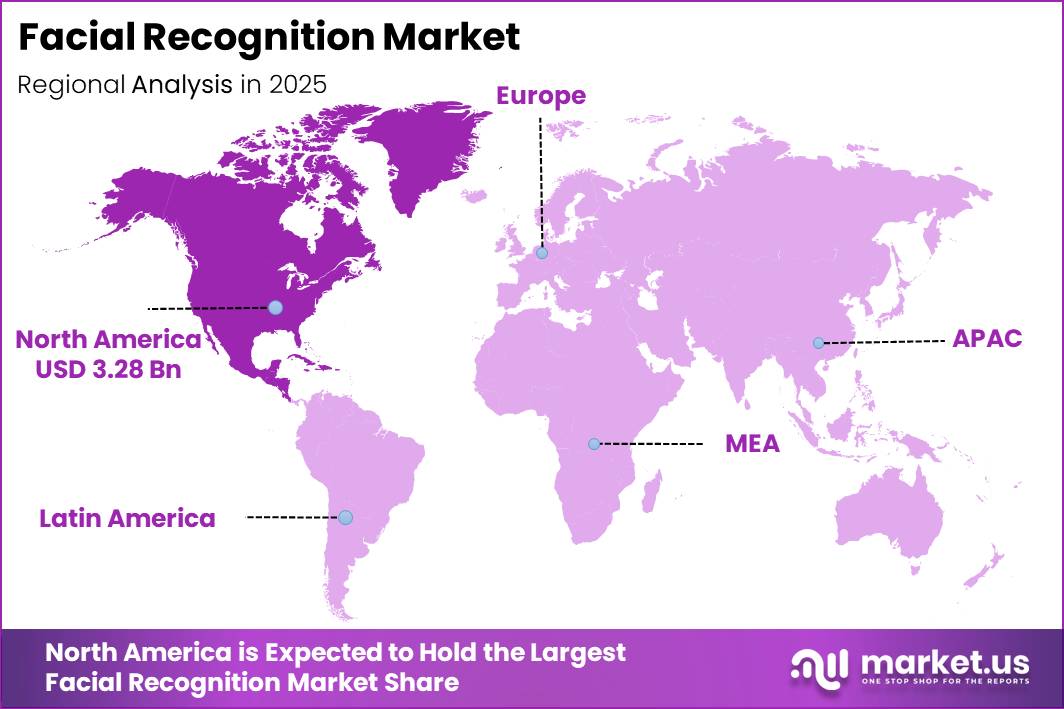
In 2025, the Global Facial Recognition Market was valued at USD 8.5 billion. The market is projected to grow at a CAGR of 14.1% during 2026–2035, reaching approximately USD 32.1 billion by 2035. North America dominated the global market in 2025, accounting for more than 38.5% of the total market share and generating approximately USD 3.2 billion in revenue.
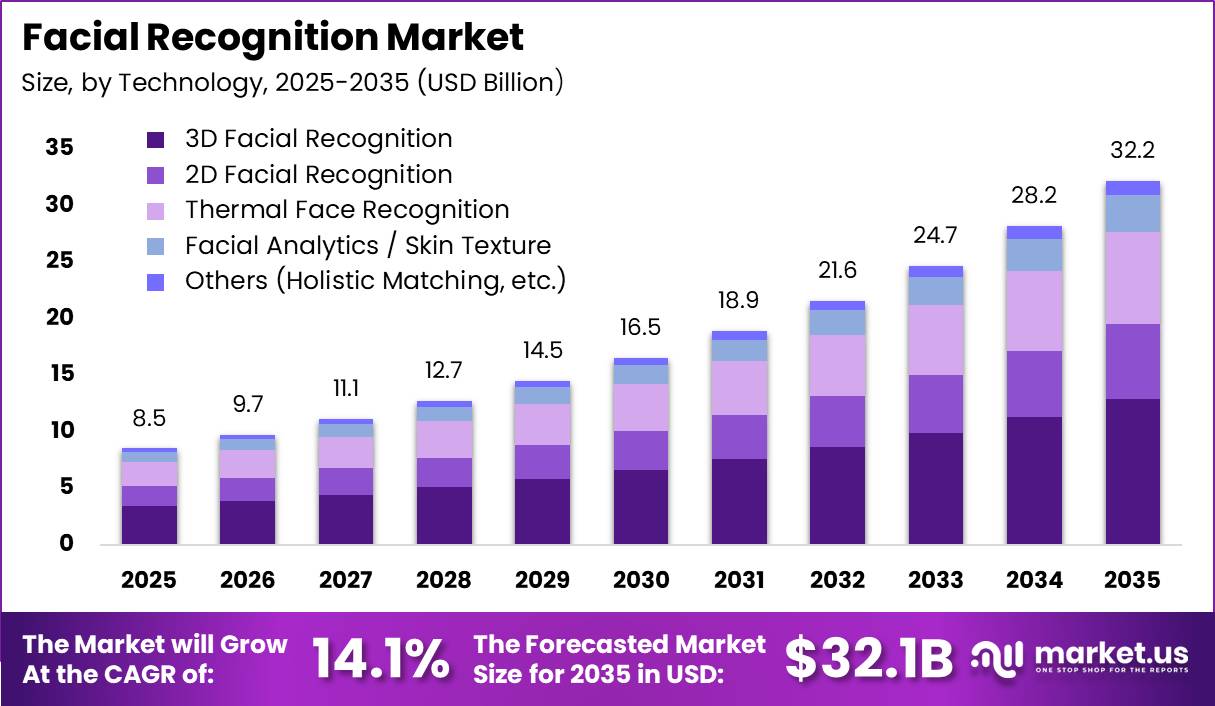
This growth is supported by rising adoption across aviation, border security, mobile devices, and government identity systems. According to ICAO, global airlines carried nearly 5 billion passengers on 38 million flights in 2025. Airports Council International also reported 9.8 billion passenger movements in 2025, representing 3.7% year-on-year growth, and expects traffic to reach 17.7 billion by 2043.
In the United States, Customs and Border Protection has screened more than 810 million people through biometric facial comparison since 2017, while 52% of departing travelers are now checked through this technology. A federal rule finalized in October 2025 is expected to expand facial photography to almost all non-citizens at airports, seaports, and land borders, covering more than 350 million travelers annually.
Mobile device adoption provides another major growth area. Global smartphone shipments reached approximately 1.25 to 1.26 billion units in 2025, the highest level since 2021. Government digital identity programs are also expanding, with 89 economies operating recognized digital ID systems in 2025, compared with 80 in 2021. In addition, 2.8 billion people still lack digital ID access.
Key Takeaway
- The Facial Recognition Market is projected to grow from USD 8.5 billion in 2025 to USD 32.1 billion by 2035, at a 14.1% CAGR.
- 3D facial recognition leads the technology segment with nearly 40% share, driven by border control, passport verification, and automated travel applications.
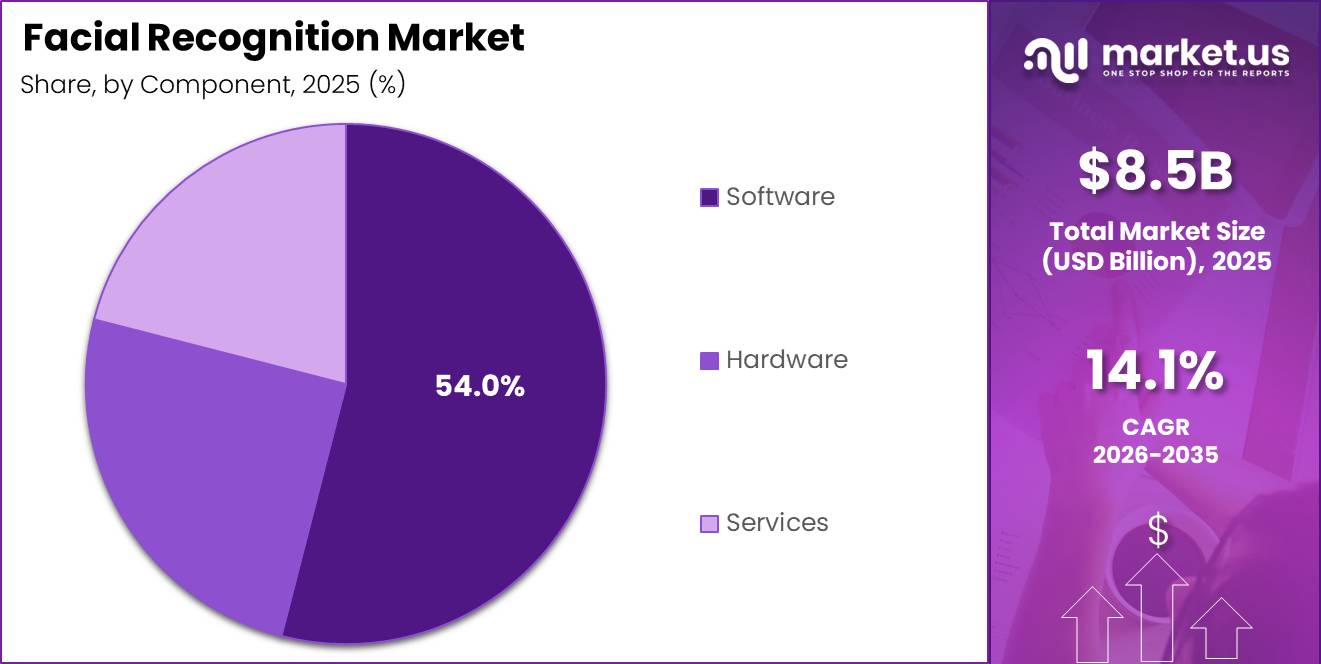
- Software dominates the component segment with a 54% share, supported by rising demand for matching algorithms, database processing, and system integration.
- Access control holds a leading 35.9% share, supported by increasing adoption across commercial, residential, and institutional buildings.
- Retail and e-commerce account for a dominant 22.5% share, driven by the need to reduce theft, fraud, and inventory losses.
- North America dominated the global facial recognition market in 2025, capturing a 38.5% share and generating nearly USD 3.2 billion in revenue.
By Technology
3D facial recognition holds nearly 40% of the technology segment, supported by its growing use in border control, passport verification, and automated travel systems. ICAO Doc 9303 requires passports and e-Passport chips to contain a high-resolution facial image that follows ISO/IEC 19794-5 specifications.
The standard recommends eye-center spacing of at least 90 pixels to support reliable machine-based facial matching. As machine-readable travel documents are used across 193 ICAO member states, regular passport issuance and renewal continue to create demand for advanced facial capture systems, cameras, sensors, and matching software.
Facial analytics and skin-texture technology are the fastest-growing device segment, expanding at a CAGR of 20%. NIST evaluates facial recognition systems using databases containing up to 12 million law-enforcement and immigration records. These large-scale tests support improvements in facial matching accuracy across low-quality images, aging faces, and poor lighting conditions.
Advanced skin-texture analysis can examine smaller facial details that may not be captured through basic image matching. Some refined recognition systems have reduced false-negative rates to approximately 0.07%, showing the performance benefits of texture-level processing. As governments, airports, and security agencies introduce stricter accuracy requirements, demand for specialized facial analytics software, processing chips, and high-quality imaging systems is expected to increase.
By Component
Software holds a dominant 54% share of the facial recognition market because the main value of the technology comes from matching algorithms, database processing, and system integration rather than cameras and sensors. The FBI’s Next Generation Identification system compares facial queries with more than 93 million interstate photo records. According to the Government Accountability Office, the FBI can also access nearly 411.9 million facial images stored across federal and state databases.
Large international databases further support demand for facial recognition software. INTERPOL processed around 7.4 billion searches across 143 million records in a single year. Handling this scale requires regular algorithm updates, cloud computing capacity, database management, security improvements, and application programming interface integration.
By Application
Access control held a dominant 35.9% share of the facial recognition market, supported by the continued expansion of commercial, residential, and institutional buildings. Global building floor area reached 273 billion square metres in 2024, increasing by 1.7% and adding nearly 12.7 million square metres of new space each day.
Security and surveillance is the fastest-growing application segment, expanding at a CAGR of 18.5%. The growth is being supported by rapid urbanization and the wider installation of camera networks. In India, the construction sector grew by 11% in 2025, reaching USD 210 billion. Similar development across Southeast Asia is driving the deployment of facial recognition cameras in public spaces, transportation hubs, and densely populated urban areas.
By End-User
Retail and e-commerce held a dominant 22.5% share of the facial recognition market, mainly due to rising inventory losses caused by theft, fraud, and operational errors. Global retail shrink reached USD 132 billion in 2024, with external theft accounting for 36% of the total. These losses are encouraging retailers to use facial recognition systems to identify repeat offenders, monitor checkout areas, and detect organized retail crime.
Global merchandise trade also reached USD 26.2 trillion in 2025, creating a large number of transactions that cannot be monitored effectively through manual security methods alone. Facial recognition offers a scalable way to strengthen loss prevention across stores and digital retail networks.
Healthcare is the fastest-growing end-user segment, expanding at a CAGR of 17.5%, as hospitals increasingly require accurate and efficient patient identification systems. Between 2014 and 2017, the United States reported 409 sentinel events associated with wrong-patient incidents. In addition, the global healthcare workforce shortage is projected to remain at approximately 11.1 million workers by 2030, increasing the need for automated identification technologies.
Key Market Segments
By Technology
- 2D Facial Recognition
- 3D Facial Recognition
- Thermal Face Recognition
- Facial Analytics / Skin Texture
- Others (Holistic Matching, etc.)
By Component
- Software
- Hardware
- Services
By Application
- Access Control
- Security & Surveillance
- Face Identification
- Emotion Recognition
- Attendance Tracking and Monitoring
- Others (Image Database Investigations, Identifying Genetic Disorders, etc.)
By End-User
- Retail & E-commerce
- Media & Entertainment
- BFSI
- Automobile & Transportation
- Telecom & IT
- Government
- Healthcare
- Others
Geopolitical Impact Analysis
U.S.-China trade tensions are increasing production costs across the facial recognition hardware market. On January 15, 2026, the United States introduced a 25% Section 232 tariff on advanced computing chips and related products. This was added to the existing 50% Section 301 duty on Chinese semiconductors, taking the blended effective U.S. tariff on Chinese goods to nearly 33% by May 2026.
These duties directly affect facial recognition cameras, image sensors, and edge-AI processors that depend on China-linked semiconductor supply chains. Higher chip import costs are raising the landed price of camera modules, biometric terminals, and other identity-verification equipment, placing pressure on hardware manufacturers’ profit margins.
China’s restrictions on critical materials are creating further supply challenges. Export licensing requirements for gallium and germanium, which are used in infrared sensors and optical components for 3D facial recognition, contributed to year-on-year declines of 57% in quarterly antimony shipments and 39% in germanium shipments. China controls approximately 98% of the global refined gallium and germanium supply, giving these controls a major impact on international buyers.
Additional export rules introduced in April and October 2025 extended licensing requirements to foreign products containing more than 0.1% Chinese-origin rare earth materials. These measures affect motors used in pan-tilt-zoom cameras and access-control systems. Although global trade reached a record USD 35 trillion in 2025, facial recognition equipment manufacturers are shifting assembly toward Vietnam and other non-China locations. This is especially important for consumer electronics exposed to combined tariffs of 30% to 55%.
Regional Analysis
North America led the global facial recognition market with a 38.5% share and revenue of nearly USD 3.2 billion in 2025. Its position is supported by continued U.S. federal spending on border security, biometric identification, and AI systems.
The One Big Beautiful Bill allocated USD 673 million for biometric entry-exit systems, USD 2.7 billion for AI-enabled Autonomous Surveillance Towers, and USD 5.2 billion for upgrading ICE facial and fingerprint verification tools. These investments form part of a wider USD 21 billion border-modernization package. Federal funding for AI research and development also reached USD 3.3 billion in FY2025 across agencies such as NSF, DARPA, and DHS.
Asia Pacific is the fastest-growing regional market, expanding at a CAGR of 22.4%, primarily due to the rapid adoption of India’s Aadhaar biometric network. Aadhaar face-authentication transactions exceeded 2 billion by mid-2025, doubling from 1 billion within 6 months. A record 15 million face authentications were completed on September 1, 2025. In August 2025, total Aadhaar authentication volume reached 221 crore, or approximately 2.2 billion, representing 10% year-on-year growth.
Face-based verification is also being used for UPI PIN resets, device-based payment approval, and recruitment across more than 850 medical colleges. This high transaction volume across banking, welfare, and public services is accelerating regional demand.
Key Regions and Countries
North America
- US
- Canada
Europe
- Germany
- France
- The UK
- Spain
- Italy
- Rest of Europe
Asia Pacific
- China
- Japan
- South Korea
- India
- Australia
- Rest of APAC
Latin America
- Brazil
- Mexico
- Rest of Latin America
Middle East & Africa
- GCC
- South Africa
- Rest of MEA
Market Dynamics
Drivers
| Driver | (~) % CAGR | Geographic Relevance | Impact Timeline |
|---|---|---|---|
| Government digital ID programs | +2.4% | Global (notably Asia, Africa) | Short term (<= 2 years) |
| E-commerce and retail loss prevention | +1.8% | North America, Europe | Medium term (2 to 4 years) |
| Airport border automation | +1.5% | Global hubs | Short term (<= 2 years) |
| Consumer device embedding | +1.3% | Global | Medium term (2 to 4 years) |
| Financial-grade KYC modernization | +0.9% | OECD, major emerging markets | Long term (> 4 years) |
Government digital ID programs
Government-backed digital ID ecosystems are a primary growth engine, adding an estimated +2.4% to the baseline facial recognition CAGR by anchoring large, recurring verification volumes in public services and payments.
According to the World Bank’s Identification for Development tracking, more than 90 countries now operate some form of digital ID with biometric enrollment, with leading systems such as India’s reporting over 150 billion cumulative authentications and more than 2 billion monthly transactions by 2025, a scale that forces adoption of face-based verification at the national level.
Per central bank and finance-ministry data in large emerging economies, these ID rails are being integrated into subsidy delivery and low-cost digital payments, which cuts cash-leakage rates by up to 10–15% versus manual processes and justifies sustained budget allocations into biometric infrastructure rather than one-off pilots.
Restraints
| Restraint | (~) % CAGR | Geographic Relevance | Impact Timeline |
|---|---|---|---|
| Explicit bans and moratoria | -2.0% | Europe, selected U.S. cities | Short term (<= 2 years) |
| High borrowing costs | -1.4% | Global | Short term (<= 2 years) |
| Data localization mandates | -1.0% | India, EU, Middle East | Medium term (2 to 4 years) |
| Public procurement delays | -0.8% | Latin America, Africa | Medium term (2 to 4 years) |
| Hardware export controls | -0.6% | U.S.–China corridor | Long term (> 4 years) |
Explicit bans and moratoria
Legislated pauses on real-time facial recognition in public spaces directly subtract an estimated -2.0% from baseline CAGR by freezing deployments in high-income urban markets where per-capita IT spend is highest.
Per European Commission reporting, several EU member states have introduced or proposed restrictions on live biometric monitoring under evolving AI and data protection frameworks, while city-level ordinances in the United States, documented in municipal registers, have blocked or rolled back police and transit deployments covering populations above 20 million.
According to national statistics offices, these affected jurisdictions account for roughly 15–20% of global public-safety IT budgets, so each year of delay diverts tens of percent of planned CapEx into less controversial analytics or non-biometric cameras, compressing addressable demand in the near term.
Vendors exposed to these regions face elongated sales cycles and must reallocate as much as 10–20% of their go-to-market budgets, as disclosed in company MD&A sections, towards privacy-enhancing variants or non-biometric offerings, which drags both revenue conversion and margins relative to more permissive markets.
Challenges
| Challenge | (~) % CAGR | Geographic Relevance | Mitigation Horizon |
|---|---|---|---|
| AI talent scarcity | -1.7% | Global | Long term (> 4 years) |
| Accuracy and bias validation | -1.3% | OECD markets | Medium term (2 to 4 years) |
| On-device processing constraints | -1.1% | Mobile and embedded devices | Medium term (2 to 4 years) |
| Interoperability across standards | -0.9% | Airports, borders | Medium term (2 to 4 years) |
| Cybersecurity and model theft | -0.7% | Global | Long term (> 4 years) |
AI talent scarcity
Chronic shortages of advanced AI engineers and data scientists impose an estimated friction drag of -1.7% on potential CAGR by slowing algorithm refresh cycles and increasing unit development costs. According to OECD labor-market indicators, demand for AI specialists has grown by more than 25% annually since 2020, while higher-education pipelines in computer science and applied mathematics have expanded at less than half that rate, creating structural vacancies across North America, Europe and Asia.
Company filings from leading AI and biometrics vendors show R&D expenses rising to 12–18% of revenue, driven in part by wage inflation where total compensation for senior ML engineers often exceeds the 95th income percentile published by national statistics agencies.
This talent imbalance forces firms to prioritize a narrower set of use-cases, extend model lifetimes beyond optimal refresh intervals by 12–24 months, and delay localization work for low-volume markets, which collectively caps how quickly new accuracy improvements and privacy-preserving techniques can be brought to market, even when customer demand and funding are available.
Opportunities
| Opportunity | (~) % CAGR | Geographic Relevance | Execution Window |
|---|---|---|---|
| Multimodal biometric platforms | +2.1% | Global | Long term (> 4 years) |
| Privacy-preserving analytics | +1.6% | Europe, North America | Medium term (2 to 4 years) |
| Embedded payments authentication | +1.4% | Asia, Africa | Medium term (2 to 4 years) |
| Industrial and workplace safety | +1.2% | Global manufacturing | Long term (> 4 years) |
| Managed compliance-as-a-service | +1.0% | OECD | Short term (<= 2 years) |
Multimodal biometric platforms
Multimodal platforms combining face, iris, and voice recognition could add nearly +2.1% to the baseline CAGR. These systems support high-security applications, stronger verification, premium pricing, and improved unit economics. Global passenger traffic through major aviation hubs exceeded 5 billion annually by the mid-2020s.
Financial regulators are also encouraging stronger customer authentication for high-value transactions. Multimodal biometric systems could support per-authentication fees that are 20–30% higher than single-factor facial checks while helping reduce fraud losses estimated at 0.05–0.1% of transaction value.
Vendors using shared processing infrastructure and cross-modality software development kits can distribute research, development, and operating costs across more transactions. This approach could improve gross margins by approximately 2–3 percentage points compared with single-modality systems.
Key Players Analysis
The facial recognition market follows a clear tiered structure, led by large technology companies with strong financial resources and high R&D spending. NEC Corporation remains a major Tier-1 player, supported by FY2025 group revenue of ¥3,423.4 billion, or approximately USD 22.9 billion. Its Social Infrastructure segment, which includes biometric and public-safety solutions, generated ¥2,459.8 billion.
This scale allows NEC to invest continuously in facial recognition technology and maintain strong performance in NIST FRTE accuracy evaluations. Hikvision also holds a leading position, reporting USD 12.9 billion in total revenue during 2025. The company invested USD 1.6 billion in R&D, equal to 12.7% of revenue, while its combined R&D spending over 6 years exceeded USD 8 billion.
Thales SA is another Tier-1 participant, although revenue from its Cyber & Digital segment declined by 3.7% to EUR 1.8 billion, or nearly USD 2.1 billion, in H1 2025. Tier-2 companies compete through specialized biometric software and cloud platforms. Verint Systems reported FY2025 revenue of USD 909.2 million and completed its acquisition by Thoma Bravo’s Calabrio platform in November 2025.
Aware, Inc. generated USD 17.3 million in 2025 revenue and spent USD 8.3 million on R&D, representing 48% of revenue. Its engineering workforce increased from 33 to 45 employees. The 20 to 1,300 times revenue gap between Tier-1 and Tier-2 companies highlights the market’s strong concentration.
Top Key Players in the Market
- Glory Ltd.
- Aware, Inc.
- Cognitec Systems GmbH
- Ayonix Corporation
- FaceFirst, Inc.
- FacePhi
- NEC Corporation
- Thales SA
- Fujitsu
- 3M Company
- Clearview AI
- Face++
- IDEMIA
- Deep Vision
- Zebra Medical Vision
- Kairos
- Tobii Technology
- Hikvision
- Verint Systems
- XimantiX
- Onfido
- TECH5
Recent Developments
- In July 2025, IN Groupe completed the acquisition of IDEMIA Smart Identity on July 1, 2025, strengthening its position in physical and digital identity solutions. The combined group employs around 4,000 people, operates in more than 130 countries, and generates consolidated revenue above €1 billion. The official completion releases did not disclose a transaction value, so the stated €1 billion purchase price cannot be confirmed from primary sources.
- In August 2025, Thoma Bravo announced the acquisition of Verint Systems on August 25, 2025, under a merger agreement signed. The all-cash transaction carried an enterprise value of USD 2 billion, offering shareholders USD 20.5 per share, representing an 18% premium. The acquisition was completed on November 26, 2025, after which Verint was combined with Calabrio to expand its AI-based customer-experience software portfolio.
- In April 2026, Amadeus announced its intention to acquire IDEMIA Public Security on April, and formally signed the transaction. The deal is valued at €1.2 billion, with a possible earn-out of up to €150 million, and is backed by a €1.2 billion syndicated bridge loan. The acquisition could increase Amadeus’ addressable market from €41 billion to €50 billion, with completion expected in mid-2027.
Report Scope
| Report Features | Description |
|---|---|
| Market Value (2025) | USD 8.5 Billion |
| Forecast Revenue (2035) | USD 32.1 Billion |
| CAGR (2026-2035) | 14.1% |
| Base Year for Estimation | 2025 |
| Historic Period | 2020-2024 |
| Forecast Period | 2026-2035 |
| Report Coverage | Revenue Forecast, Market Dynamics, Competitive Landscape, Recent Developments |
| Segments Covered | By Technology (2D Facial Recognition, 3D Facial Recognition, Thermal Face Recognition, Facial Analytics / Skin Texture, Others), By Component (Software, Hardware, Services), By Application (Access Control, Security and Surveillance, Face Identification, Emotion Recognition, Attendance Tracking and Monitoring, Others), By End-User (Retail and E-commerce, Media and Entertainment, BFSI, Automobile and Transportation, Telecom and IT, Government, Healthcare, Others) |
| Regional Analysis | North America – US, Canada; Europe – Germany, France, The UK, Spain, Italy, Rest of Europe; Asia Pacific – China, Japan, South Korea, India, Australia, Singapore, Rest of APAC; Latin America – Brazil, Mexico, Rest of Latin America; Middle East & Africa – GCC, South Africa, Rest of MEA |
| Competitive Landscape | Glory Ltd., Aware, Inc., Cognitec Systems GmbH, Ayonix Corporation, FaceFirst, Inc., FacePhi, NEC Corporation, Thales SA, Fujitsu, 3M Company, Clearview AI, Face++, IDEMIA, Deep Vision, Zebra Medical Vision, Kairos, Tobii Technology, Hikvision, Verint Systems, XimantiX, Onfido, TECH5 |
| Customization Scope | Customization for segments, region/country-level will be provided. Moreover, additional customization can be done based on the requirements. |
| Purchase Options | We have three licenses to opt for: Single User License, Multi-User License (Up to 5 Users), Corporate Use License (Unlimited Users and Printable PDF) |





























