


Global EV Battery Health Monitoring Market Size, Share, Growth Analysis By Battery (Lithium Ion, Lead Acid, NIMH, Others), By Propulsion (BEV, PHEV, HEV), By Vehicle Type (Passenger Car, Commercial Vehicle), By Technology (Battery Management Systems, Monitoring and Diagnostic, AI/ML and Cloud-Based Analytics, Fleet Telematics and Remote Monitoring, Aftermarket Diagnostic Solutions, Others), By Application (First-Life Vehicle Operation, Fleet Management, Charging Infrastructure Integration, Vehicle-To-Grid Services, Others), By End Use (Automotive OEMs, Fleet Operators, Battery Manufacturers and Suppliers, Charging Infrastructure Providers, Aftermarket Service Providers, Others), By Region and Companies - Industry Segment Outlook, Market Assessment, Competition Scenario, Statistics, Trends and Forecast 2026-2035
- Published date: Feb 2026
- Report ID: 179154
- Number of Pages: 247
- Format:
-
keyboard_arrow_up
Quick Navigation
- Report Overview
- Key Takeaways
- Battery Type Analysis
- Propulsion Type Analysis
- Vehicle Type Analysis
- Technology Analysis
- Application Analysis
- End Use Analysis
- Key Market Segments
- Drivers
- Restraints
- Growth Factors
- Emerging Trends
- Regional Analysis
- Key Regions and Countries
- Key Company Insights
- Recent Developments
- Report Scope
Report Overview
The Global EV Battery Health Monitoring Market size is expected to be worth around USD 25.6 Billion by 2035 from USD 8.1 Billion in 2025, growing at a CAGR of 12.2% during the forecast period 2026 to 2035.
EV battery health monitoring refers to the use of sensors, software, and data analytics platforms to track battery state-of-health, state-of-charge, and thermal performance. These systems are embedded within battery management systems or deployed as standalone diagnostic solutions to ensure battery safety and operational efficiency.
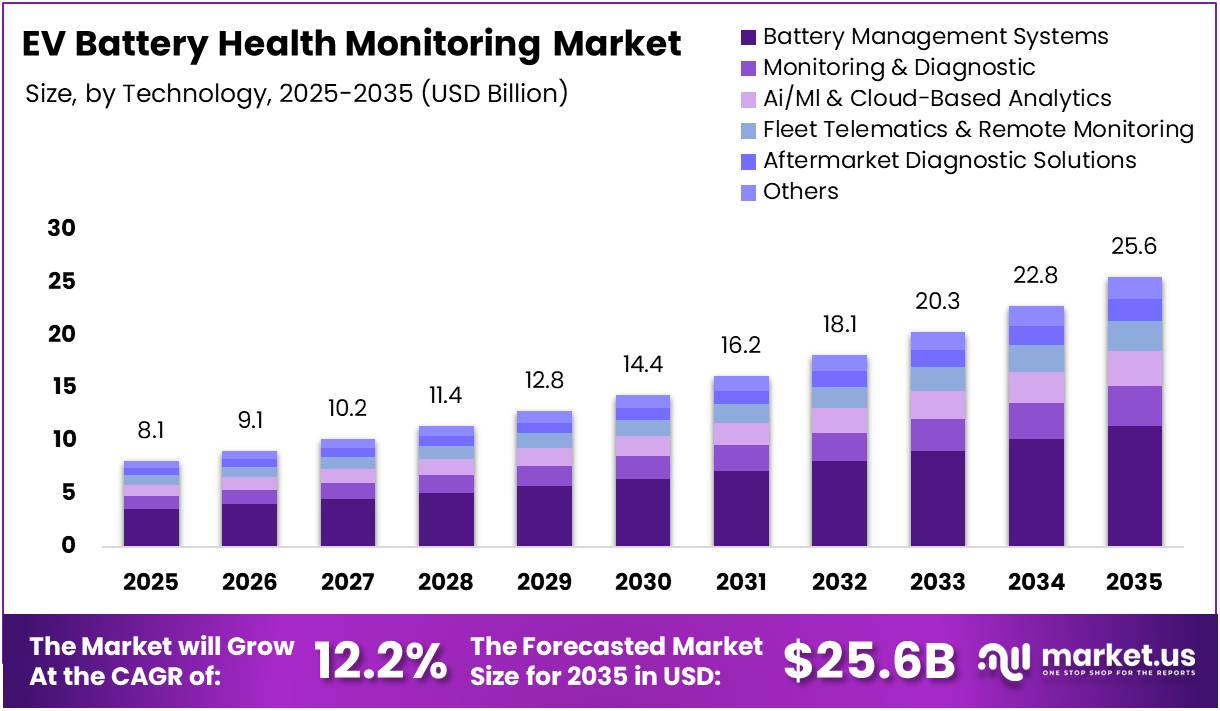
The market is growing due to the surge in global EV registrations and increasing demand for real-time battery performance data. Fleet operators and automotive OEMs are investing in battery monitoring technologies to reduce unplanned downtime, improve range reliability, and lower overall maintenance costs.
Government mandates across major economies are accelerating adoption of battery safety compliance standards. Regulatory frameworks in the European Union, China, and North America require EV manufacturers to incorporate battery health diagnostics, creating strong compliance-driven demand for advanced monitoring solutions across the value chain.
Additionally, the expansion of fast-charging infrastructure and second-life battery applications is generating new use cases for health monitoring systems. Predictive maintenance and AI-driven analytics are becoming essential for optimizing battery lifespan and maximizing return on investment for commercial and passenger EV operators.
According to Geotab, the average annual EV battery degradation rate stands at 2.3%, while batteries charged primarily with high-power DC fast charging above 100 kW degraded at up to 3.0% per year, compared to 1.5% per year for primarily lower-power charging, underscoring the need for continuous real-time monitoring.
According to research published on arXiv, integrated multi-sensor frameworks improved SOC estimation accuracy from 46.1% to 74.5% compared to conventional methods. Moreover, advanced physics-aware neural networks achieved an average performance improvement of 6.5× and 2.0× versus best baseline models, demonstrating measurable gains in state-of-health analytics.
Key Takeaways
- The global EV Battery Health Monitoring Market is valued at USD 8.1 Billion in 2025 and is projected to reach USD 25.6 Billion by 2035.
- The market is expected to expand at a CAGR of 12.2% during the forecast period 2026 to 2035.
- By Battery, Lithium Ion dominates with an 84.2% market share in 2025.
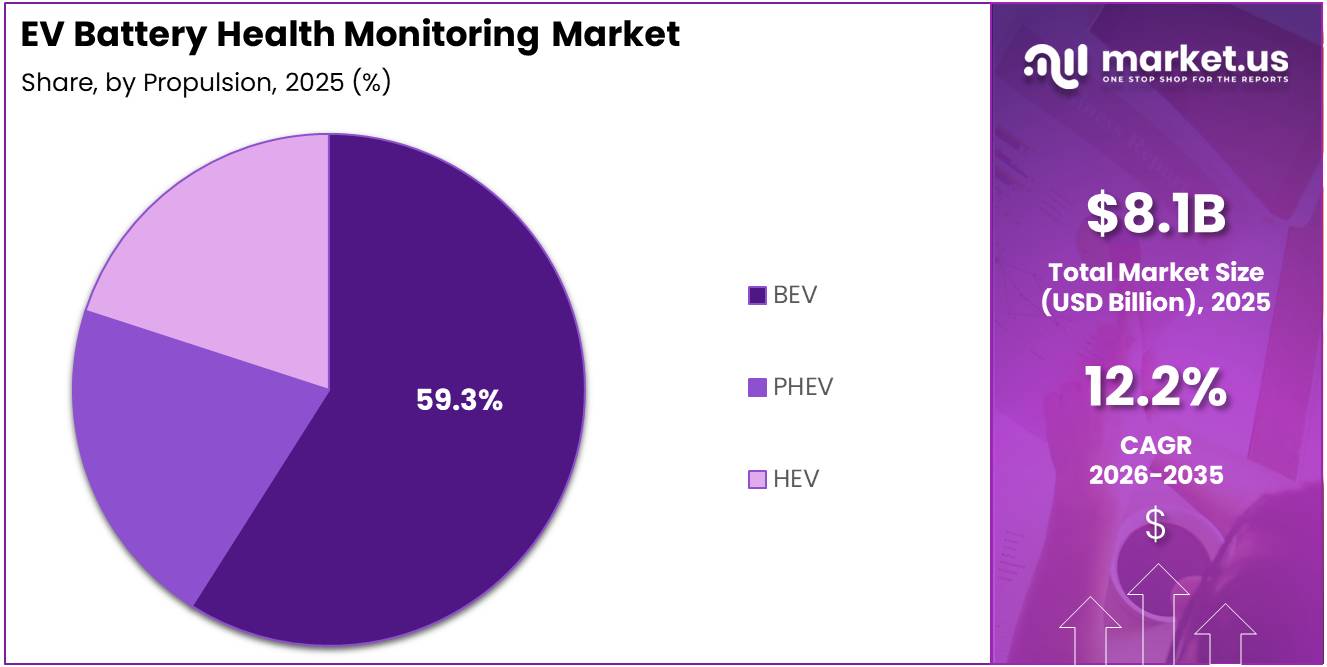
- By Propulsion, BEV leads the market with a 59.3% share.
- By Vehicle, Passenger Car holds the largest share at 74.1%.
- By Technology, Battery Management Systems account for 44.6% of the market.
- By Application, First-Life Vehicle Operation is the dominant segment with a 55.7% share.
- By End Use, Automotive OEMs lead with a 51.9% share.
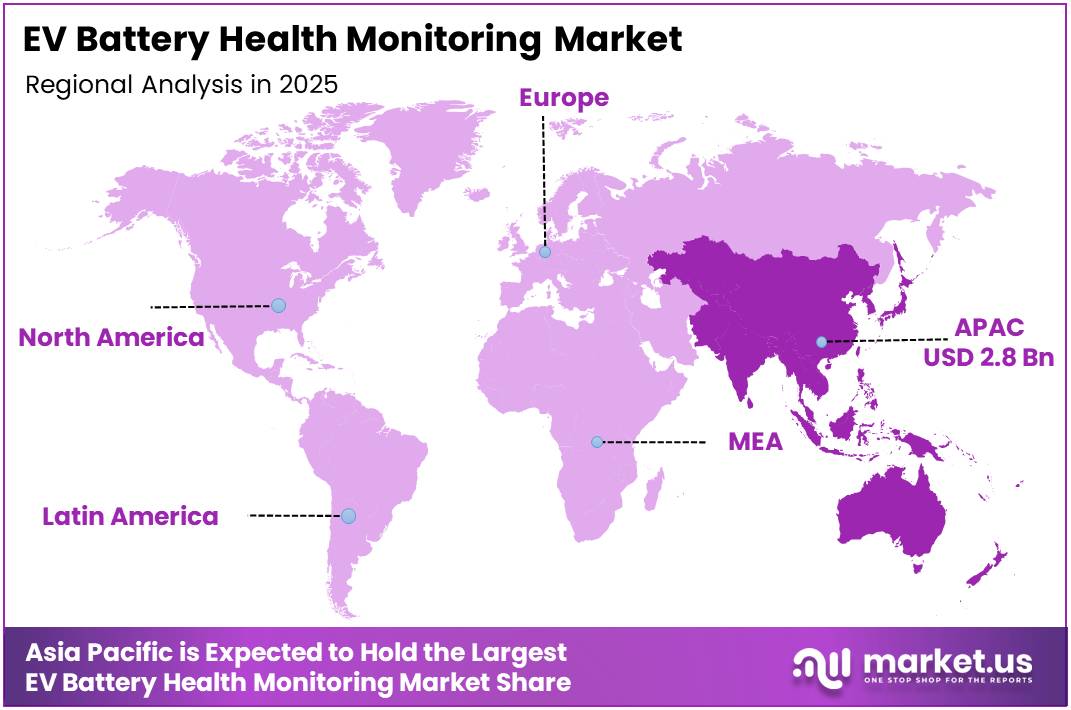
- Asia Pacific dominates the regional landscape with a 34.70% share, valued at USD 2.8 Billion.
Battery Type Analysis
Lithium Ion dominates with 84.2% due to its widespread adoption across modern BEV and PHEV platforms and high compatibility with advanced battery monitoring systems.
In 2025, Lithium Ion held a dominant market position in the By Battery segment of the EV Battery Health Monitoring Market, with an 84.2% share. Lithium-ion batteries are the preferred chemistry in modern EVs due to high energy density and long cycle life, driving demand for specialized monitoring solutions tailored to this chemistry.
Lead Acid batteries hold a smaller but notable share in this segment. These batteries remain in use in older hybrid and commercial vehicles, where health monitoring tracks sulfation levels and capacity degradation. However, declining use in new EV platforms limits the long-term growth potential of this sub-segment.
NIMH batteries remain relevant in hybrid electric vehicles operating in mature fleet environments. Their thermal sensitivity requires specialized monitoring to track capacity fade and voltage fluctuations. Additionally, NIMH diagnostics support legacy fleet maintenance where transitioning to newer battery chemistries is not yet commercially viable.
Others sub-segment covers emerging chemistries such as solid-state and sodium-ion batteries. These technologies are in early commercialization phases requiring advanced monitoring frameworks for performance validation. Therefore, growing investment in next-generation battery development is expected to expand this sub-segment over the forecast period.
Propulsion Type Analysis
BEV dominates with 59.3% due to sole dependence on battery power, making continuous real-time health monitoring essential for range assurance and vehicle safety.
In 2025, BEV held a dominant market position in the By Propulsion segment of the EV Battery Health Monitoring Market, with a 59.3% share. BEVs rely entirely on battery power, making real-time health monitoring critical for range assurance, safety management, and charging optimization across passenger and commercial applications.
PHEV vehicles operate dual powertrains, requiring health monitoring systems that manage both electric and combustion-side performance parameters. Battery monitoring for PHEVs focuses on tracking mixed charge-discharge cycles and preventing thermal events. Moreover, the growing PHEV fleet in Europe and Asia continues to support demand for this sub-segment.
HEV batteries operate in frequent shallow charge cycles that create unique degradation patterns compared to full EVs. Monitoring solutions for HEVs focus on early detection of capacity fade and thermal stress. Additionally, the large installed HEV fleet globally provides a stable long-term market for aftermarket battery health diagnostic tools.
Vehicle Type Analysis
Passenger Car dominates with 74.1% due to the largest share of EV registrations globally and diverse model variants requiring tailored battery monitoring solutions.
In 2025, Passenger Car held a dominant market position in the By Vehicle segment of the EV Battery Health Monitoring Market, with a 74.1% share. This category includes Hatchback, Sedan, and SUV models, each requiring tailored monitoring solutions to address varied driving cycles and battery usage patterns.
Within the passenger car category, SUV variants carry heavier battery packs requiring more frequent state-of-health checks. Hatchback and Sedan models use smaller battery systems typically monitored through integrated OEM platforms. Therefore, monitoring needs vary significantly across body types within the passenger car sub-segment.
Commercial Vehicle covers Light Duty, Medium Duty, and Heavy Duty variants operating under demanding usage cycles. Battery health monitoring in this segment is critical for minimizing fleet downtime and ensuring compliance with safety regulations. Consequently, logistics and transportation fleet operators are among the fastest-growing adopters of EV battery monitoring platforms.
Technology Analysis
Battery Management Systems dominate with 44.6% due to their core role in real-time battery monitoring, protection, and control within every EV platform.
In 2025, Battery Management Systems held a dominant market position in the By Technology segment of the EV Battery Health Monitoring Market, with a 44.6% share. BMS solutions monitor voltage, temperature, and state-of-charge in real time, serving as the primary platform for battery protection and performance optimization in all EV types.
Monitoring and Diagnostic solutions provide detailed battery condition analysis through embedded and external sensors. These tools help operators detect early degradation before it leads to failure. Moreover, diagnostics-as-a-service models are gaining traction in fleet and aftermarket service environments globally.
AI/ML and Cloud-Based Analytics are growing rapidly as EV platforms become increasingly connected. These technologies enable predictive state-of-health modeling, anomaly detection, and lifecycle forecasting. Consequently, cloud platforms are becoming standard in new-generation battery monitoring architectures for both OEM and aftermarket deployments.
Fleet Telematics and Remote Monitoring solutions allow centralized visibility into battery health across entire vehicle fleets. These platforms integrate GPS and usage data with battery performance metrics to support operational planning. Additionally, remote diagnostics reduce physical service visits and enable proactive maintenance scheduling for commercial operators.
Aftermarket Diagnostic Solutions serve vehicles post-warranty where OEM monitoring access is limited. These tools support independent service providers and battery refurbishers in assessing degradation and remaining useful life. Therefore, this sub-segment is growing alongside the expanding used EV market and second-life battery ecosystem.
Others sub-segment includes specialized technologies such as electrochemical impedance spectroscopy tools and advanced electrochemical monitoring platforms. These solutions target niche applications in battery research and manufacturing quality control. Their adoption is expected to grow as battery technology complexity increases across the industry.
Application Analysis
First-Life Vehicle Operation dominates with 55.7% as the primary stage where battery health monitoring is most critical for performance, safety, and warranty management.
In 2025, First-Life Vehicle Operation held a dominant market position in the By Application segment of the EV Battery Health Monitoring Market, with a 55.7% share. Monitoring during first-life operation is essential for tracking battery degradation, ensuring warranty compliance, and maintaining vehicle performance throughout the primary ownership period.
Fleet Management is a key application area enabling centralized oversight of multiple vehicles. Fleet operators use monitoring systems to schedule preventive maintenance, optimize charging routines, and reduce unplanned downtime. Consequently, this segment is growing in line with the rapid commercial EV fleet expansion worldwide.
Charging Infrastructure Integration involves embedding battery health monitoring directly within charging station networks. These systems assess battery condition at the point of charging to enable dynamic charge management and overcharge protection. Moreover, smart charging platforms increasingly incorporate health analytics to extend battery service life.
Vehicle-To-Grid Services require precise battery state-of-health monitoring to ensure EVs can safely participate in grid energy exchange without accelerating degradation. Health data informs discharge limits and cycling protocols. Therefore, V2G technology adoption is directly linked to advancement in battery monitoring capabilities.
Others sub-segment covers applications in battery recycling assessment, insurance analytics, and second-life repurposing. Accurate health data is critical for determining residual battery value in these contexts. Additionally, rising interest in battery resale markets is driving demand for standardized health monitoring protocols.
End Use Analysis
Automotive OEMs dominate with 51.9% as they integrate battery health monitoring directly into vehicle platforms during design and manufacturing stages.
In 2025, Automotive OEMs held a dominant market position in the By End Use segment of the EV Battery Health Monitoring Market, with a 51.9% share. OEMs integrate health monitoring directly into vehicle systems to ensure warranty compliance, enhance safety, and deliver real-time performance data to drivers and service centers.
Fleet Operators are the second-largest end-use group, relying on battery monitoring to manage total cost of ownership across large vehicle pools. These operators use health data to optimize charging schedules, plan maintenance, and extend battery service life. Consequently, fleet adoption of monitoring platforms continues to grow steadily.
Battery Manufacturers and Suppliers deploy health monitoring during production and post-delivery to track performance against design specifications. Monitoring data supports quality assurance, warranty management, and product improvement. Moreover, manufacturers increasingly provide embedded monitoring as a value-added service to OEM customers.
Charging Infrastructure Providers use battery health monitoring to enable smart charging protocols that protect connected vehicle batteries. These platforms adjust charge rates based on real-time health data to prevent thermal stress and capacity loss. Therefore, monitoring is becoming an integral feature of advanced charging networks.
Aftermarket Service Providers represent a growing end-use segment serving out-of-warranty EVs. These providers use diagnostic tools to assess battery condition, offer replacement recommendations, and support vehicle resale valuations. Additionally, the expanding used EV market is fueling demand for independent battery health assessment services.
Others sub-segment includes insurance companies, leasing firms, and research institutions using battery health data for risk assessment and product development. These users require standardized health metrics for financial modeling and lifecycle analysis. Consequently, data standardization efforts are expected to expand participation from these end-use groups over the forecast period.
Key Market Segments
By Battery
- Lithium Ion
- Lead Acid
- NIMH
- Others
By Propulsion
- BEV
- PHEV
- HEV
By Vehicle
- Passenger Car
- Hatchback
- Sedan
- SUV
- Commercial Vehicle
- Light Duty
- Medium Duty
- Heavy Duty
By Technology
- Battery Management Systems
- Monitoring and Diagnostic
- AI/ML and Cloud-Based Analytics
- Fleet Telematics and Remote Monitoring
- Aftermarket Diagnostic Solutions
- Others
By Application
- First-Life Vehicle Operation
- Fleet Management
- Charging Infrastructure Integration
- Vehicle-To-Grid Services
- Others
By End Use
- Automotive OEMs
- Fleet Operators
- Battery Manufacturers and Suppliers
- Charging Infrastructure Providers
- Aftermarket Service Providers
- Others
Drivers
Rising EV Adoption, Fast-Charging Expansion, and Battery Safety Compliance Drive Market Growth
The rapid increase in global electric vehicle registrations is creating substantial demand for real-time battery performance analytics. As EV adoption scales across passenger and commercial segments, automotive OEMs and fleet operators require continuous monitoring tools to manage battery state-of-health, optimize performance, and reduce the risk of premature battery failure.
The global expansion of fast-charging infrastructure is placing new stress on EV batteries, requiring continuous health condition monitoring to manage accelerated degradation. High-power DC fast chargers increase wear on battery cells, making it essential for operators and charging networks to deploy real-time monitoring solutions. Therefore, infrastructure growth is directly contributing to increased demand for advanced battery diagnostics.
Growing regulatory focus on battery safety compliance and thermal runaway prevention is compelling manufacturers to invest in comprehensive monitoring platforms. Governments across key EV markets are tightening safety standards, requiring vehicles to be equipped with systems capable of detecting abnormal thermal and electrochemical conditions. Consequently, compliance requirements are emerging as a significant structural market driver.
Restraints
High Integration Complexity and Cybersecurity Concerns Restrain Market Adoption
Integrating advanced battery health monitoring solutions with existing battery management system architectures is a significant technical challenge. Legacy BMS designs often lack the hardware interfaces and communication protocols needed to support modern monitoring platforms, increasing deployment time and cost. Consequently, automakers and fleet operators face notable barriers when upgrading older EV systems.
The complexity of integration is particularly acute in commercial fleets operating mixed vehicle types with diverse BMS configurations. Achieving standardized monitoring across heterogeneous fleets requires custom middleware and specialized engineering resources. Moreover, the absence of universal communication standards across battery suppliers and OEMs further complicates seamless and scalable platform deployment.
Cloud-based battery monitoring platforms collect and transmit sensitive operational and location data, raising serious data privacy and cybersecurity concerns. Unauthorized access to battery health data could expose vehicle performance information and enable cyberattacks on connected EV systems. Therefore, cybersecurity gaps remain a key restraint limiting broader adoption of cloud-based monitoring solutions.
Growth Factors
Predictive Maintenance, Second-Life Battery Demand, and AI Integration Accelerate Market Expansion
The increasing adoption of predictive maintenance in commercial EV fleets is a key growth driver for battery health monitoring. Fleet operators are shifting from reactive to proactive maintenance models, using real-time battery data to anticipate failures before they occur. Consequently, demand for intelligent monitoring platforms in logistics and transportation fleets is rising rapidly.
The expansion of second-life battery applications is generating significant demand for advanced state-of-health tracking solutions. Batteries repurposed for stationary energy storage after EV use require accurate health assessments to determine capacity and safety levels. Moreover, circular economy policies and sustainability mandates are encouraging investment in second-life battery markets globally.
Integration of AI-based battery analytics within connected vehicle ecosystems is creating new growth opportunities across the market. AI algorithms enable precise state-of-health predictions, anomaly detection, and adaptive charging recommendations. Additionally, connected vehicle platforms allow manufacturers to deliver over-the-air updates that continuously improve battery monitoring accuracy throughout the vehicle lifecycle.
Emerging Trends
Cloud Connectivity, Digital Twins, and Edge Computing Reshape Battery Health Monitoring Landscape
The shift toward cloud-connected and over-the-air enabled battery diagnostics platforms is one of the most prominent trends reshaping the market. These platforms allow OEMs and fleet operators to remotely access battery health data and push diagnostic updates without physical service visits. Consequently, cloud-based monitoring is becoming a standard feature in new EV architectures.
Digital twin technology is emerging as a powerful tool for real-time battery performance simulation. By creating virtual replicas of physical battery systems, manufacturers can model aging, predict failure modes, and test monitoring algorithms without physical testing. Moreover, digital twins enable continuous calibration of health monitoring models across the entire battery lifecycle.
The adoption of edge computing for on-board battery health processing is gaining momentum as a complement to cloud-based platforms. Edge solutions process battery data locally within the vehicle, reducing latency and enabling real-time responses to critical battery events. Therefore, edge computing is becoming essential for safety-critical EV monitoring applications where immediate intervention is required.
Regional Analysis
Asia Pacific Dominates the EV Battery Health Monitoring Market with a Market Share of 34.70%, Valued at USD 2.8 Billion
Asia Pacific holds a 34.70% share of the global EV Battery Health Monitoring Market, valued at USD 2.8 Billion in 2025. China, Japan, and South Korea are the primary contributors, driven by aggressive EV production targets, government subsidies, and large-scale battery manufacturing ecosystems. The region’s strong EV adoption rates and battery technology investments firmly reinforce its dominant regional position.
North America EV Battery Health Monitoring Market Trends
North America represents one of the most active markets for EV battery health monitoring, supported by strong federal policies promoting EV adoption and grid integration. The U.S. leads regional demand, with significant investment in charging infrastructure and OEM electrification programs driving the need for advanced battery diagnostics across fleet and consumer vehicle segments.
Europe EV Battery Health Monitoring Market Trends
Europe is a key regional market driven by stringent EU battery regulations and ambitious carbon neutrality targets. The EU Battery Regulation mandates performance and durability standards, compelling manufacturers to integrate comprehensive health monitoring systems. Moreover, the region’s growing second-life battery market and circular economy policies further support sustained demand for monitoring solutions.
Middle East and Africa EV Battery Health Monitoring Market Trends
The Middle East and Africa region is at an early stage of EV battery monitoring adoption, with growth centered on pilot programs and government-sponsored EV infrastructure projects. Rising interest in fleet electrification among logistics operators and ongoing investments in charging networks are expected to gradually develop demand for health monitoring solutions across the region.
Latin America EV Battery Health Monitoring Market Trends
Latin America is an emerging market for EV battery health monitoring, with Brazil and Mexico leading regional EV adoption. Growing investment in electric public transportation and government incentives for EV purchases are creating foundational demand. However, infrastructure limitations and cost sensitivity continue to moderate the pace of monitoring technology adoption across the region.
Key Regions and Countries
North America
- US
- Canada
Europe
- Germany
- France
- The UK
- Spain
- Italy
- Rest of Europe
Asia Pacific
- China
- Japan
- South Korea
- India
- Australia
- Rest of APAC
Latin America
- Brazil
- Mexico
- Rest of Latin America
Middle East & Africa
- GCC
- South Africa
- Rest of MEA
Key Company Insights
Analog Devices is a leading provider of precision sensing and signal processing technologies that form the foundation of advanced battery management systems. The company’s battery monitoring ICs and impedance spectroscopy solutions are widely deployed in EV platforms, enabling accurate state-of-health and state-of-charge measurements. Analog Devices continues to expand its BMS portfolio to address growing EV safety and performance requirements globally.
BYD is one of the world’s largest integrated EV and battery manufacturers, with deep expertise in battery health monitoring as part of its vertically integrated model. The company develops proprietary BMS technology embedded across its full EV lineup, including passenger cars and commercial vehicles. BYD’s internal monitoring capabilities support both vehicle performance optimization and battery second-life programs at scale.
CATL is the world’s largest battery manufacturer and a significant contributor to battery health monitoring technology development. The company integrates advanced monitoring systems into its battery packs, offering real-time state-of-health and state-of-charge tracking to OEM customers globally. CATL also invests in AI-based battery analytics and cloud-connected diagnostic platforms to support predictive maintenance and second-life battery assessment.
Continental is a global automotive technology supplier with a strong presence in battery management and monitoring systems. The company offers integrated BMS platforms that combine hardware and software to deliver real-time battery health data for OEM and aftermarket applications. Continental’s solutions focus on safety, scalability, and connectivity, supporting passenger car and commercial vehicle electrification programs across major global markets.
Key Players
- Analog Devices
- BYD
- CATL
- Continental
- Infineon
- LEM International
- LG Energy Solution
- Panasonic
- Samsung SDI
- Texas Instruments
Recent Developments
- October 2025 – NXP Semiconductors launched an EIS (Electrochemical Impedance Spectroscopy) capable Battery Management System chipset designed to improve real-time battery health monitoring precision. The new chipset enables more accurate state-of-health measurement, enhancing safety and performance management in next-generation EV platforms.
- March 2025 – EVident Battery secured $3.2 million in funding to advance its EV battery pack inspection technology and launched a pilot product aimed at the market. The investment supports development of non-invasive battery health assessment tools for a greener and more sustainable EV lifecycle.
- March 2025 – PULSETRAIN GmbH secured €6.1 million in funding to advance its AI-driven battery management systems focused on enhancing EV battery performance and lifespan. The company is preparing for industrial scaling of its platform, targeting both OEM integration and commercial fleet management applications.
Report Scope
Report Features Description Market Value (2025) USD 8.1 Billion Forecast Revenue (2035) USD 25.6 Billion CAGR (2026-2035) 12.2% Base Year for Estimation 2025 Historic Period 2020-2024 Forecast Period 2026-2035 Report Coverage Revenue Forecast, Market Dynamics, Competitive Landscape, Recent Developments Segments Covered By Battery (Lithium Ion, Lead Acid, NIMH, Others), By Propulsion (BEV, PHEV, HEV), By Vehicle Type (Passenger Car, Commercial Vehicle), By Technology (Battery Management Systems, Monitoring and Diagnostic, AI/ML and Cloud-Based Analytics, Fleet Telematics and Remote Monitoring, Aftermarket Diagnostic Solutions, Others), By Application (First-Life Vehicle Operation, Fleet Management, Charging Infrastructure Integration, Vehicle-To-Grid Services, Others), By End Use (Automotive OEMs, Fleet Operators, Battery Manufacturers and Suppliers, Charging Infrastructure Providers, Aftermarket Service Providers, Others) Regional Analysis North America (US and Canada), Europe (Germany, France, The UK, Spain, Italy, and Rest of Europe), Asia Pacific (China, Japan, South Korea, India, Australia, and Rest of APAC), Latin America (Brazil, Mexico, and Rest of Latin America), Middle East & Africa (GCC, South Africa, and Rest of MEA) Competitive Landscape Analog Devices, BYD, CATL, Continental, Infineon, LEM International, LG Energy Solution, Panasonic, Samsung SDI, Texas Instruments Customization Scope Customization for segments, region/country-level will be provided. Moreover, additional customization can be done based on the requirements. Purchase Options We have three licenses to opt for: Single User License, Multi-User License (Up to 5 Users), Corporate Use License (Unlimited User and Printable PDF)  EV Battery Health Monitoring MarketPublished date: Feb 2026add_shopping_cartBuy Now get_appDownload Sample
 -
-
- Analog Devices
- BYD
- CATL
- Continental
- Infineon
- LEM International
- LG Energy Solution
- Panasonic
- Samsung SDI
- Texas Instruments
Our Clients

- 179154
- Feb 2026






