


Report Overview
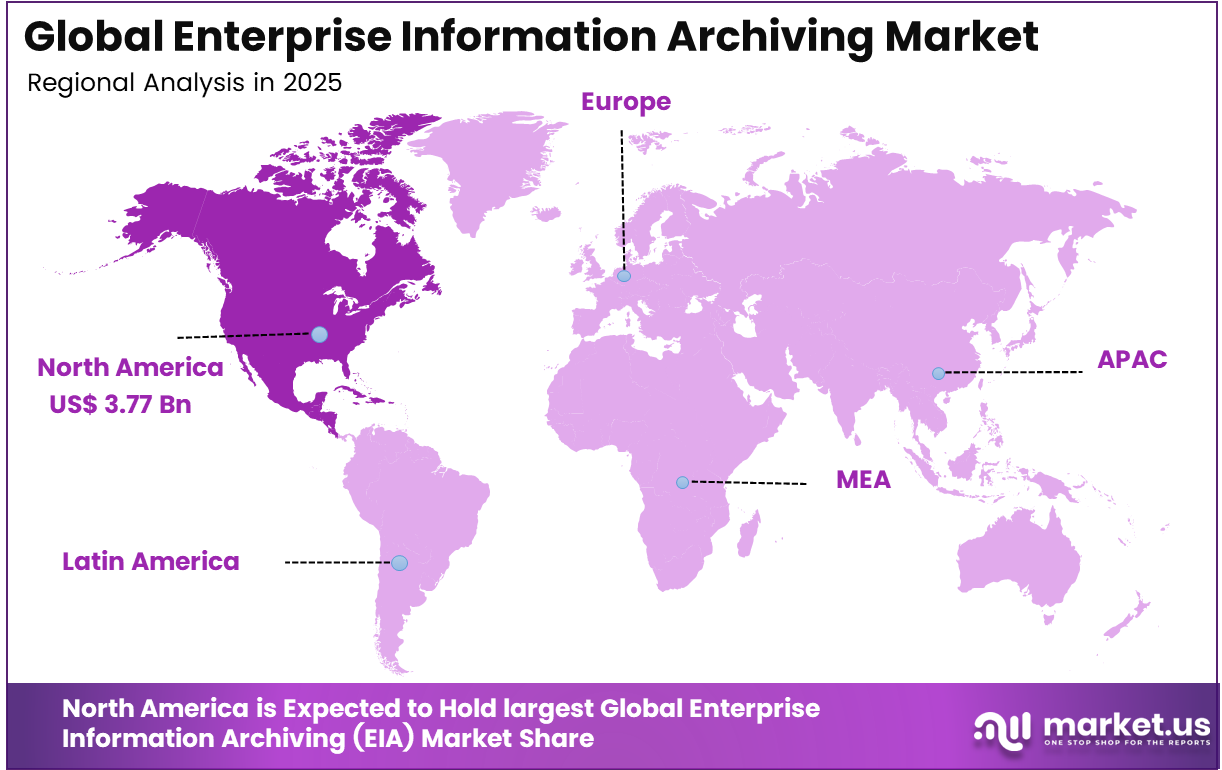
The Global Enterprise Information Archiving (EIA) Market size is expected to be worth around USD 57.67 billion by 2035, from USD 10.38 billion in 2025, growing at a CAGR of 18.7% during the forecast period from 2025 to 2035. North America held a dominant market position, capturing more than a 36.4% share, holding USD 3.77 billion in revenue.
Enterprise Information Archiving (EIA) helps big companies store emails, files, and other data long-term in a safe, central spot. It cuts storage costs by moving old info to cheaper space while keeping it easy to find. Teams stay compliant with rules through set retention times and secure access. Quick searches boost workflow for audits or checks.
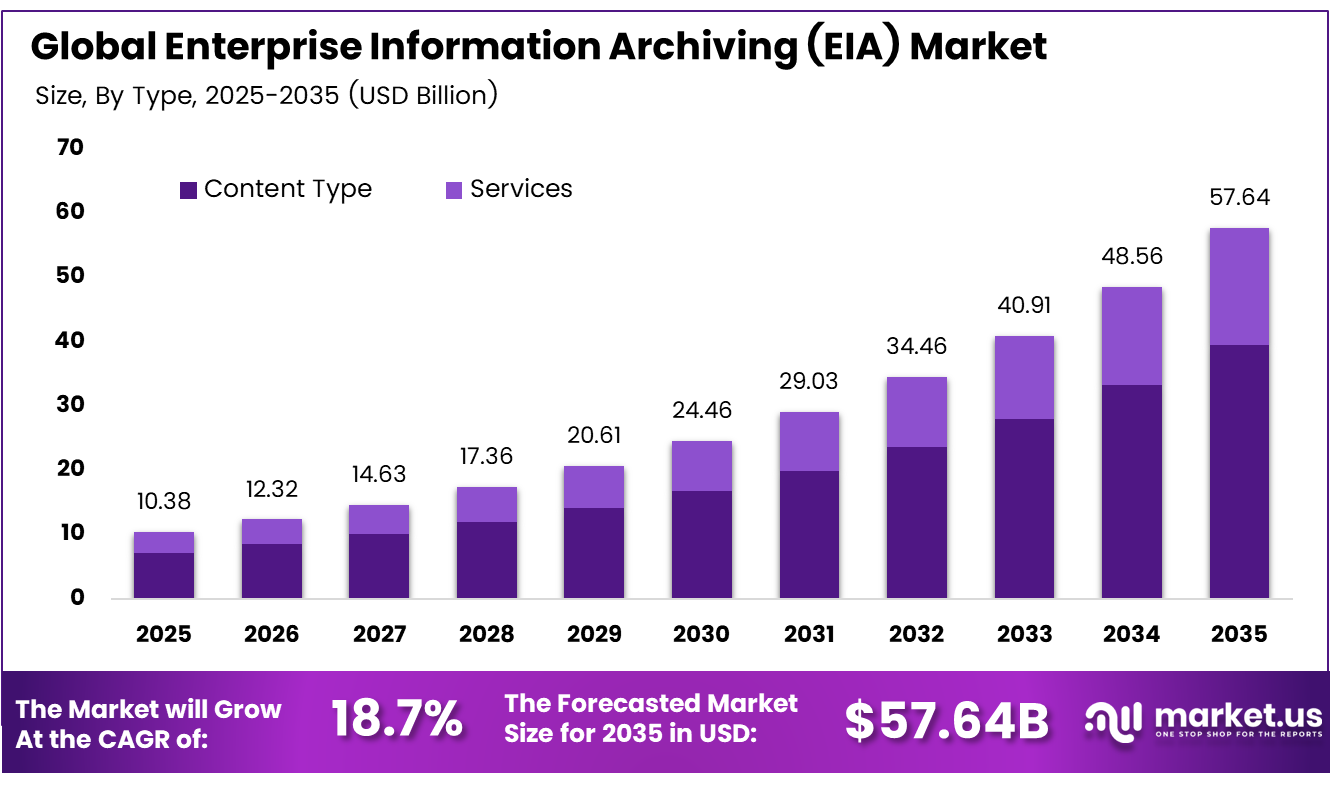
Top driving factors include the explosion of data from emails, chats, and files that overwhelm regular storage. Companies struggle to manage it all without losing track. Strict record-keeping rules push firms to archive data to stay out of legal hot water. Over 80% of businesses handle messy, unstructured info needing safe long-term homes. Daily data floods make old systems lag, so archiving clears space and keeps things running smoothly. Teams waste less time hunting for files, focusing on real work instead.
The market for Enterprise Information Archiving (EIA) is driven by rising regulatory compliance requirements. Businesses face stricter rules on keeping emails, files, and records for audits, pushing them toward reliable archiving to avoid penalties and legal headaches. These systems let teams quickly find and share needed info, turning compliance from a burden into a strength that builds customer trust. As data rules tighten across industries, EIA helps operations run smoothly while proving accountability in checks.
Demand analysis shows teams drowning in digital info from constant emails and docs piling up. Active storage gets pricey and slow with all that load. Firms turn to EIA to shift old stuff aside and boost speed. About 70% of big outfits see data grow fast yearly, sparking urgent needs. Workers need quick access without digging through clutter. This shift cuts costs on servers, too. Overall, demand spikes as businesses chase efficiency in busy daily ops.
For instance, in December 2025, Veritas Technologies expanded multicloud archiving analytics, now serving over 12,000 customers with hybrid retention tools. Solid play for e-discovery and governance in messy data environments.
Key Takeaway
- In 2025, the Content Type segment held a dominant market position, capturing a 68.4% share of the Global Enterprise Information Archiving (EIA) Market.
- In 2025, the On-premises segment held a dominant market position, capturing a 58.9% share of the Global Enterprise Information Archiving (EIA) Market.
- In 2025, the Large Enterprises segment held a dominant market position, capturing a 70.5% share of the Global Enterprise Information Archiving (EIA) Market.
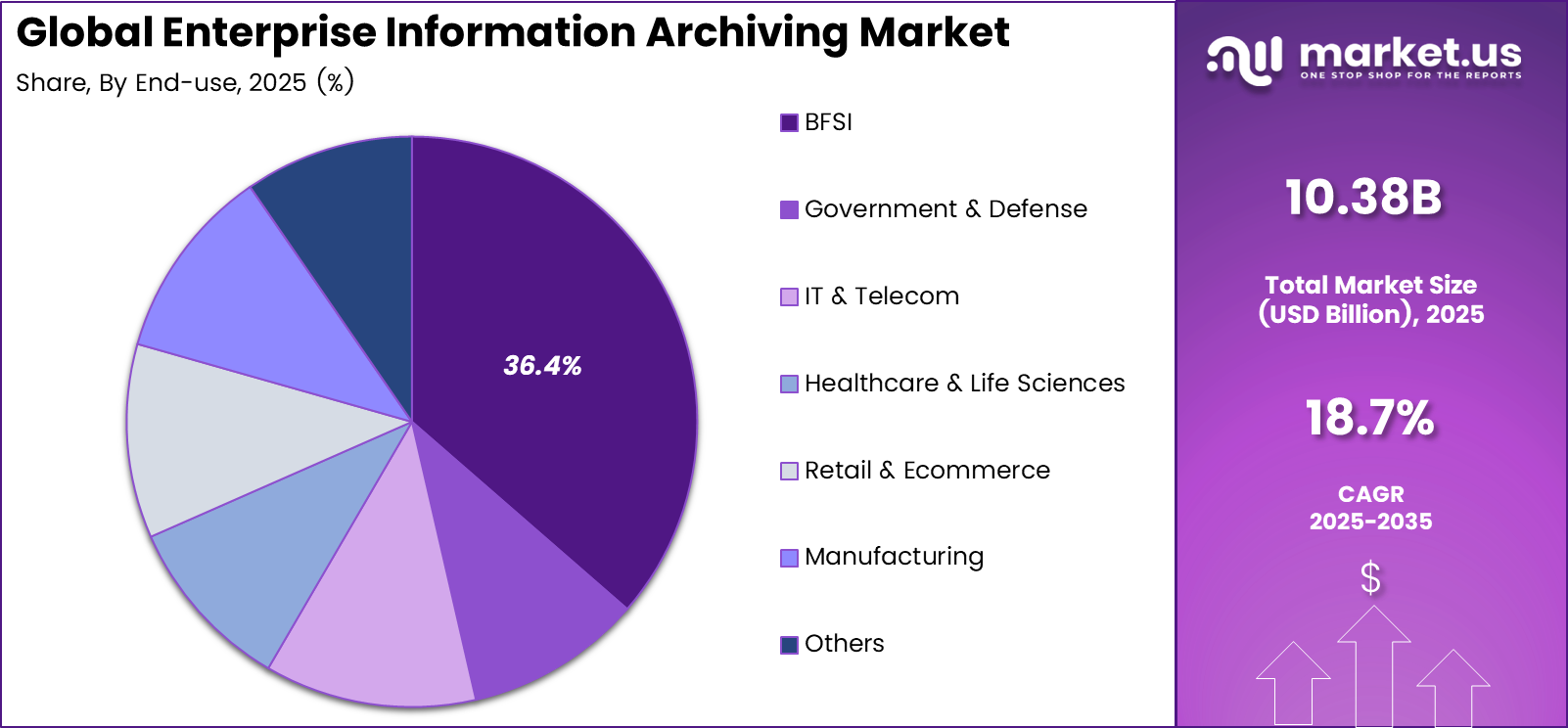
- In 2025, the BFSI segment held a dominant market position, capturing a 36.4% share of the Global Enterprise Information Archiving (EIA) Market.
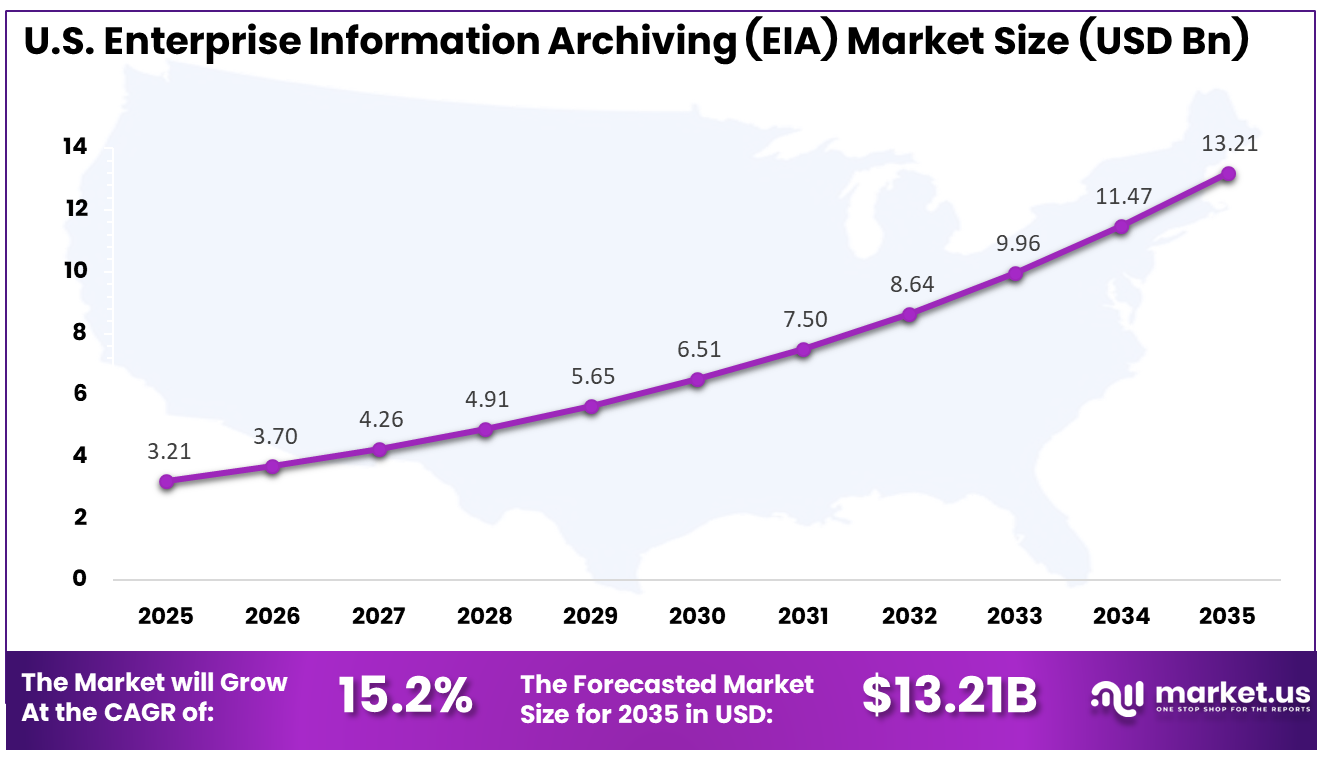
- The U.S. Enterprise Information Archiving (EIA) Market was valued at USD 3.21 Billion in 2025, with a robust CAGR of 15.2%.
- In 2025, North America held a dominant market position in the Global Enterprise Information Archiving (EIA) Market, capturing more than a 36.4% share.
Role of Generative AI
Generative AI transforms Enterprise Information Archiving (EIA) by automating data classification and metadata generation for vast unstructured repositories, including emails, documents, and multimedia. It enables natural language querying, allowing users to retrieve information through conversational searches rather than rigid keywords, streamlining eDiscovery and compliance reviews.
In EIA, generative AI enhances governance by proactively identifying sensitive data, summarizing archived content, and enforcing retention policies with contextual intelligence. It supports secure access to legacy archives, unlocking insights from historical data while maintaining immutability and auditability for regulatory adherence.
Investment and Business Benefits
Investment opportunities lie in cloud tools that flex with growing needs. Secure extras guard against breaches for spread-out teams. Hybrid mixes of local and online draw cash. Strong interest flows from smaller players jumping in. Backers like easy-to-add search boosts, too. Demand rises for mobile-safe archiving as work goes remote. Funds target simple setups, cutting IT headaches. These spots promise steady returns as data rules tighten everywhere.
Business benefits shine in fast file grabs aiding smart calls. Tight rules block hacks, keeping data safe. Fines get dodged since non-compliance costs millions yearly in hits. Workflows speed up without storage drags. Teams collaborate better, pulling shared history quickly. Backup reliability cuts the risks from crashes. Long-term, it builds trust with clear audit trails. Daily gains stack into a real edge over rivals sloppy on records.
Regional Analysis
In 2025, North America held a dominant market position in the Global Enterprise Information Archiving (EIA) Market, capturing more than a 36.4% share, holding USD 3.77 billion in revenue. This dominance is attributed to the strong presence of regulatory compliance frameworks that require long-term retention of electronic records across sectors such as banking, healthcare, and government. Organizations in the region are early adopters of digital communication platforms and enterprise IT infrastructure, which is increasing the volume of business data that must be archived securely for audit readiness, legal discovery, and internal governance purposes.
For instance, in January 2026, Barracuda Networks, Inc., headquartered in Campbell, California, enhanced its Message Archiver with AI-powered compliance analytics, reinforcing its leadership in North America’s Enterprise Information Archiving (EIA) market by streamlining eDiscovery processes and mitigating compliance risks for enterprises.
U.S. Enterprise Information Archiving (EIA) Market Size
The market for Enterprise Information Archiving (EIA) within the U.S. is growing tremendously and is currently valued at USD 3.21 billion. The market has a projected CAGR of 15.2%. The market is growing due to rising regulatory scrutiny across sectors such as finance, healthcare, and government. Organizations are required to retain electronic communications and transactional records to comply with federal mandates and litigation readiness standards. The rapid growth of cloud collaboration tools, remote work environments, and digital transactions is further increasing data volumes, driving demand for secure, scalable archiving solutions that support compliance, risk management, and long-term data governance strategies.
For instance, in February 2026, Commvault, headquartered in Tinton Falls, New Jersey, introduced Cloud Archiver Pro with zero-trust security architecture, strengthening its U.S. market leadership by enabling seamless hybrid cloud deployments for regulated sectors such as banking, financial services, and healthcare.
Key Regions and Countries
North America
- US
- Canada
Europe
- Germany
- France
- The UK
- Spain
- Italy
- Russia
- Netherlands
- Rest of Europe
Asia Pacific
- China
- Japan
- South Korea
- India
- Australia
- Singapore
- Thailand
- Vietnam
- Rest of APAC
Latin America
- Brazil
- Mexico
- Rest of Latin America
Middle East & Africa
- South Africa
- Saudi Arabia
- UAE
- Rest of MEA
Type Analysis
In 2025, the Content Type segment held a dominant market position, capturing a 68.4% share of the Global Enterprise Information Archiving (EIA) Market. Enterprises increasingly deal with large volumes of business communication data, such as emails, instant messages, enterprise documents, and multimedia records. Organizations are required to retain this information for longer durations to support legal discovery, compliance audits, and internal investigations. As digital communication becomes a primary mode of business interaction, archiving these records in a structured format helps maintain accountability and transparency across operations.
In addition, content-focused archiving helps enterprises streamline data governance practices by ensuring that critical business information remains protected and accessible whenever required. This approach supports regulatory compliance across industries such as finance and healthcare, where maintaining historical communication trails is mandatory. It also helps reduce data loss risks by preserving intellectual property and operational knowledge for future reference.
For Instance, in July 2025, Barracuda Networks launched ArchiveOne version 7.0 after acquiring C2C Systems. This update boosts content archiving for emails and files in midsize firms, making eDiscovery easier for legal teams without IT help. It simplifies searches across content types, cuts costs, and fits the growing need for managing unstructured data like chats and docs in daily business.
Deployment Analysis
In 2025, the On-premises segment held a dominant market position, capturing a 58.9% share of the Global Enterprise Information Archiving (EIA) Market. Many organizations continue to prioritize internal infrastructure for storing sensitive archived information. Enterprises operating in industries such as finance, healthcare, and government must comply with strict data residency and privacy regulations, which often require information to be retained within controlled internal environments for security and audit readiness.
Maintaining an on-premises archiving setup allows enterprises to exercise full administrative control over historical data and communication records. It also helps organizations manage legacy application data and meet industry-specific retention mandates without relying on third-party storage environments, which is particularly important for institutions managing confidential financial or customer-related information.
For instance, in February 2025, Dell debuted InfoArchive as a Service alongside on-prem software updates like InfoArchive 4.1. While SaaS grows, the core platform supports hybrid on-premises setups for secure data control in healthcare and finance. It helps firms retire apps while keeping archiving local for better customization and reliability.
Enterprise Size Analysis
In 2025, the Large Enterprises segment held a dominant market position, capturing a 70.5% share of the Global Enterprise Information Archiving (EIA) Market. This dominance is due to the need to manage large-scale enterprise data generated from transactional systems, collaboration platforms, and internal applications. As data volumes continue to grow across departments and geographies, structured archiving systems are increasingly required to store inactive business data in a secure and accessible manner.
These organizations also rely on enterprise archiving platforms to ensure long-term preservation of records required for regulatory reviews and legal proceedings. By maintaining secure archives of communication and operational data, large enterprises are better equipped to reduce compliance risks and respond efficiently to internal audits or legal investigations when necessary.
For Instance, in July 2025, Barracuda’s ArchiveOne 7.0 targets large enterprises with Advanced Discovery for corporate legal searches. IT frees up as HR and counsel query emails and files directly via web interfaces. The platform scales for complex data environments, reducing eDiscovery costs in big organizations with heavy compliance loads.
End-use Analysis
In 2025, the BFSI segment held a dominant market position, capturing a 36.4% share of the Global Enterprise Information Archiving (EIA) Market. Financial institutions are required to maintain detailed transaction histories, communication records, and customer documentation for compliance reviews and fraud monitoring. Enterprise information archiving solutions provide a secure and organized framework for preserving this data in line with financial supervision standards.
Moreover, banks and insurance providers handle large volumes of sensitive client information that must be safeguarded against unauthorized access. Archiving platforms support data integrity and traceability, which are critical for maintaining customer trust and regulatory credibility. By enabling quick search and retrieval of archived records, these systems also improve operational efficiency during audits and internal investigations.
For Instance, in July 2025, Mimecast enhanced archiving with export features and saved searches. BFSI users benefit from full-text searches across ingested emails, simplifying regulatory reviews and retention for transaction records in a sector facing strict audit demands.
Key Market Segments
By Type
- Content Type
- Database
- Social Media
- Web
- Instant Messaging
- Mobile Communication
- File and Enterprise File Synchronization and Sharing
- Services
- Consulting
- System Integration
- Training, Support, and Maintenance
By Deployment
- On-premises
- Cloud
By Enterprise Size
- Large Enterprises
- Small & Medium Enterprises
By End-use
- BFSI
- Government & Defense
- IT & Telecom
- Healthcare & Life Sciences
- Retail & Ecommerce
- Manufacturing
- Others
Emerging trends
Enterprise Information Archiving (EIA) is evolving with a strong shift toward cloud-native and hybrid solutions, enabling scalable storage for unstructured data from collaboration tools like Slack and Microsoft Teams. AI and machine learning integration automates data classification, enhances eDiscovery through intelligent search, and supports proactive compliance monitoring.
Organizations increasingly prioritize comprehensive information governance, including defensible deletion and lifecycle management, alongside robust security features like encryption and audit trails to address privacy regulations. Emerging approaches like Information Governance as a Service (IGaaS) and blockchain for data immutability further strengthen secure, unified archiving across diverse content types.
Growth Factors
Enterprise Information Archiving (EIA) growth is propelled by escalating data volumes from emails, collaboration tools, and digital communications, pushing organizations to seek efficient storage for inactive data. Stringent regulatory compliance requirements, including mandates for retention and audit trails, compel businesses to adopt robust archiving to mitigate legal risks and ensure governance.
The shift toward cloud and hybrid deployments reduces costs and enhances scalability, while AI-driven automation streamlines data management and eDiscovery processes. Rising focus on information governance and cybersecurity further accelerates adoption as enterprises prioritize secure, accessible long-term storage across diverse content types.
Market Dynamics
Drivers - Rising Regulatory Compliance Requirements
Organizations across sectors such as banking, healthcare, and public administration are required to retain electronic communications and operational records for long periods to meet legal and compliance obligations. Regulatory authorities increasingly expect companies to maintain proper documentation of financial transactions, internal communications, and customer-related data, which is driving the adoption of enterprise information archiving systems.
These solutions help enterprises securely store business-critical records in a centralized environment and retrieve them quickly during audits or investigations. This not only improves regulatory readiness but also supports internal governance by ensuring that historical communication data remains accessible whenever required for legal or compliance-related reviews.
For instance, in January 2026, Commvault deepened ties with Google Cloud to boost enterprise protection through better archiving and compliance features. The update brings air-gapped backups and quick data recovery right into Google environments, making it simpler for teams to meet strict rules without extra hassle. This move helps businesses handle rising demands for secure record-keeping in hybrid setups.
Restraint - High Setup Costs
Setting up enterprise information archiving infrastructure often requires significant investment in storage systems and IT integration processes. Organizations may need to upgrade their existing infrastructure to support archiving platforms, which can increase the total cost of implementation. This becomes a major concern for companies with limited financial resources or those still operating with legacy data management systems.
Apart from installation costs, ongoing system maintenance and monitoring also require dedicated IT personnel. Managing archived data across various departments and applications involves additional operational effort and training. These financial and technical requirements can act as a barrier for smaller organizations considering the adoption of enterprise archiving solutions.
For instance, in November 2025, Barracuda’s pricing for backup and archiving starts high at around USD 620 per month for basics, scaling with data use, which adds up fast for big operations. Many users note the capacity model leads to unexpected bills, making smaller firms rethink full setups due to the steep entry cost.
Opportunities - Expansion of Cloud Collaboration Tools
The increasing adoption of digital communication platforms such as cloud-based file sharing, enterprise messaging, and virtual meeting tools is generating vast amounts of business data that must be preserved for compliance and operational purposes. This is creating new opportunities for enterprise archiving systems that can capture and store communication data generated through collaborative work environments.
Archiving solutions integrated with cloud collaboration tools allow enterprises to automatically retain shared documents, conversation logs, and project-related data in secure storage environments. This improves data accessibility and supports compliance initiatives by ensuring that important digital interactions are archived without affecting daily business operations.
For instance, in October 2025, Proofpoint rolled out new tools to secure data in agentic workspaces, focusing on cloud collaboration with AI agents like Copilot. These features guard against data leaks across platforms while letting teams work fluidly in shared cloud spaces. It taps into growing cloud tool use by blending archiving with real-time oversight for smoother expansion.
Challenges - Managing Unstructured Data Volumes
Enterprises are increasingly dealing with unstructured data such as emails, multimedia files, and chat messages created during routine business operations. Storing and organizing this type of data in a searchable format presents a significant challenge for archiving systems. Without proper classification, retrieving relevant information during audits or legal reviews can become difficult and time-consuming.
In addition, continuous growth in digital communication is expanding enterprise data repositories at a rapid pace. Archiving platforms must ensure that this information remains secure and accessible over long retention periods. Managing such large volumes of unstructured content while maintaining data accuracy and accessibility remains a key challenge for organizations implementing enterprise archiving solutions.
For instance, in August 2025, Google tackled unstructured data risks in AI setups with better DLP and audit tools. It flags oversharing in drives and old permissions that expose files. Helps clean up sprawl in cloud-stored docs and media for safer access.
Key Players Analysis
One of the leading players in July 2025, Commvault announced plans to acquire Satori Cyber, boosting its cyber resilience platform with real-time data controls and AI governance. This move targets multicloud archiving challenges, making data management smoother for enterprises juggling hybrid setups.
Top Key Players in the Market
- Barracuda Networks, Inc.
- Commvault
- Dell Inc.
- Google LLC
- International Business Machines Corporation
- Microsoft
- Mimecast Services Limited
- Proofpoint
- Smarsh Inc.
- Veritas Technologies LLC
- Others
Recent Developments
- In March 2024, Proofpoint debuted ARCHIVE-X, a cloud archiving beast for financial services that locks down emails, chats, voice, and even video with WORM compliance and top encryption. Keeps regulated data airtight while scaling effortlessly.
- In January 2026, Microsoft enhanced Purview archiving with new AI retention policies for Teams and Exchange, supporting unlimited auto-expanding archives. Integrated into M365 Copilot Chat for post-call insights, it’s ideal for enterprises already in the ecosystem. Microsoft continues dominating EIA through seamless cloud compliance.
Report Scope
| Report Features | Description |
|---|---|
| Market Value (2025) | USD 10.38 Billion |
| Forecast Revenue (2035) | USD 57.67 Billion |
| CAGR (2026-2035) | 18.7% |
| Base Year for Estimation | 2025 |
| Historic Period | 2020-2024 |
| Forecast Period | 2026-2035 |
| Report Coverage | Revenue Forecast, Market Dynamics, Competitive Landscape, Recent Developments |
| Segments Covered | By Type (Content Type, Services), By Deployment (On-premises, Cloud), By Enterprise Size (Large Enterprises, Small & Medium Enterprises), By End-use (BFSI, Government & Defense, IT & Telecom, Healthcare & Life Sciences, Retail & Ecommerce, Manufacturing, Others) |
| Regional Analysis | North America (US and Canada), Europe (Germany, France, The UK, Spain, Italy, and Rest of Europe), Asia Pacific (China, Japan, South Korea, India, Australia, and Rest of APAC), Latin America (Brazil, Mexico, and Rest of Latin America), Middle East & Africa (GCC, South Africa, and Rest of MEA) |
| Competitive Landscape | Barracuda Networks, Inc., Commvault, Dell Inc., Google LLC, International Business Machines Corporation, Microsoft, Mimecast Services Limited, Proofpoint, Smarsh Inc., Veritas Technologies LLC, Others |
| Customization Scope | Customization for segments and region/country levels will be provided. Moreover, customization can be tailored to the requirements. |
| Purchase Options | We have three licenses to opt for: Single User License, Multi-User License (Up to 5 Users), Corporate Use License (Unlimited Users and Printable PDF) |





























