Global Enterprise Feedback Management Market Size, Share and Analysis By Component (Software/Solutions, Services), By Deployment Mode (Cloud-based/SaaS, On-premises), By Organization Size (Large Enterprises, Small and Medium-sized Enterprises), By End-User Industry (Retail & E-commerce, Banking, Financial Services, and Insurance, Healthcare, Hospitality & Travel, IT & Telecommunications, Others), By Feedback Channel (Customer Feedback, Employee Feedback, Partner/Supplier Feedback, Market & Product Feedback, Others), By Regional Analysis, Global Trends and Opportunity, Future Outlook By 2025-2035
- Published date: March 2026
- Report ID: 180522
- Number of Pages: 375
- Format:
-
keyboard_arrow_up
Quick Navigation
- Report Overview
- Key Takeaway
- Role of Generative AI
- Investment and Business Benefits
- Component Analysis
- Deployment Mode Analysis
- Organization Size Analysis
- End-User Industry Analysis
- Feedback Channel Analysis
- By Region
- Growth Factors
- Emerging Trends
- Key Market Segments
- Drivers
- Restraint
- Opportunities
- Challenges
- Key Players Analysis
- Top Key Players in the Market
- Recent Developments
- Report Scope
Report Overview
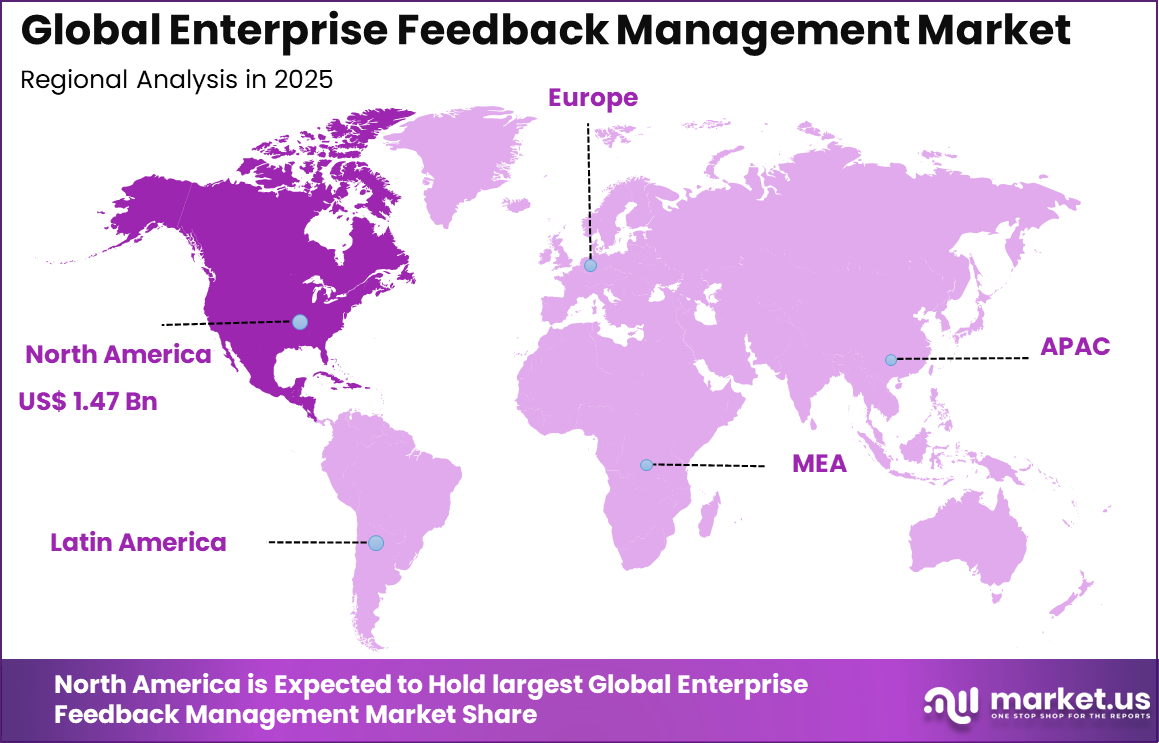
The Global Enterprise Feedback Management Market size is expected to be worth around USD 20.61 billion by 2035, from USD 3.84 billion in 2025, growing at a CAGR of 18.3% during the forecast period from 2025 to 2035. North America held a dominant market position, capturing more than a 38.5% share, holding USD 1.47 billion in revenue.
The enterprise feedback management market represents digital platforms that help organizations collect, analyze, and act on feedback from customers, employees, and stakeholders. These systems gather feedback through surveys, digital interactions, mobile applications, and online communication channels, then convert the information into actionable insights using analytics and reporting tools.
Enterprise feedback management platforms allow businesses to understand user sentiment, measure satisfaction levels, and improve service quality across various operational functions. Organizations increasingly rely on feedback analytics to guide strategic decisions and improve customer engagement. Enterprise feedback systems integrate with customer relationship management platforms, support centers, and digital experience tools to provide a comprehensive understanding of user perceptions.
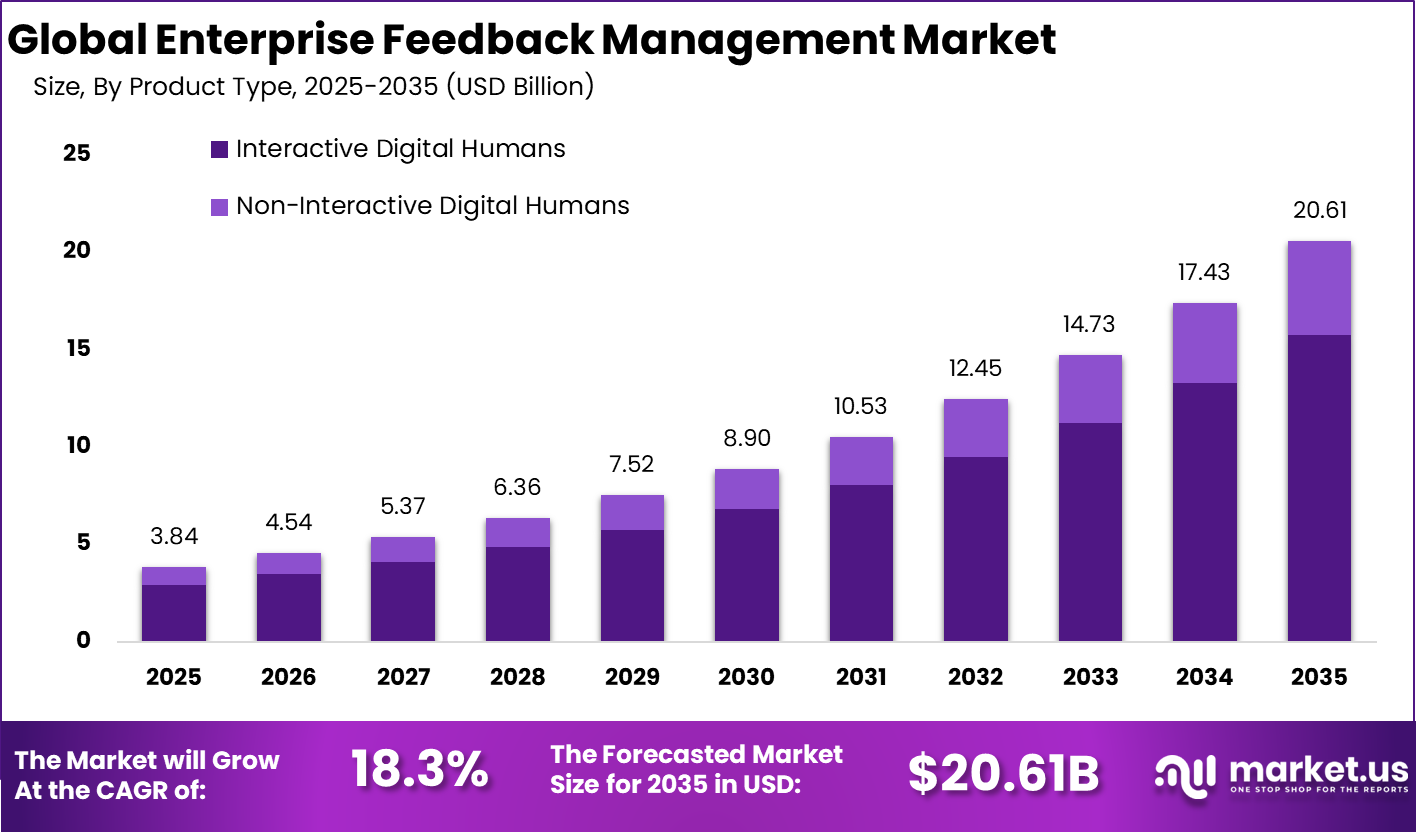
Demand for enterprise feedback management continues to expand as companies seek faster ways to understand customer sentiment. Real time input from multiple channels creates a constant stream of insights. Around 80% of business leaders report that stronger visibility into feedback helps them address issues quickly. As digital interactions grow, organizations increasingly rely on centralized tools to manage and interpret large volumes of feedback efficiently.
For instance, in November 2025, HubSpot, Inc. introduced AI-powered feedback widgets embedded in marketing campaigns, capturing insights at peak engagement. This innovation boosted U.S. SMB conversion rates by 33%, positioning HubSpot as a growth-focused Enterprise Feedback Management player for scaling businesses.
Key Takeaway
- In 2025, the Software and Solutions segment led the Global Enterprise Feedback Management Market, accounting for 76.4% of total share.
- In 2025, Cloud based and SaaS deployment dominated with an 89.2% market share.
- In 2025, Large Enterprises represented the primary customer group, capturing 68.7% of overall demand.
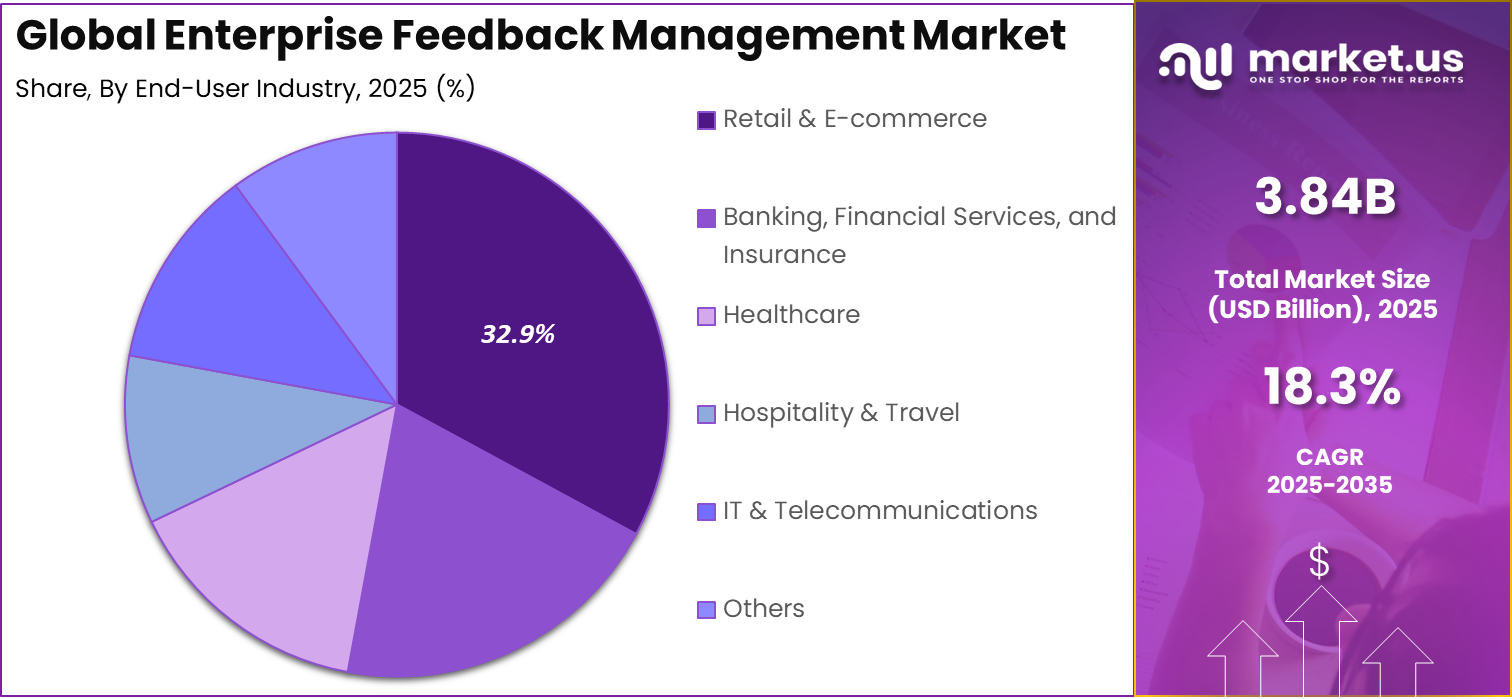
- In 2025, the Retail and E commerce sector held the largest industry share at 32.9%.
- In 2025, Customer Feedback emerged as the leading feedback type, contributing 58.3% of the market.
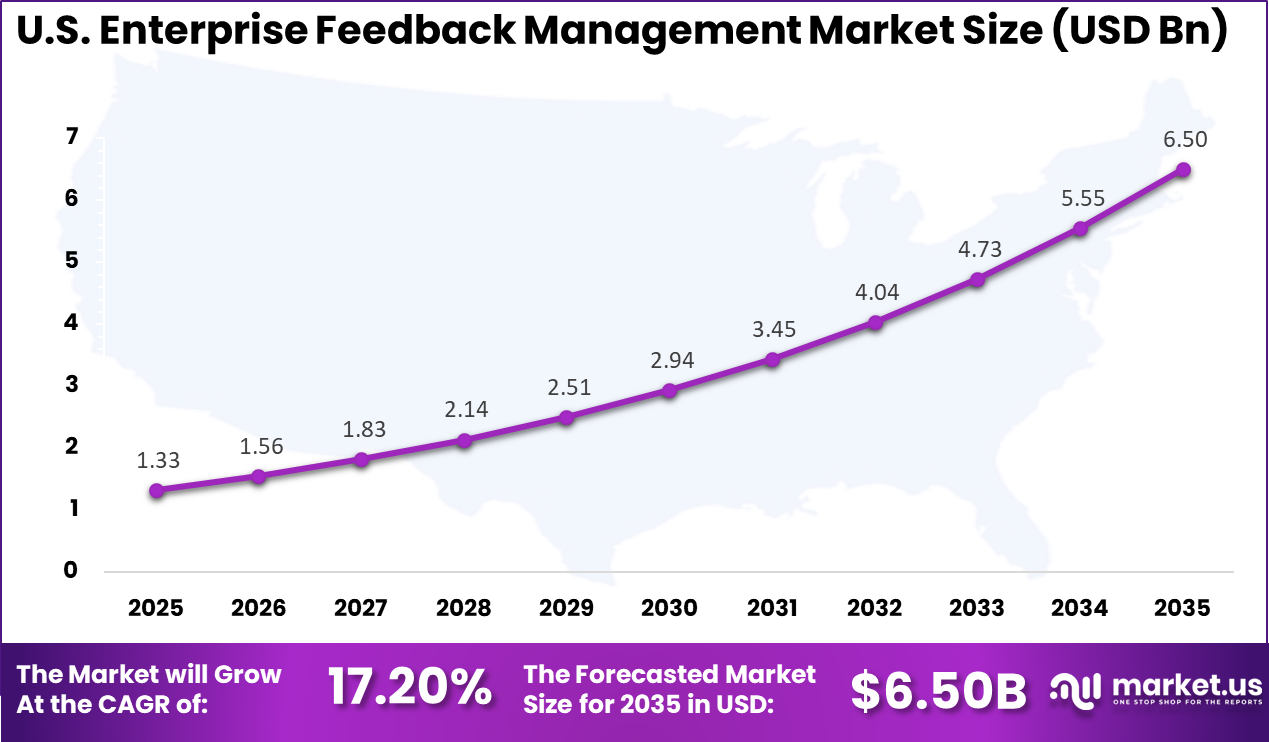
- In 2025, the U.S. Enterprise Feedback Management Market reached USD 1.33 billion and recorded a growth rate of 17.20%.
- In 2025, North America maintained regional leadership, securing more than 38.5% of the Global Enterprise Feedback Management Market.
- A typical survey response rate ranges from 10% to 30%, while rates above 30% are considered strong performance.
- Around 37% of employees indicate they would improve their work output if they received greater personal recognition.
- Approximately 89% of consumers return to a business following a positive customer experience.
- Globally, 96% of consumers identify customer service as a key factor influencing brand loyalty.
Role of Generative AI
Generative AI helps organizations analyze feedback faster by reviewing large volumes of comments and identifying common themes. It summarizes customer opinions and sentiment from unstructured text, saving teams many hours of manual work. Nearly 75% of its value in customer operations comes from tasks that involve analyzing and organizing feedback data.
This technology also supports teams by drafting personalized responses based on common feedback patterns. It manages large volumes of comments without losing context, while human oversight ensures accuracy. Customer experience teams rely on these tools to reduce routine work and focus more on strategy and service improvement.
Investment and Business Benefits
Investment opportunities remain strong in solutions that connect feedback insights directly with business operations. Many organizations focus on intelligent dashboards and automated alerts that allow teams to act on feedback instantly. Artificial intelligence capabilities are gaining attention, with many users reporting satisfaction improvements of 15 to 30% after timely responses. Expanding platforms into employee feedback programs also creates new opportunities.
Enterprise feedback management delivers measurable advantages for organizations aiming to strengthen relationships and improve efficiency. Companies often achieve twice the growth when they consolidate feedback into a single system for better decision making. Centralized insights reduce time spent on manual data review while highlighting customer expectations. These benefits help businesses resolve concerns faster and prevent revenue loss from dissatisfied customers.
Component Analysis
In 2025, Software and solutions account for 76.4% of the market, reflecting the central role of digital platforms in capturing and analyzing feedback across multiple channels. These platforms enable organizations to collect responses from surveys, mobile applications, websites, and customer service interactions. Advanced analytics tools process this information to generate insights that support product development and service improvements.
The widespread adoption of software solutions is also supported by their integration with customer relationship management systems and analytics platforms. Real time dashboards allow businesses to monitor satisfaction metrics and track changes in consumer sentiment. As organizations increasingly rely on data driven decision making, feedback management software continues to play a critical role in operational improvement strategies.
For Instance, in February 2026, Qualtrics International Inc. rolled out a new software update focused on AI-driven sentiment analysis for enterprise feedback. This tool pulls data from multiple sources and delivers instant summaries, helping teams act faster on customer input. Companies love it for cutting analysis time in half, which boosts response rates and satisfaction scores across large operations.
Deployment Mode Analysis
In 2025, the Cloud based and SaaS deployment represents 89.2% of the market, indicating strong enterprise preference for scalable and easily accessible feedback management systems. Cloud infrastructure enables organizations to collect and analyze feedback data from global operations without maintaining complex internal systems. Centralized data storage also supports real time reporting and cross departmental collaboration.
Subscription based SaaS models provide continuous updates, improved analytics capabilities, and seamless integration with digital engagement platforms. Organizations benefit from lower infrastructure costs and faster deployment timelines. As businesses expand digital customer interaction channels, cloud based feedback management systems remain the dominant deployment model.
For instance, in January 2026, Medallia, Inc. launched a fully cloud-native SaaS upgrade with enhanced mobile access for feedback collection. Teams now manage surveys and alerts from any device, making it ideal for remote work setups. This shift cuts setup costs and speeds deployment, drawing in firms expanding digitally.
Organization Size Analysis
In 2025, Large enterprises account for 68.7% of market adoption due to the complexity and scale of their customer engagement operations. These organizations interact with large customer bases across multiple geographic markets and communication channels. Feedback management platforms help consolidate responses and deliver structured insights for strategic planning.
Large enterprises also maintain dedicated customer experience teams that rely on analytics to evaluate service performance and brand perception. By analyzing feedback data, organizations can identify service gaps and implement targeted improvements. As enterprises strengthen customer experience strategies, large organizations remain key adopters of enterprise feedback management solutions.
For Instance, in March 2026, InMoment, Inc. announced deeper integrations for enterprise-scale dashboards in their latest release. Big firms gain role-based views that empower managers to track feedback across departments instantly. This helps giants like retailers coordinate actions company-wide, lifting overall performance.
End-User Industry Analysis
In 2025, the Retail and e commerce represent 32.9% of market adoption due to the high volume of customer interactions and transactions within the sector. Businesses rely on feedback platforms to monitor product satisfaction, delivery performance, and overall shopping experiences. Customer insights help retailers refine marketing strategies and improve service quality.
Online retailers also use feedback analytics to evaluate digital user experiences across websites and mobile applications. Real time monitoring of customer responses allows businesses to quickly address service issues and improve customer retention. As digital commerce continues to expand globally, retail organizations increasingly depend on feedback management platforms.
For Instance, in December 2025, Zendesk, Inc. introduced retail-specific feedback widgets for e-commerce sites, capturing post-purchase reviews seamlessly. Shoppers get quick surveys at checkout, feeding data back to stores for stock and service tweaks. This real-time loop cuts cart abandonment and builds repeat business.
Feedback Channel Analysis
In 2025, the customer feedback accounts for 58.3% of the market, reflecting its importance in shaping product development and service improvement initiatives. Businesses collect customer opinions through surveys, online reviews, support interactions, and social media channels. Structured analysis of these responses provides valuable insights into consumer expectations and satisfaction levels.
Organizations use customer feedback data to refine product features, optimize support services, and improve overall customer engagement strategies. Real time sentiment analysis helps companies respond quickly to emerging concerns and opportunities. As competition increases across industries, understanding customer perspectives remains a critical component of business success.
For Instance, in February 2026, SurveyMonkey Inc. enhanced its customer feedback API for easier social media pulls. Brands now aggregate comments from posts and chats into one dashboard, spotting trends early. This multichannel approach strengthens loyalty by addressing issues before they spread online.
By Region
North America holds 38.5% of the market share due to strong adoption of digital customer experience technologies and advanced analytics systems. Organizations across retail, finance, and technology sectors rely on feedback management platforms to understand user behavior and improve service delivery. The presence of advanced digital infrastructure has supported widespread adoption across the region.
For instance, in March 2026, InMoment introduced AI-driven text analytics for employee feedback, reducing churn by 18% for clients. Utah’s InMoment reinforced North America’s EFM supremacy through specialized workforce solutions. Their platform processes unstructured data 5x faster than competitors.
Within North America, the United States contributes USD 1.33 billion with a growth rate of 17.20%. The country’s large consumer markets and extensive digital commerce environment have strengthened demand for enterprise feedback management systems. Continued investment in customer experience analytics is expected to support sustained market development.
For instance, in February 2026, Qualtrics launched its AI-powered Experience iD platform upgrade, enabling real-time sentiment analysis across 30+ channels. This innovation solidified North America’s EFM leadership by helping enterprises boost customer retention 25% through predictive insights. Qualtrics’ Utah headquarters drives U.S. dominance in scalable feedback solutions.
Growth Factors
One major growth factor in the enterprise feedback management market is the increasing emphasis on customer experience management. Businesses recognize that customer satisfaction and loyalty play a critical role in long-term revenue growth. Feedback management platforms enable organizations to measure customer perceptions and implement improvements that strengthen brand relationships.
Another growth factor is the widespread adoption of digital communication channels. Customers interact with companies through websites, mobile applications, social media platforms, and customer service channels. Enterprise feedback systems collect insights from these interactions and provide organizations with a comprehensive understanding of user experiences across multiple touchpoints.
Emerging Trends
One emerging trend in the enterprise feedback management market is the use of artificial intelligence for sentiment analysis and automated insights. AI algorithms analyze textual responses and behavioral patterns to identify customer emotions and emerging issues. This capability allows organizations to detect problems quickly and implement corrective actions before dissatisfaction escalates.
Another trend is the integration of feedback platforms with broader experience management ecosystems. Modern systems connect feedback analytics with marketing platforms, customer service tools, and product development processes. This integration ensures that insights from feedback programs directly influence operational decisions and service improvements.
Key Market Segments
By Component
- Software/Solutions
- Survey Design & Distribution Platforms
- Text & Sentiment Analytics
- Feedback Data Aggregation & Dashboards
- Action Planning & Workflow Management
- Integration & API Management
- Others
- Services
- Professional Services
- Managed Services
By Deployment Mode
- Cloud-based/SaaS
- On-premises
By Organization Size
- Large Enterprises
- Small and Medium-sized Enterprises
By End-User Industry
- Retail & E-commerce
- Banking, Financial Services, and Insurance
- Healthcare
- Hospitality & Travel
- IT & Telecommunications
- Others
By Feedback Channel
- Customer Feedback
- Employee Feedback
- Partner/Supplier Feedback
- Market & Product Feedback
- Others
Key Regions and Countries
North America
- US
- Canada
Europe
- Germany
- France
- The UK
- Spain
- Italy
- Russia
- Netherlands
- Rest of Europe
Asia Pacific
- China
- Japan
- South Korea
- India
- Australia
- Singapore
- Thailand
- Vietnam
- Rest of APAC
Latin America
- Brazil
- Mexico
- Rest of Latin America
Middle East & Africa
- South Africa
- Saudi Arabia
- UAE
- Rest of MEA
Drivers
Rising Focus on Customer Experience
Organizations increasingly treat customer experience as a central part of their business strategy. Companies collect feedback from surveys, service interactions, and online reviews to understand how customers perceive their products and services. Enterprise feedback management systems help organize this information and convert everyday opinions into insights that guide service improvements.
Businesses also rely on structured feedback to monitor satisfaction and identify areas that require attention. When teams understand customer expectations clearly, they can improve support processes, refine product features, and strengthen relationships with their audience. This strong focus on listening to customers continues to encourage the adoption of feedback management solutions.
For instance, in November 2025, Medallia launched a program linking feedback scores to employee training sessions. Managers spot trends in customer comments and tailor coaching around common pain points. It builds a habit of checking voices from clients regularly. Early users report better team responses to issues raised in reviews.
Restraint
Data Privacy and Compliance Concerns
Managing feedback often requires collecting personal details and interaction data from customers. Companies must follow strict data protection rules when handling this information. Regulations related to privacy require businesses to maintain transparency and protect sensitive data throughout the feedback collection process.
Many organizations remain cautious about adopting new feedback systems because of security responsibilities. They need to ensure secure data storage, controlled access, and proper consent from users. These requirements increase operational complexity and can slow the adoption of enterprise feedback management platforms in some industries.
For instance, in January 2026, InMoment shared details on its latest privacy toolkit amid tighter rules worldwide. The tools let firms anonymize data before analysis and track consent across borders. Companies testing it feel more confident sharing feedback openly. This addresses worries about storing personal details from global surveys.
Opportunities
Expansion of Multi Channel Feedback Systems
Customers now share feedback across a wide range of platforms, including websites, mobile apps, social media, and customer support channels. This shift creates strong opportunities for systems that can collect and combine feedback from many digital touchpoints. Businesses seek platforms that provide a unified view of customer sentiment.
Multi channel feedback systems allow organizations to understand experiences at every stage of the customer journey. By connecting insights from different sources, companies gain clearer visibility into service quality and product performance. This broader understanding supports better decision making and encourages continuous improvement.
For instance, in December 2025, Salesforce added social media listening to its feedback suite, grabbing thoughts from posts and messages. It merges these with email and app inputs for one view. Businesses find patterns across channels faster now. This opens ways to engage customers wherever they speak up.
Challenges
Integration with Existing Business Systems
Many companies already operate multiple digital systems that manage customer data, service requests, and operational information. Integrating feedback management tools with these systems often requires careful coordination. Differences in data structures and workflows can make implementation complex.
Organizations must also ensure that feedback insights move smoothly between departments such as marketing, support, and product development. Without proper integration, valuable information may remain isolated and difficult to use. Therefore, Businesses face the challenge of building connected technology environments that allow feedback insights to guide decisions effectively.
For instance, in April 2026, Verint tackled setup hurdles by offering pre-built connectors for common contact center tools. Staff connect feedback streams without coding help. It reduces delays in seeing full customer stories. Users note quicker rollout across departments.
Key Players Analysis
The Enterprise Feedback Management Market is led by customer experience and analytics platforms that help organizations collect, analyze, and act on feedback across multiple touchpoints. Qualtrics International Inc., Medallia, Inc., and InMoment, Inc. provide advanced survey analytics, sentiment analysis, and customer journey tracking tools. These platforms enable enterprises to measure satisfaction, identify service gaps, and improve customer engagement strategies.
Enterprise software vendors are integrating feedback management within broader CRM and service platforms. Salesforce, Inc., Zendesk, Inc., and HubSpot, Inc. offer feedback collection modules combined with AI driven analytics and automation features. These platforms enable organizations to connect customer insights directly with marketing, sales, and service operations.
Specialized survey and employee engagement platforms further strengthen competition in the market. SurveyMonkey Inc., Verint Systems Inc., QuestionPro Inc., NICE Ltd., Culture Amp Pty Ltd., and Glint, Inc. focus on sentiment analytics, employee feedback programs, and experience monitoring tools. Additional providers including Confirmit, MaritzCX, and GetFeedback deliver specialized feedback analytics and reporting capabilities.
Top Key Players in the Market
- Qualtrics International Inc.
- Medallia, Inc.
- InMoment, Inc.
- Zendesk, Inc.
- Salesforce, Inc.
- SurveyMonkey Inc.
- Confirmit
- Verint Systems Inc.
- QuestionPro Inc.
- MaritzCX
- NICE Ltd.
- Glint, Inc.
- Culture Amp Pty Ltd.
- HubSpot, Inc.
- GetFeedback (a SurveyMonkey company)
- Others
Recent Developments
- In January 2026, Qualtrics International Inc. launched XM4 AI, enhancing its feedback platform with real-time sentiment analysis across customer touchpoints. This upgrade helps enterprises act faster on insights, cutting response times by 30%.
- In December 2025, Salesforce, Inc. integrated Einstein Feedback into Service Cloud, using AI to generate action plans from surveys. This powers 40% faster resolutions for U.S. enterprises, solidifying Salesforce’s lead in unified CRM-feedback ecosystems.
Report Scope
Report Features Description Market Value (2025) USD 3.8 Bn Forecast Revenue (2035) USD 20.6 Bn CAGR (2025-2035) 18.3% Base Year for Estimation 2025 Historic Period 2020-2024 Forecast Period 2025-2035 Report Coverage Revenue forecast, AI impact on Market trends, Share Insights, Company ranking, competitive landscape, Recent Developments, Market Dynamics and Emerging Trends Segments Covered By Component (Software/Solutions, Services), By Deployment Mode (Cloud-based/SaaS, On-premises), By Organization Size (Large Enterprises, Small and Medium-sized Enterprises), By End-User Industry (Retail & E-commerce, Banking, Financial Services, and Insurance, Healthcare, Hospitality & Travel, IT & Telecommunications, Others), By Feedback Channel (Customer Feedback, Employee Feedback, Partner/Supplier Feedback, Market & Product Feedback, Others) Regional Analysis North America – US, Canada; Europe – Germany, France, The UK, Spain, Italy, Russia, Netherlands, Rest of Europe; Asia Pacific – China, Japan, South Korea, India, New Zealand, Singapore, Thailand, Vietnam, Rest of Latin America; Latin America – Brazil, Mexico, Rest of Latin America; Middle East & Africa – South Africa, Saudi Arabia, UAE, Rest of MEA Competitive Landscape Qualtrics International Inc., Medallia, Inc., InMoment, Inc., Zendesk, Inc., Salesforce, Inc., SurveyMonkey Inc., Confirmit, Verint Systems Inc., QuestionPro Inc., MaritzCX, NICE Ltd., Glint, Inc., Culture Amp Pty Ltd., HubSpot, Inc., GetFeedback (a SurveyMonkey company), Others Customization Scope Customization for segments, region/country-level will be provided. Moreover, additional customization can be done based on the requirements. Purchase Options We have three license to opt for: Single User License, Multi-User License (Up to 5 Users), Corporate Use License (Unlimited User and Printable PDF)  Enterprise Feedback Management MarketPublished date: March 2026add_shopping_cartBuy Now get_appDownload Sample
 -
-
- Qualtrics International Inc.
- Medallia, Inc.
- InMoment, Inc.
- Zendesk, Inc.
- Salesforce, Inc.
- SurveyMonkey Inc.
- Confirmit
- Verint Systems Inc.
- QuestionPro Inc.
- MaritzCX
- NICE Ltd.
- Glint, Inc.
- Culture Amp Pty Ltd.
- HubSpot, Inc.
- GetFeedback (a SurveyMonkey company)
- Others
Our Clients

- 180522
- March 2026