


Report Overview
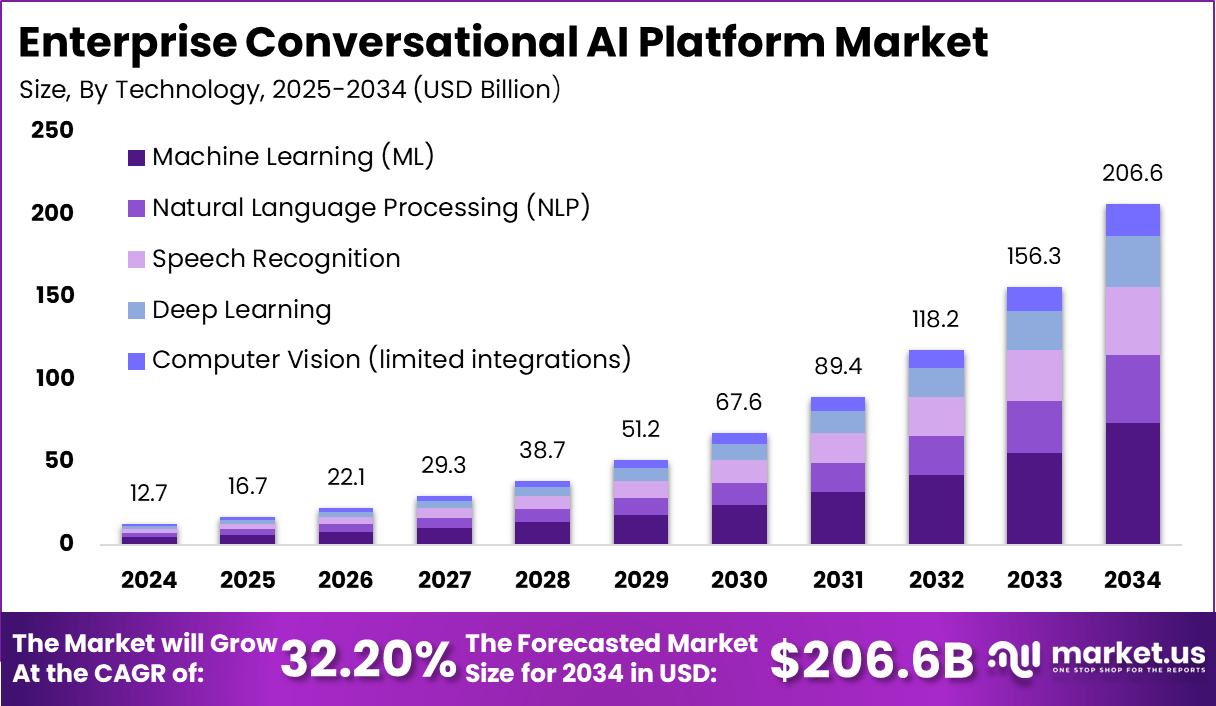
The Global Enterprise Conversational AI Platform Market, valued at USD 12.67 billion in 2024, is projected to reach USD 206.6 billion by 2034, expanding at a CAGR of 32.2%. The surge is driven by the widespread adoption of AI-powered conversational systems that automate communication, customer support, and workflow management. North America dominates the global market, holding a 33.8% share in 2024 with a valuation of USD 4.28 billion.
Enterprises are adopting natural language processing (NLP), generative AI, and machine learning to improve user interactions, productivity, and personalized experiences. Demand for intelligent virtual assistants and chatbots is also increasing across industries.
The enterprise conversational AI platform market recorded strong acquisition activity in 2025. NiCE acquired Cognigy for approximately $955 million, adding conversational AI capabilities to its customer experience portfolio and gaining access to more than 1,000 enterprise clients.
Startup funding also remained strong, with over $2.8 billion disclosed during 2024 and the first half of 2025. In January 2025, Uniphore raised $400 million in Series E funding at a valuation of $2.5 billion to expand conversational automation solutions.
Other major funding rounds included PolyAI’s $50 million Series C and Mistral AI’s $640 million Series B. These investments reflect rising confidence in large language models, enterprise automation, and conversational AI platforms.
Key Takeaways
- The global Enterprise Conversational AI Platform Market is valued at USD 12.67 billion in 2024 and is projected to reach USD 206.6 billion by 2034, expanding at a CAGR of 32.2%.
- By Component, Solutions/Platforms hold the dominant share of 67.7%, driven by increasing enterprise adoption of AI-integrated communication tools.
- By Deployment Mode, On-Premises accounts for 70.2%, attributed to data privacy, compliance, and security requirements in large organizations.
- By Technology, Machine Learning (ML) leads with 35.6%, reflecting its critical role in enabling adaptive, context-aware conversational experiences.
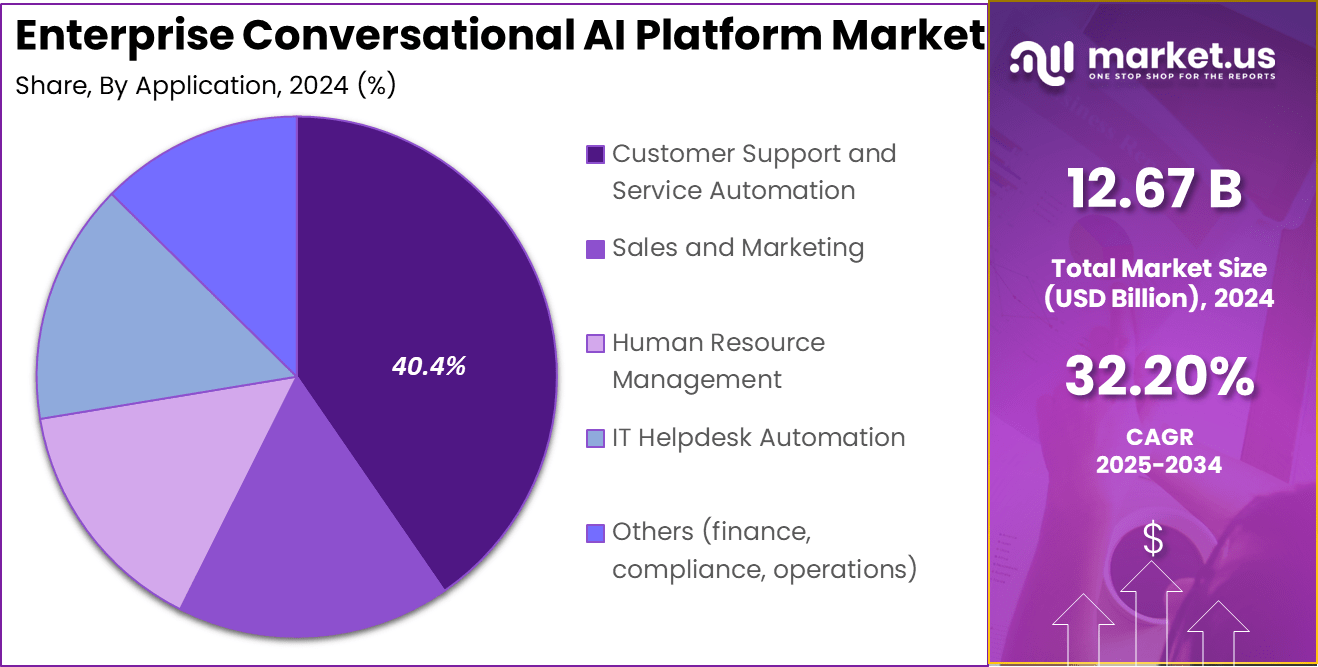
- By Application, Customer Support and Service Automation capture 40.4%, supported by the growing demand for efficient, round-the-clock interaction systems.
- By End-Use Industry, BFSI represents 30.2%, as financial institutions increasingly deploy AI chatbots and assistants for customer engagement and fraud prevention.
- By Interaction Type, Text-Based communication dominates with 48.5%, owing to widespread integration in customer messaging, live chat, and support interfaces.
- North America dominates the global market, accounting for a 33.8% share with a 2024 valuation of USD 4.28 billion.
- The US leads the regional landscape with a 2024 size of USD 3.68 billion and is expected to grow to USD 43.45 billion by 2034, registering a CAGR of 28%.
Role Of AI
Artificial intelligence plays a central role in shaping the Enterprise Conversational AI Platform market by driving automation, personalization, and scalability in enterprise communication. AI technologies such as natural language processing (NLP), machine learning (ML), and large language models (LLMs) enable systems to understand, interpret, and respond to human language with contextual accuracy.
This capability allows organizations to create seamless, human-like interactions across customer service, HR, sales, and internal collaboration channels. AI enhances efficiency by automating repetitive tasks, reducing human intervention, and improving response times, which collectively boost customer satisfaction and operational productivity.
The integration of AI also empowers enterprises with data-driven insights and adaptive learning capabilities. Machine learning models continuously analyze user behavior and conversation patterns, enabling platforms to deliver personalized responses and predictive assistance. Generative AI further strengthens conversational platforms by enabling dynamic content generation, sentiment analysis, and multi-language support.
Industry Adoption
The adoption of AI across industries has moved beyond experimentation to steady integration, with 88% of organizations reporting regular use of AI in at least one business function, up from 78% a year earlier. However, only 23% of respondents say they are scaling agentic AI systems across multiple functions. In the context of conversational AI specifically, organizations are rapidly embracing platforms to improve customer engagement and operational efficiency.
The use of conversational analytics, AI, and automation is forecast to rise steeply—from 17% to as much as 76%—as more enterprises invest in these technologies. Industries such as BFSI, healthcare, retail, and IT services are leading this adoption, leveraging conversational AI for customer support, virtual assistants, and internal workflow automation.

Despite strong momentum, adoption varies by region and firm size: larger enterprises and tech-intensive firms lead, whereas many small firms and firms in less AI-mature geographies remain in pilot phases. The trend suggests that while AI adoption is widespread, scaling across business functions and achieving enterprise-wide integration remain key challenges.
Emerging Trends
- Conversational AI is moving from rule-based chatbots to intelligent agents that use context, memory, and real-time data to deliver personalised interactions.
- Multimodal experiences combining text, voice, and visual inputs (e.g., voice assistants, video chatbots, AR-enabled agents) are becoming more common, enhancing user engagement and accessibility.
- Multilingual and cross-region support is gaining significance as enterprises serve global audiences, driving conversational AI systems to handle language variants, local dialects, and translation in real time.
- Integration with enterprise systems (CRM, knowledge bases, workflow tools) is deepening, enabling conversational platforms to fetch data, trigger actions, and provide seamless hand-offs between bot and human.
- Adoption of low-code/no-code platforms is rising, enabling business users to configure conversational agents without heavy developer dependency, thereby accelerating deployment and reducing time-to-value.
- Enhanced analytics, sentiment detection, emotional intelligence, and adaptive learning are enabling conversational agents to improve over time, recognize tone or mood, and refine responses based on user behaviour.
- Privacy, governance, and compliance are becoming integral, particularly for regulated industries; conversational platforms are being built with audit trails, secure data pipelines, and domain-specific controls.
By Component
Solutions and Platforms account for 67.7% of the enterprise conversational AI platform market, underscoring the strong enterprise preference for scalable, ready-to-deploy systems that combine natural language processing, machine learning, and automation capabilities. These platforms enable organizations to build, train, and deploy intelligent virtual assistants and chatbots seamlessly across multiple communication channels, improving response times and enhancing customer engagement.
The growing emphasis on digital transformation and self-service models has further accelerated adoption, as enterprises seek unified solutions that integrate easily with CRM, ERP, and workflow management systems to deliver consistent, efficient, and data-driven interactions.
Services, including professional and managed offerings, hold a smaller share but play a vital supporting role in the ecosystem. These services are essential for implementing, customizing, and maintaining AI platforms according to enterprise-specific needs, ensuring alignment with compliance and data governance standards.
By Deployment Mode
The Deployment Mode segment of the enterprise conversational AI platform market shows that on-premises deployment accounts for 70.2% of the total, reflecting strong enterprise preference for control, data sovereignty, and integration with existing infrastructure.
Organizations in highly regulated industries such as banking, healthcare, and government often favour on-premises models because they enable tighter oversight of security, data residency, and compliance requirements. On-premises platforms also provide opportunities for deep customization, optimized performance for internal workflows, and lower long-term ownership costs for large-scale stable workloads.
By Technology
The Technology segment of the enterprise conversational AI platform market indicates that machine learning (ML) holds a leading share of 35.6%, demonstrating its critical role in enabling conversational systems to learn from data and improve over time. ML algorithms are foundational to conversational AI, powering tasks such as intent detection, dialogue management, and response generation.
Alongside ML, natural language processing (NLP) plays a vital part by enabling these systems to interpret user inputs, extract meaning, and generate human-like responses. The integration of NLP with ML creates a feedback loop where learning continuously refines language understanding and system performance.
Computer vision, though currently limited in adoption within this market, is increasingly being integrated to support multimodal interactions—combining text, voice, and visual inputs—to deliver richer conversational experiences.
By Application
The Application segment shows that customer support and service automation account for 40.4% of the enterprise conversational AI platform market, which highlights its position as the primary use case driving demand. This dominance reflects the urgent need for enterprises to automate high-volume, repetitive customer interactions and to improve responsiveness across digital channels.
By leveraging conversational AI, organizations can reduce wait times, support 24/7 service, and allow human agents to focus on more complex tasks. Beyond customer support and service, the market is expanding into sales and marketing, human resource management, IT helpdesk automation, and other functions such as finance, compliance, and operations.
By End-Use Industry
The end-use industry segment shows that the BFSI industry holds a 30.2% share of the market, underscoring its leading role in adopting enterprise conversational AI platforms. BFSI firms are projected to continue driving demand as they increasingly deploy chatbots and virtual assistants for customer service automation, fraud detection, account management, and advisory services.
The adoption is driven by heightened customer expectations for instant, personalized service and the imperative to reduce cost-to-serve while improving scalability and operational resilience. Research highlights that conversational AI in banking facilitates 24/7 service, richer personalization, and smarter automation of routine interactions.
By Interaction Type
The Text-Based interaction type holds a 48.5% share in the interaction-type segmentation of the enterprise conversational AI platform market, underscoring its dominant role in how users currently engage with AI-driven systems. Text-based interfaces remain preferred in enterprise environments due to their ease of deployment, integration into existing digital channels (such as websites, chatbots, and messaging apps), and relatively lower complexity compared to voice or multimodal systems.
Many organisations prioritise typed chats and messaging-based virtual assistants because they are cost-effective, scalable across geographies, and well aligned with asynchronous workflows typical in customer service and internal support. Voice-based interaction and multi-modal (voice + text + vision) approaches occupy the remaining share of the market, reflecting growing interest but comparatively slower adoption.
Key Market Segments
By Component
- Solutions/Platforms
- Services (Professional and Managed)
By Deployment Mode
- On-Premises
- Cloud-Based
By Technology
- Machine Learning (ML)
- Natural Language Processing (NLP)
- Speech Recognition
- Deep Learning
- Computer Vision (limited integrations)
By Application
- Customer Support and Service Automation
- Sales and Marketing
- Human Resource Management
- IT Helpdesk Automation
- Others (finance, compliance, operations)
By End-Use Industry
- BFSI
- Retail and E-commerce
- Healthcare
- IT and Telecom
- Manufacturing
- Travel and Hospitality
- Education
- Others (government, logistics, energy)
By Interaction Type
- Text-Based
- Voice-Based
- Multi-Modal (voice + text + vision)
Regional Analysis
North America accounts for 33.8% of the global enterprise conversational AI platform market, with a 2024 valuation of USD 4.28 billion, positioning it as the leading regional market. The region’s dominance is attributed to its strong technological ecosystem, high enterprise digital maturity, and early adoption of AI-driven communication systems.
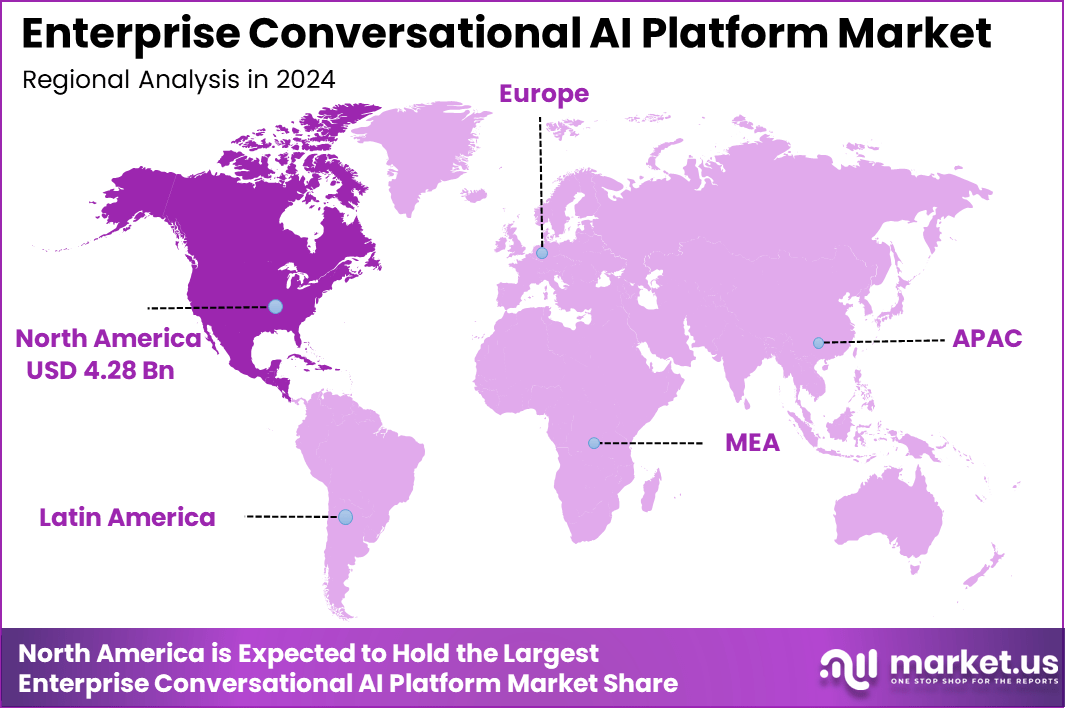
Enterprises across industries such as BFSI, IT & telecom, retail, and healthcare are increasingly implementing conversational AI to enhance customer engagement, automate workflows, and improve operational efficiency. The region’s well-established infrastructure, availability of advanced AI models, and widespread integration of natural language processing (NLP) and machine learning (ML) technologies have accelerated platform deployment across both large enterprises and mid-sized firms.
The US remains the core contributor to regional growth, supported by robust investments in AI research, cloud infrastructure, and enterprise automation solutions. Leading technology providers, including Google, IBM, Microsoft, and Amazon, are continuously innovating in conversational AI, offering platforms with enhanced contextual understanding and real-time analytics.
US Market Size
The US enterprise conversational AI platform market is witnessing exceptional growth, driven by rapid advancements in artificial intelligence, natural language processing (NLP), and generative AI technologies. Valued at USD 3.68 billion in 2024, the market is projected to surge to USD 43.45 billion by 2034, expanding at a CAGR of 28%.
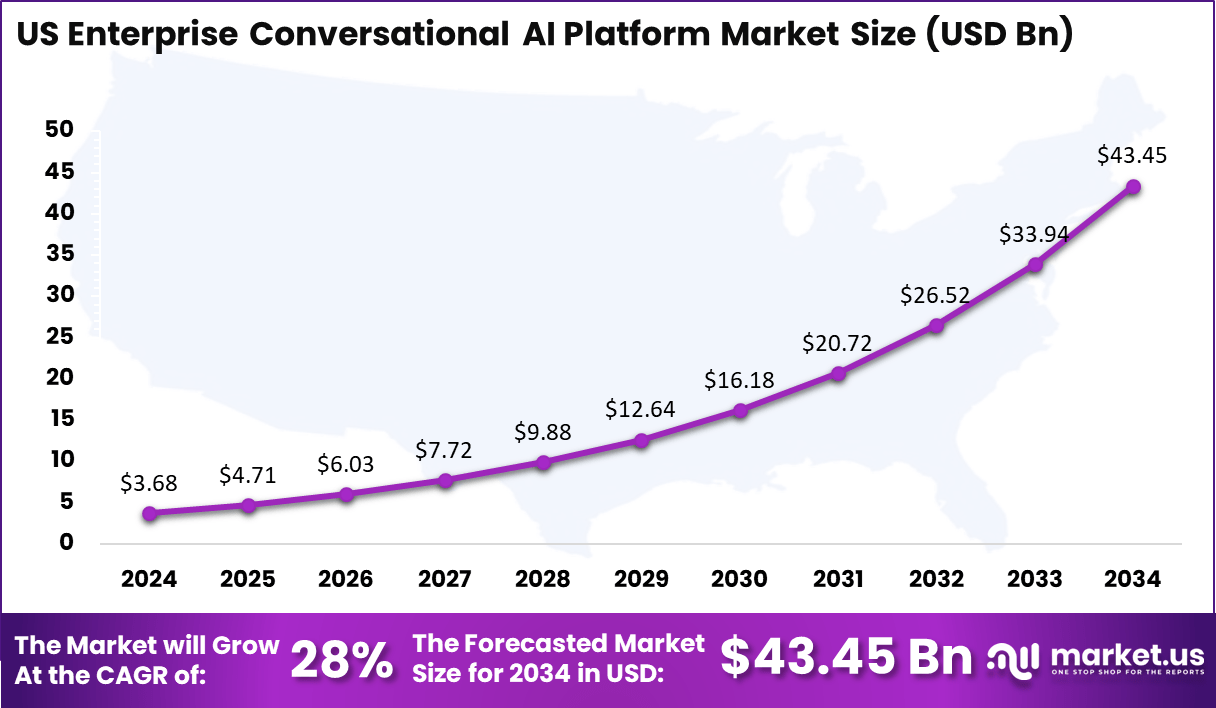
This growth is primarily attributed to the increasing demand for AI-powered virtual assistants, chatbots, and voice-based systems that enhance customer interaction, streamline enterprise workflows, and reduce operational costs. Enterprises across industries, particularly BFSI, healthcare, retail, and IT services, are adopting conversational AI to automate service delivery and improve engagement efficiency.
The US remains at the forefront of technological innovation due to its robust AI ecosystem, extensive R&D investments, and strong presence of leading tech companies such as Google, Microsoft, IBM, and Amazon. The adoption of large language models (LLMs) in enterprise systems has further accelerated market expansion by enabling more natural, context-aware conversations.
Regional Analysis and Coverage
- North America
- US
- Canada
- Europe
- Germany
- France
- The UK
- Spain
- Italy
- Russia
- Netherlands
- Rest of Europe
- Asia Pacific
- China
- Japan
- South Korea
- India
- Australia
- Singapore
- Thailand
- Vietnam
- Rest of Latin America
- Latin America
- Brazil
- Mexico
- Rest of Latin America
- Middle East & Africa
- South Africa
- Saudi Arabia
- UAE
- Rest of MEA
Market Dynamics
Drivers
| Driver | (~) % CAGR | Geographic Relevance | Impact Timeline |
|---|---|---|---|
| Agentic workflow embedding into enterprise SaaS stacks | +4.1% | North America, Western Europe | Short term (2 years or less) |
| Contact center labor cost arbitrage via LLM deflection | +3.2% | Global | Short term (2 years or less) |
| Cloud hyperscaler bundling of conversational AI into existing enterprise contracts | +2.6% | North America, APAC | Short term (2 years or less) |
| Vertical-specific fine-tuned model adoption in banking and healthcare | +1.9% | North America, Europe | Medium term (2 to 4 years) |
| Migration from legacy IVR/rules-based bots to LLM-native platforms | +1.5% | Global | Medium term (2 to 4 years) |
| Rising multilingual and voice-enabled deployment in emerging markets | +1.1% | APAC, Latin America | Medium term (2 to 4 years) |
Agentic Workflow Embedding Reshapes Enterprise Software Economics
The shift from single-turn chatbots to continuous agentic workflows embedded in CRM, ERP, and helpdesk platforms is supporting the 32.2% growth baseline. This transition contributes an estimated 4.1% uplift as vendors move from seat-based pricing to consumption- and outcome-based billing.
Agentic AI features were embedded in fewer than 5% of enterprise applications in September 2025 but are projected to reach 40% by the end of 2026. This represents an approximately eightfold increase within 12 months and could reduce customer acquisition costs by 15% to 20%.
The transition is also expected to reduce gross margins for legacy seat-based vendors by around 300 to 500 basis points. However, platforms built around agent orchestration may achieve higher contract values and customer lifetime value through usage-based billing entering 2026.
Restraints
| Restraint | (~) % CAGR | Geographic Relevance | Impact Timeline |
|---|---|---|---|
| AI infrastructure memory and GPU supply shortage | -2.8% | Global | Short term (2 years or less) |
| EU AI Act high-risk system compliance freeze on new deployments | -1.7% | European Union | Short term (2 years or less) |
| Elevated enterprise IT capital rationing amid high borrowing costs | -1.2% | North America, Europe | Short term (2 years or less) |
| Explicit sector-level bans on unsupervised AI decisioning in regulated finance | -0.9% | North America, APAC | Short term (2 years or less) |
| Data residency and sovereign cloud mandates blocking cross-border model hosting | -0.7% | Middle East, APAC | Short term (2 years or less) |
Memory And GPU Supply Shortage Freezes Deployment Timelines
The reallocation of global DRAM and NAND capacity toward high-bandwidth memory for AI data centers is expected to keep chip prices elevated through 2027. Data center GPU lead times have reached 36 to 52 weeks, causing procurement delays of 9 to 12 months for on-premises and private cloud conversational AI deployments.
Memory shortages could increase hardware selling prices by 4% to 8% if supply pressure continues into 2026. As a result, CFOs may delay capital expenditure approvals by 1 to 2 fiscal quarters, while platform vendors adopt smaller models to limit an estimated 300 to 600 basis points of input cost inflation.
Challenges
| Challenge | (~) % CAGR | Geographic Relevance | Mitigation Horizon |
|---|---|---|---|
| AI governance talent deficit | -1.6% | Global | Medium term (2 to 4 years) |
| Model hallucination liability exposure | -1.3% | Global | Medium term (2 to 4 years) |
| Legacy system integration complexity | -1.1% | North America, Europe | Medium term (2 to 4 years) |
| Multi-vendor model interoperability drag | -0.8% | Global | Long term (4 years or more) |
| Rising inference cost per active seat | -0.7% | Global | Medium term (2 to 4 years) |
AI Governance Talent Deficit Slows Scale-Up Velocity
A major structural challenge is the shortage of AI governance, risk, compliance, and MLOps professionals. More than 1 million specialized roles are expected to remain unfilled globally heading into 2026, limiting the ability of enterprises to meet the EU AI Act’s Article 4 AI literacy requirements and similar rules in the United States and APAC.
This shortage is extending conversational AI deployment timelines by 3 to 6 months, particularly for high-risk system requirements taking effect on August 2, 2026. Compliance staffing is also increasing total platform ownership costs by an estimated 8% to 12%, encouraging enterprises in banking and healthcare to establish permanent governance teams and third-party audit partnerships.
Opportunities
| Opportunity | (~) % CAGR | Geographic Relevance | Execution Window |
|---|---|---|---|
| Adjacent expansion into embedded finance and insurance advisory agents | +2.3% | North America, Europe | Medium term (2 to 4 years) |
| Sovereign and edge-hosted model roll-ups in regulated markets | +1.8% | Middle East, APAC | Medium term (2 to 4 years) |
| Outcome-based monetization replacing per-seat licensing | +1.6% | Global | Long term (4 years or more) |
| SME-tier self-serve platform penetration in underserved verticals | +1.4% | Latin America, Southeast Asia | Medium term (2 to 4 years) |
| M&A consolidation of fragmented point-solution vendors | +1.0% | North America, Europe | Long term (4 years or more) |
Embedded Finance And Insurance Advisory Agents Represent Untapped White Space
Deploying conversational AI as licensed advisory agents in embedded finance and insurance remains largely untapped because new regulatory approvals and liability frameworks are still required. This opportunity represents a potential future growth uplift of 2.3%, while more than 70% of advisory-style customer interactions are still handled by human staff.
Successful adoption could increase platform vendor gross margins by an estimated 4 to 6 percentage points and reduce the cost per resolved interaction by 25% to 35%. Wider deployment is expected once approved advisory licensing frameworks are established alongside the EU AI Act’s high-risk system provisions by August 2, 2028.
Competitive Analysis
The competitive landscape of the enterprise conversational AI platform market is marked by strong participation from global technology titans and agile specialist vendors. Key players such as Microsoft, Google, IBM (via Watson Assistant), Amazon Web Services (AWS), Oracle, SAP SE, and Nuance Communications dominate the market through broad platform offerings, cloud integration, multi-channel capabilities, and enterprise-grade governance.
These incumbents benefit from large installed bases, deep AI research, and extensive ecosystem partnerships. Specialist players such as Rasa Technologies Inc., Kore.ai, Inc., Yellow.ai, and Haptik provide highly focused solutions tailored for verticals, multilingual support, and innovation in conversational workflows.
Competitive differentiation is increasingly driven by the following factors: deep domain knowledge (e.g., financial services, healthcare), integration with enterprise systems (CRM, ERP, knowledge bases), strong data-governance capabilities (critical for on-premises deployment), and advanced AI features such as large language model (LLM) support, conversational memory, and multimodal interaction.
Top Key Players in the Market
- Microsoft
- Amazon Web Services
- IBM Watson Assistant
- Rasa
- LivePerson
- Genesys
- Twilio
- Cognigy
- Kore.ai
- Ada (Ada Support)
- Yellow.ai
- ServiceNow (Virtual Agent)
- Nuance
- Inbenta
- Recent De
- Others
Recent Developments
- In August 2025, Google LLC was named a Leader and placed furthest in vision in the 2025 Gartner Magic Quadrant for Conversational AI Platforms report.
- In July 2025, Gupshup Inc. raised over USD 60 million in a combined equity and debt financing round to accelerate global expansion and enhance its AI-driven messaging and conversational-agent capabilities.
- In June 2025, Synthflow AI, a Berlin-based startup focused on enterprise voice agents, secured USD 20 million in a Series A led by Accel Partners. The funding will support an upcoming U.S. office and further development of its no-code voice agent platform for customer support.
Report Scope
| Report Features | Description |
|---|---|
| Market Value (2024) | USD 12.67 Billion |
| Forecast Revenue (2034) | USD 206.6 Billion |
| CAGR(2025-2034) | 32.2% |
| Base Year for Estimation | 2024 |
| Historic Period | 2020-2023 |
| Forecast Period | 2025-2034 |
| Report Coverage | Revenue forecast, AI impact on Market trends, Share Insights, Company ranking, competitive landscape, Recent Developments, Market Dynamics, and Emerging Trends |
| Segments Covered | By Component (Solutions/Platforms, Services (Professional and Managed)), By Deployment Mode (On-Premises, Cloud-Based), By Technology (Machine Learning (ML), Natural Language Processing (NLP), Speech Recognition, Deep Learning, Computer Vision (limited integrations)), By Application (Customer Support and Service Automation, Sales and Marketing, Human Resource Management, IT Helpdesk Automation, Others (finance, compliance, operations)), By End-Use Industry (BFSI, Retail and E-commerce, Healthcare, IT and Telecom, Manufacturing, Travel and Hospitality, Education, Others (government, logistics, energy)), By Interaction Type (Text-Based, Voice-Based, Multi-Modal (voice + text + vision)) |
| Regional Analysis | North America – US, Canada; Europe – Germany, France, The UK, Spain, Italy, Russia, Netherlands, Rest of Europe; Asia Pacific – China, Japan, South Korea, India, New Zealand, Singapore, Thailand, Vietnam, Rest of Latin America; Latin America – Brazil, Mexico, Rest of Latin America; Middle East & Africa – South Africa, Saudi Arabia, UAE, Rest of MEA |
| Competitive Landscape | Microsoft, Google, Amazon Web Services, IBM Watson Assistant, Rasa, LivePerson, Genesys, Twilio, Cognigy, Kore.ai, Ada (Ada Support), Yellow.ai, ServiceNow (Virtual Agent), Nuance, Inbenta, Recent De, Others |
| Customization Scope | Customization for segments, region/country-level will be provided. Moreover, additional customization can be done based on the requirements. |
| Purchase Options | We have three licenses to opt for: Single User License, Multi-User License (Up to 5 Users), Corporate Use License (Unlimited Users and Printable PDF) |





























