


Report Overview
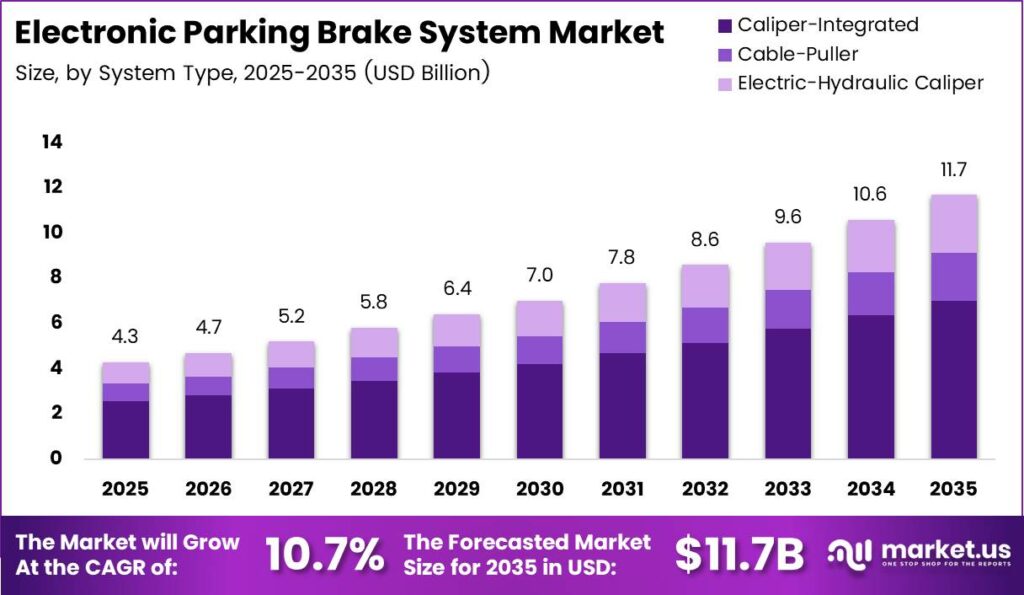
Global Electronic Parking Brake System Market size is expected to be worth around USD 11.7 Billion by 2035 from USD 4.3 Billion in 2025, growing at a CAGR of 10.7% during the forecast period 2026 to 2035.
The electronic parking brake system market covers motorized actuator assemblies, electronic control units, cabin switches, sensors, and supporting software that replace conventional lever-and-cable parking mechanisms in passenger and commercial vehicles. This reflects a shift in braking architecture from mechanical to fully electronic control across vehicle segments. Suppliers deliver complete caliper-integrated and cable-puller system configurations to both OEM production lines and the aftermarket.
Key Takeaways
- Market size reached USD 4.3 Billion in 2025 and is forecast to reach USD 11.7 Billion by 2035.
- The market grows at a CAGR of 10.7% during the forecast period 2026 to 2035.
- By System Type, Caliper-Integrated (Motor-on-Caliper) holds the dominant position with a 54.1% share.
- By Vehicle Type, Passenger Cars (Sedans, Hatchbacks, SUVs) lead with a 64.4% share.
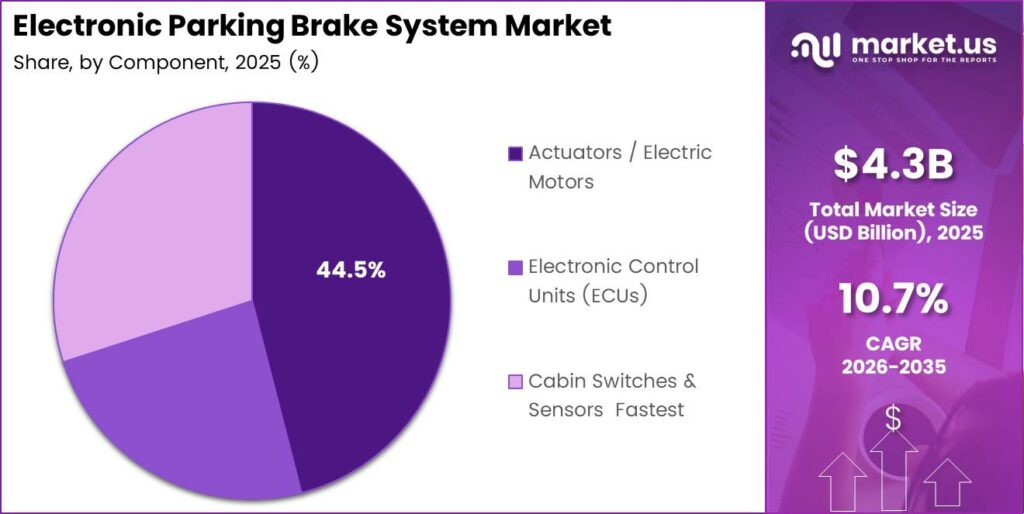
- By Component, Actuators/Electric Motors dominate with a 44.5% share.
- By Sales Channel, OEM holds the dominant position with an 82.2% share.
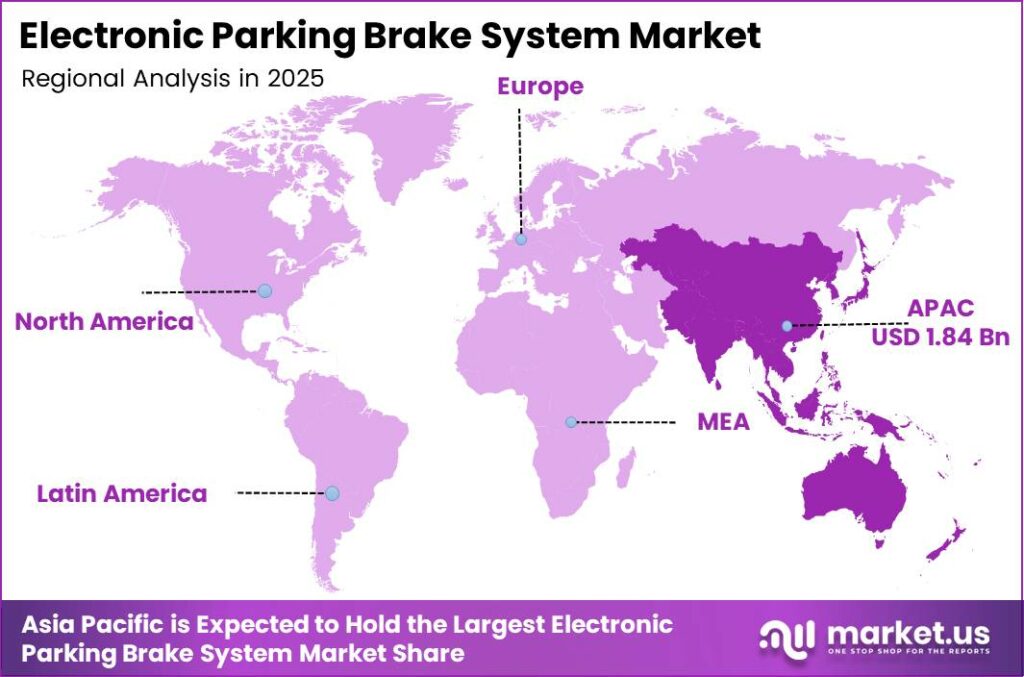
- Asia Pacific is the leading region with a 43.2% market share, valued at USD 1.84 Billion.
Government mandates are reshaping brake-system procurement timelines. According to the National Highway Traffic Safety Administration, FMVSS No. 127 will require automatic emergency braking on all new passenger cars and light trucks by September 2029. This regulation forces OEMs to integrate advanced electronic brake architecture earlier in platform development cycles, expanding electronic parking brake fitment as part of broader braking-domain upgrades.
As reported by the International Energy Agency, electric-car sales exceeded 17 million globally in 2024 and accounted for more than 20% of all car sales. IEA data also shows global electric-car sales rose by more than 25% in 2024. This volume signals a structural expansion in the vehicle base most likely to adopt electronic parking brakes as standard equipment, strengthening forward-year order pipelines for EPB suppliers.
IEA figures show global electric-car sales were projected to exceed 20 million in 2025, representing more than one in four cars sold worldwide. This penetration rate compresses the timeline for electronic parking brake standardization across mid-range trims. Suppliers who secure platform agreements with leading EV manufacturers before 2027 will lock in high-volume, multi-year production contracts ahead of late-cycle competitors.
System Type Analysis
Caliper-Integrated (Motor-on-Caliper) dominates with 54.1% due to direct actuator integration reducing cable routing complexity.
In 2025, Caliper-Integrated (Motor-on-Caliper) held a dominant market position in the By System Type segment of the Electronic Parking Brake System Market, with a 54.1% share. This system mounts the electric motor directly on the rear caliper, eliminating cable assemblies and reducing installation space requirements. OEMs on electrified platforms prefer this architecture because it supports cleaner underbody packaging and enables software-controlled clamping force without mechanical intermediaries.
Cable-Puller (Motor-on-Drum) retains strong fitment on entry-level and mid-range platforms where drum rear brakes remain cost-competitive. This system uses a centrally mounted motor to actuate cables connected to drum shoes or rear disc calipers. Its lower per-unit cost versus caliper-integrated designs keeps it competitive on high-volume budget trims in price-sensitive markets across Asia and Latin America.
Electric-Hydraulic Caliper systems represent the fastest-growing configuration within the By System Type segment. This architecture integrates an electrohydraulic pressure module that enables brake-by-wire readiness without full electromechanical conversion of the rear axle. Vehicle manufacturers developing autonomous and semi-autonomous platforms are specifying this configuration as a transitional architecture toward full brake-by-wire systems launching from 2026 onward.
Vehicle and Propulsion Type Analysis
Passenger Cars (Sedans, Hatchbacks, SUVs) dominate with 64.4% due to high-volume production and rising EPB standardization across trims.
In 2025, Passenger Cars (Sedans, Hatchbacks, SUVs) held a dominant market position in the By Vehicle and Propulsion Type segment of the Electronic Parking Brake System Market, with a 64.4% share. According to the International Organization of Motor Vehicle Manufacturers, global vehicle sales increased from 95.3 million units in 2024 to 99.8 million units in 2025, up 4.7%. The European Automobile Manufacturers’ Association reports global car production reached 37.7 million units in the first half of 2025, up 3.5% year on year. This production scale translates directly into EPB fitment volume as passenger car platforms migrate to electronic braking architecture across a widening range of trim levels.
Light Commercial Vehicles represent a structurally distinct demand layer for electronic parking brake systems. According to the Society of Indian Automobile Manufacturers, India recorded commercial-vehicle sales of 956,671 units in FY 2024 to 25. Fleet operators in logistics and urban delivery increasingly specify electronic parking brakes on light commercial vehicles to reduce rollaway incidents and enable auto-apply functionality when integrated with telematics systems.
Heavy Commercial Vehicles present a more constrained fitment environment for electronic parking brakes. SIAM data shows India’s commercial-vehicle sales declined 1.2% in FY 2024 to 25. Air-brake systems remain dominant on heavy trucks, limiting EPB penetration to specific applications such as urban delivery trucks and multi-axle buses where electronic park control is mandated or commercially preferred by fleet risk managers.
Electric and Hybrid Vehicles represent the fastest-growing propulsion category within the By Vehicle and Propulsion Type segment. IEA data shows more than 4 million electric cars were sold globally in the first quarter of 2025 alone, a 35% increase year on year. IEA figures also confirm China was responsible for more than 70% of global electric-car production in 2024. The global electric-car fleet reached nearly 58 million vehicles at the end of 2024. These figures confirm that EV-native platforms now constitute the single largest pull factor for electronic parking brake content per vehicle, since BEV and PHEV architectures require no mechanical handbrake and rely entirely on electronic actuation for parking hold.
Component Analysis
Actuators/Electric Motors dominate with 44.5% due to direct drive requirements in both caliper-integrated and cable-puller system types.
In 2025, Actuators/Electric Motors held a dominant market position in the By Component segment of the Electronic Parking Brake System Market, with a 44.5% share. Aisin’s expansion of the ADVICS Handa Plant added 61,600 square metres, bringing total plant area to 106,000 square metres specifically to strengthen output of electronically controlled brakes and electric parking brakes, as reported by Aisin Corporation. This capacity investment by a major component producer confirms that actuator supply is a primary production bottleneck and that manufacturers are committing large capital to secure output ahead of rising OEM demand.
Electronic Control Units form the second major component layer in EPB systems. ECUs manage actuator commands, force calibration, auto-apply logic, diagnostic reporting, and communication with vehicle brake-domain and powertrain controllers. As EPB architectures expand toward software-defined functionality and over-the-air update capability, ECU content value per vehicle rises, making this component sub-segment a key margin contributor for Tier 1 suppliers.
Cabin Switches and Sensors represent the fastest-growing component category in the By Component segment. Human-machine interface design is shifting toward haptic switches, capacitive panels, and integrated stalk controls that eliminate dedicated EPB buttons while maintaining regulatory compliance for driver-accessible park functions. Sensor density is also rising as hill-hold, rollaway detection, and incline compensation features add accelerometers, wheel-speed inputs, and inclination sensors to the brake-domain sensor cluster.
Sales Channel Analysis
OEM (Original Equipment Manufacturer) dominates with 82.2% due to platform-level integration requirements and long-term supply agreements.
In 2025, OEM held a dominant market position in the By Sales Channel segment of the Electronic Parking Brake System Market, with an 82.2% share. ZF’s Zhangjiagang facility expanded Active Kinematics Control capacity from 400,000 to 600,000 sets and planned steer-by-wire capacity of 380,000 systems, with cumulative campus investment of RMB 2.7 billion, as reported by ZF Friedrichshafen AG. OEM-channel dominance reflects the reality that EPB systems require vehicle-level software calibration, homologation validation, and platform-specific integration that cannot be replicated through aftermarket supply alone.
The Aftermarket channel is the fastest-growing sales channel in the By Sales Channel segment. Replacement demand builds as the first wave of EPB-equipped vehicles approaches service intervals requiring actuator, switch, or sensor replacement. Aftermarket distributors who establish EPB-specific stocking programs and technician training partnerships before 2027 will capture share ahead of the volume replacement cycle that follows wide EPB fleet penetration in the early 2020s.
Key Market Segments
By System Type
- Caliper-Integrated (Motor-on-Caliper)
- Cable-Puller (Motor-on-Drum)
- Electric-Hydraulic Caliper
By Vehicle and Propulsion Type
- Passenger Cars
- Sedans
- Hatchbacks
- SUVs
- Light Commercial Vehicles (LCVs)
- Heavy Commercial Vehicles (HCVs)
- Electric and Hybrid Vehicles
- BEVs
- PHEVs
By Component
- Actuators / Electric Motors
- Electronic Control Units (ECUs)
- Cabin Switches and Sensors
By Sales Channel
- OEM (Original Equipment Manufacturer)
- Aftermarket
Regional Analysis
Asia Pacific Dominates the Electronic Parking Brake System Market with a Market Share of 43.2%, Valued at USD 1.84 Billion
Asia Pacific holds the leading regional position in the electronic parking brake system market. The European Automobile Manufacturers’ Association confirms Asia accounted for 60.1% of global car output in the first half of 2025. IEA data shows global trade in electric cars increased 20% in 2024, with imports representing almost one-fifth of global electric-car sales. This production concentration makes Asia Pacific the primary manufacturing base and the largest volume source for EPB-fitted vehicles entering both domestic and export markets.
Asia Pacific is also the fastest-growing region in the electronic parking brake system market. SIAM data confirms India’s passenger-vehicle sales reached a record 4.3 million units in FY 2024 to 25, 2% higher than the prior year. In July 2025, ZF announced EPB supply for an Indian electric vehicle program, with production localized in India. In January 2026, ZF inaugurated an EPB production line at its Oragadam facility in Tamil Nadu with peak annual capacity of 800,000 EPB units. This localization investment confirms India as an active OEM-channel EPB growth market within the Asia Pacific region.
Europe represents a significant secondary market. ACEA data shows EU car production fell 2.8% year on year in the first half of 2025 to just under 6 million units, and EU new-car registrations declined 1.9% in the same period. Despite this volume softness, ACEA data shows 1,880,370 new battery-electric cars were registered in the EU in 2025, taking a 17.4% market share. ACEA also confirms 249 million cars on EU roads in 2023, with the EU van parc at approximately 30.1 million units. The replacement and upgrade cycle embedded in this large active vehicle parc sustains European aftermarket and OEM EPB demand even as new registrations soften.
Key Regions and Countries
North America
- US
- Canada
Europe
- Germany
- France
- The UK
- Spain
- Italy
- Rest of Europe
Asia Pacific
- China
- Japan
- South Korea
- India
- Australia
- Rest of APAC
Latin America
- Brazil
- Mexico
- Rest of Latin America
Middle East and Africa
- GCC
- South Africa
- Rest of MEA
Drivers
Battery-electric and hybrid vehicle platforms accelerate EPB fitment because their centralized electronic control architecture already supports actuator commands, auto-hold, hill-start assistance, and park-lock coordination without the packaging constraints of a mechanical lever and cable. Vehicle manufacturers expanded dedicated electrified architectures between 2024 and 2026, treating EPB as a standard braking-domain module rather than a premium option. This creates an estimated +2.2% incremental contribution to the 10.7% baseline CAGR.
System-level integration removes mechanical cables, brackets, and console space constraints, allowing suppliers to capture higher content per vehicle through calipers, ECUs, sensors, wiring, and embedded software. Premium feature adoption is also expanding into mid-range trims globally, with SUV and crossover growth in North America, India, China, and Europe reinforcing this trend. Buyers and investors can expect EPB fitment rates to accelerate as platform standardization reduces per-unit cost and simplifies assembly across vehicle lines.
| Driver | (~) % Impact on CAGR Forecast | Geographic Relevance | Impact Timeline |
|---|---|---|---|
| Electrified Vehicle Architecture | +2.2% | China, Europe, North America, Japan | Short term (≤ 2 years) |
| Premium Feature Democratization | +1.7% | Global passenger vehicles | Short term (≤ 2 years) |
| Integrated Brake-Control Demand | +1.5% | Europe, China, South Korea | Medium term (2–4 years) |
| SUV and Crossover Mix | +1.1% | North America, India, China, Europe | Short term (≤ 2 years) |
| Rollaway-Mitigation Adoption | +1.0% | North America, Europe | Medium term (2–4 years) |
| Cockpit Space Optimization | +0.8% | Global passenger vehicles | Short term (≤ 2 years) |
Restraints
In price-sensitive vehicle segments, the EPB carries an incremental bill-of-materials premium for motorized rear calipers, controller electronics, sensors, wiring, switches, and diagnostic software versus a conventional lever-and-cable solution. For entry-level vehicles, an installed-system cost premium in the approximate 1.5 to 3.5% range of brake-system content can exceed available margin headroom. Suppliers also face annual price-down demands of roughly 2 to 5%, compressing the economics further.
This cost pressure produces an estimated -1.8% deduction from the 10.7% baseline CAGR by delaying standardization, narrowing EPB fitment to upper trims, and forcing suppliers to absorb localization and tooling investment before scale economies activate. Tariff-driven component inflation and legacy platform carryover compound this effect across emerging markets, fleet segments, and commercial vehicle applications where retrofit economics rarely justify electronic conversion.
| Restraint | (~) % Impact on CAGR Forecast | Geographic Relevance | Impact Timeline |
|---|---|---|---|
| Entry-Level Vehicle Cost Pressure | -1.8% | India, ASEAN, Latin America, Africa | Short term (≤ 2 years) |
| Tariff-Driven Component Inflation | -1.4% | North America, Europe, China | Short term (≤ 2 years) |
| Legacy Platform Carryover | -1.2% | Emerging markets, fleet segments | Medium term (2–4 years) |
| Low-Volume Homologation Economics | -0.9% | Global specialty vehicles | Medium term (2–4 years) |
| Aftermarket Price Sensitivity | -0.7% | India, Latin America, Middle East, Africa | Short term (≤ 2 years) |
| Commercial Vehicle Retrofit Limits | -0.6% | Global heavy-duty fleets | Medium term (2–4 years) |
Challenges
EPB production depends on automotive-qualified microcontrollers, power-management devices, motor drivers, position sensors, communication interfaces, and passive components whose supply remains vulnerable to export controls, foundry concentration, and logistics disruptions. A single low-cost controller shortage can immobilize delivery of a much higher-value brake module. Automotive qualification and customer reapproval cycles require roughly 12 to 24 months, amplifying the commercial impact of any supply interruption.
The resulting estimated -1.5% friction drag compels suppliers to pursue dual sourcing, strategic inventory, redesigned electronics, and longer-term wafer-capacity agreements, all of which increase working capital and engineering expense. Functional safety validation under ISO 26262 and software cybersecurity compliance under UN Regulation No. 155 add further development cost and schedule risk, particularly for suppliers entering new markets or homologating EPB systems across multiple vehicle platforms simultaneously.
| Challenge | (~) % CAGR Friction Drag | Geographic Relevance | Mitigation Horizon |
|---|---|---|---|
| Semiconductor Supply Resilience | -1.5% | Global | Medium term (2–4 years) |
| Functional Safety Validation | -1.3% | Global regulated markets | Long term (≥ 4 years) |
| Software Cybersecurity Compliance | -1.1% | Europe, Japan, South Korea, China | Medium term (2–4 years) |
| Actuator Durability Assurance | -0.9% | Global, severe-climate markets | Long term (≥ 4 years) |
| Multi-Platform Calibration Complexity | -0.8% | Global | Medium term (2–4 years) |
| Skilled Mechatronics Capacity | -0.6% | India, Europe, North America, ASEAN | Long term (≥ 4 years) |
Opportunities
Software-defined EPB functionality remains largely untapped because most current programs monetize hardware at vehicle production rather than recurring post-sale functions. Configurable auto-apply logic, fleet safety analytics, predictive actuator-health monitoring, and over-the-air feature updates represent a service layer that could lift module gross-margin potential by approximately 3 to 7 percentage points versus hardware-only supply.
This service layer could also reduce field-diagnosis and warranty cost per incident by an estimated 10 to 20%, supporting up to +2.0% incremental CAGR upside above the 10.7% baseline. Europe’s Cyber Resilience Act entered into force on 10 December 2024, with main obligations applying from 11 December 2027. Suppliers who build secure software lifecycle capability ahead of this deadline will hold a structural compliance advantage when converting installed EPB hardware into recurring safety, diagnostic, and fleet-management revenue streams.
| Opportunity | (~) % Potential CAGR Upside | Geographic Relevance | Execution Window |
|---|---|---|---|
| Software-Defined Brake Services | +2.0% | Europe, China, North America, Japan | Medium term (2–4 years) |
| Commercial Fleet Rollaway Systems | +1.7% | North America, Europe, China | Medium term (2–4 years) |
| Affordable Localized EPB Platforms | +1.5% | India, ASEAN, Latin America | Medium term (2–4 years) |
| Brake-by-Wire Integration | +1.4% | China, Europe, North America | Long term (≥ 4 years) |
| Electric Two-Wheeler Adaptation | +1.0% | India, China, ASEAN, Europe | Long term (≥ 4 years) |
| Remanufacturing Service Networks | +0.8% | Europe, North America, Japan | Medium term (2–4 years) |
Key Company Insights
ZF Friedrichshafen AG reported sales of €38.8 billion in fiscal 2025 and invested €3.3 billion in research and development, equal to 8.6% of sales, as reported by ZF Friedrichshafen AG. The company operates 162 production locations across 29 countries and employs approximately 153,000 people. ZF secured a high-volume brake-by-wire order equipping nearly 5 million vehicles for a leading global OEM, establishing a durable platform revenue base that smaller competitors cannot replicate without comparable homologation infrastructure.
Continental AG reported automotive sales of €19.4 billion in 2024. Continental divested its Cairo Montenotte hydraulic drum-brake production and R&D site to Mutares, a transaction expected to generate approximately €100 million in 2025 revenue, as confirmed by Continental AG. This divestiture signals a strategic shift away from conventional brake hardware toward higher-margin electronic and software-defined brake systems, repositioning Continental’s product portfolio toward segments with stronger content-value growth. Brembo announced an approximately €500 million industrial footprint investment encompassing new plants in Mexico, China, and Poland, with total net investments of €412.159 million in 2023, as reported by Brembo S.p.A. Bosch completed public-road testing of its hydraulic brake-by-wire system over more than 3,300 kilometres, with market launch scheduled for 2026, while NHTSA estimates its AEB mandate will save at least 360 lives and prevent at least 24,000 injuries annually, underscoring the regulatory pull for advanced brake systems across the supplier landscape.
Key Players
- ZF Friedrichshafen AG (Germany)
- Continental AG (Germany)
- Robert Bosch GmbH (Germany)
- Hitachi Astemo, Ltd. (Japan)
- Aisin Corporation (Japan)
- Brembo S.p.A. (Italy)
- ADVICS Co., Ltd. (Japan)
- Hyundai Mobis Co., Ltd. (South Korea)
- HL Mando Corporation (South Korea)
- Akebono Brake Industry Co., Ltd. (Japan)
- Knorr-Bremse AG (Germany)
- Haldex AB (Sweden)
- DURA Automotive Systems (USA)
- Bethel Automotive Safety Systems (China)
- Küster Holding GmbH (Germany)
Recent Developments
- October 2024 – ZF surpassed 250 million Electric Park Brake units produced globally, marking a major production milestone for the company’s EPB business.
- October 2024 – Hyundai Mobis signed an investment agreement with the Slovak government to establish a new European electrification production base, including facilities for electric vehicle braking systems at its existing Zilina plant.
- December 2024 – Standard Motor Products released Electronic Parking Brake Actuators covering more than 13 million vehicles, including applications for Mazda 3, Ford Heavy Duty trucks, and Jeep SUVs.
- April 2025 – Standard Motor Products expanded its Electronic Parking Brake Actuator program with additional coverage for import and domestic vehicles, strengthening its aftermarket EPB product portfolio.
- June 2025 – Mutares and Continental signed an agreement for Mutares to acquire Continental’s Cairo Montenotte, Italy, production and R&D site, which manufactures the Parking Brake for Simplex Brakes (EPB-Si).
- June 2025 – Astemo showcased its Smart Brake electro-mechanical brake-by-wire actuator for high-level autonomous driving at Automotive Summit 2025, expanding its electronically controlled braking technology portfolio.
Report Scope
| Report Features | Description |
|---|---|
| Market Value (2025) | USD 4.3 Billion |
| Forecast Revenue (2035) | USD 11.7 Billion |
| CAGR (2026-2035) | 10.7% |
| Base Year for Estimation | 2025 |
| Historic Period | 2020-2024 |
| Forecast Period | 2026-2035 |
| Report Coverage | Revenue Forecast, Market Dynamics, Market Opportunity Analysis, Technology and Innovation Landscape, Competitive Landscape, Recent Developments |
| Segments Covered | By System Type (Caliper-Integrated Motor-on-Caliper, Cable-Puller Motor-on-Drum, Electric-Hydraulic Caliper), By Vehicle and Propulsion Type (Passenger Cars including Sedans, Hatchbacks, SUVs; Light Commercial Vehicles; Heavy Commercial Vehicles; Electric and Hybrid Vehicles including BEVs and PHEVs), By Component (Actuators/Electric Motors, Electronic Control Units, Cabin Switches and Sensors), By Sales Channel (OEM, Aftermarket) |
| Regional Analysis | North America (US and Canada), Europe (Germany, France, The UK, Spain, Italy, and Rest of Europe), Asia Pacific (China, Japan, South Korea, India, Australia, and Rest of APAC), Latin America (Brazil, Mexico, and Rest of Latin America), Middle East and Africa (GCC, South Africa, and Rest of MEA) |
| Competitive Landscape | ZF Friedrichshafen AG, Continental AG, Robert Bosch GmbH, Hitachi Astemo Ltd., Aisin Corporation, Brembo S.p.A., ADVICS Co. Ltd., Hyundai Mobis Co. Ltd., HL Mando Corporation, Akebono Brake Industry Co. Ltd., Knorr-Bremse AG, Haldex AB, DURA Automotive Systems, Bethel Automotive Safety Systems, Küster Holding GmbH |
| Customization Scope | Customization for segments, region/country-level will be provided. Additional customization can be done based on requirements. |
| Purchase Options | We have three licenses to opt for: Single User License, Multi-User License (Up to 5 Users), Corporate Use License (Unlimited User and Printable PDF) |





































