


Report Overview
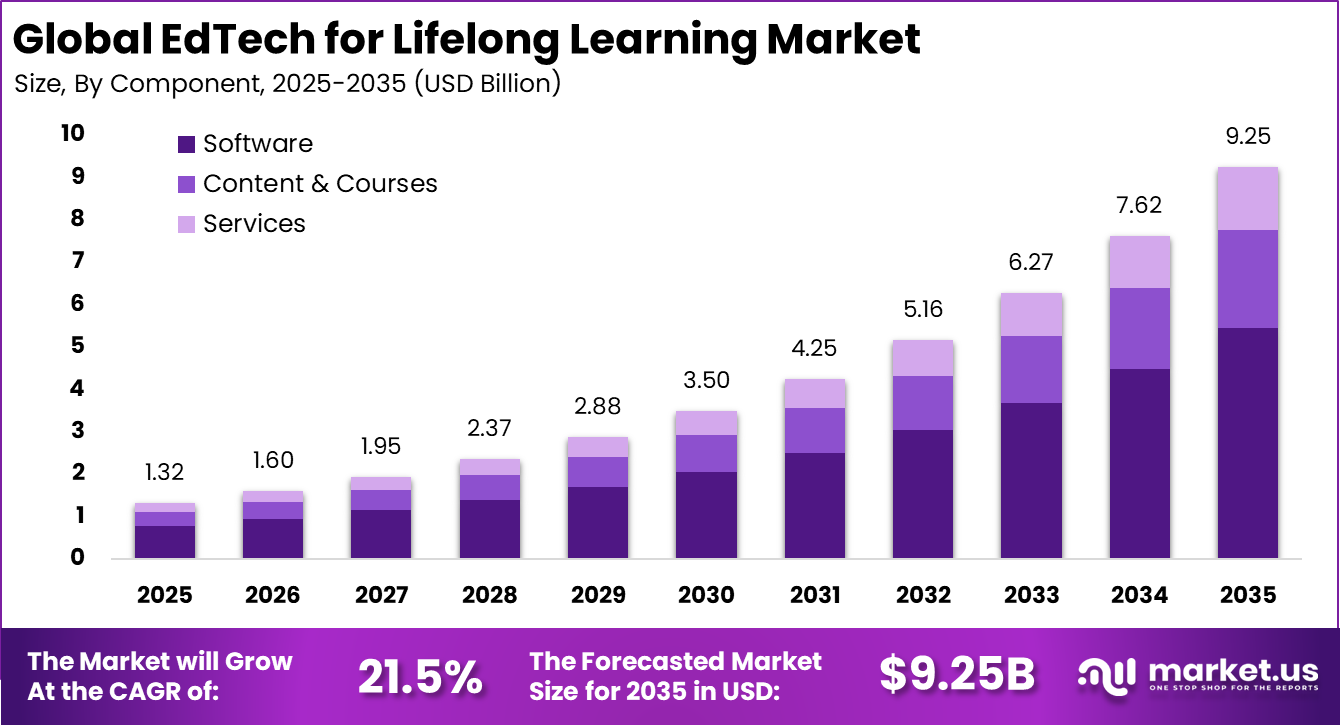
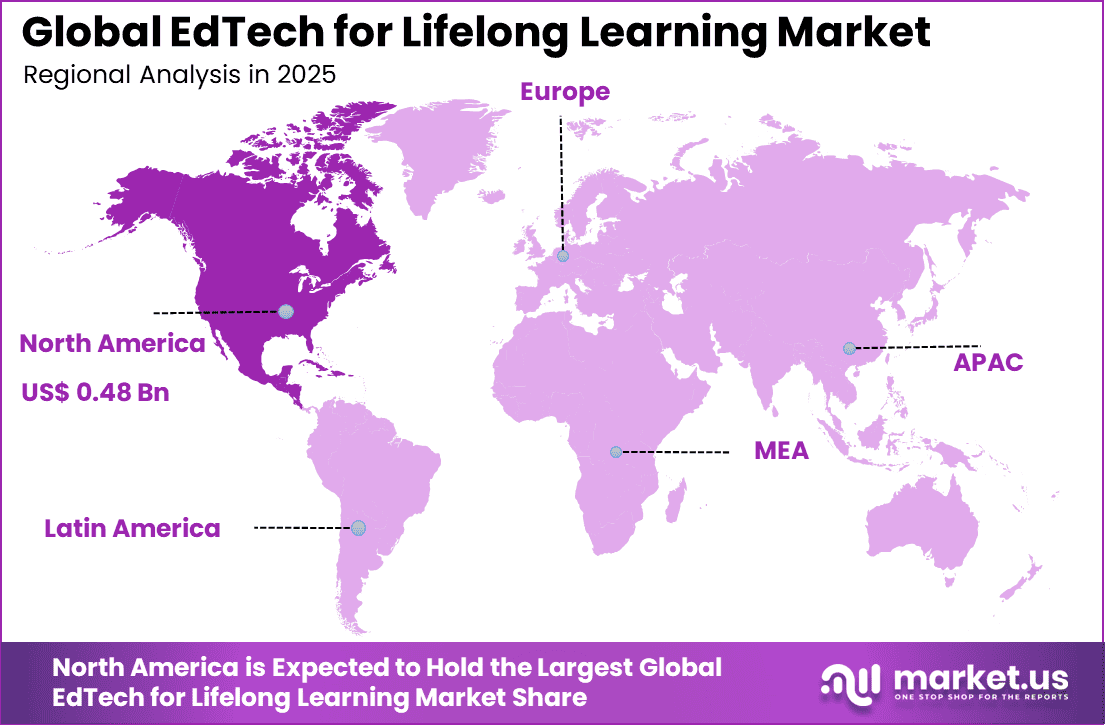
The Global EdTech for Lifelong Learning Market size is expected to be worth around USD 9.25 billion by 2035, from USD 1.32 billion in 2025, growing at a CAGR of 21.5% during the forecast period from 2025 to 2035. North America held a dominant market position, capturing more than a 37.1% share, holding USD 0.48 billion in revenue.
The EdTech for lifelong learning market refers to digital education platforms and technologies designed to support continuous skill development beyond formal schooling. These solutions enable individuals to learn new skills, upgrade knowledge, and adapt to changing job requirements throughout their careers. The concept of lifelong learning has gained strong importance as industries evolve rapidly due to technological advancements.
Digital learning is no longer limited to classrooms and has become an essential system supporting workforce development, personal growth, and continuous education across all age groups. Top driving factors for this market are strongly linked to the changing nature of work and the increasing need for continuous skill upgrades. It has been observed that automation and artificial intelligence are reshaping job roles, requiring workers to regularly update their competencies.
Learning preferences are shifting toward flexible formats as traditional education models fail to meet modern lifestyle needs. Nearly 57% of learners prefer programs that offer full scheduling flexibility. There is strong demand for short, outcome-focused courses that deliver practical knowledge quickly, allowing individuals to balance professional responsibilities while gaining relevant skills without extended time commitments.
For instance, in February 2026, Degreed, Inc. partnered with Salesforce Trailhead, integrating skills ontologies across both platforms to create unified learning ecosystems for enterprises. 3,000+ companies now track employee skills progression holistically, driving 28% higher internal mobility rates through transparent career pathing.
Key Takeaway
- In the EdTech for lifelong learning market, software accounted for 58.9%, reflecting strong demand for digital learning platforms.
- Working professionals represented 52.7%, driven by continuous upskilling and career advancement needs.
- Self-paced online courses led with 64.8%, supported by flexibility and convenience for learners.
- Professional and technical skills held a dominant share of 61.5%, highlighting the focus on job-relevant learning.
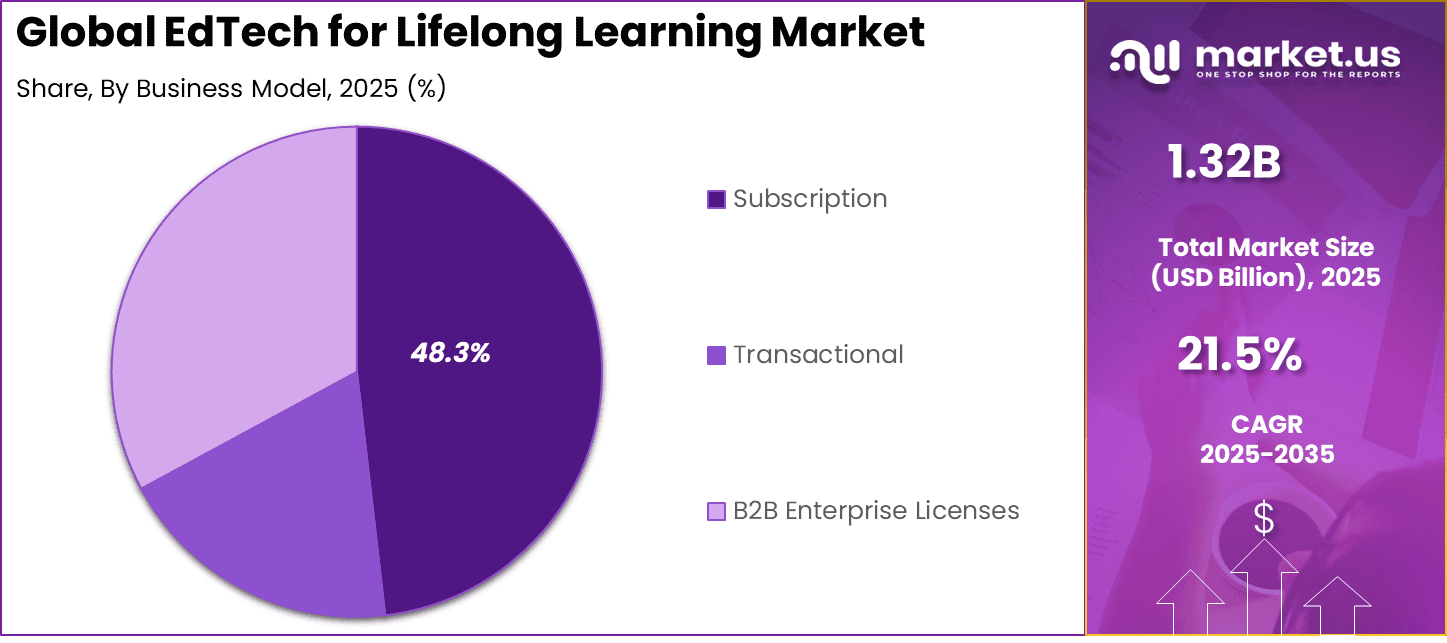
- Subscription-based models accounted for 48.3%, indicating steady adoption of recurring revenue platforms.
- North America held a leading share of 37.1%, supported by advanced digital education infrastructure.
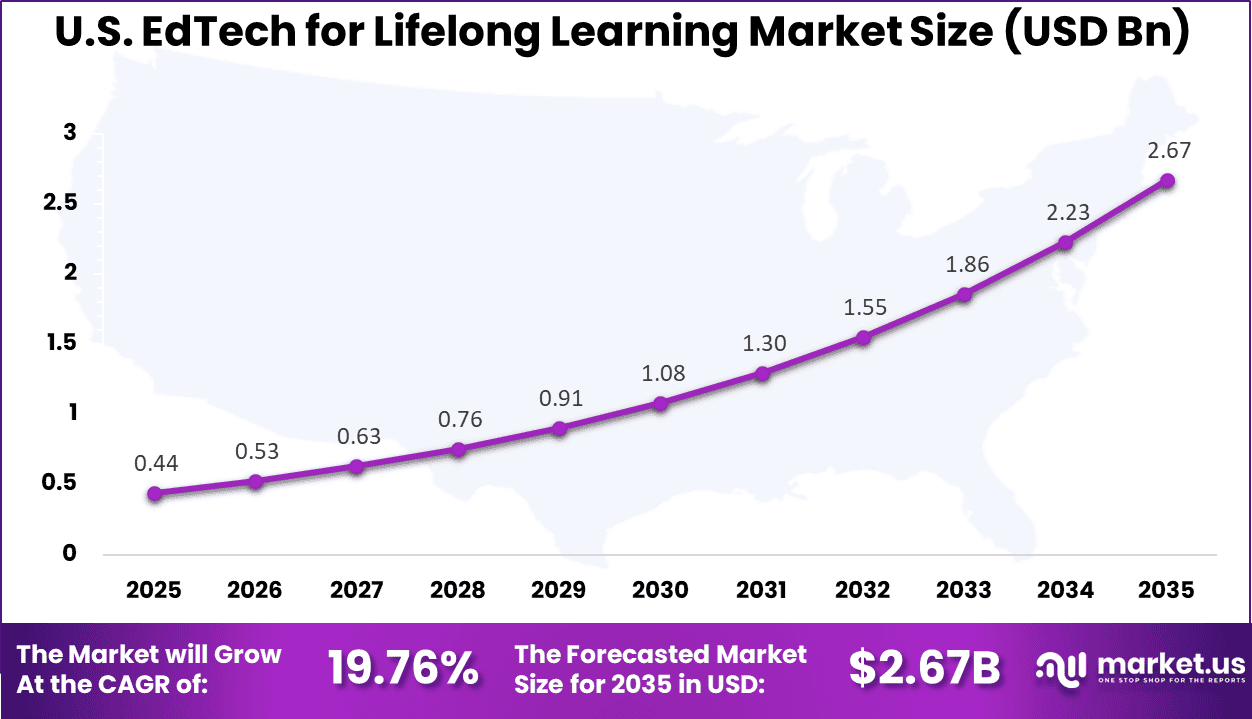
- The U.S. market was valued at USD 0.44 billion and is projected to grow at a CAGR of 19.76%.
Lifelong Learning Impact and Trends
- EdTech-supported flexible learning can improve adult learner retention by around 30%.
- AI-driven and adaptive learning experiences can raise learning outcomes by nearly 20%.
- Digital badges and micro-credentials can improve employability for adult learners by about 40%.
- Around 54% of workers believe continuous training is necessary to remain relevant in their careers.
- The business segment held a leading 67% revenue share in the EdTech market in 2025, showing strong enterprise adoption.
- Digital training can reduce learning delivery costs significantly, with some organizations lowering cost per learner from USD 95 to USD 11.
- Corporate e-learning platforms can reduce employee onboarding time by over 30%.
- Around 72% of employees say they want to future-proof their skills, especially in AI-related areas.
- About 88% of college students consider smartphones important for their academic work, highlighting the importance of mobile learning access.
- Microlearning can improve information retention by nearly 17% compared with traditional learning formats.
- More than 61% of educators already use generative AI tools to support teaching, content preparation, and continuous learning delivery.
Component Analysis
In 2025, The Software segment held a dominant market position, capturing a 58.9% share of the Global EdTech for Lifelong Learning Market. This dominance is due to the central role of software platforms in delivering and managing lifelong learning programs. These systems enable structured content delivery, learner tracking, and continuous updates, making education more efficient and accessible. Their ability to support scalable learning environments has strengthened their position across modern digital education systems.
Software tools also allow seamless integration of assessments, feedback, and personalized learning paths. This improves user experience and keeps learners engaged over time. As learning needs evolve, software platforms continue to adapt quickly, supporting flexible and continuous education for individuals seeking skill development in dynamic professional environments.
For Instance, in April 2026, Skillsoft rolled out its next-generation skills platform, making AI-powered learning tools available to enterprises everywhere. This move boosts software’s role by letting teams build workforce skills right in their daily workflows. With personalized paths surging, it shows how software keeps lifelong learning smooth and integrated for pros on the go.
Learner Type Analysis
In 2025, the Working Professionals segment held a dominant market position, capturing a 52.7% share of the Global EdTech for Lifelong Learning Market. This dominance is due to the increasing need for working individuals to upgrade their skills while staying employed. Professionals are actively seeking learning options that align with their job roles and career goals. This demand is driven by rapid workplace changes that require continuous learning and adaptation to remain competitive.
Working professionals prefer learning formats that fit within their busy schedules and provide direct career value. Courses focused on practical outcomes and job relevance attract higher participation. This group continues to lead adoption as lifelong learning becomes essential for career growth, job stability, and long-term professional development.
For instance, in February 2026, LinkedIn dropped its Skills on the Rise list, spotlighting hot skills like AI management and risk handling that working pros need now. Free courses until March help folks upskill fast for job shifts. This push fits perfectly as professionals chase growth amid quick industry changes, keeping careers on track.
Learning Mode Analysis
In 2025, The Self-paced Online Courses segment held a dominant market position, capturing a 64.8% share of the Global EdTech for Lifelong Learning Market. This dominance is due to the flexibility that self-paced learning offers to individuals balancing work and personal responsibilities. Learners can progress at their own speed, making it easier to absorb knowledge without pressure. This approach supports consistent engagement and allows individuals to revisit content whenever needed for better understanding.
Self-paced courses also provide convenience and control, which are critical for adult learners. The ability to learn anytime and from any location encourages regular participation. This mode supports different learning styles and helps individuals maintain continuity in their education without disrupting their daily routines.
For Instance, in March 2026, Degreed launched fresh AI tools at LENS 2026 to speed up fluency and leadership training through self-paced formats. These let learners dive into content at their own speed, blending work and study seamlessly. It’s a smart step for adults wanting flexible paths to master new abilities without rigid timelines.
Skills Focus Analysis
In 2025, The Professional & Technical Skills segment held a dominant market position, capturing a 61.5% share of the Global EdTech for Lifelong Learning Market. This dominance is due to the strong demand for job-related skills that directly improve employability. Learners are focusing on acquiring practical knowledge that can be applied in real work situations. As industries evolve, technical expertise and professional competencies have become essential for maintaining career relevance and growth.
Professional and technical learning programs are designed to meet industry needs and workforce expectations. They help individuals stay updated with current tools, systems, and practices. This focus ensures that learning remains aligned with real-world requirements, making it more valuable and impactful for career advancement.
For Instance, in February 2026, Codecademy updated its prompt engineering courses with fresh techniques and new lessons on AI risks, going live mid-February. This targets technical pros building real coding and AI skills hands-on. Such tweaks keep learners sharp on must-have tech abilities, matching the rush for practical know-how in evolving jobs.
Business Model Analysis
In 2025, The Subscription segment held a dominant market position, capturing a 48.3% share of the Global EdTech for Lifelong Learning Market. This dominance is due to the need for continuous access to learning resources over time. Subscription models allow users to explore multiple courses without repeated purchases. This approach supports ongoing skill development and encourages learners to return regularly for new content and updated learning materials.
Subscription-based platforms also provide flexibility and cost efficiency for users. Learners can access a wide range of topics under a single plan, making learning more convenient. This model aligns well with lifelong learning habits, where individuals engage in education continuously rather than through one-time course participation.
For Instance, in November 2025, Pluralsight shared its 2026 Tech Forecast, warning against over-relying on AI and pushing subscription-based upskilling for core tech skills. Drawing from thousands of leaders, it stresses ongoing access to courses for staying competitive. This reinforces subscriptions as the go-to for steady, affordable skill building year-round.
Regional Analysis
In 2025, North America accounted for 37.1% of the EdTech for lifelong learning market, supported by high digital adoption and strong emphasis on continuous education. The region has a well-established online learning ecosystem with widespread use of digital platforms. Professionals and organizations actively invest in upskilling and reskilling initiatives. This has positioned North America as a leading market for lifelong learning solutions.
The regional dominance is further driven by the presence of advanced infrastructure and high awareness of skill development. Companies are encouraging employees to engage in ongoing education to remain competitive. The integration of technology in education systems also supports market growth. These factors collectively contribute to sustained expansion in the region.
For instance, in March 2025, Coursera expanded its lifelong learning portfolio with new AI-powered professional certificates, partnering with Fortune 500 companies to deliver job-ready skills training. This initiative reinforces Mountain View-based Coursera’s leadership in corporate upskilling, serving millions of North American learners seeking continuous career advancement.
Country Analysis: United States
In 2025, the United States EdTech for lifelong learning market reached USD 0.44 billion and is growing at a CAGR of 19.76%, reflecting strong demand for digital education solutions. The country has a large base of working professionals seeking continuous skill development. Organizations are investing in training programs to enhance workforce capabilities. This has driven consistent adoption of online learning platforms.
The growth in the U.S. is also influenced by increasing use of technology in education and rising demand for flexible learning options. Learners are adopting online platforms to gain certifications and improve career prospects. Continuous innovation in EdTech solutions further enhances user experience and engagement. As a result, the United States remains a key contributor to the global market.
For instance, in February 2025, Udemy launched 500+ enterprise-focused micro-credentials tailored for U.S. corporations, achieving 40% adoption growth among Fortune 500 firms. This move reinforced North American dominance by delivering on-demand, practical skills training that drives workforce productivity and retention.
Emerging Trends Analysis
The EdTech for lifelong learning market is transitioning toward highly personalized and adaptive learning ecosystems. Artificial intelligence is increasingly being used to tailor content, learning pace, and assessment based on individual user behavior and performance. These systems are enabling continuous skill development across different life stages, particularly for working professionals.
The rise of AI tutors, real-time analytics, and adaptive platforms is improving engagement and learning outcomes, with studies indicating measurable improvements in retention and performance through personalized learning models. Another important trend is the growing adoption of micro-credentials and flexible learning formats.
Learners are increasingly opting for short courses, digital certifications, and skill-based programs that can be integrated into their professional journeys. Mobile-first platforms and on-demand learning models are supporting this shift, with global online learners increasing significantly due to smartphone access and internet penetration. This trend reflects a broader shift from traditional education toward continuous, career-oriented learning pathways.
Driver Analysis
The primary driver of the EdTech for lifelong learning market is the increasing need for continuous skill development in a rapidly changing job environment. It is estimated that over 75% of employees consider lifelong learning essential for career growth, highlighting the growing importance of upskilling and reskilling.
Organizations are investing in digital learning platforms to enhance workforce capabilities and remain competitive in a technology-driven economy. In addition, the rapid expansion of digital infrastructure and internet accessibility is supporting market growth.
The number of online learners has grown significantly, reaching hundreds of millions globally, driven by improved connectivity and mobile device usage. This widespread accessibility is enabling individuals from diverse backgrounds to participate in lifelong learning programs, expanding the overall reach of EdTech solutions.
Restraint Analysis
One of the key restraints in the EdTech for lifelong learning market is the digital divide and unequal access to technology. While adoption is increasing, a significant portion of the population still lacks reliable internet access or digital devices. This limits participation in online learning programs and creates disparities in skill development opportunities across regions.
Another restraint is the variability in content quality and learning outcomes. Not all digital learning platforms provide standardized or accredited content, which can affect the credibility of certifications and learning effectiveness. Learners may face challenges in identifying high-quality programs that deliver measurable career benefits, which can slow adoption in certain segments.
Opportunity Analysis
Significant opportunities are emerging from the growing integration of education with employment ecosystems. EdTech platforms are increasingly collaborating with employers to design job-oriented training programs and certification pathways. This alignment between learning and employment is improving job readiness and creating direct career opportunities for learners.
The concept of lifelong learning is expanding beyond education into workforce development and career progression. Additionally, the adoption of immersive technologies such as virtual reality and augmented reality is creating new learning experiences.
These technologies enable interactive and practical training environments, particularly in fields such as healthcare, engineering, and technical education. As these tools become more accessible, they are expected to enhance engagement and improve skill acquisition across various industries.
Challenge Analysis
A major challenge in the EdTech for lifelong learning market is maintaining learner engagement over extended periods. Lifelong learning requires continuous participation, but many learners struggle with motivation and completion rates in online courses. Ensuring consistent engagement through interactive content, gamification, and personalized feedback remains a critical challenge for platform providers.
Another challenge is ensuring data privacy and regulatory compliance. As EdTech platforms collect large volumes of user data to deliver personalized experiences, concerns around data security and privacy are increasing. Regulatory frameworks are evolving to address these concerns, requiring organizations to implement secure and transparent data management practices while maintaining user trust.
Key Market Segments
By Component
- Software
- Content & Courses
- Services
By Learner Type
- Working Professionals
- Career Changers
- Retirees & Hobby Learners
- Corporate Teams
- Others
By Learning Mode
- Self-paced Online Courses
- Cohort-based Programs
- Microlearning & Bite-sized Content
- Blended Learning
- Others
By Skills Focus
- Professional & Technical Skills
- Soft Skills & Leadership
- Personal Development & Hobbies
- Health & Wellness
- Others
By Business Model
- Subscription
- Transactional
- B2B Enterprise Licenses
Key Regions and Countries
North America
- US
- Canada
Europe
- Germany
- France
- The UK
- Spain
- Italy
- Russia
- Netherlands
- Rest of Europe
Asia Pacific
- China
- Japan
- South Korea
- India
- Australia
- Singapore
- Thailand
- Vietnam
- Rest of APAC
Latin America
- Brazil
- Mexico
- Rest of Latin America
Middle East & Africa
- South Africa
- Saudi Arabia
- UAE
- Rest of MEA
Key Players Analysis
The EdTech for Lifelong Learning Market is driven by leading online learning platforms offering flexible and scalable education solutions. Coursera, Inc., Udemy, Inc., and Udacity, Inc. provide diverse course offerings across professional and technical domains. Khan Academy, Inc. and FutureLearn, Ltd. focus on accessible and structured learning programs. These platforms support self-paced education. Their models enhance global accessibility. This drives continuous skill development.
Corporate learning and professional development platforms play a key role in workforce upskilling. LinkedIn Learning, Pluralsight, LLC, and Skillsoft Corporation offer industry-focused training solutions. Degreed, Inc. and GetSmarter support enterprise learning strategies. These companies help organizations close skill gaps. Their solutions improve employee productivity. This supports long-term workforce development.
Specialized and niche learning providers contribute to interactive and career-focused education. Codecademy, Inc., General Assembly, MasterClass, and Treehouse, Inc. deliver targeted skill-based courses. These platforms focus on practical learning experiences. Their content supports career advancement and personal growth. Increasing demand for continuous education is driving adoption. Other key players continue to expand offerings. This competitive landscape supports steady growth in lifelong learning solutions.
Top Key Players in the Market
- Coursera, Inc.
- Udemy, Inc.
- LinkedIn Learning (Microsoft)
- Pluralsight, LLC
- Skillsoft Corporation
- FutureLearn, Ltd.
- Degreed, Inc.
- GetSmarter
- Codecademy, Inc.
- General Assembly Space, Inc.
- MasterClass
- Khan Academy, Inc.
- Treehouse, Inc.
- Udacity, Inc.
- Others
Recent Developments
- In February 2026, LinkedIn Learning (Microsoft) launched Skills Genome AI, mapping career paths for 80M+ users based on real-time job market data. This breakthrough tool identifies skill gaps and recommends personalized learning journeys, helping professionals stay competitive.
- In January 2026, Pluralsight, LLC introduced Flow Adaptive Learning Paths, using AI to adjust tech training difficulty in real-time based on learner performance. Tech professionals complete certifications 40% faster, making Pluralsight essential for cloud, cybersecurity, and DevOps career advancement in competitive job markets.
Report Scope
| Report Features | Description |
|---|---|
| Market Value (2024) | USD 1.3 Bn |
| Forecast Revenue (2034) | USD 9.2 Bn |
| CAGR(2025-2034) | 21.5% |
| Base Year for Estimation | 2024 |
| Historic Period | 2020-2023 |
| Forecast Period | 2025-2034 |
| Report Coverage | Revenue forecast, AI impact on Market trends, Share Insights, Company ranking, competitive landscape, Recent Developments, Market Dynamics and Emerging Trends |
| Segments Covered | By Component (Software, Content & Courses, Services), By Learner Type (Working Professionals, Career Changers, Retirees & Hobby Learners, Corporate Teams, Others), By Learning Mode (Self-paced Online Courses, Cohort-based Programs, Microlearning & Bite-sized Content, Blended Learning, Others), By Skills Focus (Professional & Technical Skills, Soft Skills & Leadership, Personal Development & Hobbies, Health & Wellness, Others), By Business Model (Subscription, Transactional, B2B Enterprise Licenses) |
| Regional Analysis | North America – US, Canada; Europe – Germany, France, The UK, Spain, Italy, Russia, Netherlands, Rest of Europe; Asia Pacific – China, Japan, South Korea, India, New Zealand, Singapore, Thailand, Vietnam, Rest of Latin America; Latin America – Brazil, Mexico, Rest of Latin America; Middle East & Africa – South Africa, Saudi Arabia, UAE, Rest of MEA |
| Competitive Landscape | Coursera, Inc., Udemy, Inc., LinkedIn Learning (Microsoft), Pluralsight, LLC, Skillsoft Corporation, FutureLearn, Ltd., Degreed, Inc., GetSmarter, Codecademy, Inc., General Assembly Space, Inc., MasterClass, Khan Academy, Inc., Treehouse, Inc., Udacity, Inc., Others |
| Customization Scope | Customization for segments, region/country-level will be provided. Moreover, additional customization can be done based on the requirements. |
| Purchase Options | We have three license to opt for: Single User License, Multi-User License (Up to 5 Users), Corporate Use License (Unlimited User and Printable PDF) |





























