


Report Overview
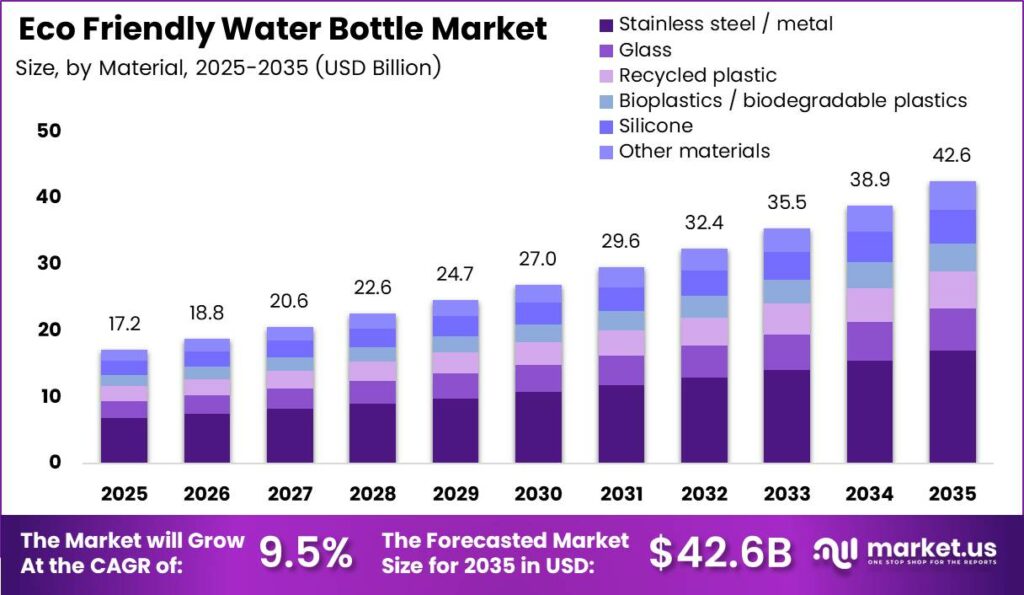
Global Eco Friendly Water Bottle Market size is expected to be worth around USD 42.6 Billion by 2035 from USD 18.8 Billion in 2026, growing at a CAGR of 9.5% during the forecast period 2026 to 2035. These durable drinking containers support repeated filling, reducing dependence on disposable bottles while serving daily hydration, workplace, fitness, and travel needs across consumer and institutional channels.
Reusable-bottle suppliers compete through materials, thermal performance, drinking interfaces, and distribution, while residential, workplace, education, and recreation buyers create distinct purchasing patterns. According to the U.S. EPA, containers and packaging generated 82.2 million short tons of American municipal waste in 2018. That broader waste burden strengthens the commercial case for durable hydration products, but suppliers must demonstrate repeated use rather than assume every reusable purchase displaces disposable packaging.
Key Takeaways
- The global Eco Friendly Water Bottle Market value stands at USD 18.8 Billion in 2026.
- The forecast market value reaches USD 42.6 Billion in 2035.
- The headline CAGR stands at 9.5% for 2026 to 2035.
- Stainless steel / metal leads Material with a 40.00% share in 2026.
- Insulated water bottles lead Product Type with a 52.00% share in 2026.
- The 500 ml to 1 liter category leads Capacity with a 46.00% share in 2026.
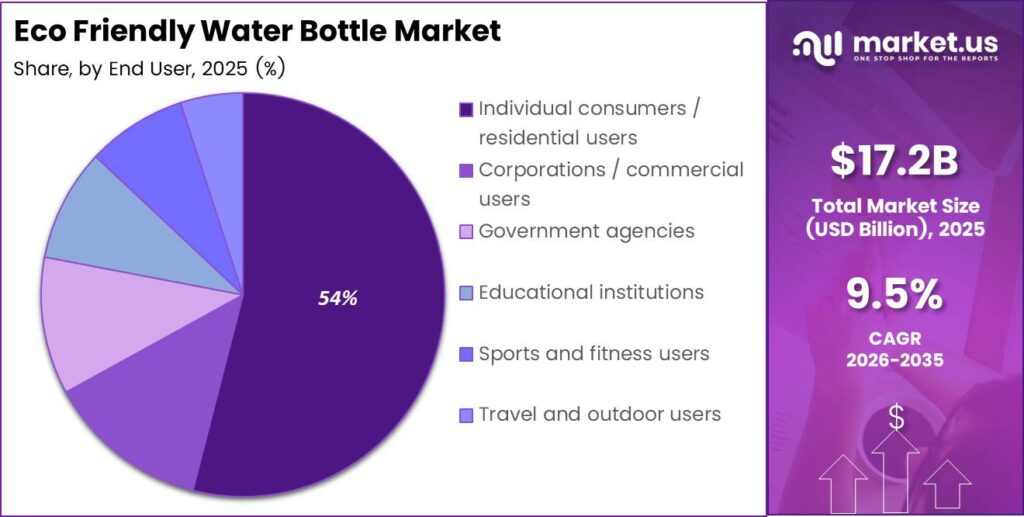
- Individual consumers / residential users lead End User with a 54.00% share in 2026.
- Online stores / e-commerce lead Distribution Channel with a 26.00% share in 2026.
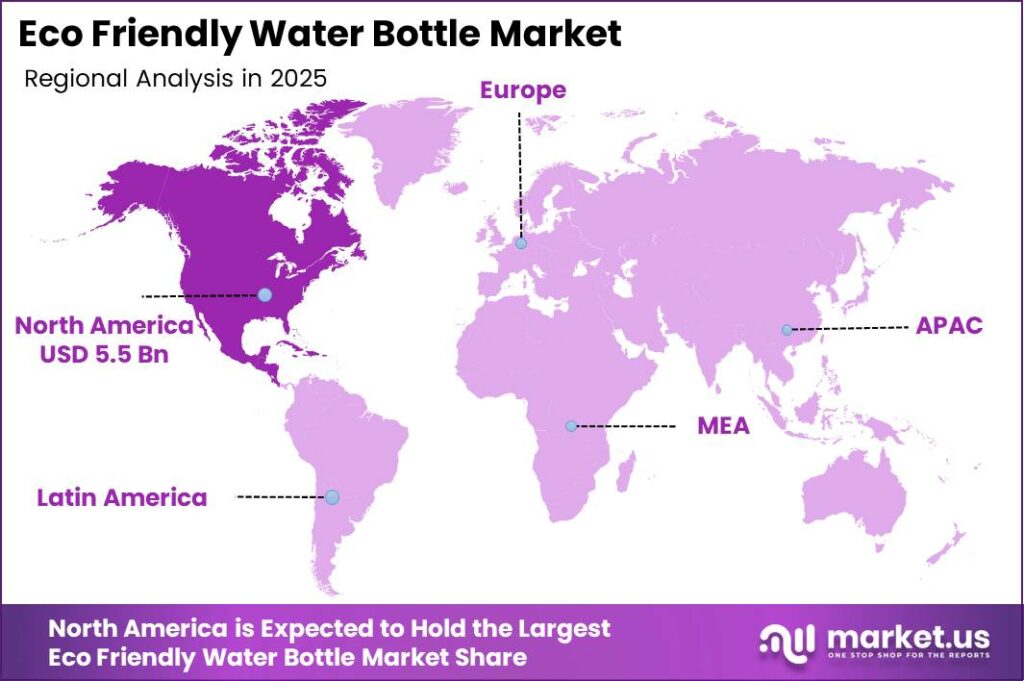
- North America leads regional revenue with a 32.00% share and USD 5.5 Billion in 2026.
- The forecast period extends from 2026 to 2035.
Policy discussions around waste prevention give durable drinkware a clearer strategic role, although plastic-production figures do not measure regulatory spending or bottle sales. As reported by OECD, global plastics production reached 460 million tonnes in 2019, compared with 234 million tonnes in 2000. That material expansion supports investment in reusable formats and traceable inputs, while manufacturers still need product-specific evidence before making environmental claims.
Brand partnerships expand reusable drinkware beyond utility and into identity-based purchasing, creating openings for differentiated designs without changing the underlying bottle function. Hydro Flask indicates that its September 2026 Role Model collection included 24-ounce and 32-ounce bottles alongside a 400-millilitre format. The assortment links artist-led discovery with multiple drinking occasions, giving retailers a clearer merchandising story while requiring careful control of limited-edition inventory.
North America leads the market with a 32.00% share in 2026, valued at USD 5.5 Billion, giving suppliers a substantial premium-product revenue base. The region’s commercial appeal rests on serving repeat-use occasions through accessible retail, brand differentiation, and practical product features rather than price alone. Investors should prioritize dependable replenishment and customer retention because those capabilities protect established positions when competing brands introduce similar materials and designs.
Material Analysis
Stainless steel / metal dominates with 40.00% share in 2026 due to durable construction and effective thermal performance.
In 2026, stainless steel / metal held a 40.00% share in the Material segment of the Eco Friendly Water Bottle Market. According to Klean Kanteen, Rise Classic bottles use certified 90% recycled stainless steel, linking durable construction with material sourcing. Steel supports repeated handling and insulated construction, helping suppliers justify premium pricing through useful performance rather than decorative features alone.
Glass serves buyers who prioritize a nonmetallic drinking surface and clear visibility of bottle contents, although weight affects portability and shipping costs. As reported by the U.S. EPA, American glass-container recycling reached 31.3% in 2018, covering packaging rather than reusable bottles specifically. Glass suppliers therefore need protective construction and credible collection guidance, because material recyclability alone does not guarantee recovery or economical distribution.
Recycled plastic serves buyers who need low carrying weight and resistance to everyday handling without the mass of metal or glass alternatives. Nalgene indicates that its Sustain material derives from 50% waste plastic through certified mass balance, not physically segregated content in every bottle. That distinction makes sourcing documentation commercially important, because clear claims help brands defend positioning without overstating the composition of individual products.
Product Type Analysis
Insulated water bottles dominate with 52.00% share in 2026 due to temperature retention across daily drinking occasions.
In 2026, insulated water bottles held a 52.00% share in the Product Type segment of the Eco Friendly Water Bottle Market. According to Hydro Flask, its Wide Mouth model keeps drinks cold for 24 hours and hot for 12 hours. Vacuum insulation slows heat transfer, supporting premium pricing when buyers value temperature control during commuting, work, and recreation rather than storage capacity alone.
Non-insulated water bottles suit buyers who prioritize carrying weight, straightforward construction, and easy refilling over extended temperature control during daily use and shorter trips. As reported by Nalgene, the Wide Mouth Sustain range includes a 1-litre bottle, demonstrating a practical everyday format. The absence of a vacuum-insulated wall simplifies construction, giving suppliers room to compete through convenient openings, reliable closures, and lower shipping weight.
Other water bottles include technology-enabled products that add functions beyond storing and dispensing drinking water, creating a separate route to product differentiation. Echo Water indicates that its smart hydrogen-water Flask carries 12 ounces, illustrating a compact connected-product format. Buyers evaluate added functionality against charging, cleaning, and servicing needs, so manufacturers must establish dependable usability without treating technological novelty as proof of environmental superiority.
Capacity Analysis
500 ml to 1 liter dominates with 46.00% share in 2026 due to balanced portability and everyday hydration capacity.
Bottles below 500 ml address compact carrying needs, giving buyers a reusable option when bags, pockets, and short journeys limit available space. According to Hydro Flask, the Micro Hydro Mini Bottle holds 200 millilitres, demonstrating how brands serve minimal-volume drinking occasions. Smaller bodies reduce carrying bulk, but suppliers must justify pricing through convenience and build quality rather than positioning capacity as the main value measure.
In 2026, the 500 ml to 1 liter category held a 46.00% share in the Capacity segment of the Eco Friendly Water Bottle Market. As reported by CamelBak, its Thrive Chug format holds 32 ounces, approximately 946 millilitres. This volume balances useful water storage with manageable carrying size, encouraging suppliers to differentiate through grip, closure reliability, and drinking access rather than capacity alone.
Bottles holding 1 to 2 liters serve buyers who need more water between refill opportunities, particularly during longer outings or extended work periods. YETI indicates that its Rambler Chug Cap bottle includes a 64-ounce, or 1.9-litre, format. Larger volumes reduce refill frequency but increase filled weight, making secure handles, stable closures, and practical carrying arrangements central to buyer acceptance and repeat recommendations.
End User Analysis
Individual consumers / residential users dominate with 54.00% share in 2026 due to frequent personal use and independent purchasing.
In 2026, individual consumers / residential users held a 54.00% share in the End User segment of the Eco Friendly Water Bottle Market. According to the U.S. Census Bureau, America had 38.5 million single-person households in 2024, representing residential context rather than bottle ownership. Individually selected products let brands tailor appearance, size, and drinking interfaces, making customer-level differentiation more relevant than uniform bulk specifications.
Sports and fitness users evaluate bottles through grip, drinking access, carrying weight, and cleaning convenience because movement changes how products perform during use. As reported by WHO, approximately 31% of adults did not meet recommended activity levels in 2022, a participation indicator rather than bottle demand. Suppliers should target actual exercise occasions and practical hydration needs, avoiding sales forecasts that treat inactive populations as committed fitness customers.
Travel and outdoor users need bottles that remain usable away from familiar kitchens, storage spaces, and refill routines, making portability a purchasing consideration. Figures from UN Tourism show an estimated 1.52 billion international tourist arrivals in 2025, measuring trips rather than unique bottle buyers. That travel activity supports occasion-based merchandising, while reliable seals and practical carrying designs help retailers address the consequences of leaks inside packed luggage.
Distribution Channel Analysis
Online stores / e-commerce dominate with 26.00% share in 2026 due to convenient comparison and broad product discovery.
In 2026, online stores / e-commerce held a 26.00% share in the Distribution Channel segment of the Eco Friendly Water Bottle Market. According to the U.S. Census Bureau, e-commerce represented 16.4% of total American retail sales in the second quarter of 2026. That broader benchmark supports digital distribution investment, while detailed product pages help buyers compare dimensions, cleaning requirements, and closures before purchasing without physical inspection.
Supermarkets and hypermarkets place reusable bottles alongside routine shopping, allowing customers to inspect size, weight, and closure design before adding products to baskets. As reported by the U.S. Census Bureau, grocery-store sales reached USD 894.847 Billion in its initial full-year 2024 estimates. That broader channel scale does not measure bottle revenue, but it explains why shelf placement and dependable replenishment matter to suppliers seeking repeat retail exposure.
Direct-to-consumer channels give brands greater control over product presentation, assortment, and customer relationships, although operating costs replace some traditional wholesale expenses across fulfillment and service. YETI indicates that its company-defined DTC channel generated 60% of net sales in fiscal 2025, including several selling formats. Suppliers should distinguish seller ownership from transaction medium, because direct sales can include physical stores and corporate orders rather than online purchases alone.
Key Market Segments
By Material
- Stainless steel / metal
- Glass
- Recycled plastic
- Bioplastics / biodegradable plastics
- Silicone
- Other materials
By Product Type
- Insulated water bottles
- Non-insulated water bottles
- Other water bottles
By Capacity
- Less than 500 ml
- 500 ml to 1 liter
- 1 to 2 liters
- More than 2 liters
By End User
- Individual consumers / residential users
- Corporations / commercial users
- Government agencies
- Educational institutions
- Sports and fitness users
- Travel and outdoor users
By Distribution Channel
- Online stores / e-commerce
- Supermarkets and hypermarkets
- Convenience stores
- Specialty stores
- Direct-to-consumer (D2C) channels
- Wholesale distributors
- Institutional and bulk sales
- Other distribution channels
Regional Analysis
North America Dominates the Eco Friendly Water Bottle Market with a Market Share of 32.00% in 2026, Valued at USD 5.5 Billion
North America holds a 32.00% market share in 2026, with regional sales valued at USD 5.5 Billion, supporting focused investment in distribution and customer retention. According to the U.S. EPA, American plastic packaging generation reached 14.5 million short tons in 2018. That U.S. waste context strengthens the case for repeated-use products, but brands must connect environmental positioning with dependable daily performance to defend premium prices.
Europe offers a packaging-conscious commercial setting where suppliers need clear environmental claims, practical product life, and credible material information rather than broad sustainability labels. As reported by Eurostat, EU residents generated 35.3 kilograms of plastic packaging waste per person in 2023. That EU-specific measure supports waste-prevention positioning, while sellers benefit most when durable bottles fit existing refill routines and remain economical to clean and maintain.
Asia-Pacific requires country-specific selling strategies because environmental pressures do not establish uniform purchasing power, refill access, or reusable-bottle preferences across the region’s many markets. OECD found that China accounted for 25% of global plastic leakage in its 2019 analysis, a country-level environmental measure. Suppliers should pair waste-reduction messaging with practical price points and channel selection rather than treat that figure as regional bottle demand or market share.
Key Regions and Countries
North America
- US
- Canada
Europe
- Germany
- France
- The UK
- Spain
- Italy
- Rest of Europe
Asia Pacific
- China
- Japan
- South Korea
- India
- Australia
- Rest of APAC
Latin America
- Brazil
- Mexico
- Rest of Latin America
Middle East and Africa
- GCC
- South Africa
- Rest of MEA
Market Dynamics
Reusable-bottle economics depend on repeated use, reliable refill access, and product durability rather than material choice alone, making practical ownership costs central to purchasing decisions. According to OECD, only 9% of global plastic waste ultimately entered recycling after processing losses in 2019. That recovery gap supports prevention-focused positioning, while manufacturers need clear cleaning guidance, durable closures, and restrained environmental claims to turn buyer interest into sustained use.
Drivers
Packaging policy gives retailers and institutional buyers a clearer reason to support reusable drinkware, although those rules do not require personal-bottle purchases. The European policy framework established packaging-reduction targets of 5% by 2030, 10% by 2035, and 15% by 2040. Provisions supporting customer-owned takeaway containers expand practical refill occasions, encouraging suppliers to prioritize compatible drinking formats and dependable procurement channels rather than novelty alone.
Analyst scenarios assign policy-led substitution a 0.65-percentage-point contribution, reflecting commercial adoption rather than a direct conversion of statutory targets into sales. The DORT model separately retains a 9.6% baseline, approximately 7.0% downside, and approximately 11.2% upside, without adding embedded drivers again. Those scenario figures remain distinct from the report’s headline forecast, helping investors evaluate conditional execution risks rather than treat modeled sensitivities as observed causal effects.
| Driver | (~) % Impact on CAGR Forecast | Geographic Relevance | Impact Timeline |
|---|---|---|---|
| Policy-led substitution of disposable drinkware | +0.65% | Europe; policy spillovers globally | Short term (≤ 2 years) |
| Consumer savings from repeated refilling | +0.45% | Global; potable-water-accessible markets | Short term (≤ 2 years) |
| Institutional reusable-bottle procurement | +0.35% | North America; Europe; urban Asia-Pacific | Short term (≤ 2 years) |
| Insulation-led functional premiumization | +0.30% | North America; Europe; developed Asia-Pacific | Medium term (2–4 years) |
| Digital distribution and product discovery | +0.25% | Global; digitally connected consumers | Short term (≤ 2 years) |
Restraints
BPA restrictions can interrupt sales of affected food-contact products, making compliance a market-access requirement rather than a general operating preference for exposed reusable-bottle suppliers. The European Commission adopted its ban on 19 December 2024, establishing a general transition period of 18 months. The principal first-placement deadline for ordinary affected repeat-use articles was 20 July 2026, requiring exposed suppliers to qualify compliant materials before introducing further inventory.
Qualifying affected articles placed on the market within the applicable transition can remain available until 20 January 2029, avoiding an immediate withdrawal of every unit. The modeled 0.45-percentage-point downside assumes interrupted launches or unavailable compliant stock among a subset of suppliers, not a universal bottle-sales decline. Manufacturers face replacement-material and documentation spending before revenue recovery, while established compliant assortments can capture buyers seeking substitutes without changing their hydration routines.
| Restraint | (~) % Impact on CAGR Forecast | Geographic Relevance | Impact Timeline |
|---|---|---|---|
| BPA-related market-access restrictions | -0.45% | European Union; suppliers exporting into Europe | Short term (≤ 2 years) |
| Upfront affordability barriers | -0.40% | Price-sensitive markets globally | Short term (≤ 2 years) |
| Unsafe or unavailable refill water | -0.35% | Underserved urban and rural markets | Long term (≥ 4 years) |
| Long replacement cycles | -0.20% | Mature reusable-bottle markets | Medium term (2–4 years) |
| Inventory-financing constraints | -0.15% | Smaller brands and import-dependent distributors | Short term (≤ 2 years) |
Challenges
Ocean-route disruption can delay bottles and components even when factories remain productive, exposing import-dependent brands to unreliable replenishment and less predictable product-launch timing. UNCTAD reported mid-2024 tonnage declines of 70% through Suez and 76% through the Gulf of Aden, illustrating the historical disruption mechanism. Longer routes increased vessel ton-mile demand by 3% and container-ship demand by 12%, tightening transport capacity without establishing identical conditions throughout 2026.
An illustrative supplier model adds 10 to 15 days to a normal 60-day inventory cycle, increasing pipeline inventory needs by approximately 17 to 25%. The modeled 0.35-percentage-point friction reflects slower replenishment and weaker seasonal availability, not a prohibition on bottle sales. Manufacturers and distributors can qualify alternate ports and regional finishing, accepting some procurement inefficiency to protect service levels and reduce dependence on a single shipping route.
| Challenge | (~) % CAGR Friction Drag | Geographic Relevance | Mitigation Horizon |
|---|---|---|---|
| Ocean Freight Route Volatility | -0.35% | Asia–Europe trade; globally sourced brands | Short term (≤ 2 years) |
| Multi Component Quality Consistency | -0.25% | Global contract-manufacturing networks | Medium term (2–4 years) |
| Lifecycle Claim Verification Complexity | -0.20% | Europe; North America; sustainability-led channels | Medium term (2–4 years) |
| Specialty Alloy Input Volatility | -0.15% | Global stainless-steel bottle supply chains | Short term (≤ 2 years) |
| Cleaning And Odor Management | -0.10% | Global daily-use consumer segments | Medium term (2–4 years) |
Opportunities
Modular servicing creates revenue from lids, seals, carrying parts, and drinking interfaces while allowing durable bottle bodies to remain in use for longer periods. UNEP’s lifecycle approach supports extended product life, but environmental benefits still depend on actual reuse and end-of-life practices rather than modularity alone. An illustrative model assumes accessory attachment of 15 to 20% and spending equal to 20 to 25% of original bottle prices.
Those assumptions produce accessory revenue equivalent to approximately 3 to 5% of original bottle sales for each participating installed-base cohort, supporting a distinct after-sales proposition. Bundled fulfillment assumes accessory margins 5 to 8 percentage points above bottle margins, making shipment economics central to execution. Gradual adoption supports modeled CAGR upside of 0.50 percentage points and blended margin improvement of 0.1 to 0.4 percentage points before platform-development costs.
| Opportunity | (~) % Potential CAGR Upside | Geographic Relevance | Execution Window |
|---|---|---|---|
| Modular bottle servicing and accessories | +0.50% | Europe; North America; developed Asia-Pacific | Medium term (2–4 years) |
| Adaptive hydration product platforms | +0.35% | Aging populations; rehabilitation channels globally | Medium term (2–4 years) |
| Connected hydration coaching subscriptions | +0.30% | Digitally mature health and fitness markets | Long term (≥ 4 years) |
| Specialist brand consolidation platforms | +0.25% | Fragmented regional premium segments | Medium term (2–4 years) |
| Bottle-based water-quality diagnostics | +0.20% | Outdoor recreation; professional fieldwork markets | Long term (≥ 4 years) |
Key Company Insights
Hydro Flask
Hydro Flask competes through durable hydration products within Helen of Troy’s broader Home & Outdoor business, making parent-segment resources relevant to its commercial position. According to Helen of Troy, that segment generated USD 906.331 Million in fiscal 2025 net sales, covering several businesses rather than Hydro Flask alone. Investors should assess brand execution separately from segment revenue, because broader sales do not establish the bottle brand’s standalone scale or share.
Hydro Flask’s January 2026 Ocean Conservancy partnership connects its reusable-drinkware positioning with planned public-facing environmental activity, giving marketing teams a clearer activation platform beyond product launches. As reported by Hydro Flask, the first year included plans around two premier sporting events under Protect Where We Play. The partnership’s commercial value depends on execution and measured engagement, so investors should distinguish announced activation plans from completed outcomes or verified sales effects.
YETI Holdings, Inc.
YETI’s drinkware category provides a substantial financial base for competing through durable outdoor and everyday products, although its category extends beyond water bottles. Figures from YETI show approximately USD 1,085.8 Million in Drinkware net sales during fiscal 2025, making category performance relevant to capital allocation. Investors should examine product mix and channel economics rather than treat the entire amount as reusable-bottle revenue or infer brand-level market share.
YETI completed its Mystery Ranch acquisition in February 2024, expanding its outdoor-equipment platform rather than directly adding bottle-manufacturing capacity or establishing a new hydration production facility. According to YETI’s annual-report disclosure, total consideration reached USD 36.2 Million, net of a working-capital adjustment and acquired cash. The transaction offers adjacent product relationships, while investors must evaluate integration and category fit separately from any unproven effect on drinkware sales.
Key Players
- Hydro Flask
- Klean Kanteen, Inc.
- CamelBak Products, LLC
- SIGG Switzerland AG
- Thermos LLC
- Stanley 1913 / PMI Worldwide Brands, LLC
- YETI Holdings, Inc.
- S’well
- Nalgene Outdoor Products
- Contigo / Newell Brands Inc.
- Tupperware Brands Corporation
- Chilly’s Bottles
- Ocean Bottle
- Corkcicle, LLC
- Kinto Co., Ltd.
Recent Developments
2026
- October 2026: Nalgene Outdoor expanded its Mythical Creatures collection with three additional designs, bringing the range to six characters on 32-ounce bottles. Business Wire’s issuer-release newsroom excerpt identifies the launch; the evidence is an excerpt rather than a permanent individual announcement page.
- May 2026: Nalgene Outdoor launched the Fresh Flow straw bottle in a 24-ounce format at a suggested retail price of USD 19.99, initially offering three colours. According to the company’s Business Wire release, the launch extends its drinking-interface assortment.
- March 2026: Nalgene Outdoor expanded its DigDeep partnership with a USD 50,000 commitment and matching initiative intended to generate USD 100,000. As reported by the company through Business Wire, the initiative supports water access rather than manufacturing capacity.
- January 2026: Nalgene Outdoor launched Thrill & Motion in six colour combinations, including 32-ounce narrow-mouth and wide-mouth formats priced at USD 16.99. The company’s Business Wire announcement positions colour assortment as a tool for product differentiation.
- January 2026: Echo Water announced the Echo Forty, a 40-ounce hydrogen-water tumbler, for preorder at a suggested retail price of USD 399. The company’s Business Wire release describes an adjacent hydration-technology launch, not independently established environmental performance.
2025
- September 2025: Stanley 1913 announced its JENNIE partnership and product collection, including a 12-ounce bottle at USD 45 and a 30-ounce tumbler at USD 75. According to its PR Newswire release, the collaboration links hydration products with artist-led premium positioning.
- August 2025: Nalgene Outdoor launched GloWyld with five glow-in-the-dark designs on 32-ounce bottles. The company’s Business Wire announcement demonstrates design-based assortment expansion without requiring an entirely new bottle-use occasion.
- July 2025: Stanley 1913 announced its Messi Striker Blue collection, including a 24-ounce bottle at USD 40 and a 64-ounce jug at USD 65. As reported in its PR Newswire release, the collection combines sports branding with distinct carrying capacities.
- July 2025: Nalgene Outdoor launched Wild Expressions with AtomicChild on 16-ounce narrow-mouth bottles, marking its second collaboration with the artist. The company’s Business Wire release identifies a partnership-led product refresh rather than a production-capacity expansion.
- May 2025: Nalgene Outdoor announced a USD 50,000 donation to DigDeep’s Appalachia Water Project alongside a limited-edition bottle launch. The company’s Business Wire release, reproduced by Times-Online, connects product promotion with a distinct charitable water-access partnership.
2024
- August 2024: Corkcicle launched its KFC partnership collection, including a reusable canteen with company-claimed cold retention of up to 25 hours. According to the company’s PR Newswire release, the launch combines recognizable brand imagery with an established functional product feature.
Geopolitical Impact Analysis
Global shipping entered a more uncertain trading environment as geopolitical tensions and trade-policy shifts complicated sourcing decisions for internationally distributed reusable bottles. According to UNCTAD, maritime trade expanded 2.2% in 2024, while its September 2025 forecast anticipated only 0.5% growth for 2025. Those figures distinguish a historical outcome from a dated forecast, rather than establish realized conditions throughout the current report period. Stainless-steel bodies, molded plastic lids, and silicone seals can cross separate supply chains before assembly, making coordinated delivery important to factory schedules. Manufacturers should evaluate component availability alongside finished-product transport, while distributors should avoid assuming that slower aggregate shipping growth guarantees dependable replenishment.
Strategic shipping chokepoints create a separate exposure because route interruptions can alter delivery paths even when bottle orders and factory output remain stable. As reported by UNCTAD, Suez Canal ship tonnage remained 70% below 2023 levels by May 2025, while Hormuz handled approximately 11% of global trade. Those measures describe different route exposures and do not establish identical effects on every bottle supplier or destination market. Longer or less predictable movements can affect stainless-steel inputs, closure components, and completed bottles, tying up cash before distributors receive saleable inventory. Buyers should qualify alternate shipping arrangements and review supplier delivery commitments, while manufacturers should price service reliability rather than promise unsupported freight-cost savings.
Report Scope
| Report Features | Description |
|---|---|
| Market Value (2026) | USD 18.8 Billion |
| Forecast Revenue (2035) | USD 42.6 Billion |
| CAGR (2026-2035) | 9.5% |
| Base Year for Estimation | 2026 |
| Historic Period | 2021-2025 |
| Forecast Period | 2026-2035 |
| Report Coverage | Revenue Forecast, Market Dynamics, Market Opportunity Analysis, Technology and Innovation Landscape, Competitive Landscape, Recent Developments |
| Segments Covered | Material: Stainless steel / metal, Glass, Recycled plastic, Bioplastics / biodegradable plastics, Silicone, Other materials. Product Type: Insulated water bottles, Non-insulated water bottles, Other water bottles. Capacity: Less than 500 ml, 500 ml to 1 liter, 1 to 2 liters, More than 2 liters. End User: Individual consumers / residential users, Corporations / commercial users, Government agencies, Educational institutions, Sports and fitness users, Travel and outdoor users. Distribution Channel: Online stores / e-commerce, Supermarkets and hypermarkets, Convenience stores, Specialty stores, Direct-to-consumer (D2C) channels, Wholesale distributors, Institutional and bulk sales, Other distribution channels. |
| Regional Analysis | North America (US and Canada), Europe (Germany, France, The UK, Spain, Italy, and Rest of Europe), Asia Pacific (China, Japan, South Korea, India, Australia, and Rest of APAC), Latin America (Brazil, Mexico, and Rest of Latin America), Middle East and Africa (GCC, South Africa, and Rest of MEA) |
| Competitive Landscape | Hydro Flask; Klean Kanteen, Inc.; CamelBak Products, LLC; SIGG Switzerland AG; Thermos LLC; Stanley 1913 / PMI Worldwide Brands, LLC; YETI Holdings, Inc.; S’well; Nalgene Outdoor Products; Contigo / Newell Brands Inc.; Tupperware Brands Corporation; Chilly’s Bottles; Ocean Bottle; Corkcicle, LLC; Kinto Co., Ltd. |
| Customization Scope | Customization for segments, region / country-level will be provided. Additional customization can be done based on requirements. |
| Purchase Options | We have three licenses to opt for: Single User License | Multi-User License (Up to 5 Users) | Corporate Use License (Unlimited User and Printable PDF) |





































