


Report Overview
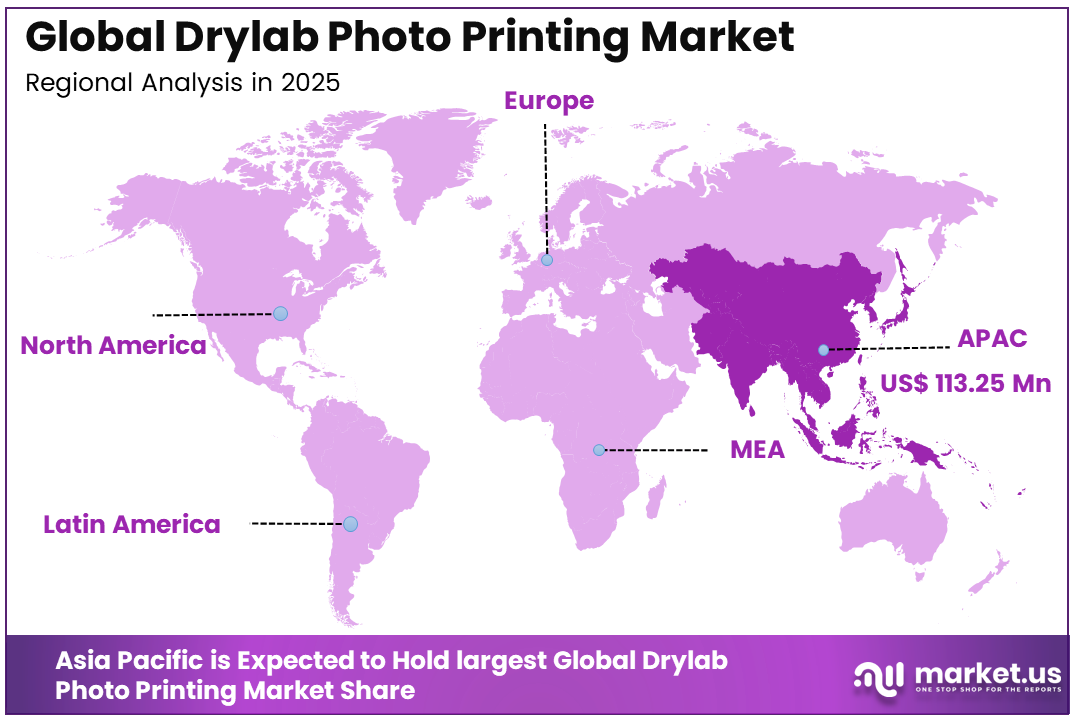
The Global Drylab Photo Printing Market size is expected to be worth around USD 476.69 million by 2035, from USD 281.73 million in 2025, growing at a CAGR of 5.4% during the forecast period from 2026 to 2035. Asia Pacific held a dominant market position, capturing more than a 40.2% share, holding USD 113.25 million in revenue.
Drylab Photo Printing refers to a modern photo printing method that produces high-quality prints without using traditional chemical processing. It uses inkjet or dye sublimation technology to deliver clean, sharp, and durable images. This system is widely used by photo labs, studios, retail counters, and event printing services.
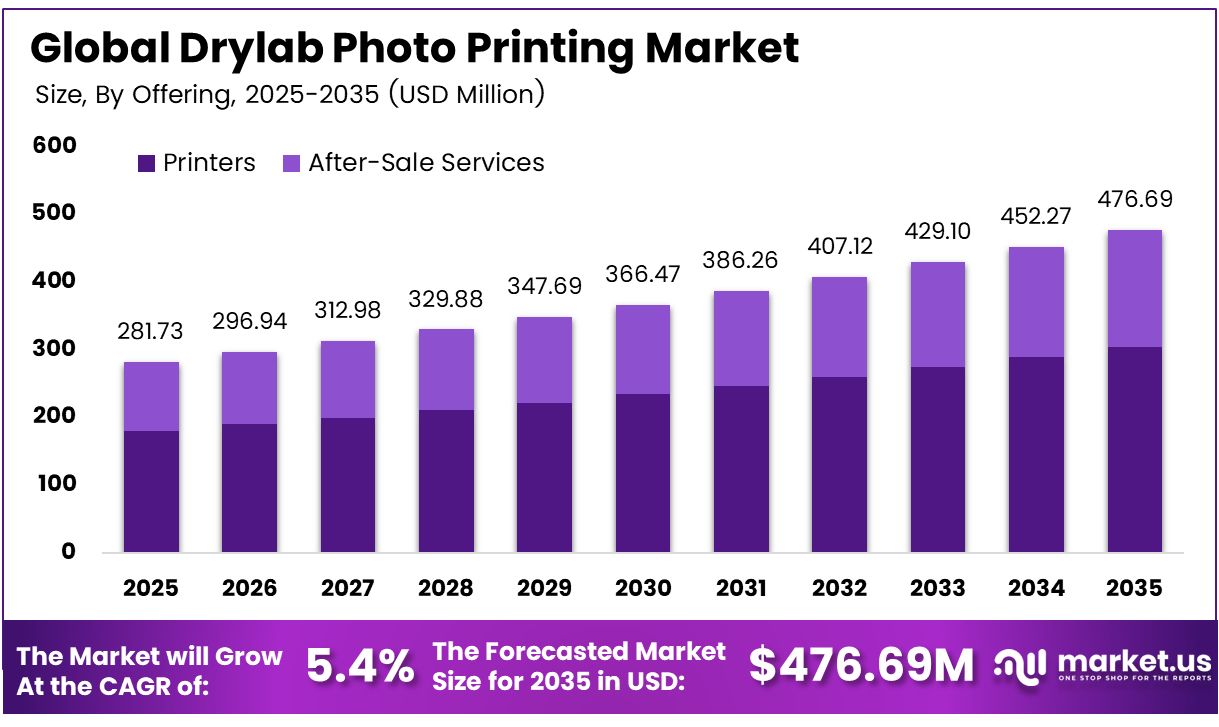
Top driving factors include the shift from film to digital photography, rising use of instant prints at events, and the need for clean, chemical-free operations. Over 70% of consumer images are now captured on smartphones, which supports demand for on-demand, high-quality prints across retail stores, kiosks, and self-service photo points.
The market for Drylab Photo Printing is driven by rising demand for fast, clean, and high-quality photo prints across retail stores, studios, events, and online photo services. Customers increasingly prefer instant prints, photo gifts, albums, and personalized products. Drylab systems support this demand by offering consistent output, easier maintenance and chemical-free operation for commercial photo printing businesses.
Demand is supported by the growing preference for personalized photo products, including albums, greeting cards and photo gifts. Same-day delivery expectations in many urban markets are also increasing the use of drylab systems. Professional photographers and labs prefer these systems for runs of a few dozen to a few hundred prints where speed and quality both matter.
For instance, in August 2025, HP continued to blur the line between commercial photo and graphics printing by promoting web-connected inkjet systems into photo labs seeking versatile dry workflows. By supporting photo prints alongside posters and décor, HP is capturing incremental share from labs that want to diversify revenue without adding separate platforms.
Key Takeaway
- In 2025, the Glossy segment held a dominant market position, capturing a 35.4% share of the Global Drylab Photo Printing Market.
- In 2025, the Printers segment held a dominant market position, capturing a 63.8% share of the Global Drylab Photo Printing Market.
- In 2025, the Wired (USB, Ethernet) segment held a dominant market position, capturing a 60.7% share of the Global Drylab Photo Printing Market.
- In 2025, the 4 to 6 Inches segment held a dominant market position, capturing a 55.2% share of the Global Drylab Photo Printing Market.
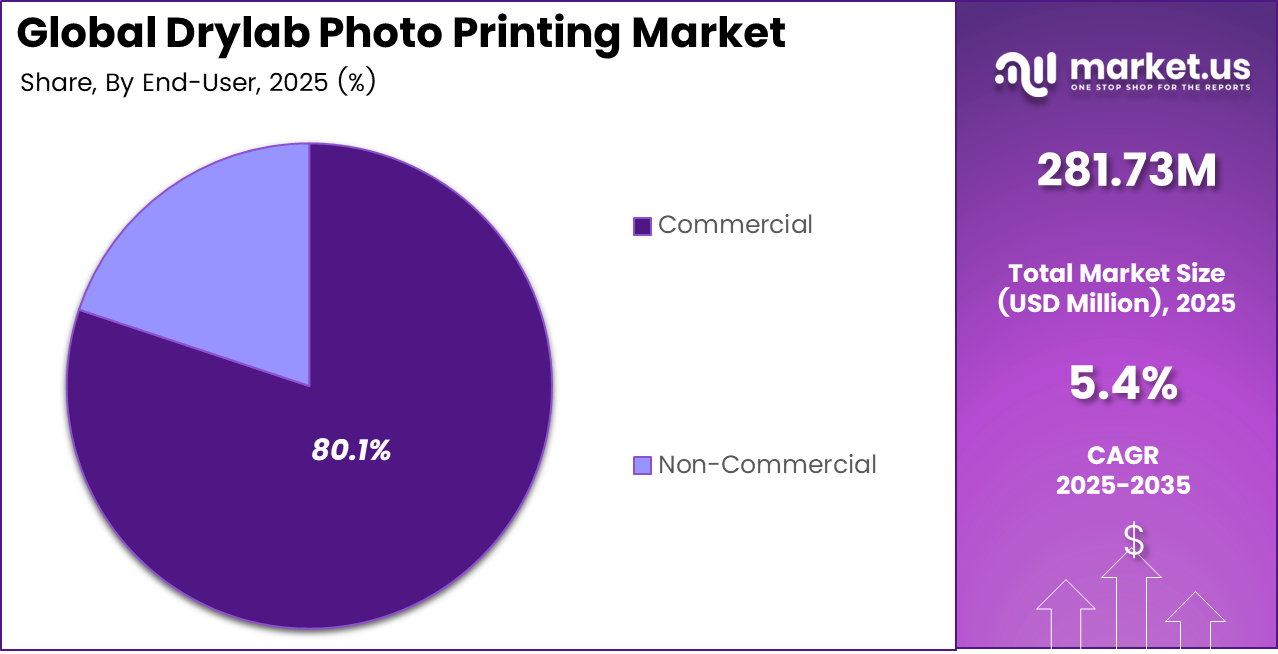
- In 2025, the Commercial segment held a dominant market position, capturing a 80.1% share of the Global Drylab Photo Printing Market.
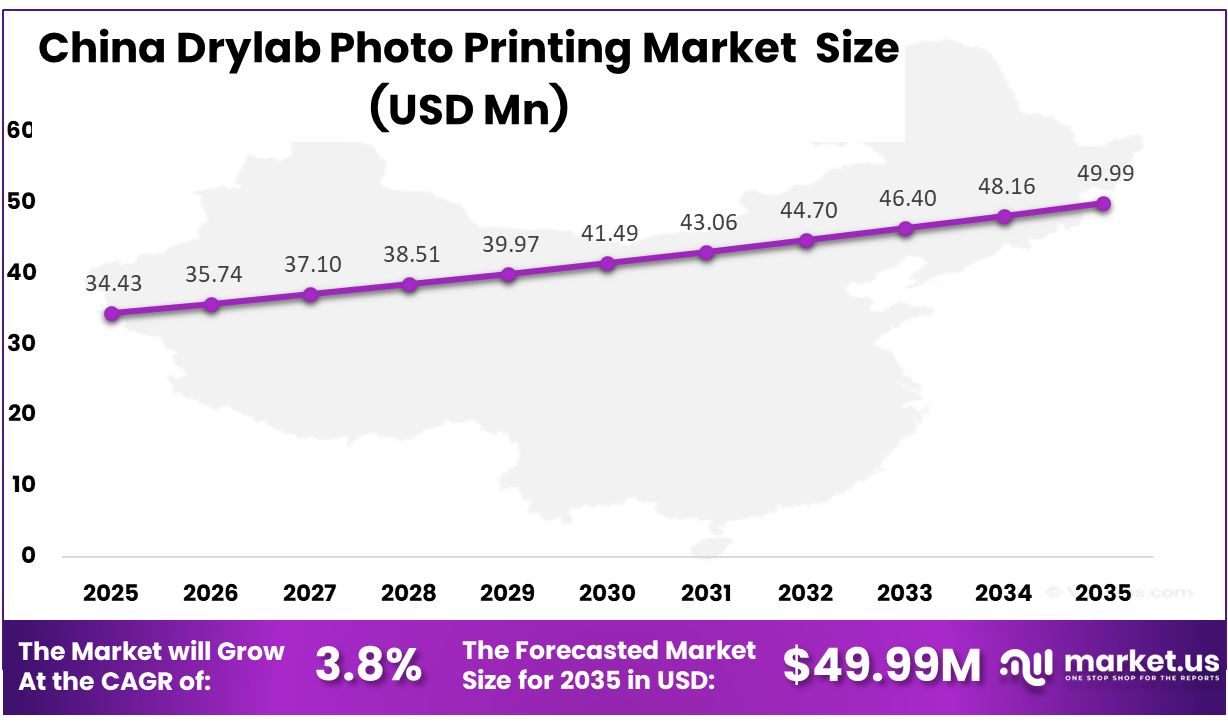
- The China Drylab Photo Printing Market was valued at USD 34.43 Million in 2025, with a robust CAGR of 3.8%.
- In 2025, Asia Pacific held a dominant market position in the Global Drylab Photo Printing Market, capturing more than a 40.2% share.
Role of Generative AI
Generative AI is improving how drylab photo printing workflows are managed. It helps clean image noise, adjust exposure, and balance skin tones before printing. This reduces the need for manual correction and supports faster processing. Some AI-based tools are reported to cut retouching time by 30% to 40%.
AI is also changing customer expectations around printed photos. Many users now prefer stylized portraits, background changes and creative layouts along with standard prints. More than 60% of professional photographers use AI-assisted editing, which is increasing the volume of print-ready digital files handled by drylab systems.
Investment and Business Benefits
Investment opportunities are emerging in compact printers for retail stores, event printing, workflow software, and eco-friendly media. Franchise photo kiosks in high-traffic locations are also gaining attention. Regions with rising middle-class photo spending and limited legacy lab infrastructure offer strong potential for investors that can bundle hardware, service support and consumables.
Business benefits include faster turnaround, stable print quality and the ability to offer customized merchandise without depending on large batch sizes. On-site dry lab capacity helps many labs keep more orders in-house instead of outsourcing. This improves control over service quality and can lift margins on premium prints by several percentage points.
Regional Analysis
In 2025, the Asia Pacific held a dominant market position in the Global Drylab Photo Printing Market, capturing more than a 40.2% share, holding USD 113.25 million in revenue. This dominance is due to strong photo printing demand across China, India, Japan, South Korea and Southeast Asia, where smartphone photography, retail photo services and event-based printing are widely used. The region also has a large consumer base for personalized photo gifts, albums and instant prints. Growing urban retail networks, wedding photography, tourism and small photo labs further support the adoption of drylab systems for faster and cleaner print production.
For instance, in December 2025, Seiko Epson ramped up shipments of its SureLab drylab inkjet systems into the Asia Pacific, targeting premium studio and photo-kiosk operators demanding high-resolution, water-resistant prints, while leveraging Japan-based R&D in inkjet dispensing to anchor its dominance in professional photo workflows across China, Japan, India, and emerging ASEAN markets.
China Drylab Photo Printing Market Size
The market for Drylab Photo Printing within China is growing tremendously and is currently valued at USD 34.43 million; the market has a projected CAGR of 3.8%. The market is growing due to China’s expanding digital photo culture, strong smartphone usage and rising demand for quick, high-quality prints across retail stores, studios and event services. Consumers are spending more on personalized photo gifts, albums and instant prints for family occasions, travel, and celebrations. Drylab systems are also gaining preference because they offer cleaner operation, faster output, and easier maintenance compared with traditional photo processing.
Key Regions and Countries
North America
- US
- Canada
Europe
- Germany
- France
- The UK
- Spain
- Italy
- Russia
- Netherlands
- Rest of Europe
Asia Pacific
- China
- Japan
- South Korea
- India
- Australia
- Singapore
- Thailand
- Vietnam
- Rest of APAC
Latin America
- Brazil
- Mexico
- Rest of Latin America
Middle East & Africa
- South Africa
- Saudi Arabia
- UAE
- Rest of MEA
Photo Printing Analysis
In 2025, the Glossy segment held a dominant market position, capturing a 35.4% share of the Global Drylab Photo Printing Market. This dominance is due to the strong customer preference for bright, sharp, and polished photo output. Glossy prints are widely used for portraits, event photos, travel memories, and retail photo products, as they give images a clean and premium appearance that appeals to both personal and professional users.
Glossy printing also supports a higher perceived value for photo labs and retail counters. Customers often associate glossy finishes with richer colours and better visual impact. This makes it a preferred option for quick photo prints, gifting products, and displaying photographs where appearance plays an important role.
For instance, in January 2024, Fujifilm expanded its photo printing portfolio with new glossy paper options tuned for drylab systems, giving minilabs richer colour rendition for everyday consumer work. This move supports the glossy segment by making it easier for retailers and studios to offer vivid, lab-style prints that match what customers expect from premium photo finishes.
Offering Analysis
In 2025, the Printers segment held a dominant market position, capturing a 63.8% share of the Global Drylab Photo Printing Market. This dominance is due to the central role of printers in drylab photo printing operations. Printers are the core equipment used by photo labs, retail stores, event photographers, and kiosk operators to produce fast, consistent, and high-quality prints without the need for traditional chemical processing.
Demand for printers is also supported by compact designs, easier maintenance and flexible installation. Businesses prefer drylab printers because they can handle daily print jobs with lower operational complexity. This helps service providers improve turnaround time while offering reliable photo output for walk-in and professional customers.
For instance, in January 2023, Epson introduced the SureLab D1070 minilab photo printer, designed specifically for high-volume drylab applications in retail, event, and e-commerce settings. The launch underlines ongoing investment in dedicated drylab hardware, encouraging labs to upgrade from older systems and fuelling growth in the printer segment as the main spend category.
Connectivity Analysis
In 2025, the Wired (USB, Ethernet) segment held a dominant market position, capturing a 60.7% share of the Global Drylab Photo Printing Market. This dominance is due to the need for stable and dependable connectivity in commercial photo printing environments. Wired connections are preferred by labs, studios and retail counters because they reduce interruptions during print transfer and support smoother handling of multiple orders throughout the day.
USB and Ethernet connectivity also help operators maintain better workflow control. These connections are easy to integrate with kiosks, computers and print management systems. For businesses handling time-sensitive photo orders, wired connectivity provides the reliability needed to avoid delays and maintain consistent service quality.
For instance, in July 2025, Fujifilm’s introduction of the Frontier DX400W compact inkjet printer emphasized flexible integration into existing photo workflows, including use in networked lab setups. The system supports a reliable connection with store IT infrastructure, helping operators maintain stable wired links between ordering stations and printers.
Print Width Analysis
In 2025, the 4 to 6 Inches segment held a dominant market position, capturing a 55.2% share of the Global Drylab Photo Printing Market. This dominance is due to the wide use of standard photo sizes in consumer and commercial printing. Prints in this range are commonly used for albums, frames, event handouts, passport-style photos and personalized gifts, making them one of the most practical formats for daily photo production.
This size range is also cost-efficient and easy to handle for both customers and operators. Drylab printers can produce these formats quickly with consistent colour quality. As demand for instant and same-day photo printing grows, this print width remains highly suitable for retail and event-based services.
For instance, in January 2023, the SureLab D1070 was promoted with strong capabilities in small photo formats commonly ordered in labs and retail stores. Its output profile is well-suited for the popular 4 to 6 inch range, allowing operators to process large volumes of everyday prints efficiently for walk-in customers.
End-User Analysis
In 2025, the Commercial segment held a dominant market position, capturing a 80.1% share of the Global Drylab Photo Printing Market. This dominance is due to the strong use of drylab photo printing by photo labs, studios, retail stores, event service providers, and gift shops. Commercial users need fast print production, predictable quality and equipment that can support regular customer orders without depending on chemical-based processing.
Commercial operators also benefit from offering value-added services such as photo gifts, albums, cards, and customized merchandise. Drylab systems allow them to manage smaller batches profitably and keep more work in-house. This improves service control, supports faster delivery, and helps strengthen customer retention.
For instance, in March 2026, Canon announced an America-wide production print strategy that emphasizes support for commercial print providers, including shops handling photo products. The initiative underlines how large vendors see professional and retail outlets as the main users of high-duty photo printing systems, reinforcing growth in the commercial drylab segment.
Key Market Segments
By Photo Printing
- Glossy
- Luster
- Silk
- Pearl
- Others
By Offering
- Printers
- After-Sale Services
By Connectivity
- Wired
- Wireless
By Print Width
- Below 4 Inches
- 4 to 6 Inches
- Above 6 Inches
By End-User
- Non-Commercial
- Commercial
- Retail Stores
- Photography Labs
- Gift Shops
- Others
Emerging Trends
A major trend is the shift toward shorter print runs and faster delivery. Retail photo counters, studios, and event printers are adopting compact drylab systems because they can handle small batches efficiently. In several regional studies, more than 50% of photo print orders are now below 20 prints.
Another trend is the growth of photo books, calendars, and personalized gifts through online ordering platforms. These products need faster production and flexible media handling. Personalized products account for 35% to 45% of print-related revenue for many online platforms, supporting wider use of drylab printers.
Growth Factors
The recovery of weddings, events and professional photography is supporting drylab photo printing demand. Photographers prefer compact systems that deliver stable colour, quick output and lower operating complexity. In some markets, professional and commercial users account for more than 60% of drylab installations.
Consumer photo printing is also being supported by smartphone and camera usage. People capture more images, but only selected photos are printed. Mobile ordering apps make this process easier. Studies show that simple app-based ordering can increase photo print volumes per user by 20% to 30%.
Market Dynamics
Drivers - Shift toward Instant, High Quality Photo Prints
The market for drylab photo printing is driven by rising demand for quick and premium photo output. Consumers now expect clear, sharp, and ready-to-collect prints at retail counters, studios, and events. Drylab systems support this need by offering fast printing without complex chemical processing.
Professional photographers and photo service providers also prefer drylab printers for urgent orders and small batch printing. These systems help maintain colour consistency while reducing waiting time. As customers continue to value printed memories for gifts, events, and albums, demand for instant photo printing remains strong.
For instance, in January 2025, Kodak Alaris refreshed parts of its scanner portfolio with enhanced image accuracy and data capture features. These capabilities reinforce the company’s expertise in high-fidelity imaging and workflow, which can support drylab-style photo environments where clean image handling and integration with digital systems are important drivers of service quality.
Restraint - High Initial Investment and Upgrade Burden
High initial investment remains a key restraint for small photo labs and independent studios. Drylab printers, workflow software, media supplies, and maintenance support can require notable upfront spending. For businesses with uncertain order volumes, this cost can delay adoption or limit the move from older printing systems.
Upgrade pressure also affects operators, as customers expect better print quality, faster service and more product choices. Businesses may need to invest in newer equipment, staff training, and compatible media. This creates an ongoing cost burden, especially for smaller players working with limited budgets and seasonal demand.
For instance, in January 2023, even as Epson launched the SureLab D1070, the announcement acknowledged that the printer targets specific retail and event scenarios where volumes justify dedicated hardware. This narrower focus reflects the restraint from consumers who are satisfied with digital sharing, meaning only selected venues and photo businesses see enough print demand to invest in drylab systems.
Opportunities - Growth in Personalized Photo Products
Personalized photo products create a strong opportunity for drylab photo printing providers. Customers increasingly want photo books, greeting cards, calendars, framed prints, and customized gifts for personal occasions. Drylab systems allow businesses to produce these products quickly, with flexible formats and consistent output quality.
This opportunity is also supported by online ordering and retail pickup models. Photo labs can receive digital files through apps or websites and print them on demand. By offering more customized products, businesses can increase order value and serve customers beyond standard photo printing needs.
For instance, in July 2025, Fujifilm’s photofinishing offering includes print-on-demand and specialty photo solutions that support custom products. By combining compact inkjet printers like the Frontier DX400W with software for e-commerce and specialty items, Fujifilm enables labs and retailers to exploit the opportunity in personalized photo merchandise and omnichannel ordering.
Challenges - Competition from Digital-Only Sharing and Home Printing
A major challenge comes from digital-only photo sharing, as many consumers prefer storing and sending images through phones, cloud platforms, and social media. This reduces the habit of printing everyday photos. Drylab service providers must therefore focus on emotional, premium, and gifting use cases to sustain demand.
Home printing also creates competition for basic photo needs. Some consumers choose compact home printers for convenience, especially for casual prints. Commercial drylab operators need to compete through better quality, wider media options, faster service, and value-added products that are difficult to produce at home.
For instance, in February 2025, Canon emphasized continuous investments in production print platforms and related service networks in the Americas. For smaller photo labs, this underlines the challenge of keeping pace with Canon’s rapid hardware and software refresh cycles, because adopting the latest systems for drylab-type use can demand significant upfront spending and careful volume planning.
Key Players Analysis
One of the leading players in October 2025, Canon expanded its drylab portfolio with a refreshed compact photo printer line for minilabs and retail kiosks, targeting higher throughput and lower per-print costs. The company is positioning these systems as upgrade paths for legacy wet labs, supporting the market’s shift to eco-friendly, on-demand photo production in high-traffic retail environments.
Top Key Players in the Market
- Canon Inc.
- Seiko Epson Corporation
- Fujifilm Corporation
- Dai Nippon Printing Co. Ltd.
- Kodak Alaris Inc.
- Noritsu Precision Co., Ltd.
- Hiti Digital, Inc.
- HP Development Company
- Sinfonia Technology Co. Ltd.
- Citizen Systems Japan Co., Ltd.
- Polaroid Corporation
- Mitsubishi Electric Corporation
- Ricoh
- Others
Recent Developments
- In September 2025, Epson strengthened its position in drylab photo printing by promoting high-capacity inkjet minilabs into supermarket and drugstore chains in North America and Europe. The focus is on consistent colour, reduced maintenance, and integration with cloud ordering workflows, directly tapping rising demand for personalized photo gifts and fast retail fulfillment.
- In June 2025, Fujifilm rolled out upgrades across its Frontier-class drylab systems, improving print speeds and media handling to support premium photo books, wall art, and event printing. The enhancements are aimed at professional labs looking to lift margins as the market pivots from commodity 10×15 cm prints to higher-value creative applications.
Report Scope
| Report Features | Description |
|---|---|
| Market Value (2025) | USD 281.73 Million |
| Forecast Revenue (2035) | USD 476.69 Million |
| CAGR (2026-2035) | 5.4% |
| Base Year for Estimation | 2025 |
| Historic Period | 2020-2024 |
| Forecast Period | 2026-2035 |
| Report Coverage | Revenue Forecast, Market Dynamics, Competitive Landscape, Recent Developments |
| Segments Covered | By Photo Printing (Glossy, Lustre, Silk, Pearl, Others), By Offering (Printers, After-Sale Services), By Connectivity (Wired, Wireless), By Print Width (Below 4 Inches, 4 to 6 Inches, Above 6 Inches), By End-User (Non-Commercial, Commercial) |
| Regional Analysis | North America (US and Canada), Europe (Germany, France, The UK, Spain, Italy, and Rest of Europe), Asia Pacific (China, Japan, South Korea, India, Australia, and Rest of APAC), Latin America (Brazil, Mexico, and Rest of Latin America), Middle East & Africa (GCC, South Africa, and Rest of MEA) |
| Competitive Landscape | Canon Inc., Seiko Epson Corporation, Fujifilm Corporation, Dai Nippon Printing Co. Ltd., Kodak Alaris Inc., Noritsu Precision Co. Ltd., Hiti Digital, Inc., HP Development Company, Sinfonia Technology Co. Ltd., Citizen Systems Japan Co. Ltd., Polaroid Corporation, Mitsubishi Electric Corporation, Ricoh, Others |
| Customization Scope | Customization for segments and region/country levels will be provided. Moreover, customization can be tailored to the requirements. |
| Purchase Options | We have three licenses to opt for: Single User License, Multi-User License (Up to 5 Users), Corporate Use License (Unlimited Users and Printable PDF) |





























