


Report Overview
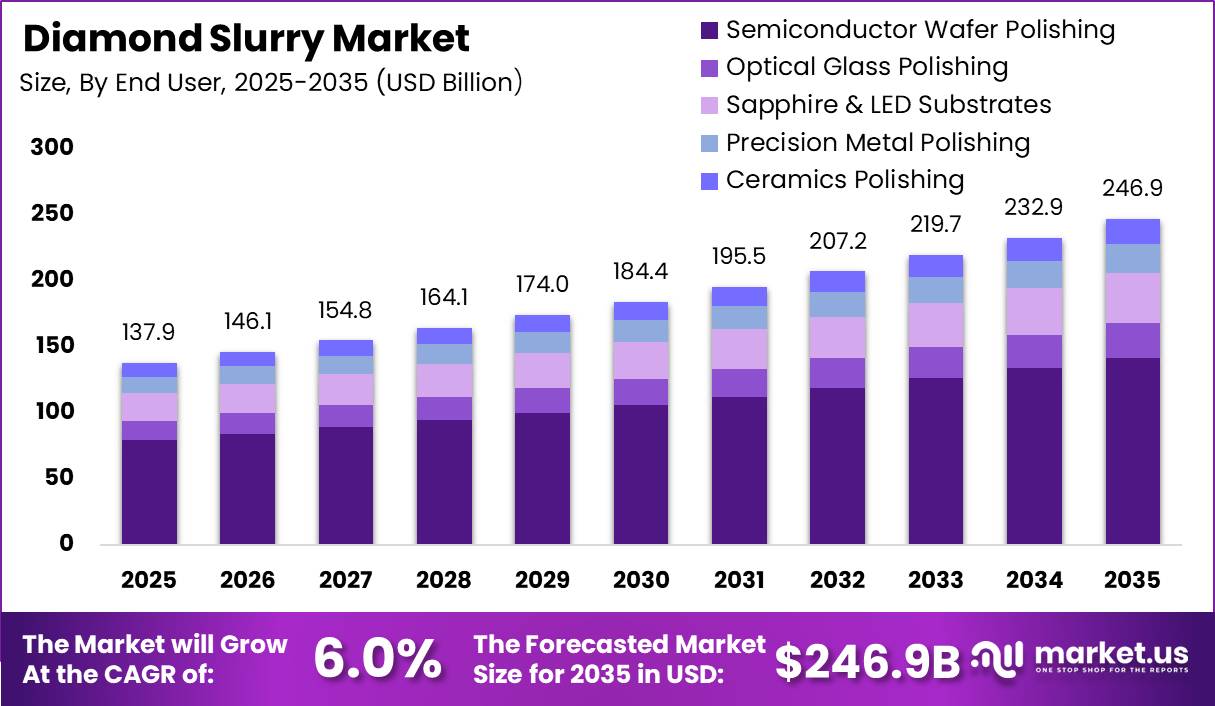
Global Diamond Slurry Market size is expected to be worth around USD 246.9 Billion by 2035 from USD 137.9 Billion in 2025, growing at a CAGR of 6.0% during the forecast period 2026 to 2035.
Diamond slurry is a precision abrasive suspension combining synthetic diamond particles with a liquid carrier — water, oil, or glycol — used to polish and planarize ultra-hard substrates including semiconductor wafers, optical glass, sapphire, ceramics, and superalloy components. The market spans multiple end-use industries and is distributed through direct sales channels and third-party distributors globally.
Key Takeaways
- Market size reached USD 137.9 Billion in 2025 and is forecast to reach USD 246.9 Billion by 2035.
- The market grows at a CAGR of 6.0% during the 2026 to 2035 forecast period.
- By Type, Water-Based Diamond Slurry dominates with a 61.80% share.
- By Abrasive Size, Nano Diamond Slurry holds the leading position with a 48.60% share.
- By Application, Semiconductor Wafer Polishing leads with a 57.40% share.
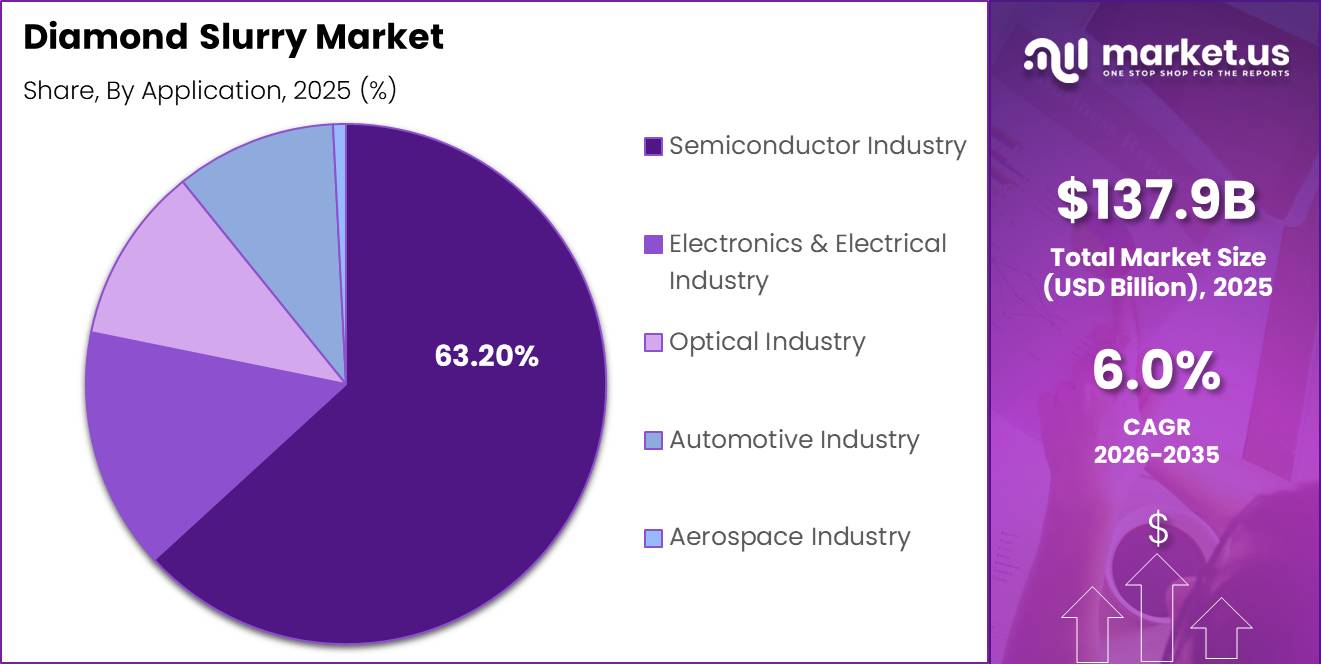
- By End User, the Semiconductor Industry holds a 63.20% share.
- By Distribution Channel, Direct Sales accounts for 66.50% of the market.
- By Form, Liquid Slurry dominates with a 72.10% share.
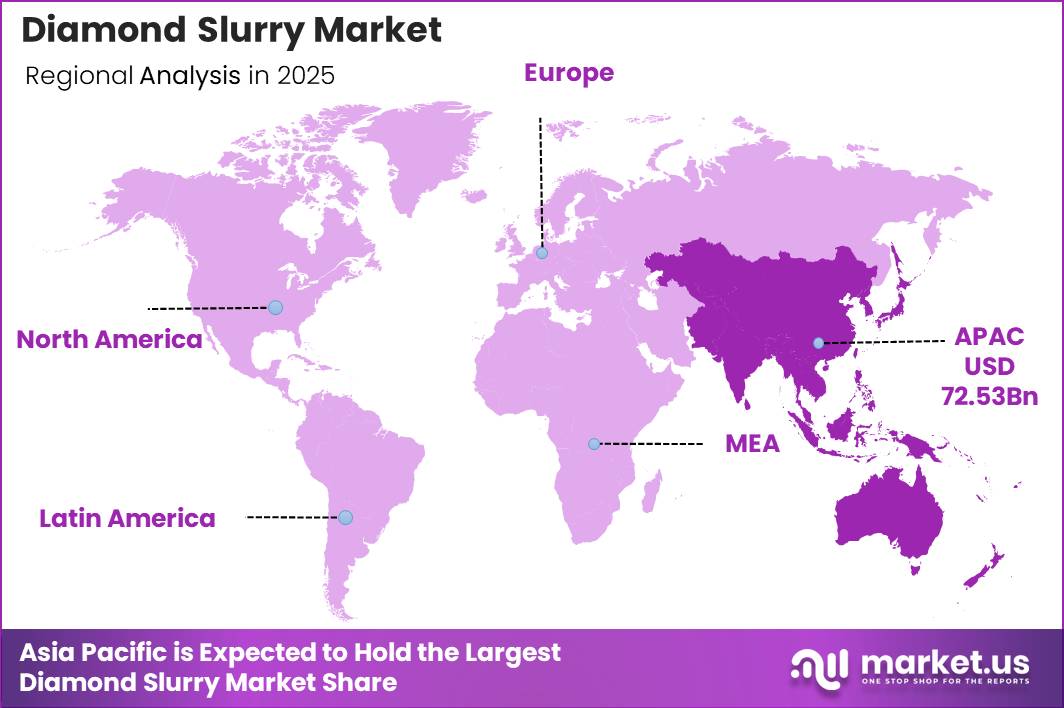
- Asia-Pacific is the dominant region with a 52.60% share, valued at USD 72.53 Billion.
Government-led semiconductor reshoring programs are accelerating capital deployment into wafer fabrication facilities, directly expanding procurement volumes for CMP consumables including diamond slurry. The U.S. CHIPS Act and equivalent European and Asian policy initiatives fund fab construction at a scale that structurally expands slurry demand over the medium term. Early-stage suppliers that qualify under national procurement frameworks gain durable volume commitments.
According to SEMI, worldwide silicon wafer shipments reached 12,973 million square inches in 2025, a 5.8% increase over 2024. This shipment growth directly expands the addressable volume for diamond slurry, as every wafer requires multiple polishing stages consuming slurry as a process consumable. Suppliers with capacity already scaled to this volume gain immediate revenue advantage over constrained competitors.
SEMI data shows global silicon wafer revenue totaled USD 11.4 Billion in 2025 despite shipment growth, indicating sustained investment in advanced wafer processing. In February 2026, FUJIFILM Corporation completed a ¥5 Billion investment in Rapidus Corporation to support leading-edge logic semiconductor production in Japan, with FUJIFILM supplying CMP slurries and related process materials. This partnership signals that integrated material supply models are becoming the preferred structure for next-generation fab programs.
Type Analysis
Water-Based Diamond Slurry dominates with 61.80% due to environmental compliance and semiconductor fab compatibility.
In 2025, Water-Based Diamond Slurry held a dominant market position in the By Type segment of the Diamond Slurry Market, with a 61.80% share. Water-based formulations are preferred across semiconductor fabs because they align with REACH and EPA VOC regulations governing carrier fluid disposal. Global semiconductor fab wastewater treatment infrastructure is optimized for aqueous slurry streams. Manufacturers that supply water-based slurry gain qualification access to the largest and fastest-growing end-use customer base without additional regulatory compliance cost.
Oil-Based Diamond Slurry retains a structural role in precision metal lapping and ceramic component finishing, where water-sensitive substrates require non-aqueous carriers to prevent corrosion or surface oxidation. Oil-based formulations deliver superior lubricity during high-pressure lapping of superalloy components used in aerospace turbine manufacturing. Aerospace finishing applications typically require surface tolerances below 0.2 micrometers Ra, and oil-based carriers preserve substrate integrity across multi-hour polishing cycles better than aqueous alternatives.
Glycol-Based Diamond Slurry occupies a bridging role between aqueous and oil-based formulations, offering moderate viscosity control and lower surface tension than water for polishing microporous ceramics and LED substrates. Glycol carriers reduce slurry absorption into porous substrate surfaces during polishing, improving material removal consistency across production batches. Manufacturers targeting the LED sapphire substrate segment use glycol-based slurries to achieve tighter surface roughness control at sub-1 nm Ra specifications than pure water-based alternatives permit.
Abrasive Size Analysis
Nano Diamond Slurry dominates with 48.60% due to sub-nanometer surface finish requirements at advanced nodes.
In 2025, Nano Diamond Slurry held a dominant market position in the By Abrasive Size segment of the Diamond Slurry Market, with a 48.60% share. Advanced semiconductor nodes below 5 nm require particle sizes under 100 nm to avoid subsurface crystallographic damage during CMP. The International Roadmap for Devices and Systems (IRDS) 2023 edition specifies that logic nodes at 2 nm and below require planarization consumables with particle size distributions tighter than ±5% CV. Slurry producers that achieve this specification gain preferred qualification status at leading-edge fabs globally.
Micro Diamond Slurry serves established volume applications in optical glass polishing, sapphire substrate preparation, and precision ceramic finishing where particle sizes between 1 and 50 micrometers remove material efficiently at higher removal rates than nano-scale alternatives. The global optical glass market processed over 380,000 metric tons of optical-grade glass in 2024 according to the International Commission on Glass, sustaining consistent base demand for micro-grade slurry. This segment provides slurry manufacturers with stable margin contributions outside the cyclical semiconductor procurement cycle.
Sub-Micron Diamond Slurry bridges the nano and micro categories, targeting polishing applications that require removal rates above nano-grade capability but surface finishes below standard micro-grade tolerance. Quantum computing component fabrication and photonic waveguide polishing both require sub-micron abrasives to achieve surface roughness below 0.5 nm Ra while maintaining throughput rates viable for small-volume specialty production runs. Producers serving this tier command premium pricing that exceeds standard micro-grade slurry by an estimated 30 to 50 percent per liter of finished product.
Application Analysis
Semiconductor Wafer Polishing dominates with 57.40% due to mandatory multi-stage CMP at every advanced node.
In 2025, Semiconductor Wafer Polishing held a dominant market position in the By Application segment of the Diamond Slurry Market, with a 57.40% share. SEMI reported that Q2 2025 worldwide silicon wafer shipments reached 3,327 million square inches, a 9.6% year-over-year increase, while demand for 300 mm wafers remained particularly strong throughout 2025 due to AI processor and HBM production. Each 300 mm wafer passes through multiple diamond slurry polishing stages before epitaxial deposition, making wafer volume growth a direct multiplier of slurry consumption. Suppliers already qualified at leading 300 mm fabs are positioned to capture this volume without additional customer acquisition cost.
Optical Glass Polishing is the second-largest application segment, driven by sustained production of precision lenses for defense, LiDAR, medical imaging, and telecommunications systems. High-power laser optics and space telescope mirrors require surface figure accuracy below lambda/20 and surface roughness below 1 angstrom RMS, achievable only with diamond slurry polishing sequences. The U.S. Department of Defense allocated over USD 3.2 Billion to directed energy and electro-optical sensor programs in fiscal year 2025, according to the DoD budget request, directly sustaining demand for precision optical polishing consumables.
Sapphire and LED Substrate polishing serves the LED lighting, semiconductor-on-sapphire, and RF device markets, where 2-inch to 6-inch sapphire wafers require diamond slurry lapping prior to epitaxial GaN deposition. Global LED production reached approximately 187 Billion units in 2024 according to the International Energy Agency, sustaining consistent base demand for sapphire polishing consumables across Asia-Pacific manufacturing centers. This segment offers slurry producers predictable order cycles aligned to lighting industry procurement calendars.
End User Analysis
Semiconductor Industry dominates with 63.20% due to mandatory CMP at every fabrication node.
In 2025, the Semiconductor Industry held a dominant market position in the By End User segment of the Diamond Slurry Market, with a 63.20% share. The CHIPS and Science Act authorized USD 52.7 Billion in U.S. semiconductor manufacturing and research investments, with leading-edge fab construction programs across Arizona, Ohio, and New York committing to volume CMP consumable procurement over multi-year horizons. Each new 300 mm fab typically procures between USD 15 and USD 40 million in annual CMP slurry volume at full production capacity. Slurry suppliers that achieve early qualification at greenfield fabs lock in recurring revenue streams before competing suppliers can complete their own qualification cycles.
The Electronics and Electrical Industry applies diamond slurry to PCB substrate finishing, power module ceramic carrier polishing, and lead frame surface preparation for high-reliability packaging applications. Global PCB production output reached approximately 75 Billion USD in 2024 according to the IPC State of the Industry report, with high-density interconnect substrates requiring increasingly precise surface conditioning that standard alumina or silica abrasives cannot deliver. Diamond slurry suppliers that develop PCB-specific low-contamination formulations gain entry into a high-volume recurring consumable market adjacent to their core semiconductor customer base.
Distribution Channel Analysis
Direct Sales dominates with 66.50% due to technical specification complexity requiring supplier application support.
In 2025, Direct Sales held a dominant market position in the By Distribution Channel segment of the Diamond Slurry Market, with a 66.50% share. Semiconductor and wafer fab procurement teams require direct application engineering support from slurry suppliers to manage qualification protocols, process integration, and batch-to-batch consistency verification. The Semiconductor Equipment and Materials International (SEMI) F47 and related standards governing CMP slurry qualification require documented supplier traceability that distributor-mediated supply chains cannot reliably maintain. Manufacturers that invest in direct field application engineering teams at customer fab sites generate stronger retention and higher contract renewal rates than distributor-dependent competitors.
Distributors serve smaller-volume end users in the optical, aerospace, and ceramics finishing sectors where order sizes do not justify direct supplier application support teams. Industrial abrasive distributors typically stock a range of diamond slurry grades from multiple suppliers, providing customers with faster order fulfillment and consolidated invoicing. For slurry manufacturers, the distributor channel enables geographic market coverage in tier-2 and tier-3 industrial markets — particularly in Southeast Asia and Eastern Europe — without the fixed cost of direct sales infrastructure.
Form Analysis
Liquid Slurry dominates with 72.10% due to compatibility with continuous-flow CMP tool delivery systems.
In 2025, Liquid Slurry held a dominant market position in the By Form segment of the Diamond Slurry Market, with a 72.10% share. CMP tools manufactured by Applied Materials, Ebara, and other leading equipment suppliers are engineered around continuous liquid slurry delivery systems with flow rates typically between 100 and 300 ml per minute per platen. Liquid slurry integrates directly into point-of-use dilution and blending systems installed at fab chemical distribution points, eliminating manual handling and reducing contamination risk. Slurry producers that supply in bulk liquid format with validated shelf-life and agglomeration stability data hold a procurement qualification advantage over paste or gel competitors in high-volume fab environments.
Paste and Gel Form slurry serves manual and semi-automated lapping applications in optics workshops, aerospace component finishing, and jewelry and gemstone polishing where continuous-flow delivery equipment is not installed. Paste formulations provide longer working time on vertical and angled substrate surfaces than liquid alternatives, making them preferred for hand-lapping of large-format telescope mirror blanks and aerospace nacelle components. The global aerospace MRO market exceeded USD 80 Billion in 2024 according to the International Air Transport Association (IATA), sustaining demand for paste-form abrasives in component refurbishment applications.
Key Market Segments
By Type
- Water-Based Diamond Slurry
- Oil-Based Diamond Slurry
- Glycol-Based Diamond Slurry
- Others
By Abrasive Size
- Nano Diamond Slurry
- Micro Diamond Slurry
- Sub-Micron Diamond Slurry
- Macro Diamond Slurry
By Application
- Semiconductor Wafer Polishing
- Optical Glass Polishing
- Sapphire & LED Substrates
- Precision Metal Polishing
- Ceramics Polishing
By End User
- Semiconductor Industry
- Electronics & Electrical Industry
- Optical Industry
- Automotive Industry
- Aerospace Industry
By Distribution Channel
- Direct Sales
- Distributors
By Form
- Liquid Slurry
- Paste/Gel Form
Regional Analysis
Asia-Pacific Dominates the Diamond Slurry Market with a Market Share of 52.60%, Valued at USD 72.53 Billion
Asia-Pacific accounts for 52.60% of global diamond slurry revenue, valued at USD 72.53 Billion, driven by the concentration of semiconductor wafer fabs, SiC substrate producers, and LED manufacturers across China, Japan, South Korea, and Taiwan. This region hosts the majority of global 300 mm wafer production capacity and the fastest-growing SiC device manufacturing base outside North America. Slurry suppliers with qualified production facilities and logistics infrastructure within Asia-Pacific hold a structural cost and lead-time advantage over import-dependent competitors.
North America is the fastest-growing regional market, accelerated by CHIPS Act-funded fab construction programs that are adding leading-edge 300 mm wafer capacity across Arizona, Ohio, and New York through 2028. Government procurement frameworks under these programs require domestic or allied-nation supply chain qualification for critical consumables including CMP slurry. Suppliers that achieve domestic qualification status before competing entrants complete their own programs gain multi-year volume commitments that are difficult for later entrants to displace.
Europe sustains a concentrated demand base in precision optics, aerospace component finishing, and automotive power electronics manufacturing, particularly in Germany, France, and the UK. The European Chips Act targets doubling Europe’s share of global semiconductor production to 20% by 2030, according to the European Commission, creating a medium-term pipeline of new fab installations that will expand regional CMP consumable procurement. Latin America and the Middle East and Africa remain early-stage markets where demand is driven primarily by imported finished components rather than in-region substrate manufacturing.
Key Regions and Countries
North America
- US
- Canada
Europe
- Germany
- France
- The UK
- Spain
- Italy
- Rest of Europe
Asia Pacific
- China
- Japan
- South Korea
- India
- Australia
- Rest of APAC
Latin America
- Brazil
- Mexico
- Rest of Latin America
Middle East and Africa
- GCC
- South Africa
- Rest of MEA
Market Dynamics
Market Opportunity Analysis - Underserved substrate types and reshoring-driven regional shifts create high-margin entry points for focused slurry suppliers
The Nano Diamond Slurry sub-segment within the By Abrasive Size category remains underexploited by mid-tier manufacturers because the contamination control infrastructure required to qualify at advanced semiconductor nodes exceeds the capital capacity of most regional producers. However, the 48.60% share this sub-segment already holds signals that demand concentration is accelerating ahead of qualified supply. New entrants that invest in ISO Class 5 cleanroom blending and ICP-MS QC infrastructure before 2027 can secure qualification positions at greenfield fabs before incumbent suppliers lock in long-term agreements.
The Paste and Gel Form segment, which holds the minority share below the 72.10% dominant liquid form, is structurally underserved in the aerospace MRO and large-format optics finishing segments. These applications require manual application on non-planar surfaces where liquid delivery systems are not viable. As defense optics specifications tighten and aerospace MRO volumes recover, paste-form slurry suppliers that develop application-specific viscosity profiles for curved and angled substrate geometries can capture premium pricing unavailable in high-volume liquid semiconductor markets.
The Distributor channel, which holds the minority share against the 66.50% dominant Direct Sales segment, is underexploited as a growth vector in Southeast Asian and Eastern European industrial markets. These geographies host mid-tier optical glass fabricators, ceramic component finishers, and precision metal polishing shops that purchase in volumes too small for direct supplier engagement. Slurry manufacturers that build structured distributor programs with application training and co-marketing support in these regions can expand revenue without proportional field sales cost increases.
The Automotive Industry end-user segment, positioned below the dominant 63.20% Semiconductor Industry share, is an underexploited growth vector for diamond slurry suppliers as EV powertrain manufacturing scales in Europe and North America outside Asia-Pacific. SiC inverter component finishing and ceramic brake rotor polishing both require diamond slurry grades already produced by semiconductor-grade manufacturers. Suppliers that adapt existing product lines with automotive-qualified documentation packages can cross-sell into automotive OEM supply chains without significant reformulation investment.
Technology and Innovation Landscape - Hybrid abrasive formulations and slurry reclaim systems redefine process economics for semiconductor and optical polishing applications
A 2025 study published in Materials (MDPI) demonstrated that a hybrid SiO₂–diamond slurry increased the material removal rate of polycrystalline diamond wafers by 15.5% compared with conventional pure diamond slurry, while reducing surface roughness to Sa = 1.39 μm. The synergistic interaction between silica and diamond particles improves material removal efficiency without increasing abrasive concentration. Manufacturers that commercialize hybrid abrasive formulations reduce per-wafer slurry cost while meeting tighter surface quality specifications at advanced nodes.
A separate 2025 study published in Wear (Elsevier) found that a green diamond and SiO₂ composite slurry increased the material removal rate by 65.4% for sapphire wafer polishing versus conventional pure diamond slurry, while reducing surface roughness by 24.4%. Bubble cavitation and chemical reactions contributed 27.5% of total material removal during the chemomechanical polishing process. This mechanism allows sapphire substrate producers to achieve LED-grade surface finish at significantly higher throughput, reducing per-unit polishing cost and expanding margin at volume.
The optimum abrasive ratio identified across both 2025 studies was 50 wt.% SiO₂ combined with 50 wt.% diamond particles, a formulation that balances mechanical removal from diamond with chemical surface conditioning from silica. This ratio discovery provides slurry formulators with a validated starting point for developing hybrid product lines targeting sapphire, SiC, and polycrystalline diamond substrates. Producers that file process IP around specific SiO₂-to-diamond ratios for defined substrate types can create defensible product differentiation in markets where commodity slurry pricing compresses standard margins.
The migration from oil-based to water-based slurry chemistries is accelerating across semiconductor polishing lines because water-based formulations reduce VOC emissions and simplify spent slurry disposal under EPA RCRA and EU REACH regulations. Slurry reclaim and reuse programs, now adopted by large-volume fabs, are driving investment in closed-loop slurry management systems that filter, reconcentrate, and re-dispense spent slurry. Manufacturers that integrate reclaim-compatible formulation chemistry and supply slurry management equipment alongside product create a service revenue stream that compounds alongside consumable volume growth.
Drivers
Silicon carbide wafer production for EV power electronics is the primary force expanding diamond slurry consumption. SiC substrates require diamond abrasives across lapping, rough grinding, and CMP stages because no alternative abrasive achieves the required hardness differential. Automakers and charging infrastructure builders are accelerating SiC device procurement, which translates directly into sustained, non-substitutable slurry volume growth for qualified suppliers.
Advanced semiconductor node progression and three-dimensional packaging architectures are intensifying CMP process requirements at each technology generation. Sub-5 nm logic nodes require more polishing steps per wafer than prior generations, and nano-scale diamond slurry is the only consumable that achieves the surface roughness tolerances these nodes demand. Precision optics growth in defense LiDAR and photonics manufacturing adds a parallel, policy-insulated demand stream that diversifies slurry market revenue beyond semiconductor cycles.
| Driver | (~) % Impact on CAGR Forecast | Geographic Relevance | Impact Timeline |
|---|---|---|---|
| SiC Wafer Polishing Demand from EV & Power Electronics Expansion | +2.4% | China, Japan, South Korea, Germany, United States | Short term (≤ 2 years) |
| Advanced Semiconductor Node & 3D Packaging CMP Process Intensity | +1.8% | Taiwan, South Korea, United States, Japan | Short term (≤ 2 years) |
| Precision Optics & Photonics Manufacturing Growth (Defense, LiDAR, Telecom) | +0.9% | United States, Germany, Japan, China, Israel | Medium term (2–4 years) |
| Aerospace & Medical Device Superalloy & Ceramic Component Finishing Demand | +0.7% | United States, Western Europe, Japan | Medium term (2–4 years) |
| Nano-Diamond Slurry Adoption for Sub-Nanometer Surface Finish Requirements | +0.5% | Global, accelerating in EUV lithography & quantum device fabs | Medium term (2–4 years) |
Restraints
China’s Ministry of Commerce export licensing controls on synthetic diamond powder below 50 micrometers, effective November 2025, are the most disruptive active restraint in this market. China supplies an estimated 80 to 85 percent of global synthetic industrial diamond by volume, and non-Chinese slurry formulators that relied on Chinese feedstock now face licensing delays and spot price increases of 15 to 25 percent. This cost-push directly compresses gross margins on commodity-grade lapping slurry and limits the ability to commit to multi-year supply agreements with SiC wafer customers.
High formulation and production costs constrain mid-tier slurry manufacturers from competing at scale in the fastest-growing semiconductor-grade segments. Achieving ISO Class 5 to 6 cleanroom blending environments and ICP-MS contamination testing at sub-0.1 ppb thresholds requires fixed infrastructure investment of approximately USD 3 to USD 8 million per production facility. This capital barrier concentrates high-specification supply among a small number of tier-1 producers and limits new entrants from displacing incumbents in leading-edge fab qualification programs.
| Restraint | (~) % Impact on CAGR Forecast | Geographic Relevance | Impact Timeline |
|---|---|---|---|
| China Synthetic Diamond Export Controls (Effective November 2025) Disrupting Supply | -2.1% | United States, EU, Japan, South Korea, Taiwan — all non-China importers | Short term (≤ 2 years) |
| High Formulation & Production Cost Limiting SME Slurry Manufacturer Viability | -1.3% | Global, most acute for non-integrated mid-tier producers | Medium term (2–4 years) |
| Regulatory Pressure on Hazardous Carrier Fluid Disposal (VOC & Heavy Metal Controls) | -0.8% | EU (REACH), United States (EPA RCRA), Japan | Short term (≤ 2 years) |
| Customer In-House Slurry Reclaim & Reuse Programs Reducing Purchase Volume | -0.6% | Global large-volume semiconductor & wafer fabs | Medium term (2–4 years) |
| U.S.–China Trade War Escalation Raising Input Tariff Costs on Synthetic Diamond Feedstock | -0.5% | United States, import-dependent slurry formulators globally | Short term (≤ 2 years) |
Challenges
Maintaining tight particle size distribution and contamination-free formulations across production batches is the most technically persistent challenge suppressing market growth. Synthetic diamond powder production via HPHT synthesis yields a raw particle size distribution with a coefficient of variation of 25 to 45 percent, requiring multiple milling and classification stages to reach the tolerances advanced semiconductor nodes demand. Each reclassification stage adds 12 to 20 percent to per-kilogram finished powder cost, concentrating viable high-specification supply among a handful of well-capitalized producers.
A single metallic ion contamination event above 1 to 10 parts per billion for transition metals can cause catastrophic device yield losses at advanced CMOS fabs, triggering qualification re-runs that require 6 to 12 weeks of re-audit per incident. This contamination risk forces slurry manufacturers to invest in cleanroom blending infrastructure and ICP-MS analytical capability costing approximately USD 3 to USD 8 million per facility. These fixed costs create a scale barrier that limits mid-tier entrants from capturing share in high-specification semiconductor-grade segments.
| Challenge | (~) % CAGR Friction Drag | Geographic Relevance | Mitigation Horizon |
|---|---|---|---|
| Particle Size Consistency & Contamination Control | -1.5% | Global, most critical in semiconductor-grade applications | Long term (≥ 4 years) |
| Slurry Shelf Life & Agglomeration Stability | -1.0% | Global, particularly affecting long-haul distribution to Asia-Pacific | Medium term (2–4 years) |
| Non-Chinese Synthetic Diamond Capacity Gap | -0.9% | India, United States, South Africa, Europe | Long term (≥ 4 years) |
| CMP Process Transition to Fixed-Abrasive Pads | -0.7% | Advanced node semiconductor fabs globally | Medium term (2–4 years) |
| Workforce Expertise Shortage in Slurry Formulation | -0.5% | North America, Europe, India | Long term (≥ 4 years) |
Opportunities
China’s November 2025 export licensing controls have fundamentally altered the economics of non-Chinese synthetic diamond powder production. Prior to the controls, ex-China production carried a 40 to 80 percent cost disadvantage versus Chinese supply. Licensed Chinese material now costs 20 to 35 dollars per kilogram, narrowing the gap with non-Chinese alternatives to approximately 10 to 20 percent. Slurry formulators that vertically integrate into India- or U.S.-based HPHT production can improve gross margins by an estimated 12 to 22 percentage points versus purchasing licensed Chinese feedstock.
India’s Production Linked Incentive scheme for advanced materials provides capital subsidies of 4 to 8 percent of incremental production value for qualifying synthetic diamond manufacturers. Slurry producers that establish or secure tolling agreements with India-based HPHT facilities gain dual advantages: feedstock cost competitiveness and preferred-supplier status under U.S. Department of Defense and EU strategic supply chain frameworks. This positions them to capture volume from China-dependent formulators that cannot meet trusted-supplier qualification requirements at defense and advanced-node fab customers.
| Opportunity | (~) % Potential CAGR Upside | Geographic Relevance | Execution Window |
|---|---|---|---|
| Non-Chinese Synthetic Diamond Supply Chain Buildout (India, U.S., Europe) | +2.0% | India, United States, South Africa, Ukraine (pre-conflict capacity), EU | Medium term (2–4 years) |
| Diamond Slurry-as-a-Service & Slurry Reclaim Loop Monetization | +1.5% | North America, Japan, South Korea, Taiwan, Europe | Medium term (2–4 years) |
| Gallium Nitride (GaN) & Gallium Oxide Substrate Polishing Market Entry | +1.1% | United States, Japan, South Korea, Germany | Long term (≥ 4 years) |
| Quantum Computing & Diamond Substrate Precision Finishing Niche | +0.8% | United States, UK, Germany, Japan | Long term (≥ 4 years) |
| Defense & Space Optical Component Polishing Specification Upgrade | +0.6% | United States, France, Germany, Israel, Japan | Medium term (2–4 years) |
Key Company Insights
Engis Corporation holds a structural advantage in the diamond slurry market through its vertically integrated approach to diamond particle sizing and slurry formulation, enabling tighter batch-to-batch consistency than formulators dependent on third-party powder suppliers. GNPGraystar, a subsidiary of SurfacePrep, strengthened its abrasive portfolio through the strategic acquisition of UK Abrasives, expanding distribution reach into European industrial markets. This move creates competitive pressure on established European slurry distributors.
Fujimi Incorporated competes directly across semiconductor CMP slurry categories, with a product portfolio spanning oxide, metal, and barrier slurries alongside precision abrasive compounds for optical and ceramic applications. Fujimi’s established qualification relationships at leading Asia-Pacific wafer fabs provide recurring revenue from the 52.60% dominant regional market without proportional customer acquisition cost. However, dependence on Asia-Pacific concentration creates revenue exposure if regional fab utilization softens during memory cycle downturns.
Key Players
- Engis Corporation
- Fujimi Incorporated
- Saint-Gobain Ceramics & Plastics
- Lapmaster Wolters
- H.C. Starck Solutions
- 3M
- Asahi Diamond Industrial
- ILJIN Diamond
- Zhengzhou Research Institute of Abrasives & Grinding
- Microdiamant AG
- Henan Union Abrasives Corp.
- Ningbo Zhongnan Diamond Tools Co., Ltd.
- Pureon AG
- Grish Diamond Tools
- Mapal Group
Recent Developments
- March 2026 – Hyperion Materials & Technologies announced the acquisition of Electronica Tungsten Ltd., with the transaction expected to close by the end of Q1 2026 following regulatory approvals, expanding Hyperion’s hard materials and abrasive component manufacturing capabilities.
- 2026 – Flexaseal Engineered Seals and Systems, LLC acquired Robco of America, with Robco continuing to operate under its own name as a division of Flexaseal, extending Flexaseal’s sealing and fluid handling solutions portfolio into North American industrial markets.
- February 2026 – FUJIFILM Corporation completed a ¥5 Billion investment in Rapidus Corporation to support mass production of leading-edge logic semiconductors in Japan, with FUJIFILM supplying CMP slurries, post-CMP cleaners, photoresists, and related process materials to accelerate next-generation semiconductor manufacturing.
Report Scope
| Report Features | Description |
|---|---|
| Market Value (2025) | USD 137.9 Billion |
| Forecast Revenue (2035) | USD 246.9 Billion |
| CAGR (2026-2035) | 6.0% |
| Base Year for Estimation | 2025 |
| Historic Period | 2020-2024 |
| Forecast Period | 2026-2035 |
| Report Coverage | Revenue Forecast, Market Dynamics, Market Opportunity Analysis, Technology and Innovation Landscape, Competitive Landscape, Recent Developments |
| Segments Covered | By Type (Water-Based Diamond Slurry, Oil-Based Diamond Slurry, Glycol-Based Diamond Slurry, Others), By Abrasive Size (Nano Diamond Slurry, Micro Diamond Slurry, Sub-Micron Diamond Slurry, Macro Diamond Slurry), By Application (Semiconductor Wafer Polishing, Optical Glass Polishing, Sapphire & LED Substrates, Precision Metal Polishing, Ceramics Polishing), By End User (Semiconductor Industry, Electronics & Electrical Industry, Optical Industry, Automotive Industry, Aerospace Industry), By Distribution Channel (Direct Sales, Distributors), By Form (Liquid Slurry, Paste/Gel Form) |
| Regional Analysis | North America (US and Canada), Europe (Germany, France, The UK, Spain, Italy, and Rest of Europe), Asia Pacific (China, Japan, South Korea, India, Australia, and Rest of APAC), Latin America (Brazil, Mexico, and Rest of Latin America), Middle East and Africa (GCC, South Africa, and Rest of MEA) |
| Competitive Landscape | Engis Corporation, Fujimi Incorporated, Saint-Gobain Ceramics & Plastics, Lapmaster Wolters, H.C. Starck Solutions, 3M, Asahi Diamond Industrial, ILJIN Diamond, Zhengzhou Research Institute of Abrasives & Grinding, Microdiamant AG, Henan Union Abrasives Corp., Ningbo Zhongnan Diamond Tools Co., Ltd., Pureon AG, Grish Diamond Tools, Mapal Group |
| Customization Scope | Customization for segments, region/country-level will be provided. Additional customization can be done based on requirements. |
| Purchase Options | We have three licenses to opt for: Single User License, Multi-User License (Up to 5 Users), Corporate Use License (Unlimited User and Printable PDF) |





































