


Global Dental Suction Mirror Market By Type (Disposable and Reusable), By Mirror Type (Single-Sided and Double-Sided), By End User (Hospitals, Dental Clinics and Ambulatory Surgical Centers), By Distribution Channel (Direct Sales, Dental Distributors and Retail Pharmacies), Region and Companies – Industry Segment Outlook, Market Assessment, Competition Scenario, Trends and Forecast 2026-2035
- Published date: March 2026
- Report ID: 182002
- Number of Pages: 216
- Format:
-
keyboard_arrow_up
Quick Navigation
Report Overview
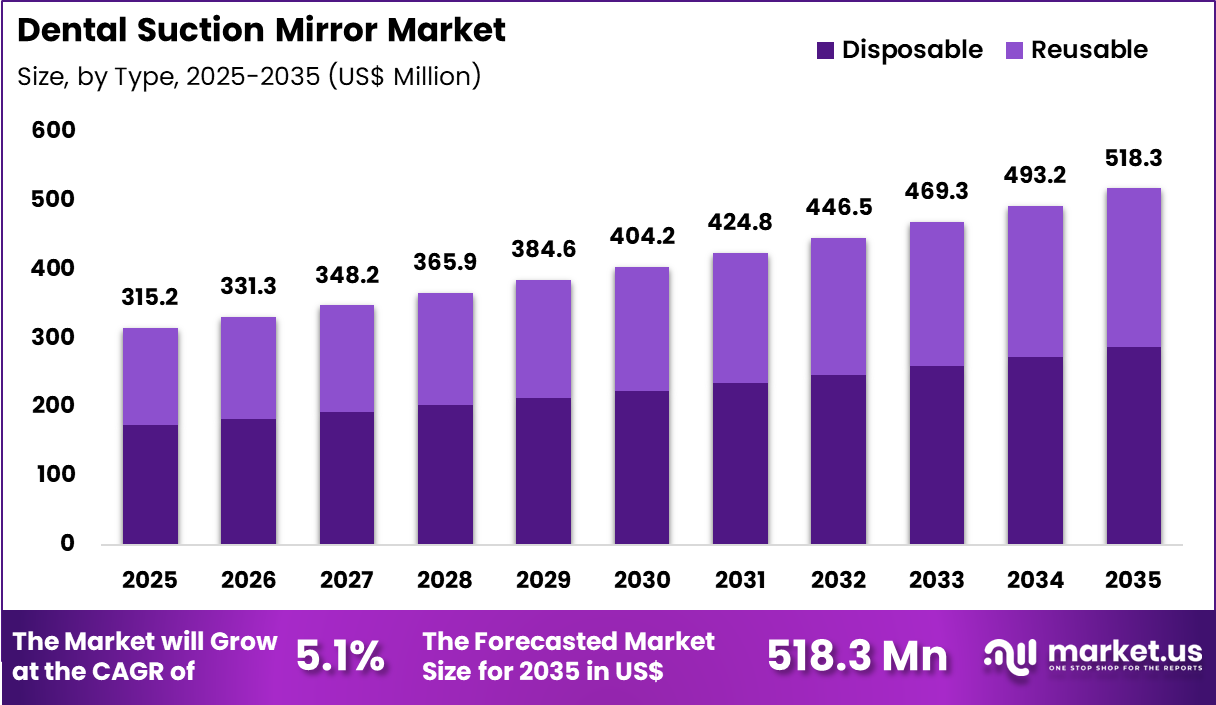
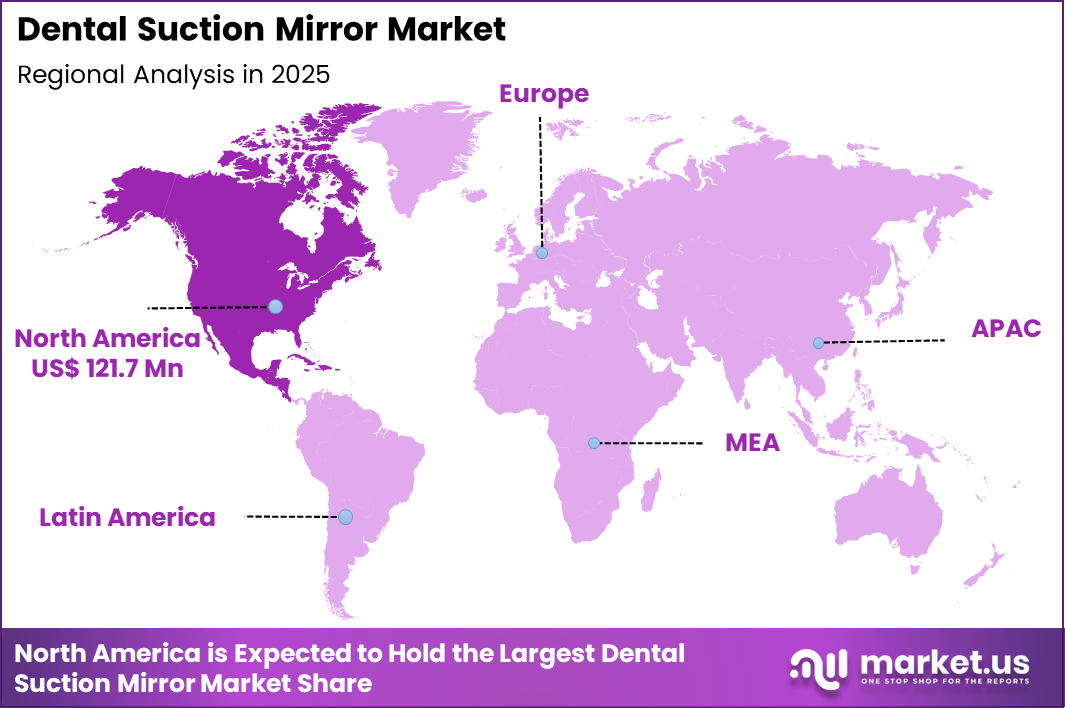
The Global Dental Suction Mirror Market size is expected to be worth around US$ 518.3 Million by 2035 from US$ 315.2 Million in 2025, growing at a CAGR of 5.1% during the forecast period 2026-2035. In 2025, North America led the market, achieving over 38.6% share with a revenue of US$ 121.7 Million.
Increasing adoption of efficient, ergonomic tools in dental practice propels the Dental Suction Mirror market as clinicians seek devices that combine clear visualization with simultaneous fluid evacuation to streamline procedures and enhance patient comfort.
General dentists increasingly utilize suction mirrors during restorative treatments, where the integrated high-volume evacuation removes water spray and debris while providing unobstructed views of occlusal surfaces and interproximal margins for precise composite placement and finishing.
These devices support periodontal therapy by maintaining a dry field during ultrasonic scaling and root planing, allowing clear observation of subgingival calculus and pocket depths to improve thoroughness and reduce postoperative sensitivity. Hygienists apply suction mirrors in prophylaxis appointments to efficiently clear saliva and polishing paste while visualizing lingual surfaces and posterior teeth, minimizing interruptions and enhancing patient experience.
Endodontists use them during access cavity preparation and canal location, where continuous suction prevents pooling of irrigants and maintains visibility of pulp chamber anatomy. In pediatric dentistry, suction mirrors facilitate gentle, quick procedures by controlling moisture and providing clear sightlines, reducing anxiety and improving cooperation in young patients.
Manufacturers pursue opportunities to develop compact, lightweight suction mirrors with enhanced ergonomic grips and direct-connect designs that attach seamlessly to existing evacuation systems, expanding applications in solo and high-volume practices where efficiency and infection control remain critical.
These advancements support integration with ergonomic handpieces and loupes for improved posture and reduced fatigue during prolonged procedures. Opportunities emerge in disposable or semi-disposable models that incorporate antimicrobial surfaces, addressing stringent sterilization requirements in multi-provider settings.
Companies invest in improved suction flow dynamics and anti-fog mirror coatings to enhance visibility in challenging intraoral environments. In May 2025, Nu-Bird introduced its HVE Direct Connect evacuation mirror, designed to attach directly to standard high-volume evacuation ports.
The device combines suction capability with mirror functionality, enabling clinicians to maintain clear visibility while performing procedures such as ultrasonic scaling and restorative treatments, particularly in solo practice settings.
Recent trends emphasize multifunctional, user-centric designs and seamless compatibility with existing equipment, positioning dental suction mirrors as essential tools for improved procedural efficiency, infection control, and clinician comfort in modern dental practice.
Key Takeaways
- In 2025, the market generated a revenue of US$ 315.2 Million, with a CAGR of 5.1%, and is expected to reach US$ 518.3 Million by the year 2035.
- The type segment is divided into disposable and reusable, with disposable taking the lead with a market share of 55.4%.
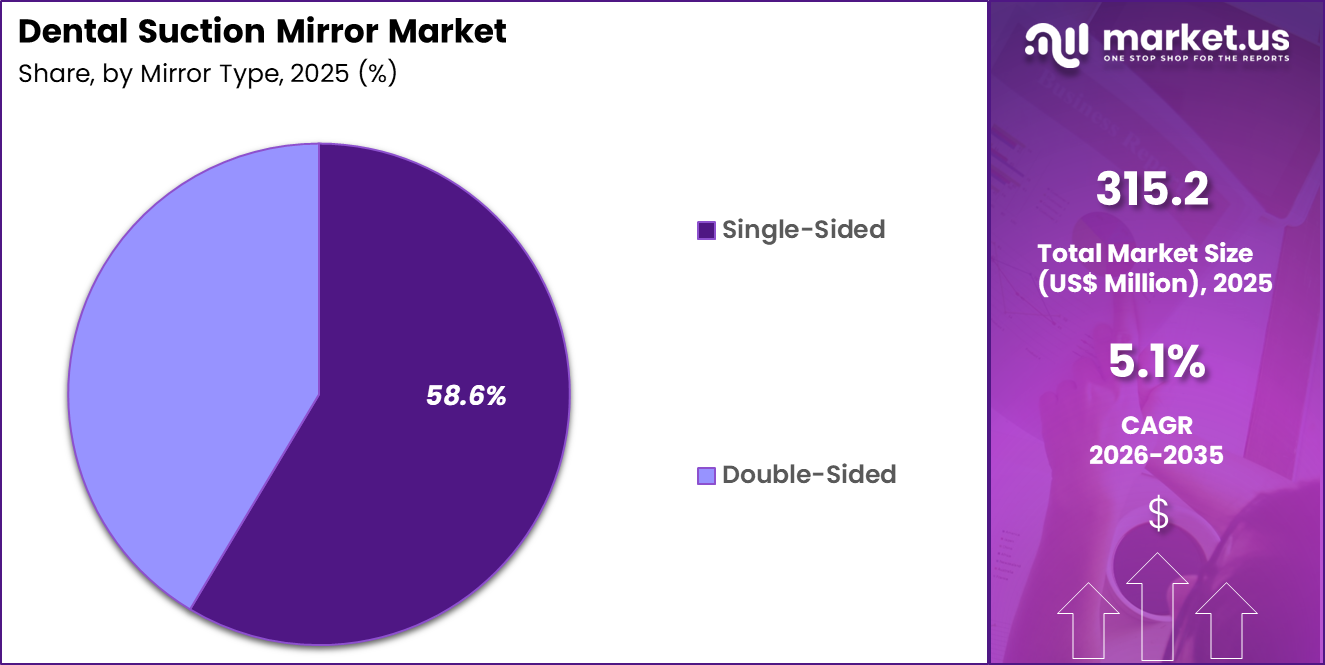
- Considering mirror type, the market is divided into single-sided and double-sided. Among these, single-sided held a significant share of 58.6%.
- Furthermore, concerning the end user segment, the market is segregated into hospitals, dental clinics and ambulatory surgical centers. The dental clinics sector stands out as the dominant player, holding the largest revenue share of 61.8% in the market.
- The distribution channel segment is segregated into direct sales, dental distributors and retail pharmacies, with the dental distributors segment leading the market, holding a revenue share of 48.6%.
- North America led the market by securing a market share of 38.6%.
Type Analysis
Disposable dental suction mirrors accounted for 55.4% of growth within type and dominate the dental suction mirror market due to the increasing emphasis on infection control and single-use clinical tools in dental practices. Dental professionals prioritize disposable instruments to reduce cross-contamination risks and comply with strict sterilization guidelines issued by healthcare authorities.
The Centers for Disease Control and Prevention highlights the importance of infection prevention practices in dental settings, which supports the adoption of single-use devices. Dental clinics increasingly prefer disposable suction mirrors because they eliminate the need for sterilization and reduce operational turnaround time between patients.
The segment is expected to expand as dental procedures increase globally and hygiene standards continue to tighten. Rising patient awareness regarding safety and infection control is likely to further strengthen demand for disposable dental instruments.
Mirror Type Analysis
Single-sided mirrors accounted for 58.6% of growth within mirror type and dominate the dental suction mirror market due to their simplicity, ease of use, and widespread applicability in routine dental examinations. Dentists frequently use single-sided mirrors for visualization during procedures such as cleaning, cavity inspection, and restorative treatments.
These mirrors provide clear reflection and better maneuverability in confined oral spaces. Dental practitioners prefer single-sided designs because they are cost-effective and compatible with most suction systems used in clinics.
The segment is projected to grow as dental clinics continue to perform high volumes of routine diagnostic and preventive procedures. Increasing demand for efficient and easy-to-handle dental tools is expected to support continued adoption of single-sided suction mirrors across clinical settings.
End User Analysis
Dental clinics accounted for 61.8% of growth within end users and dominate the dental suction mirror market due to the high volume of routine dental procedures performed in outpatient settings. Clinics handle a wide range of services including preventive care, restorative treatments, and cosmetic dentistry, which require frequent use of suction mirrors.
The American Dental Association reports that millions of dental procedures are performed annually, with most occurring in private dental practices. Dental clinics increasingly invest in efficient and hygienic tools to improve patient care and workflow efficiency.
The segment is expected to expand as the global demand for dental services increases due to rising oral health awareness and growing patient populations. Expansion of private dental practices and clinics further strengthens the demand for suction mirror devices.
Distribution Channel Analysis
Dental distributors accounted for 48.6% of growth within distribution channel and dominate the dental suction mirror market due to their strong supply networks and ability to provide a wide range of dental products to clinics and hospitals. Distributors maintain relationships with manufacturers and healthcare providers, which enables efficient product delivery and inventory management.
Dental professionals prefer distributors because they offer bulk purchasing options, competitive pricing, and reliable product availability. Distribution networks also support smaller clinics that rely on consistent supply of dental instruments.
The segment is anticipated to grow as dental supply chains become more organized and demand for dental equipment continues to increase. Expansion of distribution networks and partnerships with dental manufacturers is likely to further strengthen the role of distributors in the market.
Key Market Segments
By Type
- Disposable
- Reusable
By Mirror Type
- Single-Sided
- Double-Sided
By End User
- Hospitals
- Dental Clinics
- Ambulatory Surgical Centers
By Distribution Channel
- Direct Sales
- Dental Distributors
- Retail Pharmacies
Drivers
Increasing demand for ergonomic and anti-fog dental mirrors is driving the market.
Dental practitioners require suction mirrors that maintain clear visibility during procedures while simultaneously evacuating fluids and debris. These devices combine reflective surfaces with integrated aspiration channels to enhance operative efficiency. The driver corresponds with expanded utilization in restorative, endodontic, and surgical interventions where continuous moisture control proves essential.
Manufacturers emphasize lightweight construction and anti-fog coatings to improve user comfort during prolonged use. The trend supports higher throughput in busy clinical schedules through reduced need for separate suction instruments.
Enhanced mirror durability addresses frequent sterilization cycles in infection control protocols. Facilities prioritize designs that minimize hand fatigue and improve procedural precision. The expansion reflects ongoing emphasis on clinician ergonomics in modern dental practice. Sustained procedural volumes sustain procurement of specialized mirror systems. This factor reinforces consistent market demand for integrated suction-reflective instrumentation.
Restraints
High manufacturing costs for precision-engineered suction mirrors are restraining the market.
Production of dental suction mirrors involves specialized materials and multi-step fabrication processes to achieve optical clarity and reliable aspiration performance. These requirements elevate unit costs compared to standard mouth mirrors. The restraint moderates adoption in price-sensitive general practices and emerging markets.
Ongoing expenses include quality control testing for fog resistance and suction integrity. The factor contributes to deferred replacement cycles for functional legacy instruments. Smaller clinics prioritize essential consumables over premium mirror upgrades. The dynamic influences preference for basic models lacking advanced ergonomic features.
Providers encounter challenges justifying investment without demonstrated long-term efficiency gains. This constraint tempers penetration of sophisticated suction mirror designs. The limitation persists in constraining broader market expansion in cost-conscious segments.
Opportunities
Advancement of disposable suction mirror variants is creating growth opportunities.
Single-use suction mirrors eliminate cross-contamination risks while maintaining procedural efficiency in high-volume settings. These products incorporate pre-attached aspiration tubing and disposable reflective surfaces. Opportunities arise for infection control-focused practices seeking compliance with stringent sterilization guidelines.
The framework supports rapid turnover in multi-operatory clinics without reprocessing delays. Manufacturers gain capacity to offer sterile-packaged solutions for immediate use. The development facilitates expansion into ambulatory and mobile dental services. Such variants attract attention for simplified workflow integration.
The opportunity fosters differentiation through reduced instrument processing overhead. Stakeholders anticipate increased utilization in infection-sensitive environments. This progression positions participants for growth in disposable instrumentation segments.
Impact of Macroeconomic / Geopolitical Factors
Dental clinics continue to adopt suction mirrors to improve visibility and moisture control during procedures, yet economic conditions shape purchasing behavior across practices. Rising input costs for plastics, tubing, and sterilization processes increase product pricing, which affects procurement decisions in smaller clinics.
Limited access to financing also slows expansion of advanced dental setups in cost-sensitive markets. Global geopolitical factors disrupt the supply of medical-grade materials and manufacturing components, creating sourcing uncertainty for suppliers. US tariffs on imported dental devices and raw materials increase production costs and reduce margin flexibility for manufacturers.
These pressures may delay bulk purchasing and limit upgrades in independent practices. At the same time, suppliers invest in local manufacturing and streamlined distribution to ensure consistent availability. Continued focus on procedural efficiency and infection control supports steady long-term demand for dental suction mirrors.
Latest Trends
Introduction of enhanced anti-fog suction mirror designs is driving the market.
Manufacturers introduced updated suction mirror models in 2024-2025 featuring advanced hydrophilic coatings that resist fog formation under prolonged moisture exposure. These designs maintain reflective clarity throughout extended procedures. The 2024-2025 development addresses longstanding visibility challenges during ultrasonic scaling and restorative work.
Clinicians benefit from uninterrupted procedural views without frequent mirror wiping. The innovation aligns with preferences for reliable instrumentation in aerosol-generating activities. Facilities report potential reductions in operative interruptions.
The advancement stimulates replacement demand for standard mirrors in busy practices. Early clinical feedback highlights consistent performance under high-humidity conditions. The introduction supports educational initiatives on ergonomic benefits of modern mirror systems. Overall, this technological enhancement elevates visibility standards in dental instrumentation applications.
Regional Analysis
North America is leading the Dental Suction Mirror Market
North America accounted for 38.6% of the dental suction mirror market in 2025 as dental clinics and hospitals expanded adoption of advanced diagnostic instruments to improve visibility and precision during oral procedures. Dentists across the United States and Canada increasingly rely on suction-enabled mirrors to enhance visualization, maintain a clear operating field, and reduce procedural time in routine and complex treatments.
The growing burden of oral diseases continues to drive clinical demand, with global health data indicating that around 3.5 billion people are affected by oral conditions, reinforcing the need for efficient diagnostic and treatment tools in developed healthcare systems. Increased focus on preventive dental care and early diagnosis has encouraged practitioners to adopt multifunctional instruments that combine suction and visualization in a single device.
Dental service organizations and large clinic networks are standardizing equipment procurement, which supports widespread adoption of advanced dental tools. Technological improvements such as anti-fog coatings, LED illumination, and ergonomic designs have enhanced usability and clinical efficiency.
Rising demand for cosmetic dentistry and implant procedures has also increased reliance on precise intraoral visualization tools. Dental education programs across the region emphasize modern instrumentation and ergonomic workflows, further supporting product uptake. These developments collectively contributed to steady growth of advanced dental diagnostic tools across North America in 2025.
The Asia Pacific region is expected to experience the highest CAGR during the forecast period
Asia Pacific is expected to witness strong expansion during the forecast period as dental healthcare infrastructure improves and awareness of oral hygiene increases across emerging economies. Countries such as China, India, Japan, and South Korea are expanding dental clinics and hospital-based oral care services to meet rising patient demand.
The World Health Organization highlights that oral diseases remain one of the most widespread health conditions globally, with increasing prevalence linked to urbanization and lifestyle changes, which is particularly evident across Asian populations. Governments across the region are promoting preventive dental care programs and expanding access to oral health services in both urban and rural areas.
Dental professionals are increasingly adopting modern diagnostic tools that improve efficiency and patient comfort during procedures. Growth in dental tourism and cosmetic dentistry services is also encouraging clinics to invest in advanced equipment that enhances treatment quality.
Regional manufacturers are introducing cost-effective instruments tailored to high-volume dental practices. Universities and training institutes are strengthening dental education programs that emphasize modern clinical tools and techniques. These developments are expected to accelerate adoption of advanced dental diagnostic instruments across Asia Pacific in the coming years.
Key Regions and Countries
North America
- The US
- Canada
Europe
- Germany
- France
- The U.K.
- Italy
- Spain
- Russia & CIS
- Rest of Europe
Asia Pacific
- China
- India
- Japan
- South Korea
- ASEAN
- Australia & New Zealand
- Rest of Asia Pacific
Middle East & Africa
- GCC
- South Africa
- Rest of Middle East & Africa
Latin America
- Brazil
- Mexico
- Rest of Latin America
Key Players Analysis
Key participants in the Dental Suction Mirror Market expand their presence by developing multifunctional instruments that combine illumination, suction, and visualization to improve clinical efficiency during dental procedures. Companies collaborate with dental professionals and clinics to refine ergonomic designs and enhance infection control features that support routine and surgical treatments.
They also invest in disposable and autoclavable product lines that align with hygiene standards and reduce cross-contamination risks in dental settings. Zirc Dental Products represents a notable participant in the Dental Suction Mirror Market and operates as a U.S.-based manufacturer that specializes in dental instruments, infection control solutions, and color-coded systems used in dental practices worldwide.
The company focuses on user-friendly designs and durable materials that improve workflow efficiency in dental clinics. Industry competitors continue to introduce innovative dental instruments, expand distribution networks, and strengthen clinical partnerships to drive adoption of integrated suction and visualization tools.
Top Key Players
- Nu-Bird Inc.
- RNDent-IP Ltd.
- ACTEON Group
- Henry Schein, Inc.
- Hager Worldwide
- Dentsply Sirona
- Surgivalley
- Fima Instruments Company
- Creative Dental
- Carl Martin GmbH
Recent Developments
- At ADF 2025 in November, ACTEON Group launched the ECOwin program, a sustainability-focused initiative aimed at recycling dental mirrors and hand instruments. The program promotes reuse of materials from returned products and encourages adoption of environmentally responsible instruments within dental practices.
- Entering 2026, Dentsply Sirona expanded integration of its accessory portfolio into the DS Core digital platform. This approach allows dental professionals to align visualization tools, including mirrors, with cloud-based workflows and AI-supported diagnostic systems, helping streamline clinical processes from imaging to treatment planning.
Report Scope
Report Features Description Market Value (2025) US$ 315.2 Million Forecast Revenue (2035) US$ 518.3 Million CAGR (2026-2035) 5.1% Base Year for Estimation 2025 Historic Period 2020-2024 Forecast Period 2026-2035 Report Coverage Revenue Forecast, Market Dynamics, COVID-19 Impact, Competitive Landscape, Recent Developments Segments Covered By Type (Disposable and Reusable), By Mirror Type (Single-Sided and Double-Sided), By End User (Hospitals, Dental Clinics and Ambulatory Surgical Centers), By Distribution Channel (Direct Sales, Dental Distributors and Retail Pharmacies) Regional Analysis North America – The US, Canada; Europe – Germany, France, The U.K., Italy, Spain, Russia & CIS, Rest of Europe; Asia Pacific – China, India, Japan, South Korea, ASEAN, Australia & New Zealand, Rest of Asia Pacific; Middle East & Africa – GCC, South Africa, Rest of Middle East & Africa; Latin America – Brazil, Mexico, Rest of Latin America Competitive Landscape Nu-Bird Inc., RNDent-IP Ltd., ACTEON Group, Henry Schein, Inc., Hager Worldwide, Dentsply Sirona, Surgivalley, Fima Instruments Company, Creative Dental, Carl Martin GmbH. Customization Scope Customization for segments, region/country-level will be provided. Moreover, additional customization can be done based on the requirements. Purchase Options We have three licenses to opt for: Single User License, Multi-User License (Up to 5 Users), Corporate Use License (Unlimited User and Printable PDF)  Dental Suction Mirror MarketPublished date: March 2026add_shopping_cartBuy Now get_appDownload Sample
 -
-
- Nu-Bird Inc.
- RNDent-IP Ltd.
- ACTEON Group
- Henry Schein, Inc.
- Hager Worldwide
- Dentsply Sirona
- Surgivalley
- Fima Instruments Company
- Creative Dental
- Carl Martin GmbH
Our Clients

- 182002
- March 2026






