


Report Overview
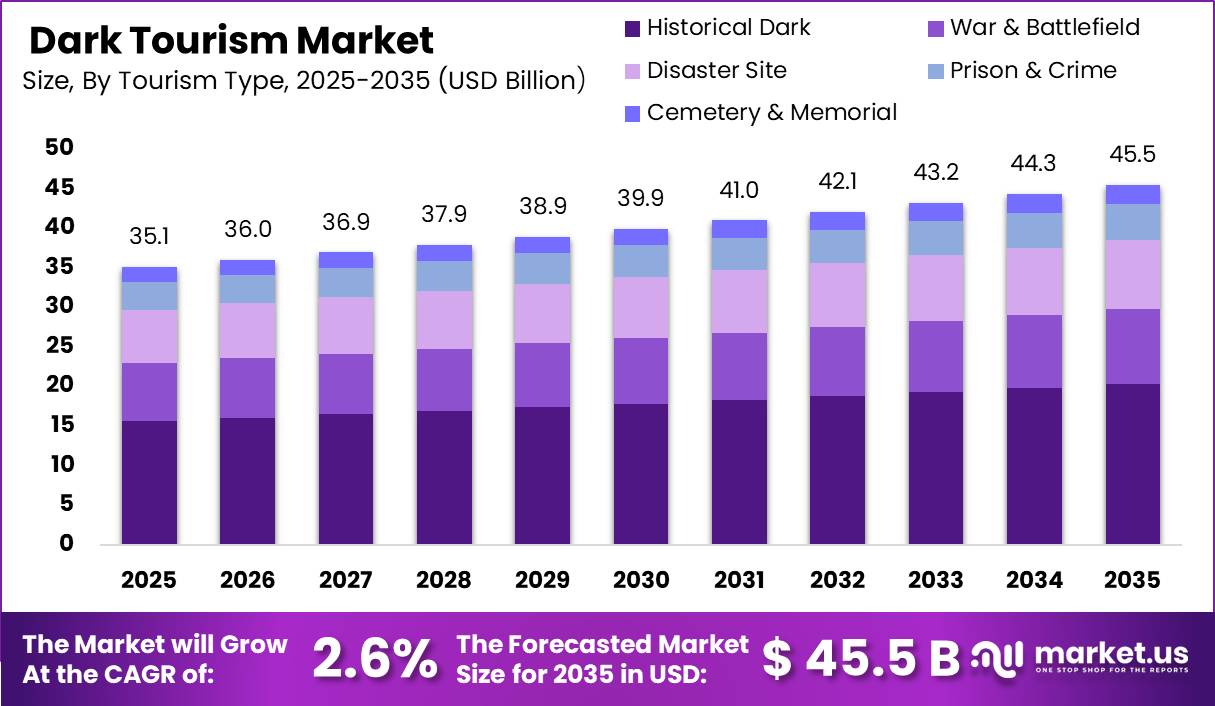
Global Dark Tourism Market size is expected to be worth around USD 45.5 Billion by 2035 from USD 35.1 Billion in 2025, growing at a CAGR of 2.6% during the forecast period 2026 to 2035. This steady pace reflects consistent traveler interest in historical remembrance and educational site visits worldwide.
This means the market covers guided tours, memorial visits, and educational travel connected to sites of tragedy, conflict, or disaster. The industry spans historical landmarks, war memorials, disaster zones, and prison museums. Operators combine transportation, interpretation, and access permissions to structure these visits. Growth depends on public interest in remembrance travel and site accessibility.
Key Takeaways
- The Dark Tourism Market size is valued at USD 35.1 Billion in 2025 and is projected to reach USD 45.5 Billion by 2035.
- The market is set to grow at a CAGR of 2.6% between 2026 and 2035.
- Historical Dark Tourism leads the By Tourism Type segment with a 44.60% share.
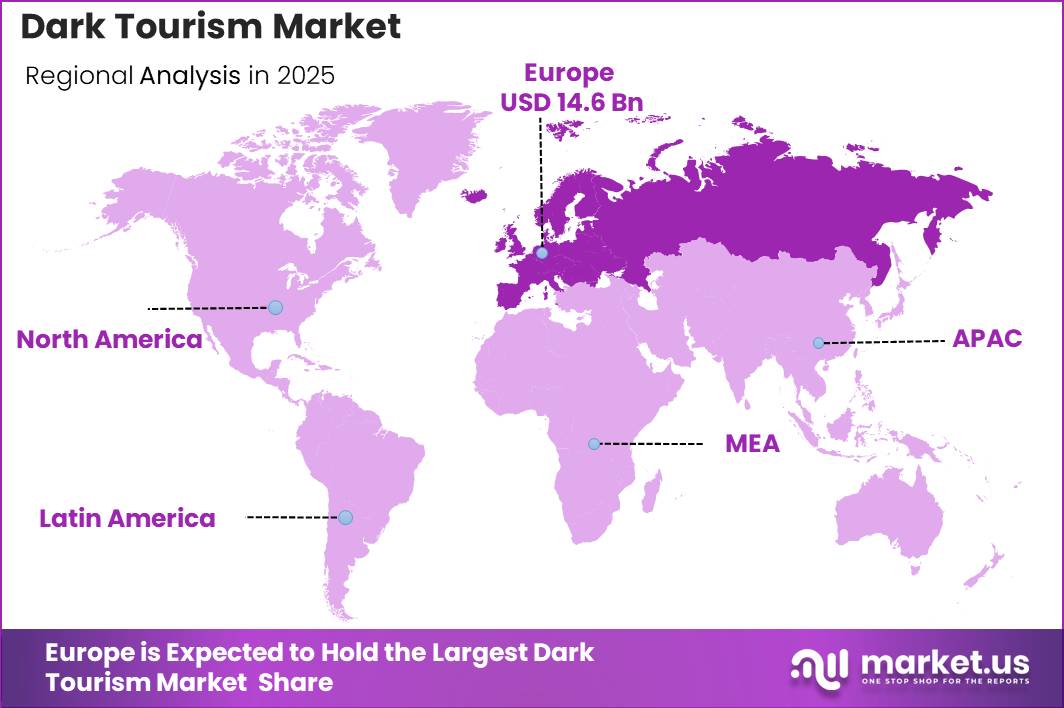
- Europe dominates the market with a 41.60% share, valued at USD 14.6 Billion.
- Domestic Tourists hold the largest share in the By Traveler Type segment at 61.30%.
- Travelers aged 25 to 44 years account for 42.80% of the market by age group.
Instead of relying only on ticket revenue, heritage sites increasingly draw preservation funding from cultural and technology partners. In May 2025, the Picture From Auschwitz initiative secured approximately €1.5 Million to build high resolution digital replicas of the site. This funding lets filmmakers recreate locations without physical access. Such support signals rising institutional backing for site preservation.
According to the Auschwitz Memorial, the site recorded 1.95 Million visitors in 2025, a 7% increase over 2024. This rise shows durable demand for Holocaust education travel. As reported by the Hiroshima Peace Memorial Museum, the site welcomed 2,580,926 visitors in fiscal 2025, its highest attendance ever. This signals rising appetite for peace tourism in Asia Pacific.
By Tourism Type
Historical Dark Tourism dominates with 44.6% due to strong museum and heritage demand.
Historical Dark Tourism leads because visitors trust well-kept museums, memorials, and listed heritage sites for serious learning. Europe supports this lead, as the region holds 41.6% of the market and generates USD 14.60 billion in value. Major sites also give this sub-segment steady traffic: the Auschwitz-Birkenau site entered the UNESCO World Heritage List in 1979, and the memorial reported more than 1.83 million visitors in 2024.
These places offer guided tours, archives, school programs, and clear visitor routes, so tour firms can package them with nearby cities. War & Battlefield Tourism grows faster because travelers want direct, place-based stories about conflict, freedom, and national memory. Public site systems also widen access; the U.S. National Park Service recorded 331,863,358 recreation visits in 2024 across more than 400 units, including battlefield and military history locations. This creates more routes for battlefield tours, coach trips, veteran travel, and school visits.
By Traveler Type
Domestic Tourists dominate with 61.3% due to shorter trips and lower costs.
Domestic Tourists dominate because dark tourism often depends on local memory, national school trips, and short visits to nearby sites. Families, teachers, and local tour guides can plan these trips with less paperwork, no visas, and lower travel risk. Domestic travel also fits weekend demand, which helps prisons, memorials, cemeteries, and conflict museums keep a steady visitor base through the year. Europe shows this pattern clearly: Eurostat reported 3.00 billion tourism nights in EU tourist accommodation in 2024, and domestic guests still accounted for 251.4 million nights in the first quarter dataset.
International Tourists grow faster because cross-border tourism has returned strongly and long-haul travelers now add memorial sites to city breaks and culture routes. UN Tourism estimated 1.4 billion international tourist arrivals in 2024, up 11% from 2023, while global tourism receipts reached USD 1.6 trillion. This recovery gives operators more room to sell guided dark tourism packages to visitors who want deeper context beyond standard sightseeing.
By Age Group
25–44 Years dominates with 42.8% due to high mobility and spending power.
People aged 25–44 lead because they combine income, flexible trip planning, and strong interest in real-world stories. Many in this age band choose city breaks, museum passes, and guided walks that connect history with today’s social issues. They also use digital maps, reviews, and mobile tickets, which makes it easy to compare dark tourism sites and book quickly. OECD data shows that about 92% of people aged 16–74 used the internet across OECD countries in 2022, up from 52% in 2005, so working-age travelers can research niche sites with less effort.
The Below 25 Years group grows faster because schools, universities, and youth programs use heritage sites for learning and identity building. UNESCO launched its World Heritage Education Programme in 1994 to involve young people in heritage protection, and the 2024 World Heritage Young Professionals Forum selected 30 global participants plus 20 participants from India. These programs build early interest in memorials, conflict history, and cultural loss.
By Booking Channel
Online Travel Agencies (OTA) dominate with 57.5% due to wide choice and instant booking.
Online Travel Agencies dominate because travelers want one place to compare routes, read reviews, pay, and confirm entry times. Dark tourism trips often need timed museum slots, guided walks, transport links, and local rules, so OTAs help reduce planning work. Their scale also supports small operators that sell prison tours, cemetery walks, battlefield visits, and memorial day trips without building large sales teams.
Eurostat reported 123.7 million guest nights in EU short-term rentals booked through Airbnb, Booking, Expedia Group, or Tripadvisor in the first quarter of 2024, a 28.3% rise from the same period in 2023. Direct Booking grows faster because major museums and memorials want stronger control over visitor flow, education content, and ticket rules. Site owners can manage capacity, reduce commission costs, and send visitors safety notices before arrival. Corporate filings also show the size of digital demand: Booking Holdings reported USD 21.4 billion in revenue for 2023, giving travel suppliers a clear reason to improve their own direct channels.
By Application
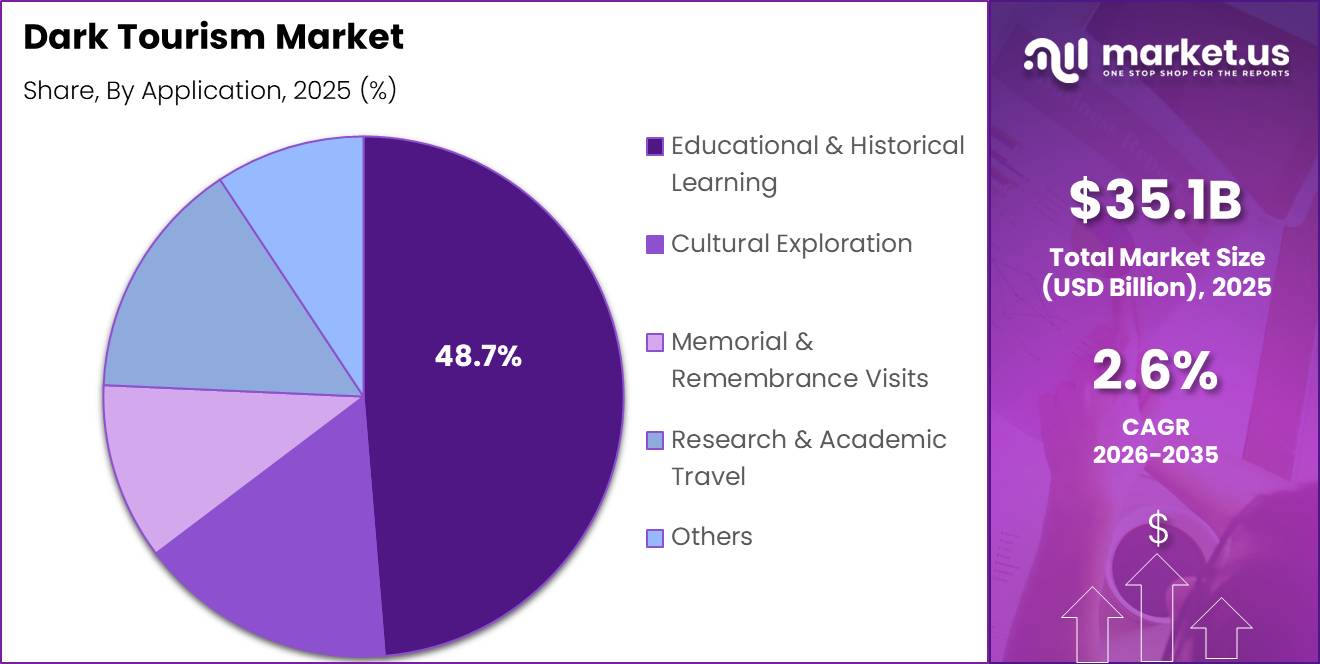
Educational & Historical Learning dominates with 48.7% due to strong curriculum-linked site visits.
Educational & Historical Learning leads because dark tourism sites help visitors understand events through place, objects, testimony, and guided context. Schools, colleges, museums, and civic groups use these trips to teach war, genocide, disaster response, justice, and human rights. Strong public education programs support this demand. The U.S. Holocaust Memorial Museum’s 2024–25 annual report shows how museums link exhibitions, teacher training, and public programs, while the institution maintains large education resources for learners outside the building.
Cultural Exploration grows faster because travelers now seek local stories that explain how communities remember loss, rebuild, and protect identity. UNESCO’s World Heritage List includes 1,223 properties across 168 States Parties, and 952 of these properties fall under the cultural category, giving tour planners a broad base for culture-led routes. This helps dark tourism move beyond one-site visits into walking tours, archive visits, local food stops, and community storytelling. The result gives operators more ways to serve travelers who want meaning, not only sightseeing.
By End User
Leisure Travelers dominate with 54.9% due to flexible culture-led trip planning.
Leisure Travelers dominate because most dark tourism visits happen inside broader holidays, city breaks, and cultural tours. These travelers mix memorials, museums, former prisons, cemeteries, and battlefield walks with food, hotels, shopping, and transport. This pattern gives tour companies a large addressable base because the visit does not need a formal research purpose.
UN Tourism reported that international tourism recovered to 99% of pre-pandemic levels in 2024, and international arrivals grew by 140 million over 2023. That broad rebound lifts leisure-led demand for deeper cultural products. Students & Academic Groups grow faster because educators want field learning that feels real and direct. The Council of Europe’s Cultural Routes programme had 48 certified routes in 2024, which helps schools and universities connect heritage themes across countries. Academic groups also travel in planned blocks, use guides, and need structured content, so operators can build repeat programs around memorial learning, human rights, archaeology, and conflict history.
Key Market Segments
By Tourism Type
- Historical Dark Tourism
- War & Battlefield Tourism
- Disaster Site Tourism
- Prison & Crime Tourism
- Cemetery & Memorial Tourism
By Traveler Type
- Domestic Tourists
- International Tourists
By Age Group
- 25–44 Years
- Below 25 Years
- 45–64 Years
- 65 Years & Above
By Booking Channel
- Online Travel Agencies (OTA)
- Direct Booking
- Offline Travel Agencies
By Application
- Educational & Historical Learning
- Cultural Exploration
- Memorial & Remembrance Visits
- Research & Academic Travel
By End User
- Leisure Travelers
- Students & Academic Groups
- Researchers & Historians
Regional Analysis
Europe Dominates the Dark Tourism Market with a Market Share of 41.60%, Valued at USD 14.6 Billion
Europe leads the Dark Tourism Market with a 41.60% share, valued at USD 14.6 Billion in 2025. As reported by the Auschwitz-Birkenau Memorial and Museum, around 25% of 2024 visitors came from Poland, while the UK, Spain, Italy, and Germany supplied the largest international groups. This spread shows strong intra European travel demand. Therefore, operators across the region benefit from dense, well connected heritage tourism corridors.
North America holds a meaningful share of Holocaust and remembrance education travel. Figures from the Holocaust and Humanity Center show more than 50,000 museum visitors during the 2024 to 2025 period. This means US institutions attract steady educational tourism outside peak travel seasons. As a result, regional operators can build year round programming around school and community group visits.
Asia Pacific gained visibility in 2026 after the Hiroshima Peace Memorial Museum expanded multilingual visitor support following record attendance. The museum recorded 945,618 foreign visitors during fiscal 2025, its highest international turnout ever. This signals growing inbound interest in peace and remembrance sites. Consequently, regional operators should scale interpretation services to match rising foreign visitor volumes.
Key Regions and Countries
North America
- US
- Canada
Europe
- Germany
- France
- The UK
- Spain
- Italy
- Rest of Europe
Asia Pacific
- China
- Japan
- South Korea
- India
- Australia
- Rest of APAC
Latin America
- Brazil
- Mexico
- Rest of Latin America
Middle East and Africa
- GCC
- South Africa
- Rest of MEA
Market Dynamics
Market Opportunity Analysis - Underserved traveler segments and emerging regions offer clear entry points for new operators
International Tourists remain a smaller share of the By Traveler Type segment compared with Domestic Tourists. This means cross border marketing and multilingual booking support stay underused across many operators. Therefore, companies that invest in international visitor acquisition can capture share before larger domestic focused players expand abroad.
Offline Travel Agencies trail far behind Online Travel Agencies within the By Booking Channel segment. This signals an opening for agencies serving older or less digitally active travelers. Consequently, operators that maintain in person booking support can retain customers who avoid fully digital travel platforms.
Researchers and Historians make up a small share of the By End User segment next to Leisure Travelers. This reflects an underused niche for specialized, archive based travel packages. As a result, operators offering research access and academic partnerships can build a defensible specialist niche.
Latin America and Middle East and Africa hold smaller positions within the Regional Analysis compared with Europe. This reflects early stage development of heritage tourism infrastructure in these regions. Instead of competing directly with established European sites, new entrants can build first mover positions in emerging heritage corridors.
Technology and Innovation Landscape - Digital replication and interpretation tools reshape how sensitive historical sites reach global audiences
Memorials and heritage sites increasingly deploy AR and VR installations to digitally recreate historical events for visitors. This means guests can experience context that physical remains alone cannot show. Therefore, operators using immersive technology can extend engagement time and justify premium ticket pricing.
The Picture From Auschwitz project built a high resolution digital replica of the site using new funding secured in May 2025. This allows filmmakers and educators to recreate the location without physical access. Consequently, sensitive heritage sites can expand their reach while limiting wear from direct visitor traffic.
The Commonwealth War Graves Commission expanded digital genealogy and casualty record systems covering millions of war dead worldwide. This means families can trace history remotely before ever visiting a physical site. As a result, digital tools now function as a discovery channel that feeds future in person visitation.
Multiple European heritage organizations adopted digital twin technology to preserve and share sensitive remembrance sites virtually. This signals a shift toward hybrid physical and digital heritage tourism models. Instead of relying only on foot traffic, operators can now monetize digital access alongside traditional guided visits.
Drivers
Global tourism recovery supports rising demand for meaningful and educational travel experiences. According to UN Tourism, international arrivals reached 1.4 Billion in 2024, marking a full recovery to pre pandemic levels. In the first half of 2025, arrivals grew 5% year over year and stood about 4% above pre pandemic levels.
This steady travel growth pushes more visitors toward sites with historical and cultural significance. Remembrance and heritage destinations gain from this broader shift. Therefore, museums, memorials, and guided historical tours see stronger demand for immersive, educational experiences across major travel corridors.
| Driver | (~) % Impact | Geographic Relevance | Impact Timeline |
|---|---|---|---|
| Post-Pandemic Purposeful & Transformational Travel Shift | +2.4% | North America, EU, Australia, APAC | Short term (≤ 2 years) |
| True Crime & Dark History Media Ecosystem | +2.1% | North America core, EU, APAC | Short term (≤ 2 years) |
| Education, Collective Memory & Empathy-Driven Visitation | +1.9% | EU, North America, Southeast Asia | Medium term (2–4 years) |
| AI & Digital Storytelling Transforming On-Site Experience | +2.6% | EU, North America, Japan | Medium term (2–4 years) |
| War-Zone & Post-Conflict Site Magnetism | +2.3% | Eastern Europe, Middle East, Southeast Asia | Medium term (2–4 years) |
| Wellness Tourism Crossover — Grief & Trauma Processing Travel | +1.7% | North America, EU, Australia | Long term (≥ 4 years) |
Restraints
Many major dark tourism destinations face unresolved disputes over site ownership and memorialization rights. A BBC investigation published on 12 June 2026 reported growing conflict between local communities and international heritage conservation groups. UNESCO can monitor protection or list a site as in danger, but it does not resolve ownership disputes.
A March 2026 study by the University of Central Lancashire found that competing claims from governments, survivor groups, and heritage bodies complicate site management. These disputes delay licensing and infrastructure planning. Consequently, investors face longer timelines before sensitive heritage destinations reach full tourism readiness.
| Restraint | (~) % Impact | Geographic Relevance | Impact Timeline |
|---|---|---|---|
| U.S. Expanded Travel Ban — 39-Country Access Prohibition | -2.3% | Middle East, Sub-Saharan Africa, Caribbean | Short term (≤ 2 years) |
| War & Conflict Zone Insurance Exclusion Blanket | -2.7% | Ukraine, Middle East, Myanmar, Sudan | Short term (≤ 2 years) |
| Contested Site Ownership & Memorialization Rights Disputes | -1.9% | EU, Middle East, APAC, post-conflict zones | Medium term (2–4 years) |
| Historical Disinformation Corrupting Visitor Demand | -1.6% | Global digital acquisition funnel | Medium term (2–4 years) |
| UNESCO De-listing & Heritage Status Revocation Risk | -1.4% | Mediterranean, Sub-Saharan Africa, APAC | Medium term (2–4 years) |
| State-Level Site Access Prohibition & Permit Gatekeeping | -1.8% | India border zones, China, North Korea-adjacent | Long term (≥ 4 years) |
Challenges
Dark tourism sites need guides with deep historical, cultural, and psychological training, yet specialized programs remain scarce. Research from the University of Central Lancashire found that guides must stay historically accurate while remaining empathetic toward visitors. Emerald Publishing identifies specialized interpretation training as essential for professionalizing the sector.
At the Auschwitz-Birkenau Memorial, about 300 trained guides serve visitors across multiple languages, and certification requires an 18 month training process. This lengthy pathway limits the supply of qualified guides. Therefore, destinations struggle to scale quality interpretation during peak visitor periods.
| Challenge | (~) % Friction Drag | Geographic Relevance | Mitigation Horizon |
|---|---|---|---|
| Ethicalization of Profit — Commercialization Backlash | -1.8% | Global — all dark tourism destinations | Short term (≤ 2 years) |
| Specialist Guide Talent Deficit & Interpretation Quality Gap | -1.6% | EU, North America, Southeast Asia | Medium term (2–4 years) |
| Survivor & Community Resentment Toward Visitor Intrusion | -2.1% | Eastern Europe, Middle East, APAC | Medium term (2–4 years) |
| Site Physical Deterioration Under Visitor Load Pressure | -1.9% | Mediterranean EU, Latin America, APAC | Medium term (2–4 years) |
| Visitor Psychological Welfare & Secondary Trauma Risk | -1.3% | North America, EU, Australia | Medium term (2–4 years) |
| Climate Change Threat to Coastal Dark Heritage Sites | -1.5% | Mediterranean, Sub-Saharan Africa, Pacific | Long term (≥ 4 years) |
Opportunities
Younger travelers increasingly seek immersive, meaningful dark tourism experiences centered on history and reflection. Academic research from 2024 found that Gen Z and millennial visitors are drawn to historical authenticity and firsthand heritage engagement. In January 2026, enquiries for dark tourism among young Indian travelers rose about 7 to 8% year over year.
The same report noted dark tourism made up around 14% of specialty travel bookings within this age group. Most current offerings remain limited to standard day tours. This creates room for curated, multi day, expert led itineraries built around historical education and deeper cultural engagement.
| Opportunity | (~) % Potential Incremental Upside | Geographic Relevance | Execution Window |
|---|---|---|---|
| Immersive VR/AR Digital Dark Tourism Platform | +3.2% | North America, EU, Asia Pacific | Short term (≤ 2 years) |
| Gen Z & Millennial “Grief Tourism” Premium Tier | +2.6% | North America, EU, Southeast Asia | Short term (≤ 2 years) |
| Post-Conflict Emerging Destination Buildout | +2.9% | Eastern Europe, Middle East, Southeast Asia | Medium term (2–4 years) |
| School & University Accredited Educational Tours | +2.1% | EU, North America, Australia | Medium term (2–4 years) |
| Subscription Community & Content Monetization | +1.8% | North America, EU, APAC | Medium term (2–4 years) |
| Carbon-Neutral Dark Heritage Eco-Tourism Certification | +1.6% | EU, Australia, North America | Long term (≥ 4 years) |
Key Company Insights
Dark Rome Tours built its position through guided historical and archaeological tours across major European heritage cities. Its focus on licensed, expert led storytelling creates strong differentiation in a market where interpretation quality varies widely. This positioning supports premium pricing but limits scale in lower cost regions where operators discount access to sensitive sites.
City Wonders operates small group tours across major European landmarks, emphasizing skip the line access and licensed local guides. This model reduces visitor wait times at high demand sites and supports repeat bookings. However, dependence on a small pool of certified guides creates a scaling risk during peak historical tourism seasons.
Key Players
- Dark Rome Tours
- City Wonders
- Viator
- GetYourGuide
- Context Travel
- Historic Royal Palaces
- National Trust
- Auschwitz Memorial Tours
- Alcatraz City Cruises
- Chernobyl Tour
- Sandemans New Europe
- Musement
- Tiqets
- Walks LLC
- ToursByLocals
Recent Developments
- May 2025 – The Auschwitz-Birkenau Foundation, the Auschwitz Memorial, and technology partners launched the Picture From Auschwitz project to build a digital replica of the site for film, education, and preservation use.
- 2025 – The Commonwealth War Graves Commission expanded digital genealogy and casualty record infrastructure covering approximately 1.7 Million war dead across more than 150 countries and territories.
- 2025 – Multiple European heritage organizations collaborated on digital preservation and virtual access initiatives for sensitive remembrance and conflict history sites using digital twin technologies.
Report Scope
| Report Features | Description |
|---|---|
| Market Value (2025) | USD 35.1 Billion |
| Forecast Revenue (2035) | USD 45.5 Billion |
| CAGR (2026-2035) | 2.6% |
| Base Year for Estimation | 2025 |
| Historic Period | 2020-2024 |
| Forecast Period | 2026-2035 |
| Report Coverage | Revenue Forecast, Market Dynamics, Market Opportunity Analysis, Technology and Innovation Landscape, Competitive Landscape, Recent Developments |
| Segments Covered | By Tourism Type (Historical Dark Tourism, War & Battlefield Tourism, Disaster Site Tourism, Prison & Crime Tourism, Cemetery & Memorial Tourism), By Traveler Type (Domestic Tourists, International Tourists), By Age Group (25–44 Years, Below 25 Years, 45–64 Years, 65 Years & Above), By Booking Channel (Online Travel Agencies, Direct Booking, Offline Travel Agencies), By Application (Educational & Historical Learning, Cultural Exploration, Memorial & Remembrance Visits, Research & Academic Travel), By End User (Leisure Travelers, Students & Academic Groups, Researchers & Historians) |
| Regional Analysis | North America (US and Canada), Europe (Germany, France, The UK, Spain, Italy, and Rest of Europe), Asia Pacific (China, Japan, South Korea, India, Australia, and Rest of APAC), Latin America (Brazil, Mexico, and Rest of Latin America), Middle East and Africa (GCC, South Africa, and Rest of MEA) |
| Competitive Landscape | Dark Rome Tours, City Wonders, Viator, GetYourGuide, Context Travel, Historic Royal Palaces, National Trust, Auschwitz Memorial Tours, Alcatraz City Cruises, Chernobyl Tour, Sandemans New Europe, Musement, Tiqets, Walks LLC, ToursByLocals |
| Customization Scope | Customization for segments, region/country-level will be provided. Additional customization can be done based on requirements. |
| Purchase Options | We have three licenses to opt for: Single User License, Multi-User License (Up to 5 Users), Corporate Use License (Unlimited User and Printable PDF) |





































