


Market Overview
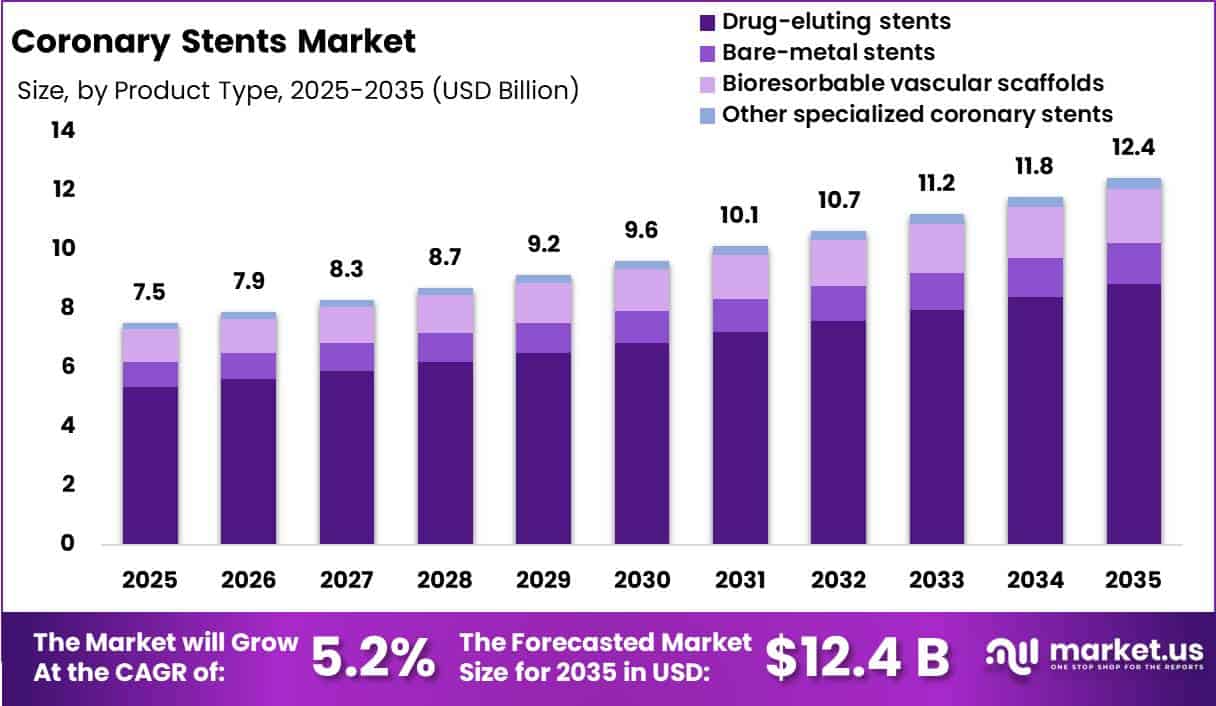
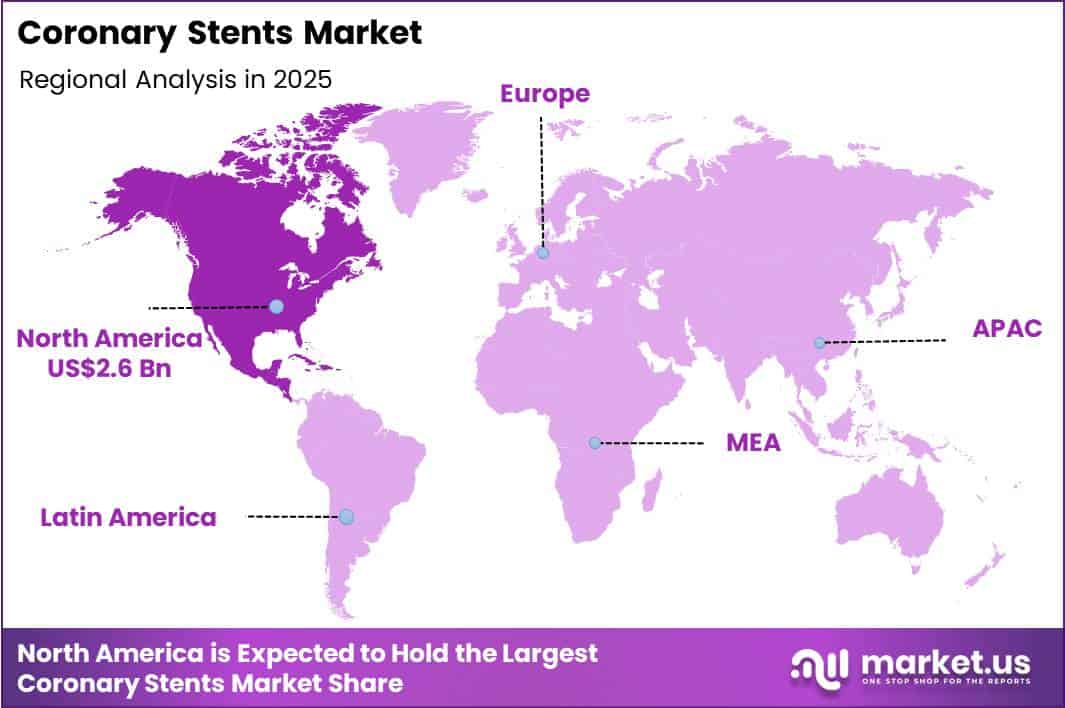
Global Coronary Stents Market size is expected to be worth around US$ 12.4 Billion by 2035 from US$ 7.5 Billion in 2025, growing at a CAGR of 5.2% during the forecast period from 2026 to 2035. In 2025, North America led the market, achieving over 34.8% share with a revenue of US$ 2.6 Billion.
The Coronary Stents Market is expanding due to the increasing global burden of coronary artery disease (CAD), growing demand for minimally invasive cardiovascular interventions, and continuous advancements in stent design and implantation techniques.
Coronary stents are widely used during percutaneous coronary intervention (PCI) procedures to restore blood flow in narrowed or blocked coronary arteries, improving outcomes for patients with ischemic heart conditions.
According to the World Health Organization (WHO), cardiovascular diseases remain the leading cause of death globally, accounting for approximately 17.9 million deaths each year, with coronary heart disease representing a major contributor. The rising prevalence of risk factors such as hypertension, diabetes, obesity, sedentary lifestyles, and aging populations is increasing the need for effective coronary artery treatment solutions.
The market is being influenced by technological advancements in drug-eluting stents (DES), improved biocompatible materials, thinner stent platforms, and polymer technologies designed to minimize complications such as restenosis and thrombosis. Healthcare systems are also focusing on improving access to advanced cardiac procedures, particularly in regions experiencing a rapid increase in cardiovascular disease cases.
The U.S. Centers for Disease Control and Prevention (CDC) reports that coronary heart disease is one of the most common forms of heart disease in the United States, affecting millions of adults and contributing significantly to healthcare burden. Additionally, initiatives from organizations such as the National Heart, Lung, and Blood Institute (NHLBI) continue to support cardiovascular research and innovation.
Increasing investments in interventional cardiology infrastructure, rising adoption of minimally invasive procedures, and ongoing development of next-generation stent technologies are expected to strengthen the growth prospects of the coronary stents industry.
Key Takeaways
- Market Size: The Coronary Stents Market size was US$ 7.5 Billion in 2025.The market is estimated to grow to US$ 12.4 Billion by 2035.
- Market Share: The Compound Annual Growth Rate (CAGR) of the market from 2026 to 2035 will be 5.2%.
- By Product Type: Drug‑eluting stents has the largest market share, accounting for 71.1% of total sales.
- By Material Category: Metallic stents the segment, accounting for 84.4% of total revenue.
- By Design Type: Balloon‑expandable stents leads the segment, accounting for 61.1% of total revenue.
- By End User: Hospitals & cardiac centers leads the segment, accounting for 62.2% of total revenue.
- Regional: North America is the dominant regional market,accounting for 34.8% of global sales.
Product Type Analysis
The coronary stents market is segmented by product type into drug-eluting stents (DES), bare-metal stents (BMS), bioresorbable/bioabsorbable vascular scaffolds (BVS), and other specialized coronary stents. Among these, drug-eluting stents dominate the market with a 71.1% share in 2025, driven by their superior clinical performance, reduced rates of restenosis, and widespread adoption in percutaneous coronary intervention (PCI) procedures.
DES technology continues to evolve with advanced drug coatings, improved polymer designs, and thinner strut structures that enhance vessel healing and long-term outcomes.
Bioresorbable/bioabsorbable vascular scaffolds account for 14.8% of the market in 2025 and represent an emerging segment focused on temporary vessel support followed by natural restoration of vascular function. Although adoption remains limited due to design and clinical challenges, ongoing material innovations are supporting future growth opportunities.
Bare-metal stents hold a 11.2% share, primarily used in specific patient populations where drug-eluting technologies may not be preferred. Other specialized coronary stents contribute 2.9%, including customized and niche stent solutions designed for complex lesions and specialized cardiovascular interventions.
Overall, technological advancements and demand for improved patient outcomes continue to strengthen the dominance of drug-eluting stents.
Material Category Analysis
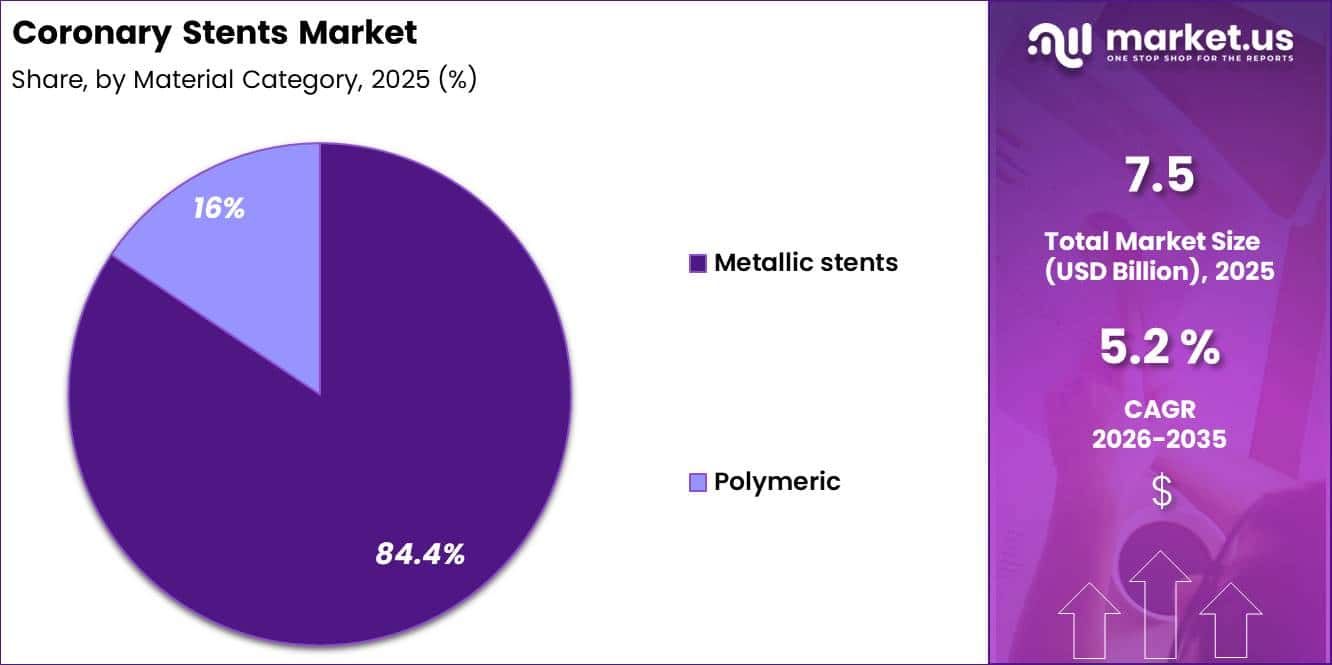
Based on material category, the coronary stents market is classified into metallic stents and polymeric stents. Metallic stents dominate the market with an 84.4% share in 2025, supported by their established clinical reliability, mechanical strength, durability, and extensive use in cardiovascular procedures worldwide.
Metallic platforms, including stainless steel, cobalt-chromium, and platinum-chromium alloys, provide excellent radial strength and flexibility, making them suitable for treating a wide range of coronary artery conditions.
The continued development of thinner metallic struts, improved biocompatible coatings, and enhanced delivery systems has further increased physician preference for metallic stents. These advancements help minimize vessel injury, improve blood flow restoration, and support better long-term outcomes after implantation.
Polymeric stents account for 15.6% of the market in 2025 and represent an innovative segment focused on temporary vessel support and reduced long-term foreign material presence. Polymer-based technologies are primarily associated with bioresorbable vascular scaffolds designed to gradually dissolve after completing their therapeutic function.
Despite potential benefits, adoption is influenced by factors such as mechanical performance, clinical validation, and manufacturing complexity. Overall, metallic stents maintain market leadership, while polymeric solutions continue gaining attention through ongoing research and material innovation.
Design Type Analysis
The coronary stents market is segmented by design type into balloon-expandable stents and self-expanding stents. Among these, balloon-expandable stents dominate the market with a 61.1% share in 2025, owing to their high precision, controlled deployment, and extensive application in coronary artery interventions.
These stents are widely preferred during PCI procedures because they allow accurate placement at the target lesion and provide consistent vessel expansion through balloon inflation.
Balloon-expandable stent designs have benefited from continuous technological improvements, including reduced strut thickness, enhanced flexibility, improved radial strength, and advanced drug-coating technologies. These innovations help address complex coronary lesions while minimizing complications such as restenosis and vessel injury.
Self-expanding stents represent another important design category, offering advantages such as continuous outward force and adaptability to changing vessel dimensions. Although more commonly associated with peripheral vascular applications, advancements in design engineering are creating opportunities for expanded coronary applications in selected clinical scenarios.
The growing prevalence of coronary artery disease, increasing PCI procedures, and demand for minimally invasive cardiovascular treatments continue to support the adoption of advanced stent designs. Balloon-expandable stents are expected to maintain their leading position due to their proven clinical effectiveness and procedural accuracy.
End-user Analysis
The coronary stents market is segmented by end-user into hospitals & cardiac centers, ambulatory surgical centers (ASCs), and other healthcare facilities. Hospitals & cardiac centers dominate the market with a 62.2% share in 2025, driven by their advanced cardiovascular infrastructure, availability of specialized cardiologists, and ability to perform complex percutaneous coronary intervention (PCI) procedures.
Hospitals remain the primary setting for coronary stent implantation due to the requirement for advanced imaging systems, catheterization laboratories, emergency care capabilities, and post-procedure monitoring.
The increasing burden of cardiovascular diseases, rising number of coronary interventions, and expansion of specialized cardiac units worldwide continue to strengthen hospital-based demand for coronary stents. Large hospitals and dedicated cardiac centers are also adopting next-generation stent technologies, including drug-eluting and advanced metallic stent platforms, to improve treatment outcomes.
Ambulatory surgical centers are gradually expanding their role in coronary procedures due to growing preference for minimally invasive treatments, shorter hospital stays, and cost-efficient healthcare delivery models. Other healthcare facilities contribute through specialized clinics and smaller intervention centers providing cardiovascular services.
Overall, hospitals and cardiac centers are expected to remain the leading end-user segment, supported by advanced procedural capabilities, increasing cardiovascular patient volumes, and continuous improvements in interventional cardiology infrastructure.
Market Segmentations
By Product Type
- Drug‑eluting stents (DES)
- Bare‑metal stents (BMS)
- Bioresorbable / bioabsorbable vascular scaffolds (BVS)
- Other specialized coronary stents
By Material Category
- Metallic stents
- Polymeric
- By Design Type
- Balloon‑expandable stents
- Self‑expanding stents
By End-user
- Hospitals & cardiac centers
- Ambulatory surgical centers / outpatient facilities
- Other healthcare settings (clinics, specialty centers)
Driver
Aging CAD Burden and Recurrent Acute Coronary Events
The dominant structural driver of stent demand is the expanding and aging population of patients with coronary artery disease CAD, combined with the high recurrence rate of acute ischemic events. CAD is highly prevalent, affecting a significant portion of adults in major economies, and remains a leading cause of morbidity and mortality globally.
In the United States alone, coronary heart disease contributes hundreds of thousands of deaths annually, alongside roughly 805,000 heart attacks each year, a substantial share of which are recurrent events in previously treated patients. This recurrence dynamic is commercially important because patients with prior myocardial infarction or prior percutaneous coronary intervention PCI are more likely to re enter the interventional care pathway.
As survival rates improve, more patients live long enough to experience repeat ischemic episodes, expanding the long term procedural pool rather than depleting it. Globally, cardiovascular disease accounts for nearly 20 million deaths annually, with over three quarters occurring in low and middle income countries.
This shifts the growth profile from purely mature market replacement demand to broader global expansion driven by aging, urbanization, and persistent risk factors such as diabetes, hypertension, and obesity. For stent manufacturers, this translates into higher PCI volumes, increased cath lab throughput, and stronger demand for diversified product portfolios tailored to complex anatomies such as calcified lesions, bifurcations, and long lesions.
It also supports broader SKU expansion across stent sizes and designs.Overall, this is a core, near term demand engine that significantly underpins growth in North America, Europe, Japan, and high volume Asian cardiac centers.
| Driver | (~) % Impact on CAGR Forecast | Geographic Relevance | Impact Timeline |
|---|---|---|---|
| Aging CAD burden and recurrent acute coronary events | +1.9% | North America core, EU, Japan, urban China | Short term |
| Diabetes-linked lesion complexity and restenosis risk | +1.4% | North America, India, China, Middle East | Short term |
| DES technology refinement and broader lesion-addressability | +1.6% | U.S., EU, Japan, South Korea, China tertiary centers | Medium term |
| Coronary ISR retreatment expansion via DCB-adjacent workflows | +0.9% | U.S. core, EU, APAC advanced cath labs | Short term |
| Reimbursement stability and outpatient PCI migration | +1.1% | U.S. core, Western Europe selective, developed APAC | Medium term |
| LMIC access expansion through essential-cardiac-care agendas | +1.3% | India, Southeast Asia, Latin America, Africa urban corridors | Long term |
Challenge
Cath Lab Capacity Bottlenecks and Their Impact on Coronary Intervention Throughput
Cath lab capacity constraints represent a meaningful friction point in coronary intervention delivery, limiting the translation of growing CAD prevalence into proportional PCI volume growth. As demand rises due to aging populations and persistent cardiovascular risk factors, procedural capacity in many health systems, particularly in urban LMICs and high volume centers in North America and Europe, has not expanded at the same pace.
In practice, many tertiary hospitals operate only 1 to 3 cath labs, each capable of handling roughly 8 to 12 PCI procedures per day, while serving catchment populations of hundreds of thousands of patients with known or suspected coronary artery disease.
This imbalance creates scheduling pressure and prioritization challenges, especially when emergency cases compete with elective interventions. As a result, 10 to 20 % of elective PCI procedures may be deferred or rescheduled, contributing to longer wait times and reduced system efficiency.
While STEMI cases still require urgent intervention under door to balloon targets of under 90 minutes, elective PCI can experience delays ranging from several days to weeks depending on capacity availability. These delays reduce throughput, increase administrative burden, and elevate per procedure overhead costs due to inefficient utilization of cath lab time and staff.
From a market perspective, these bottlenecks slow adoption cycles for new stent technologies and constrain procedural volume expansion, contributing to an estimated 0.8 % point drag on potential CAGR. Mitigation requires multi layer interventions, including cath lab workflow optimization, standardized device preparation protocols, digital scheduling systems, and regional referral networks that redistribute cases across facilities.
Over the medium term, expansion of cath lab infrastructure in high burden regions will be necessary to unlock full procedural demand potential.
| Challenge | (~) % CAGR Friction Drag | Geographic Relevance | Mitigation Horizon |
|---|---|---|---|
| Complex multi-morbid patients | -1.2% | North America, EU, East Asia | Long term (≥ 4 years) |
| Cath lab capacity bottlenecks | -0.8% | Urban LMICs, EU hubs | Medium term (2-4 years) |
| Post-PCI adherence gaps | -0.9% | Global, LMIC-heavy | Long term (≥ 4 years) |
| Regulatory evidence escalation | -0.7% | U.S., EU, Japan | Medium term (2-4 years) |
| Data & interoperability lag | -0.6% | Global tertiary centers | Long term (≥ 4 years) |
| Talent & skill asymmetry | -1.0% | LMIC cath labs, rural centers | Long term (≥ 4 years) |
Restraints
Rising Procedure Cost and Hospital Margin Pressure
Rising total procedure costs for percutaneous coronary interventions PCI, combined with sustained hospital margin compression, is creating a structural restraint on stent market expansion by intensifying pricing pressure and altering device mix preferences.
Across North America and Western Europe, hospital operating margins in cardiovascular service lines that previously ranged around 8 to 12 % have in many systems declined to approximately 3 to 6 %, driven by bundled payments, DRG based reimbursement, and broader value based care adoption.
At the same time, the direct cost of PCI procedures has increased by an estimated 10 to 20 % over the past 3 to 4 years, reflecting higher labor expenses, inflation in cath lab consumables, and growing adoption of advanced imaging tools and robotic assisted systems.
However, reimbursement growth has not kept pace, resulting in tighter per case economics for providers.This cost reimbursement mismatch is leading hospitals to impose stricter per procedure device budgets and increase scrutiny of implant selection. In practice, this favors mid tier drug eluting stents DES over premium or specialty platforms, particularly those with ASP premiums of 30 to 50 % above standard offerings.
It also contributes to an estimated 3 to 5 % reduction in discretionary stent utilization, as borderline or elective cases face more rigorous review.Over a 2 to 4 year horizon, these dynamics are expected to suppress adoption of higher end technologies and shift product mix toward cost efficient platforms.
Overall, rising procedural cost pressure and constrained margins are estimated to reduce global stent market CAGR by approximately 1.0 % point, primarily through pricing compression and mix down trading rather than reductions in underlying disease incidence or procedural need.
| Restraint | (~) % Impact on CAGR Forecast | Geographic Relevance | Impact Timeline |
|---|---|---|---|
| Escalating post-market regulatory burden (FDA, EU MDR) | -1.5% | North America core, EU | Medium term (2-4 years) |
| Price caps and reimbursement compression | -1.2% | India, Emerging Asia, select LATAM | Long term (≥ 4 years) |
| Supply chain fragility in high-precision components | -0.9% | North America, EU, APAC corridors | Short–Medium (≤ 4 years) |
| Rising procedure cost and hospital margin pressure | -1.0% | North America core, EU, urban APAC | Medium term (2-4 years) |
| Clinical safety, durability and vigilance requirements | -0.8% | North America, EU, Japan | Long term (≥ 4 years) |
| Competitive commoditization and ASP erosion | -0.7% | Global, strongest in Asia & LATAM | Long term (≥ 4 years) |
Opportunity
Local Manufacturing and Tiered Access Programs Expanding PCI Adoption in LMICs
A long term structural opportunity in the stent market is the expansion of local manufacturing and tiered access programs in low and middle income countries LMICs, where cardiovascular disease burden is high but PCI penetration remains constrained by affordability and limited infrastructure.
Although LMICs account for a large share of global cardiovascular mortality, current market models still assume low procedural access and heavy reliance on imported, higher priced devices.Establishing regional manufacturing hubs can reduce dependence on imports and lower landed device costs through localized production, simplified logistics, and faster supply cycles.
When combined with government procurement programs and tiered pricing strategies, manufacturers can offer stents at 30 to 40 % lower prices in public systems while maintaining higher pricing in developed markets through cross subsidization.
Importantly, lower pricing does not necessarily reduce revenue potential. If reduced costs unlock 3 to 4 times higher PCI volumes in underserved regions, overall revenue can still expand significantly due to scale effects and improved utilization of production capacity.
This also helps reduce treatment delays and increases access to life saving interventions.Over time, localized ecosystems improve regulatory familiarity, supply chain resilience, and demand predictability, supporting sustained procedural growth.
If such models expand to cover 20 to 25 % of global PCI volume by 2035, they could contribute approximately 2 % points of incremental CAGR, driven primarily by volume expansion rather than price increases, while also improving equity in cardiovascular care access.
| Opportunity | (~) % Potential CAGR Upside | Geographic Relevance | Execution Window |
|---|---|---|---|
| Value-based, outcome-linked stent contracts | +2.0% | North America, Western Europe | Short term (≤ 2 years) |
| Ultra-low-DAPT bioresorbable platforms for high-bleed risk | +1.8% | EU, Japan, aging APAC | Medium term (2-4 years) |
| Diabetic and multi-vascular disease stent portfolios | +1.5% | South Asia, Middle East, Latin America | Medium term (2-4 years) |
| AI-guided PCI planning and stent selection | +1.3% | Global tertiary centers (NA, EU, China) | Medium term (2-4 years) |
| Local manufacturing + access programs in LMICs | +2.2% | Sub-Saharan Africa, South Asia, ASEAN LMICs | Long term (≥ 4 years) |
| Hybrid drug-device platforms for secondary prevention | +1.4% | Global, emphasis on high-income markets | Long term (≥ 4 years) |
Regional Analysis
In 2025, North America led the market, achieving over 34.8% share with a revenue of US$ 2.6 Billion.
North America remains the leading region in the global coronary stents market, supported by the strong presence of advanced cardiovascular care infrastructure, high prevalence of coronary artery disease, and widespread adoption of minimally invasive interventional cardiology procedures.
The region benefits from well-established healthcare systems, favorable reimbursement frameworks, and continuous technological advancements in drug-eluting stents, bioresorbable technologies, and next-generation stent platforms.
Increasing demand for safer and more effective coronary interventions, along with growing awareness regarding early diagnosis and treatment of cardiovascular disorders, continues to drive market expansion across the United States and Canada. Additionally, collaborations between medical device manufacturers and healthcare providers are accelerating innovation in stent design, improving clinical outcomes and patient recovery.
Europe represents another significant market, driven by the rising burden of cardiovascular diseases, increasing adoption of percutaneous coronary intervention (PCI), and government initiatives aimed at strengthening cardiac care services.
Countries such as Germany, France, and the United Kingdom are witnessing higher utilization of advanced coronary stent technologies due to improved hospital infrastructure and access to specialized cardiac centers.
The Asia-Pacific region is expected to experience notable growth due to increasing cardiovascular disease incidence, expanding healthcare investments, improving access to interventional procedures, and growing demand for cost-effective coronary devices.
Emerging economies are enhancing healthcare facilities and adopting advanced cardiovascular technologies, creating new opportunities for market players. Meanwhile, Latin America and the Middle East & Africa are gradually expanding due to improving healthcare accessibility and rising investments in cardiovascular treatment infrastructure.
Key Regions and Countries
North America
- The US
- Canada
Europe
- Germany
- France
- The U.K.
- Italy
- Spain
- Russia & CIS
- Rest of Europe
Asia Pacific
- China
- India
- Japan
- South Korea
- ASEAN
- Australia & New Zealand
- Rest of Asia Pacific
Middle East & Africa
- GCC
- South Africa
- Rest of Middle East & Africa
Latin America
- Brazil
- Mexico
- Rest of Latin America
Key Player Analysis
The Coronary Stents Market is moderately consolidated, with competition shaped by a combination of large medical device manufacturers, established cardiovascular technology providers, and emerging innovation-focused companies.
The market is in a mature development stage, with growth driven by advancements in drug-eluting stent platforms, bioresorbable technologies, improved delivery systems, and patient-specific cardiovascular interventions.
Companies are increasingly focusing on precision-based approaches, including improved stent designs, enhanced biocompatibility, and technologies aimed at reducing restenosis and improving long-term clinical outcomes.
The market structure consists of three major strategic tiers. The first tier includes large multinational cardiovascular device companies such as Abbott Laboratories, Boston Scientific Corporation, Medtronic plc, Terumo Corporation, and B. Braun SE / B. Braun Melsungen AG, which leverage extensive R&D capabilities, global distribution networks, and broad interventional cardiology portfolios.
The second tier comprises established specialty cardiovascular device manufacturers, including BIOTRONIK SE & Co. KG, Biosensors International Group, Ltd., MicroPort Scientific Corporation, Cook Medical LLC, and C. R. Bard, Inc. (now part of BD), focusing on targeted product innovation and regional expansion.
The third tier includes innovation-driven and emerging players such as Meril Life Sciences Pvt. Ltd., Alvimedica, Lepu Medical Technology (Beijing) Co., Ltd., OrbusNeich Medical Group, and STENTYS SA, emphasizing differentiated stent technologies and specialized clinical applications.
Competitive strategies center on continuous R&D investment, clinical validation, regulatory approvals, and collaborations with healthcare institutions. Companies compete through next-generation drug-eluting stents, improved polymer technologies, minimally invasive delivery systems, and integration with interventional cardiology workflows.
Partnerships, physician networks, and clinical trial capabilities remain important factors influencing competitive positioning across the coronary stents ecosystem.
Top Key Players
- Abbott Laboratories
- Boston Scientific Corporation
- Medtronic plc
- Terumo Corporation
- B. Braun SE / B. Braun Melsungen AG
- BIOTRONIK SE & Co. KG
- Biosensors International Group, Ltd.
- MicroPort Scientific Corporation
- Cook Medical LLC
- C. R. Bard, Inc. (now part of BD)
- Meril Life Sciences Pvt. Ltd.
- Alvimedica
- Lepu Medical Technology (Beijing) Co., Ltd.
- OrbusNeich Medical Group
- STENTYS SA
- others
Recent Developments
- In 2025, Lepu Medical continued expansion of its cardiovascular device portfolio and international market presence; no major coronary stent acquisition or new flagship coronary stent launch was publicly reported during the reviewed period.
- In April 2026, Abbott received FDA clearance and CE Mark for its next-generation Ultreon™ 3.0 AI-powered coronary imaging platform, enhancing PCI guidance by combining OCT imaging with AI-based insights to support improved stent sizing and placement decisions.
- In May 2026, Boston Scientific announced a strategic investment of approximately US$1.5 billion in MiRus LLC, strengthening its cardiovascular technology portfolio through access to advanced implant and structural heart technologies.
Report Scope
| Report Features | Description |
|---|---|
| Market Value (2025) | US$ 7.5 Billion |
| Forecast Revenue (2035) | US$ 12.4 Billion |
| CAGR (2026-2035) | 5.2 % |
| Base Year for Estimation | 2025 |
| Historic Period | 2020-2024 |
| Forecast Period | 2026-2035 |
| Report Coverage | Revenue Forecast, Market Dynamics, Competitive Landscape, Recent Developments |
| Segments Covered | By Product Type (Drug‑eluting stents (DES), Bare‑metal stents (BMS), Bioresorbable / bioabsorbable vascular scaffolds (BVS), Other specialized coronary stents) By Material Category (Metallic stents, Polymeric) By Design Type (Balloon‑expandable stents, Self‑expanding stents) By End-user (Hospitals & cardiac centers, Ambulatory surgical centers / outpatient facilities, Other healthcare settings (clinics, specialty centers)) |
| Regional Analysis | North America – The US, Canada; Europe – Germany, France, U.K., Italy, Spain, Russia & CIS, Rest of Europe; Asia Pacific – China, India, Japan, South Korea, ASEAN, Australia & New Zealand, Rest of Asia Pacific; Middle East & Africa – GCC, South Africa, Rest of Middle East & Africa; Latin America – Brazil, Mexico, Rest of Latin America |
| Competitive Landscape | Abbott Laboratories, Boston Scientific Corporation, Medtronic plc, Terumo Corporation, B. Braun SE / B. Braun Melsungen AG, BIOTRONIK SE & Co. KG, Biosensors International Group, Ltd., MicroPort Scientific Corporation,Cook Medical LLC, C. R. Bard, Inc. (now part of BD), Meril Life Sciences Pvt. Ltd., Alvimedica, Lepu Medical Technology (Beijing) Co., Ltd., OrbusNeich Medical Group, STENTYS SA, Others |
| Customization Scope | Customization for segments, region/country-level will be provided. Moreover, additional customization can be done based on the requirements. |
| Purchase Options | We have three licenses to opt for: Single User License, Multi-User License (Up to 5 Users), Corporate Use License (Unlimited User and Printable PDF) |





































