Global Core Network KPI Dashboard Market Size, Share, Growth Analysis By Component (Software, Hardware, Services), By Deployment Mode (On-Premises, Cloud), By Application (Network Optimization, Security and Compliance, Traffic Management, Quality of Service, Others), By End-User (Telecommunications, Enterprises, Cloud Service Providers, Others), By Region and Companies - Industry Segment Outlook, Market Assessment, Competition Scenario, Statistics, Trends and Forecast 2025-2035
- Published date: Mar 2026
- Report ID: 182921
- Number of Pages: 223
- Format:
-
keyboard_arrow_up
Quick Navigation
- Report Overview
- Core Key Insights
- Core Network Analysis
- Future Predictions
- Market Outlook
- Key Market Segments
- Research-Based Segments
- By Component
- By Deployment Mode
- By Application
- By End-User
- Regional Analysis
- US Market Size
- Driving Factors
- Restraint Factors
- Growth Opportunities
- Trending Factors
- Competitive Analysis
- Recent Developments
- Report Scope
Report Overview
The Core Network KPI Dashboard market is gaining strong attention from telecom operators and enterprise network teams that want better control, visibility, and real-time performance tracking of their core infrastructure. From a client perspective, this market reflects a clear shift toward data-driven network operations.
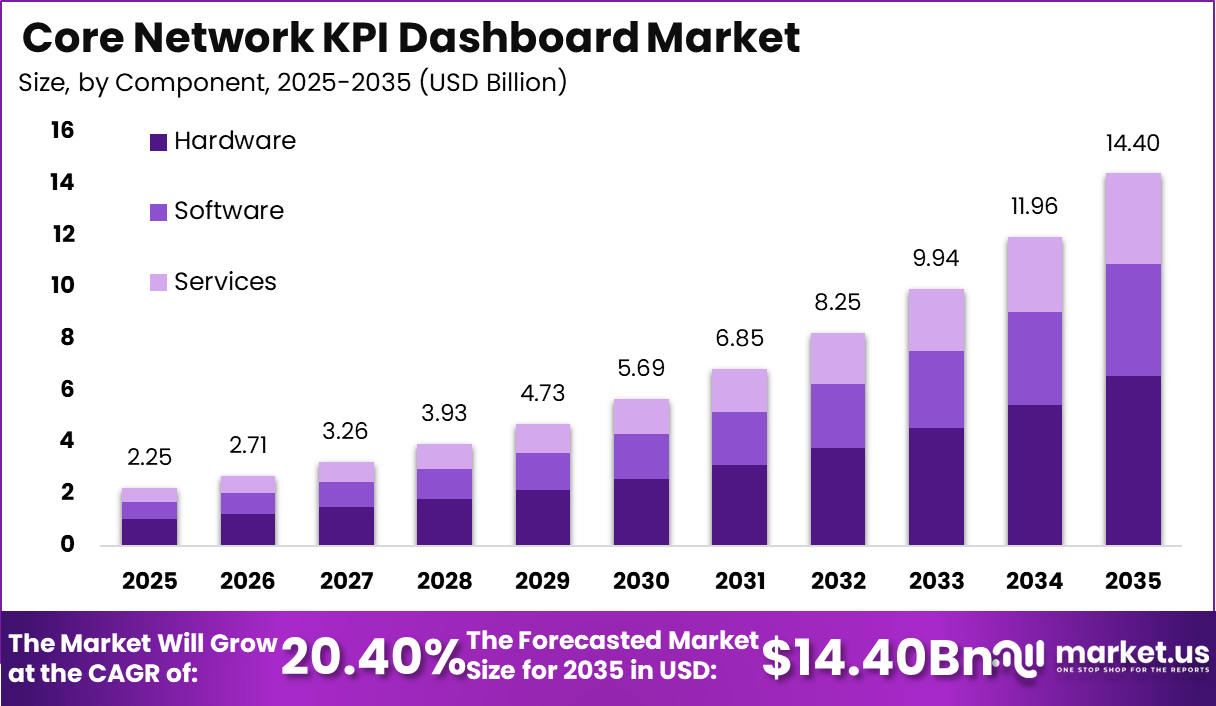
Where decision-making relies on accurate KPI monitoring across 4G, 5G, and evolving cloud-native core environments. In 2025, the market stands at USD 2.25 billion and is projected to reach USD 14.40 billion by 2035, expanding at a CAGR of 20.40%, indicating rapid adoption driven by increasing network complexity and demand for service quality assurance.
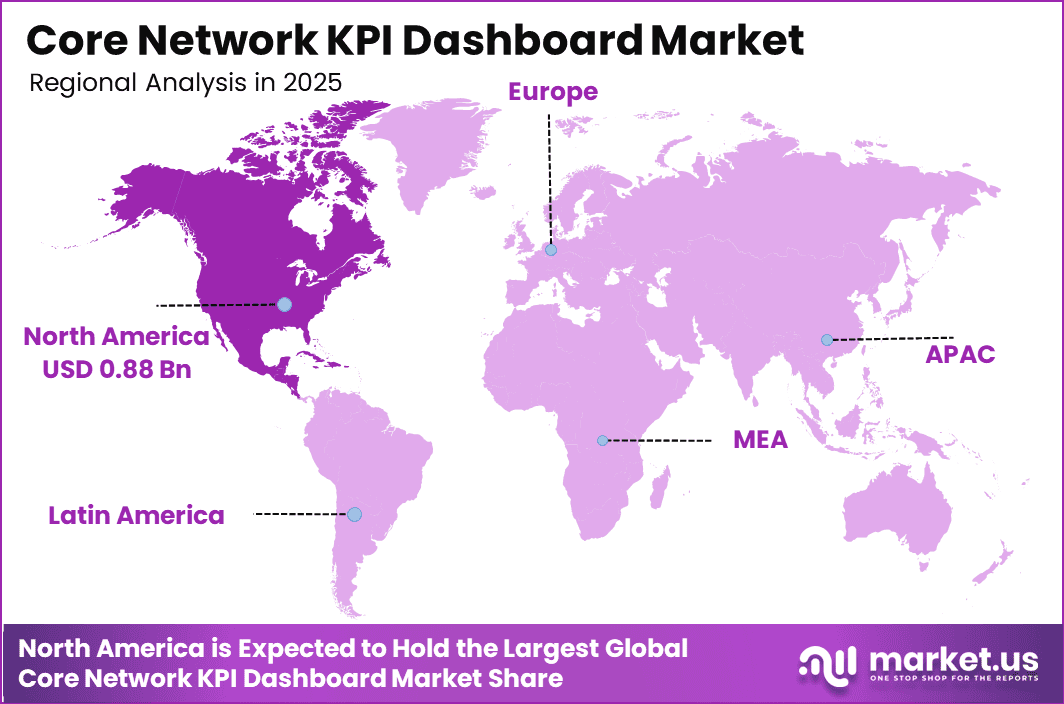
North America holds a dominant position with a 39.4% share, contributing around USD 0.88 billion in 2025. This leadership is supported by early 5G deployment, strong telecom infrastructure, and higher investments in network automation.
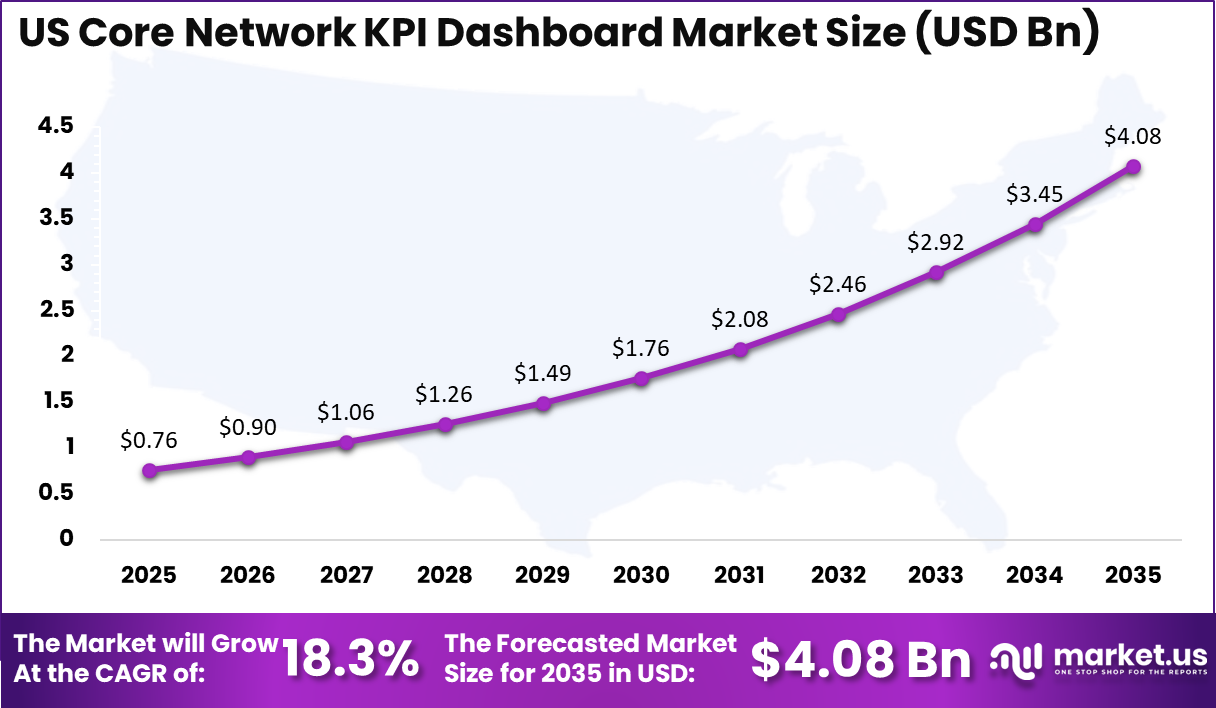
Within the region, the US represents a major revenue contributor, reaching USD 0.76 Billion in 2025 and projected to grow to USD 4.08 billion by 2035 at a CAGR of 18.3%. For clients evaluating this market, these figures highlight a high-growth environment with strong opportunities in analytics platforms, AI-driven monitoring tools, and performance optimization solutions tailored for next-generation telecom networks.
The Core Network KPI Dashboard ecosystem is shaped by measurable shifts in telecom traffic, performance expectations, and operational complexity. Global mobile data traffic crossed 130 exabytes per month in 2024, with projections indicating it may exceed 400 exabytes per month by the end of the decade, creating a strong need for real-time KPI visibility across core networks.
Average 5G download speeds in advanced markets range between 150 Mbps and 300 Mbps, while latency targets are being pushed below 10 milliseconds for critical applications such as industrial automation and connected mobility. Network reliability benchmarks have also tightened, with leading operators targeting uptime levels above 99.999%, allowing less than 6 minutes of downtime annually.
At the same time, telecom networks now generate millions of performance data points per minute, driven by signaling traffic, user sessions, and IoT device connections, which are expected to surpass 30 billion globally by 2030. Around 65% of telecom operators have already integrated AI-based monitoring tools into their network operations to improve fault detection and predictive maintenance accuracy.
Additionally, over 70% of service providers report increased operational costs linked to network complexity, reinforcing the demand for centralized KPI dashboards that can reduce troubleshooting time by nearly 40% and improve service-level compliance across dynamic network environments.
Core Key Insights
- The market is projected to expand strongly, reaching USD 14.40 billion by 2035, supported by a CAGR of 20.4%, reflecting the rapid adoption of real-time network monitoring solutions.
- North America leads the market with a 39.4% share, generating USD 0.88 billion in 2025, driven by advanced telecom infrastructure and early adoption of network analytics tools.
- The US remains the key contributor within the region, growing from USD 0.76 Billion in 2025 to USD 4.08 billion by 2035, supported by increasing investments in 5G core network optimization.
- By component, hardware dominates with a 45.7% share, indicating strong demand for physical infrastructure supporting KPI tracking and performance monitoring systems.
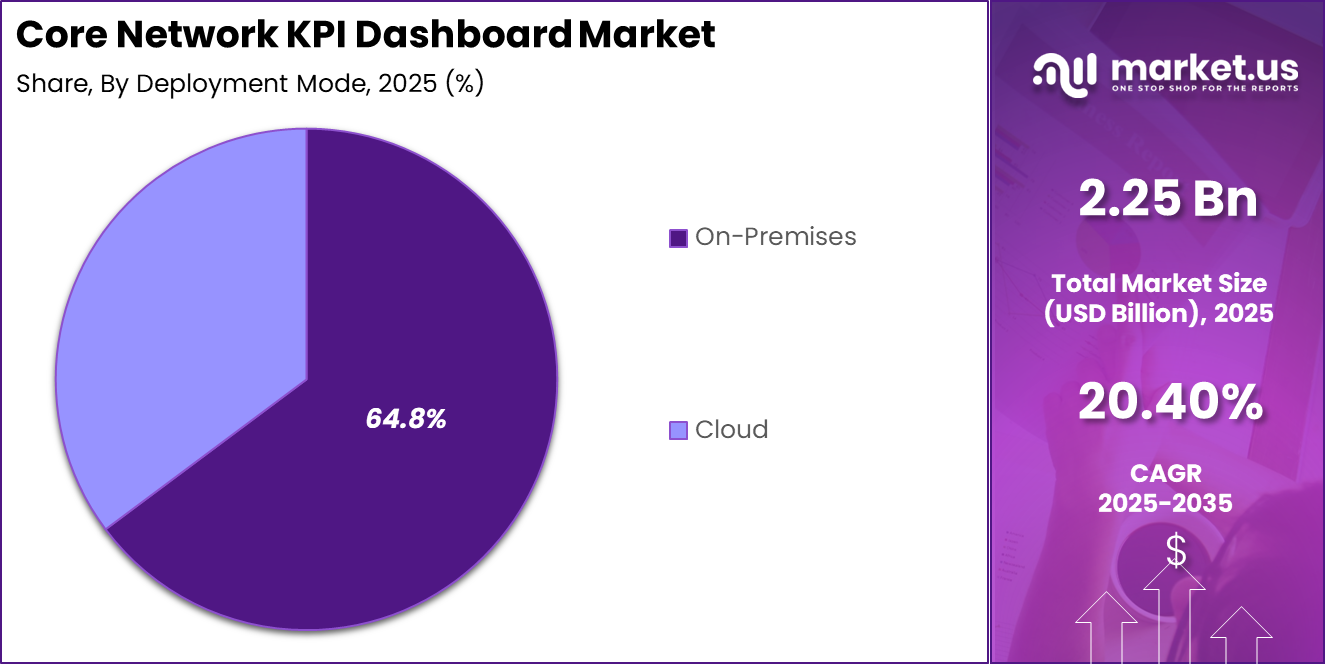
- By deployment mode, on-premises solutions lead with 64.8%, highlighting preference for data control, security, and integration within existing telecom environments.
- By application, network optimization accounts for 44.6%, as operators prioritize improving network efficiency, latency management, and service quality.
- By end-user, telecommunications holds the largest share at 52.7%, driven by the continuous need for performance visibility across expanding and complex core network architectures.
Core Network Analysis
Core network environments are undergoing rapid transformation as telecom operators shift toward cloud-native architectures and 5G standalone deployments. Globally, more than 300 commercial 5G networks are operational, with over 50 adopting standalone core networks that require advanced KPI monitoring systems.
These networks support ultra-low latency targets of under 10 milliseconds and peak data speeds exceeding 1 Gbps, increasing the complexity of performance tracking across distributed systems. The volume of signaling data in core networks has risen sharply, with large operators processing over 5 to 10 million transactions per second during peak hours.
This surge is driven by growing smartphone penetration, which has crossed 6.8 billion users worldwide, along with IoT connections expected to exceed 29 billion devices by 2030. Each connected device continuously generates performance metrics, increasing the demand for centralized KPI dashboards capable of handling real-time analytics.
Network downtime remains a critical concern, with even a single hour of outage potentially costing telecom operators over USD 300,000 in lost revenue and service penalties. As a result, nearly 70% of operators have started deploying AI-based network analytics to improve fault prediction and reduce mean time to resolution by up to 45%. This shift highlights the increasing reliance on intelligent KPI dashboards to maintain service reliability and operational efficiency.
Future Predictions
The future of the Core Network KPI Dashboard market is expected to be shaped by the rapid evolution of 5G standalone networks, early 6G research, and the growing use of AI-driven operations. Over the next decade, telecom networks are anticipated to handle more than 500 exabytes of monthly mobile data traffic globally, significantly increasing the need for advanced KPI monitoring and predictive analytics tools.
As networks become more software-driven, over 75% of core network functions are expected to run on cloud-native platforms, requiring dashboards that can manage virtualized and containerized environments in real time. AI and automation are projected to play a central role, with more than 80% of telecom operators expected to rely on autonomous network management systems to reduce manual intervention.
These systems are likely to improve fault detection accuracy by over 50% and reduce network downtime significantly. In parallel, the number of connected IoT devices is expected to cross 30 billion, creating continuous streams of performance data that demand scalable and intelligent dashboard solutions.
Edge computing adoption is also expected to rise, with nearly 40% of data processing anticipated to occur closer to the network edge. This shift will require KPI dashboards to provide decentralized visibility while maintaining unified control, ensuring consistent performance across increasingly complex and distributed network ecosystems.
Market Outlook
The Core Network KPI Dashboard market is expected to experience sustained expansion as telecom operators continue modernizing their infrastructure and prioritizing real-time network intelligence. The transition toward 5G standalone and cloud-native cores is accelerating globally, with operators increasingly investing in tools that provide granular visibility into network performance, subscriber behavior, and service quality.
This shift is creating strong demand for KPI dashboards that can process high-volume data streams and deliver actionable insights with minimal latency. From a client standpoint, the market outlook remains highly favorable due to the rising complexity of telecom ecosystems. Networks are no longer centralized, as functions are distributed across edge, cloud, and hybrid environments.
This evolution is expected to increase reliance on unified monitoring platforms that can track performance across multiple layers in a single interface. Additionally, growing enterprise use cases such as private 5G networks, smart manufacturing, and connected mobility are anticipated to further drive demand for advanced KPI solutions.
Operational efficiency is also becoming a key focus area, as telecom providers aim to reduce downtime, improve service-level compliance, and optimize resource utilization. As a result, KPI dashboards are expected to evolve beyond monitoring tools into intelligent decision-support systems, enabling proactive network management and supporting long-term scalability in increasingly data-intensive network environments.
Key Market Segments
The Core Network KPI Dashboard market shows a clear concentration of demand across specific segments, reflecting current telecom infrastructure priorities.
By component, hardware accounts for 45.7%, indicating strong reliance on physical systems such as servers, probes, and network appliances that enable real-time data collection and performance tracking. These systems remain essential as telecom networks handle millions of signaling events per second and require high processing capacity to maintain accuracy in KPI reporting.
By deployment mode, on-premises leads with 64.8%, highlighting the importance of data security, latency control, and direct infrastructure integration. Telecom operators continue to prefer on-site deployments as core networks process sensitive subscriber and operational data, often exceeding several terabytes daily in large-scale environments. This approach also supports faster troubleshooting and ensures compliance with strict regulatory requirements in many regions.
By application, network optimization holds 44.6%, driven by the need to manage increasing data traffic and improve service quality. With average mobile data consumption per user surpassing 20 GB per month in several markets, operators depend on KPI dashboards to identify bottlenecks and optimize network resources efficiently.
By end-user, telecommunications dominates with 52.7%, as operators require continuous monitoring across complex, multi-layered core networks to maintain uptime, enhance user experience, and support evolving digital services.
Research-Based Segments
By Component
- Software
- Hardware
- Services
By Deployment Mode
- On-Premises
- Cloud
By Application
- Network Optimization
- Security and Compliance
- Traffic Management
- Quality of Service
- Others
By End-User
- Telecommunications
- Enterprises
- Cloud Service Providers
- Others
By Component
Hardware accounts for 45.7% of the Core Network KPI Dashboard market, reflecting its critical role in supporting high-performance data collection and processing across telecom networks. Core network environments generate massive volumes of real-time data, often exceeding several terabytes per day for large operators, which requires robust physical infrastructure such as servers, probes, and data acquisition systems.
These hardware components enable continuous monitoring of signaling traffic, session performance, and network utilization, ensuring accurate KPI measurement across complex architectures. Software plays an equally important role by transforming raw network data into actionable insights. Modern KPI dashboard software platforms integrate advanced analytics, visualization tools, and AI-based algorithms to process millions of events per second.
Many operators are increasingly adopting cloud-native and containerized software solutions that allow flexible scaling and seamless integration with virtualized core networks. This shift supports faster decision-making and enhances network visibility across distributed environments. Services support both hardware and software components by ensuring smooth deployment, integration, and ongoing optimization.
Telecom operators rely on managed and professional services to handle system configuration, upgrades, and performance tuning. With growing network complexity, service providers also assist in implementing automation strategies, helping reduce manual intervention and improving overall operational efficiency in KPI monitoring systems.
By Deployment Mode
On-premises deployment holds 64.8% of the Core Network KPI Dashboard market, reflecting strong preference among telecom operators for direct control over critical network data and infrastructure. Core networks process highly sensitive subscriber information and operational metrics, often generating multiple terabytes of data daily, which makes local deployment essential for ensuring data security and regulatory compliance.
On-premises systems also enable faster data processing with minimal latency, allowing operators to monitor millions of signaling events per second and respond quickly to network issues. This deployment model is particularly important in environments where uptime targets exceed 99.999%, requiring highly reliable and tightly integrated monitoring systems.
Cloud deployment is gradually gaining traction as operators move toward virtualized and software-defined core networks. Cloud-based KPI dashboards offer scalability, enabling telecom providers to handle fluctuating data volumes without heavy upfront infrastructure investment. These solutions support centralized monitoring across geographically distributed networks and allow easier integration with AI-driven analytics tools.
As more than half of new core network functions are expected to operate in cloud environments, demand for cloud-based KPI dashboards is anticipated to increase steadily. This shift is particularly relevant for operators seeking flexibility, faster deployment cycles, and cost-efficient expansion of monitoring capabilities in evolving telecom ecosystems.
By Application
Network optimization accounts for 44.6% of the Core Network KPI Dashboard market, driven by the growing need to manage rising data traffic and improve overall network efficiency. Telecom networks now handle peak loads exceeding several terabits per second in dense urban environments, requiring continuous monitoring to identify congestion points and optimize resource allocation.
KPI dashboards support operators in analyzing real-time performance metrics, helping reduce latency levels that are often targeted below 10 milliseconds for advanced services. Security and compliance have become critical applications as telecom networks process sensitive user and enterprise data.
With cyberattacks on telecom infrastructure increasing year over year, operators are using KPI dashboards to track anomalies, detect unauthorized access, and ensure adherence to regulatory standards. These systems help monitor millions of events daily to maintain secure and compliant operations.
Traffic management plays a key role in balancing network load across multiple nodes and regions. KPI dashboards enable operators to dynamically route traffic, improving efficiency during peak usage periods. Quality of service focuses on maintaining a consistent user experience, with dashboards tracking metrics such as call drop rates, packet loss, and latency. The other category includes applications like capacity planning and predictive maintenance, which support long-term network performance and scalability.
By End-User
Telecommunications accounts for 52.7% of the Core Network KPI Dashboard market, reflecting its central role in managing large-scale, high-complexity network environments. Telecom operators handle millions of concurrent user sessions and process vast volumes of signaling data every second, requiring continuous monitoring to maintain service reliability.
KPI dashboards enable operators to track critical metrics such as latency, throughput, and network availability, supporting uptime targets that often exceed 99.999%. With the expansion of 5G standalone networks and increasing demand for real-time services, telecom providers rely heavily on these dashboards to ensure consistent performance and rapid fault resolution.
Enterprises are emerging as a growing segment, particularly with the adoption of private 5G networks and digital transformation initiatives. Large organizations require KPI dashboards to monitor internal network performance, support mission-critical applications, and ensure seamless connectivity across distributed operations.
Cloud service providers also represent a key user group, as they manage large data centers and virtualized network functions. These providers depend on KPI dashboards to maintain service-level agreements, optimize resource utilization, and handle fluctuating workloads efficiently. The other category includes sectors such as government and research institutions, where network monitoring supports secure communication and specialized operational requirements.
Regional Analysis
North America holds 39.4% of the Core Network KPI Dashboard market, reaching USD 0.88 Billion in 2025, supported by strong telecom infrastructure and early adoption of advanced network technologies. The region has a high concentration of 5G deployments, with hundreds of operational networks and a growing shift toward standalone core architectures.
This evolution has increased the need for real-time KPI monitoring solutions capable of handling millions of network events per second and ensuring ultra-low latency performance across services. The United States plays a central role in regional growth, driven by continuous investments in network modernization and automation.
Telecom operators in the region are actively integrating AI-based analytics into their operations, with a large share already using intelligent monitoring systems to improve fault detection and reduce downtime. High mobile data consumption, often exceeding 25 GB per user per month, further drives the demand for advanced KPI dashboards that can optimize network performance and manage congestion effectively.
In addition, North America benefits from strong cloud infrastructure and the presence of large-scale data centers, enabling seamless integration of KPI dashboards with virtualized and cloud-native core networks. This combination of technological maturity and investment focus positions the region as a key hub for innovation and sustained growth in network performance monitoring solutions.
US Market Size
The United States Core Network KPI Dashboard market is valued at USD 0.76 Billion in 2025 and is projected to reach USD 4.08 billion by 2035, expanding at a CAGR of 18.3%. This growth reflects the country’s strong focus on telecom infrastructure modernization and increasing reliance on advanced network analytics.
The US has one of the most mature telecom ecosystems, with widespread 5G deployment and a growing transition toward standalone core networks, which require continuous and precise KPI monitoring. From a client perspective, the US market presents significant opportunities driven by high mobile data consumption and dense network traffic.
Average monthly data usage per smartphone user has already crossed 25 GB, while large operators manage millions of simultaneous connections, creating a need for real-time performance tracking tools. KPI dashboards help telecom providers maintain high service standards, reduce network downtime, and improve customer experience in highly competitive environments.
Additionally, the adoption of AI and automation in network operations is accelerating across the US. A large share of operators are investing in predictive analytics to reduce fault resolution time and enhance operational efficiency. The presence of advanced cloud infrastructure and data centers further supports the deployment of scalable KPI dashboard solutions, positioning the US as a key growth hub in this market.
Regional Analysis and Coverage
- North America
- US
- Canada
- Europe
- Germany
- France
- The UK
- Spain
- Italy
- Russia
- Netherlands
- Rest of Europe
- Asia Pacific
- China
- Japan
- South Korea
- India
- Australia
- Singapore
- Thailand
- Vietnam
- Rest of Latin America
- Latin America
- Brazil
- Mexico
- Rest of Latin America
- Middle East & Africa
- South Africa
- Saudi Arabia
- UAE
- Rest of MEA
Driving Factors
The Core Network KPI Dashboard market is driven by the rapid increase in mobile data consumption and the expansion of 5G standalone networks. Global smartphone users have crossed 6.8 billion, and average monthly data usage in advanced markets exceeds 20 to 30 GB per user, creating a strong need for real-time network visibility.
Telecom operators process millions of signaling events per second, making manual monitoring inefficient and increasing reliance on automated KPI dashboards. The push for ultra-reliable networks with uptime targets above 99.999% further strengthens demand, as even a few minutes of downtime can lead to significant revenue loss.
Additionally, the rise of latency-sensitive applications such as autonomous systems, remote healthcare, and industrial automation requires continuous performance tracking. KPI dashboards enable operators to detect anomalies instantly and maintain consistent service quality, supporting network stability in highly dynamic environments.
Restraint Factors
High implementation complexity and integration challenges act as key restraints in this market. Telecom networks consist of legacy systems, multi-vendor environments, and evolving architectures, making it difficult to deploy unified KPI dashboards. Large operators often manage thousands of network nodes and distributed data centers, which complicates data aggregation and standardization.
Initial deployment costs can also be substantial, as infrastructure upgrades and skilled workforce requirements add to operational expenses. Data privacy and regulatory compliance present additional barriers, especially when handling sensitive subscriber information across multiple regions.
Moreover, false alerts and data overload from millions of real-time metrics can reduce efficiency if dashboards are not properly optimized. These challenges may slow adoption among smaller operators or those with limited technical capabilities.
Growth Opportunities
The growing adoption of cloud-native networks and virtualization presents strong growth opportunities for KPI dashboard solutions. More than half of new telecom core functions are now deployed using containerized and software-defined architectures, creating demand for flexible and scalable monitoring tools.
The expansion of private 5G networks across industries such as manufacturing, logistics, and energy is opening new revenue streams for KPI dashboard providers. These networks require customized performance monitoring to support critical operations and ensure reliability.
In addition, the rise of IoT ecosystems, expected to exceed 30 billion connected devices globally, is generating continuous streams of performance data. This creates opportunities for advanced analytics platforms that can process and interpret large datasets in real time. Integration with AI and machine learning also offers potential to enhance predictive maintenance and optimize network operations efficiently.
Trending Factors
A key trend shaping the market is the increasing use of AI-driven and autonomous network management systems. Around 70% of telecom operators are adopting AI-based tools to improve fault detection and reduce resolution time by up to 40%. These intelligent KPI dashboards can analyze patterns, predict failures, and automate corrective actions without manual intervention.
Another major trend is the shift toward edge computing, where nearly 40% of data processing is expected to occur closer to end users. This requires decentralized KPI monitoring while maintaining centralized visibility. Real-time analytics and visualization capabilities are also becoming more advanced, enabling operators to monitor network performance at granular levels.
Additionally, there is a growing demand for unified dashboards that integrate multiple network layers, including core, edge, and cloud, into a single platform. These trends highlight the movement toward more intelligent, scalable, and responsive network monitoring solutions.
Competitive Analysis
The competitive landscape of the Core Network KPI Dashboard market is shaped by large telecom technology providers and specialized network analytics firms, each leveraging scale, innovation, and integration capabilities.
Companies such as Huawei Technologies Co., Ltd. lead the broader telecom infrastructure space with revenues exceeding USD 118 billion, reflecting their strong global footprint in network equipment and monitoring solutions.
Cisco Systems, Inc. operates with over 86,000 employees and focuses on integrating networking with security and analytics, strengthening its position in KPI dashboard solutions through AI-driven insights and automation.
Nokia Corporation and Ericsson AB reported annual revenues of around USD 26 billion and USD 22 billion, respectively, highlighting their strong presence in network infrastructure and performance monitoring platforms.
Mid-tier and software-focused players such as Amdocs Limited, Netcracker Technology Corporation, and Mavenir Systems, Inc. are gaining traction by offering cloud-native KPI analytics and service assurance platforms. These companies focus on flexible deployment and faster integration with 5G core environments.
Meanwhile, firms like Ciena Corporation and Fujitsu Limited are investing in automation and real-time analytics to enhance network visibility. Overall, competition remains moderately concentrated, with large vendors controlling significant infrastructure deployments while smaller players compete through innovation, API-driven platforms, and specialized analytics capabilities.
Top Key Players in the Market
- Cisco Systems, Inc.
- Huawei Technologies Co., Ltd.
- Nokia Corporation
- Ericsson AB
- ZTE Corporation
- Amdocs Limited
- Oracle Corporation
- Hewlett Packard Enterprise (HPE)
- Netcracker Technology Corporation
- Sandvine Incorporated ULC
- Allot Ltd.
- Comarch SA
- Openet (Amdocs)
- Affirmed Networks (Microsoft)
- Mavenir Systems, Inc.
- Casa Systems, Inc.
- Ciena Corporation
- Fujitsu Limited
- NEC Corporation
- Radisys Corporation
- Other
Recent Developments
- In 2025, Cisco Systems, Inc. reported annual revenues of over USD 57 billion, with continued investment in AI-driven network analytics, strengthening its capabilities in intelligent KPI monitoring and automated network operations.
- In 2024, Huawei Technologies Co., Ltd., deployed more than 3,000 commercial 5G core network projects globally, accelerating the need for scalable KPI dashboard solutions to manage complex and distributed network environments.
- In 2025, Ericsson AB expanded its standalone 5G core deployments across over 40 telecom operators, increasing demand for centralized KPI tracking systems to ensure low latency and high service reliability.
Report Scope
Report Features Description Market Value (2025) USD 2.25 Billion Forecast Revenue (2035) USD 14.40 Billion CAGR(2025-2035) 20.40% Base Year for Estimation 2025 Historic Period 2020-2024 Forecast Period 2026-2035 Report Coverage Revenue forecast, AI impact on Market trends, Share Insights, Company ranking, competitive landscape, Recent Developments, Market Dynamics, and Emerging Trends Segments Covered By Component (Software, Hardware, Services), By Deployment Mode (On-Premises, Cloud), By Application (Network Optimization, Security and Compliance, Traffic Management, Quality of Service, Others), By End-User (Telecommunications, Enterprises, Cloud Service Providers, Others) Regional Analysis North America – US, Canada; Europe – Germany, France, The UK, Spain, Italy, Russia, Netherlands, Rest of Europe; Asia Pacific – China, Japan, South Korea, India, New Zealand, Singapore, Thailand, Vietnam, Rest of Latin America; Latin America – Brazil, Mexico, Rest of Latin America; Middle East & Africa – South Africa, Saudi Arabia, UAE, Rest of MEA Competitive Landscape Cisco Systems, Inc., Huawei Technologies Co., Ltd., Nokia Corporation, Ericsson AB, ZTE Corporation, Amdocs Limited, Oracle Corporation, Hewlett Packard Enterprise (HPE), Netcracker Technology Corporation, Sandvine Incorporated ULC, Allot Ltd., Comarch SA, Openet (Amdocs), Affirmed Networks (Microsoft), Mavenir Systems, Inc., Casa Systems, Inc., Ciena Corporation, Fujitsu Limited, NEC Corporation, Radisys Corporation, Other Customization Scope Customization for segments, region/country-level will be provided. Moreover, additional customization can be done based on the requirements. Purchase Options We have three licenses to opt for: Single User License, Multi-User License (Up to 5 Users), Corporate Use License (Unlimited Users and Printable PDF)  Core Network KPI Dashboard MarketPublished date: Mar 2026add_shopping_cartBuy Now get_appDownload Sample
 -
-
- Cisco Systems, Inc.
- Huawei Technologies Co., Ltd.
- Nokia Corporation
- Ericsson AB
- ZTE Corporation
- Amdocs Limited
- Oracle Corporation
- Hewlett Packard Enterprise (HPE)
- Netcracker Technology Corporation
- Sandvine Incorporated ULC
- Allot Ltd.
- Comarch SA
- Openet (Amdocs)
- Affirmed Networks (Microsoft)
- Mavenir Systems, Inc.
- Casa Systems, Inc.
- Ciena Corporation
- Fujitsu Limited
- NEC Corporation
- Radisys Corporation
- Other
Our Clients

- 182921
- Mar 2026