Core Banking On Kubernetes Market By Component (Software, Services (Managed Services, Professional Services)), By Deployment Mode (On-Premises, Cloud), By Organization Size (Large Enterprises, Small and Medium Enterprises), By Application (Retail Banking, Corporate Banking, Investment Banking, Others), By End-User (Banks, Credit Unions, Financial Institutions, Others), By Regional Analysis, Global Trends and Opportunity, Future Outlook By 2026-2035
The Global Core Banking On Kubernetes Market generated USD 2.9 billion in 2025 and is predicted to register growth from USD 3.6 billion in 2026 to about USD 26.9 billion by 2035, recording a CAGR of 25% throughout the forecast span. In 2025, North America held a dominant market position, capturing more than a 34.3% share, holding USD 0.99 Billion revenue.
Top Market Takeaways
Component Software accounts for 73.7% of the Core Banking on Kubernetes market, as banks mainly invest in modern core banking platforms and microservices designed to run natively on Kubernetes.
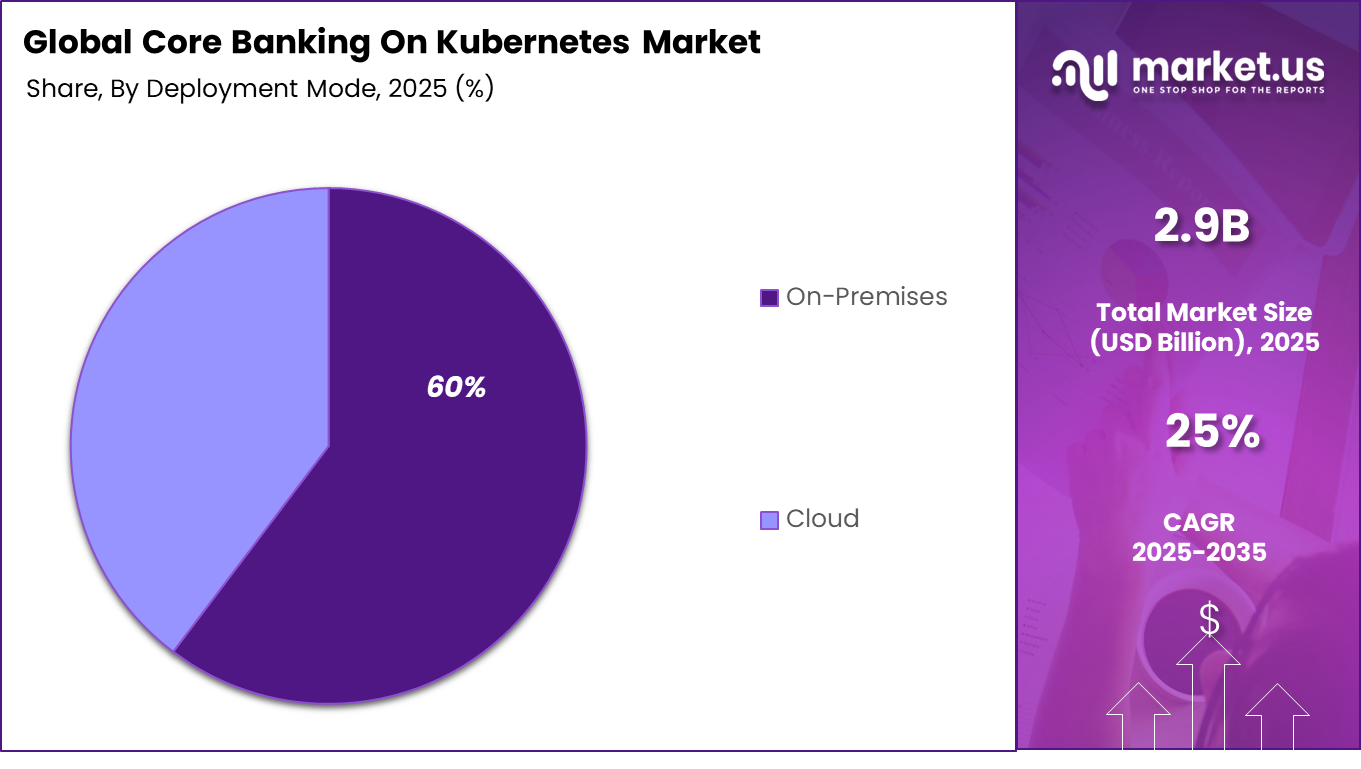
Deployment Mode On-premises holds 60.3% of the market, because many financial institutions still prefer to deploy Kubernetes clusters within their own data centers for tighter control, security, and regulatory compliance.
Organization Size Large enterprises make up 68.2%, reflecting that big banks and large financial groups are leading the shift to containerized, cloud-native core banking architectures.
Application Retail banking represents 44.5% of demand, since many Kubernetes-based core systems are first rolled out to support high-volume retail services such as accounts, payments, and loans.
End-User Banks account for 42.9% of the market, as they are the primary users implementing core banking workloads on Kubernetes to improve scalability and resilience.
Region North America represents 34.3% of the global market, driven by early adoption of cloud-native technologies and strong digital transformation initiatives in the banking sector.
Country The US market is valued at USD 0.85 billion and is expected to grow at a CAGR of 22.1%, as more banks migrate legacy cores to Kubernetes-based architectures to enhance agility and reduce time-to-market for new products.
Core banking on Kubernetes refers to the deployment and management of core banking applications through containerized environments using Kubernetes orchestration technology. This approach allows banks to run critical banking functions such as account management, payments, lending, and transaction processing in a more flexible and scalable infrastructure.
Traditional banking systems are often tied to rigid architectures, while Kubernetes based environments support faster deployment, easier updates, and better resource management. As financial institutions modernize their digital infrastructure, Kubernetes is becoming an important foundation for next generation banking operations.
One of the main driving factors is the growing need for agility and scalability in banking technology environments. Banks are under pressure to launch digital services faster while maintaining high system availability and security. Kubernetes helps institutions manage applications more efficiently by automating deployment, scaling, and recovery processes.
In addition, the shift toward cloud native development is encouraging banks to move away from monolithic systems and adopt microservices based architectures. The increasing demand for continuous service delivery and real time transaction processing is also supporting the adoption of container orchestration technologies in core banking environments.
Demand for core banking on Kubernetes solutions is rising as financial institutions seek modern infrastructure that can support digital transformation goals. There is a strong preference for platforms that provide operational flexibility, automated scaling, and seamless integration with cloud and hybrid environments.
Banks are also looking for solutions that improve resilience, reduce downtime, and simplify application updates without disrupting customer services. The demand is particularly strong among institutions modernizing legacy systems and expanding digital banking capabilities. As banking operations become more software driven and service oriented, the need for scalable and efficient Kubernetes based core banking environments is expected to grow steadily.
By Component Analysis
The software segment accounted for 73.7% of the market share, reflecting its central role in enabling containerized banking operations and modern financial infrastructure management. This dominance is supported by the growing demand for scalable platforms that support microservices architecture, workload orchestration, and automated deployment. Banks are increasingly adopting software solutions to improve flexibility, operational efficiency, and service delivery.
Another factor driving this segment is the need for continuous application updates and faster digital transformation within banking environments. Software platforms built on Kubernetes help institutions manage complex workloads more efficiently while improving system resilience and performance. These capabilities continue to strengthen adoption across the banking sector.
By Deployment Mode Analysis
The on-premises segment held 60% share, driven by the need for stronger control over financial data, regulatory compliance, and internal infrastructure. Many financial institutions prefer on-premises deployment to maintain direct oversight of sensitive banking operations and customer information. This approach supports higher levels of security and customization.
In addition, banks often operate legacy systems that require close integration with modern core banking platforms. On-premises deployment allows institutions to manage upgrades and configurations according to internal operational requirements. These advantages continue to support the strong presence of on-premises solutions in the market.
By Organization Size Analysis
The large enterprises segment captured 68.2% of the market, reflecting the extensive adoption of advanced banking infrastructure among major financial institutions. Large enterprises manage complex operations, high transaction volumes, and broad customer bases, creating strong demand for scalable and resilient banking platforms. Kubernetes-based systems help improve workload management and operational continuity.
Moreover, large organizations have the financial and technical capacity to invest in modern infrastructure transformation projects. Their focus on improving agility, reducing downtime, and supporting digital banking services continues to drive strong adoption within this segment.
By Application Analysis
The retail banking segment accounted for 44.5% of the market share, driven by the increasing need to support digital customer services, mobile banking, and real-time transactions. Retail banks are modernizing core systems to improve customer experience, speed up service delivery, and support continuous availability. Kubernetes-based platforms help streamline these operations.
Furthermore, growing customer expectations for seamless and secure digital banking experiences have encouraged investment in modernized core banking infrastructure. Retail banking institutions rely on scalable systems to manage transaction loads efficiently and support future service expansion.
By End-User Analysis
The banks segment held 42.9% share, reflecting their direct role in adopting modern core banking technologies to improve operational performance and customer engagement. Banks are transitioning toward cloud-native and containerized environments to support faster innovation and reduce infrastructure limitations. Kubernetes-based solutions help improve scalability and reliability.
In addition, increasing competition in the financial sector has encouraged banks to modernize legacy systems and accelerate digital transformation strategies. These platforms support efficient resource utilization and faster application deployment, reinforcing their growing importance among banking institutions.
Drivers Impact Analysis
Key Driver
Impact on CAGR Forecast (~%)
Geographic Relevance
Impact Timeline
Additional Insight
Rising adoption of cloud-native banking infrastructure
+5.1%
North America, Europe, Asia Pacific
Medium to long term
Banks modernize core systems
Growing demand for scalable and flexible banking platforms
+4.7%
Global
Medium term
Kubernetes improves scalability
Increasing digital banking and fintech expansion
+4.3%
Global
Medium to long term
Digital services drive modernization
Need for faster deployment and continuous software updates
+3.8%
Developed markets
Medium term
DevOps practices accelerate releases
Rising focus on operational efficiency and cost optimization
+3.4%
Global
Medium to long term
Containerization reduces infrastructure costs
Restraints Impact Analysis
Key Restraint
Impact on CAGR Forecast (~%)
Geographic Relevance
Impact Timeline
Additional Insight
Complexity in migrating legacy banking systems
-3.6%
Global
Medium term
Legacy systems slow transformation
High implementation and integration costs
-3.2%
Emerging markets
Short to medium term
Costs limit adoption among smaller banks
Data security and regulatory compliance concerns
-2.8%
North America, Europe
Medium to long term
Compliance requirements increase challenges
Shortage of Kubernetes and cloud-native expertise
-2.4%
Global
Medium term
Skill gaps affect deployments
Operational risks during platform transition
-2.0%
Global
Long term
Migration issues can disrupt services
Key Challenges
Complex migration from legacy banking systems to Kubernetes environments.
High implementation and infrastructure costs for banks.
Security and data privacy concerns in cloud-native environments.
Strict regulatory and compliance requirements in the banking sector.
Lack of skilled professionals with Kubernetes and banking expertise.
Integration challenges with existing core banking applications.
Risk of downtime during deployment or system upgrades.
Managing large volumes of financial transaction data is difficult.
Dependence on stable cloud and network infrastructure.
Continuous monitoring and maintenance increase operational complexity.
Emerging Trends
The core banking on Kubernetes market is evolving toward more agile and cloud native banking infrastructure that supports faster service delivery and continuous scalability. One of the key emerging trends is the growing adoption of microservices architecture, where banking functions are broken into smaller independent services that can be deployed and updated more efficiently through Kubernetes environments. This is helping financial institutions improve flexibility and reduce system downtime during upgrades.
Another important trend is the rise of containerized core banking applications that allow banks to run workloads consistently across private, public, and hybrid cloud environments. There is also increasing focus on automated orchestration, enabling better resource allocation, workload balancing, and system resilience. In addition, DevOps integration and continuous deployment practices are becoming more common, helping banks accelerate innovation while maintaining operational stability. Enhanced security monitoring and policy management within Kubernetes environments are also gaining importance as financial institutions strengthen digital infrastructure protection.
Growth Factors
The growth of this market is driven by the increasing demand for modern banking platforms that can support real time services and rapid digital transformation. Traditional banking systems often struggle with scalability and flexibility, which is encouraging institutions to adopt Kubernetes based infrastructure for better operational efficiency. The expansion of digital banking, mobile transactions, and open banking ecosystems is also creating demand for highly responsive and scalable core systems.
Another major factor is the need to reduce infrastructure costs and improve system reliability through automated management and efficient resource utilization. Banks are also focusing on faster product deployment and improved customer experience, which supports the move toward cloud native architectures. Furthermore, growing regulatory expectations around operational resilience and service continuity are encouraging financial institutions to modernize legacy environments with Kubernetes based core banking solutions.
Key Market Segments
By Component
Software
Services
By Deployment Mode
On-Premises
Cloud
By Organization Size
Large Enterprises
Small and Medium Enterprises
By Application
Retail Banking
Corporate Banking
Investment Banking
Others
By End-User
Banks
Credit Unions
Financial Institutions
Others
Regional Analysis
North America accounted for 34.3% of the Core Banking On Kubernetes market, supported by rapid digital transformation across the banking sector and increasing adoption of cloud-native infrastructure. Financial institutions in the region are modernizing legacy banking systems to improve scalability, operational flexibility, and service delivery.
Kubernetes-based core banking platforms are gaining attention because they support faster deployment, efficient workload management, and improved resilience across hybrid and multi-cloud environments. In addition, growing demand for real-time banking services and continuous application updates is strengthening market growth across the region.
The U.S. market reached USD 0.85 Billion and is projected to grow at a CAGR of 22.1%, driven by rising investments in cloud-native banking technologies and digital financial services. Banks are adopting Kubernetes-based architectures to accelerate innovation, reduce infrastructure complexity, and support secure application modernization.
The increasing shift toward open banking, digital payments, and API-driven services is also contributing to strong market demand. In addition, financial institutions are focusing on improving system reliability and operational efficiency, which is expected to support robust growth of the market in the US over the coming years.
Key Regions and Countries
North America
US
Canada
Europe
Germany
France
The UK
Spain
Italy
Russia
Netherlands
Rest of Europe
Asia Pacific
China
Japan
South Korea
India
Australia
Singapore
Thailand
Vietnam
Rest of APAC
Latin America
Brazil
Mexico
Rest of Latin America
Middle East & Africa
South Africa
Saudi Arabia
UAE
Rest of MEA
Competitive Analysis
The competitive landscape of the Core Banking On Kubernetes Market is driven by established core banking providers and cloud-native banking platform companies. Companies such as Temenos, Finastra, Infosys Finacle, Tata Consultancy Services (TCS) BaNCS, Oracle Financial Services Software, FIS (Fidelity National Information Services), and SAP focus on modernizing banking infrastructure through containerized and cloud-based deployments.
These players provide scalable and flexible core banking solutions that support faster application deployment, improved operational efficiency, and easier integration with digital banking services. Their strong relationships with financial institutions and deep banking expertise help them maintain a leading position in the market.
At the same time, companies such as nCino, Thought Machine, Mambu, Backbase, Intellect Design Arena, Jack Henry & Associates, Avaloq, Silverlake Axis, Sopra Banking Software, EdgeVerve Systems, Technisys, Crealogix, and Five Degrees compete by offering cloud-native and API-driven banking platforms built for Kubernetes environments.
These players focus on microservices architecture, automation, and rapid product innovation to help banks improve agility and customer experience. Competition in this market is driven by scalability, cloud integration, security, and the ability to support real-time digital banking operations efficiently.
The future outlook for the Core Banking on Kubernetes Market looks very strong as banks continue to modernize their IT infrastructure and move toward cloud-native systems. The market is expected to grow with increasing demand for scalable, flexible, and faster banking operations that can support digital services and real-time transactions. Financial institutions are anticipated to adopt Kubernetes-based platforms to improve system reliability, reduce operational complexity, and speed up application deployment. In the coming years, integration with AI, automation, and hybrid cloud environments is expected to enhance efficiency and security, making Kubernetes an important technology for the future of core banking systems.
Recent Developments
January 2026, Temenos – Temenos continues to push its cloud‑native core banking platform on Kubernetes so banks can scale faster and update core systems more easily. It highlights Kubernetes as the standard way to run Temenos Transact in the cloud. Banks use this to reduce downtime during upgrades and launch new products quicker.
2025–2026, Finastra – Finastra expands support for running its core and lending software as containerized workloads so banks can use Kubernetes in hybrid and multi‑cloud setups. This gives banks more control over where data and services run. It also speeds up testing and release cycles for new features.
Report Scope
Report Features
Description
Market Value (2025)
USD 2.9 Billion
Forecast Revenue (2035)
USD 26.9 Billion
CAGR(2025-2035)
25%
Base Year for Estimation
2024
Historic Period
2020-2024
Forecast Period
2026-2035
Report Coverage
Revenue forecast, AI impact on Market trends, Share Insights, Company ranking, competitive landscape, Recent Developments, Market Dynamics and Emerging Trends
Segments Covered
By Component (Software, Services (Managed Services, Professional Services)), By Deployment Mode (On-Premises, Cloud), By Organization Size (Large Enterprises, Small and Medium Enterprises), By Application (Retail Banking, Corporate Banking, Investment Banking, Others), By End-User (Banks, Credit Unions, Financial Institutions, Others)
Regional Analysis
North America – US, Canada; Europe – Germany, France, The UK, Spain, Italy, Russia, Netherlands, Rest of Europe; Asia Pacific – China, Japan, South Korea, India, New Zealand, Singapore, Thailand, Vietnam, Rest of Latin America; Latin America – Brazil, Mexico, Rest of Latin America; Middle East & Africa – South Africa, Saudi Arabia, UAE, Rest of MEA
Competitive Landscape
Temenos, Finastra, Infosys Finacle, Tata Consultancy Services (TCS) BaNCS, Oracle Financial Services Software, FIS (Fidelity National Information Services), SAP, nCino, Thought Machine, Mambu, Backbase, Intellect Design Arena, Jack Henry & Associates, Avaloq, Silverlake Axis, Sopra Banking Software, EdgeVerve Systems, Technisys, Crealogix, Five Degrees, Others
Customization Scope
Customization for segments, region/country-level will be provided. Moreover, additional customization can be done based on the requirements.
Purchase Options
We have three license to opt for: Single User License, Multi-User License (Up to 5 Users), Corporate Use License (Unlimited User and Printable PDF)