


Market Overview
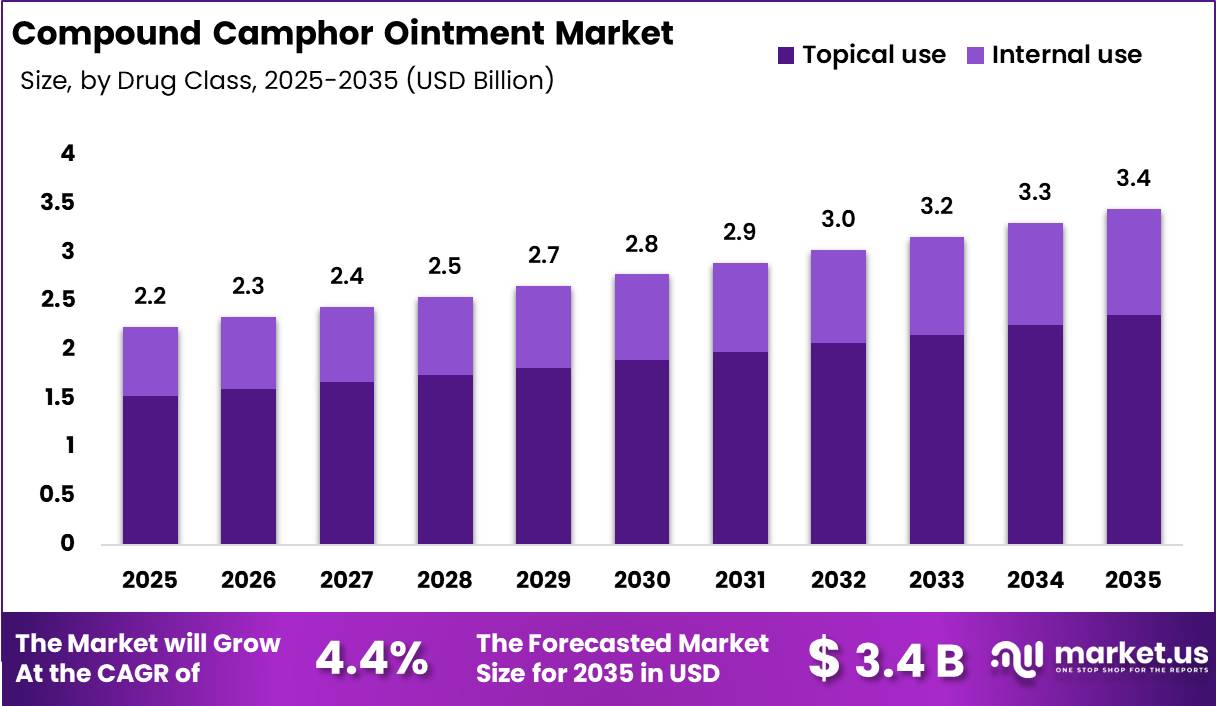
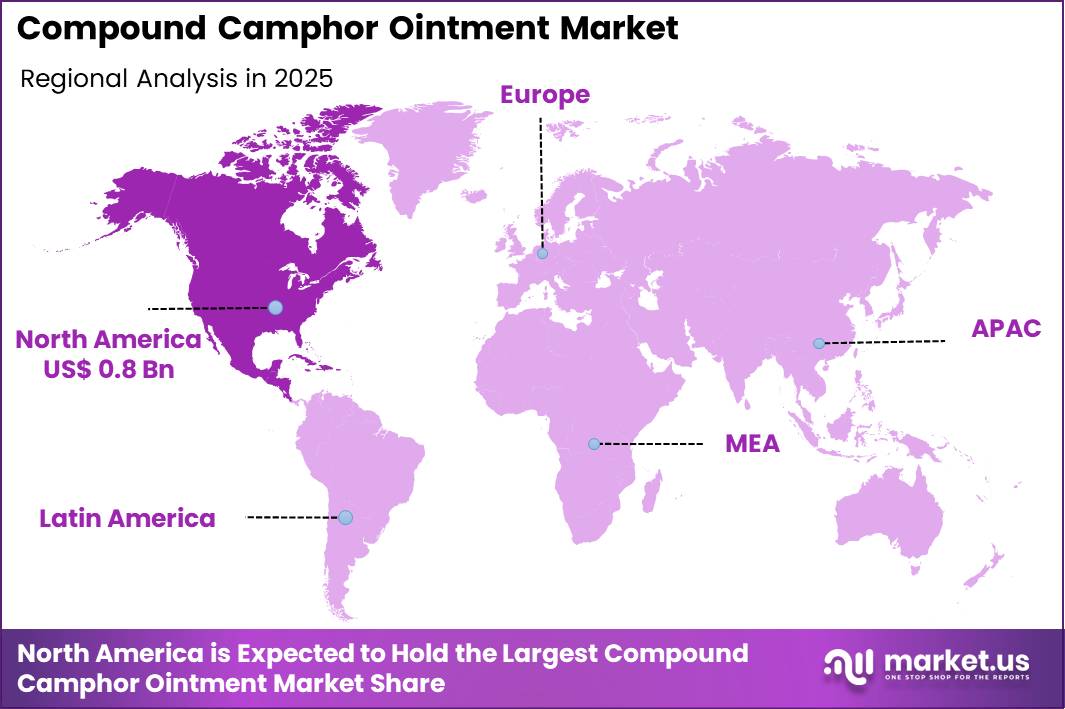
Global Compound Camphor Ointment Market size is expected to be worth around US$ 3.4 Billion by 2035 from US$ 2.2 Billion in 2025, growing at a CAGR of 4.4% during the forecast period from 2026 to 2035. In 2025, North America led the market, achieving over 35.9% share with a revenue of US$ 0.8 Billion.
Compound camphor ointment is a widely used over-the-counter (OTC) topical formulation designed to provide temporary relief from minor muscle and joint pain, arthritis, backache, itching, and skin irritation. Camphor produces a warming and cooling sensation by stimulating nerve endings in the skin, making it a common ingredient in topical analgesics and anti-itch preparations.
According to the U.S. National Library of Medicine’s DailyMed database, commercially available camphor ointments contain concentrations ranging from 1.24% to 10% camphor, while adults are generally instructed to apply the product 3 to 4 times daily depending on the formulation.
The product continues to benefit from growing consumer preference for non-prescription pain management solutions, particularly for minor musculoskeletal discomfort and localized skin conditions. The U.S. Food and Drug Administration regulates topical camphor products under OTC monograph requirements, and products marketed in the United States must comply with established safety and labeling standards.
DailyMed labels also emphasize that these ointments are intended for external use only, should not be applied to damaged skin, and require medical attention if symptoms persist for more than 7 days or recur after improvement.
Safety remains a critical consideration for the market. The National Institutes of Health MedlinePlus medical encyclopedia warns that accidental ingestion of camphor can cause serious poisoning, including seizures and respiratory complications, and recommends immediate contact with poison control services in overdose situations.
Healthcare authorities also advise keeping camphor-containing products out of the reach of children. These evidence-based recommendations, combined with widespread OTC availability, continue to support the clinical relevance and consumer demand for compound camphor ointments in self-care and topical pain relief applications.
Key Takeaways
- Market Size: Global Compound Camphor Ointment Market size is expected to be worth around US$ 3.4 Billion by 2035 fromUS$ 2.2 Billionin 2025.
- Market Share: The market is growing at a CAGR of 4.4% during the forecast period from 2026 to 2035.
- Drug Class: The topical use segment dominated the compound camphor ointment market in 2025, accounting for 68.3% of the total market share.
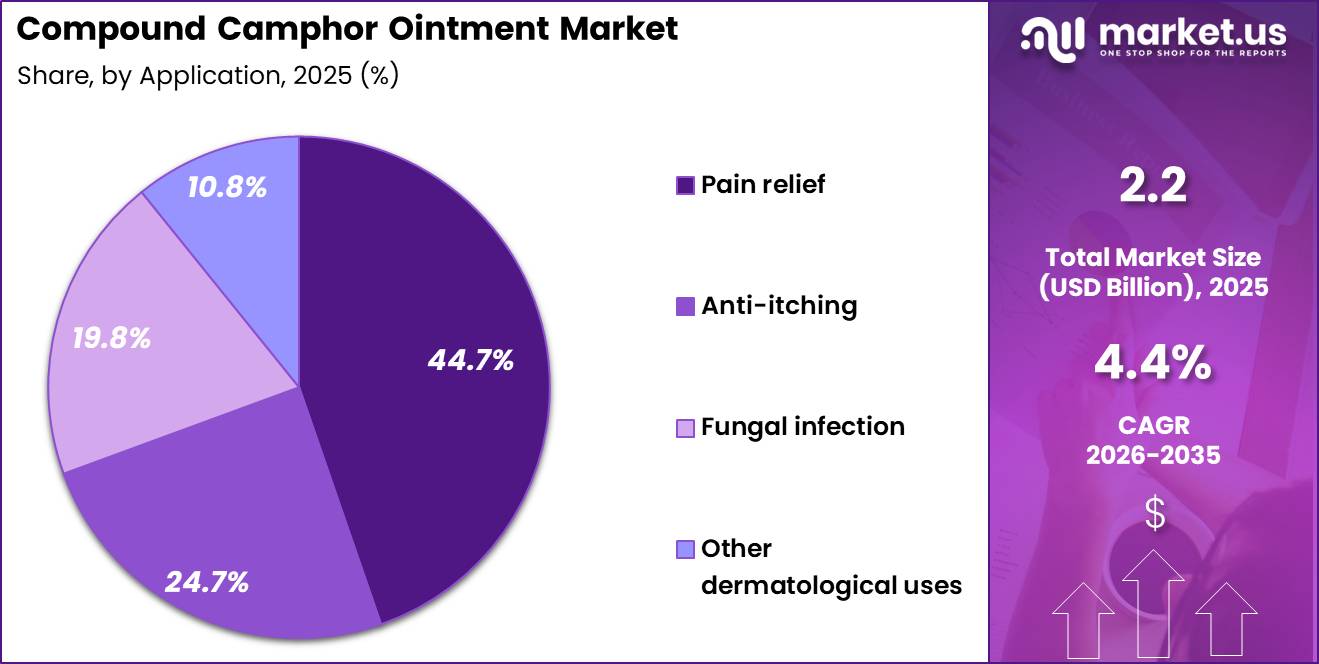
- Application: The pain relief segment held the largest share of the compound camphor ointment market in 2025, accounting for 44.7% of total revenue.
- Distribution Channel: Retail pharmacies and drugstores dominated the compound camphor ointment market in 2025, capturing 55.6% of the total market share.
- Regional Analysis: In 2025, North America led the market, achieving over 35.9% share with a revenue of US$ 0.8 Billion.
Drug Class Analysis
Topical Use Segment Dominates the Compound Camphor Ointment Market.
The topical use segment dominated the compound camphor ointment market in 2025, accounting for 68.3% of the total market share. This leadership is attributed to the widespread use of compound camphor ointments as externally applied formulations for localized relief of pain, itching, inflammation, and minor skin irritations.
Topical application enables direct delivery of active ingredients to the affected area, allowing faster symptom management while minimizing systemic exposure. Healthcare professionals and consumers continue to prefer topical formulations because they are easy to apply, readily available without complex administration, and suitable for self-care in treating common musculoskeletal discomfort and dermatological conditions.
The growing preference for over-the-counter topical analgesics, expanding elderly population experiencing joint and muscle pain, and increasing participation in sports and physical activities have further strengthened demand for externally applied compound camphor products. Manufacturers are also improving formulations with enhanced skin absorption, non-greasy textures, and longer-lasting therapeutic effects, increasing consumer acceptance and repeat purchases.
The internal use segment represented 31.7% of the market in 2025. Although comparatively smaller, this segment serves specialized medicinal applications where camphor-containing formulations are incorporated under regulated pharmaceutical guidance. Strict safety regulations, limited indications, and preference for topical therapies continue to restrain broader adoption, keeping internal use a niche yet clinically relevant category.
Application Analysis
Pain Relief Segment Dominates the Compound Camphor Ointment Market.
The pain relief segment held the largest share of the compound camphor ointment market in 2025, accounting for 44.7% of total revenue. Its dominance is driven by the growing incidence of muscle soreness, joint pain, arthritis, sprains, back pain, and sports-related injuries across all age groups.
Compound camphor ointments produce a warming and soothing sensation that temporarily alleviates pain and stiffness, making them a preferred option for both acute and chronic musculoskeletal conditions.
Increasing consumer preference for non-invasive topical therapies, rising self-medication trends, and broad availability through pharmacies have further accelerated demand. The expanding elderly population and physically active workforce continue to support sustained consumption of pain-relief ointments.
The anti-itching segment accounted for 24.7% of the market, supported by growing use in relieving insect bites, allergic skin reactions, and minor irritations. The fungal infection segment represented 19.8%, benefiting from increasing awareness of topical skin care and complementary treatment approaches.
Meanwhile, other dermatological uses, comprising 10.8%, include applications for minor skin discomfort, irritation management, and supportive dermatological care, contributing additional growth opportunities across consumer healthcare markets.
Distribution Channel Analysis
Retail Pharmacies and Drugstores Dominate the Compound Camphor Ointment Market.
Retail pharmacies and drugstores dominated the compound camphor ointment market in 2025, capturing 55.6% of the total market share. Their leadership is supported by extensive product accessibility, widespread geographic presence, and strong consumer trust in pharmacist-recommended over-the-counter treatments.
Consumers frequently purchase compound camphor ointments from retail pharmacies for immediate management of muscle pain, itching, minor skin irritation, and joint discomfort without requiring a physician’s prescription.
The availability of multiple brands, convenient store locations, and professional guidance on product selection continue to strengthen this channel. Rising demand for self-care products and expanding retail pharmacy networks across urban and rural regions further reinforce market growth.
Hospital and clinic pharmacies remain an important distribution channel, particularly for patients receiving physician-directed treatment or post-procedural care where healthcare professionals recommend specific topical therapies.
Meanwhile, online pharmacies and e-commerce are experiencing rapid growth due to increasing digital healthcare adoption, home delivery convenience, competitive pricing, broader product availability, and the rising popularity of online purchasing for over-the-counter healthcare products. These digital channels are expected to gain market share steadily as consumer confidence in online pharmaceutical retail continues to increase.
Key Market Segments
By Drug Class
- Topical use
- Internal use
By Application
- Pain relief
- Anti‑itching
- Fungal infection
- Other dermatological uses
By Distribution channel
- Retail pharmacies and drugstores
- Hospital and clinic pharmacies
- Online pharmacies / e‑commerce
Drivers
Multi symptom value positioning in camphor menthol topical formats.
Compound camphor ointment benefits from a practical value proposition: one low cost SKU can address several everyday use occasions, including mild muscle pain, itch, and cold season comfort depending on local labeling and formulation.
Public product references show camphor topical ointments commonly used in 3% to 11% strengths, while chest rub style uses cluster around roughly 4.7% to 5.3% camphor in some marketed formats, illustrating how formulation bands can support differentiated positioning without abandoning a familiar active ingredient story.
That versatility improves shelf productivity for retailers and lowers customer acquisition cost for manufacturers because a single product can be merchandised across family care, winter wellness, and topical pain relief missions.
Strategically, this pushes the market away from narrow single indication competition and toward bundled sensory efficacy, cooling, warming, decongestant perception, and soothing texture, which is especially attractive in APAC and Middle East pharmacy retail where household remedies often win through multifunctionality and heritage trust.
| Driver | (~) % Impact on CAGR Forecast | Geographic Relevance | Impact Timeline |
|---|---|---|---|
| OTC pain-relief access under external analgesic rules | +1.4% | North America core, select Commonwealth OTC markets | Short term (≤ 2 years) |
| Self-care adoption for minor pain and congestion episodes | +1.1% | APAC corridors, North America, Western Europe, Latin America urban | Short term (≤ 2 years) |
| Ageing and musculoskeletal burden lifting repeat-use volumes | +1.6% | North America core, EU, Japan, South Korea, China urban, India metro spill-over | Medium term (2-4 years) |
| Multi-symptom value positioning in camphor-menthol topical formats | +0.9% | APAC core, North America, Middle East retail pharmacy channels | Medium term (2-4 years) |
| Pharmacy and e-commerce reach improving last-mile OTC conversion | +0.8% | India, Southeast Asia, U.S., Canada, Gulf markets | Short term (≤ 2 years) |
| Compliance-led formulation and packaging upgrades strengthening formal trade | +0.7% | EU, U.S., Canada, export-oriented Asian manufacturers | Medium term (2-4 years) |
Challenge
Topical Quality Assurance Load.
A third challenge is the unusually heavy quality burden attached to semi solid topical products, because ointment manufacturing must control not just assay and identity but also viscosity, water content, microbial limits, preservative performance, packaging compatibility, crystallization behavior, and release performance, all of which are explicitly emphasized in current topical and transdermal quality frameworks and become harder to stabilize when essential oil based excipients and petrolatum systems are used together.
The friction is amplified by the broader medicine quality environment, with WHO continuing to state that at least 1 in 10 medicines in low and middle income countries are substandard or falsified, raising the inspection, serialization, and batch documentation expectations placed even on relatively mature OTC categories.
Operationally, that means more retained samples, tighter environmental monitoring, additional line clearance checks, longer batch release queues, and reject or rework risks that can plausibly absorb 2% to 4% of annual plant throughput, so long term mitigation requires digital batch records, near line rheology and microbial screening, and tighter vendor qualification for base waxes, oils, tubes, and cartons rather than simply expanding nominal filling capacity.
| Challenge | (~) % CAGR Friction Drag | Geographic Relevance | Mitigation Horizon |
|---|---|---|---|
| Camphor Input Volatility | -0.8% | India sourcing base, APAC extractors, North America importers | Medium term (2-4 years) |
| OTC Compliance Complexity | -0.6% | North America core, EU regulatory hubs, export-oriented Asian formulators | Medium term (2-4 years) |
| Topical Quality Assurance Load | -0.7% | Global GMP plants, LMIC supply chains, contract manufacturers | Medium term (2-4 years) |
| Maritime Chokepoint Delays | -0.9% | EU import corridors, MENA routes, APAC-Europe lanes | Short term (≤ 2 years) |
| Informal Channel Counterfeiting | -0.5% | South Asia, Africa, Latin America, online cross-border trade | Long term (≥ 4 years) |
| Skilled QC Talent Gaps | -0.4% | U.S. plants, India clusters, ASEAN CDMOs, EU batch-release sites | Long term (≥ 4 years) |
Restraints
OTC compliance tightening.
Regulatory tightening is a direct restraint because the broader topical pain relief category is under sharper FDA scrutiny, with the agency in 2024 warning consumers against certain OTC topical pain products and issuing warning letters to six companies, while also reinforcing that products exceeding permitted OTC thresholds can trigger serious safety concerns and enforcement risk.
Even though compound camphor ointments that stay within monograph limits remain marketable, the compliance burden rises materially when firms must recheck actives, claims language, warnings, and digital channel merchandising against monograph conditions such as camphor at over 3% to 11% and menthol at 1.25% to 16%.
For smaller brands this can add 3 to 6 months to relabeling cycles, push regulatory consulting and quality assurance spend up by an estimated 8% to 15%, and trigger SKU rationalization where online sales copy or legacy claims stray beyond permitted external analgesic framing.
The strategic consequence is not merely compliance cost but commercial friction: slower new product launches, higher retailer onboarding scrutiny, and a narrower pool of aggressive digital sellers, producing a modeled 0.9 point deduction to near term CAGR, with the largest effect in North America and cross border e commerce channels.
| Restraint | (~) % Impact on CAGR Forecast | Geographic Relevance | Impact Timeline |
|---|---|---|---|
| API cost volatility | -1.2% | APAC supply base, North America core, EU importers | Short term (≤ 2 years) |
| OTC compliance tightening | -0.9% | North America core, selected LATAM online channels | Short term (≤ 2 years) |
| Cross-border formulation friction | -0.8% | EU, UK, export-oriented APAC corridors | Medium term (2-4 years) |
| Private-label price erosion | -0.7% | North America core, India, Southeast Asia | Medium term (2-4 years) |
| Pharmacy destocking cycles | -0.6% | US, Canada, EU retail pharmacy chains | Short term (≤ 2 years) |
| Efficacy substitution pressure | -1.0% | North America, EU, urban APAC markets | Medium term (2-4 years) |
Opportunity
Self care pharmacy bundles.
This is an opportunity rather than a driver because the category is still largely sold as a single product, symptom specific purchase, while the future upside sits in converting it into a basket building self care platform bundled with decongestant balms, steam inhalation accessories, saline products, analgesics, and sleep support items through pharmacies, e commerce carts, and telepharmacy prompts.
WHO explicitly frames self care interventions as health tools that can be accessed outside formal care systems, which supports a model where compound camphor ointment becomes part of a protocolized “cold night kit” or “pain relief starter pack”; this can increase revenue per transaction by 1.7x to 2.3x, cut customer acquisition cost by 12% to 20% through shared merchandising, and improve repeat purchase rates by 600 to 900 basis points when linked to seasonal refill reminders.
The most attractive upside is in India, Southeast Asia, Latin America, and the Middle East where pharmacy trust remains high and fragmented OTC categories still have underdeveloped basket orchestration, making this a near term commercialization lever with realistic incremental CAGR upside above baseline category growth.
| Opportunity | (~) % Potential CAGR Upside | Geographic Relevance | Execution Window |
|---|---|---|---|
| Senior-care symptom relief SKUs | +1.4% | North America core, EU, Japan, urban China | Medium term (2-4 years) |
| Self-care pharmacy bundles | +1.8% | India, Southeast Asia, Latin America, Middle East | Short term (≤ 2 years) |
| Herbal-premium crossover line | +1.6% | India core, GCC, ASEAN, diaspora markets | Short term (≤ 2 years) |
| Respiratory seasonality expansion | +1.2% | South Asia, Southeast Asia, Africa urban markets | Medium term (2-4 years) |
| Localized export white spaces | +2.1% | Africa, MENA, South Asia frontier, LATAM | Medium term (2-4 years) |
| Roll-up of regional OTC brands | +2.4% | India, ASEAN, Africa, Eastern Europe | Long term (≥ 4 years) |
Regional Analysis
North America Dominated the Compound Camphor Ointment Market.
In 2025, North America accounted for over 35.9% of the global Compound Camphor Ointment Market, generating approximately US$ 0.8 billion in revenue. The region’s leadership is driven by strong consumer demand for over-the-counter topical analgesics, well-established healthcare infrastructure, and widespread awareness of self-care practices for managing minor musculoskeletal pain, itching, and skin irritation.
The United States represents the largest contributor within the region due to its extensive retail pharmacy network, high healthcare expenditure, and broad availability of medicated topical formulations through pharmacies, supermarkets, and e-commerce channels.
Increasing preference for non-invasive pain management solutions, particularly among the aging population and physically active individuals, continues to support product demand. Regulatory oversight ensures high product quality and consumer confidence, encouraging manufacturers to introduce improved formulations and convenient packaging.
Canada also contributes significantly, supported by rising adoption of OTC healthcare products and growing consumer preference for affordable topical remedies. Additionally, expanding digital pharmacy platforms and omnichannel retail distribution have enhanced product accessibility across urban and rural markets.
Continuous innovation in topical formulations, including improved absorption characteristics and skin-friendly ingredients, further strengthens regional growth. Strong brand presence, favorable reimbursement for certain topical therapies, and increasing awareness regarding early management of minor pain and skin discomfort are expected to help North America maintain its leading position throughout the forecast period.
Key Regions and Countries
North America
- The US
- Canada
Europe
- Germany
- France
- The U.K.
- Italy
- Spain
- Russia & CIS
- Rest of Europe
Asia Pacific
- China
- India
- Japan
- South Korea
- ASEAN
- Australia & New Zealand
- Rest of Asia Pacific
Middle East & Africa
- GCC
- South Africa
- Rest of Middle East & Africa
Latin America
- Brazil
- Mexico
- Rest of Latin America
Key Player Analysis
The global Compound Camphor Ointment Market is moderately fragmented, with competition shaped by a mix of established healthcare brands, regional manufacturers, and consumer wellness companies. Market participants compete on product quality, brand trust, pricing, and distribution strength, while innovation is increasingly focused on improving topical effectiveness, skin compatibility, and ease of access across pharmacies, retail stores, and online channels.
Leading players in the market include Cigna, GHC Group, LLC, Thera Wise, Emu Joy, and Amrutanjan Health Care Limited, which represent the competitive direction of the industry through their broad market presence and product positioning.
Competitive strategy in this market is centered on research and development, with companies working to improve formulation stability, absorption performance, and user safety while meeting regulatory expectations. Product innovation remains a key differentiator, with manufacturers introducing skin-friendly ingredients, convenient packaging, and multipurpose ointment formats for pain relief and itch management.
Partnerships with distributors, pharmacies, and retail chains help strengthen market reach and improve supply chain efficiency. Workflow integration through digital inventory systems, omnichannel sales, and e-commerce platforms supports faster product availability and better consumer engagement.
Ecosystem-based competition is also becoming more important, as companies combine product development, distribution, healthcare partnerships, and consumer education to build stronger brand loyalty and sustain long-term growth.
Top Key Players
- Cigna
- GHC Group, LLC
- Thera Wise
- Emu Joy
- DLC Laboratories, Inc.
- Delon Laboratories Ltd.
- Vi‑Jon Laboratories
- Amrutanjan Health Care Limited
- Caribe Natural LLC
- China Resources Sanjiu Medical & Pharmaceutical
- Greenbrier International, Inc.
- World Perfumes, Inc.
- McKesson Canada
- Indiana Botanic Gardens
- Focus Consumer Healthcare LLC
- Others
Recent Developments
- In October 2025, Germa Products updated the FDA-listed labeling for its Germa Camphor Ointment, including revised directions, warnings, storage conditions, and product information under the OTC drug listing
- In December 2025, Tiger Balm updated the FDA DailyMed listing for Tiger Balm Ultra Strength Ointment, maintaining the formulation containing 11% camphor and 11% menthol with revised regulatory labeling.
- In March 2026, CVS Health updated the FDA-listed labeling for its CVS Muscle Balm, a camphor-containing topical analgesic, reflecting revised OTC labeling and product information.
Report Scope
| Report Features | Description |
|---|---|
| Market Value (2025) | US$ 2.2 Billion |
| Forecast Revenue (2035) | US$ 3.4 Billion |
| CAGR (2026-2035) | 4.4% |
| Base Year for Estimation | 2025 |
| Historic Period | 2020-2024 |
| Forecast Period | 2026-2035 |
| Report Coverage | Revenue Forecast, Market Dynamics, Competitive Landscape, Recent Developments |
| Segments Covered | By Drug Class (Topical use, Internal use), By Application (Pain relief, Anti-itching, Fungal infection, Other dermatological uses), By Distribution channel (Retail pharmacies and drugstores, Hospital and clinic pharmacies, Online pharmacies / e-commerce) |
| Regional Analysis | North America – The US, Canada; Europe – Germany, France, U.K., Italy, Spain, Russia & CIS, Rest of Europe; Asia Pacific – China, India, Japan, South Korea, ASEAN, Australia & New Zealand, Rest of Asia Pacific; Middle East & Africa – GCC, South Africa, Rest of Middle East & Africa; Latin America – Brazil, Mexico, Rest of Latin America |
| Competitive Landscape | Cigna, GHC Group, LLC, Thera Wise, Emu Joy, DLC Laboratories, Inc., Delon Laboratories Ltd., Vi‑Jon Laboratories, Amrutanjan Health Care Limited, Caribe Natural LLC, China Resources Sanjiu Medical & Pharmaceutical , Greenbrier International, Inc., World Perfumes, Inc., McKesson Canada, Indiana Botanic Gardens, Focus Consumer Healthcare LLC, Others. |
| Customization Scope | Customization for segments, region/country-level will be provided. Moreover, additional customization can be done based on the requirements. |
| Purchase Options | We have three licenses to opt for: Single User License, Multi-User License (Up to 5 Users), Corporate Use License (Unlimited User and Printable PDF) |





































