


Global CBD Skin Care Market Size, Share, Growth Analysis By Product (Creams, Moisturizer, and Lotions, Facial Oils, Serums, Masks, Cleansers, Others), By Source (Hemp-derived CBD, Marijuana-derived CBD), By Distribution Channel (Online/E-Commerce, Supermarkets/Hypermarkets, Specialty Beauty Stores, Pharmacies/Drugstores, Others), By Region and Companies - Industry Segment Outlook, Market Assessment, Competition Scenario, Statistics, Trends and Forecast 2026-2035
- Published date: March 2026
- Report ID: 182114
- Number of Pages: 391
- Format:
-
keyboard_arrow_up
Quick Navigation
Report Overview
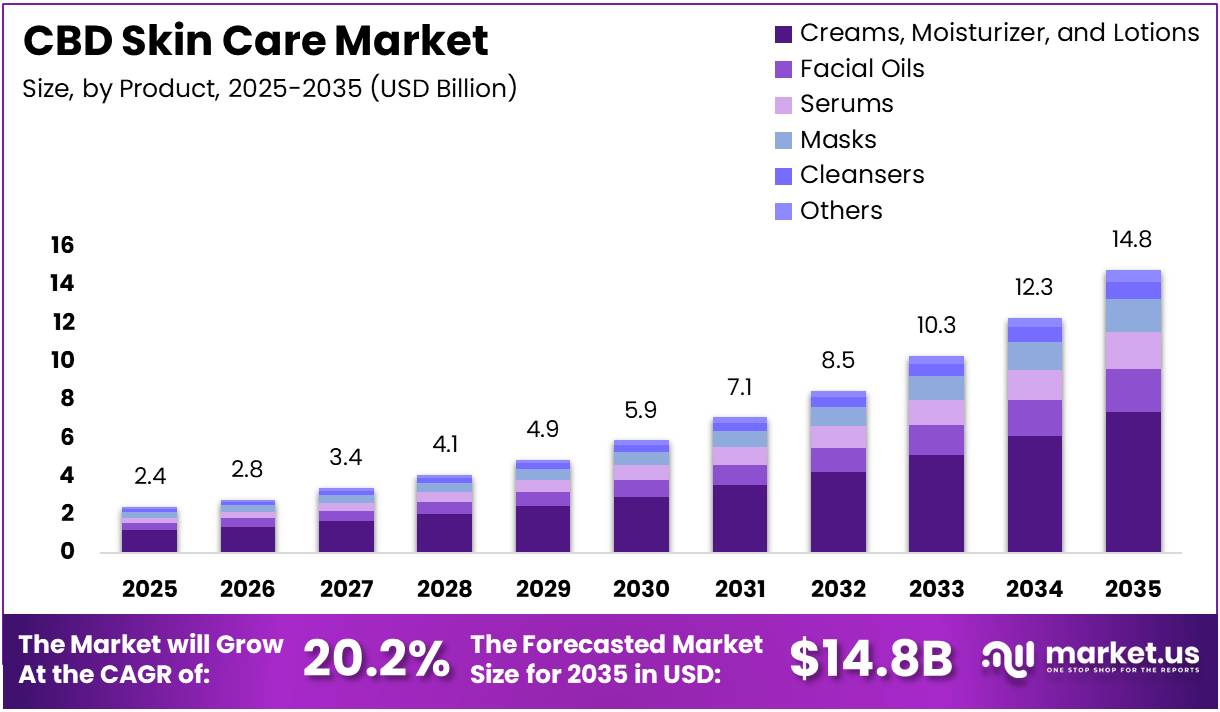
The Global CBD Skin Care Market size is expected to be worth around USD 14.8 Billion by 2035 from USD 2.4 Billion in 2025, growing at a CAGR of 20.2% during the forecast period 2026 to 2035.
The CBD skin care market encompasses cosmetic and dermatological products formulated with cannabidiol, a non-psychoactive compound extracted from the cannabis plant. Product categories include creams, serums, facial oils, masks, and facial cleansers. These formulations are designed to address skin concerns such as inflammation, acne, dryness, and skin sensitivity.
CBD-infused skincare has gained widespread attention due to its anti-inflammatory, antioxidant, and sebum-regulating properties. Consumers are steadily moving away from synthetic ingredient profiles in favor of clean-label and natural alternatives. Consequently, CBD skin care has transitioned from niche wellness positioning into mainstream retail and professional skincare channels.
Market growth is supported by rising consumer awareness of the therapeutic potential of cannabidiol in managing chronic and acute skin conditions. Moreover, the rapid expansion of e-commerce and specialty beauty retail has significantly improved product accessibility. Growing demand for multi-functional skincare solutions further broadens the market’s commercial appeal across demographics.
Regulatory frameworks governing CBD-based cosmetics continue to evolve across North America, Europe, and Asia Pacific. Governments in multiple regions are updating legislation to permit hemp-derived CBD in personal care applications. This regulatory progress is encouraging greater market investment and broadening the scope of product development across international markets.
According to Forbes Health, 60% of U.S. adults have tried CBD products, reflecting widespread consumer familiarity and openness to cannabidiol-based skincare. This level of mainstream adoption highlights CBD’s strong consumer acceptance and supports continued brand investment in skincare products portfolios.
According to a study published in MDPI Cosmetics, satisfaction rates of 75–86% were recorded across adults and children for soothing, hydration, itch relief, and skin repair after 56 days of CBD cream use. Additionally, according to 23state.com, topical CBD reduces acne lesions by 30% over 12 weeks by controlling sebum production and inflammatory activity.
Key Takeaways
- The global CBD Skin Care Market is valued at USD 2.4 Billion in 2025 and is projected to reach USD 14.8 Billion by 2035.
- The market is expanding at a CAGR of 20.2% during the forecast period 2026 to 2035.
- By Product, the Creams, Moisturizer, and Lotions segment leads with a 36.8% market share in 2025.
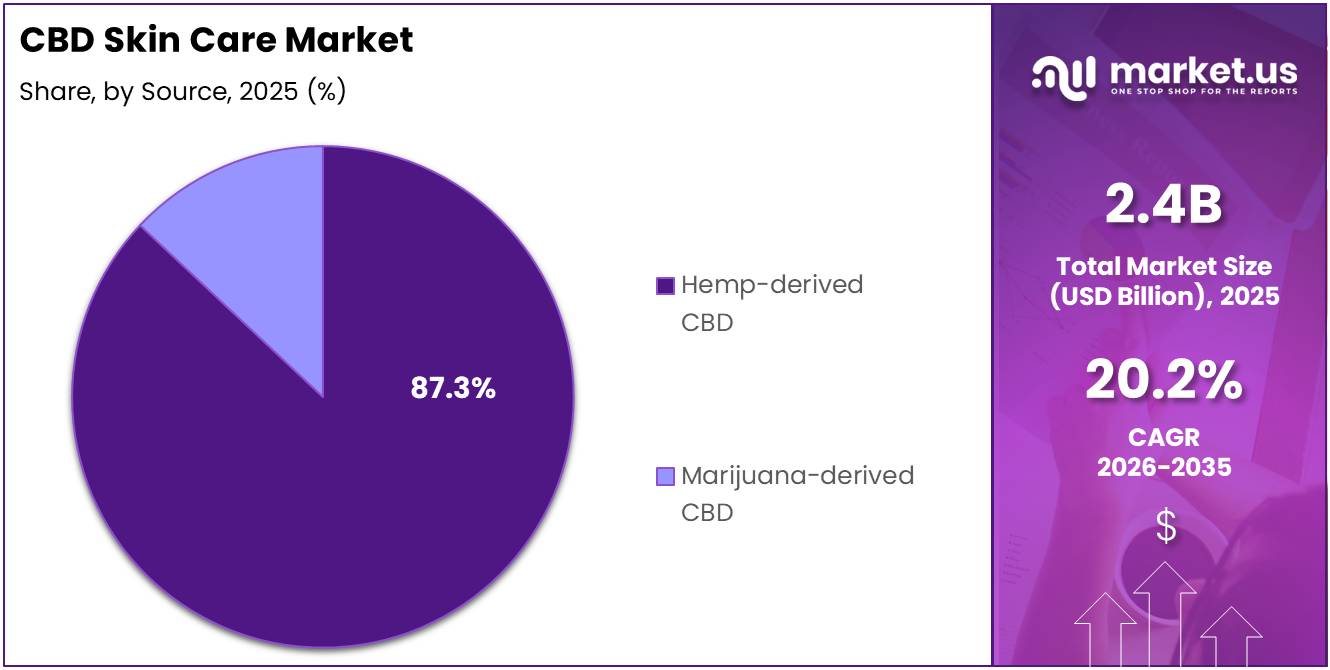
- By Source, Hemp-derived CBD dominates the market with an 87.3% share in 2025.
- By Distribution Channel, Online/E-Commerce holds the largest share at 39.5% in 2025.
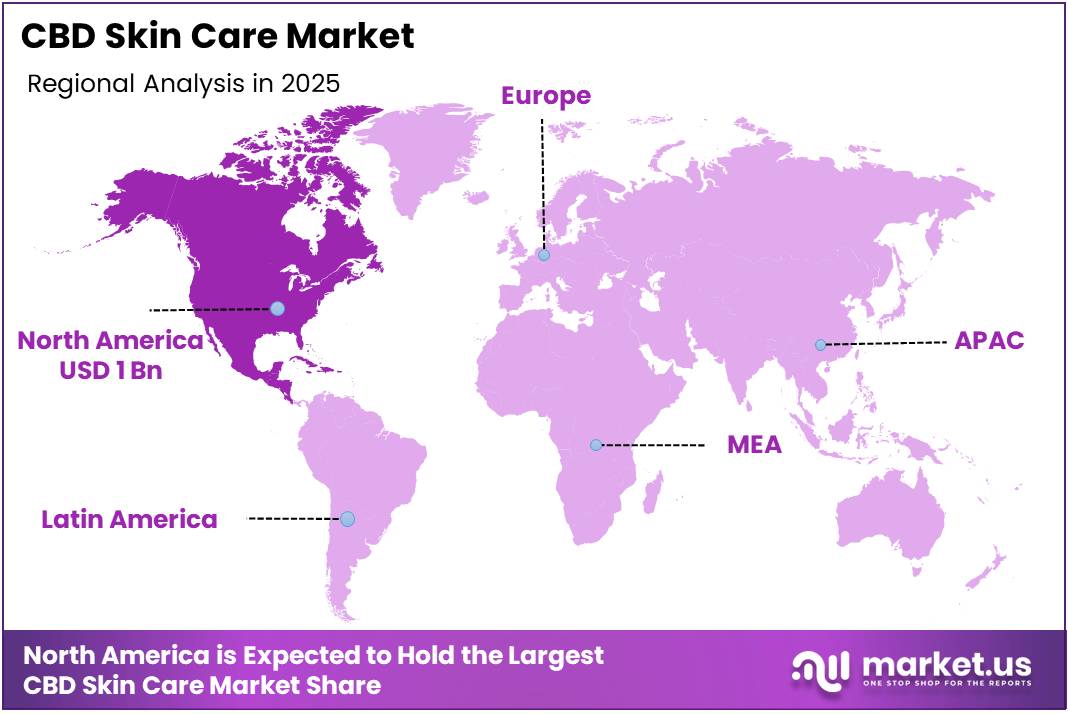
- North America leads the global market with a 45.80% share, valued at USD 1 Billion in 2025.
By Product Analysis
Creams, Moisturizer, and Lotions dominate with 36.8% due to widespread consumer adoption and ease of daily skincare application.
In 2025, Creams, Moisturizer, and Lotions held a dominant market position in the By Product segment of the CBD Skin Care Market, with a 36.8% share. These products are widely preferred for daily skincare routines due to their familiar format and moisturizing benefits. Moreover, their anti-inflammatory properties make them suitable for a broad range of skin types and consumer age groups.
Facial Oils represent a fast-growing sub-segment driven by demand for concentrated, nutrient-rich CBD formulations. They are particularly favored among consumers with dry or mature skin types. Additionally, their alignment with premium and luxury skincare positioning has expanded their presence across specialty beauty and high-end retail channels.
Serums are gaining significant traction as high-potency CBD delivery formats targeting fine lines, hyperpigmentation, and skin sensitivity. Their lightweight texture and rapid absorption appeal to younger, ingredient-conscious consumers. Consequently, serums are being increasingly incorporated into both mass-market skincare lines and dermatologist-recommended product portfolios.
Masks are emerging as a popular CBD product format offering intensive treatment for redness, congestion, and dullness. They are commonly used as part of weekly skincare treatment rituals. Furthermore, the introduction of CBD-infused sheet masks and wash-off formulas has expanded this sub-segment’s addressable consumer base considerably.
Cleansers with CBD are gaining interest for their ability to gently remove impurities while delivering soothing and anti-inflammatory benefits. This sub-segment is particularly appealing to individuals with sensitive or acne-prone skin. Additionally, the broader clean beauty movement has accelerated the development and commercialization of CBD-infused cleansing formulations.
The Others sub-segment covers toners, eye creams, spot treatments, and lip care products containing CBD. These formats address niche skincare needs and are increasingly available through online and specialty retail platforms. Moreover, ongoing innovation in product formats within this category continues to attract consumer attention and brand investment.
By Source Analysis
Hemp-derived CBD dominates with 87.3% due to its broad legal accessibility and commercial availability across global markets.
In 2025, Hemp-derived CBD held a dominant market position in the By Source segment of the CBD Skin Care Market, with an 87.3% share. Hemp-derived CBD is legally accessible in most markets due to its low THC content and favorable regulatory status. Consequently, it has become the preferred and commercially viable source for mainstream skincare and cosmetic manufacturers globally.
Marijuana-derived CBD accounts for a smaller market share due to stricter regulatory restrictions across the majority of global markets. However, in jurisdictions where medical cannabis is legally authorized, this source is used in specialized therapeutic and dermatological skincare formulations. Its broader commercial adoption remains constrained relative to hemp-derived alternatives.
By Distribution Channel Analysis
Online/E-Commerce dominates with 39.5% due to growing consumer preference for convenient, direct-to-consumer CBD skincare purchasing.
In 2025, Online/E-Commerce held a dominant market position in the By Distribution Channel segment of the CBD Skin Care Market, with a 39.5% share. Digital platforms allow brands to reach consumers directly while navigating traditional retail restrictions on CBD product listings. Moreover, online channels effectively support subscription models and precisely targeted marketing for CBD skincare brands.
Supermarkets/Hypermarkets represent a growing distribution channel for mainstream CBD skincare products targeting everyday consumers. Their broad geographic footprint and high foot traffic provide effective mass-market brand visibility. Additionally, large-format retailers are increasingly expanding their beauty and personal care sections to accommodate CBD-based skincare product ranges.
Specialty Beauty Stores cater to premium and ingredient-conscious consumers seeking curated CBD skincare selections with expert support. These outlets offer a personalized shopping environment and informed product guidance. Consequently, they serve as a preferred channel for niche and high-end CBD skincare brands targeting well-informed and discerning consumers.
Pharmacies/Drugstores serve as a credible distribution channel for CBD skincare products with clinical and therapeutic positioning. Consumers tend to trust pharmacy-endorsed formulations for addressing specific skin conditions. Furthermore, the growing presence of dermatologist-recommended CBD products within this channel strengthens overall market credibility and consumer confidence.
Others channel includes direct sales, salons, spas, and wellness centers offering CBD skincare products as part of professional treatment services. These venues frequently serve as discovery environments for first-time consumers. Additionally, partnerships between CBD skincare brands and wellness service providers are steadily expanding product visibility across alternative retail settings.
Key Market Segments
By Product
- Creams, Moisturizer, and Lotions
- Facial Oils
- Serums
- Masks
- Cleansers
- Others
By Source
- Hemp-derived CBD
- Marijuana-derived CBD
By Distribution Channel
- Online/E-Commerce
- Supermarkets/Hypermarkets
- Specialty Beauty Stores
- Pharmacies/Drugstores
- Others
Drivers
Rising Demand for Natural, Therapeutic, and Multi-Functional Skincare Ingredients Drives CBD Skin Care Market Growth
Consumer preference for natural, plant-based, and clean-label skincare ingredients is a primary growth driver for the CBD skin care market. Shoppers are actively shifting away from synthetic formulations and toward botanical alternatives. Consequently, brands that emphasize the natural origin and purity of their CBD ingredients are gaining stronger consumer trust and commercial traction.
Increasing awareness of CBD’s anti-inflammatory and soothing properties is encouraging broader use in dermatological applications. Consumers managing conditions such as eczema, rosacea, and acne are actively seeking topical solutions with calming and healing effects. Moreover, healthcare professionals are beginning to recommend CBD-based formulations as complementary options for sensitive and reactive skin care.
Growing demand for multi-functional skincare products that combine beauty outcomes with therapeutic benefits is further accelerating market growth. Consumers now expect a single product to simultaneously moisturize, protect, and address skin conditions. Therefore, CBD’s versatility as a functional cosmetic ingredient makes it highly attractive for formulation innovation across multiple product categories.
Restraints
Regulatory Uncertainty and Consumer Safety Concerns Restrain Global CBD Skin Care Market Expansion
Regulatory uncertainty remains one of the most significant barriers to growth in the global CBD skin care market. The lack of standardized guidelines for CBD concentration limits, labeling requirements, and permissible product claims varies considerably across regions. Consequently, manufacturers face complex compliance challenges that increase operational costs and delay new product launches.
The absence of a unified global regulatory framework limits market entry for smaller brands and creates quality inconsistencies across markets. Varying legal classifications of CBD in different countries also create barriers to international product distribution. These regulatory gaps continue to slow capital investment and broader market development in several important regional markets.
Consumer concerns regarding product safety, quality consistency, and mislabeling further restrain market expansion. Reports of inaccurate CBD concentration levels on product labels have eroded trust among cautious buyers. Furthermore, the absence of mandatory third-party testing requirements in many markets makes it difficult for consumers to independently verify product quality and label claims.
Growth Factors
Premiumization, Anti-Aging Integration, and Product Format Innovation Create Strong Growth Opportunities in CBD Skin Care
Expansion into premium and dermatologist-recommended skincare segments presents a substantial growth opportunity for CBD skin care brands. Consumers in high-income markets are increasingly willing to invest in clinically validated, science-backed formulations. Moreover, strategic partnerships with dermatologists and skin care professionals strengthen brand authority and drive adoption among quality-focused and health-conscious consumers.
Increasing integration of CBD into anti-aging and sensitive skin formulations is opening new product development pathways. CBD’s antioxidant and skin-barrier strengthening properties make it highly compatible with age-management skincare lines. Consequently, brands targeting mature consumer segments are incorporating CBD as a key active ingredient to meaningfully differentiate their premium product offerings.
The development of innovative product formats including serums, masks, and transdermal delivery solutions is broadening the market’s overall growth potential. These formats appeal to consumers seeking targeted and highly efficient skincare solutions. Additionally, continued advances in formulation technology are enabling more stable and bioavailable CBD delivery systems within topical skincare applications.
Emerging Trends
Sustainability, Transparency, and Hybrid Formulations Emerge as Defining Trends in the CBD Skin Care Market
A strong surge in demand for vegan, cruelty-free cosmetics, and sustainably sourced CBD skincare products is reshaping brand strategies across the market. Environmentally conscious consumers are prioritizing products aligned with ethical sourcing and responsible production practices. Consequently, brands that communicate clear sustainability credentials are experiencing stronger consumer loyalty and competitive differentiation in retail markets.
Increased consumer focus on transparency, third-party testing, and ingredient traceability is becoming a critical industry trend. Buyers are actively demanding verifiable evidence of CBD potency and product purity through published certificates of analysis. Furthermore, brands investing in clear and open communication about ingredient sourcing and testing protocols are building significantly stronger trust with informed buyers.
The emergence of hybrid beauty products combining CBD with high-performance actives such as retinol, hyaluronic acid, and niacinamide represents a notable innovation trend. These multi-active formulations more effectively address complex skin concerns than single-ingredient alternatives. Additionally, pairing CBD with clinically recognized actives has strong appeal among results-driven and science-aware consumer segments globally.
Regional Analysis
North America Dominates the CBD Skin Care Market with a Market Share of 45.80%, Valued at USD 1 Billion
North America leads the global CBD skin care market, holding a dominant share of 45.80% and valued at USD 1 Billion in 2025. The region benefits from high consumer awareness of CBD’s skincare benefits, a well-established regulatory environment for hemp-derived products, and strong multi-channel retail infrastructure. Moreover, rising demand for natural and therapeutically active skincare solutions continues to reinforce regional market leadership.
Europe CBD Skin Care Market Trends
Europe represents a significant and growing market for CBD skin care products, supported by increasing consumer preference for natural and organic beauty formulations. Countries including the United Kingdom, Germany, and France are leading adoption within the region. However, varying national regulations on permissible CBD concentrations in cosmetics continue to present challenges for seamless cross-border product distribution.
Asia Pacific CBD Skin Care Market Trends
Asia Pacific is an emerging high-potential region for the CBD skin care market, supported by rising disposable incomes and expanding beauty consciousness among younger consumers. Growing e-commerce penetration is further accelerating product access across the region. Additionally, increasing regulatory clarity in markets such as Australia and Japan is enabling the broader commercial introduction of CBD-based cosmetic products.
Latin America CBD Skin Care Market Trends
Latin America presents moderate growth prospects for CBD skin care, supported by rising consumer awareness and expanding online retail channels. Brazil and Mexico are the primary contributors to regional market activity. Furthermore, the progressive development of cannabis-related legislation across several Latin American countries is expected to gradually support future market growth and brand investment.
Middle East and Africa CBD Skin Care Market Trends
The Middle East and Africa region currently represents a smaller portion of the global CBD skin care market. Limited regulatory clarity and lower consumer awareness remain the primary barriers to wider adoption. However, growing demand for premium beauty products in Gulf Cooperation Council countries is expected to gradually support market development over the forecast period.
Key Regions and Countries
North America
- US
- Canada
Europe
- Germany
- France
- The UK
- Spain
- Italy
- Rest of Europe
Asia Pacific
- China
- Japan
- South Korea
- India
- Australia
- Rest of APAC
Latin America
- Brazil
- Mexico
- Rest of Latin America
Middle East & Africa
- GCC
- South Africa
- Rest of MEA
Key Company Insights
L’Oréal (Kiehl’s) is one of the most prominent players in the global CBD skin care market, leveraging decades of beauty industry expertise and established brand equity to develop dermatologist-tested CBD formulations. The Kiehl’s brand commands strong presence across luxury and specialty retail channels worldwide. Moreover, continued investment in clinical skincare research supports product efficacy claims and builds lasting consumer confidence.
707 Flora, LLC is a dedicated hemp-derived CBD skincare company focused on delivering clean, sustainably sourced beauty and wellness formulations. The brand has built a loyal consumer following by prioritizing ingredient transparency and targeted skincare solutions. Additionally, its product range is designed to address specific concerns including inflammation, sensitivity, acne, and moisture loss across a variety of skin types.
CBD For Life is a recognized specialty CBD beauty brand offering a broad product portfolio that includes topical rubs, serums, eye serums, facial cleansers, and bath products. The brand differentiates itself through transparent labeling practices and mandatory third-party testing of all formulations. Furthermore, its strong e-commerce presence supports effective direct-to-consumer outreach among informed and ingredient-conscious buyer segments.
Charlotte’s Web, Inc. is a leading vertically integrated hemp company that has expanded its expertise into the premium CBD skincare category. The brand is recognized for high-quality hemp extracts, rigorous production standards, and strong commitment to transparency in sourcing. Consequently, its skincare line continues to grow distribution through both digital platforms and physical retail channels across key markets.
Key Players
- L’Oréal (Kiehl’s)
- 707 Flora, LLC
- CBD For Life
- Charlotte’s Web, Inc.
- Elixinol
- Sweet Earth LLC
- The CBD Skincare Co
- Cannabliss Organic LLC
- Herbivore Botanicals
Recent Developments
- March 2026 – NourishUs Naturals, a naturally derived skin and hair care manufacturer, announced the launch of its CBD Ready Collection, a suite of cosmetic bases tested to maintain stability, texture, and preservation when formulated with hemp-derived CBD ingredients. This launch reflects growing industry investment in professionally formulated CBD-compatible cosmetic bases for the skincare sector.
- February 2025 – Prima, a well-regarded CBD wellness and skincare brand, was acquired by a leading hemp house of brands. This acquisition consolidates hemp-focused skincare portfolios under a single ownership structure, strengthening the acquirer’s position across the premium CBD beauty and wellness market segment.
- September 2025 – Karo Healthcare completed the acquisition of a science-backed skincare company to strengthen its presence in Northern Europe. This strategic move expands Karo Healthcare’s dermatological product portfolio and enhances its footprint in key European skincare markets with growing demand for clinically supported formulations.
Report Scope
Report Features Description Market Value (2025) USD 2.4 Billion Forecast Revenue (2035) USD 14.8 Billion CAGR (2026-2035) 20.2% Base Year for Estimation 2025 Historic Period 2020-2024 Forecast Period 2026-2035 Report Coverage Revenue Forecast, Market Dynamics, Competitive Landscape, Recent Developments Segments Covered By Product (Creams, Moisturizer, and Lotions, Facial Oils, Serums, Masks, Cleansers, Others), By Source (Hemp-derived CBD, Marijuana-derived CBD), By Distribution Channel (Online/E-Commerce, Supermarkets/Hypermarkets, Specialty Beauty Stores, Pharmacies/Drugstores, Others) Regional Analysis North America (US and Canada), Europe (Germany, France, The UK, Spain, Italy, and Rest of Europe), Asia Pacific (China, Japan, South Korea, India, Australia, and Rest of APAC), Latin America (Brazil, Mexico, and Rest of Latin America), Middle East & Africa (GCC, South Africa, and Rest of MEA) Competitive Landscape L’Oréal (Kiehl’s), 707 Flora LLC, CBD For Life, Charlotte’s Web Inc., Elixinol, Sweet Earth LLC, The CBD Skincare Co, Cannabliss Organic LLC, Herbivore Botanicals Customization Scope Customization for segments, region/country-level will be provided. Moreover, additional customization can be done based on the requirements. Purchase Options We have three licenses to opt for: Single User License, Multi-User License (Up to 5 Users), Corporate Use License (Unlimited User and Printable PDF) 
-
-
- L'Oréal (Kiehl's)
- 707 Flora, LLC
- CBD For Life
- Charlotte's Web, Inc.
- Elixinol
- Sweet Earth LLC
- The CBD Skincare Co
- Cannabliss Organic LLC
- Herbivore Botanicals
Our Clients

- 182114
- March 2026






