


Report Overview
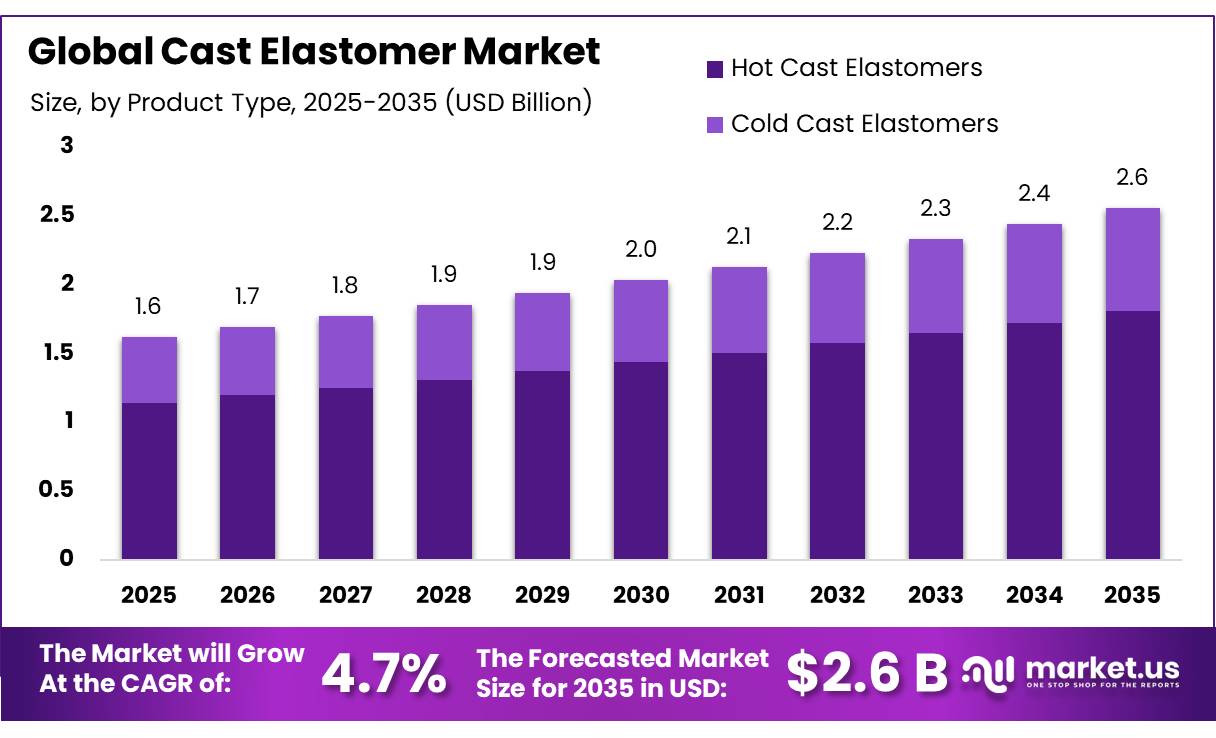
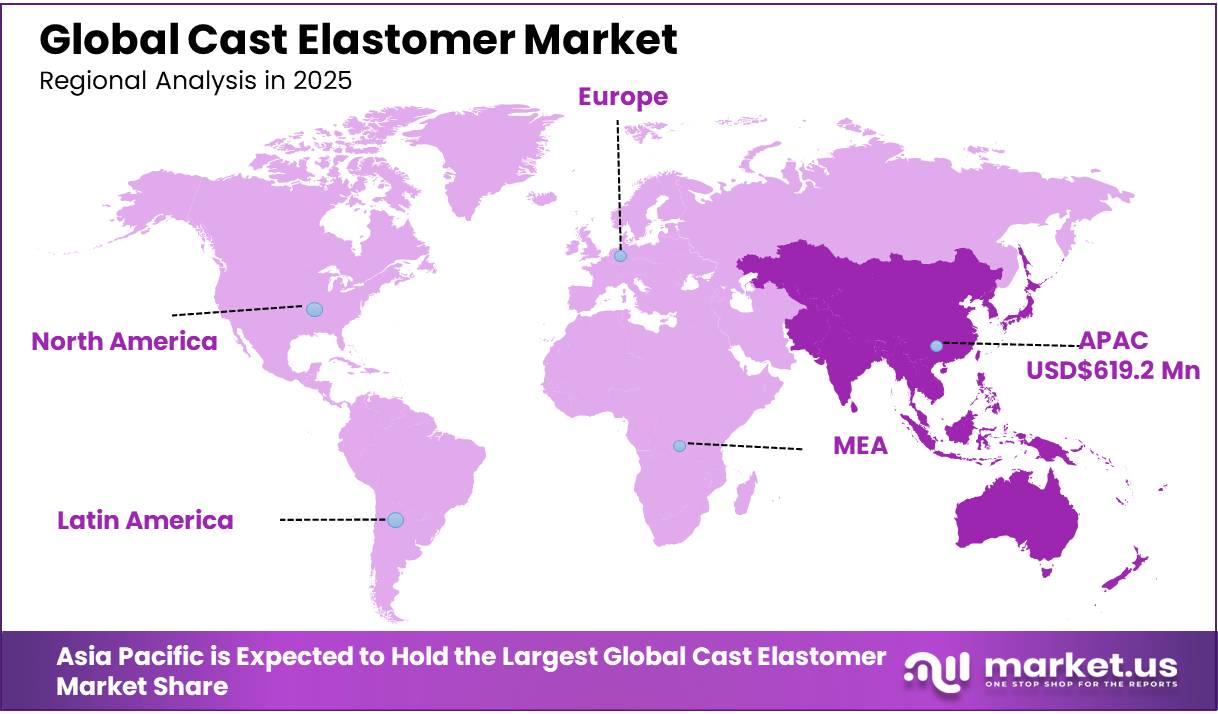
In 2025, the Global Cast Elastomer Market was valued at USD 1.6 billion, and between 2026 and 2035, this market is estimated to register a CAGR of 4.7%, reaching about USD 2.6 billion by 2035. In 2025, Asia Pacific held a dominant market position, capturing more than a 38.7% share, holding USD 619.2 Million revenue.
The Cast Elastomer market is characterized by the growing adoption of high-performance materials across defense, aerospace, and industrial applications. Known for their impact resistance, vibration-dampening capabilities, and chemical and thermal stability, cast elastomers are increasingly used in armored vehicles, aircraft, and industrial machinery components.
- The current industrial scenario is strongly supported by mining, material handling, heavy machinery, and processing equipment. The U.S. Geological Survey reported that U.S. nonfuel mineral production reached USD 112 billion in 2025, increasing 5.6%, while mineral-reliant industries generated approximately USD 4.09 trillion in economic value.
Factory automation provides another major demand driver. The International Federation of Robotics reported in September 2025 that 542,000 industrial robots were installed worldwide, while the global operational stock reached 4.664 million units, increasing 9% year over year. Automated guided vehicles, conveyors, stacker cranes, warehouse systems, and robotic manufacturing equipment depend on durable wheels, rollers, bumpers, and vibration-control components.
Chemical suppliers are also improving processing safety and material performance. Covestro states that its low-unreacted TDI prepolymers contain less than 0.1% free monomer, helping reduce operator exposure while retaining strong resilience and load-bearing properties.
Renewable energy is creating another opportunity. WindEurope reported that Europe installed 19.1 GW of new wind capacity in 2025, including 2 GW of offshore capacity. Another 151 GW is expected to be installed across Europe during 2026–2030. Offshore wind equipment requires durable elastomeric pads, cable-protection systems, rollers, seals, and vibration-management components capable of handling water, oils, impact, and repeated mechanical stress.
Key Takeaways
- The global cast elastomer market was valued at USD 1.6 billion in 2025.
- The global market is projected to grow at a CAGR of 4.7% and is estimated to reach USD 2.6 billion by 2035.
- On the basis of product type, hot cast elastomers dominated the market, constituting 70.6% of the total market share.
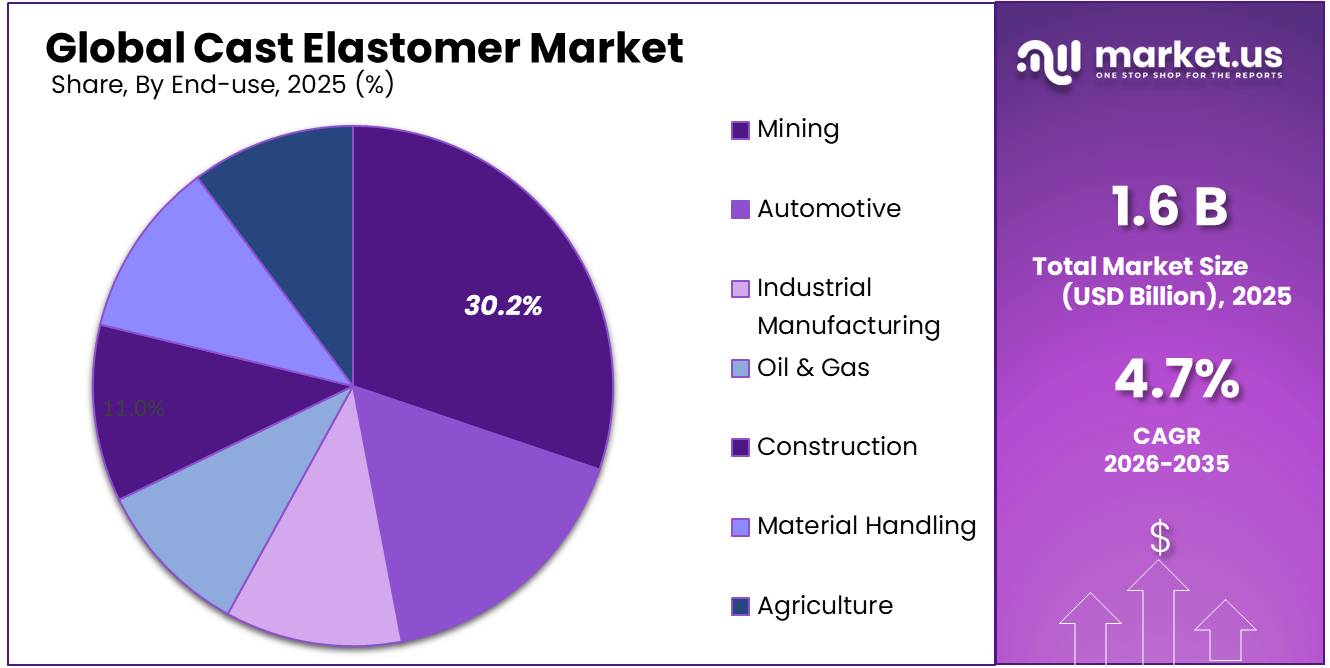
- Among the end users, the mining sector held a major share in the cast elastomer market, 30.2% of the market share.
- In 2025, the Asia Pacific was the most dominant region in the cast elastomer market, accounting for 38.7% of the total global consumption.
Product Type Analysis
Hot Cast Elastomers are a Prominent Segment in the Market.
Hot cast elastomers account for the largest share of the market, representing 70.6% of total demand, reflecting their widespread adoption across defense, aerospace, and industrial applications. These materials are favored for their superior mechanical properties, including high tensile strength, excellent abrasion resistance, and enhanced thermal stability, which make them suitable for components exposed to extreme operational conditions.
The hot casting process allows for precise control over polymerization and curing, resulting in consistent dimensional accuracy and performance reliability. Applications such as armored vehicle liners, aerospace vibration-damping systems, and industrial seals benefit from these characteristics. Additionally, the ability to integrate fiber reinforcements and hybrid composites further enhances impact resistance and multifunctionality, positioning hot cast elastomers as the preferred choice for high-performance and mission-critical applications where durability and operational efficiency are essential.
End User Analysis
Cast Elastomer is Widely Utilized in the Mining Sector.
The mining sector represents the largest end-use segment, accounting for 30.2% of total cast elastomer consumption, driven by the industry’s demand for durable, wear-resistant materials capable of withstanding harsh operational conditions. Cast elastomers are extensively used in mining equipment components such as conveyor belts, liners, screens, and vibration-dampening mounts, where abrasion resistance, impact absorption, and chemical stability are critical.
Their ability to reduce downtime through enhanced service life and minimize maintenance requirements makes them particularly valuable in high-intensity operations. The integration of fiber reinforcements and hybrid formulations further improves mechanical performance, ensuring resilience against extreme loads and continuous wear. The sector’s focus on operational efficiency and safety continues to sustain strong demand for high-performance cast elastomer solutions, positioning mining as a key driver of market adoption.
Key Market Segments
By Product Type
- Hot Cast Elastomers
- Cold Cast Elastomers
By End-Use Industry
- Mining
- Automotive
- Industrial Manufacturing
- Oil & Gas
- Construction
- Material Handling
- Agriculture
- Aerospace
- Marine
- Others
Driver Analysis
Mining Wear-Part Replacement
Mining-sector replacement demand is a high-value driver for cast elastomers because abrasive ore handling, slurry transport, screening, hydrocycloning, flotation, crushing, and conveyor operations consume liners, screen panels, rollers, scraper blades, pump linings, impellers, and chute components continuously rather than only when a new mine is commissioned. Cast polyurethane systems can be formulated across approximately Shore A 70–95 hardness ranges and are used where abrasion, cut resistance, wet-slurry exposure, resilience, and impact resistance exceed the practical performance envelope of standard rubber or unprotected steel; industrial suppliers report that cast-PU wear components can extend abrasive slurry-pump service life by up to 300% in suitable duty cycles.
The unit-economic impact is material: if a polyurethane hydrocyclone lining or screen panel reduces unplanned shutdowns by even one production shift per quarter, the avoided lost throughput can outweigh a component-price premium of 30–100% versus conventional rubber or metal alternatives, shifting purchasing decisions away from initial acquisition cost toward total cost of ownership.
Mining demand is therefore structurally favorable to custom casting companies because field geometry, ore composition, slurry pH, particle size, temperature, and wear profiles require application-specific formulations and short replacement lead times, creating higher switching costs and more stable aftermarket margins than standard molded elastomer products.
Drivers Impact Analysis
| Driver | (~) % Impact on CAGR Forecast | Geographic Relevance | Impact Timeline |
|---|---|---|---|
| Mining wear-part replacement | +2.3% | APAC, Latin America, Africa | Medium term (2-4 years) |
| Factory automation expansion | +2.0% | China, North America, EU | Medium term (2-4 years) |
| Wind-turbine service demand | +1.7% | China, EU, North America | Long term (≥4 years) |
| EV lightweight components | +1.5% | China, EU, North America | Medium term (2-4 years) |
| Machinery safety upgrades | +1.2% | EU core, global OEM spill-over | Short term (≤2 years) |
| Infrastructure equipment renewal | +1.1% | North America, India, Gulf | Medium term (2-4 years) |
Restraint Analysis
MDI/TDI Supply Volatility
Cast polyurethane elastomer production is exposed to an unusually concentrated upstream supply base for MDI and TDI, and 2026 has demonstrated how quickly that concentration becomes a margin and availability constraint: polymeric and monomeric MDI prices reportedly rose by nearly 40% from January through mid-2026, while TDI, flexible-foam polyols, and TPU increased by more than 20% over roughly six months as Middle East shipping disruption, plant maintenance, and force-majeure events curtailed available supply.
The regional effect is more severe in import-dependent markets: reported early-2026 price movements in India reached roughly 53% for TDI, 65% for polymeric MDI, and 74% for flexible slabstock polyols, while Europe’s effective TDI capacity was reported near only 250,000 tonnes per year amid maintenance and force-majeure events.
For cast-elastomer processors, isocyanate and polyol systems can account for approximately 45–65% of finished-product variable cost, so a 20–40% raw-material movement can lift total manufacturing cost by 10–25% before energy, labor, scrap, logistics, and margin are considered; because industrial rollers, mining liners, wheels, seals, and custom wear parts are typically sold through 3–12 month customer contracts, only part of the increase can be passed through immediately.
Restraint Impact Analysis
| Restraint | (~) % Impact on CAGR Forecast | Geographic Relevance | Impact Timeline |
|---|---|---|---|
| MDI/TDI supply volatility | -2.4% | Europe, India, Middle East, global imports | Short term (≤2 years) |
| Isocyanate safety compliance | -1.7% | EU core, UK, global OEM spill-over | Medium term (2-4 years) |
| Tariff-distorted input costs | -1.5% | North America, China-EU corridors | Short term (≤2 years) |
| High tooling qualification cost | -1.3% | Global, SME converters | Medium term (2-4 years) |
| Metal and rubber substitution | -1.1% | APAC, North America, EU | Medium term (2-4 years) |
| Carbon and microplastic compliance | -0.8% | EU core, export-dependent APAC | Long term (≥4 years) |
Opportunity Analysis
Critical-Mineral Mining Systems
The EU Critical Raw Materials Act creates a targeted future opportunity for cast-elastomer suppliers to develop mining-specific wear systems for lithium, copper, graphite, nickel, rare-earth, and battery-mineral projects rather than merely selling standard liners, wheels, and screens into the conventional mining replacement market. The regulation sets 2030 benchmarks for the EU to source 10% of its annual strategic-material requirement from domestic extraction, process 40% domestically, recycle 25%, and avoid reliance on any single third country for more than 65% of annual demand at a relevant processing stage.
This industrial-policy shift is likely to bring new ore-processing, beneficiation, crushing, flotation, slurry-pumping, hydrometallurgical, and recycling capacity into Europe and allied markets, but the opportunity is not automatically captured by all elastomer suppliers because battery-mineral ore streams can differ materially in particle sharpness, pH, temperature, corrosive chemistry, and slurry density. A producer that develops application-specific cast polyurethane systems for hydrocyclone liners, trommel panels, slurry-pump components, flotation cells, pipe spools, mill linings, and screen media can command an estimated 15–30% premium over generic wear grades by linking pricing to throughput, abrasion loss, or downtime reduction rather than component mass.
A 10,000–20,000 tonne annual ore-processing plant can consume several hundred high-wear polymer components over its operating cycle; converting only 5–10% of addressable replacement spend into performance-based cast elastomer contracts could generate 2–4 times higher customer lifetime value than conventional spot sales, particularly in new European, Australian, Canadian, Chilean, Argentine, African, and Indonesian critical-mineral developments.
Opportunity Impact Analysis
| Opportunity | (~) % Potential CAGR Upside | Geographic Relevance | Execution Window |
|---|---|---|---|
| Critical-mineral mining systems | +2.5% | EU, Australia, Latin America, Africa | Medium term (2-4 years) |
| Predictive aftermarket contracts | +2.1% | North America, EU, APAC | Short term (≤2 years) |
| Wind-blade erosion platforms | +1.8% | China, EU, North America | Medium term (2-4 years) |
| Additive-casting hybrid tooling | +1.6% | North America, EU, Japan | Medium term (2-4 years) |
| Low-monomer circular systems | +1.4% | EU core, North America, Japan | Medium term (2-4 years) |
| Specialty converter M&A roll-ups | +1.2% | EU, North America, India | Short term (≤2 years) |
Challenges Analysis
Reactive-Process Talent Scarcity
Cast-elastomer manufacturing depends on specialist expertise in prepolymer handling, moisture control, stoichiometric ratio management, vacuum degassing, mold-temperature control, cure kinetics, post-curing, hardness verification, abrasion testing, and machining tolerance, yet these skills remain scarce because polyurethane casting is more process-sensitive than conventional injection molding or rubber compression molding.
In 2026, around 71% of rubber and plastics manufacturers report difficulty finding suitable candidates, while the US rubber-and-plastics products subsector employs approximately 940,000 people and competes with automotive, battery, aerospace, electronics, and advanced-manufacturing employers for the same maintenance, controls, laboratory, and production talent.
The operating penalty is significant: a small variation in mix ratio, raw-material temperature, humidity, or curing profile can create bubbles, incomplete cure, hardness drift, shrinkage, poor tear strength, or premature hydrolysis failure, raising scrap from a target range of 2–4% toward 6–10% during inexperienced shifts or changeovers.
Challenges Impact Analysis
| Challenge | (~) % CAGR Friction Drag | Geographic Relevance | Mitigation Horizon |
|---|---|---|---|
| Reactive-process talent scarcity | -1.3% | North America, EU, India | Medium term (2-4 years) |
| Formula-to-field validation cycles | -1.1% | Global mining, industrial OEM hubs | Medium term (2-4 years) |
| Isocyanate logistics variability | -1.0% | EU-APAC, Middle East, India | Medium term (2-4 years) |
| Thermoset circularity gap | -0.9% | EU, North America, Japan | Long term (≥4 years) |
| Digital quality-control adoption | -0.8% | SMEs globally, APAC plants | Medium term (2-4 years) |
| Distributed aftermarket service | -0.7% | Africa, Latin America, Australia | Long term (≥4 years) |
Geopolitical Impact Analysis
Defense Rearmament and Supply Chain Realignment Reshaping Global Cast Elastomer Demand Dynamics.
Escalating geopolitical tensions, particularly the Russia–Ukraine conflict, Red Sea maritime disruptions, and broader NATO rearmament initiatives, are reshaping procurement patterns across the global Cast Elastomers market. Increased defense mobilization has accelerated demand for abrasion-resistant and impact-tolerant elastomeric components used in armored mobility systems, aerospace support equipment, vibration-isolation assemblies, protective linings, and military-grade industrial machinery. NATO reported that European allies and Canada raised defense expenditure by nearly 20% in real terms during 2025, with combined spending reaching approximately USD 574 billion.
- Simultaneously, NATO members agreed to expand long-term defense and security-related investment targets to 5% of GDP by 2035, intensifying procurement activity for advanced military platforms and associated industrial components. Increasing equipment modernization programs across Europe have strengthened demand for high-durability elastomer systems capable of operating under severe mechanical stress and harsh environmental conditions.
Supply-side pressures have also intensified. Continued Red Sea shipping disruptions during 2025 forced rerouting around the Cape of Good Hope, extending transit times and increasing logistics complexity for chemicals and industrial raw materials used in polyurethane and specialty elastomer production. These disruptions have encouraged manufacturers to diversify sourcing strategies, regionalize supply chains, and maintain larger inventories of critical feedstocks to reduce exposure to geopolitical transport risks.
Regional Analysis
Asia Pacific Held the Largest Share of the Global Cast Elastomer Market.
In 2025, the Asia Pacific dominated the global cast elastomer market, holding about 38.7% of the total global consumption. The region has emerged as a major hub for cast elastomer utilization, driven by expanding defense, aerospace, and industrial sectors. According to the Ministry of Defence, India, Annual Report 2023-24, India’s modernization programs include armored vehicle upgrades requiring elastomer-based vibration isolation and protective layers.
- Similarly, the Japan Ministry of Defense White Paper, 2023, reports that over 70% of newly commissioned armored and aerospace systems incorporate advanced elastomer components for impact and vibration mitigation.
In China, the State Administration for Science, Technology and Industry for National Defense (SASTIND) 2022 Bulletin highlights large-scale deployment of elastomer-sealed components in military transport aircraft and naval vessels, with tests indicating a reduction of shock transmission by up to 30% compared with rigid polymer alternatives. Infrastructure and industrial machinery applications, supported by national standards such as China GB/T 16537–2022 for elastomeric vibration isolators, further reinforce the region’s strategic adoption of high-performance cast elastomers.
Key Regions and Countries
- North America
- The US
- Canada
- Europe
- Germany
- France
- The UK
- Spain
- Italy
- Russia & CIS
- Rest of Europe
- APAC
- China
- Japan
- South Korea
- India
- ASEAN
- Rest of APAC
- Latin America
- Brazil
- Mexico
- Rest of Latin America
- Middle East & Africa
- GCC
- South Africa
- Rest of MEA
Key Players Analysis
Manufacturers of cast elastomers concentrate on advancing material performance and production capabilities to gain a competitive edge. They invest in the development of customized formulations, including high-strength, abrasion-resistant, and temperature-stable elastomers, often reinforced with fibers or composite materials to meet specific application requirements in defense, aerospace, and industrial sectors. Enhancing manufacturing precision through controlled casting processes, post-curing techniques, and rigorous quality assurance helps ensure consistency and reliability.
Strategic collaborations with end-users, research institutions, and defense agencies enable rapid adoption and integration of specialized solutions. Sustainability efforts, such as recyclable elastomer systems and reduced environmental impact during processing, are increasingly prioritized. Complementary technical support and application engineering services strengthen customer relationships, fostering long-term partnerships and reinforcing market positioning.
The Major players in the industry
- BASF
- Coim Group
- Covestro AG
- Dow
- Era Polymers Pty Ltd
- Everchem Specialty Chemicals
- Huntsman International LLC
- LANXESS
- Mitsui Chemicals, Inc.
- Tosoh Asia Pte. Ltd.
- VCM Polyurethanes Pvt. Ltd.
- Notdome
- UBE Corporation
- FSI
- Argonics, Inc.
- Other Key Players
Report Scope
| Report Features | Description |
|---|---|
| Market Value (2025) | US$1.6 Bn |
| Forecast Revenue (2035) | US$2.6 Bn |
| CAGR (2026-2035) | 4.7% |
| Base Year for Estimation | 2025 |
| Historic Period | 2020-2024 |
| Forecast Period | 2026-2035 |
| Report Coverage | Revenue Forecast, Market Dynamics, Competitive Landscape, Recent Developments |
| Segments Covered | By Material Type (Metals & Alloys, Ceramics, Composites, Para-Aramid Fibers, Ultra-High-Molecular-Weight Polyethylene (UHMWPE), Fiberglass, and Others), By Application (Body Armor, Vehicle Armor, Aerospace Armor, and Marine & Civil Armor), By End-User (Defense, Homeland Security & Law‐Enforcement, and Civil & Commercial) |
| Regional Analysis | North America – The US & Canada; Europe – Germany, France, The UK, Spain, Italy, Russia & CIS, Rest of Europe; APAC– China, Japan, South Korea, India, ASEAN & Rest of APAC; Latin America– Brazil, Mexico & Rest of Latin America; Middle East & Africa– GCC, South Africa, & Rest of MEA |
| Competitive Landscape | BASF, Coim Group, Covestro AG, Dow, Era Polymers Pty Ltd, Everchem Specialty Chemicals, Huntsman International LLC, LANXESS, Mitsui Chemicals, Inc., Tosoh Asia Pte. Ltd., VCM Polyurethanes Pvt. Ltd., Notdome, UBE Corporation, FSI, Argonics, Inc., and Other Players. |
| Customization Scope | Customization for segments, region/country-level will be provided. Moreover, additional customization can be done based on the requirements. |
| Purchase Options | We have three licenses to opt for: Single User License, Multi-User License (Up to 5 Users), Corporate Use License (Unlimited Users and Printable PDF) |





































