


Report Overview
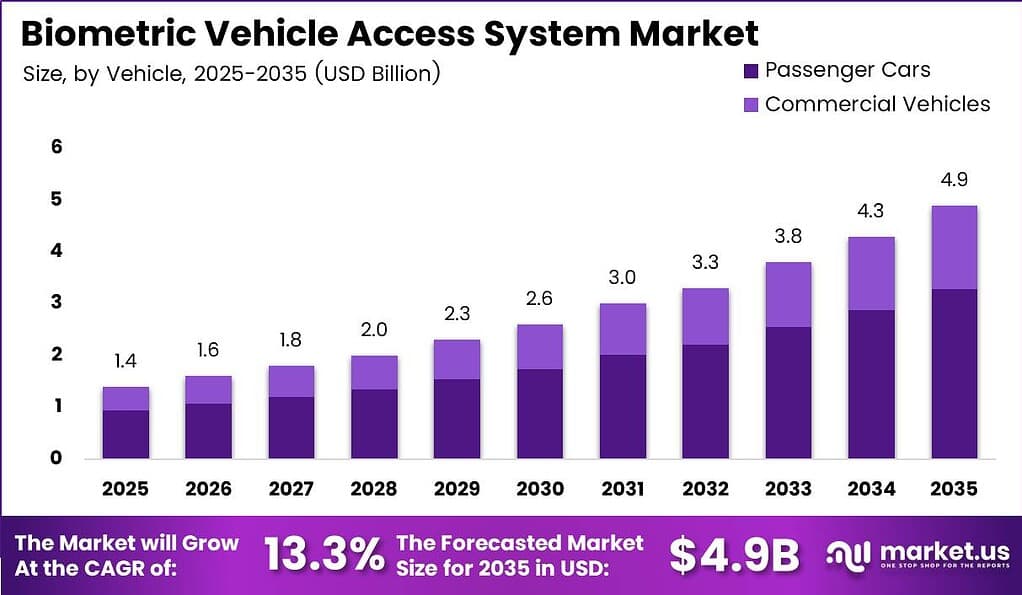
Global Biometric Vehicle Access System Market size is expected to be worth around USD 4.9 Billion by 2035 from USD 1.4 Billion in 2025, growing at a CAGR of 13.3% during the forecast period 2026 to 2035.
The biometric vehicle access system market covers hardware and software solutions that authenticate vehicle users through physiological or behavioral identifiers. These systems include fingerprint recognition modules, voice recognition platforms, and multimodal sensor arrays embedded at the point of vehicle entry. They connect to onboard credential management layers and, increasingly, to cloud-based key delegation and fleet orchestration platforms.
As per our research, more than 650,000 vehicles were stolen in the United States in 2025, equivalent to one vehicle every 48 seconds. This scale of loss drives insurance cost escalation and fleet liability exposure. Automakers and fleet operators that deploy biometric access systems can differentiate on security credentials and reduce theft-related warranty and liability claims.
Key Takeaways
- Market size in 2025 stood at USD 1.4 Billion, forecast to reach USD 4.9 Billion by 2035 at a CAGR of 13.3%.
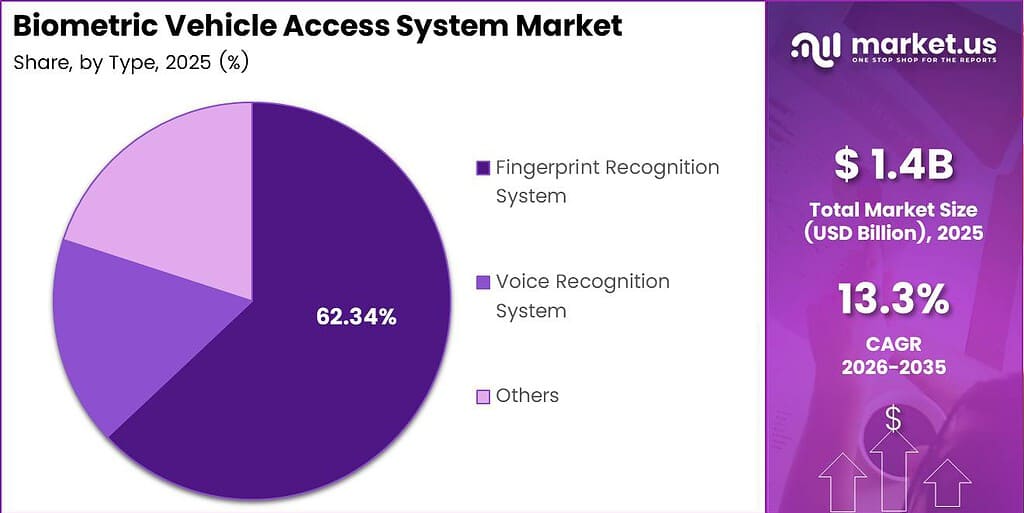
- Fingerprint Recognition System dominates the By Type segment with a 62.34% share.
- Passenger Cars dominate the By Vehicle segment with a 67.45% share.
- OEM dominates the By Sales Channel segment with an 87.11% share.
- Asia-Pacific leads all regions with a 52.13% market share, valued at USD 0.72 Billion.
- Voice Recognition System is the fastest-growing sub-segment in By Type.
- Aftermarket is the fastest-growing sub-segment in By Sales Channel.
According to OICA, global vehicle production rose from 92.7 million units in 2024 to 96.4 million units in 2025, an increase of 3.9%. As reported by ACEA, global new-car registrations reached 77.6 million units in 2025, an increase of 3.5%. This output expansion widens the total addressable market for factory-fitted biometric access hardware in each annual model cycle.
Bosch Ventures launched a new venture-capital fund worth approximately €250 million in May 2025, targeting early-stage mobility and software-defined vehicle technology companies. Bosch also reported that more than 1 million vehicles were equipped with its Electronic Horizon system by September 2024. These investments signal that tier-one suppliers are actively funding the software layers that biometric credential systems depend on for scalable deployment.
As per our research, a multi-sensor vehicle-security system incorporating fingerprint authentication achieved overall recognition accuracy above 96%, as documented in IEEE Xplore. This performance threshold validates fingerprint recognition as a production-viable technology. Suppliers that can demonstrate consistent above-96% field accuracy will hold a credible advantage in OEM procurement discussions.
Type Analysis
In 2025, Fingerprint Recognition System held a dominant market position in the By Type segment of the Biometric Vehicle Access System Market, with a 62.34% share. This dominance reflects the technology’s established sensor supply chain, low per-unit integration cost relative to iris or vein recognition, and high consumer familiarity from smartphone use. OEM programs that anchor biometric entry on fingerprint modules reduce certification complexity and time-to-market versus multimodal-first architectures.
ACEA data shows global car production reached 78.7 million units in 2025, an increase of 4.2%. Voice Recognition System is the fastest-growing sub-segment within By Type, reflecting the expansion of in-cabin AI platforms. Bosch reported that more than one million vehicles were equipped with its Electronic Horizon system by September 2024, confirming that voice and contextual recognition infrastructure is already scaling across production vehicles.
In January 2025, Bosch announced a brake-by-wire market launch from autumn 2025, projected for deployment in more than 5.5 million vehicles by 2030. This signals a broader shift toward software-defined actuation across the vehicle platform, creating natural integration points for biometric identity layers. In June 2024, Volkswagen and Cerence deployed Cerence Chat Pro across 4 Volkswagen Group brands in 5 languages, demonstrating that voice-led credential use cases are already moving beyond pilot into multi-brand production programs.
Others, which includes iris recognition, facial recognition, and palm vein systems, holds the remaining share within the By Type segment. These modalities see adoption primarily in high-security fleet and premium vehicle programs. As sensor costs decrease and regulatory frameworks for biometric data handling mature, these alternatives are positioned to capture incremental OEM share.
EU van registrations fell 8.8%, truck registrations fell 6.2%, and bus registrations increased 7.5% in 2025, according to ACEA. This divergence signals that biometric access demand within Commercial Vehicles is concentrating in bus and transit applications rather than van and heavy-truck programs. Suppliers should prioritize passenger-transport fleet contracts where the economics of per-vehicle biometric integration are strongest.
Vehicle Analysis
In 2025, Passenger Cars held a dominant market position in the By Vehicle segment of the Biometric Vehicle Access System Market, with a 67.45% share. Premium and upper-mid passenger car programs drive the highest biometric attach rates because consumers in these segments actively compare access convenience features across competing brands. This concentration means that OEM partnerships with top-ten passenger-car producers directly determine volume scale for biometric system suppliers.
Commercial Vehicles hold the remaining share in the By Vehicle segment and represent the fastest-growing sub-segment. Regulatory compliance requirements for commercial driver verification in North America, Europe, and India are creating mandatory demand that does not depend on consumer preference cycles. Fleet operators that face driver authentication mandates must integrate compliant biometric systems regardless of unit cost, making this sub-segment relatively price-inelastic.
Sales Channel Analysis
In 2025, OEM held a dominant market position in the By Sales Channel segment of the Biometric Vehicle Access System Market, with an 87.11% share. Factory-fitted biometric access benefits from shared development cost recovery across high-volume trim configurations, tighter integration with vehicle security architecture, and warranty support from the OEM brand. This structural advantage locks most biometric volume into OEM contracts rather than the replacement channel.
Aftermarket is the fastest-growing sub-segment within By Sales Channel, though it starts from a smaller base than OEM. Retrofit demand is concentrated in fleet and commercial operators who purchased vehicles before biometric systems were offered as a factory option. Suppliers that develop plug-and-play aftermarket modules compatible with existing CAN-bus and door-latch architectures can capture this fleet upgrade cycle before next-generation OEM vehicles replace the existing parc.
Key Market Segments
By Type
- Fingerprint Recognition System
- Voice Recognition System
- Others
By Vehicle
- Passenger Cars
- Commercial Vehicles
By Sales Channel
- OEM
- Aftermarket
Regional Analysis
Asia-Pacific Dominates the Biometric Vehicle Access System Market with a Market Share of 52.13%, Valued at USD 0.72 Billion
According to OICA, Asia-Pacific vehicle production reached approximately 59.2 million units in 2025, increasing 7.6% and representing more than 61% of global output. This production concentration makes the region the primary sourcing and adoption hub for factory-fitted biometric access hardware. Suppliers that establish local OEM partnerships in China, Japan, and South Korea will capture the largest share of first-fit biometric volume in the current model cycle.
Asia-Pacific is also the fastest-growing region in this market. SIAM data shows Indian passenger-vehicle sales reached 4,643,439 units in FY2025–26, an increase of 7.9%. India’s expanding premium and upper-mid vehicle segment creates an addressable base for biometric access features that did not exist at meaningful scale three years ago. Suppliers entering the Indian OEM supply chain now can shape spec decisions before the segment consolidates around two or three dominant platform architectures.
ACEA data shows North American new-car registrations reached 15,571,250 units in 2025, an increase of 1.0%. In March 2026, Valeo broke ground on a 337,000-square-foot Texas plant backed by a $225 million five-year investment, expected to create up to 500 jobs. This facility signals that global tier-one suppliers are committing capital to US-based production capacity for software-defined vehicle components, including access system platforms. SMMT figures show UK new-car registrations reached 2,020,520 units in 2025, an increase of 3.5%, while UK used-vehicle transactions reached 2,009,318 units in Q2 2026, up 0.7%, confirming that European vehicle volume remains a viable secondary market for biometric retrofit and factory-fit programs.
Key Regions and Countries
North America
- US
- Canada
Europe
- Germany
- France
- The UK
- Spain
- Italy
- Rest of Europe
Asia Pacific
- China
- Japan
- South Korea
- India
- Australia
- Rest of APAC
Latin America
- Brazil
- Mexico
- Rest of Latin America
Middle East and Africa
- GCC
- South Africa
- Rest of MEA
Market Dynamics
Market Opportunity Analysis - Underserved sales channels and high-growth vehicle sub-segments offer entry points for challengers and new capital
The Aftermarket sales channel holds the smallest share within the By Sales Channel segment but carries the fastest growth trajectory. Most current biometric access volume sits within OEM contracts that lock in specifications years before production. Retrofit-focused suppliers that develop certified, plug-and-play modules can access a fleet upgrade cycle that OEM programs cannot serve, without competing directly against established tier-one integration partners.
Commercial Vehicles represent the fastest-growing sub-segment within By Vehicle, driven by regulatory driver-authentication requirements rather than consumer preference. This demand profile is more predictable and less susceptible to feature-deletion decisions in economy trims. New entrants that develop compliance-certified biometric driver verification modules for logistics fleets in North America, Europe, and India can build recurring revenue from mandatory annual certification renewals.
Asia-Pacific holds a 52.13% market share at USD 0.72 billion but contains markets at very different stages of biometric adoption. India’s passenger-vehicle segment is expanding at rates that outpace most other major markets, yet factory-fitted biometric access remains concentrated in premium trims. Suppliers that offer cost-engineered fingerprint modules suitable for upper-mid vehicle programs in India can reach a volume segment that premium-only strategies miss entirely.
The Others sub-segment within By Type, covering iris, facial, and palm vein recognition, remains a small share of total biometric vehicle access volume today. However, these modalities are advancing toward production readiness in high-security fleet and government vehicle programs. Investors that back modality-agnostic credential management platforms, rather than single-sensor hardware bets, can capture adoption across all biometric input types as fleet operator requirements mature.
Technology and Innovation Landscape - Multimodal sensor fusion, on-device processing, and AI-driven liveness detection define the next competitive threshold
Multimodal sensor fusion is the central engineering direction in this market. Systems that combine fingerprint, voice, and facial recognition into a single authentication decision reduce the false-acceptance and false-rejection rates that single-modality solutions cannot overcome in real-world vehicle environments. Suppliers that demonstrate integrated multimodal architectures in production programs will set the interoperability baseline that OEM procurement teams use to evaluate all competing bids.
Thales’ multimodal biometric pod captures dual irises and a face in 2 seconds at distances of 0.5–1.5 metres, as documented by Thales Group. This speed and range specification is relevant to vehicle access because it establishes what passive, approach-triggered authentication can deliver before a user touches the door handle. Systems approaching this performance profile enable touchless entry architectures that directly compete with traditional key fob convenience while adding identity verification.
China was the leading refiner for 19 of 20 strategic minerals analysed, with an average market share of approximately 70%, according to the IEA. Rare earth elements and specialty metals are critical inputs for fingerprint sensors, infrared cameras, and voice processing chips. Supply concentration at this level creates input cost and availability risk for biometric hardware manufacturers that have not diversified their materials sourcing or redesigned components around alternative material sets.
LG announced plans to invest more than KRW 1 trillion, approximately $740 million, in webOS capabilities through 2027. This investment covers the software platform layer that connects in-vehicle applications, including potential biometric credential management interfaces, to consumer electronics ecosystems. Platform-level investment at this scale by a tier-one electronics supplier signals that the software stack above the biometric sensor is becoming a distinct competitive battleground, separate from the sensor hardware itself.
Drivers
Cross-platform digital-key standardization is the leading active driver, contributing an estimated +1.6% to the 13.3% baseline CAGR. Certified NFC implementations appeared in 2024, followed in 2025 by expanded testing covering UWB, Bluetooth Low Energy, and cross-version interoperability. This infrastructure converts biometric vehicle access from a proprietary option into a repeatable smartphone-to-vehicle architecture, reducing model-specific validation work by an estimated 10–20% and compressing launch schedules by roughly 3–6 months.
Software-defined vehicle adoption adds an estimated +1.2% to CAGR, primarily across China, Europe, North America, and South Korea. Persistent vehicle-theft risk contributes a further +1.0%, concentrated in North America and Latin America. Premium contactless convenience adds +0.8% in key markets including China, Germany, South Korea, Japan, and the United States. Mainstream biometric familiarity and OTA feature monetization add +0.6% and +0.5% respectively, with global reach across smartphone-intensive consumer markets.
| Driver | (~) % Impact on CAGR Forecast | Geographic Relevance | Impact Timeline |
|---|---|---|---|
| Standardized Smartphone Keys | +1.6% | Global; strongest in North America, Europe and East Asia | Short term (≤ 2 years) |
| Software-Defined Vehicle Adoption | +1.2% | China, Europe, North America and South Korea | Medium term (2–4 years) |
| Persistent Vehicle-Theft Risk | +1.0% | North America, Latin America and selected European markets | Short term (≤ 2 years) |
| Premium Contactless Convenience | +0.8% | China, Germany, South Korea, Japan and the United States | Short term (≤ 2 years) |
| Mainstream Biometric Familiarity | +0.6% | Global smartphone-intensive consumer markets | Medium term (2–4 years) |
| OTA Feature Monetization | +0.5% | North America, Europe and China | Medium term (2–4 years) |
Restraints
Biometric privacy liability is the strongest immediate restraint, deducting an estimated 1.3% from forecast CAGR. European rules classify biometric identifiers used for unique identification as special-category data, with serious non-compliance attracting penalties of up to €20 million or 4% of worldwide annual turnover. Illinois retained a private right of action when its biometric statute was amended effective August 2, 2024. These requirements force suppliers to fund privacy-impact assessments, consent logging, on-device template storage, and regional feature controls, potentially raising program engineering expenditure by 8–15% and delaying launches by 3–6 months.
High embedded hardware cost removes an estimated 1.0% from CAGR in price-sensitive markets including India, Southeast Asia, Latin America, and Africa. Slow vehicle platform refresh deducts 0.8% across global incumbent production markets, where model cycles limit how quickly new biometric architectures can reach volume. Used-vehicle identity transfer, economy-trim feature deletion, and aftermarket warranty exclusions each impose additional drag of 0.6%, 0.5%, and 0.4% respectively, compressing scale economies and gross margin across replacement and retrofit channels.
| Restraint | (~) % Impact on CAGR Forecast | Geographic Relevance | Impact Timeline |
|---|---|---|---|
| Biometric Privacy Liability | -1.3% | European Economic Area, United Kingdom and regulated US states | Short term (≤ 2 years) |
| High Embedded Hardware Cost | -1.0% | India, Southeast Asia, Latin America and Africa | Short term (≤ 2 years) |
| Slow Vehicle Platform Refresh | -0.8% | Global incumbent vehicle-production markets | Medium term (2–4 years) |
| Used-Vehicle Identity Transfer | -0.6% | North America, Europe and Japan | Medium term (2–4 years) |
| Economy-Trim Feature Deletion | -0.5% | Price-sensitive global automotive markets | Short term (≤ 2 years) |
| Aftermarket Warranty Exclusions | -0.4% | Global replacement and retrofit channels | Medium term (2–4 years) |
Challenges
Environmental recognition variability creates the largest operational challenge, imposing an estimated -1.1% friction drag. Vehicle access must function under glare, darkness, dust, rain, facial occlusion, wet fingerprints, and gloves while maintaining extremely low false-acceptance rates. Controlled testing found that high-coverage masks raised false non-match rates to roughly 10–40% for otherwise competitive systems. Even a 2–3% field failure rate across high-volume vehicle programs can materially increase service contacts and undermine customer trust.
Long-term mitigation requires multimodal fusion, infrared illumination, liveness detection, and over-the-air model updates, adding an estimated 10–18% to software-validation workloads. Evolving spoof attack surface imposes a further -0.8% drag, while automotive sensor supply concentration across Asian electronics hubs contributes -0.6%. Irrevocable template breach risk, the specialized engineering talent gap, and calibration lifecycle burden add -0.5%, -0.4%, and -0.3% respectively, increasing dependence on specialist safety, cybersecurity, and machine-vision teams across all major production markets.
| Challenge | (~) % CAGR Friction Drag | Geographic Relevance | Mitigation Horizon |
|---|---|---|---|
| Environmental Recognition Variability | -1.1% | Global; elevated in extreme-climate and high-dust markets | Medium term (2–4 years) |
| Evolving Spoof Attack Surface | -0.8% | Global connected-vehicle markets | Long term (≥ 4 years) |
| Automotive Sensor Supply Concentration | -0.6% | Global; concentrated exposure across Asian electronics hubs | Medium term (2–4 years) |
| Irrevocable Template Breach Risk | -0.5% | Global cloud-connected vehicle ecosystems | Long term (≥ 4 years) |
| Specialized Engineering Talent Gap | -0.4% | Europe, North America, Japan and emerging engineering centers | Medium term (2–4 years) |
| Calibration Lifecycle Burden | -0.3% | Global dealer and independent-repair networks | Long term (≥ 4 years) |
Opportunities
Fleet and rental orchestration offers the largest unexploited upside, adding an estimated +1.0% above the 13.3% baseline CAGR. The next-generation digital-key specification introduced server-based owner devices and multi-level key delegation in 2025, but interoperability and certification-readiness testing was still continuing during 2026. Combining server-issued credentials with on-device biometric confirmation could reduce physical key handoffs by an estimated 50–70%, lower unauthorized-use incidents by 20–35%, and shorten vehicle reassignment from hours to minutes.
A shift from hardware-only supply toward per-vehicle credential orchestration could support software gross margins of approximately 60–75%, compared with an estimated 20–35% for embedded access hardware. Biometric vehicle payments add +0.7% potential upside across China, North America, Europe, and South Korea. Commercial driver compliance contributes +0.6%, while autonomous mobility identity, two-wheeler access expansion, and teen and family permissions add +0.5%, +0.4%, and +0.3% respectively across long-term execution windows in high-growth markets.
| Opportunity | (~) % Potential CAGR Upside | Geographic Relevance | Execution Window |
|---|---|---|---|
| Fleet and Rental Orchestration | +1.0% | North America, Europe, China and major tourism markets | Medium term (2–4 years) |
| Biometric Vehicle Payments | +0.7% | China, North America, Europe and South Korea | Medium term (2–4 years) |
| Commercial Driver Compliance | +0.6% | North America, Europe, India and logistics-intensive Asian markets | Medium term (2–4 years) |
| Autonomous Mobility Identity | +0.5% | China, United States, Gulf states and selected European cities | Long term (≥ 4 years) |
| Two-Wheeler Access Expansion | +0.4% | India, Southeast Asia, China and Latin America | Long term (≥ 4 years) |
| Teen and Family Permissions | +0.3% | North America, Europe, Australia and affluent Asian markets | Medium term (2–4 years) |
Key Company Insights
Robert Bosch GmbH generated €91.0 billion in sales and €1.8 billion in EBIT from operations in 2025. In July 2026, Bosch secured up to $225 million in direct US government funding to support an investment of up to $2 billion in its Roseville semiconductor facility. This capital commitment positions Bosch to localize production of the sensor and processing components that underpin biometric vehicle access hardware, reducing supply-chain exposure for its OEM customers.
Synaptics Incorporated generated fiscal-2025 revenue of $1.074 billion, an increase of 12%. In June 2026, Onsemi agreed to acquire Synaptics in an all-stock transaction valued at approximately $7 billion. This acquisition restructures Synaptics’ strategic position within automotive sensing, combining its fingerprint and touch interface technology with Onsemi’s power and imaging semiconductor portfolio. Microsoft completed its acquisition of Nuance Communications for $18.8 billion, and in March 2025 launched Dragon Copilot, demonstrating that voice AI platforms originally developed outside automotive are entering adjacent in-vehicle authentication use cases.
Key Players
- Robert Bosch GmbH
- Synaptics Incorporated
- Nuance Communications, Inc.
- Valeo SA
- Safran
- VOXX International Corp.
- Cerence Inc.
- Thales Group
- Gentex Corporation
- LG Electronics
- Other Key Players
Recent Developments
- August 25, 2026 – Advanced Smart Mobility deployed Cerence Emergency Vehicle Detection for autonomous-bus trials; the technology supports more than 1,500 sirens across 47 countries.
- August 6, 2026 – Cerence authorized a share-repurchase programme of up to $30 million over 12 months.
- July 1, 2026 – Safran announced a €20 million Dijon investment comprising an initial €10 million modernization phase and another €10 million for capacity expansion.
- September 16, 2025 – Valeo placed €500 million of green bonds maturing March 23, 2032, with a 4.625% coupon.
- July 31, 2025 – Bosch completed its $8 billion acquisition of Johnson Controls’ residential and light-commercial HVAC business and the Johnson Controls-Hitachi Air Conditioning joint venture.
- April 1, 2025 – Gentex completed its VOXX International acquisition at $7.50 per share.
- January 31, 2025 – Gentex reported 2.96 million Full Display Mirror shipments in 2024, an increase of 21%.
- November 14, 2024 – Synaptics priced $400 million of 0.75% convertible senior notes with an initial conversion price of approximately $99.69 per share.
- August 21, 2024 – LG announced plans to invest more than KRW 1 trillion, approximately $740 million, in webOS capabilities through 2027.
Report Scope
| Report Features | Description |
|---|---|
| Market Value (2025) | USD 1.4 Billion |
| Forecast Revenue (2035) | USD 4.9 Billion |
| CAGR (2026-2035) | 13.3% |
| Base Year for Estimation | 2025 |
| Historic Period | 2020-2024 |
| Forecast Period | 2026-2035 |
| Report Coverage | Revenue Forecast, Market Dynamics, Market Opportunity Analysis, Technology and Innovation Landscape, Competitive Landscape, Recent Developments |
| Segments Covered | By Type (Fingerprint Recognition System, Voice Recognition System, Others), By Vehicle (Passenger Cars, Commercial Vehicles), By Sales Channel (OEM, Aftermarket) |
| Regional Analysis | North America (US and Canada), Europe (Germany, France, The UK, Spain, Italy, and Rest of Europe), Asia Pacific (China, Japan, South Korea, India, Australia, and Rest of APAC), Latin America (Brazil, Mexico, and Rest of Latin America), Middle East and Africa (GCC, South Africa, and Rest of MEA) |
| Competitive Landscape | Robert Bosch GmbH, Synaptics Incorporated, Nuance Communications, Inc., Valeo SA, Safran, VOXX International Corp., Cerence Inc., Thales Group, Gentex Corporation, LG Electronics, Other Key Players |
| Customization Scope | Customization for segments, region/country-level will be provided. Additional customization can be done based on requirements. |
| Purchase Options | We have three licenses to opt for: Single User License, Multi-User License (Up to 5 Users), Corporate Use License (Unlimited User and Printable PDF) |





































