


Report Overview
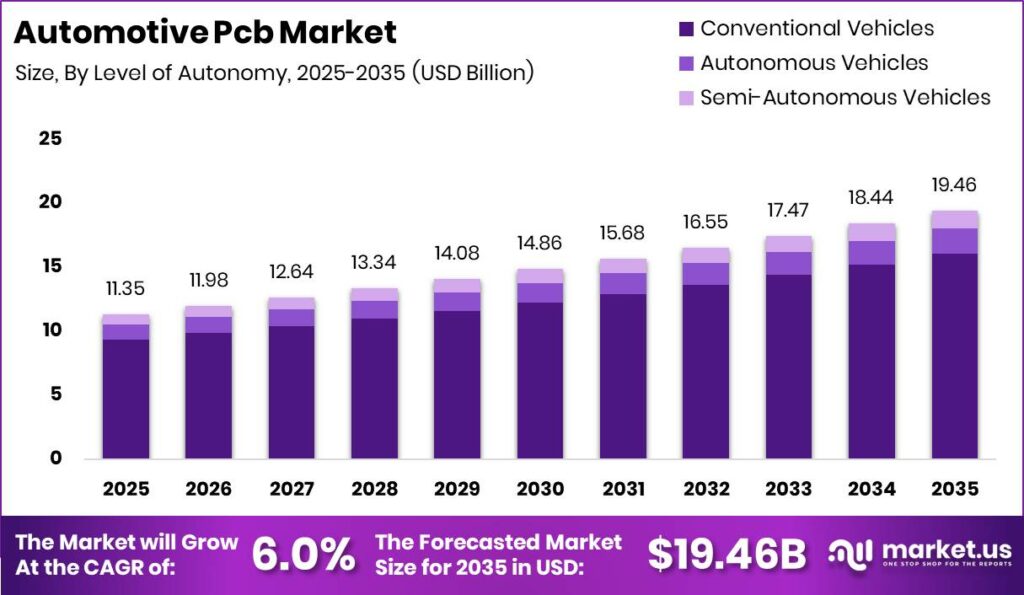
Global Automotive PCB Market size is expected to be worth around USD 19.46 Billion by 2035 from USD 11.35 Billion in 2025, growing at a CAGR of 6.0% during the forecast period 2026 to 2035. This trajectory reflects broad structural changes in vehicle architecture across both established and emerging automotive markets globally.
The automotive PCB market covers printed circuit boards designed and qualified for use inside road vehicles. These boards span single-sided, double-sided, and multi-layer configurations. They serve applications from infotainment and body electronics to advanced driver-assistance systems, powertrain management, and autonomous driving compute. Vehicle electrification and rising electronic content per unit define the structural demand base for this market.
Key Takeaways
- The global Automotive PCB Market is valued at USD 11.35 Billion in 2025 and is forecast to reach USD 19.46 Billion by 2035.
- The market grows at a CAGR of 6.0% during the forecast period 2026 to 2035.
- By PCB Type, Double-Sided PCB leads with a 36.50% share, making it the largest segment.
- By Vehicle Type, Passenger Cars hold the dominant position with a 61.00% share.
- By Propulsion Type, ICE Vehicles account for the largest share at 55.00%.
- By Level of Autonomy, Conventional Vehicles dominate with an 82.50% share.
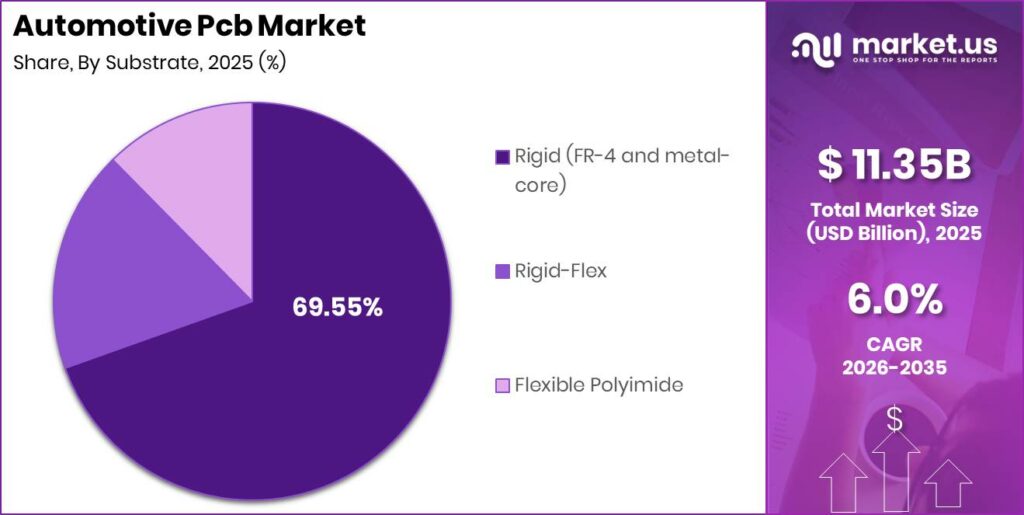
- By Substrate, Rigid (FR-4 and metal-core) leads with a 69.55% share.
- By Application, ADAS and Safety Systems holds the largest segment share at 34.00%.
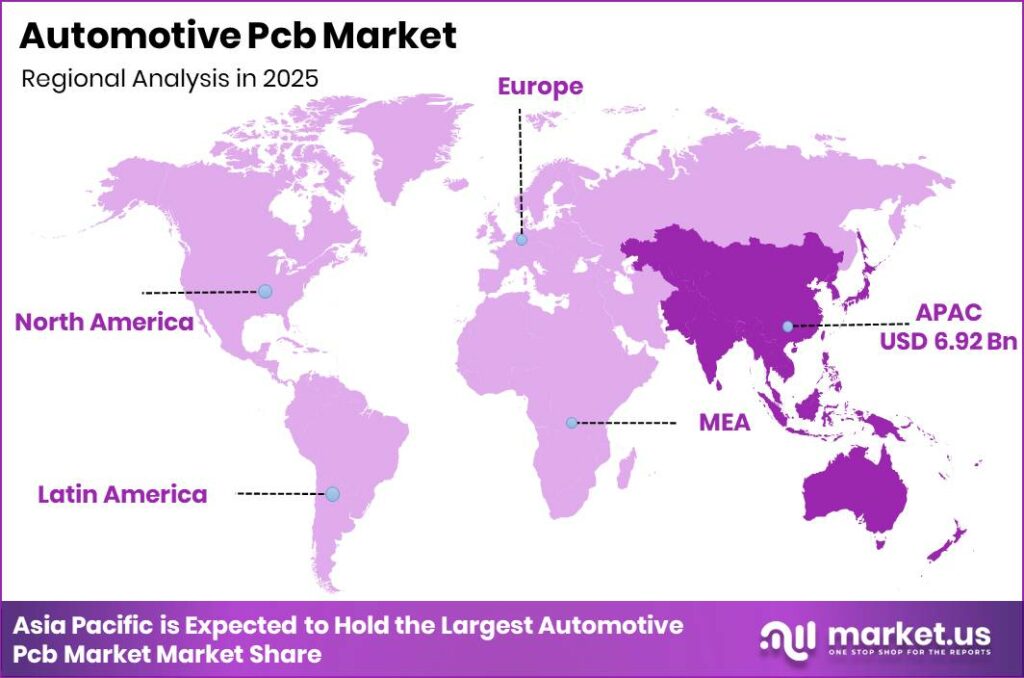
- Asia Pacific dominates regionally with a 61.00% share, valued at USD 6.92 Billion in 2025.
Government bodies in the EU and India have introduced regulatory mandates such as eCall emergency-call requirements and phased ADAS type-approval standards that compel OEMs to embed certified electronics into every new vehicle. These mandates convert compliance from optional to obligatory, shifting PCB procurement from discretionary to built-in demand. As a result, suppliers who hold regulatory pre-qualification hold structural leverage over new market entrants who must still absorb the certification timeline and cost.
In April 2025, AT&S marked 25 years of continuous operation at its Nanjangud, India PCB production facility, reinforcing the role of long-established Asian manufacturing hubs in supplying high-reliability boards for automotive and industrial customers. Vehicle electrification deepens this dependency, as each battery-electric vehicle carries several multiples of the PCB layer count of a comparable combustion vehicle. This creates direct volume uplift for qualified fabricators and widens the revenue gap between certified suppliers and commodity board producers.
As per our research, global electric car sales surpassed 20 million units in 2025, exceeding 25% of all new vehicles sold worldwide. This surge restructures automotive PCB content from low-margin single-sided boards toward high-layer-count, thermally-managed power boards with richer gross margins. Buyers and investors focused on this market must recognize that the board is no longer a peripheral component; it is a primary cost and performance differentiator in every new-generation vehicle platform.
PCB Type Analysis
Double-Sided PCB dominates with 36.50% due to balanced cost and routing density.
In 2025, Double-Sided PCB held a dominant market position in the By PCB Type segment of the Automotive PCB Market, with a 36.50% share. According to IPC’s 2024 North American PCB industry statistics, double-sided boards account for a substantial portion of automotive-grade production volume because they enable component mounting on both surfaces without the tooling cost of multi-layer lamination. This cost-performance balance makes double-sided PCB the default specification for body electronics, lighting control, and low-complexity powertrain modules, giving fabricators a stable, recurring revenue base that underpins capacity utilization across production lines.
Multi-Layer PCB is the fastest-growing sub-segment in this group, driven by rising electronic content per vehicle in ADAS, battery management, and domain controller applications. According to IPC Global Printed Circuit Board Industry Statistics, multi-layer boards represent the highest-value production category for automotive suppliers. Each additional layer adds fabrication complexity and raw-material cost, which expands average selling prices. Fabricators who invest in high-layer-count capability capture margin uplift that single or double-sided production cannot match, positioning multi-layer expertise as a core differentiator in supplier selection by premium OEMs.
Single-Sided PCB serves the cost-sensitive end of the automotive electronics spectrum, covering simple sensor modules, basic relay boards, and legacy comfort electronics where routing complexity is low. According to UNIDO industrial production data, single-sided board output remains concentrated in lower-cost manufacturing regions where labor and overhead structures support thin-margin production. This sub-segment faces structural compression as vehicle platforms migrate toward higher-density designs. Suppliers relying heavily on single-sided volume face gradual revenue erosion unless they invest in capability upgrades that allow them to serve the more technically demanding sub-segments.
Vehicle Type Analysis
Passenger Cars dominates with 61.00% due to high-volume platform PCB standardization.
In 2025, Passenger Cars held a dominant market position in the By Vehicle Type segment of the Automotive PCB Market, with a 61.00% share. According to OICA global vehicle production data, passenger car output exceeded 70 million units annually in recent years, making passenger platforms the largest single source of automotive PCB demand. Each modern passenger car integrates boards across infotainment, powertrain control, safety, and body systems. The sheer unit volume of passenger car production gives board suppliers a high-frequency, repeatable order base that supports efficient capacity planning and long-term supplier agreements.
Commercial Vehicles represent the fastest-growing sub-segment in the By Vehicle Type group, driven by fleet electrification programs and the adoption of telematics, driver monitoring, and advanced braking systems in trucks and buses. According to the International Road Transport Union, commercial vehicle fleets in Asia and Europe are accelerating compliance with emissions and safety regulations that require additional onboard electronics. Each regulatory upgrade cycle adds PCB content per commercial vehicle unit, creating incremental revenue opportunities for suppliers who hold automotive-grade qualifications across both passenger and commercial platform specifications.
Propulsion Type Analysis
ICE Vehicles dominates with 55.00% due to existing global fleet scale and replacement demand.
In 2025, ICE Vehicles held a dominant market position in the By Propulsion Type segment of the Automotive PCB Market, with a 55.00% share. According to IEA Global EV Outlook 2024, the internal-combustion fleet still represents the overwhelming majority of registered vehicles worldwide, sustaining aftermarket and replacement PCB demand across engine control units, transmission systems, and emission-management electronics. This installed base creates a stable, low-volatility revenue stream for board suppliers. ICE dominance also reflects the slower EV penetration rate in markets outside China and Europe, where charging infrastructure constraints sustain combustion vehicle demand for the medium term.
Battery Electric Vehicles are the fastest-growing propulsion sub-segment, with IEA data showing global EV sales surpassing 17 million units in 2024. BEV platforms require inverter boards, battery management system boards, and onboard charger PCBs that carry significantly higher layer counts and copper weights than equivalent ICE electronics. This per-vehicle content expansion translates directly into a higher average selling price per board set, making BEV supply contracts disproportionately valuable to suppliers relative to their unit count. Hybrid and Plug-in Hybrid Vehicles occupy the mid-tier, combining both ICE and electric board requirements, expanding total PCB content per vehicle above either pure architecture alone.
Level of Autonomy Analysis
Conventional Vehicles dominates with 82.50% due to global fleet volume and long replacement cycles.
In 2025, Conventional Vehicles held a dominant market position in the By Level of Autonomy segment of the Automotive PCB Market, with an 82.50% share. According to World Bank transport statistics, the global registered vehicle fleet exceeds 1.4 billion units, the vast majority of which operate without autonomous or semi-autonomous systems. This scale sustains predictable, repeatable PCB demand for standard engine management, body control, and infotainment boards. Suppliers serving conventional vehicle platforms benefit from long product lifecycles and stable bill-of-materials requirements, which reduce qualification costs and support high-volume, efficiency-driven production models.
Autonomous Vehicles represent the fastest-growing sub-segment under Level of Autonomy, driven by expanding compute requirements for sensor fusion, lidar processing, and redundant control systems. According to SAE International and regulatory filing disclosures from autonomous vehicle developers, compute boards for Level 4 autonomy require significantly higher layer counts and stricter thermal management than any current production vehicle. This creates a premium-priced board category with limited qualified suppliers, giving early-qualified fabricators pricing power and long-term design-in stickiness. Semi-Autonomous Vehicles currently occupy the mid-range, integrating ADAS features at scale across mass-market passenger platforms globally.
Substrate Analysis
Rigid (FR-4 and metal-core) dominates with 69.55% due to proven thermal and structural reliability.
In 2025, Rigid (FR-4 and metal-core) held a dominant market position in the By Substrate segment of the Automotive PCB Market, with a 69.55% share. According to IPC material qualification standards, FR-4 and metal-core substrates are the default specification for automotive-grade boards requiring dimensional stability across wide temperature ranges and resistance to mechanical vibration. Metal-core variants serve high-power LED lighting and power electronics applications where thermal dissipation is critical. The combination of established supply chains, broad fabricator competence, and long OEM qualification histories entrenches rigid substrate as the volume-leading material category.
Rigid-Flex PCB is the fastest-growing substrate sub-segment, enabled by design requirements in compact cockpit electronics, foldable display systems, and space-constrained ADAS sensor housings. According to IPC industry surveys, rigid-flex adoption is accelerating in premium vehicle segments where interior packaging constraints make traditional rigid board assemblies impractical. Each rigid-flex design requires specialized lamination and coverlay processes that increase fabrication cost but enable premium pricing and long-term supply contracts. Flexible Polyimide substrates serve the most demanding bend-radius and weight-reduction applications, occupying a smaller but technically differentiated share of the substrate market.
Application Analysis
ADAS and Safety Systems dominates with 34.00% due to mandatory regulatory safety content per vehicle.
In 2025, ADAS and Safety Systems held a dominant market position in the By Application segment of the Automotive PCB Market, with a 34.00% share. According to Euro NCAP and NHTSA regulatory filings, mandatory safety-feature requirements for new vehicle type approvals in the EU and North America have made collision warning, automatic emergency braking, and lane-keeping systems standard equipment across mass-market platforms. Each system requires dedicated PCBs for sensor processing and actuator control. Regulatory mandates convert ADAS board demand from discretionary to obligatory, locking in volume and insulating this application category from cyclical demand pressure.
Autonomous Driving Compute is the fastest-growing application sub-segment, with compute board complexity and layer counts rising sharply as developers scale from Level 2 to Level 3 and Level 4 systems. In 2025, TTM Technologies launched the MSK5065RH radiation-hardened switching regulator module, expanding its high-reliability component portfolio to serve demanding automotive-adjacent compute applications. According to SAE International technical standards, autonomous compute platforms require redundant board architectures with independent power domains, multiplying the PCB surface area and content value per vehicle. Infotainment Components, Powertrain and Electrification, and Body, Comfort, and Vehicle Lighting account for the remaining application share, each sustaining stable demand from established vehicle subsystems across global production volumes.
Key Market Segments
By PCB Type
- Double-Sided PCB
- Multi-Layer PCB
- Single-Sided PCB
By Vehicle Type
- Passenger Cars
- Commercial Vehicles
By Propulsion Type
- ICE Vehicles
- Battery Electric Vehicles (BEV)
- Hybrid/Plug-in Hybrid Vehicles
By Level of Autonomy
- Conventional Vehicles
- Autonomous Vehicles
- Semi-Autonomous Vehicles
By Substrate
- Rigid (FR-4 and metal-core)
- Rigid-Flex
- Flexible Polyimide
By Application
- Infotainment Components
- ADAS and Safety Systems
- Autonomous Driving Compute
- Powertrain and Electrification
- Body, Comfort, and Vehicle Lighting
Regional Analysis
Asia Pacific Dominates the Automotive PCB Market with a Market Share of 61.00%, Valued at USD 6.92 Billion
Asia Pacific holds a commanding position in the global automotive PCB market, supported by the concentration of vehicle assembly capacity, consumer electronics manufacturing expertise, and board fabrication infrastructure across China, Japan, South Korea, and Taiwan. According to OICA production data, Asia accounts for more than half of global vehicle output annually, giving regional PCB suppliers structural proximity to their largest customer base. This geographic alignment shortens qualification cycles, reduces logistics costs, and positions Asian fabricators as first-choice suppliers for high-volume programs across both ICE and electric platforms.
North America represents the fastest-growing regional market outside Asia, driven by OEM investment in domestic EV production, federal incentives under the Inflation Reduction Act, and nearshore supply chain restructuring that pulls board fabrication closer to US assembly plants. According to World Bank economic data, US manufacturing investment in automotive electronics accelerated through 2024 and 2025, with new EV assembly facilities requiring localized PCB supply to meet content-of-origin requirements. This policy-driven localization creates a structural demand pull for North American fabricators and rewards suppliers who establish qualified capacity within the region before OEM ramp schedules tighten.
Europe maintains a significant share of automotive PCB demand, anchored by premium OEM platforms in Germany and the broader EU regulatory push toward mandatory ADAS and eCall compliance. Latin America and the Middle East and Africa regions collectively account for a smaller but developing share, with Mexico emerging as a nearshore manufacturing destination given its proximity to US assembly operations and favorable trade terms under USMCA. In April 2025, AT&S celebrated 25 years of production at its Nanjangud, India facility, signaling India’s growing relevance as a supply base for automotive-grade PCBs serving both domestic and export demand across Asia and Europe.
Key Regions and Countries
North America
- US
- Canada
Europe
- Germany
- France
- The UK
- Spain
- Italy
- Rest of Europe
Asia Pacific
- China
- Japan
- South Korea
- India
- Australia
- Rest of APAC
Latin America
- Brazil
- Mexico
- Rest of Latin America
Middle East and Africa
- GCC
- South Africa
- Rest of MEA
Market Dynamics
Market Opportunity Analysis - Underexploited segments and emerging regions offer structural entry points for qualified automotive PCB suppliers
The Autonomous Driving Compute application sub-segment remains the most underexploited category in the automotive PCB market. As established in the Application Analysis, this sub-segment is the fastest-growing but currently holds a small share of total application revenue. Redundant board architectures for Level 3 and Level 4 systems require specialized multi-layer designs with independent power domains that few current fabricators supply at automotive-grade qualification. Suppliers who invest in qualification now face less competition and can lock in design-in positions before volume ramps commoditize the segment.
Flexible Polyimide substrate represents an underexploited niche within the Substrate segment. As noted in the Substrate Analysis, Flexible Polyimide occupies a smaller but technically differentiated share of the substrate market. Demand is growing from compact cockpit and space-constrained sensor applications, yet few mid-tier fabricators hold the specialized lamination and coverlay capabilities required for automotive-grade flex production. This capability gap creates a pricing premium for qualified flex suppliers and delays new entrants, giving existing qualified producers a window to expand share before additional capacity enters the market.
Latin America and the Middle East and Africa represent structurally underdeveloped regions for automotive PCB supply despite growing vehicle assembly activity. As identified in the Regional Analysis, Mexico is emerging as a nearshore manufacturing destination with USMCA trade advantages relative to US OEM assembly plants. This geographic advantage is underutilized, as few domestic PCB fabricators in these regions hold the automotive-grade qualifications that global OEMs require. Investors who support qualification-capable fabs in Mexico or India gain first-access to OEM localization mandates before competing suppliers establish regional footholds.
The aftermarket and retrofit electronics segment across Asia Pacific and the EU presents a recurring, undermonetized revenue stream that does not require new vehicle OEM qualifications. As captured in the Opportunities section, this segment offers medium-term CAGR upside of +0.6% above the baseline. Retrofit electronics for fleet telematics, EV battery upgrades, and safety system additions create demand for standard PCB types already in production at qualified fabricators. Suppliers who develop aftermarket catalog products alongside OEM programs diversify their revenue base and reduce dependence on OEM program cycle timing, improving earnings stability.
Technology and Innovation Landscape - Inspection automation, thermal standards, and precision manufacturing protocols define the competitive frontier for automotive PCB producers
Automated optical inspection has become a critical quality differentiator in automotive PCB production. A 2025 PCB failure-analysis article reports that AOI detects defects such as component misalignment with more than 95% accuracy. A separate 2025 case study on real-time AOI in automotive PCB manufacturing found that introducing online AOI reduced manual inspection time per panel by approximately 40%, cutting average inspection from roughly 5 minutes to 3 minutes per panel while lifting first-pass yield from 93% to between 96% and 98%. Fabricators who deploy real-time AOI capture both cost reduction and quality improvement simultaneously, strengthening their competitive position in OEM supplier audits.
IPC-6012 Class 3 qualification standards set the technical floor for automotive-grade PCB production and define the innovation boundary that suppliers must clear. A 2026 overview referencing IPC-6012 Class 3 specifies that conductor width tolerance allows finished conductors as thin as 80% of nominal width, with hole-location accuracy required at a maximum of ±100 µm. A separate Class 3 guide specifies dielectric thickness between conductive layers of at least 90 µm and plated-through-hole barrel fill of at least 75% of barrel length. Fabricators who engineer processes to consistently exceed these minimums rather than merely meet them reduce field failure rates and accelerate OEM re-qualification timelines.
Thermal management capability is a direct competitive differentiator as BEV and ADAS board densities increase. Accelerated thermal cycling protocols described in a 2025 reliability article cycle boards between −40°C and 125°C for 500 to 1,000 cycles, with failure criteria set at a resistance change of 10 to 20% or visible solder-joint cracking to reproduce multiple years of automotive field stress. Infineon’s May 2025 automotive OptiMOS 6 device supports a 175°C operating temperature and a 260°C peak reflow temperature. Component and board suppliers who validate to these thermal envelopes win design-in positions on high-power inverter and BMS platforms ahead of competitors who validate to lower temperature ceilings.
Precision voltage regulation and tight PCB-level power-network engineering are emerging as board-level differentiators in next-generation automotive platforms. A 2025 article on vehicle PCB defect-rate optimization describes major automotive PCB producers testing boards at 300 V with leakage thresholds set at 30 MΩ and short-circuit detection at 20 Ω, reducing latent defect escapes from the low-100s DPPM range to below 50 DPPM in customer shipments. IPC Class 3 guidance recommends base materials with glass transition temperature above 170°C and thermal conductivity greater than 0.4 W/m·K for high-reliability designs. Fabricators who build these specifications into standard process controls rather than treating them as premium options expand their addressable OEM customer base without adding per-board qualification cost.
Drivers
EV powertrain electrification is the single largest demand driver for automotive PCBs. According to IEA electric-vehicle tracking, global electric car sales surpassed 20 million units in 2025, representing more than 25% of all new vehicles sold globally, with first-quarter 2025 sales up 35% year-on-year. Each BEV platform embeds several multiples of the PCB surface area of a comparable combustion vehicle. This mechanically lifts per-vehicle board content and pushes procurement toward long-term qualified-supplier contracts, giving certified fabricators pricing power and supply-chain stickiness that commodity producers cannot replicate.
ADAS proliferation and the shift toward zonal electrical-electronic architecture add a second structural layer of PCB demand above the EV baseline. Regulatory mandates in the EU and India for eCall systems and ADAS type approval compel OEMs to embed certified board assemblies in every new vehicle regardless of powertrain type. In-vehicle infotainment upgrade cycles and the rise of HDI and substrate-like PCB content per vehicle further expand the addressable bill of materials. Together these forces raise average PCB revenue per vehicle and extend the growth runway well beyond pure EV unit volume gains.
| Driver | (~) % Impact on CAGR Forecast | Geographic Relevance | Impact Timeline |
|---|---|---|---|
| EV powertrain electrification & onboard power boards | +2.4% | China, EU, North America | Short term (2 years or less) |
| ADAS & radar/sensor board proliferation | +1.8% | Global | Short term (2 years or less) |
| Zonal E/E architecture & domain controllers | +1.1% | EU, North America, Japan | Medium term (2 to 4 years) |
| In-vehicle infotainment & connectivity upgrade cycles | +0.9% | Asia-Pacific, North America | Short term (2 years or less) |
| HDI & substrate-like PCB content per vehicle rise | +0.7% | Japan, South Korea, Taiwan | Medium term (2 to 4 years) |
| Regulatory safety mandates (eCall, ADAS type approval) | +0.5% | EU, India | Medium term (2 to 4 years) |
Restraints
Capital cost is the primary restraint on automotive PCB supply expansion. As reflected in World Bank and IMF policy-rate indices, benchmark interest rates held at multi-year highs through 2024 and into 2025, making greenfield HDI fabrication lines uneconomic for mid-tier suppliers without OEM balance-sheet backing. According to OECD financing-condition surveys, mid-tier fabricators face margin erosion of several percentage points as working-capital costs rise and scale economics from new fabs are deferred beyond 2027. This freezes supply precisely as EV and ADAS demand accelerates, creating a widening gap between latent demand and available qualified capacity.
Copper and laminate raw-material cost inflation compounds the capital constraint by squeezing variable-cost margins on boards already under OEM price pressure. US-China tariffs and export controls on board inputs add a third layer of cost friction, particularly for North American and Chinese fabricators who rely on cross-border material flows. EV demand softening in select EU and North American markets introduces volume uncertainty that makes CapEx commitments harder to justify. Environmental compliance costs under RoHS and REACH regulations in Europe add a further capital barrier for suppliers seeking to maintain market access in the region’s premium OEM supply chains.
| Restraint | (~) % Impact on CAGR Forecast | Geographic Relevance | Impact Timeline |
|---|---|---|---|
| Elevated interest rates freezing fab CapEx | -1.3% | North America, EU | Short term (2 years or less) |
| Copper & laminate raw-material cost inflation | -1.0% | Global | Short term (2 years or less) |
| Tariffs & export controls on board inputs | -0.8% | US, China | Short term (2 years or less) |
| EV demand softening in select mature markets | -0.6% | EU, North America | Short term (2 years or less) |
| Environmental compliance capital barriers (RoHS/REACH) | -0.4% | EU | Medium term (2 to 4 years) |
Challenges
Automotive-grade semiconductor supply remains the dominant friction point constraining PCB assembly throughput. Per SIA industry shipment data, global semiconductor revenue tracked toward roughly $717 billion in 2025, yet production mix skewed toward leading-edge AI logic rather than trailing-node automotive MCUs, IGBTs, and power devices that populate vehicle boards. PCB assemblers unable to fully populate boards on schedule carry partially built inventory that strains working capital and reduces effective throughput below installed capacity, compressing net margins across the supply chain.
Skilled process-engineering talent shortages in North America and the EU slow qualification of new HDI and rigid-flex production lines, extending the timeline for capacity expansion. Thermal and reliability qualification bottlenecks add further friction as OEMs demand longer validation cycles before approving new board suppliers or next-generation designs. Geopolitical supply-route concentration risk, particularly across Taiwan, China, and Japan, keeps supply-chain resilience low for buyers dependent on a narrow fabrication base. Miniaturization and HDI yield complexity in Asia Pacific constrain throughput rates on the most advanced board platforms, limiting near-term supply additions.
| Challenge | (~) % CAGR Friction Drag | Geographic Relevance | Mitigation Horizon |
|---|---|---|---|
| Automotive-grade chip supply drag | -1.1% | Global | Medium term (2 to 4 years) |
| Skilled process-engineering talent deficit | -0.7% | North America, EU | Long term (4 years or more) |
| Thermal & reliability qualification bottlenecks | -0.6% | Global | Medium term (2 to 4 years) |
| Geopolitical supply-route concentration risk | -0.5% | Taiwan, China, Japan | Long term (4 years or more) |
| Miniaturization & HDI yield complexity | -0.4% | Asia-Pacific | Medium term (2 to 4 years) |
Opportunities
The migration to 800V high-voltage EV powertrains creates the highest-value untapped opportunity in this market. Per IEA total-cost-of-ownership analysis, faster charging efficiency is pushing next-generation platforms toward higher operating voltages, yet only a minority of current production models run 800V systems. Silicon-carbide-compatible, high-creepage board platforms for these architectures remain under-productized. Suppliers who qualify early gain pricing power through qualification barriers and gross-margin expansion of several percentage points over legacy 400V board programs, converting first-mover qualification into durable, sticky revenue above the 6.0% baseline CAGR.
Nearshore fabrication capacity build-out in India, Mexico, and the US captures a second structural opportunity tied to OEM supply-chain localization requirements and content-of-origin rules. Autonomous-driving compute board white space represents a long-term premium opportunity as Level 3 and Level 4 platforms require redundant, high-layer-count board architectures that carry significantly higher average selling prices. Aftermarket and retrofit electronics monetization in Asia Pacific and the EU adds a medium-term recurring revenue stream. M&A consolidation of fragmented mid-tier fabricators offers acquirers scale economics and qualification breadth across multiple OEM programs simultaneously.
| Opportunity | (~) % Potential CAGR Upside | Geographic Relevance | Execution Window |
|---|---|---|---|
| 800V high-voltage architecture board platforms | +1.6% | China, EU, North America | Medium term (2 to 4 years) |
| Localized nearshore fab capacity build-out | +1.2% | India, Mexico, US | Medium term (2 to 4 years) |
| Autonomous-driving compute board white space | +1.0% | North America, China | Long term (4 years or more) |
| Aftermarket & retrofit electronics monetization | +0.6% | Asia-Pacific, EU | Medium term (2 to 4 years) |
| M&A roll-up of fragmented mid-tier fabricators | +0.5% | Global | Long term (4 years or more) |
Key Company Insights
Samsung Electro-Mechanics holds a structural advantage in the automotive PCB market through its integration of substrate-like PCB and HDI production within a broader component ecosystem that includes multilayer ceramic capacitors and camera modules for vehicle OEMs. This vertical breadth reduces customer switching costs and positions Samsung Electro-Mechanics as a preferred single-source supplier for complex automotive electronic assemblies, which commands stickier long-term contracts and protects against margin pressure from pure-play PCB competitors.
In March 2026, Meiko Electronics acquired NAGANO FCL COMPONENTS LIMITED to absorb its EMS business, directly expanding Meiko’s ability to offer integrated PCB design, fabrication, and assembly services to automotive customers. This vertical integration move reduces customer dependence on multiple suppliers and strengthens Meiko’s positioning in the higher-margin assembly layer of the automotive electronics value chain. Suppliers who control both board production and component assembly capture a larger share of per-vehicle electronics spend and reduce OEM procurement complexity, improving contract retention rates.
Key Players
- Samsung Electro-Mechanics
- Unimicron Technology Corp.
- Meiko Electronics Co. Ltd
- TTM Technologies Inc.
- Amitron Corporation
- Chin Poon Industrial
- Nippon Mektron
- KCE Electronics
- Tripod Technology
- Kingboard Chem GRP
- Amitron Corp
- CMK Corp.
Recent Developments
- July 2025: TTM Technologies acquired a 750,000-square-foot manufacturing facility in Eau Claire, Wisconsin, and secured land rights in Penang, Malaysia, to expand advanced PCB production capacity and strengthen regional supply chain capabilities for high-reliability electronics including automotive PCB solutions.
- January 2025: SOMACIS completed the acquisition of AT&S Korea Co., Ltd. from AT&S, adding high-reliability HDI flex, rigid-flex, and rigid PCB manufacturing capabilities to its portfolio for advanced electronic applications including automotive supply chains.
- June 2026: TTM Technologies announced the planned acquisition of Swiss Technology Group AG and ILFA GmbH to expand its European PCB manufacturing footprint, adding rigid, flexible, and rigid-flex PCB capabilities relevant to high-performance automotive and industrial electronics applications.
Geopolitical Impact Analysis
US-China trade tensions have reshaped the cost structure of automotive PCB supply chains through tariff escalation on electronic components and raw materials. According to WTO trade policy monitoring, US Section 301 tariffs on Chinese electronics imports have reached up to 25% on key PCB input categories, raising material costs for North American assemblers who source copper-clad laminates and specialty chemicals from Chinese suppliers. According to World Bank commodity price indices, copper prices rose by more than 20% between 2023 and 2025, compounding the tariff impact. These dual pressures force fabricators to accelerate supplier diversification toward Taiwan, South Korea, and India, adding qualification cost and lead-time risk during the transition period.
Shipping route disruptions in the Red Sea and heightened geopolitical risk across Taiwan Strait shipping lanes have introduced measurable transit-time volatility for automotive PCB supply chains dependent on East Asia manufacturing. According to the World Shipping Council, Red Sea rerouting added an average of 10 to 14 days to transit times on Asia-to-Europe lanes, raising freight costs by an estimated 200% to 300% at the peak of disruptions. According to UNCTAD trade flow data, roughly 40% of global electronics trade passes through geopolitically sensitive maritime corridors. Automotive OEMs and tier-one suppliers are responding by increasing safety-stock inventory targets and accelerating nearshore fabrication investments in Mexico, India, and Eastern Europe to reduce exposure to single-corridor supply risk.
Report Scope
| Report Features | Description |
|---|---|
| Market Value (2025) | USD 11.35 Billion |
| Forecast Revenue (2035) | USD 19.46 Billion |
| CAGR (2026-2035) | 6.0% |
| Base Year for Estimation | 2025 |
| Historic Period | 2020-2024 |
| Forecast Period | 2026-2035 |
| Report Coverage | Revenue Forecast, Market Dynamics, Market Opportunity Analysis, Technology and Innovation Landscape, Competitive Landscape, Recent Developments |
| Segments Covered | By PCB Type (Double-Sided PCB, Multi-Layer PCB, Single-Sided PCB), By Vehicle Type (Passenger Cars, Commercial Vehicles), By Propulsion Type (ICE Vehicles, Battery Electric Vehicles (BEV), Hybrid/Plug-in Hybrid Vehicles), By Level of Autonomy (Conventional Vehicles, Autonomous Vehicles, Semi-Autonomous Vehicles), By Substrate (Rigid (FR-4 and metal-core), Rigid-Flex, Flexible Polyimide), By Application (Infotainment Components, ADAS and Safety Systems, Autonomous Driving Compute, Powertrain and Electrification, Body, Comfort, and Vehicle Lighting) |
| Regional Analysis | North America (US and Canada), Europe (Germany, France, The UK, Spain, Italy, and Rest of Europe), Asia Pacific (China, Japan, South Korea, India, Australia, and Rest of APAC), Latin America (Brazil, Mexico, and Rest of Latin America), Middle East and Africa (GCC, South Africa, and Rest of MEA) |
| Competitive Landscape | Samsung Electro-Mechanics, Unimicron Technology Corp., Meiko Electronics Co. Ltd, TTM Technologies Inc., Amitron Corporation, Chin Poon Industrial, Nippon Mektron, KCE Electronics, Tripod Technology, Kingboard Chem GRP, Amitron Corp, CMK Corp. |
| Customization Scope | Customization for segments, region / country-level will be provided. Additional customization can be done based on requirements. |
| Purchase Options | We have three licenses to opt for: Single User License | Multi-User License (Up to 5 Users) | Corporate Use License (Unlimited User and Printable PDF) |





































