Automotive Engineering Service Market Size, Share, Growth Analysis By Service Type (Designing, Testing & validation, System integration, Prototyping, Concept / research), By Application (Powertrain & exhaust, Electrical, electronics & body controls, ADAS & safety systems, Connectivity & software / infotainment, Interior, exterior & body engineering, Simulation & other advanced services), By Vehicle Type (Passenger cars, Light commercial vehicles (LCVs)), By Location Type (Off-shore / outsourced, On-shore / in-house), By Region and Companies - Industry Segment Outlook, Market Assessment, Competition Scenario, Statistics, Trends and Forecast 2026-2035
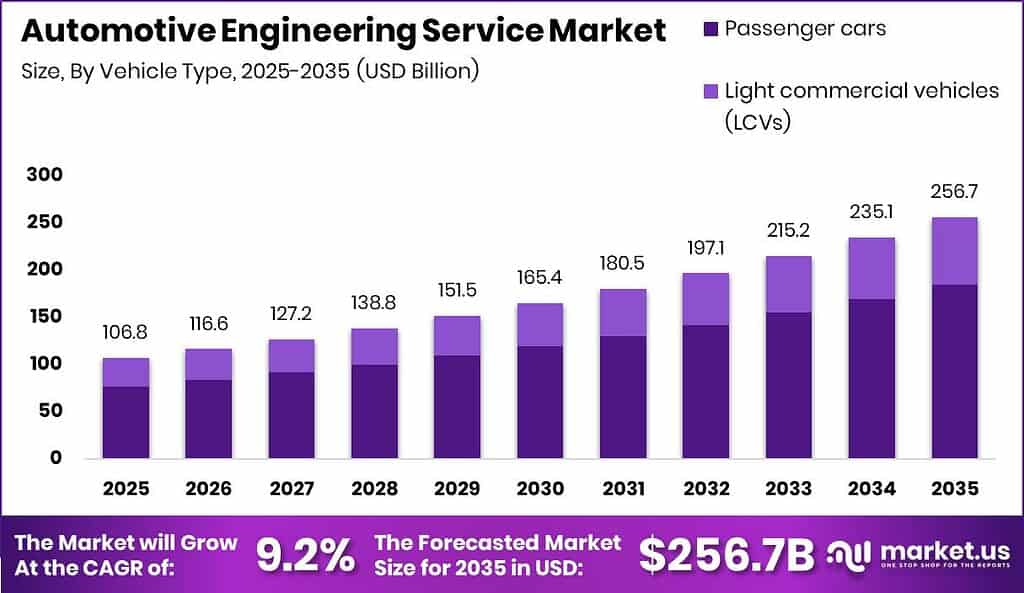
Global Automotive Engineering Service Market size is expected to be worth around USD 256.70 Billion by 2035 from USD 106.80 Billion in 2025, growing at a CAGR of 9.2% during the forecast period 2026 to 2035. This expansion reflects rising multi-domain vehicle programs that blend mechanical design, electronics, software, and validation into single supplier contracts. Buyers now fund architecture work that spans full vehicle lifecycles rather than isolated component tasks.
Therefore, the Automotive Engineering Service Market covers outsourced and captive support for vehicle design, testing, system integration, prototyping, and concept research. Providers serve powertrain, electronics, ADAS, connectivity, body, and simulation workloads across passenger and light commercial fleets. Location models split between off-shore delivery hubs and on-shore client sites, shaping cost, IP control, and program speed for OEM and Tier-1 buyers.
Key Takeaways
The market reaches USD 106.8 Billion in 2025 and USD 256.7 Billion by 2035 at a 9.2% CAGR.
Designing leads Service Type with a 34.4% share.
Powertrain and exhaust leads Application with a 53.3% share.
Passenger cars lead Vehicle Type with a 72.2% share.
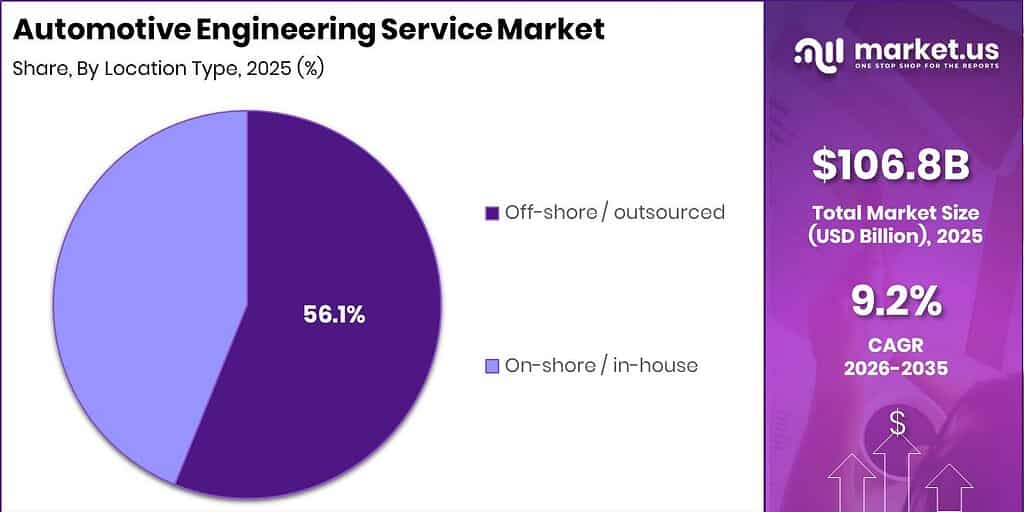
Off-shore and outsourced delivery leads Location Type with a 56.1% share.
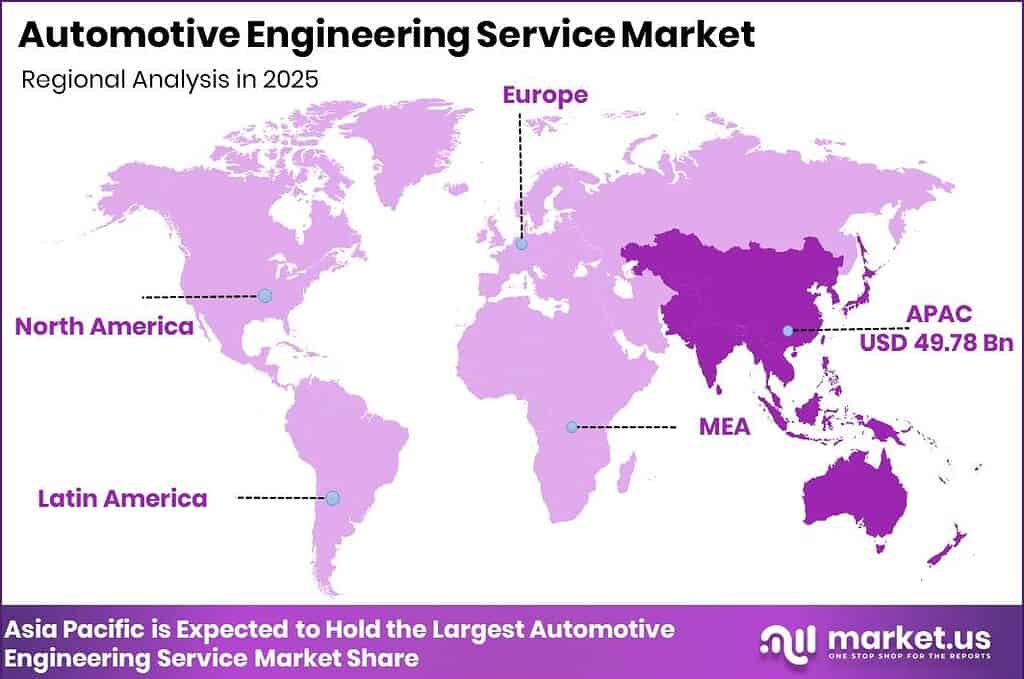
Asia Pacific leads regionally with a 46.6% share, valued at USD 49.78 Billion.
System integration is the fastest growing Service Type segment.
ADAS and safety systems is the fastest growing Application segment.
Light commercial vehicles is the fastest growing Vehicle Type segment.
OEM capital now prioritizes software-defined and electric architectures, which pulls engineering spend into multi-year platform contracts. In June 2025, Tata Technologies was selected by Volvo Cars as a strategic engineering supplier for product engineering, vehicle systems, component engineering, embedded software, and PLM solutions. This award signals that large OEMs lock preferred partners early to secure scarce systems talent. As a result, suppliers without deep embedded and PLM stacks risk exclusion from master service agreements.
However, European and Asian OEMs still expand specialized capability through targeted acquisitions and joint builds. In September 2025, Tata Technologies agreed to acquire Germany-based ES-Tec Group for 75 million euros, adding ADAS, connected driving, embedded systems, electronics, and systems engineering depth. According to Capgemini, generative AI linked to a 7 to 18% productivity rise across automotive software development work in a 2025 survey. Vendors that productize these gains into fixed-price modules can defend margins when program budgets tighten.
As reported by Capgemini, AI coding assistance delivered an average 9% efficiency gain, with gains reaching 34% in some cases. This efficiency frees senior engineers for integration and safety cases instead of routine code tasks. End-use growth in electric and connected fleets therefore converts directly into higher billable hours for validation, cybersecurity, and over-the-air release engineering.
Service Type Analysis
Designing dominates with 34.4% due to early architecture lock-in needs.
In 2025, Designing held a dominant market position in the By Service Type segment of Automotive Engineering Service Market, with a 34.4% share. ACEA data show global car manufacturing totalled 75.5 million units in 2024, sustaining continuous body, chassis, and packaging design cycles. Design ownership sets tooling and supplier choices years before launch. Firms that win concept-to-detailed design seats capture follow-on testing and integration revenue across the full program life.
Testing and validation teams convert design intent into homologation-ready evidence under functional safety rules. ISO 26262 defines the lifecycle framework for electrical and electronic safety-related systems in series production road vehicles. This standard forces repeatable hazard analysis, verification, and safety case work on every major electronic change. Providers with accredited test labs and hardware-in-the-loop fleets shorten OEM approval timelines and reduce late-stage redesign cost.
System integration is the fastest growing service line as vehicles centralize compute and software. UNECE Regulation No. 155 made cybersecurity management mandatory for all new vehicles in applicable markets from July 2024. This rule multiplies interface verification across ECUs, sensors, and cloud services. In February 2026, Akkodis was recognized as a global leader in Software-Defined Vehicle engineering services, underscoring buyer demand for SDV integration depth. Prototyping and concept research hold the remaining share collectively and feed early risk reduction before series tooling freezes.
Application Analysis
Powertrain and exhaust dominates with 53.3% due to electrified propulsion redesign intensity.
In 2025, Powertrain and exhaust held a dominant market position in the By Application segment of Automotive Engineering Service Market, with a 53.3% share. The IEA recorded electric car sales above 17 million in 2024, up more than 25% year on year. Each electric platform rebuilds battery, thermal, inverter, and durability workstreams. Suppliers with reusable pack and e-axle toolkits raise utilization across multiple OEM launches.
Electrical, electronics, and body controls engineering manages wiring, domain controllers, and body electronic modules as feature content rises. The Semiconductor Industry Association notes finished-chip manufacturing can take up to 26 weeks, with wafer cycle times near 12 weeks. Long component lead times force earlier electrical architecture freezes and more parallel validation. Service firms that couple electronics design with supply-risk simulation protect client launch dates when chip revisions slip.
ADAS and safety systems is the fastest growing application as perception stacks and regulatory proof loads expand. UNECE R155 cybersecurity type-approval duties apply across passenger and goods vehicle categories fitted with electronic control units. This scope raises sensor fusion, fail-operational, and audit documentation hours per program. Connectivity, infotainment, interior and exterior body engineering, plus simulation and other advanced services, hold the remaining share collectively and support cabin, UX, and virtual sign-off workloads.
In April 2024, Tata Technologies and BMW Group announced a 50:50 joint venture to develop automotive software for automated driving, infotainment, and dashboard systems. This structure shows premium OEMs ring-fence software IP while still buying external scale. Investors should track JV and captive hybrid models because they reallocate high-margin software hours away from pure time-and-materials vendors.
Vehicle Type Analysis
Passenger cars dominates with 72.2% due to high global production volume base.
In 2025, Passenger cars held a dominant market position in the By Vehicle Type segment of Automotive Engineering Service Market, with a 72.2% share. ACEA reported global car sales of 74.6 million units in 2024, up 2.5% from 2023. High unit volume funds continuous platform refreshes, facelifts, and regional variants. Engineering vendors aligned to high-volume passenger architectures secure steadier backlog than niche vehicle specialists.
Light commercial vehicles is the fastest growing vehicle type as fleets electrify delivery and service routes. ACEA noted EU new van sales increased by 8.3% in 2024 while the bus segment rose 9.2%. Fleet buyers demand uptime, payload, and depot-energy engineering rather than pure consumer features. Providers that package route energy modeling with durability testing win multi-year commercial program seats.
OICA data show world motor vehicle production near 92.5 million units in 2024, confirming a broad base for both passenger and commercial engineering demand. Commercial programs often reuse passenger electronic cores but retune thermal, chassis, and body loads. This creates cross-sell paths for suppliers already embedded in car platforms. Firms without commercial vehicle calibration depth leave fleet OEM growth on the table.
Location Type Analysis
Off-shore and outsourced dominates with 56.1% due to scalable global delivery cost structures.
In 2025, Off-shore / outsourced held a dominant market position in the By Location Type segment of Automotive Engineering Service Market, with a 56.1% share. NASSCOM-linked industry analysis has placed India at about 30% of global engineering R&D outsourcing share, with a stated ambition to reach 50%. Scale hubs absorb peak CAD, software, and validation loads without permanent OEM headcount. Buyers gain flexible capacity, while vendors compete on secure delivery campuses and domain-certified talent pools.
Based on Capgemini data, 78% of software professionals expected generative AI to improve collaboration between business and technology teams. This coordination metric matters most in outsourced programs where OEM product owners and offshore engineers split daily work. Tooling that ties requirements, code, and test evidence across sites reduces rework. Vendors lagging on shared AI-assisted workflows will lose multi-shore bids on communication risk alone.
On-shore and in-house models retain sensitive IP, late-stage integration, and regulator-facing sign-off near OEM engineering centers. Co-located teams handle vehicle builds, track testing, and last-mile change control that remote desks cannot close alone. Hybrid operating models therefore pair offshore volume execution with onshore systems authority. Suppliers that staff both layers capture larger wallet share than pure offshore code factories.
Key Market Segments
By Service Type
Designing
Testing & validation
System integration
Prototyping
Concept / research
By Application
Powertrain & exhaust
Electrical, electronics & body controls
ADAS & safety systems
Connectivity & software / infotainment
Interior, exterior & body engineering
Simulation & other advanced services
By Vehicle Type
Passenger cars
Light commercial vehicles (LCVs)
By Location Type
Off-shore / outsourced
On-shore / in-house
Regional Analysis
Asia Pacific Dominates the Automotive Engineering Service Market with a Market Share of 46.6%, Valued at USD 49.78 Billion
Asia Pacific concentrates vehicle production, electronics supply, and large offshore engineering campuses that feed global OEM programs. The region’s USD 49.78 Billion base in 2025 gives local and global suppliers dense access to powertrain, software, and validation talent. This means platform work started in China, India, Japan, and South Korea often sets cost benchmarks for worldwide delivery. Investors should weight Asia Pacific capacity when modeling utilization and wage inflation risk.
Europe remains a critical onshore hub for premium vehicle engineering, cybersecurity compliance, and OEM proximity delivery. In December 2025, Bertrandt established a new location in Gothenburg, Sweden, strengthening proximity to Scandinavian automotive customers. In October 2025, Bertrandt announced autonomous-shuttle development under its BumbleB program for future mobility applications. These moves show European engineering spend shifting toward software-defined mobility while retaining local customer intimacy.
North America, Latin America, and Middle East and Africa add localized homologation, commercial vehicle, and assembly-linked engineering demand. Cross-region programs still route high-volume digital workloads to Asia Pacific hubs while keeping certification work near end markets. Consequently, global suppliers need dual footprints rather than single-region concentration. Portfolio risk rises for firms unable to move work between cost centers when tariffs or client mandates shift.
Key Regions and Countries
North America
US
Canada
Europe
Germany
France
The UK
Spain
Italy
Rest of Europe
Asia Pacific
China
Japan
South Korea
India
Australia
Rest of APAC
Latin America
Brazil
Mexico
Rest of Latin America
Middle East and Africa
GCC
South Africa
Rest of MEA
Market Dynamics
Market Opportunity Analysis - Lower-share service lines, commercial vehicles, and hybrid delivery models still leave white space for focused entrants
System integration remains the fastest growing Service Type even though Designing holds 34.4%. Many mid-tier suppliers still sell fragmented ECU work instead of full vehicle software integration. This gap favors specialists that own interface governance, cybersecurity evidence, and release trains. New entrants that productize integration accelerators can unseat generalists on SDV programs without matching full design headcount.
ADAS and safety systems is the fastest growing Application while Powertrain and exhaust still controls 53.3%. Capital is heavy in propulsion, so perception, safety case, and homologation support stay comparatively underserved at scale. Therefore, investors can fund ADAS validation factories with faster payback than new powertrain lab networks. Early capacity in scenario testing and safety documentation wins sticky multi-year OEM frameworks.
Light commercial vehicles is the fastest growing Vehicle Type against a Passenger cars base of 72.2%. Fleet electrification needs depot, duty-cycle, and uptime engineering that passenger-car teams rarely package. This creates room for commercial-vehicle native engineering houses in Europe, North America, India, and China. Providers that arrive with reusable LCV templates can price outcomes instead of hours.
By contrast, On-shore / in-house delivery still trails Off-shore / outsourced share of 56.1%, yet regulated software sign-off keeps local seats essential. Hybrid models that pair Asia Pacific scale with European or North American authority remain incomplete at many vendors. Firms that deliberately staff both layers can take wallet share from pure offshore factories. Regional white space also exists outside Asia Pacific’s 46.6% lead where local homologation partners remain thin.
Technology and Innovation Landscape - AI requirements tools, virtual execution, and governed automation reshape engineering margins
Continental reported in March 2025 that its AI-based requirements-engineering application can cut effort to analyze automotive development specifications by up to 80%. A Continental Automotive user-experience project can contain up to 30,000 requirements that teams must evaluate, implement, and test. This scale makes manual triage a margin killer on fixed-price bids. Vendors adopting similar AI requirements pipelines can bid sharper schedules without adding equal headcount.
Figures from Microsoft’s Continental case show one relevant requirement took about 140 minutes from analysis through implementation, versus about 10 minutes when a requirement was not relevant to the team. Automated relevance filtering therefore removes thousands of low-value hours before design starts. This reflects a direct path from AI workflow design to gross-margin expansion. Buyers will increasingly score suppliers on requirements-cycle time, not only on peak staff counts.
Synopsys’ 2025 Virtualizer Native Execution release supports virtual-prototype execution on Arm server hardware operating at approximately 2 to 4 GHz. Earlier software integration, validation, debugging, and performance analysis become possible before physical ECUs arrive. This creates fewer lab bottlenecks on software-defined programs. Engineering firms that industrialize virtual execution can start client software bring-up months sooner than hardware-tied rivals.
Data from Capgemini shows 43% of automotive software professionals used generative-AI tools that companies had not officially authorized or supported. Only 4% of surveyed organizations planned to use generative AI to reduce headcount, so gains mainly augment capacity. Shadow AI without traceability threatens safety cases and audit trails. Providers that pair productivity tools with governed model catalogs will win regulated OEM work over unmanaged freelancers.
Drivers
Electric platform launches are turning automotive engineering from part-level tasks into full vehicle architecture programs. Work now bundles battery systems, thermal control, high-voltage safety, power electronics, charging compatibility, embedded controls, durability tests, and plant readiness. The International Energy Agency recorded electric car sales above 17 million in 2024, up more than 25%, and its 2025 outlook placed sales above 20 million. This scale lets providers reuse pack architectures and test libraries across clients, lifting utilization while cutting release time and cost.
U.S. Bureau of Labor Statistics projections cited with this demand point to 17% employment growth in vehicle electrical-equipment manufacturing between 2021 and 2031. That labor signal matches rising electrical and software content inside EV programs. As a result, EV platform engineering supports an estimated +1.8% contribution to the 9.2% baseline CAGR. Sellers who package reusable calibration modules win repeat platform seats before competitors staff equivalent teams.
Driver
(~) % Impact on CAGR Forecast
Geographic Relevance
Impact Timeline
EV platform engineering expansion
+1.8%
Global; China, Europe, North America
Medium term (2 to 4 years)
Software-defined vehicle programs
+1.4%
China, Europe, Japan, North America
Medium term (2 to 4 years)
Cybersecurity compliance engineering
+1.2%
Europe, Japan, South Korea, North America
Short term (2 years or less)
ADAS validation demand
+1.0%
Global; advanced automotive markets
Medium term (2 to 4 years)
Virtual testing adoption
+0.9%
Global
Short term (2 years or less)
Powertrain localization programs
+0.7%
India, ASEAN, Latin America, China
Medium term (2 to 4 years)
Restraints
European production weakness and margin pressure cut funding for new architectures, prototype campaigns, and long technology contracts. ACEA reported EU car production of 11.5 million units in 2024, about 750,000 units below the prior year. EU motor-vehicle output near 14 million units sat roughly 1 million lower year on year after 14.8 million units in 2023. Fewer builds mean postponed design starts and shorter purchase-order visibility for engineering suppliers.
The European Commission flexibility proposal allows carbon-dioxide compliance checks across 2025, 2026, and 2027, easing immediate fines while letting some makers delay spend. This sequencing weakens near-term demand for discretionary outsourced engineering. The resulting -1.1% CAGR deduction reflects fixed-price renegotiation risk and weaker recovery of specialist labor costs. Providers exposed mainly to European OEM discretionary programs face utilization swings until production and margins stabilize.
Restraint
(~) % Impact on CAGR Forecast
Geographic Relevance
Impact Timeline
European production and margin pressure
-1.1%
Europe; global supplier spillover
Short term (2 years or less)
Program capital rationing
-0.9%
Global; mature automotive markets
Short term (2 years or less)
Vehicle-program cancellation risk
-0.8%
Europe, North America, China
Short term (2 years or less)
Engineering insourcing mandates
-0.7%
China, Europe, North America
Medium term (2 to 4 years)
Vehicle-data sovereignty barriers
-0.6%
China, Europe, North America
Medium term (2 to 4 years)
Trade-policy uncertainty
-0.5%
North America, Europe, China
Medium term (2 to 4 years)
Challenges
Software centralization multiplies interactions among ECUs, cloud services, driver-assistance sensors, over-the-air functions, middleware, and safety hardware. Teams must validate configurations across the full lifecycle, not only at production release. UNECE Regulation No. 155 set cybersecurity-management rules from January 22, 2021, with approval paths differing for vehicles approved before July 1, 2024. This split keeps compliance workloads active on both legacy and new platforms for years.
The Semiconductor Industry Association notes finished-chip manufacturing can take up to 26 weeks, disrupting redesign when parts change mid-program. The World Economic Forum found 54% of employers expected talent availability to worsen through 2030 in surveyed markets. These frictions support an estimated -1.3% drag on maximum growth potential. Providers must fund systems engineers, regression labs, and supplier interface governance before complexity turns into scalable revenue.
Challenge
(~) % CAGR Friction Drag
Geographic Relevance
Mitigation Horizon
Software integration verification complexity
-1.3%
Global
Long term (4 years or more)
Specialist talent scarcity
-1.1%
Global; Europe, North America, Japan
Long term (4 years or more)
Semiconductor supply volatility
-0.8%
Global; Asia-linked supply chains
Medium term (2 to 4 years)
Multi-supplier interface failures
-0.7%
Global
Medium term (2 to 4 years)
Toolchain interoperability gaps
-0.6%
Global
Long term (4 years or more)
Cybersecurity lifecycle burden
-0.5%
Global; regulated vehicle markets
Long term (4 years or more)
Opportunities
Commercial fleet electrification remains open white space because most engineering offers still follow vehicle development milestones. Fleet operators need route energy modeling, battery sizing, charging-depot design, grid planning, thermal validation, approval support, and operations analytics in one package. The Clean Vehicles Directive covers procurement after August 2, 2021, and its clean light-duty threshold becomes zero-emission from January 1, 2026. Providers that bundle these services into uptime contracts can raise gross margins versus pure time-and-materials work.
IEA figures already show a large electric car supply base that fleet engineering models can extend into vans and trucks. The World Economic Forum found 87% of respondents named artificial-intelligence-related vulnerabilities as the fastest-growing cyber risk over 2025, raising demand for fleet data governance design. Reusable depot and vehicle templates can cut commissioning effort per vehicle by roughly 15% to 25%. Early movers targeting this package support a conditional +1.5% CAGR upside above baseline.
Opportunity
(~) % Potential CAGR Upside
Geographic Relevance
Execution Window
Commercial fleet electrification services
+1.5%
Europe, North America, China, India
Medium term (2 to 4 years)
AI-native engineering automation
+1.3%
Global
Medium term (2 to 4 years)
Lifecycle software service contracts
+1.1%
Global; connected-vehicle markets
Long term (4 years or more)
Battery circularity engineering
+0.9%
Europe, China, North America
Long term (4 years or more)
Emerging-market homologation platforms
+0.8%
India, ASEAN, Latin America, Africa
Medium term (2 to 4 years)
Mobility data monetization design
+0.6%
Europe, China, North America
Long term (4 years or more)
Key Company Insights
Capgemini Engineering positions at the intersection of product engineering, software, and industrial AI for global OEM programs. In October 2025, Siemens and Capgemini expanded their strategic partnership to co-develop AI-native solutions for product engineering, manufacturing, and industrial operations. This alliance strengthens end-to-end digital thread offers from design through factory execution. Competitors without deep PLM and AI co-creation partners face longer sales cycles on software-defined vehicle deals.
ALTEN Group competes as a multi-sector engineering services scale player with dense automotive delivery capacity across Europe and global nearshore hubs. Its breadth supports simultaneous powertrain, electronics, and validation staffing when OEM programs peak. This model favors clients that want flexible multi-skill benches rather than single-domain boutiques. The risk is margin pressure if automotive mix shifts toward specialized SDV work where pure software natives price more aggressively.
February 2024: EDAG Engineering and Bosch Engineering signed a memorandum of understanding to jointly provide complete vehicle engineering services, combining complementary engineering capabilities.
May 2024: Bertrandt completed the acquisition of Spanish engineering company Centum Digital to strengthen quality assurance, cybersecurity, and systems engineering capabilities.
January 2025: EDAG Group announced a major portfolio repositioning focused on Mobility Solutions, Industry Solutions, and Public Solutions, expanding beyond traditional automotive engineering.
May 2025: KPIT Technologies approved the acquisition of Caresoft’s global engineering solutions business, strengthening vehicle engineering, commercial vehicle, off-highway, and manufacturing engineering capabilities.
August 2025: KPIT Technologies finalized the acquisition of Caresoft’s engineering solutions business for up to USD 157 million, strengthening vehicle engineering and truck and off-highway offerings.
January 2026: Bertrandt introduced its Production Cluster concept to transform existing factories into smart factories while improving production quality, efficiency, and digitalization.
April 2026: Bertrandt launched its Light MES software solution to provide greater transparency and control over shop-floor operations and manufacturing processes.
May 2026: Akkodis agreed to acquire AXISCADES’ engineering services businesses for approximately USD 30.6 million, expanding capabilities across automotive, heavy engineering, and energy sectors.
Geopolitical Impact Analysis
According to UNCTAD, maritime trade grew 2.2% in 2024 but is set to slow to 0.5% in 2025 as rerouting and policy shocks raise costs. UNCTAD also notes shipping moves over 80% of world merchandise trade, so engineering hardware loops for prototypes, ECUs, and test benches face longer transit and freight volatility. This means automotive engineering programs that depend on cross-border rigs and parts absorb delay risk inside fixed validation windows. Suppliers should dual-source lab equipment corridors and build buffer stock into milestone contracts.
As reported through WTO consultation records and related trade actions, the United States applied 25% ad valorem measures on selected automobile and parts imports with actions effective around April and May 2025. India sought WTO consultations after exposure on auto-component flows that included about USD 2.2 billion of Indian parts into a US import pool near USD 89 billion in 2024. Consequently, localization engineering, supplier requalification, and bill-of-materials redesign hours rise when tariffs hit engines, transmissions, and electrical components. Engineering service demand shifts toward regional content compliance and dual-sourcing architecture work rather than pure cost-out design.
By Service Type (Designing, Testing & validation, System integration, Prototyping, Concept / research), By Application (Powertrain & exhaust, Electrical, electronics & body controls, ADAS & safety systems, Connectivity & software / infotainment, Interior, exterior & body engineering, Simulation & other advanced services), By Vehicle Type (Passenger cars, Light commercial vehicles (LCVs)), By Location Type (Off-shore / outsourced, On-shore / in-house)
Regional Analysis
North America (US and Canada), Europe (Germany, France, The UK, Spain, Italy, and Rest of Europe), Asia Pacific (China, Japan, South Korea, India, Australia, and Rest of APAC), Latin America (Brazil, Mexico, and Rest of Latin America), Middle East and Africa (GCC, South Africa, and Rest of MEA)
Competitive Landscape
Capgemini Engineering, ALTEN Group, EDAG Engineering Group AG, AVL List GmbH, Ricardo plc, IAV GmbH, FEV Group GmbH, Magna International Inc., KPIT Technologies Ltd., L&T Technology Services Ltd., Tech Mahindra Ltd., AKKA Technologies (now Akkodis), HCL Technologies Ltd., Tata Technologies Ltd., Infosys Ltd.
Customization Scope
Customization for segments, region / country-level will be provided. Additional customization can be done based on requirements.
Purchase Options
We have three licenses to opt for: Single User License | Multi-User License (Up to 5 Users) | Corporate Use License (Unlimited User and Printable PDF)