


Report Overview
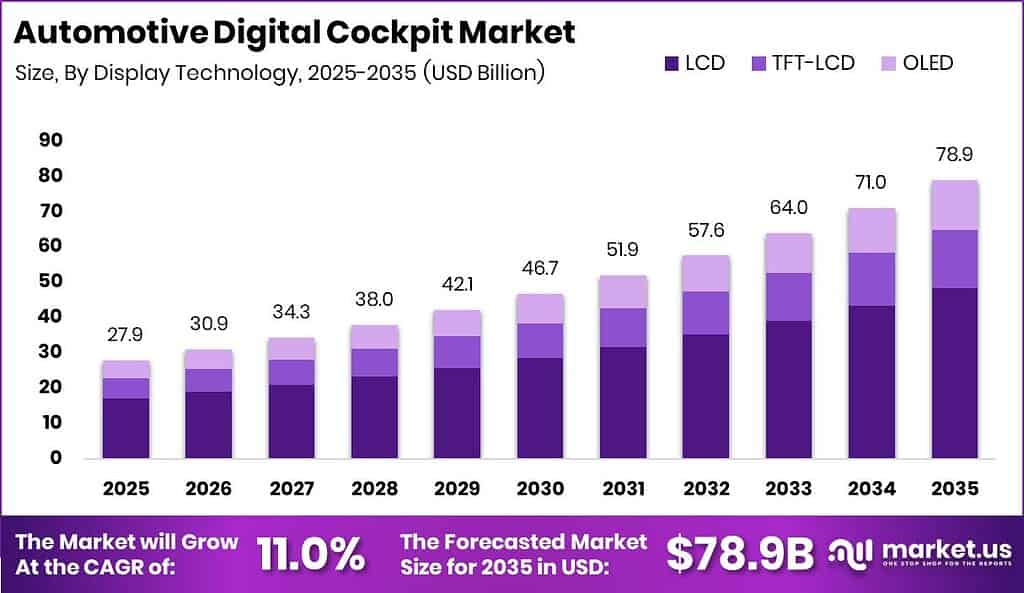
Global Automotive Digital Cockpit Market size is expected to be worth around USD 78.90 Billion by 2035 from USD 27.90 Billion in 2025, growing at a CAGR of 11.0% during the forecast period 2026 to 2035. This expansion reflects rising software content per vehicle and multi-display cabin architectures. Investors should treat cockpit electronics as a recurring software margin pool rather than a one-time hardware sale.
Therefore, the Automotive Digital Cockpit Market covers integrated digital instrument clusters, infotainment systems, head-up displays, and driver monitoring hardware plus software that replace traditional analog dashboards. The structure splits by equipment type, display technology, application focus, and vehicle type. Buyers pay for unified domain controllers that fuse safety, navigation, and cabin experience into one platform.
Key Takeaways
- The market reaches USD 27.90 Billion in 2025 and USD 78.90 Billion by 2035 at a CAGR of 11.0%.
- Digital instrument cluster leads equipment with a 46.7% share.
- LCD leads display technology with a 61.2% share.
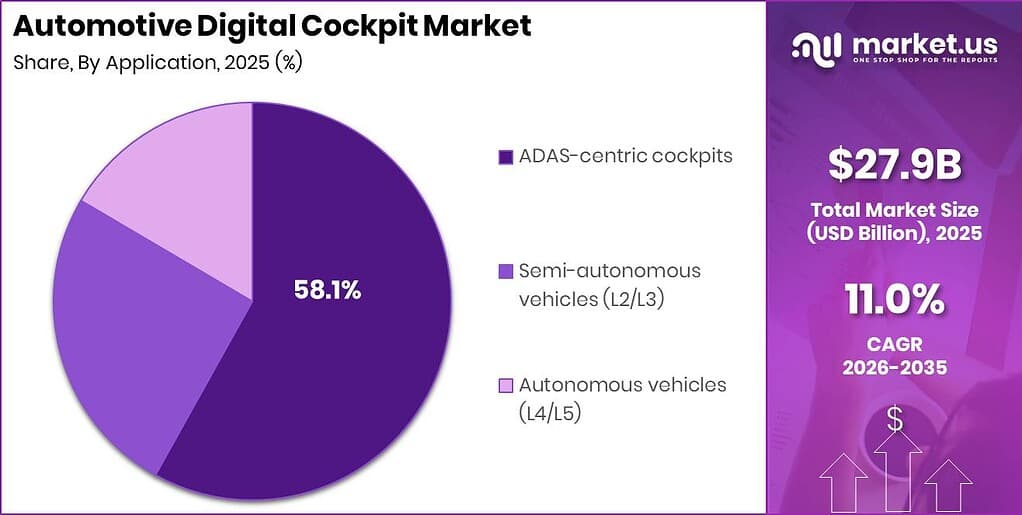
- ADAS-centric cockpits lead application with a 58.1% share.
- Passenger vehicles lead vehicle type with a 76.6% share.
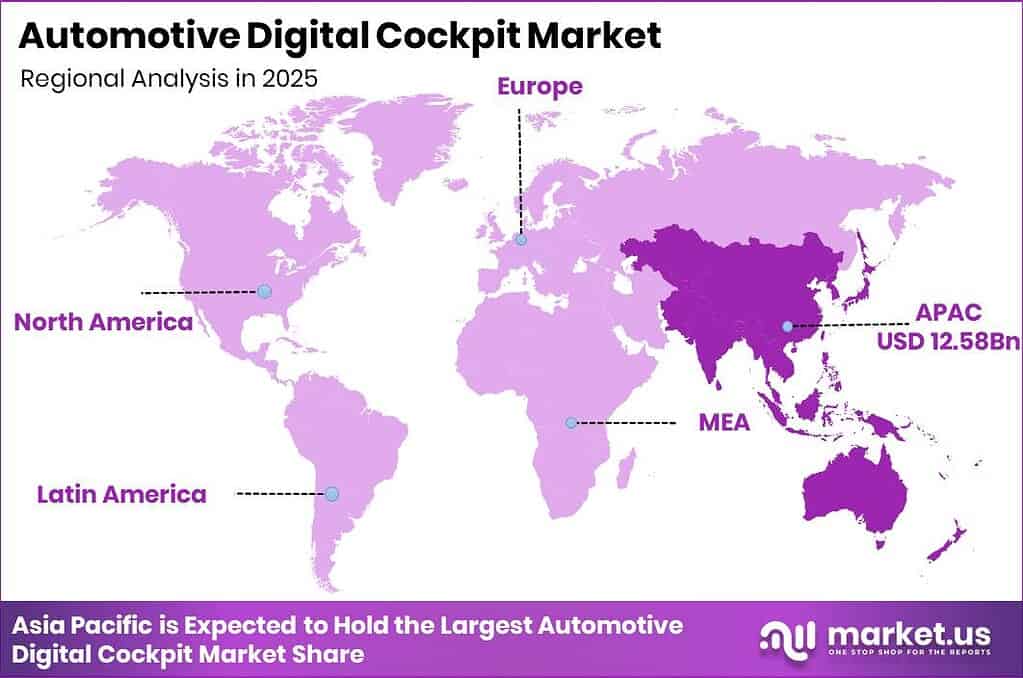
- Asia Pacific leads regions with a 45.1% share valued at USD 12.58 Billion.
- Head-up display, OLED, semi-autonomous L2/L3, and electric vehicles rank as fastest-growing sub-segments.
As per our research, Bosch delivered more than 10 million cockpit computers powered by Qualcomm Snapdragon platforms by April 2026, up from 1 million units in 2023. This 10× volume jump proves centralized cockpit compute has left pilot status. Suppliers who lock long-term SoC allocations now capture OEM platform wins that last a full vehicle generation.
Consequently, a 2025 survey of 1,428 drivers found that 89% preferred physical buttons over touchscreen-only controls. This usability signal forces cockpit designers to blend haptic controls with digital screens. Vendors who ignore button demand risk higher warranty claims and lower owner satisfaction scores.
As a result, Geely consolidated nearly 2,000 digital cockpit R&D engineers into one organization in March 2025 to cut duplicated effort across brands. This internal scale-up ties end-use EV and multi-brand growth directly to shared cockpit software platforms. Investors gain when OEMs treat cockpit stacks as reusable corporate assets rather than brand-specific projects.
Equipment Analysis
Digital instrument cluster dominates with 46.7% due to mandatory digital gauge replacement.
In 2025, Digital instrument cluster held a dominant market position in the By Equipment segment of Automotive Digital Cockpit Market, with a 46.7% share. OICA data show global vehicle production reached 96.4 million units in 2025, up 3.9% from 2024. Clusters convert every new build into a digital display order. Suppliers who certify clusters for multiple OEM platforms win volume before HUD and monitoring scale.
Infotainment systems deliver media, navigation, and smartphone projection as the primary passenger interface layer. Global vehicle sales hit 99.8 million units in 2025 per OICA tallies. Each sale that ships with connected media raises software attach value. Vendors who bundle app ecosystems with hardware lock recurring license fees after the vehicle leaves the plant.
Head-up display projects speed and navigation onto the windshield and ranks as the fastest-growing equipment line. Driver monitoring cameras and sensors track gaze and fatigue for safety compliance. Both lines hold the remaining equipment share collectively. Early movers in HUD optics and camera modules capture premium trim content as regulations tighten cabin awareness rules.
Display Technology Analysis
LCD dominates with 61.2% due to proven cost and supply scale.
In 2025, LCD held a dominant market position in the By Display Technology segment of Automotive Digital Cockpit Market, with a 61.2% share. OICA recorded 96.4 million vehicles produced worldwide in 2025, anchoring mass LCD panel demand. Cost predictability keeps LCD as the default for volume trims. Panel makers who secure automotive-grade yield protect margin when premium OLED remains capacity-limited.
TFT-LCD variants improve response time and viewing angles for multi-screen cockpits without full OLED cost. National statistical office vehicle output data align display orders with assembly schedules across major producing nations. This technology bridges economy and mid-tier cabins. Suppliers who dual-source TFT lines reduce OEM allocation risk during chip and glass shortages.
OLED ranks as the fastest-growing display technology for deep contrast and flexible form factors. In January 2025, AUO and BHTC unveiled the AUO Smart Cockpit 2025 at CES with transparent Micro LED and advanced HMI display solutions. Premium brands adopt OLED first on flagship trims. Display vendors who qualify automotive OLED lifetimes win design slots that migrate downward over the decade.
Application Analysis
ADAS-centric cockpits dominate with 58.1% due to safety feature bundling.
In 2025, ADAS-centric cockpits held a dominant market position in the By Application segment of Automotive Digital Cockpit Market, with a 58.1% share. Global ADAS and related system penetration stood near 66% of relevant vehicle classes in 2025 per industry association tracking. Cockpits that fuse ADAS alerts with the driver display become the default safety surface. Tier-1s who certify fused HMI stacks shorten OEM validation cycles.
Semi-autonomous vehicles at L2 and L3 form the fastest-growing application because drivers still need rich status and takeover cues. IEA data show electric car sales on track to surpass 20 million units in 2025, many shipping with L2 packages. Higher autonomy software content raises cockpit compute spend per unit. Software suppliers who certify L2/L3 HMI templates gain multi-year platform revenue.
Autonomous vehicles at L4 and L5 require full cabin redesign once the driver role fades. Regulatory filings and trade association roadmaps still place high-volume L4 fleets later in the decade. This application holds remaining share with long design cycles. Investors who fund cabin experience software for robotaxi interiors position for the next architecture wave.
Vehicle Type Analysis
Passenger vehicles dominate with 76.6% due to high personal car volumes.
In 2025, Passenger vehicles held a dominant market position in the By Vehicle Type segment of Automotive Digital Cockpit Market, with a 76.6% share. OICA figures place passenger car production well above 67 million units in recent full-year tallies inside the broader 96.4 million vehicle total for 2025. Personal cars absorb the bulk of multi-display and cluster spend. Suppliers who optimize BOM for high-volume passenger platforms secure the largest absolute revenue base.
Commercial vehicles need durable clusters, fleet telematics links, and simplified HMI for professional drivers. Fleet operators prioritize uptime and remote diagnostics over luxury screens. This segment rewards ruggedized controllers and long software support windows. Vendors who certify commercial duty cycles win municipal and logistics contracts with multi-year service attachments.
Electric vehicles across BEV, HEV, and PHEV rank as the fastest-growing vehicle type for native digital HMI. IEA reports electric car sales expected to surpass 20 million in 2025, over a quarter of global car sales. EV platforms launch without analog legacy constraints. Cockpit vendors who ship EV-native energy and range interfaces capture share as electrification rises.
Key Market Segments
By Equipment
- Digital instrument cluster
- Infotainment system
- Head-up display (HUD)
- Driver monitoring
By Display Technology
- LCD
- TFT-LCD
- OLED
By Application
- ADAS-centric cockpits
- Semi-autonomous vehicles (L2/L3)
- Autonomous vehicles (L4/L5)
By Vehicle Type
- Passenger vehicles
- Commercial vehicles
- Electric vehicles (BEV/HEV/PHEV)
Regional Analysis
Asia Pacific Dominates the Automotive Digital Cockpit Market with a Market Share of 45.1%, Valued at USD 12.58 Billion
Asia Pacific leads with a 45.1% share worth USD 12.58 Billion on the back of high vehicle output in China, Japan, South Korea, and India. Regional OEM software-defined launches pull multi-display and domain-controller content into mass models. Suppliers with local engineering and assembly footprints convert this volume into sticky platform contracts. This means regional content rules favor partners who co-develop with domestic brands.
North America and Europe follow as high-value markets where ADAS mandates and premium EV trims raise average cockpit spend per vehicle. Interest-rate and tariff pressure slow some CapEx, yet software attach still rises. By contrast, Latin America and Middle East and Africa remain earlier in multi-display adoption. Vendors who offer modular mid-tier stacks open those fleets without full premium BOM cost.
Key Regions and Countries
North America
- US
- Canada
Europe
- Germany
- France
- The UK
- Spain
- Italy
- Rest of Europe
Asia Pacific
- China
- Japan
- South Korea
- India
- Australia
- Rest of APAC
Latin America
- Brazil
- Mexico
- Rest of Latin America
Middle East and Africa
- GCC
- South Africa
- Rest of MEA
Market Dynamics
Market Opportunity Analysis - OLED, HUD, L2/L3, and EV cabins remain the clearest entry lanes for new capital.
OLED display technology still sits behind LCD share yet ranks as the fastest-growing display path. Premium contrast and flexible layouts remain under-penetrated outside flagship trims. New entrants who qualify automotive lifetimes and dual-source panels can undercut incumbents on design-win speed. This creates a clear wedge before OLED becomes standard mid-trim content.
Head-up display equipment grows fastest within the equipment group while cluster still holds 46.7%. Many volume models still lack full-color HUD. Suppliers focused on compact optics and lower BOM cost open the mid-market. Investors who fund HUD-specific optical stacks capture content growth without fighting the mature cluster installed base.
Semi-autonomous L2/L3 applications outpace pure ADAS-centric share growth even though ADAS-centric cockpits hold 58.1%. Takeover cues and status-rich HMI remain unfinished on many platforms. Software firms that certify L2/L3 templates across multiple OEMs scale faster than hardware-only rivals. This reflects a pure software attach opportunity on already-shipping compute.
Electric vehicles grow fastest by vehicle type while passenger cars still hold 76.6%. EV architectures accept native digital HMI without analog legacy. Regional white space in India and Southeast Asia favors affordable EV cockpit packs. Entrants who price for emerging-market EV platforms gain volume before global Tier-1s fully localize.
Technology and Innovation Landscape - Centralized AI compute and fused cabin sensing redefine cockpit value.
Qualcomm confirmed in 2026 that its centralized automotive computer manages inputs from up to 13 cameras while running infotainment, climate, connectivity, and driver assistance together. This single-box design cuts wiring and ECU count. Manufacturers who adopt it lower assembly cost and raise OTA feature speed. Investors should track SoC design-win lists as the new competitive scoreboard.
Horizon Robotics disclosed in 2026 a next-generation automotive processor targeting roughly 500 to 700 TOPS for integrated cockpit-driving workloads. Higher TOPS density supports on-device generative AI without constant cloud calls. Tier-1s who integrate such silicon early differentiate on latency and privacy. This signals a shift of AI budget from data centers into the vehicle bill of materials.
Market.us indicates that new intelligent cockpit platforms combine Driver Monitoring System, Cabin Monitoring System, Face ID, cockpit audio, and AI services into one architecture instead of separate boxes. Integration lowers BOM and simplifies cybersecurity boundaries. Suppliers who ship pre-integrated sensing stacks win faster OEM validation. Buyers gain cleaner HMI behavior across safety and comfort functions.
A 2025 automotive digital twin case study ran on a 1/10-scale autonomous vehicle and validated standardized software architectures for intelligent cockpits. Digital twins shorten calibration loops before full vehicle builds. Engineering teams that adopt twin-based sign-off cut prototype spend. This creates a software-tools adjacency for cockpit middleware vendors.
Drivers
OEMs accelerated the move from many separate ECUs to centralized cockpit domain computers through 2024 and 2025 platform launches. Cockpit SoC shipments with neural processing rose an estimated 18% to 22% year on year. Electronics cost per vehicle rose roughly USD 120 to 180. Connected-cockpit attach passed 70% of new registrations in the EU and China by 2025. This shift opens software margins of 60% to 75% while hardware-only margins compress 3 to 5 points.
Therefore, Tier-1 suppliers must move CapEx from discrete display modules toward SoC and middleware research. Buyers gain over-the-air feature activation after sale. Investors should favor firms that already sell subscription-ready cockpit stacks rather than pure glass and plastic suppliers.
| Driver | (~) % Impact on CAGR Forecast | Geographic Relevance | Impact Timeline |
|---|---|---|---|
| Software-defined vehicle architecture shift | +2.6% | Global, led by North America & China | Short term (2 years or less) |
| Rising multi-display and passenger-side screen adoption | +1.8% | China, South Korea, Western Europe | Short term (2 years or less) |
| EV platform proliferation demanding native digital HMI | +1.5% | China, Europe, India | Short term (2 years or less) |
| Consumer pull for smartphone-grade connectivity in-cabin | +1.2% | Global | Short term (2 years or less) |
| OEM shift to centralized cockpit domain controllers | +0.9% | Germany, Japan, United States | Medium term (2 to 4 years) |
Restraints
Cockpit-grade SoC and display driver capacity sits in a few Southeast Asian and Taiwanese foundry clusters. Lead times stayed at 26 to 34 weeks through 2025 versus a prior baseline near 12 weeks. OEMs reported production derating of 5% to 8% on cockpit-equipped trims. Surplus ordering ran 10% to 20% above forecast. This bottleneck slows feature rollouts and forces capital into allocation deals instead of new R&D.
As a result, Tier-1 suppliers absorb component cost inflation of roughly 8% to 12% per unit under fixed OEM contracts. High rates and import tariffs on processors add further delay in North America and Europe. Market participants who dual-source silicon and qualify alternate display drivers protect delivery schedules and margin.
| Restraint | (~) % Impact on CAGR Forecast | Geographic Relevance | Impact Timeline |
|---|---|---|---|
| Cockpit-grade semiconductor and display supply constraints | -1.9% | Global, acute in Southeast Asia foundries | Short term (2 years or less) |
| High interest-rate environment delaying OEM electronics CapEx | -1.3% | North America, Europe | Short term (2 years or less) |
| Import tariffs on processors, sensors and connectivity modules | -1.1% | United States, EU | Short term (2 years or less) |
| Premium price ceiling limiting mass-market cockpit adoption | -0.7% | India, Southeast Asia, Latin America | Short term (2 years or less) |
Challenges
UNECE R155 and R156 type-approval rules since 2024 force OEMs to run an auditable Cybersecurity Management System for the full vehicle life. Compliance and audit costs sit 15% to 25% above prior engineering baselines. OTA incident staffing extends validation by 4 to 6 months per platform refresh. This burden does not stop sales yet caps how fast cockpit software features can refresh.
This creates demand for standing CSMS operations teams and third-party audit tooling as a new services revenue stream. Suppliers who productize continuous monitoring and update pipelines sell multi-year contracts. Engineering bandwidth shifts from pure feature velocity to sustained compliance across a decade-long vehicle life.
| Challenge | (~) % CAGR Friction Drag | Geographic Relevance | Mitigation Horizon |
|---|---|---|---|
| Cybersecurity compliance lifecycle burden | -1.4% | EU, Japan, South Korea (UNECE markets) | Medium term (2 to 4 years) |
| Embedded software talent shortage | -1.0% | Global, acute in Germany, United States | Medium term (2 to 4 years) |
| Cross-domain software integration complexity | -0.8% | Global | Medium term (2 to 4 years) |
| Fragmented regional HMI localization needs | -0.5% | India, China, Southeast Asia | Long term (4 years or more) |
Opportunities
In-cabin sensing hardware already ships under safety rules, yet the data monetization layer remains largely unused. EU General Safety Regulation paths point to near-universal driver-monitoring fitment in new EU registrations by 2026. Software attach for fatigue alerts, insurance feeds, and fleet analytics still sits in low single digits. Modeled software margins reach 55% to 65% with little extra hardware cost.
This signals blended gross-margin expansion of 4 to 6 points for suppliers who productize the data layer early. Feature-on-demand subscriptions and affordable localized cockpits for India, Southeast Asia, and Africa add further upside. Early movers who pair sensors with clear data-governance offers define the next profit pool before rivals standardize the stack.
| Opportunity | (~) % Potential CAGR Upside | Geographic Relevance | Execution Window |
|---|---|---|---|
| In-cabin sensing and driver-state monetization | +1.9% | Europe, North America, China | Medium term (2 to 4 years) |
| Feature-on-demand subscription layer for cockpit functions | +1.6% | Global | Medium term (2 to 4 years) |
| Localized affordable cockpit platforms for emerging markets | +1.3% | India, Southeast Asia, Africa | Long term (4 years or more) |
| AR-HUD and generative-AI voice assistant adjacencies | +1.0% | Japan, South Korea, Western Europe | Long term (4 years or more) |
| Cockpit-electronics roll-up consolidation among Tier-2 suppliers | +0.7% | Global | Medium term (2 to 4 years) |
Key Company Insights
Robert Bosch GmbH plans to invest more than €2.5 billion in artificial intelligence by the end of 2027 for cockpit software and driver assistance. The firm expects software and services revenue above €6 billion in the early 2030s, with about two-thirds from mobility. This scale funds centralized cockpit computers already past 10 million units shipped. Rivals without matching AI budgets risk losing domain-controller nominations.
Continental AG introduced its Emotional Cockpit at CES 2025 with a full-width E Ink Prism display and AI-enabled adaptive interface for passenger vehicles. This design positions the company in premium cabin experience rather than pure cluster volume. The approach wins design awards and high-trim content. However, slower mass-market cost curves could limit share if volume OEMs prioritize cheaper LCD stacks.
Key Players
- Robert Bosch GmbH
- Continental AG
- DENSO Corporation
- Visteon Corporation
- Harman International (Samsung)
- Panasonic Corporation
- Aptiv PLC
- Hyundai Mobis Co., Ltd.
- LG Electronics Inc.
- Faurecia SE (FORVIA)
- Marelli Holdings Co., Ltd.
- Pioneer Corporation
- Desay SV Automotive
- Joyson Electronics
- Garmin Ltd.
Recent Developments
- January 2025: Visteon unveiled its cognitoAI digital cockpit platform and a next-generation high-performance cockpit controller at CES 2025, consolidating infotainment, driver information, navigation, and ADAS functions into a single computing platform.
- April 2025: Visteon launched its next-generation intelligent digital cockpit platform built on the Qualcomm Snapdragon Cockpit Elite Platform, delivering generative AI capabilities, immersive HMI, and centralized cockpit computing for software-defined vehicles.
Geopolitical Impact Analysis
According to WTO-linked trade measures tracked through 2025 and 2026, the United States applied a 25% tariff on automobiles and certain auto parts and a 25% duty on covered advanced computing chips under Section 232 actions. Cockpit SoCs, sensors, and connectivity modules sit inside these categories. As a result, landed cost for imported domain controllers rises sharply for US assembly. OEMs reroute sourcing toward domestic or allied foundry capacity to protect trim pricing.
Data from UNCTAD and World Bank logistics monitors show prolonged semiconductor lead times and elevated freight volatility on Asia-Europe and Asia-US lanes through the mid-2020s. Automotive-grade chip waits of roughly 26 to 34 weeks versus a 12-week norm amplify tariff shocks. This means cockpit program launches slip when allocation and customs clearance stack together. Suppliers with multi-region backend packaging and bonded inventory gain share when single-region pipelines stall.
Report Scope
| Report Features | Description |
|---|---|
| Market Value (2025) | USD 27.90 Billion |
| Forecast Revenue (2035) | USD 78.90 Billion |
| CAGR (2026-2035) | 11.0% |
| Base Year for Estimation | 2025 |
| Historic Period | 2020-2024 |
| Forecast Period | 2026-2035 |
| Report Coverage | Revenue Forecast, Market Dynamics, Market Opportunity Analysis, Technology and Innovation Landscape, Competitive Landscape, Recent Developments |
| Segments Covered | By Equipment (Digital instrument cluster, Infotainment system, Head-up display (HUD), Driver monitoring), By Display Technology (LCD, TFT-LCD, OLED), By Application (ADAS-centric cockpits, Semi-autonomous vehicles (L2/L3), Autonomous vehicles (L4/L5)), By Vehicle Type (Passenger vehicles, Commercial vehicles, Electric vehicles (BEV/HEV/PHEV)) |
| Regional Analysis | North America (US and Canada), Europe (Germany, France, The UK, Spain, Italy, and Rest of Europe), Asia Pacific (China, Japan, South Korea, India, Australia, and Rest of APAC), Latin America (Brazil, Mexico, and Rest of Latin America), Middle East and Africa (GCC, South Africa, and Rest of MEA) |
| Competitive Landscape | Robert Bosch GmbH, Continental AG, DENSO Corporation, Visteon Corporation, Harman International (Samsung), Panasonic Corporation, Aptiv PLC, Hyundai Mobis Co., Ltd., LG Electronics Inc., Faurecia SE (FORVIA), Marelli Holdings Co., Ltd., Pioneer Corporation, Desay SV Automotive, Joyson Electronics, Garmin Ltd. |
| Customization Scope | Customization for segments, region / country-level will be provided. Additional customization can be done based on requirements. |
| Purchase Options | We have three licenses to opt for: Single User License | Multi-User License (Up to 5 Users) | Corporate Use License (Unlimited User and Printable PDF) |





































