


Global Auto Dimming Mirror Market Size, Share, Growth Analysis By Fuel Type (ICE, Hybrid, Electric), By Functionality (Connected Auto-Dimming Mirrors, Non-Connected Auto-Dimming Mirrors), By Technology (Automatic Dimming, Manual Dimming), By Vehicle Type (Passenger Vehicle, Commercial Vehicle), By Application (Inside Rear-View Mirror, Outside Rear-View Mirror), By Region and Companies - Industry Segment Outlook, Market Assessment, Competition Scenario, Statistics, Trends and Forecast 2025-2034
- Published date: Jan 2026
- Report ID: 173342
- Number of Pages: 271
- Format:
-
keyboard_arrow_up
Quick Navigation
Report Overview
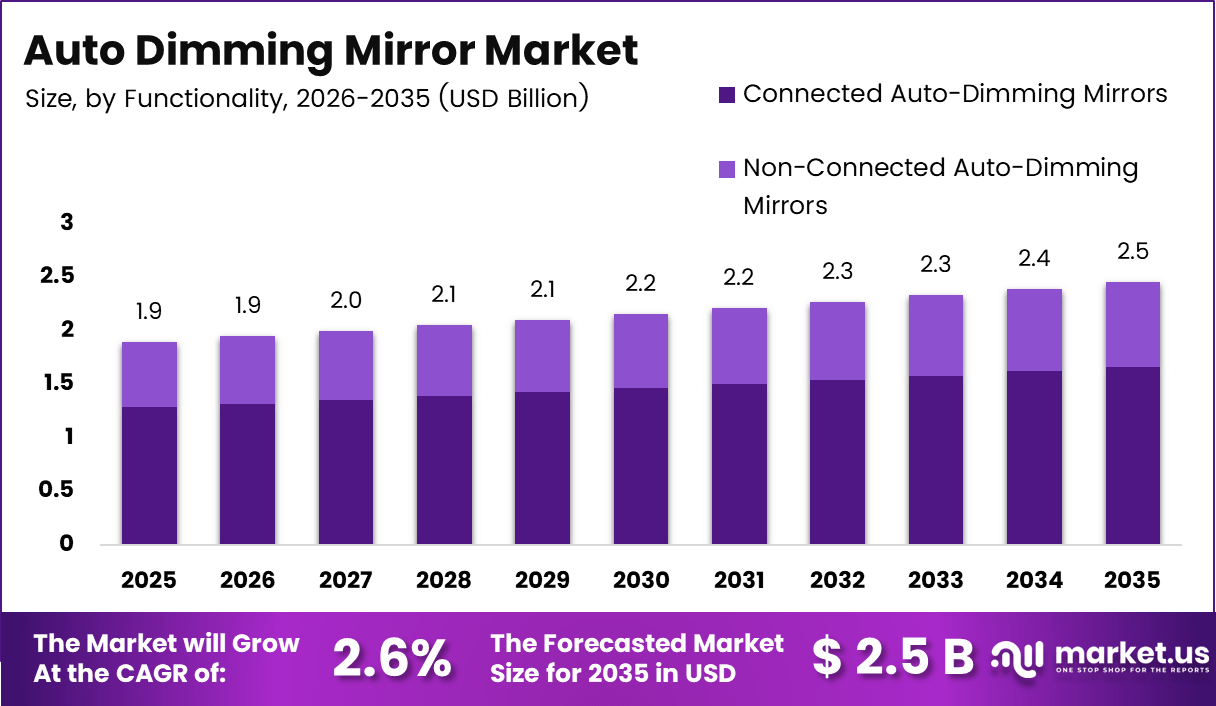
The Global Auto Dimming Mirror Market size is expected to be worth around USD 2.5 billion by 2035, from USD 1.9 billion in 2025, growing at a CAGR of 2.6% during the forecast period from 2026 to 2035.
The auto dimming mirror market represents the commercial ecosystem around intelligent rearview mirrors that automatically reduce glare from trailing headlights. From a functional standpoint, these mirrors improve night driving visibility, reduce eye strain, and enhance overall road safety. Consequently, OEMs increasingly treat auto dimming mirrors as standard safety and comfort components.
From an analyst viewpoint, the auto dimming mirror market reflects the automotive industry’s steady shift toward smarter cabin electronics. As vehicle interiors evolve into digital cockpits, demand grows for glare free visibility solutions supporting driver focus. Moreover, rising adoption across passenger cars, SUVs, and premium fleets strengthens long term market attractiveness.
Market growth remains closely linked to increasing vehicle production, safety awareness, and consumer expectations for comfort features. In parallel, electrification and semi autonomous driving trends accelerate integration of advanced mirrors supporting cameras, sensors, and display. As a result, manufacturers prioritize scalable electrochromic technologies compatible with modern vehicle architectures.
Government investment and regulation further support market expansion through road safety mandates and visibility standards. Many transportation authorities promote technologies reducing night time accidents caused by headlight glare. Therefore, regulatory encouragement indirectly accelerates OEM installation rates, especially in mid range and premium vehicles, supporting consistent demand across mature and emerging regions.
From a product perspective, an auto dimming mirror is defined as an interior cabin mirror used to view objects behind the vehicle. According to Ford, electrochromic rearview mirrors dynamically adjust reflectivity for glare control. Ford specifies mirror weight at 1.50 lb, supporting lightweight vehicle interior design priorities.
According to Ford specifications, mirror dimensions measure 11.25 L x 8.63 W x 4.13 H in, reflecting compact integration suitability. From a cost standpoint, industry sources indicate replacement pricing typically ranges between 10 and 400 dollars, depending on vehicle class, technology integration, and installation complexity.
Technology evolution further shapes market opportunities through display innovation. According to Nissan, conventional monitors with 4:3 or 16:9 aspect ratios fail to fit rearview mirror formats effectively. Therefore, Nissan developed LCD mirrors with an approximate 4:1 aspect ratio, enabling wider rear visibility and digital mirror adoption.
Key Takeaways
- Global Auto Dimming Mirror Market is projected to reach USD 2.5 billion by 2035, up from USD 1.9 billion in 2025, growing at a 2.6% CAGR.
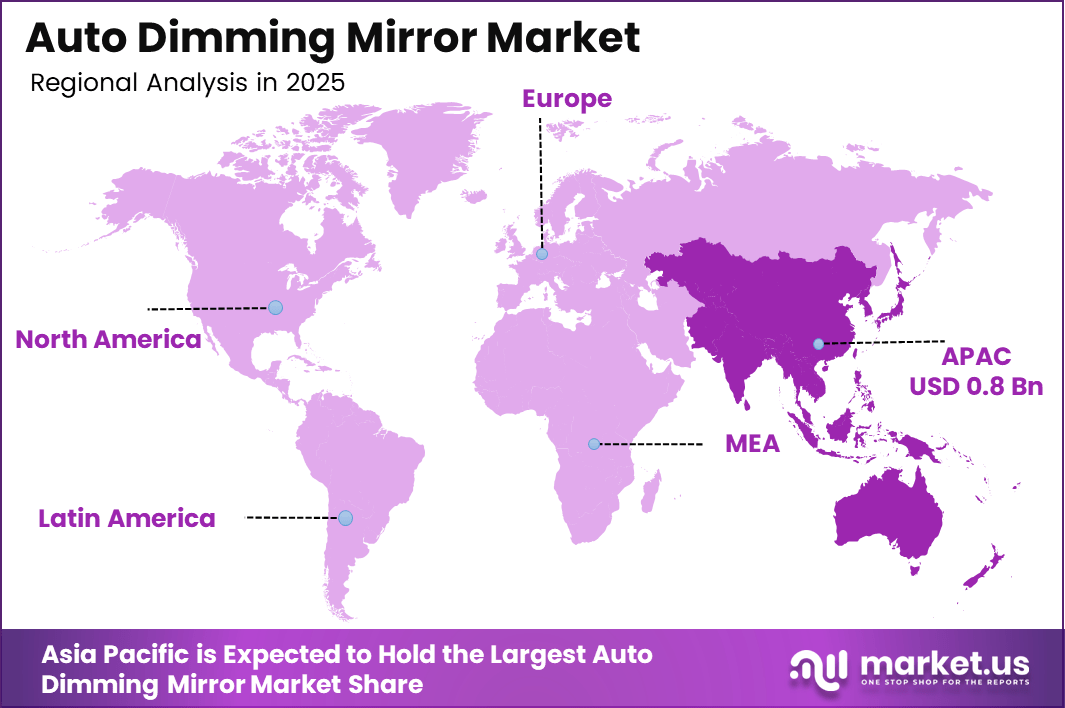
- Asia Pacific dominates the market with a 43.8% share, valued at USD 0.8 billion, driven by high vehicle production and safety feature adoption.
- By fuel type, ICE vehicles lead with a dominant 71.2% share, reflecting the large global installed vehicle base.
- By functionality, Connected Auto-Dimming Mirrors account for 67.7% of the market due to expanding smart cockpit integration.
- By technology, Automatic Dimming holds a commanding 89.9% share, supported by superior glare reduction performance.
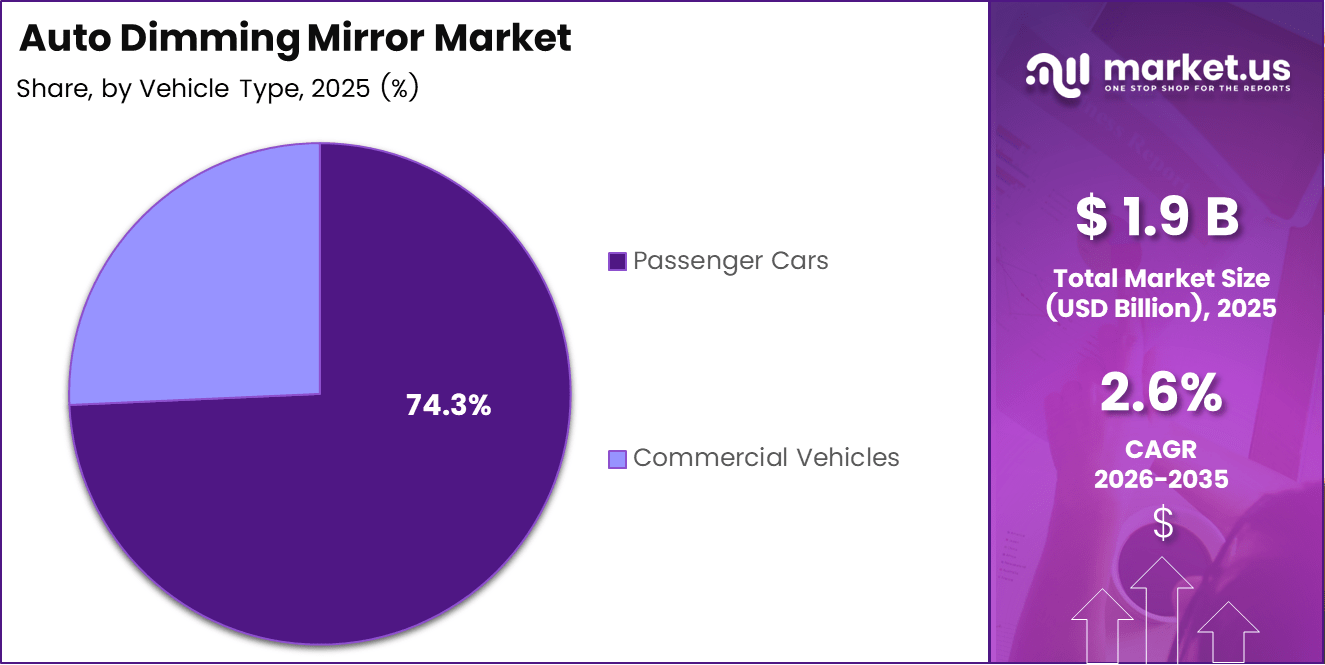
- By vehicle type, Passenger Vehicles represent 74.30% of demand, driven by comfort and safety feature standardization.
- By application, Inside Rear-View Mirrors dominate with a 61.20% share, highlighting their critical role in night driving visibility.
By Fuel Type Analysis
ICE dominates with 71.2% due to its widespread global vehicle parc and sustained production volumes.
In 2025, ICE held a dominant market position in the By Fuel Type Analysis segment of Auto Dimming Mirror Market, with a 71.2% share. ICE vehicles continue driving demand due to high penetration across passenger and commercial fleets. Moreover, OEMs integrate auto dimming mirrors to enhance safety compliance and cabin comfort.
Hybrid vehicles represent a growing adoption base as manufacturers blend fuel efficiency with comfort features. As hybrids increasingly target mid priced consumers, auto dimming mirrors gain relevance as semi premium additions. Consequently, hybrid platforms create steady incremental demand without displacing ICE dominance.
Electric vehicles contribute to long term opportunity through advanced cockpit designs and digital integration. Although adoption volumes remain lower, EV platforms emphasize glare free visibility and sensor compatibility. Therefore, auto dimming mirrors align well with electric mobility strategies focused on intelligent interiors.
By Functionality Analysis
Connected Auto Dimming Mirrors dominate with 67.7% driven by rising smart cockpit integration.
In 2025, Connected Auto Dimming Mirrors held a dominant market position in the By Functionality Analysis segment of Auto Dimming Mirror Market, with a 67.7% share. Connectivity enables data exchange with vehicle systems, improving driver awareness and user experience across navigation and safety functions.
Non Connected Auto Dimming Mirrors maintain relevance in cost sensitive vehicle segments. These mirrors deliver core glare reduction benefits without advanced electronics. As a result, they remain preferred in entry level and fleet vehicles prioritizing affordability and functional reliability.
By Technology Analysis
Automatic Dimming dominates with 89.9% due to superior glare response and driver convenience.
In 2025, Automatic Dimming held a dominant market position in the By Technology Analysis segment of Auto Dimming Mirror Market, with a 89.9% share. Automatic systems use electrochromic technology to adjust reflectivity instantly. Therefore, drivers benefit from consistent visibility without manual intervention.
Manual Dimming mirrors continue serving niche applications where cost constraints dominate. These mirrors rely on physical adjustment mechanisms. Although technologically limited, they retain usage in older vehicle platforms and price driven markets prioritizing simplicity over automation.
By Vehicle Type Analysis
Passenger Vehicle dominates with 74.30% supported by high production volumes and feature demand.
In 2025, Passenger Vehicle held a dominant market position in the By Vehicle Type Analysis segment of Auto Dimming Mirror Market, with a 74.30% share. Consumers increasingly expect glare reduction as a standard comfort feature. Consequently, OEMs integrate auto dimming mirrors across sedans, SUVs, and crossovers.
Commercial vehicles adopt auto dimming mirrors at a slower pace due to cost sensitivity. However, safety focused fleet operators gradually integrate these mirrors to reduce driver fatigue. As regulations evolve, commercial adoption is anticipated to strengthen steadily.
By Application Analysis
Inside Rear View Mirror dominates with 61.20% due to direct impact on night driving safety.
In 2025, Inside Rear View Mirror held a dominant market position in the By Application Analysis segment of Auto Dimming Mirror Market, with a 61.20% share. Interior mirrors remain critical for glare reduction from trailing vehicles. Therefore, they represent the primary installation point for auto dimming technology.
Outside Rear View Mirrors gain attention as vehicle designs emphasize all round visibility. These mirrors support glare control from adjacent lanes. Although adoption remains lower, growing emphasis on driver assistance features supports gradual expansion in exterior applications.
Key Market Segments
By Fuel Type
- ICE
- Hybrid
- Electric
By Functionality
- Connected Auto-Dimming Mirrors
- Non-Connected Auto-Dimming Mirrors
By Technology
- Automatic Dimming
- Manual Dimming
By Vehicle Type
- Passenger Vehicle
- Commercial Vehicle
By Application
- Inside Rear-View Mirror
- Outside Rear-View Mirror
Drivers
Rising Integration of Advanced Driver Assistance Features Drives Market Growth
The auto dimming mirror market gains strong momentum from the growing use of advanced driver assistance features in modern vehicles. As vehicles adopt more safety focused systems, glare reduction becomes essential for clear rear visibility. Therefore, manufacturers increasingly integrate auto dimming mirrors to support safer night driving.
Regulatory focus on road safety further supports demand growth. Many authorities emphasize reducing accidents caused by headlight glare during low visibility conditions. As a result, auto dimming mirrors align well with safety standards and guidelines. This regulatory push encourages broader adoption across passenger and commercial vehicles.
Consumer preference also plays an important role in market expansion. Buyers increasingly value premium comfort and visibility enhancing features, even in mid range vehicles. Consequently, auto dimming mirrors transition from luxury options to expected interior features. This shift supports steady demand across multiple vehicle categories.
Expanding production of luxury electric vehicles strengthens long term growth. These vehicles feature smart interior systems focused on driver experience. Therefore, auto dimming mirrors fit naturally into modern cabin designs emphasizing comfort, safety, and digital integration.
Restraints
Higher Component Costs Limit Wider Market Penetration
The auto dimming mirror market faces restraint from higher component and replacement costs compared to conventional mirrors. Advanced electrochromic technology and electronic components increase manufacturing expenses. As a result, pricing remains a concern for cost sensitive buyers and manufacturers.
Replacement and repair costs also restrict adoption, especially in markets focused on affordability. When damage occurs, auto dimming mirrors require specialized parts. Therefore, maintenance costs discourage installation in vehicles designed for budget conscious consumers.
Limited penetration in low cost and entry level vehicle segments further restrains growth. Manufacturers in these segments prioritize essential features over comfort upgrades. Consequently, auto dimming mirrors remain optional rather than standard in lower priced models.
Additionally, uneven awareness across developing markets slows demand. Some consumers remain unfamiliar with long term safety benefits. Therefore, education and cost reduction remain necessary to improve adoption across all vehicle categories.
Growth Factors
Expanding Adoption in Electric Vehicles Creates New Opportunities
The auto dimming mirror market presents strong opportunities through expanding adoption of electrochromic mirrors in electric and autonomous vehicles. These platforms emphasize advanced safety and digital visibility solutions. Therefore, auto dimming mirrors align closely with future mobility requirements.
Aftermarket upgrades offer another promising growth avenue, particularly in emerging automotive markets. Vehicle owners increasingly seek comfort and safety enhancements after purchase. As a result, demand for retrofitting auto dimming mirrors continues to rise steadily.
Integration potential with camera based and digital rear view mirror systems creates additional value. These systems require optimized glare control for clear image display. Therefore, auto dimming technology complements digital visibility solutions in modern vehicles.
Growing vehicle sales in Asia Pacific and Latin America further support expansion. Rising disposable income and urbanization increase demand for advanced interior features. Consequently, these regions represent high growth potential for manufacturers.
Emerging Trends
Shift Toward Smart and Multifunctional Mirror Designs Shapes Trends
The auto dimming mirror market trends reflect a shift toward frameless and multifunctional interior mirror designs. Manufacturers focus on sleek aesthetics and space efficiency. As a result, mirrors increasingly combine glare reduction with modern interior styling.
Integration with compass and temperature displays continues gaining traction. These added features improve driver convenience without increasing dashboard complexity. Therefore, auto dimming mirrors evolve into multifunctional information tools inside the cabin.
Use of lightweight materials represents another important trend. Automakers prioritize weight reduction to improve fuel efficiency and driving range. Consequently, mirror designs adopt lighter materials without compromising performance or durability.
Alignment with connected and smart cockpit platforms further shapes market direction. Auto dimming mirrors increasingly interact with vehicle electronics and displays. Therefore, connectivity and digital compatibility define future product development strategies.
Regional Analysis
Asia Pacific Dominates the Auto Dimming Mirror Market with a Market Share of 43.8%, Valued at USD 0.8 Billion
Asia Pacific leads the auto dimming mirror market due to high vehicle production volumes and rapid adoption of advanced interior technologies. In this region, the market holds a dominant share of 43.8%, supported by strong demand from passenger vehicles and expanding electric mobility. Moreover, regional market value reached USD 0.8 billion, driven by growing safety awareness and urbanization.
North America Auto Dimming Mirror Market Trends
North America represents a mature market with strong emphasis on vehicle safety and comfort features. High penetration of advanced driver assistance systems supports steady demand for auto dimming mirrors. Additionally, consumer preference for premium interiors and regulatory focus on glare reduction sustain consistent market adoption.
Europe Auto Dimming Mirror Market Trends
Europe shows stable growth driven by stringent road safety regulations and strong automotive engineering standards. Automakers increasingly integrate glare reducing technologies to meet safety expectations. Furthermore, growing adoption of electric and luxury vehicles supports continued demand for advanced mirror systems.
Middle East and Africa Auto Dimming Mirror Market Trends
The Middle East and Africa market reflects gradual adoption influenced by improving vehicle safety standards and rising premium vehicle imports. Urban development and infrastructure expansion encourage demand for advanced vehicle features. However, cost sensitivity limits faster penetration across all vehicle segments.
Latin America Auto Dimming Mirror Market Trends
Latin America demonstrates emerging growth supported by increasing vehicle ownership and gradual feature upgrades. Consumers show rising interest in comfort and safety enhancements. As automotive production stabilizes, demand for auto dimming mirrors is anticipated to strengthen steadily across key markets.
U.S. Auto Dimming Mirror Market Trends
The U.S. market benefits from high consumer awareness of safety technologies and widespread use of advanced vehicle systems. Auto dimming mirrors align well with demand for comfort oriented driving solutions. Consequently, consistent integration across passenger and light commercial vehicles supports market stability.
Key Regions and Countries
North America
- US
- Canada
Europe
- Germany
- France
- The UK
- Spain
- Italy
- Rest of Europe
Asia Pacific
- China
- Japan
- South Korea
- India
- Australia
- Rest of APAC
Latin America
- Brazil
- Mexico
- Rest of Latin America
Middle East & Africa
- GCC
- South Africa
- Rest of MEA
Key Auto Dimming Mirror Company Insights
Ficosa International SA maintains a strong position through its focus on interior vision systems and advanced mirror electronics. The company aligns auto dimming mirror development with connected vehicle platforms, supporting seamless integration into modern dashboards. Its strategy emphasizes lightweight design and compatibility with advanced driver assistance architectures.
FLABEG AUTOMOTIVE GLASS GROUP GMBH leverages deep expertise in automotive glass processing to strengthen its auto dimming mirror offerings. The company emphasizes optical quality, glare control efficiency, and durability. Its analyst appeal lies in balancing advanced electrochromic performance with cost optimized glass solutions for global OEM programs.
Gentex Corporation remains a technology driven leader by continuously advancing electrochromic mirror functionality. The company focuses on automatic dimming precision, multifunction integration, and system reliability. From a market perspective, Gentex benefits from early innovation leadership and sustained investment in next generation mirror technologies.
Honda Lock Mfg. Co. Ltd. (Honda Motor Company Ltd) supports the market through close alignment with vehicle interior and body component development. Its auto dimming mirror strategy emphasizes safety, quality consistency, and integration within broader vehicle systems. Analysts view its strength in stable OEM demand and disciplined engineering execution.
Overall, these players shape the auto dimming mirror market by prioritizing safety enhancement, digital readiness, and manufacturing scalability. Their strategies reflect a shift toward intelligent interior components that support long term automotive transformation rather than standalone hardware features.
Top Key Players in the Market
- Ficosa International SA
- FLABEG AUTOMOTIVE GLASS GROUP GMBH
- Gentex Corporation
- Honda Lock Mfg. Co. Ltd. (Honda Motor Company Ltd)
- Konview Electronics Corporation Limited
- Magna International Inc.
- Murakami Corporation
- SAMVARDHANA MOTHERSON GROUP
- Germid Co. Ltd.
- TOKAIRIKA CO., LTD.
Recent Developments
- In Nov 2025, Gentex Corporation showcased its innovation leadership at the SEMA show by unveiling two custom vehicles, including one collaboration with Ringbrothers and another with Classic Car Studio, highlighting advanced aftermarket integration, the company launched a slim profile, carbon fiber automatic dimming rearview mirror tailored for the custom car segment, designed for lightweight performance and sold exclusively through Ringbrothers.
Report Scope
Report Features Description Market Value (2025) USD 1.9 billion Forecast Revenue (2035) USD 2.5 billion CAGR (2026-2035) 2.6% Base Year for Estimation 2025 Historic Period 2020-2024 Forecast Period 2026-2035 Report Coverage Revenue Forecast, Market Dynamics, Competitive Landscape, Recent Developments Segments Covered By Fuel Type (ICE, Hybrid, Electric), By Functionality (Connected Auto-Dimming Mirrors, Non-Connected Auto-Dimming Mirrors), By Technology (Automatic Dimming, Manual Dimming), By Vehicle Type (Passenger Vehicle, Commercial Vehicle), By Application (Inside Rear-View Mirror, Outside Rear-View Mirror) Regional Analysis North America (US and Canada), Europe (Germany, France, The UK, Spain, Italy, and Rest of Europe), Asia Pacific (China, Japan, South Korea, India, Australia, and Rest of APAC), Latin America (Brazil, Mexico, and Rest of Latin America), Middle East & Africa (GCC, South Africa, and Rest of MEA) Competitive Landscape Ficosa International SA, FLABEG AUTOMOTIVE GLASS GROUP GMBH, Gentex Corporation, Honda Lock Mfg. Co. Ltd. (Honda Motor Company Ltd), Konview Electronics Corporation Limited, Magna International Inc., Murakami Corporation, SAMVARDHANA MOTHERSON GROUP, Germid Co. Ltd., TOKAIRIKA CO., LTD. Customization Scope Customization for segments, region/country-level will be provided. Moreover, additional customization can be done based on the requirements. Purchase Options We have three licenses to opt for: Single User License, Multi-User License (Up to 5 Users), Corporate Use License (Unlimited User and Printable PDF) 
-
-
- Ficosa International SA
- FLABEG AUTOMOTIVE GLASS GROUP GMBH
- Gentex Corporation
- Honda Lock Mfg. Co. Ltd. (Honda Motor Company Ltd)
- Konview Electronics Corporation Limited
- Magna International Inc.
- Murakami Corporation
- SAMVARDHANA MOTHERSON GROUP
- Germid Co. Ltd.
- TOKAIRIKA CO., LTD.
Our Clients

- 173342
- Jan 2026






