AML Investigation Platform Market By Component (Software, Services), By Deployment Mode (On-Premises, Cloud-Based), By Organization Size (Large Enterprises, Small and Medium Enterprises), By Application (Transaction Monitoring, Case Management, Compliance Reporting, Risk Assessment, Others), By End-User (Banks and Financial Institutions, Insurance Companies, Fintech Companies, Government Agencies, Others), By Regional Analysis, Global Trends and Opportunity, Future Outlook By 2026-2035
The Global AML Investigation Platform Market generated USD 3.7 billion in 2025 and is predicted to register growth from USD 4.5 billion in 2026 to about USD 25.3 billion by 2035, recording a CAGR of 21.3% throughout the forecast span. In 2025, North America held a dominant market position, capturing more than a 37.7% share, holding USD 1.38 Billion revenue.
Top Market Takeaways
Component Software accounts for 68.2% of the AML Investigation Platform market, as most institutions invest in advanced investigation and analytics tools rather than standalone services.
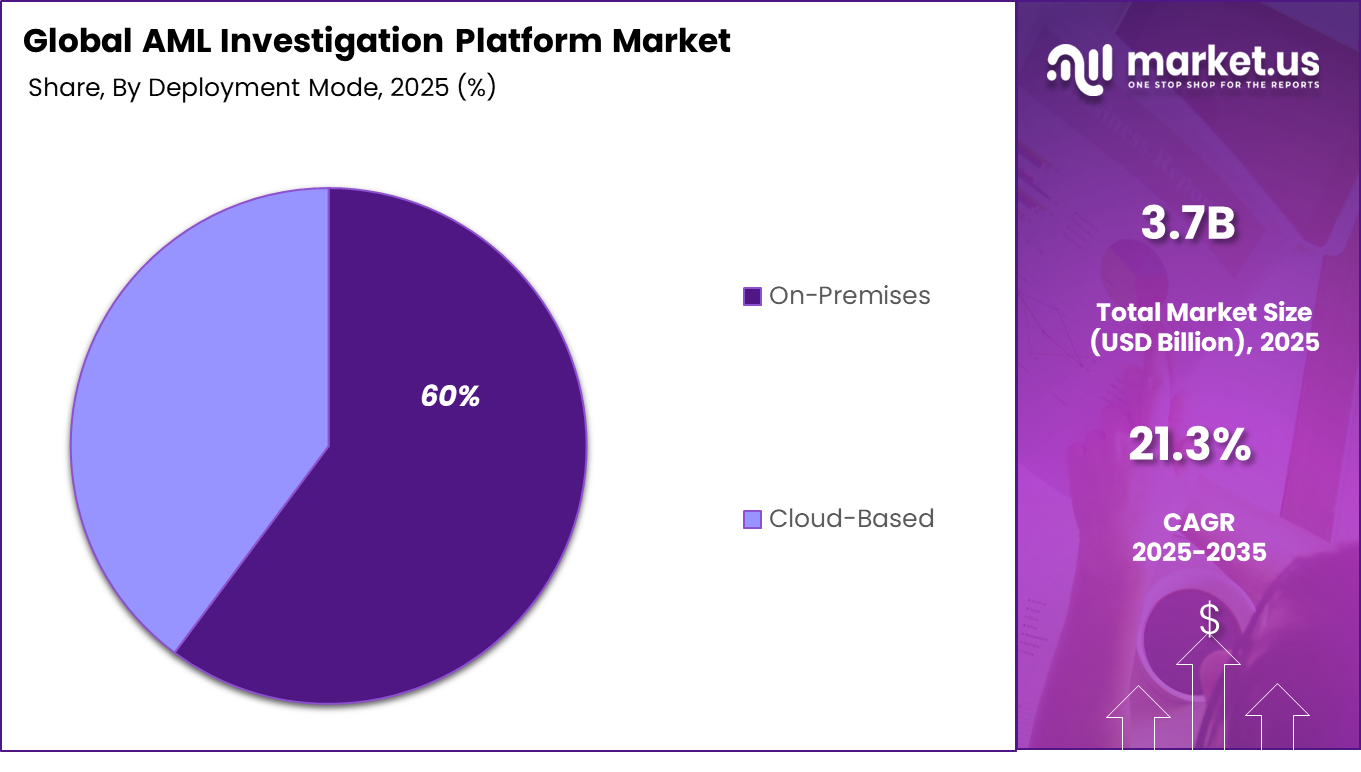
Deployment Mode On-premises holds 60.2% of the market, because many banks and financial institutions prefer to host AML platforms within their own data centers to meet strict security and regulatory requirements.
Organization Size Large enterprises make up 75.2%, reflecting that major banks and large financial groups have the most complex compliance needs and highest transaction volumes.
Application Transaction monitoring represents 64.9% of demand, since detecting suspicious transactions and patterns is the core use case for AML investigation platforms.
End-User Banks and financial institutions account for 43.7% of the market, as they are the primary users responsible for complying with AML regulations and reporting obligations.
Region North America represents 37.7% of the global market, supported by stringent regulatory frameworks and strong investment in compliance technology.
Country The US market is valued at USD 1.18 billion and is expected to grow at a CAGR of 19.4%, driven by rising regulatory scrutiny, increasing fines, and the need for more sophisticated AML investigation capabilities.
AML investigation platforms are digital systems used by financial institutions and regulated organizations to detect, review, and investigate suspicious financial activities linked to money laundering and financial crime. These platforms help compliance teams analyze transaction patterns, customer behavior, alerts, and risk indicators through a centralized workflow.
They are designed to improve the speed and accuracy of investigations while maintaining proper documentation for regulatory reporting. As financial crime methods become more complex and digital transactions increase, AML investigation platforms are becoming an important part of compliance operations.
One of the main driving factors is the growing pressure on institutions to strengthen financial crime monitoring and meet stricter regulatory expectations. Banks, payment providers, and financial service companies are managing rising transaction volumes that are difficult to review manually. In addition, criminals are using more advanced methods to move funds across digital channels, increasing the need for smarter investigation tools.
The adoption of artificial intelligence and analytics is also supporting the market by helping teams identify unusual behavior and reduce false alerts. Greater emphasis on risk management and reputational protection is further encouraging investment in advanced AML systems.
Demand for AML investigation platforms is rising as organizations seek faster and more accurate ways to manage compliance investigations. There is a strong preference for solutions that provide case management, automated alert prioritization, real time monitoring, and clear audit trails.
Institutions are also looking for platforms that can integrate with transaction monitoring systems, customer databases, and regulatory reporting workflows. The demand is particularly strong among banks, fintech companies, insurance firms, and payment service providers that manage large volumes of financial activity. As regulatory oversight continues to expand, the need for reliable and intelligent AML investigation solutions is expected to grow steadily.
Drivers Impact Analysis
Key Driver
Impact on CAGR Forecast (~%)
Geographic Relevance
Impact Timeline
Additional Insight
Rising financial crime and money laundering risks
+4.9%
North America, Europe, Asia Pacific
Short to medium term
Higher fraud risks increase AML demand
Growing regulatory compliance requirements
+4.5%
North America, Europe
Medium term
Compliance mandates support adoption
Increasing digital banking and transaction volumes
+4.1%
Global
Medium to long term
More transactions require monitoring
Rising adoption of AI and analytics in fraud detection
+3.7%
Global
Medium term
AI improves investigation efficiency
Expansion of cross-border financial activities
+3.3%
Global
Medium to long term
Global payments raise AML complexity
Restraints Impact Analysis
Key Restraint
Impact on CAGR Forecast (~%)
Geographic Relevance
Impact Timeline
Additional Insight
High implementation and operational costs
-3.5%
Emerging markets
Short to medium term
Costs limit adoption among smaller firms
Complexity in integrating legacy banking systems
-3.1%
Global
Medium term
Older systems slow deployment
High false-positive alert rates
-2.7%
Global
Medium to long term
Excess alerts reduce efficiency
Data privacy and regulatory complexities
-2.3%
Europe, North America
Medium term
Compliance challenges increase burden
Shortage of skilled AML investigation professionals
-2.0%
Global
Long term
Talent gaps affect operations
By Component Analysis
The software segment accounted for 68.2% of the market share, reflecting its central role in detecting suspicious financial activities and supporting anti-money laundering investigations. This dominance is supported by the growing need for platforms that can analyze large transaction volumes, identify unusual behavior, and automate compliance workflows. Financial organizations are increasingly adopting software solutions to strengthen monitoring accuracy and reduce manual investigation efforts.
Another factor driving this segment is the increasing complexity of financial crimes and regulatory requirements. AML investigation software helps institutions improve case management, data analysis, and reporting efficiency. The ability to integrate with existing banking systems and provide real-time alerts continues to strengthen adoption across the financial sector.
By Deployment Mode Analysis
The on-premises segment held 60.2% share, driven by the need for stronger control over sensitive financial data and compliance management. Many organizations prefer on-premises deployment to maintain direct oversight of investigation processes and customer information within secure internal environments. This approach supports stricter governance and regulatory compliance.
In addition, financial institutions often require customized systems that align with internal policies and existing IT infrastructure. On-premises solutions provide better flexibility for configuration and system integration, while reducing dependency on external environments. These advantages continue to support strong market demand.
By Organization Size Analysis
The large enterprises segment captured 75.2% of the market, reflecting their extensive need to manage high transaction volumes and complex compliance obligations. Large organizations require advanced AML platforms to monitor financial activities, detect suspicious behavior, and maintain regulatory standards across multiple regions and operations.
Moreover, large enterprises have the financial and technical capacity to invest in sophisticated investigation tools with analytics, automation, and reporting capabilities. Their focus on reducing compliance risks and financial crime exposure continues to drive adoption of AML investigation platforms.
By Application Analysis
The transaction monitoring segment accounted for 64.9% of the market share, driven by the growing need to continuously track and analyze financial transactions for suspicious activity. Transaction monitoring helps institutions identify irregular patterns, detect potential fraud, and flag unusual account behavior before risks escalate. This function remains a critical part of anti-money laundering operations.
Furthermore, increasing transaction volumes and digital banking activity have made automated monitoring more important than manual review processes. Organizations are investing in advanced systems that improve detection accuracy and reduce investigation time, reinforcing the leading position of this segment.
By End-User Analysis
The banks and financial institutions segment held 43.7% share, reflecting their direct responsibility to comply with anti-money laundering regulations and protect financial systems from illicit activity. These organizations rely on AML investigation platforms to improve oversight, manage cases efficiently, and strengthen risk detection capabilities.
In addition, rising regulatory scrutiny and the increasing sophistication of financial crime have encouraged stronger investment in compliance technologies. AML platforms help financial institutions improve transparency, reduce operational risk, and maintain trust within the financial ecosystem, reinforcing their importance in this segment.
Investor Type Impact Analysis
Investor Type
Growth Sensitivity
Risk Exposure
Geographic Focus
Investment Outlook
Venture capital firms
Very high
High
US, Europe
Investing in RegTech and AML startups
Private equity firms
High
Moderate
North America and Europe
Scaling compliance technology providers
Corporate investors
Very high
Moderate
Global
Strategic investments in fraud prevention systems
Institutional investors
Moderate to high
Moderate
Developed markets
Prefer scalable fintech and compliance firms
Government and public funding bodies
High
Low
Global
Supporting financial crime prevention
Technology Enablement Analysis
Technology
Impact on CAGR Forecast (~%)
Geographic Relevance
Impact Timeline
Additional Insight
AI-driven suspicious activity detection
+5.1%
North America, Europe, Asia Pacific
Medium to long term
Improves fraud detection accuracy
Machine learning for false-positive reduction
+4.6%
Global
Medium term
Enhances investigation efficiency
Cloud-based AML investigation platforms
+4.2%
Global
Medium term
Enables scalable monitoring
Real-time transaction monitoring systems
+3.8%
Global
Short to medium term
Detects suspicious activity faster
Graph analytics for network risk mapping
+3.4%
Developed markets
Medium to long term
Improves criminal pattern analysis
Key Challenges
High implementation cost makes adoption difficult for small financial institutions.
Complex integration with existing banking and compliance systems.
Large volumes of transaction data make investigations difficult.
High false alert rates increase workload for compliance teams.
Data privacy and security concerns with sensitive financial information.
Lack of skilled professionals for AML investigation and analytics.
Difficulty in detecting advanced and evolving financial crimes.
Frequent updates needed to match changing regulations and fraud patterns.
Resistance to moving from manual investigation processes to automated platforms.
Emerging Trends
The AML investigation platform market is evolving toward more intelligent and automated financial crime detection systems that improve investigation speed and accuracy. One of the key emerging trends is the growing use of AI and machine learning to identify suspicious transaction patterns, detect hidden relationships, and prioritize high risk cases for investigators. This is helping institutions reduce false positives and focus resources more effectively.
Another important trend is the integration of graph analytics and network visualization tools that allow investigators to uncover complex money movement paths and connections between entities. There is also increasing adoption of unified case management systems that combine alerts, customer data, and investigation workflows into a single environment for better coordination. In addition, real time monitoring capabilities are becoming more advanced, enabling institutions to respond quickly to unusual activities before risks escalate. Cloud based deployment and automation in reporting processes are also gaining traction as organizations seek greater operational efficiency.
Growth Factors
The growth of this market is driven by the increasing complexity of financial crime and stricter regulatory expectations around compliance and reporting. Financial institutions are facing rising pressure to improve transparency and strengthen their ability to identify suspicious activities, which is encouraging investment in advanced investigation platforms. The rapid growth of digital payments, online banking, and cross border transactions is also creating more complex risk environments that require stronger monitoring tools.
Another major factor is the need to reduce investigation time and manual workload, as traditional review methods often struggle to handle large volumes of alerts. Organizations are also focusing on improving accuracy and minimizing compliance risks, which supports demand for data driven investigation systems. Furthermore, growing concerns around fraud, money laundering, and financial misconduct are pushing institutions to modernize compliance operations with more scalable and intelligent AML investigation platforms.
Key Market Segments
By Component
Software
Services
By Deployment Mode
On-Premises
Cloud-Based
By Organization Size
Large Enterprises
Small and Medium Enterprises
By Application
Transaction Monitoring
Case Management
Compliance Reporting
Risk Assessment
Others
By End-User
Banks and Financial Institutions
Insurance Companies
Fintech Companies
Government Agencies
Others
Regional Analysis
North America accounted for 37.7% of the AML Investigation Platform market, supported by strict financial compliance requirements and strong focus on fraud prevention across banking and financial institutions. The region has a mature financial ecosystem where organizations are increasingly adopting advanced investigation platforms to identify suspicious transactions, streamline case management, and improve regulatory reporting.
Rising complexity in financial crimes and growing pressure to strengthen anti-money laundering practices are encouraging institutions to invest in intelligent investigation tools. In addition, increasing integration of analytics and automation in compliance operations is strengthening market growth across the region.
The U.S. market reached USD 1.18 Billion and is projected to grow at a CAGR of 19.4%, driven by increasing regulatory scrutiny and rising demand for advanced financial crime detection systems. Financial institutions are adopting AML investigation platforms to improve monitoring efficiency, reduce false alerts, and accelerate case resolution processes.
The growing volume of digital transactions and expansion of online banking services are also increasing the need for more effective investigation capabilities. In addition, continuous investment in risk management technologies and data-driven compliance strategies is expected to support strong growth of the market in the US over the coming years.
Key Regions and Countries
North America
US
Canada
Europe
Germany
France
The UK
Spain
Italy
Russia
Netherlands
Rest of Europe
Asia Pacific
China
Japan
South Korea
India
Australia
Singapore
Thailand
Vietnam
Rest of APAC
Latin America
Brazil
Mexico
Rest of Latin America
Middle East & Africa
South Africa
Saudi Arabia
UAE
Rest of MEA
Competitive Analysis
The competitive landscape of the AML Investigation Platform Market is led by established financial crime prevention and analytics companies. Companies such as Oracle Corporation, SAS Institute Inc., FICO (Fair Isaac Corporation), Actimize (NICE Ltd.), BAE Systems, ACI Worldwide, Fiserv, Inc., and FIS (Fidelity National Information Services, Inc.) focus on advanced AML investigation platforms that help financial institutions detect suspicious activities, manage case investigations, and meet regulatory requirements.
These players provide solutions with analytics, risk scoring, and automated workflows to improve investigation accuracy and reduce compliance burden. Their strong experience in banking technology and financial risk management helps them maintain a leading position in the market.
At the same time, companies such as Experian plc, LexisNexis Risk Solutions, Refinitiv (London Stock Exchange Group), ComplyAdvantage, Featurespace, Feedzai, Infrasoft Technologies, Temenos AG, CaseWare RCM Inc., EastNets, IdentityMind Global, and Truth Technologies, Inc. compete by offering AI-based monitoring, identity verification, sanctions screening, and fraud detection capabilities.
These players focus on faster investigations, reduced false alerts, and real-time transaction monitoring. Competition in this market is driven by regulatory compliance, automation, analytics accuracy, and the ability to identify complex financial crime patterns efficiently.
FIS (Fidelity National Information Services, Inc.)
Experian plc
LexisNexis Risk Solutions
Refinitiv (London Stock Exchange Group)
ComplyAdvantage
Featurespace
Feedzai
Infrasoft Technologies
Temenos AG
CaseWare RCM Inc.
EastNets
IdentityMind Global
Truth Technologies, Inc.
Others
Future Outlook
The future outlook for the AML Investigation Platform Market looks strong as financial institutions continue to strengthen efforts to detect and prevent financial crimes. The market is expected to grow with increasing regulatory pressure and rising concerns over money laundering, fraud, and suspicious transactions. Banks and financial organizations are anticipated to adopt advanced investigation platforms to improve case management, reduce manual work, and speed up investigations. In the coming years, integration with AI, machine learning, and advanced analytics is expected to improve detection accuracy and real-time monitoring, making AML investigation platforms more effective and widely adopted.
Recent Developments
April 2026, Oracle Corporation – Oracle adds AI agent features from Lucinity into its Financial Crime and Compliance Management platform so AML teams can automate parts of investigations, surface key facts faster, and make better decisions on alerts.
January 2026, FICO (Fair Isaac Corporation) – FICO highlights new AI and analytics trends for 2026, including advanced models to detect fraud and suspicious behavior, supporting smarter alerts and investigations in AML platforms.
Report Scope
Report Features
Description
Market Value (2025)
USD 3.7 Billion
Forecast Revenue (2035)
USD 25.3 Billion
CAGR(2025-2035)
21.3%
Base Year for Estimation
2024
Historic Period
2020-2024
Forecast Period
2026-2035
Report Coverage
Revenue forecast, AI impact on Market trends, Share Insights, Company ranking, competitive landscape, Recent Developments, Market Dynamics and Emerging Trends
Segments Covered
By Component (Software, Services), By Deployment Mode (On-Premises, Cloud-Based), By Organization Size (Large Enterprises, Small and Medium Enterprises), By Application (Transaction Monitoring, Case Management, Compliance Reporting, Risk Assessment, Others), By End-User (Banks and Financial Institutions, Insurance Companies, Fintech Companies, Government Agencies, Others)
Regional Analysis
North America – US, Canada; Europe – Germany, France, The UK, Spain, Italy, Russia, Netherlands, Rest of Europe; Asia Pacific – China, Japan, South Korea, India, New Zealand, Singapore, Thailand, Vietnam, Rest of Latin America; Latin America – Brazil, Mexico, Rest of Latin America; Middle East & Africa – South Africa, Saudi Arabia, UAE, Rest of MEA
Competitive Landscape
Oracle Corporation, SAS Institute Inc., FICO (Fair Isaac Corporation), Actimize (NICE Ltd.), BAE Systems, ACI Worldwide, Fiserv, Inc., FIS (Fidelity National Information Services, Inc.), Experian plc, LexisNexis Risk Solutions, Refinitiv (London Stock Exchange Group), ComplyAdvantage, Featurespace, Feedzai, Infrasoft Technologies, Temenos AG, CaseWare RCM Inc., EastNets, IdentityMind Global, Truth Technologies, Inc., Others
Customization Scope
Customization for segments, region/country-level will be provided. Moreover, additional customization can be done based on the requirements.
Purchase Options
We have three license to opt for: Single User License, Multi-User License (Up to 5 Users), Corporate Use License (Unlimited User and Printable PDF)