


Global AI in Microscopy Market By Application (Image Restoration (Denoising & Super-Resolution), Virtual Labeling/Staining, Intelligent Segmentation, Image Classification & Analysis, Smart Microscopy (Adaptive Acquisition) and Others), By Microscopy Type (Optical Microscopy, Fluorescence Microscopy, Electron Microscopy and Others), By End-use (Hospital Laboratories, Pharmaceutical & Biotechnology Companies, Academic & Research Institutes, Clinical Research Laboratories and Others), Region and Companies – Industry Segment Outlook, Market Assessment, Competition Scenario, Trends and Forecast 2026-2035
- Published date: March 2026
- Report ID: 181428
- Number of Pages: 286
- Format:
-
keyboard_arrow_up
Quick Navigation
Report Overview
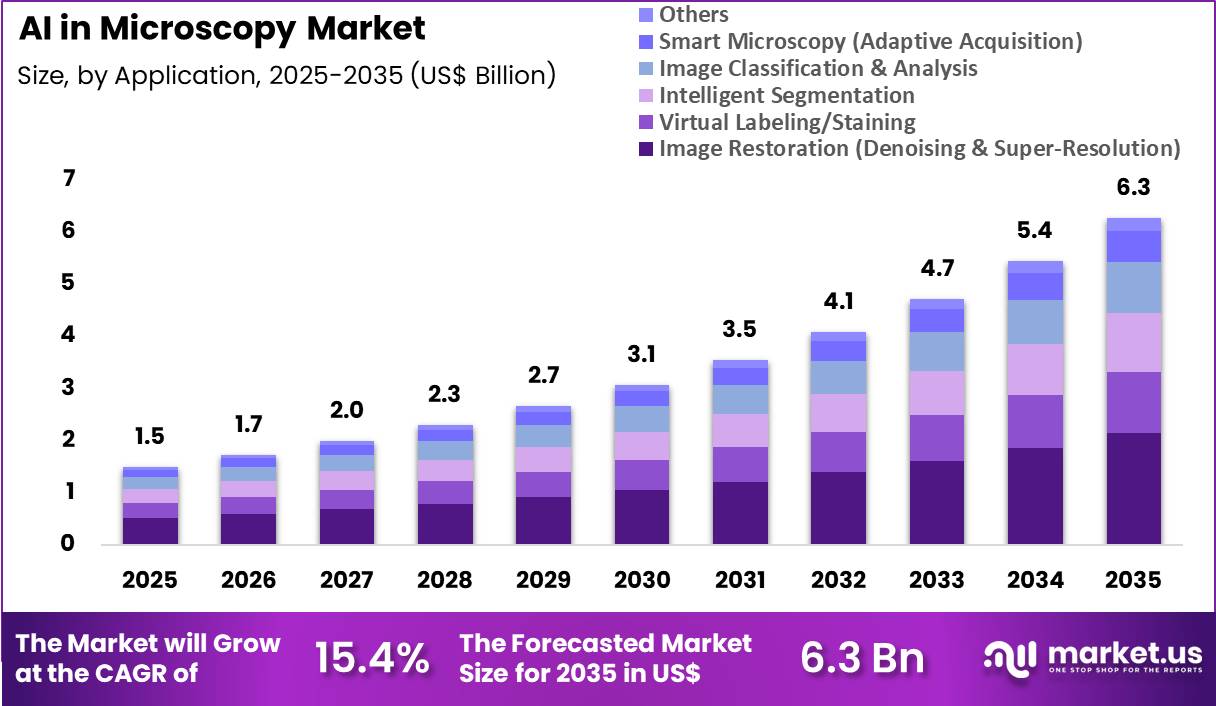
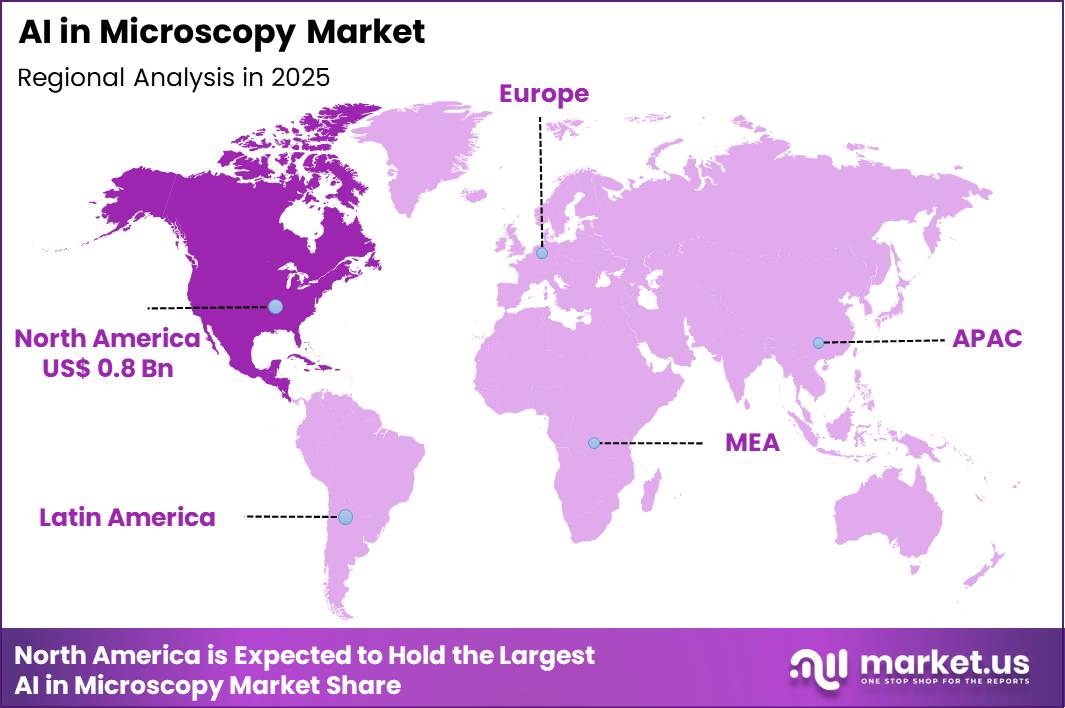
The Global AI in Microscopy Market size is expected to be worth around US$ 6.3 Billion by 2035 from US$ 1.5 Billion in 2025, growing at a CAGR of 15.4% during the forecast period 2026-2035. In 2025, North America led the market, achieving over 53.1% share with a revenue of US$ 0.8 Billion.
Increasing demand for high-throughput, high-accuracy imaging in life sciences and materials research propels the AI in Microscopy market as scientists require intelligent systems that automate complex image analysis and accelerate discovery.
Researchers increasingly apply AI-powered image processing in confocal microscopy to segment and quantify cellular structures in 3D tissue samples, enabling precise analysis of neuronal networks in brain organoids and tumor microenvironments in cancer studies.
These tools support automated detection of rare events in high-content screening assays, identifying phenotypic changes in drug-treated cells for phenotypic drug discovery in oncology and neuroscience. In electron microscopy, AI algorithms enhance image denoising and reconstruction, improving resolution in cryo-EM datasets to resolve atomic structures of membrane proteins and large macromolecular complexes.
Pathologists utilize AI-assisted digital microscopy to classify tissue features in histopathology slides, supporting rapid identification of mitotic figures and tumor grading in diagnostic workflows. Materials scientists employ AI-driven analysis in scanning electron microscopy to characterize nanoparticle morphology and surface defects, facilitating quality control in semiconductor and nanomaterial development.
Manufacturers pursue opportunities to embed deep learning models directly into microscope hardware and software, expanding applications in live-cell imaging where real-time analysis tracks dynamic processes such as cell migration and organelle trafficking.
Developers advance automated workflow platforms that integrate AI for sample navigation, focus optimization, and anomaly detection, broadening utility in large-scale organoid and spheroid studies. These innovations support multi-modal data fusion, combining fluorescence, phase contrast, and brightfield images for comprehensive cellular phenotyping.
Opportunities emerge in cloud-based AI platforms that enable collaborative analysis of massive datasets across research consortia. Companies invest in explainable AI frameworks that provide interpretable results for regulatory and publication purposes.
In August 2025, Thermo Fisher Scientific launched two advanced electron microscopy platforms, the Scios 3 FIB-SEM and Talos 12 TEM. These systems integrate AI-supported automation for cryo-electron microscopy workflows, enabling faster site-specific analysis for applications in materials science, structural biology, and pharmaceutical research.
During late 2025, the CellXpress.ai automated imaging platform from Molecular Devices gained adoption at research institutions including Emory University and UCLA. The system uses artificial intelligence to support automated growth monitoring and analysis of complex three-dimensional brain organoids used in neurological and disease modeling studies.
Recent trends emphasize end-to-end automation, multi-modal integration, and real-time decision support, positioning AI in Microscopy as a transformative force in accelerated, data-driven scientific discovery.
Key Takeaways
- In 2025, the market generated a revenue of US$ 1.5 Billion, with a CAGR of 15.4%, and is expected to reach US$ 6.3 Billion by the year 2035.
- The application segment is divided into image restoration (denoising & super-resolution), virtual labeling/staining, intelligent segmentation, image classification & analysis, smart microscopy (adaptive acquisition) and others, with image restoration (denoising & super-resolution) taking the lead with a market share of 34.2%.
- Considering microscopy type, the market is divided into optical microscopy, fluorescence microscopy, electron microscopy and others. Among these, optical microscopy held a significant share of 49.2%.
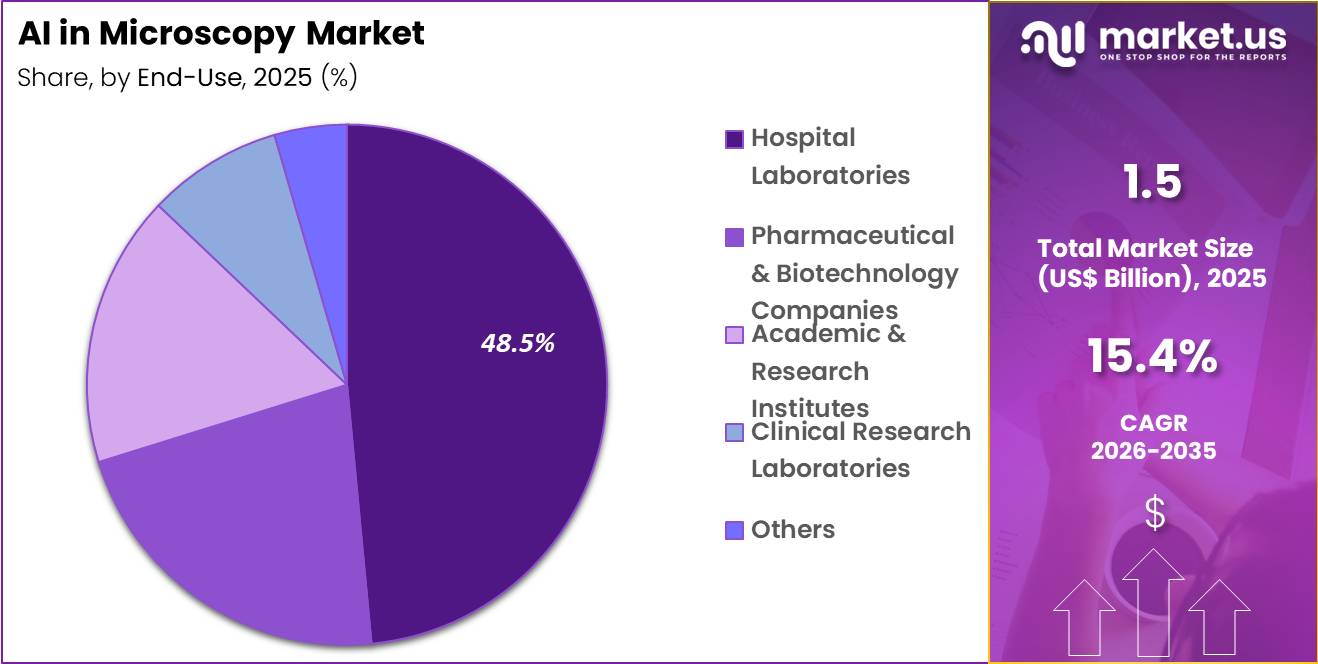
- Furthermore, concerning the end-use segment, the market is segregated into hospital laboratories, pharmaceutical & biotechnology companies, academic & research institutes, clinical research laboratories and others. The hospital laboratories sector stands out as the dominant player, holding the largest revenue share of 48.5% in the market.
- North America led the market by securing a market share of 53.1%.
Application Analysis
Image restoration accounted for 34.2% of growth within application and dominate the AI in microscopy market due to the growing need to improve image quality from low-signal, noisy, or low-resolution microscopy datasets. AI-driven denoising and super-resolution models help laboratories recover clearer structural detail without relying only on longer acquisition times or stronger illumination, which is important when samples are light-sensitive or throughput matters.
Recent microscopy reviews describe AI-based denoising and super-resolution as key tools for enhancing image acquisition and interpretation across fluorescence and other microscopy workflows. This segment is expected to strengthen as laboratories seek faster imaging, reduced phototoxicity, and more consistent downstream analysis.
Researchers also increasingly prefer restoration tools because better raw image quality improves segmentation, classification, and quantitative interpretation in the same workflow. The segment is likely to expand further as AI restoration becomes embedded directly into microscope software and image-processing pipelines.
Microscopy Type Analysis
Optical microscopy accounted for 49.2% of growth within microscopy type and dominate the AI in microscopy market due to its wide use across pathology, routine biological analysis, and clinical laboratory workflows. NIH-linked literature notes that optical microscopes have been used widely in pathology-related clinical laboratories to diagnose a variety of diseases, which gives this modality the broadest installed base for AI integration.
Optical systems are expected to maintain leadership because they support large testing volumes, comparatively accessible workflows, and easier adoption of digital image enhancement tools than many higher-cost modalities. Hospitals, diagnostic labs, and research groups increasingly combine optical microscopy with AI-based interpretation, especially in digital pathology and slide analysis.
Reviews on digital pathology also show that AI use continues to expand around slide-based optical imaging for diagnosis and workflow support. This segment is projected to remain dominant as laboratories continue digitizing routine microscopy and linking optical image streams with AI-assisted analysis.
End-Use Analysis
Hospital laboratories accounted for 48.5% of growth within end-use and dominate the AI in microscopy market due to their central role in diagnostic testing, pathology review, and high-volume specimen handling. Hospital labs already generate large microscopy workloads, and digital pathology programs show how AI becomes more valuable as slide volumes increase.
One recent public-hospital digital pathology program in Italy covered 12 pathology laboratories producing more than 2.5 million slides per year, which illustrates the scale at which automation and AI-supported interpretation become operationally attractive. Hospital laboratories are expected to strengthen their lead as they seek faster turnaround, improved reproducibility, and better support for pathologists and lab staff.
AI tools are also likely to gain traction in hospitals because they help with image enhancement, triage, and diagnostic consistency in routine practice. Literature on digital pathology consistently positions clinical laboratory settings as one of the main environments for practical AI deployment in microscopy-based diagnosis.
Key Market Segments
By Application
- Image Restoration (Denoising & Super-Resolution)
- Virtual Labeling/Staining
- Intelligent Segmentation
- Image Classification & Analysis
- Smart Microscopy (Adaptive Acquisition)
- Others
By Microscopy Type
- Optical Microscopy
- Fluorescence Microscopy
- Electron Microscopy
- Others
By End-use
- Hospital Laboratories
- Pharmaceutical & Biotechnology Companies
- Academic & Research Institutes
- Clinical Research Laboratories
- Others
Drivers
Rising integration of AI-enabled image analysis in research microscopy is driving the market.
The AI in microscopy market experiences sustained expansion through increased adoption of artificial intelligence algorithms for automated image processing and feature extraction in both academic and industrial research settings. These systems analyze high-resolution micrographs from confocal, super-resolution, and electron microscopy to identify cellular structures, quantify protein localization, and track dynamic processes with enhanced precision.
Researchers utilize AI tools to reduce manual annotation time in large-scale imaging datasets. The driver aligns with growing demand for high-content screening in drug discovery and developmental biology studies. Core facilities report improved throughput through AI-assisted segmentation of complex three-dimensional volumes.
The technology supports reproducible quantification across diverse sample types and imaging modalities. Enhanced pattern recognition capabilities facilitate discovery of subtle phenotypic changes. The trend corresponds with expanded investment in computational microscopy infrastructure. Sustained utilization reflects confidence in AI reliability for publication-quality data. This factor maintains consistent forward momentum in advanced imaging applications.
Restraints
High computational resource requirements for training AI models are restraining the market.
Development and deployment of robust AI models for microscopy demand substantial GPU computing capacity and specialized high-performance clusters. Many academic institutions and smaller biotechnology companies lack access to adequate on-premises infrastructure for model training on terabyte-scale imaging datasets.
Cloud-based solutions introduce recurring costs and data transfer challenges for sensitive proprietary images. The restraint limits rapid prototyping and iteration of custom AI algorithms. The factor contributes to reliance on pre-trained generalist models that may underperform on specialized microscopy modalities. Facilities encounter difficulties scaling inference for real-time applications without dedicated hardware.
The dynamic moderates adoption velocity in resource-constrained environments. Providers face extended timelines for validation and deployment of institution-specific solutions. This constraint persists in constraining broader market penetration across diverse user segments. The limitation influences strategic decisions regarding investment in internal versus outsourced computational capabilities.
Opportunities
Expansion of AI-driven automated microscopy workflows is creating growth opportunities.
Instrument manufacturers have introduced integrated platforms combining automated stage control, continuous imaging, and on-the-fly AI analysis for unattended long-term experiments. These systems enable continuous monitoring of cellular behaviors over extended periods without operator intervention. Opportunities arise for high-throughput phenotypic screening in drug development pipelines.
The framework supports scalable deployment in core facilities managing multiple concurrent projects. Enhanced automation reduces variability introduced by manual operation across time-lapse acquisitions. The development facilitates integration with laboratory automation robotics for fully closed-loop experimentation.
Such capabilities promote discovery of novel biological mechanisms through unbiased analysis of large datasets. The opportunity fosters differentiation through superior experimental reproducibility and data density. Stakeholders anticipate improved return on investment for high-end imaging systems. This advancement positions participants for expansion in automated discovery platforms.
Impact of Macroeconomic / Geopolitical Factors
Macroeconomic pressures influence the AI in microscopy market as research organizations and laboratories reconsider budgets for advanced imaging technologies and digital laboratory infrastructure. Increasing operating costs raise the price of high-performance imaging processors, computing capacity for data analysis, and software platforms used for laboratory integration. These factors place additional financial pressure on universities, research institutes, and emerging biotech companies that rely on sophisticated microscopy systems for scientific studies.
Tighter credit conditions and limited access to funding also slow technology upgrades across academic and commercial laboratories. At the same time, geopolitical tensions affect the supply of precision optics, specialized sensors, and semiconductor components used in intelligent microscopy platforms.
Tariffs in the US on imported electronic hardware and computing equipment further increase procurement costs for laboratories adopting AI-enabled imaging workflows. Despite these challenges, equipment manufacturers are strengthening local supply chains and forming regional production partnerships to reduce dependency on global sourcing. Meanwhile, rising demand for automated cell imaging, digital pathology, and AI-supported drug discovery continues to sustain long-term growth in the AI microscopy market.
Latest Trends
FDA clearance for AI-assisted pathology slide analysis systems is driving the market.
The U.S. Food and Drug Administration granted 510(k) clearance in 2025 to an advanced AI platform designed for automated detection and classification of features in digital whole-slide images from light microscopy. The clearance covers primary diagnostic support in anatomic pathology workflows.
The system demonstrates substantial equivalence to predicate devices while providing quantitative measurements of cellular morphology. Pathologists benefit from prioritized case review through AI-flagged regions of interest. The 2025 regulatory milestone aligns with increasing digitization of anatomic pathology laboratories.
Facilities report potential reductions in diagnostic turnaround time for routine specimens. The development supports implementation of standardized reporting criteria across networked pathology groups. Early clinical implementations demonstrate consistent performance in detection sensitivity.
The clearances facilitate reimbursement discussions with payers for AI-enhanced services. Overall, this regulatory advancement accelerates integration of AI tools into mainstream clinical microscopy practice.
Regional Analysis
North America is leading the AI in Microscopy Market
North America accounted for 39.2% of the AI in microscopy market in 2025 as research laboratories, pharmaceutical companies, and academic institutions expanded adoption of artificial intelligence to automate image analysis and improve scientific discovery. Life science laboratories across the United States and Canada increasingly integrate machine learning algorithms with high-resolution imaging systems to accelerate analysis of cellular structures, tissue samples, and molecular interactions.
According to the National Science Foundation, U.S. research and development expenditure reached about USD 886 billion in 2022, providing strong financial support for advanced imaging technologies and computational biology research. Growing demand for high-throughput drug discovery and precision medicine research has encouraged pharmaceutical companies to adopt automated microscopy platforms capable of processing large imaging datasets.
AI algorithms help researchers identify subtle cellular changes, detect disease markers, and quantify experimental results more accurately than manual analysis. Universities and biomedical research institutes are expanding interdisciplinary programs that combine computational science with microscopy and cellular biology.
Technology companies are developing deep learning software that enhances image resolution and reduces analysis time in complex biological experiments. These developments collectively strengthened the adoption of intelligent microscopy platforms across North America in 2025.
The Asia Pacific region is expected to experience the highest CAGR during the forecast period
Asia Pacific is expected to experience strong expansion during the forecast period as biotechnology research, semiconductor manufacturing, and academic science programs increasingly rely on advanced imaging technologies. Countries such as China, Japan, South Korea, and Singapore are investing heavily in artificial intelligence and scientific research infrastructure to support innovation in life sciences and nanotechnology.
China’s National Bureau of Statistics reported that national research and development spending reached about 3.09 trillion yuan in 2022, reflecting substantial investment in scientific research including advanced imaging technologies. Research laboratories across the region are integrating machine learning with microscopy systems to improve analysis of biological samples, materials science experiments, and semiconductor components.
Universities and biotechnology institutes are strengthening research in computational biology and digital pathology, which rely heavily on automated image analysis tools. Pharmaceutical companies are also adopting AI-driven imaging platforms to accelerate drug discovery and toxicity testing.
Governments are supporting innovation through national research programs and high-technology laboratories dedicated to advanced microscopy and imaging science. Regional technology companies are developing imaging software platforms tailored for high-throughput laboratory environments. These developments are expected to accelerate the adoption of intelligent microscopy technologies across Asia Pacific in the coming years.
Key Regions and Countries
North America
- The US
- Canada
Europe
- Germany
- France
- The U.K.
- Italy
- Spain
- Russia & CIS
- Rest of Europe
Asia Pacific
- China
- India
- Japan
- South Korea
- ASEAN
- Australia & New Zealand
- Rest of Asia Pacific
Middle East & Africa
- GCC
- South Africa
- Rest of Middle East & Africa
Latin America
- Brazil
- Mexico
- Rest of Latin America
Key Players Analysis
Key participants in the AI in Microscopy Market expand growth by developing intelligent image analysis software, integrating machine learning algorithms with advanced microscopes, and collaborating with research institutes to accelerate automated cell and tissue analysis. Companies focus on improving image recognition accuracy and workflow automation so laboratories can analyze large datasets faster and reduce manual interpretation time.
They also invest in cloud-based data platforms and AI-driven imaging tools that support drug discovery, pathology research, and materials science applications. Carl Zeiss AG represents a major participant in the AI in Microscopy Market and operates as a German technology company that develops optical systems, imaging solutions, and digital microscopy platforms for scientific and industrial research.
The company emphasizes advanced imaging analytics and software-driven microscopy technologies to enhance laboratory productivity. Industry competitors continue to introduce AI-enabled imaging software, strengthen collaborations with life science laboratories, and expand digital microscopy ecosystems to accelerate adoption of intelligent imaging solutions.
Top Key Players
- Molecular Devices, LLC.
- SigTuple Technologies Pvt. Ltd.
- Leica Microsystems
- Nikon Corporation Healthcare Business Unit
- Revvity Signals Software, Inc.
- Oxford Instruments
- ZEISS
- Thermo Fisher Scientific Inc.
- KOLAIDO GmbH
- Ariadne.ai ag
Recent Developments
- In September 2025, ZEISS obtained CE certification for its CIRRUS PathFinder system, an artificial intelligence–driven clinical support solution designed for ophthalmic imaging. The tool applies deep learning algorithms to automatically detect irregular macular scan patterns, helping clinicians prioritize cases and reduce diagnostic workload in high-volume eye care practices.
- At the RANZCO 2025 conference, Leica Microsystems introduced two advanced surgical visualization technologies: the Proveo 8x digital microscope and the MyVeo integrated surgical headset. The systems feature extremely low image-processing latency of about 16 milliseconds and support enhanced digital visualization, enabling surgeons to operate with near real-time image feedback and improved depth perception.
- In July 2025, Nikon marked its 100-year milestone in microscopy with the introduction of the ECLIPSE Ti2-I imaging platform. The motorized microscope is tailored for reproductive medicine applications and incorporates AI-supported imaging tools designed to improve precision in procedures such as ICSI and IMSI used in fertility treatments.
- In October 2025, Revvity introduced new artificial intelligence software aimed at improving the interpretation of preclinical imaging data. Around the same period, European startup Cytely secured €3 million in funding to expand development of its automated cell imaging analysis platform powered by AI for life science research laboratories.
Report Scope
Report Features Description Market Value (2025) US$ 1.5 Billion Forecast Revenue (2035) US$ 6.3 Billion CAGR (2026-2035) 15.4% Base Year for Estimation 2025 Historic Period 2020-2024 Forecast Period 2026-2035 Report Coverage Revenue Forecast, Market Dynamics, COVID-19 Impact, Competitive Landscape, Recent Developments Segments Covered By Application (Image Restoration (Denoising & Super-Resolution), Virtual Labeling/Staining, Intelligent Segmentation, Image Classification & Analysis, Smart Microscopy (Adaptive Acquisition) and Others), By Microscopy Type (Optical Microscopy, Fluorescence Microscopy, Electron Microscopy and Others), By End-use (Hospital Laboratories, Pharmaceutical & Biotechnology Companies, Academic & Research Institutes, Clinical Research Laboratories and Others) Regional Analysis North America – The US, Canada; Europe – Germany, France, The U.K., Italy, Spain, Russia & CIS, Rest of Europe; Asia Pacific – China, India, Japan, South Korea, ASEAN, Australia & New Zealand, Rest of Asia Pacific; Middle East & Africa – GCC, South Africa, Rest of Middle East & Africa; Latin America – Brazil, Mexico, Rest of Latin America Competitive Landscape Molecular Devices, LLC., SigTuple Technologies Pvt. Ltd., Leica Microsystems, Nikon Corporation Healthcare Business Unit, Revvity Signals Software, Inc., Oxford Instruments, ZEISS, Thermo Fisher Scientific Inc., KOLAIDO GmbH, Ariadne.ai ag. Customization Scope Customization for segments, region/country-level will be provided. Moreover, additional customization can be done based on the requirements. Purchase Options We have three licenses to opt for: Single User License, Multi-User License (Up to 5 Users), Corporate Use License (Unlimited User and Printable PDF) 
-
-
- Molecular Devices, LLC.
- SigTuple Technologies Pvt. Ltd.
- Leica Microsystems
- Nikon Corporation Healthcare Business Unit
- Revvity Signals Software, Inc.
- Oxford Instruments
- ZEISS
- Thermo Fisher Scientific Inc.
- KOLAIDO GmbH
- Ariadne.ai ag
Our Clients

- 181428
- March 2026






