Global AI For Scientific Discovery Market Size, Share and Analysis Report By Type (Predictive AI, Descriptive AI, Generative AI, Optimization AI, Others), By Deployment (Cloud-based, On-Premises), By Application (AI in Drug Discovery and Healthcare, AI in Genomics and Biotechnology, AI in Material Science and Chemistry, AI in Astrophysics and Space, AI in Climate Science and Environmental Research, Others), By End-User (Pharmaceutical Research and Development, Biotechnology Companies, Academic and National Labs, Chemical and Materials Science Firms, Others), By Regional Analysis, Global Trends and Opportunity, Future Outlook By 2025-2035
- Published date: Feb. 2026
- Report ID: 179234
- Number of Pages: 328
- Format:
-
keyboard_arrow_up
Quick Navigation
- Report Overview
- Key Takeaway
- AI For Scientific Discovery Statistics
- By Type
- By Deployment Mode
- By Application
- By End-User
- By Geography
- Key Market Segments
- Key Regions and Countries
- Emerging Trends Analysis
- Driver Analysis
- Restraint Analysis
- Opportunity Analysis
- Challenge Analysis
- Key Players Analysis
- Recent Developments
- Report Scope
Report Overview
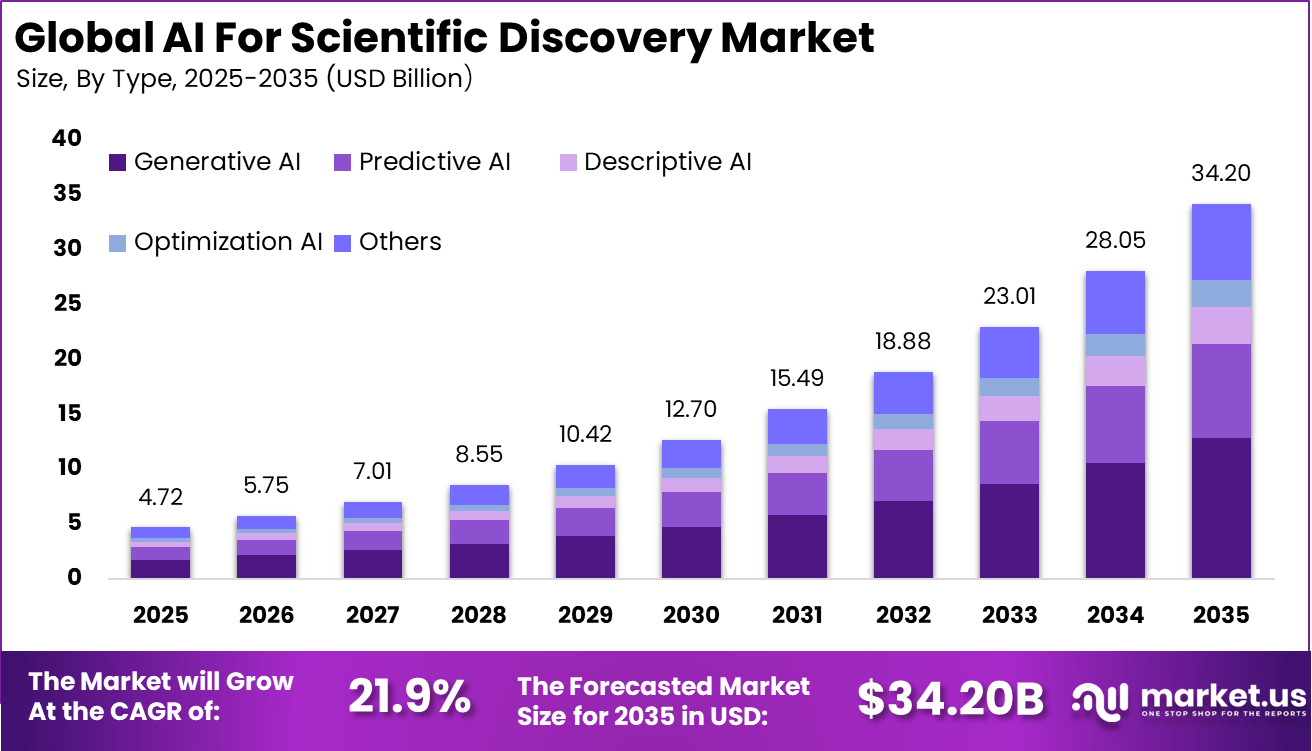
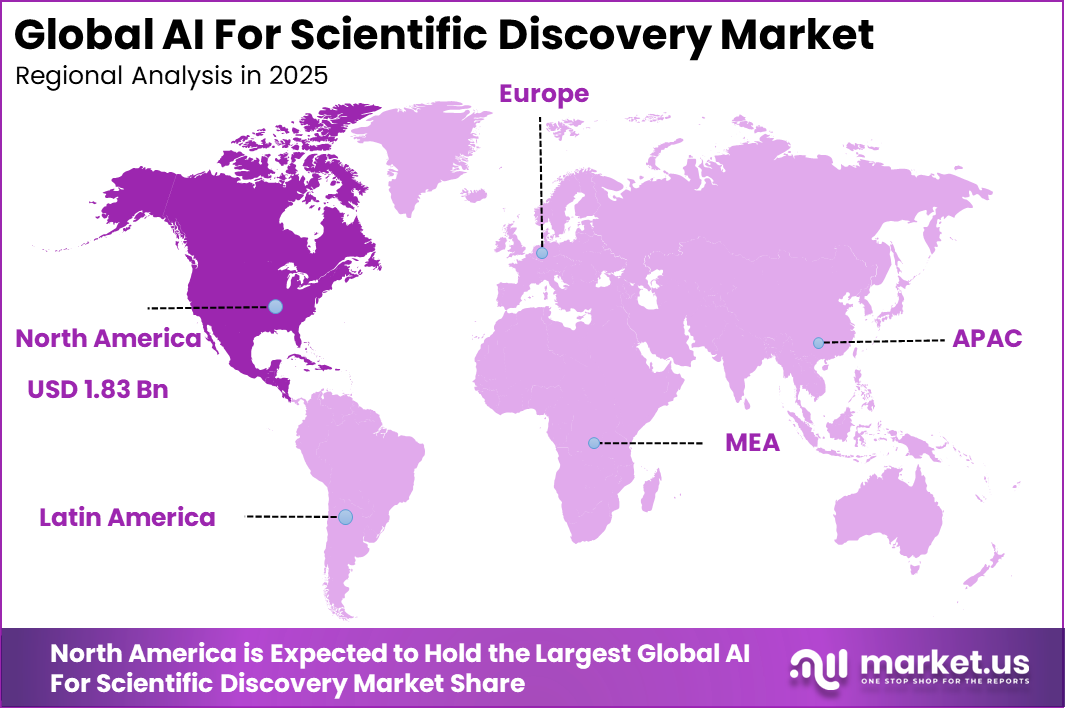
The Global AI for Scientific Discovery Market size is expected to be worth around USD 34.20 billion by 2035, from USD 4.72 billion in 2025, growing at a CAGR of 21.9% during the forecast period from 2025 to 2035. North America held a dominant market position, capturing more than a 38.84% share, holding USD 1.83 billion in revenue.
The AI for scientific discovery market is expanding as research institutions integrate advanced computational intelligence into experimental workflows. Artificial intelligence models are being applied to analyze complex datasets, simulate molecular interactions, and generate research hypotheses. This transformation is improving efficiency across life sciences, materials science, and advanced engineering disciplines. AI driven discovery platforms are increasingly viewed as strategic research infrastructure.
The growing availability of large scientific datasets is strengthening the adoption of AI systems in laboratories and research centers. High performance computing resources allow researchers to train complex models that can identify hidden patterns within experimental data. This capability reduces dependence on purely trial based experimentation. As a result, research cycles are becoming more data driven and predictive.
One major driver of the AI for Scientific Discovery Market is the exponential growth of data generated from advanced instruments, high throughput experimentation, and collaborative research projects. Scientific domains now produce massive datasets that require computational tools capable of identifying patterns and correlations at scale. AI technologies provide methods to process and extract meaningful information from diverse and high dimensional data.
For instance, in January 2026, NVIDIA powered over 80 new global science systems with 4,500 exaflops of AI performance via BioNeMo expansions for RNA prediction and molecular synthesis. Features like lab-in-the-loop workflows and AI agents are transforming digital biology and quantum research.
Demand for AI for scientific discovery solutions is strong in pharmaceutical and biotechnology sectors where complex biological datasets and drug discovery processes require advanced analytical capabilities. AI driven models are used to identify potential therapeutic targets, predict molecular behavior, and prioritize candidate compounds for development. These capabilities reduce time to discovery and improve success rates in experimental stages.
Key Takeaway
- In 2025, the Generative AI segment led the Global AI for Scientific Discovery market, accounting for 37.6% share, supported by its application in molecular modeling, simulation, and hypothesis generation.
- In 2025, Cloud-based deployment captured 58.4% of the market, driven by scalable computing resources and collaborative research platforms.
- In 2025, AI in Drug Discovery and Healthcare represented 32.71% share, reflecting increasing reliance on machine learning for compound screening and clinical data analysis.
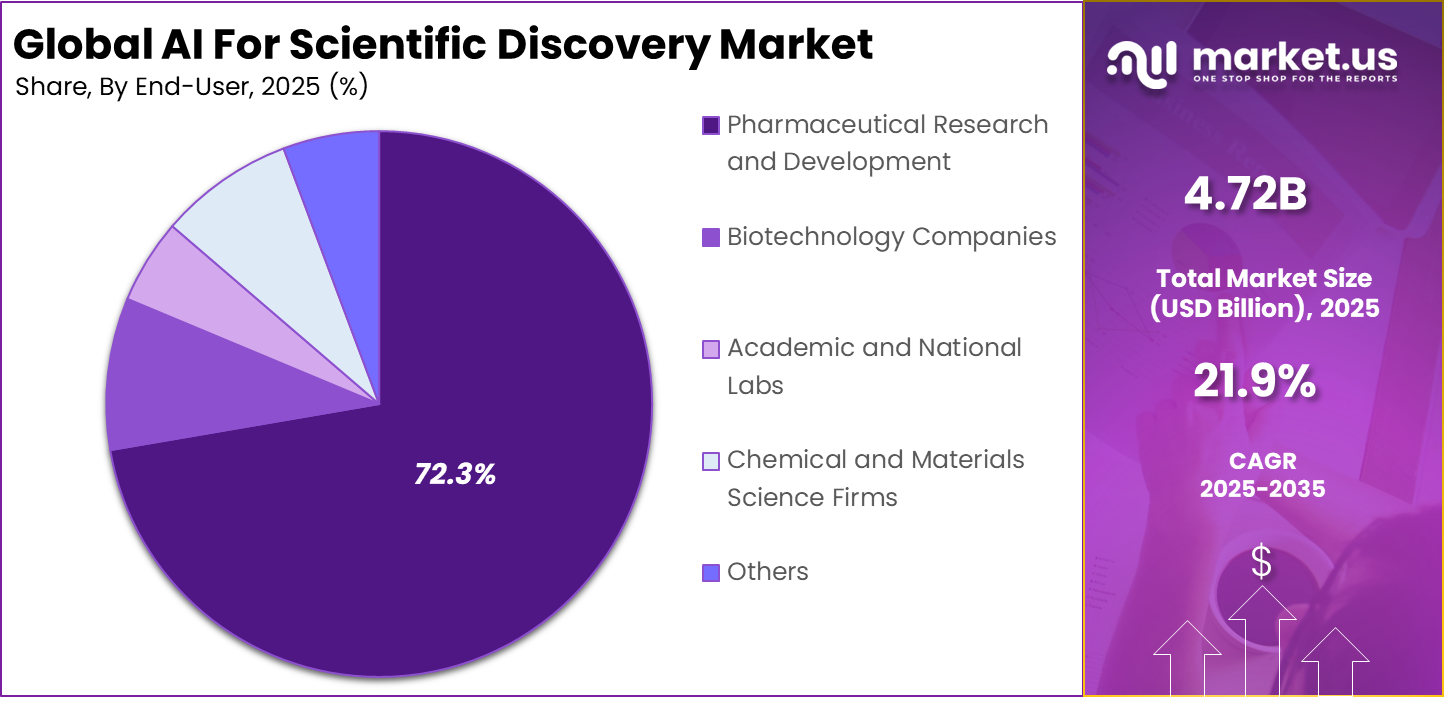
- In 2025, Pharmaceutical Research and Development held a dominant 72.3% share, as AI tools were widely adopted to accelerate early-stage research and reduce experimental timelines.
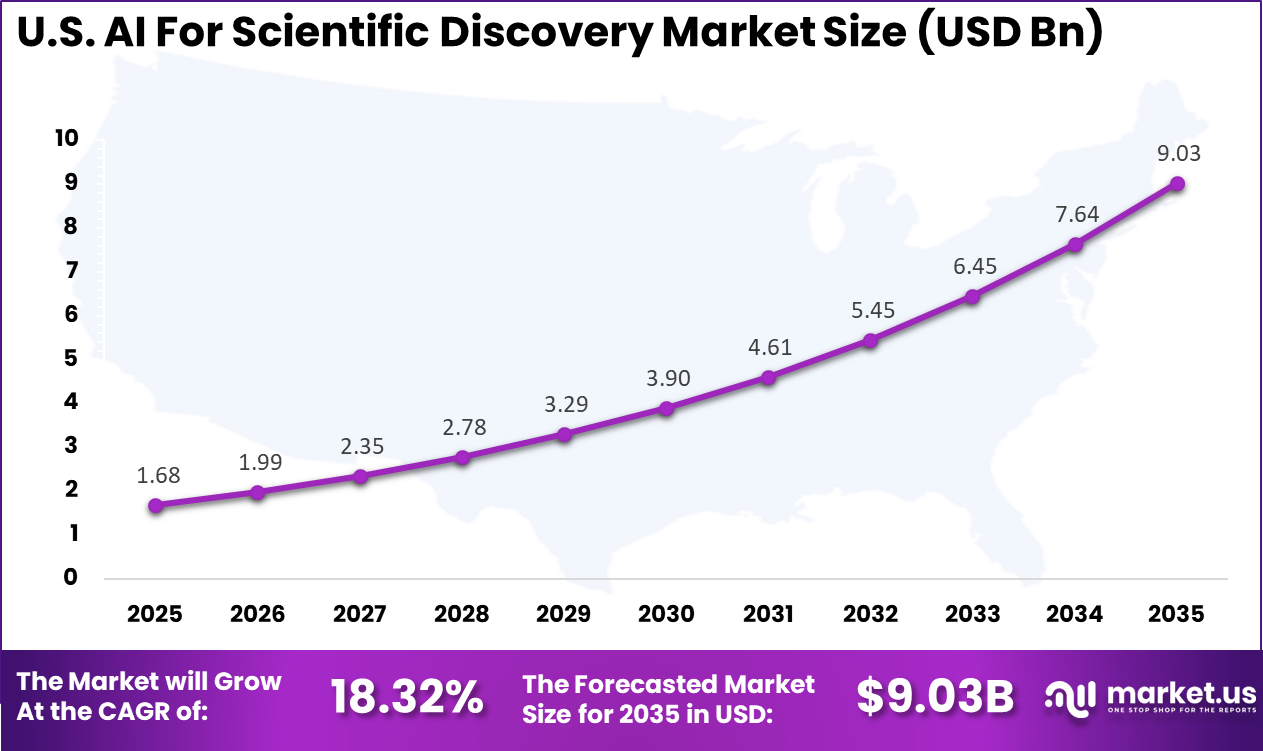
- The U.S. AI for Scientific Discovery market was valued at USD 1.68 billion in 2025 and is projected to expand at a 18.32% CAGR, supported by strong investment in biomedical and computational research.
- In 2025, North America captured more than 38.84% of the global market, reflecting advanced research infrastructure and sustained funding for AI-driven scientific innovation.
AI For Scientific Discovery Statistics
- Researchers leveraging AI tools report 44% more material discoveries and generate 39% more patents, reflecting measurable productivity gains.
- AI-enabled researchers publish 3.02 times more papers and receive 4.84 times more citations, indicating higher research visibility and academic influence.
- Adoption of AI shortens career progression timelines, with AI-augmented researchers becoming project leaders 1.37 years earlier than peers not using such tools.
- Productivity benefits are unevenly distributed. Top-performing researchers nearly double their output, while the bottom third experience limited measurable improvement.
- AI systems automate approximately 57% of idea-generation tasks, accelerating early-stage research planning and hypothesis development.
- AI adoption has been associated with a 4.63% reduction in topic diversity, as research focus shifts toward data-rich and computationally accessible fields.
- Studies indicate a 22% decline in researcher engagement and collaboration, potentially linked to increased reliance on automated workflows.
- Around 82% of scientists report reduced job satisfaction, citing concerns related to diminished creativity and underutilization of domain expertise.
- Non-expert users may allocate resources toward validating AI-generated false positives, despite expert users achieving up to 44% more discoveries, highlighting the importance of domain knowledge in AI-assisted research.
By Type
Generative AI accounts for 37.6% of the AI for scientific discovery market, reflecting its growing role in hypothesis generation and molecular design. Research institutions are using generative models to simulate chemical structures and predict biological interactions. These systems reduce the time required to identify viable research pathways. The segment’s expansion is closely linked to advancements in deep learning and large language models.
Generative AI tools are increasingly applied to protein modeling, materials science, and experimental simulation. By analyzing vast scientific datasets, these models identify patterns that may not be visible through conventional methods. This accelerates early-stage research and improves experimental accuracy. As computational power expands, generative AI is becoming central to modern scientific workflows.
For Instance, in October 2025, BenevolentAI raised $150 million to boost its generative AI platform for drug discovery. The funds help refine tools that spot new targets and repurpose drugs, tackling high failure rates in tough diseases. This move speeds up molecule design and cuts development timelines for better patient outcomes.
By Deployment Mode
The deployment segment holds 58.4%, reflecting strong adoption of scalable computing environments in research institutions. Many organizations rely on advanced computational infrastructure to manage complex simulations and high-volume datasets. Secure deployment frameworks are essential for handling proprietary research data. Flexible infrastructure enables researchers to scale experiments without major hardware constraints.
Hybrid and cloud-based models are increasingly used to support collaborative scientific projects across global institutions. Research teams benefit from remote accessibility and shared computational resources. Secure data governance remains a priority, particularly in regulated healthcare research. As data-intensive science expands, deployment flexibility continues to drive adoption.
For instance, in October 2024, Amazon Web Services launched NVIDIA BioNeMo on its cloud for generative AI in drug discovery. Pharma teams now scale model training with proprietary data on AWS, easing access to high-power computing. It helps innovators like Alchemab run biomolecular models faster without local hardware.
By Application
AI in drug discovery and healthcare represents 32.71% of applications, highlighting its strong impact on pharmaceutical innovation. AI models assist in identifying potential drug candidates and predicting molecular behavior. This reduces laboratory trial time and improves screening efficiency. Data-driven approaches are improving precision in therapeutic development.
Machine learning systems also support clinical trial optimization and patient stratification. Predictive analytics enhance understanding of disease mechanisms and treatment responses. The integration of AI reduces research costs and accelerates time-to-market for new therapies. As healthcare research becomes increasingly data-centric, AI-driven drug discovery remains a primary growth area.
For Instance, in January 2026, Google Cloud teamed with Ginkgo Bioworks on Vertex AI for biotech drug discovery. Using over 2 billion protein sequences, they build custom models to find drug candidates more quickly. This partnership cuts simulation times and boosts precision in healthcare applications.
By End-User
Pharmaceutical research and development accounts for 72.3% of end-user demand, reflecting the sector’s heavy reliance on advanced analytics. Drug development involves complex experimentation and regulatory scrutiny, requiring precise data modeling tools. AI platforms support target identification, compound screening, and toxicity prediction. This strengthens efficiency across the research pipeline.
R&D teams are integrating AI systems with laboratory automation technologies. Enhanced computational models improve success rates in early discovery phases. Pharmaceutical organizations prioritize innovation to remain competitive in global markets. The dominance of this segment indicates that AI adoption is becoming embedded in core research operations.
For Instance, in March 2025, Insilico Medicine secured $110 million in Series E to advance AI-driven R&D. Their Pharma.AI platform slashed preclinical timelines to 12-18 months, testing fewer molecules per program. It powers a pipeline of 30 assets, with leads like ISM001-055 in trials for lung fibrosis.
By Geography
North America holds 38.84% of the market, supported by strong research infrastructure and investment in biotechnology innovation. Universities, research institutes, and pharmaceutical companies in the region actively integrate AI into scientific exploration.
For instance, in January 2026, NVIDIA Corp. unveiled a major upgrade to its BioNeMo platform, creating an open development ecosystem for lab-in-the-loop AI workflows in biology and drug discovery, including RNA prediction and toxicity modeling. Deployed by firms like Basecamp Research, it enables real-time hypothesis generation and robotic lab automation, boosting North American AI infrastructure for scientific breakthroughs.
The United States represents a major contributor, with a market value of USD 1.68 Billion and a CAGR of 18.32%. Continued investment in computational research strengthens regional leadership. Public and private funding programs support AI-driven scientific initiatives across healthcare and materials research.
Advanced computing resources and regulatory clarity further enable innovation. Collaboration between academia and industry accelerates AI adoption. The regional outlook remains robust as scientific research increasingly integrates artificial intelligence technologies.
For instance, in February 2026, Google LLC revealed plans via CEO Demis Hassabis for its Isomorphic Labs spin-out to initiate clinical trials of AI-designed drugs by late 2026, building on AlphaFold’s protein prediction success. This advancement targets faster drug development from years to months, exemplifying U.S. dominance in generative AI for novel therapeutics discovery.
Key Market Segments
By Type
- Generative AI
- Predictive AI
- Descriptive AI
- Optimization AI
- Others
By Deployment
- Cloud-based
- On-Premises
By Application
- AI in Drug Discovery and Healthcare
- AI in Genomics and Biotechnology
- AI in Material Science and Chemistry
- AI in Astrophysics and Space
- AI in Climate Science and Environmental Research
- Others
By End-User
- Pharmaceutical Research and Development
- Biotechnology Companies
- Academic and National Labs
- Chemical and Materials Science Firms
- Others
Key Regions and Countries
North America
- US
- Canada
Europe
- Germany
- France
- The UK
- Spain
- Italy
- Russia
- Netherlands
- Rest of Europe
Asia Pacific
- China
- Japan
- South Korea
- India
- Australia
- Singapore
- Thailand
- Vietnam
- Rest of APAC
Latin America
- Brazil
- Mexico
- Rest of Latin America
Middle East & Africa
- South Africa
- Saudi Arabia
- UAE
- Rest of MEA
Emerging Trends Analysis
One significant trend is the integration of AI with automated laboratory systems. Robotic experimentation platforms combined with predictive models create closed loop research environments. Data generated from experiments is immediately analyzed to guide subsequent testing. This accelerates discovery cycles.
Another trend is the development of multimodal AI models that process genomic, chemical, and imaging data simultaneously. Combining multiple data sources improves predictive accuracy. Researchers are using integrated models to gain comprehensive insights. This advancement supports cross disciplinary innovation.
Driver Analysis
A primary driver is the need to reduce research timelines and associated costs. Traditional discovery methods often require extensive manual experimentation. AI driven modeling allows rapid screening of potential solutions. This efficiency supports faster innovation.
Another driver is the exponential growth of scientific data. Advances in sequencing and imaging technologies generate large datasets. AI systems are essential for interpreting this information. Without computational tools, data utilization would remain limited.
For instance, in January 2025, AbCellera Biologics Inc. expanded its partnership with AbbVie to discover T-cell engagers for oncology using its AI-powered platform. The move taps into AI’s speed to scan vast antibody data and predict structures quickly, helping teams chase faster breakthroughs in tough cancer targets without years of manual lab work. This keeps research humming at a brisk pace in competitive fields.
Restraint Analysis
High computational requirements present a restraint for smaller research institutions. Advanced AI models demand substantial processing power and storage capacity. Not all organizations possess adequate infrastructure. This can limit widespread adoption.
Data quality and standardization also affect model performance. Inconsistent or incomplete datasets reduce predictive accuracy. Researchers must invest in structured data management. Effective governance is necessary to maintain reliability.
For instance, in September 2025, NVIDIA Corp. stressed key steps for data quality checks in AI certification programs aimed at science tools. They pointed out how messy datasets trip up models in research, urging clean inputs from lab gear to avoid bias and weak predictions that stall reliable scientific advances.
Opportunity Analysis
A key opportunity exists in personalized medicine and rare disease research. AI models can analyze complex patient datasets to identify targeted treatment pathways. This supports innovation in specialized therapeutic areas. Expanding research applications strengthens market growth.
Another opportunity lies in materials science and sustainable energy research. AI driven simulations can accelerate development of efficient materials. This supports environmental and industrial advancements. Broader application areas increase long term potential.
For instance, in October 2025, Google LLC unveiled DeepSomatic AI for spotting genetic variants in tumors, speeding trial designs with precise patient matching from real data. Paired with AlphaFold impacts, it trims trial timelines by simulating outcomes better upfront.
Challenge Analysis
Ensuring interpretability of AI generated results remains a significant challenge. Researchers and regulatory authorities require transparency in predictive outputs. Explainable AI frameworks are essential for validation. Without clarity, trust in automated systems may decline.
Integration with existing laboratory workflows also requires careful planning. Legacy systems may not align easily with AI platforms. Training researchers to use advanced computational tools is necessary. Organizational adaptation plays a critical role in successful implementation.
For instance, in May 2025, IBM Corp. earned top marks in data science platforms for trustworthy AI tools in research. Their Granite models and BeeAI focus on clear, tunable outputs so scientists grasp decisions, easing doubts in high-stakes discovery where explanations build real confidence.
Key Players Analysis
The AI for Scientific Discovery market is driven by biotechnology innovators and advanced technology providers working across drug discovery and life sciences research. AbCellera Biologics Inc., Atomwise Inc., Recursion Pharmaceuticals Inc., and Insilico Medicine apply AI to accelerate target identification and molecule design. BenevolentAI, Generate Biomedicines, and Evaxion AS focus on computational biology and predictive modeling.
Healx Ltd. and Nimbus Therapeutics concentrate on rare diseases and novel therapeutic development, improving research productivity and reducing early stage failure rates. Technology infrastructure companies play a critical enabling role in this market. Amazon Web Services Inc., Google LLC, Microsoft Corp., and NVIDIA Corp. provide cloud computing, high performance processing, and AI acceleration platforms.
IBM Corp. supports scientific computing with advanced analytics and hybrid cloud environments. Benchling Inc. and BenchSci Analytics Inc. strengthen laboratory data management and experimental intelligence. Schrodinger Inc. delivers physics based simulation tools integrated with machine learning models.
Large pharmaceutical organizations are integrating AI into core research pipelines. Novartis AG collaborates with AI driven platforms to enhance clinical development and biomarker discovery. Strategic partnerships between biotech startups and technology vendors are increasing across regions. The competitive landscape remains research intensive and innovation focused.
Top Key Players in the Market
- AbCellera Biologics Inc.
- Amazon Web Services Inc.
- Atomwise Inc.
- Benchling Inc.
- BenchSci Analytics Inc.
- BenevolentAI
- Evaxion AS
- Generate Biomedicines
- Google LLC
- Healx Ltd.
- IBM Corp.
- Insilico Medicine
- Microsoft Corp.
- Nimbus Therapeutics
- Novartis AG
- NVIDIA Corp.
- Recursion Pharmaceuticals Inc.
- Schrodinger Inc.
- Others
Recent Developments
- In February 2026, Benchling launched its AI platform to general availability, now used by over 500 biotech companies. The tool handles instant data structuring, report generation, and model execution, cutting R&D bottlenecks. It’s becoming the central nervous system for biopharma workflows, with strong uptake proving AI’s real-world impact on lab efficiency.
- In November 2025, NVIDIA accelerated AI for scientific discovery across 4,500 exaflops in newly unveiled systems worldwide. BioNeMo’s new models enable closed-loop lab automation, cutting cell therapy costs by 70% and boosting throughput 100-fold, as seen with partners like Multiply Labs.
Report Scope
Report Features Description Market Value (2025) USD 4.7 Bn Forecast Revenue (2035) USD 34.2 Bn CAGR(2026-2035) 21.9% Base Year for Estimation 2025 Historic Period 2020-2024 Forecast Period 2026-2035 Report Coverage Revenue forecast, AI impact on Market trends, Share Insights, Company ranking, competitive landscape, Recent Developments, Market Dynamics and Emerging Trends Segments Covered By Type (Predictive AI, Descriptive AI, Generative AI, Optimization AI, Others), By Deployment (Cloud-based, On-Premises), By Application (AI in Drug Discovery and Healthcare, AI in Genomics and Biotechnology, AI in Material Science and Chemistry, AI in Astrophysics and Space, AI in Climate Science and Environmental Research, Others), By End-User (Pharmaceutical Research and Development, Biotechnology Companies, Academic and National Labs, Chemical and Materials Science Firms, Others) Regional Analysis North America – US, Canada; Europe – Germany, France, The UK, Spain, Italy, Russia, Netherlands, Rest of Europe; Asia Pacific – China, Japan, South Korea, India, New Zealand, Singapore, Thailand, Vietnam, Rest of Latin America; Latin America – Brazil, Mexico, Rest of Latin America; Middle East & Africa – South Africa, Saudi Arabia, UAE, Rest of MEA Competitive Landscape AbCellera Biologics Inc., Amazon Web Services Inc., Atomwise Inc., Benchling Inc., BenchSci Analytics Inc., BenevolentAI, Evaxion AS, Generate Biomedicines, Google LLC, Healx Ltd., IBM Corp., Insilico Medicine, Microsoft Corp., Nimbus Therapeutics, Novartis AG, NVIDIA Corp., Recursion Pharmaceuticals Inc., Schrodinger Inc., Others Customization Scope Customization for segments, region/country-level will be provided. Moreover, additional customization can be done based on the requirements. Purchase Options We have three license to opt for: Single User License, Multi-User License (Up to 5 Users), Corporate Use License (Unlimited User and Printable PDF)  AI For Scientific Discovery MarketPublished date: Feb. 2026add_shopping_cartBuy Now get_appDownload Sample
 -
-
- AbCellera Biologics Inc.
- Amazon Web Services Inc.
- Atomwise Inc.
- Benchling Inc.
- BenchSci Analytics Inc.
- BenevolentAI
- Evaxion AS
- Generate Biomedicines
- Google LLC
- Healx Ltd.
- IBM Corp.
- Insilico Medicine
- Microsoft Corp.
- Nimbus Therapeutics
- Novartis AG
- NVIDIA Corp.
- Recursion Pharmaceuticals Inc.
- Schrodinger Inc.
- Others
Our Clients

- 179234
- Feb. 2026