Report Overview
The Global Address Geocoding Software Market size is expected to be worth around USD 4.50 billion by 2035, from USD 1.53 billion in 2025, growing at a CAGR of 11.4% during the forecast period from 2025 to 2035. North America held a dominant market position, capturing more than a 38.9% share, holding USD 0.59 billion in revenue.
Address Geocoding Software refers to a system that converts written addresses into geographic coordinates, such as latitude and longitude. It helps businesses map locations, verify address accuracy, and improve data quality. This software is widely used in logistics, retail, and services to support delivery planning, customer analysis, and location-based decision making.

The growth of this software is being supported by the need to understand location data quickly and accurately. More than 80% of company data now carries a geographic element, which increases its value across logistics, retail, and delivery operations. The wider shift toward mobile services, digital platforms, and data-based decisions is also strengthening adoption across industries.
The market for Address Geocoding Software is driven by the growing need for accurate location data across logistics, retail, e-commerce, and public services. Businesses depend on precise address mapping to improve deliveries, customer insights, and service planning. Increasing digital transactions, mobile usage, and data-driven operations are also supporting adoption as organizations focus on improving efficiency and reducing operational errors.
Demand is increasing in logistics, retail, e-commerce, public services, and field operations, where accurate address data improves service quality and response time. It is also being driven by organizations with large customer databases that need cleaner records and fewer duplicates. In many cases, adoption begins when poor address quality becomes a repeated and visible operating cost.
For instance, in November 2025, Mapbox expanded its geocoding API portfolio with a “Location‑Aware SDK” tailored for mobile app developers, enabling real‑time forward and reverse geocoding without heavy server‑side infrastructure. The SDK emphasizes low‑latency, edge‑side address resolution for ride‑hailing and on‑demand services, giving the platform a stronger foothold in hyperlocal, API‑heavy use‑cases.
Key Takeaways
- In 2025, the Real-time Geocoding segment held a dominant market position, capturing a 41.3% share of the Global Address Geocoding Software Market.
- In 2025, the Cloud-based segment held a dominant market position, capturing a 62.5% share of the Global Address Geocoding Software Market.
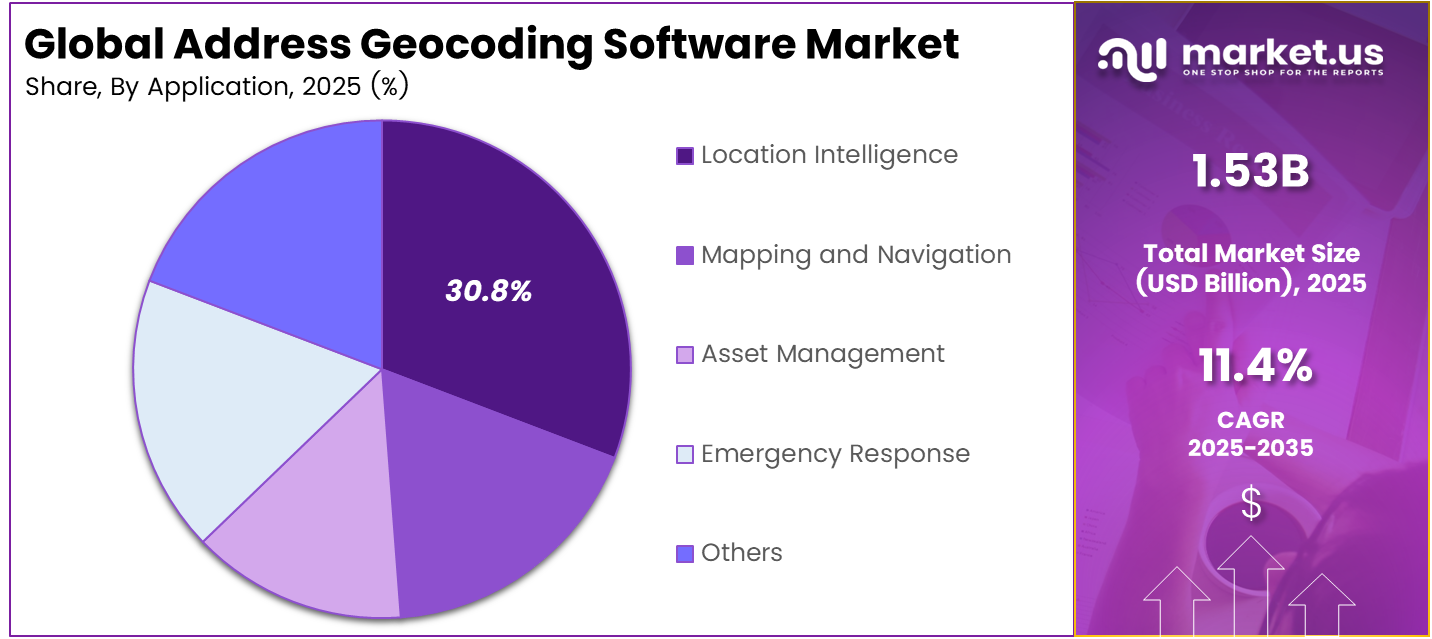
- In 2025, the Location Intelligence segment held a dominant market position, capturing a 30.8% share of the Global Address Geocoding Software Market.
- In 2025, the Retail and E-commerce segment held a dominant market position, capturing a 27.3% share of the Global Address Geocoding Software Market.
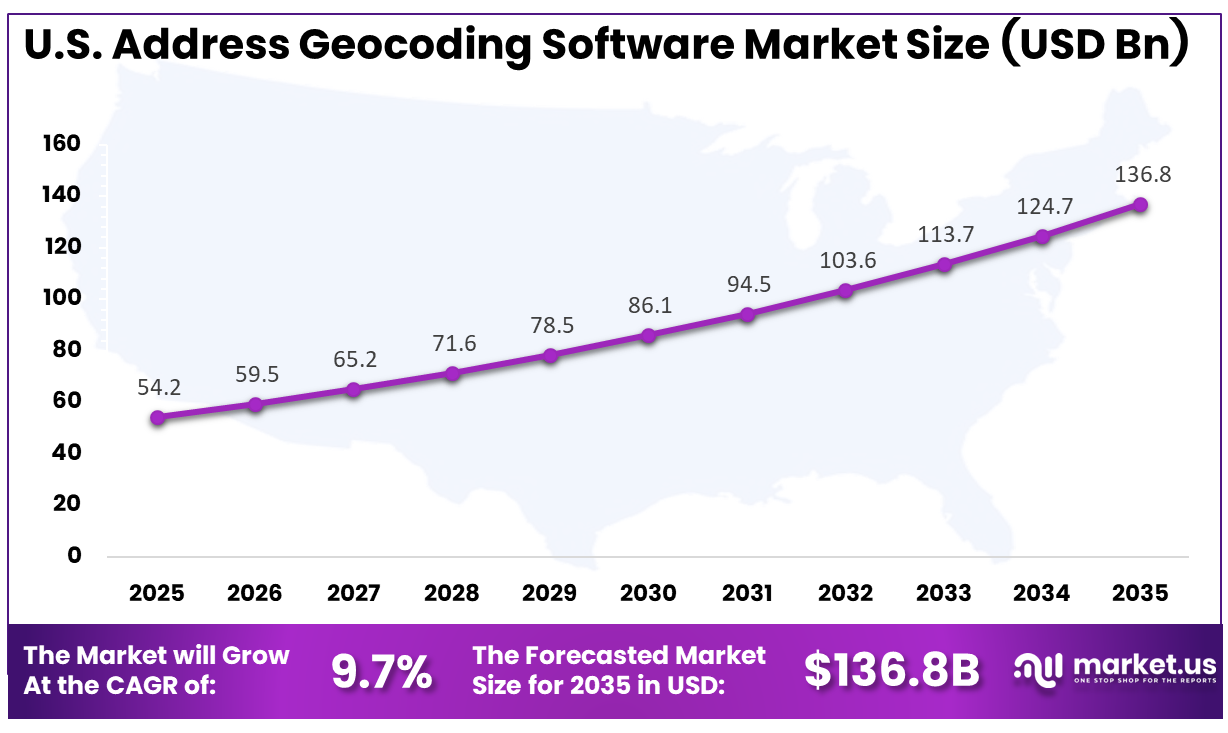
- The U.S. Address Geocoding Software Market was valued at USD 54.2 billion in 2025, with a robust CAGR of 9.7%.
- In 2025, North America held a dominant market position in the Global Address Geocoding Software Market, capturing more than a 38.9% share.
Role of Generative AI
Generative AI is improving how incomplete or unclear addresses are processed by predicting accurate coordinates using satellite data and partial inputs. It increases accuracy by 40-50% in rural or complex regions where traditional systems often fail, helping businesses maintain reliable location data across wider geographic areas.
It also supports automated address creation in unmapped locations, reducing manual workload by up to 75%. This allows faster expansion of global databases and improves service reach. As a result, organizations can scale operations efficiently while maintaining consistent address quality across both developed and emerging markets.
Investment and Business Benefits
Investment activity is centered on address validation, multilingual matching, API-based integration, and broader data quality workflows. Strong potential also exists in solutions designed for local address structures, especially in markets with unstructured formats. Privacy-focused and in-house geocoding tools are also attracting attention in sectors where strict data handling rules limit external platform use.
The benefits of geocoding software are practical and clearly visible in day-to-day operations. It helps reduce failed deliveries, lowers manual correction work, improves customer record quality, and supports more accurate route and service planning. It also strengthens customer analysis by linking location with buying behavior, engagement patterns, and underserved areas.
Regional Analysis
In 2025, North America held a dominant market position in the Global Address Geocoding Software Market, capturing more than a 38.9% share, holding USD 0.59 billion in revenue. This dominance is because the region has strong digital infrastructure, high use of cloud platforms, and wide adoption of location-based technologies across retail, logistics, healthcare, and financial services. Businesses in the region place high importance on address accuracy, route efficiency, and customer data quality. Early technology adoption and strong enterprise spending also continue to support market leadership.
For instance, in March 2025, Pitney Bowes Inc. enhanced its Spectrum Spatial platform with advanced geocoding capabilities, achieving 98% accuracy for U.S. addresses. The upgrade supports real-time location intelligence for logistics firms, reinforcing North America’s leadership through superior data processing and enterprise integration.

U.S. Address Geocoding Software Market Size
The market for Address Geocoding Software within the U.S. is growing tremendously and is currently valued at USD 54.2 billion; the market has a projected CAGR of 9.7%. The market is growing because businesses across retail, e-commerce, logistics, healthcare, and financial services are relying more on accurate location data in daily operations. Strong demand for faster deliveries, cleaner customer records, better route planning, and location-based decision making is supporting adoption. Growth is also being encouraged by cloud deployment, rising digital transactions, and the need to improve address accuracy across large databases.
For instance, in February 2025, Google LLC expanded Google Maps Platform with AI-powered forward and reverse geocoding, processing 10 million queries per second globally. The enhancement delivers sub-meter accuracy across North America, powering ride-sharing and delivery services while solidifying U.S. innovation leadership in scalable geocoding solutions.
Key Regions and Countries
North America
- US
- Canada
Europe
- Germany
- France
- The UK
- Spain
- Italy
- Russia
- Netherlands
- Rest of Europe
Asia Pacific
- China
- Japan
- South Korea
- India
- Australia
- Singapore
- Thailand
- Vietnam
- Rest of APAC
Latin America
- Brazil
- Mexico
- Rest of Latin America
Middle East & Africa
- South Africa
- Saudi Arabia
- UAE
- Rest of MEA
Type Analysis
In 2025, the Real-time Geocoding segment held a dominant market position, capturing a 41.3% share of the Global Address Geocoding Software Market. This dominance is due to the growing need for instant address validation during transactions and service requests. Businesses prefer systems that can confirm location details in real time to reduce errors and improve efficiency. It helps operations run smoothly by ensuring accurate data is captured at the point of entry.
Real-time solutions are also widely used in delivery, mobility, and digital services where a quick response is essential. They support a better customer experience by avoiding delays caused by incorrect addresses. As operations become more time sensitive, real-time processing continues to play a central role in location-based workflows.
For instance, in January 2026, Google expanded its Geocoding API v4 with new routing‑oriented features that support instant address resolution for delivery and navigation use cases. The platform now includes experimental destination‑search endpoints that help apps pinpoint pickup and drop‑off points in real time, strengthening its role in on‑demand services and logistics workflows.
Deployment Analysis
In 2025, the Cloud-Based segment held a dominant market position, capturing a 62.5% share of the Global Address Geocoding Software Market. This dominance is due to the increasing demand for flexible and scalable systems that can handle large volumes of address data. Cloud-based deployment allows businesses to access geocoding tools without heavy infrastructure investment. It also enables easy updates and smooth integration with other digital platforms across locations.
Organizations prefer cloud environments because they support centralized data management and remote access. This improves collaboration across teams and simplifies system maintenance. As companies expand their digital operations, cloud-based geocoding remains a practical and efficient deployment choice for managing growing data needs.
For instance, in January 2026, Microsoft reinforced its cloud‑based geocoding position by embedding location APIs deeper into its Azure ecosystem. The update lets developers consume geocoding as managed services within data pipelines, analytics, and microservices, reducing the need for on‑prem GIS infrastructure and accelerating cloud‑native mapping projects.
Application Analysis
In 2025, the Location Intelligence segment held a dominant market position, capturing a 30.8% share of the Global Address Geocoding Software Market. This dominance is due to the rising need for deeper insights from geographic data in business decision-making. Location intelligence helps organizations understand customer behavior, demand patterns, and service gaps. It turns address data into meaningful insights that support planning and operational improvements across various sectors.
Businesses are also using these insights to improve targeting, optimize resources, and enhance service delivery. By combining location data with analytics, companies gain a clearer view of market trends. This makes location intelligence a valuable application area for organizations focused on data-driven strategies.
For instance, in December 2025, Pitney Bowes enhanced its location‑intelligence suite with upgraded geocoding tools that improve address‑level accuracy and support richer spatial analytics. The release helps clients map customer behavior, risk exposure, and site performance more reliably by turning raw addresses into precise coordinates fed into planning and visualization tools.
End-User Analysis
In 2025, the Retail and E-commerce segment held a dominant market position, capturing a 27.3% share of the Global Address Geocoding Software Market. This dominance is due to the strong reliance on accurate address data in online transactions and delivery operations. Retail and e-commerce businesses need correct location details to ensure timely order fulfillment and avoid delivery issues. Accurate geocoding helps reduce returns and improve overall customer satisfaction.
These businesses also use location data to understand customer preferences and improve service reach. It supports better planning for delivery routes and regional demand. As online shopping continues to grow, the importance of reliable address data remains critical for efficient retail and e-commerce operations.
For instance, in April 2026, Mapbox expanded its geocoding and search APIs to better support global e‑commerce and last‑mile delivery workflows, refining how addresses are cleaned and matched in real time. The update helps retailers and delivery platforms reduce failed shipments and improve checkout experiences by matching customer‑entered addresses to precise pickup or delivery points.
Key Market Segments
By Type
- Batch Geocoding
- Real-time Geocoding
- Interactive Geocoding
- Reverse Geocoding
- Others
By Deployment
- On-Premises
- Cloud-based
By Application
- Location Intelligence
- Mapping and Navigation
- Asset Management
- Emergency Response
- Others
By End-User
- BFSI
- Retail and E-commerce
- Transportation and Logistics
- Government
- Real Estate
- Utilities
- Others
Emerging Trends
High-precision rooftop geocoding is becoming more important in industries like insurance and logistics, where exact building identification is critical. Adoption has increased by 30% in the last two years, supported by improvements in real-time data and mapping technologies that enable more accurate location identification.
At the same time, AI-based enrichment is adding value by attaching property details and risk insights to coordinates. This improves verification processes, especially in fintech, where reliability has improved by 25%. These trends reflect a shift toward deeper, more actionable location intelligence beyond simple mapping.
Growth Factors
The rapid growth of e-commerce and last-mile delivery services is increasing the need for precise geocoding solutions. Demand has grown by 35% in logistics as mobile ordering expands, making accurate address handling essential for timely deliveries and efficient route planning across both urban and semi-urban areas.
In addition, the rise of IoT devices and real-time tracking systems is accelerating adoption. Software usage has increased by 28% as smart city initiatives expand, requiring instant address conversion and continuous location updates. This supports better coordination, monitoring, and service delivery across connected infrastructure environments.
Market Dynamics
Drivers - Need for Accurate Location Data
The market is driven by the increasing need for precise location data across industries such as logistics, retail, and public services. Businesses depend on accurate addresses to improve delivery performance, reduce operational errors, and enhance customer satisfaction through better service coverage and planning.
Accurate geocoding also supports decision-making by linking location with customer behavior and service demand. It helps organizations identify gaps, optimize routes, and manage resources more effectively. As data becomes central to operations, the demand for reliable location information continues to grow steadily.
For instance, in June 2025, HERE was highlighted by an analyst benchmark as the top global location platform, ahead of several major rivals, reflecting how customers now depend on highly accurate map and geocoding data for navigation and enterprise use cases. The recognition underlines how fleet operators, automotive clients, and location‑based app providers increasingly treat precise address‑to‑coordinate conversion as core infrastructure in their digital services.
Restraint - Irregular Address Formats
A key restraint in the market is the presence of inconsistent and unstructured address formats across different regions. Variations in language, formatting, and missing details make it difficult for systems to process and match addresses accurately, leading to errors in geocoding results.
This challenge increases the need for additional data cleaning and validation efforts, which can slow down operations. Businesses often face delays and higher processing costs when dealing with poor address quality, limiting the efficiency and reliability of geocoding solutions in certain environments.
For instance, in July 2025, Oracle documentation for customer data management highlights that its geocoding features work best when sales teams enter valid postal addresses, and it recommends using separate address verification services to improve input quality. This guidance reflects how inconsistent or incomplete address formats can limit geocoding results and force customers to add extra validation steps.
Opportunities - Smarter Logistics and Public Services
There is a strong opportunity to improve logistics operations and public services through better use of geocoding software. Accurate location data helps streamline deliveries, improve route planning, and enhance service coverage in both urban and remote areas, supporting efficient operations.
Public sector applications are also expanding as governments use geocoding for planning infrastructure, emergency response, and service distribution. This creates new opportunities for software adoption, as reliable location data becomes essential for improving access, coordination, and overall service effectiveness.
For instance, in June 2025, broader digital map and geospatial analytics coverage listed Hexagon as an important provider for infrastructure, utilities, and public‑sector clients. Its platforms use geocoded assets and addresses to support smart grid management, transportation planning, and environmental monitoring, showing how accurate address location is central to smarter public services and critical networks.
Challenges - Privacy and Security Pressure
Handling location data raises concerns about privacy and data protection. Address information can reveal personal patterns, which makes secure storage and responsible use essential. Organizations must ensure that data is collected and processed in a way that respects user privacy and meets regulatory expectations.
This creates pressure to build strong security measures and clear data policies. Companies must balance the benefits of location insights with the need to protect sensitive information. As regulations become stricter, maintaining trust while using geocoding data remains a critical challenge.
For instance, in November 2024, Esri’s approach to hosting global location and enrichment data in ArcGIS services involves regular quality checks and integration with existing security and access controls in its cloud platform. This setup helps organizations govern which users can work with detailed geocoded datasets, addressing internal security and compliance needs around address-level information.
Key Players Analysis
One of the leading players in June 2025, Foursquare expanded its Places and Geocoding APIs to support richer POI‑backed address resolution, linking street addresses to venues, competitors, and foot‑traffic patterns. The move strengthens its value proposition for retail, real‑estate, and CPG clients wanting to tie geocoding to store‑level analytics and competitive intelligence rather than basic coordinate lookups.
Top Key Players in the Market
- Pitney Bowes Inc.
- HERE Technologies
- Google LLC
- Esri Inc.
- TomTom International BV
- Mapbox
- Microsoft Corporation
- Oracle Corporation
- Salesforce, Inc.
- TCS (Tata Consultancy Services)
- Foursquare Labs Inc.
- CARTO
- MapQuest
- Hexagon AB
- GeoIQ
- Apple Inc.
- Other Key Players
Recent Developments
- In May 2025, CARTO revamped its cloud‑based geocoding engine to support high‑throughput batch processing and real‑time streaming for IoT and mobility use‑cases, tightening integration with its spatial analytics notebooks. The upgrade targets data‑science teams building location‑driven machine‑learning models, making it easier to transform address lists into enriched geospatial features without external ETL layers.
- In January 2026, Esri rolled out an AI‑driven address normalization engine within its ArcGIS Geocoding services, boosting parsing accuracy for non‑standard and informal addresses in developing economies. The update lowers matching errors for local governments and utilities mapping networks, while tighter integration with ArcGIS Field Maps supports real‑time, mobile‑centric field data collection tied to official geocoding frameworks.
Report Scope
| Report Features | Description |
|---|---|
| Market Value (2025) | USD 1.53 Billion |
| Forecast Revenue (2035) | USD 4.50 Billion |
| CAGR (2026-2035) | 11.4% |
| Base Year for Estimation | 2025 |
| Historic Period | 2020-2024 |
| Forecast Period | 2026-2035 |
| Report Coverage | Revenue Forecast, Market Dynamics, Competitive Landscape, Recent Developments |
| Segments Covered | By Type (Batch Geocoding, Real-time Geocoding, Interactive Geocoding, Reverse Geocoding, Others), By Deployment (On-Premises, Cloud-based), By Application (Location Intelligence, Mapping and Navigation, Asset Management, Emergency Response, Others), By End-User (BFSI, Retail and E-commerce, Transportation and Logistics, Government, Real Estate, Utilities, Others) |
| Regional Analysis | North America (US and Canada), Europe (Germany, France, The UK, Spain, Italy, and Rest of Europe), Asia Pacific (China, Japan, South Korea, India, Australia, and Rest of APAC), Latin America (Brazil, Mexico, and Rest of Latin America), Middle East & Africa (GCC, South Africa, and Rest of MEA) |
| Competitive Landscape | Pitney Bowes Inc., HERE Technologies, Google LLC, Esri Inc., TomTom International BV, Mapbox, Microsoft Corporation, Oracle Corporation, Salesforce, Inc., TCS (Tata Consultancy Services), Foursquare Labs Inc., CARTO, MapQuest, Hexagon AB, GeoIQ, Apple Inc., Other Key Players |
| Customization Scope | Customization for segments, region/country-level will be provided. Moreover, additional customization can be done based on the requirements. |
| Purchase Options | We have three licenses to opt for: Single User License, Multi-User License (Up to 5 Users), Corporate Use License (Unlimited Users and Printable PDF) |