


Quick Navigation
- Report Overview
- Key Takeaways
- Technology Analysis
- Application Analysis
- Vehicle Type Analysis
- Installation Analysis
- Key Market Segments
- Regional Analysis
- Key Regions and Countries
- Market Dyanamic
- Drivers
- Restraints
- Challenges
- Opportunities
- Key Company Insights
- Recent Developments
- Geopolitical Impact Analysis
- Report Scope
Report Overview
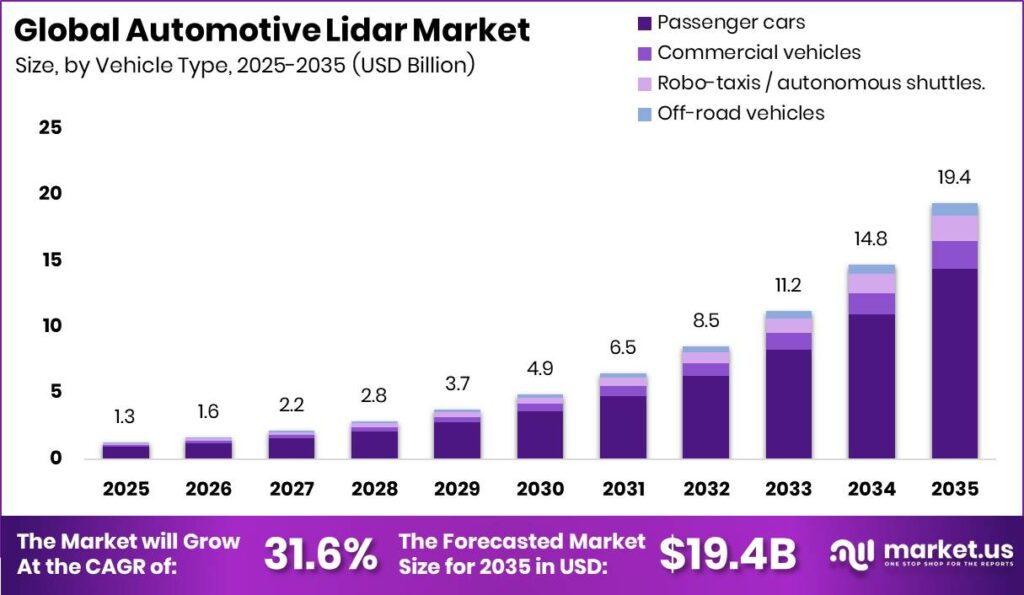
Global Automotive Lidar Market size is expected to be worth around USD 19.40 Billion by 2035 from USD 1.30 Billion in 2025, growing at a CAGR of 31.6% during the forecast period 2026 to 2035. This steep trajectory reflects the shift of lidar from a research tool into a production-grade sensing layer. Suppliers who lock in OEM nominations early will capture disproportionate volume as adoption scales.
Therefore, the Automotive Lidar Market covers sensors that measure distance using laser pulses to build precise three-dimensional maps around a vehicle. The market spans Advanced Driver Assistance Systems hardware, higher-level automation platforms, and commercial autonomy fleets. Vendors compete across technology type, application, vehicle type, and mounting position, which means product design and cost structure vary sharply by target platform.
Key Takeaways
- Automotive Lidar Market size reached USD 1.30 Billion in 2025 and is forecast to hit USD 19.40 Billion by 2035 at a CAGR of 31.6%.
- Solid-state LiDAR led the By Technology segment with a 65.1% share in 2025.
- ADAS dominated the By Application segment with a 78.1% share.
- Passenger cars held the largest By Vehicle Type share at 74.1%.
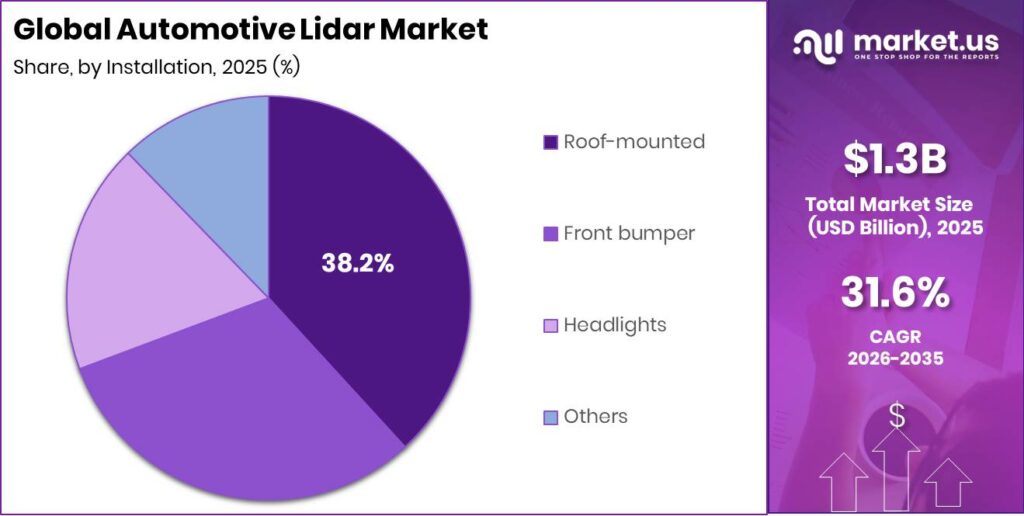
- Roof-mounted installation led the By Installation segment with a 38.2% share.
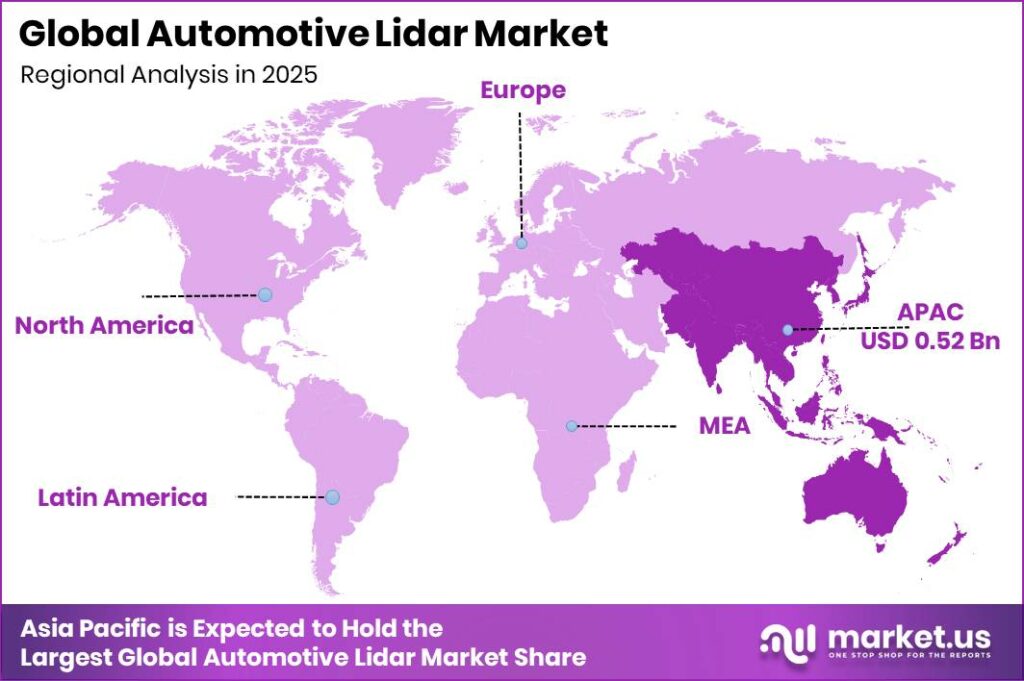
- Asia Pacific led all regions with a 41.7% market share.
Government regulation now drives lidar demand faster than any single technology trend. Regulators in China set a national automotive lidar standard effective in 2025, while the European Commission applied its General Safety Regulation to all new vehicles. This means OEMs must qualify sensors against binding benchmarks, so suppliers with certified, standards-ready products gain a clear commercial edge over unvalidated challengers.
Consequently, production scale has become the decisive competitive factor in this market. As per our research, one leading manufacturer surpassed monthly lidar production and deliveries of 200,000 units during 2025. This volume lets high scalers absorb fixed costs and undercut smaller rivals on price. Companies unable to match this cadence risk losing OEM contracts on cost grounds alone.
As a result, rising automation programs connect directly to higher lidar content per vehicle. Multi-sensor architectures on premium platforms raise unit counts per car, which expands the total addressable volume for every qualified supplier. This creates a durable demand base that rewards vendors already embedded in production programs today.
Technology Analysis
Solid-state LiDAR dominates with 65.1% due to durable no-moving-parts automotive-grade reliability.
In 2025, Solid-state LiDAR held a dominant market position in the By Technology segment of Automotive Lidar Market, with a 65.1% share. RoboSense’s EM4 detects 10%-reflectivity targets at 300 meters with a maximum range of 600 meters. This range headroom lets OEMs qualify one sensor across multiple trims. Suppliers offering long-range solid-state units will win platform-wide design slots ahead of narrower rivals.
Mechanical LiDAR relies on spinning assemblies to sweep the environment, which historically delivered wide coverage at higher failure risk. Hesai’s AT128P far-field horizontal resolution reaches 0.1 degrees at 10 Hz, showing how fine mechanical scanning can still resolve distant objects. This precision keeps mechanical units relevant for robotaxi roofs. However, buyers increasingly favor solid-state designs for passenger-car durability and lower warranty exposure.
MEMS LiDAR uses tiny mirrors to steer beams, cutting size and cost for embedded automotive placement. Flash LiDAR floods a scene with light for fast full-frame capture, which suits short-range corner sensing. Optical phased array LiDAR steers beams electronically with no mechanical parts at all. These three technologies together hold the remaining share, and each targets specific packaging and cost niches that mainstream solid-state units cannot fully serve.
Application Analysis
ADAS dominates with 78.1% due to mandated active-safety braking adoption.
In 2025, ADAS held a dominant market position in the By Application segment of Automotive Lidar Market, with a 78.1% share. Aeva’s Atlas detects 10%-reflectivity targets at up to 250 meters and measures at distances up to 500 meters. This long reach improves early hazard detection for braking systems. Suppliers who meet regulatory braking distances will secure high-volume ADAS nominations across mass-market fleets.
Semi-autonomous driving relies on lidar to handle lane control and highway pilot functions under driver supervision. Aeva’s Atlas operates across a wide thermal window from −40 degrees Celsius to 85 degrees Celsius, which suits varied climates. This durability supports consistent performance in real driving conditions. Vendors proving wide-temperature reliability gain trust from OEMs deploying Level 2-plus systems at scale.
Fully autonomous driving is the fastest-growing application because it demands maximum sensing redundancy and range. Automatic emergency braking and adaptive cruise control round out the segment, each drawing on lidar for precise distance measurement. These functions hold the remaining share collectively. Early movers building validated autonomy-grade stacks will control premium pricing before commodity competition arrives.
In June 2025, Innoviz Technologies signed a Statement of Development Work with a top-five global passenger vehicle OEM to customize its InnovizTwo lidar for a Level 3 production program, showing how OEM commitments now anchor autonomy revenue.
Vehicle Type Analysis
Passenger cars dominate with 74.1% due to mass-market ADAS installation volumes.
In 2025, Passenger cars held a dominant market position in the By Vehicle Type segment of Automotive Lidar Market, with a 74.1% share. RoboSense’s EMX lidar uses 192 beams and produces 2.88 million points per second. This dense output fits compact passenger-car sensing budgets. Suppliers optimizing point density against price will dominate the highest-volume vehicle category.
Commercial vehicles adopt lidar to protect large blind zones and support long-haul driver assistance. Aeva’s Atlas Ultra offers a 250-meter range for 10%-reflectivity targets and a standard field of view of 120 degrees by 25 degrees. This coverage suits truck highway operation. Vendors targeting fleet operators can command premium contracts tied to safety and uptime gains.
Robo-taxis and autonomous shuttles form the fastest-growing vehicle type because they require dense multi-sensor coverage. Off-road vehicles use lidar for terrain mapping in mining and agriculture settings. These categories hold the remaining share collectively. Suppliers building rugged, high-channel-count units will capture the premium autonomy and off-road niches ahead of passenger-focused rivals.
Installation Analysis
Roof-mounted dominates with 38.2% due to unobstructed 360-degree sensing coverage.
In 2025, Roof-mounted held a dominant market position in the By Installation segment of Automotive Lidar Market, with a 38.2% share. Hesai’s AT128P covers a 120-degree horizontal field of view and a 25.4-degree vertical field of view. This wide arc suits elevated roof placement. Suppliers designing for roof integration will lead robotaxi and premium platform contracts where sightline matters most.
Front bumper installation places lidar low for close-range obstacle and pedestrian detection during braking. This position favors compact, contamination-resistant sensors that survive road spray and impacts. Bumper mounting suits mass-market ADAS packages. Vendors offering rugged, low-profile units gain an edge in high-volume passenger programs where cost and durability decide selection.
Headlight integration is the fastest-growing installation point because it hides lidar behind styling while preserving forward range. The Others category covers grille, mirror, and A-pillar placements that serve niche packaging needs. These positions hold the remaining share collectively. Suppliers mastering discreet integration will win design-conscious OEMs seeking sensors that do not disrupt vehicle aesthetics.
Key Market Segments
By Technology
- Mechanical LiDAR
- Solid-state LiDAR
- MEMS LiDAR
- Flash LiDAR
- Optical phased array LiDAR
By Application
- ADAS
- Semi-autonomous driving
- Fully autonomous driving
- Automatic emergency braking
- Adaptive cruise control
By Vehicle Type
- Passenger cars
- Commercial vehicles
- Robo-taxis / autonomous shuttles
- Off-road vehicles
By Installation
- Roof-mounted
- Front bumper
- Headlights
- Others
Regional Analysis
Asia Pacific Dominates the Automotive Lidar Market with a Market Share of 41.7%, Valued at USD 0.52 Billion
Asia Pacific led the Automotive Lidar Market in 2025 with a 41.7% share worth USD 0.52 Billion. China anchors this lead through a national lidar standard and dense electric-vehicle production. This concentration gives regional suppliers scale advantages that lower unit costs. Global OEMs sourcing from Asia Pacific gain access to the most mature, cost-competitive lidar supply base available today.
North America ranks as the fastest-growing region because autonomy programs and safety mandates accelerate demand. In 2025, Aeva Technologies expanded its production collaboration with Daimler Truck and Torc Robotics through added manufacturing investment for its 4D lidar platform on autonomous trucks. This commitment signals rising commercial autonomy volume. Suppliers building North American capacity will capture the region’s fleet and freight opportunities first.
Europe contributes meaningful demand through its General Safety Regulation and premium vehicle platforms that adopt multi-lidar architectures early. This regulatory push raises lidar content per qualified vehicle across the region. European OEMs favor validated, standards-compliant sensors. Suppliers meeting these requirements can secure long-term nominations on high-value platforms where safety differentiation justifies premium pricing.
Key Regions and Countries
North America
- US
- Canada
Europe
- Germany
- France
- The UK
- Spain
- Italy
- Rest of Europe
Asia Pacific
- China
- Japan
- South Korea
- India
- Australia
- Rest of APAC
Latin America
- Brazil
- Mexico
- Rest of Latin America
Middle East and Africa
- GCC
- South Africa
- Rest of MEA
Market Dyanamic
Market Opportunity Analysis - Underserved regions, robotaxi fleets, and discreet installation points open room for new entrants
Robo-taxis and autonomous shuttles remain underexploited within the By Vehicle Type segment despite their fastest-growing status. These fleets demand more sensors per vehicle than passenger cars, yet unit volumes stay small today. This creates a high-margin niche before commodity competition arrives. New entrants with rugged, high-channel-count units can capture premium contracts while incumbents chase passenger-car volume.
Headlight installation stays underused within the By Installation segment even as it grows fastest. Most suppliers still target roof and bumper positions, leaving styling-integrated placement open. This means design-focused OEMs lack proven headlight-ready partners. Investors backing suppliers who master discreet integration can secure differentiated design wins before rivals adapt their packaging.
Fully autonomous driving stays underpenetrated within the By Application segment because deployment remains gated by permits and validation. However, this gap leaves room for suppliers building autonomy-grade stacks ahead of demand. By contrast, ADAS is already crowded with established players. Early movers positioning for autonomy volume will control pricing when fleet programs finally scale.
Technology and Innovation Landscape - Higher point density, extended range, and multi-beam scanning redefine competitive edges
RoboSense’s EM4 generates as many as 41.04 million points per second using up to 2,160 scanning beams. This density lets perception systems resolve small distant objects with far greater confidence. As a result, suppliers offering ultra-high point output gain a clear edge in autonomy programs. Vendors stuck at lower resolutions risk losing high-value nominations to denser rivals.
According to RoboSense, the EM4’s longer detection range can extend an intelligent-driving system’s available response time by as much as 70%. This extra reaction window directly improves safety margins at highway speeds. Therefore, OEMs increasingly treat range as a safety differentiator, not just a spec. Suppliers who lead on range can justify premium pricing against shorter-range competitors.
RoboSense’s EMX provides global angular resolution of 0.08 degrees by 0.1 degrees and detection out to 300 meters. Aeva’s Atlas Ultra delivers three times the resolution of its earlier configuration and up to 150 degrees of horizontal vision. This means suppliers now compete on fine-grained perception fidelity. Investors should favor vendors advancing resolution fastest, since perception quality drives long-term platform selection.
Drivers
ADAS requirements are moving lidar from optional autonomy hardware toward a core sensing layer on safety-critical platforms. The European Commission applied its General Safety Regulation to all new EU motor vehicles on July 7, 2024, projecting more than 25,000 lives saved and at least 140,000 serious injuries avoided by 2038. This mandate lifts sensor content per vehicle. Suppliers offering validated perception packages gain durable content growth.
NHTSA’s 2024 FMVSS 127 rule requires nearly all US light vehicles to meet automatic-braking performance by September 2029, including braking for imminent collisions at up to 90 mph. China’s national lidar standard, effective in 2025, added common benchmarks that cut OEM qualification ambiguity. Together these milestones support a roughly +3.2% CAGR contribution. Suppliers shift from stand-alone hardware toward integrated validation and lifecycle support.
| Driver | (~) % Impact on CAGR Forecast | Geographic Relevance | Impact Timeline |
|---|---|---|---|
| ADAS Sensor-Stack Proliferation | +3.2% | Global; strongest in China, Europe, and North America | Short term (2 years or less) |
| Lidar Unit-Cost Compression | +2.7% | China-led, expanding globally | Short term (2 years or less) |
| Higher-Level Automation Programs | +2.2% | China, United States, Europe, Japan, and South Korea | Medium term (2 to 4 years) |
| Automotive Lidar Standardization | +1.6% | China with global supply-chain relevance | Short term (2 years or less) |
| Multi-Lidar Vehicle Architectures | +1.3% | China and premium global platforms | Medium term (2 to 4 years) |
Restraints
The main immediate restraint is the hard bill-of-materials ceiling on high-volume vehicles, because lidar competes for budget with radar, cameras, and domain controllers. One manufacturer lifted shipments from 501,889 units in 2024 to 1,620,406 in 2025, a 222.9% rise, while another disclosed only 8,100 fourth-quarter shipments despite a 60% gross margin. Scale decides survival here.
NHTSA’s FMVSS 127 mandates braking outcomes rather than lidar specifically, letting OEMs meet rules with cheaper camera-and-radar setups. This optionality produces an estimated -3.0% drag against the 31.6% baseline CAGR. As a result, suppliers must fund aggressive design-to-cost programs. Vendors should defer capacity spending until binding OEM nominations and volumes are secured.
| Restraint | (~) % Impact on CAGR Forecast | Geographic Relevance | Impact Timeline |
|---|---|---|---|
| Vehicle BOM Affordability Ceiling | -3.0% | Global; acute in mass-market vehicle segments | Short term (2 years or less) |
| Geopolitical Procurement Restrictions | -2.4% | United States–China supply corridors | Short term (2 years or less) |
| Automotive CapEx Selectivity | -1.8% | Europe, North America, and Japan | Short term (2 years or less) |
| Autonomy Deployment Permitting Limits | -1.5% | United States, Europe, and selected Asian markets | Medium term (2 to 4 years) |
| Legacy Platform Lock-In | -1.1% | Global incumbent OEM platforms | Medium term (2 to 4 years) |
Challenges
Automotive lidar must hold detection accuracy across rain, fog, snow, spray, vibration, and interference, creating a continuous validation burden. China’s GB/T 45500-2025 formalized testing across ranging accuracy, angular resolution, and environmental durability, while NHTSA sets braking thresholds to 90 mph. UNECE’s global ADS framework, approved in June 2026, added lifecycle safety management and continuous performance monitoring. These overlapping demands raise engineering cost per program.
These expectations impose an estimated -2.6% friction drag through larger validation fleets, repeated software regression, and extended OEM sign-off. Therefore, suppliers must invest in digital twins, accelerated-life testing, and modular safety cases. This creates a new revenue stream for validation tooling and simulation partners. Vendors selling reusable safety cases can turn a cost burden into a service business.
| Challenge | (~) % CAGR Friction Drag | Geographic Relevance | Mitigation Horizon |
|---|---|---|---|
| Environmental Validation Complexity | -2.6% | Global | Medium term (2 to 4 years) |
| Cross-Sensor Interference Control | -2.1% | Dense urban and high-penetration markets | Medium term (2 to 4 years) |
| Perception Data Fragmentation | -1.7% | Global, especially multinational programs | Long term (4 years or more) |
| Automotive Talent Scarcity | -1.3% | North America, Europe, Japan, and South Korea | Medium term (2 to 4 years) |
| Field Reliability Management | -1.0% | Global | Long term (4 years or more) |
Opportunities
Commercial autonomy remains an opportunity because large-scale driverless trucking, robotaxi, and logistics fleets still need investment, permits, and validated safety cases. Beijing’s autonomous-driving framework took effect on April 1, 2025 for Level 3 and higher systems, while UNECE’s 2026 rules set common validation requirements. In the United States, NHTSA moved in June 2025 to streamline FMVSS exemptions for autonomous vehicles.
If operators convert this opening into repeatable fleet programs, bundled hardware, software, and uptime support could add roughly +2.8% above the 31.6% baseline CAGR. Multi-sensor fleet architectures could raise lidar units per vehicle by about 2 to 5 times. This means recurring service attachment could lift blended program gross margin by an estimated 5 to 10 percentage points for early movers.
| Opportunity | (~) % Potential CAGR Upside | Geographic Relevance | Execution Window |
|---|---|---|---|
| Commercial Autonomy Fleet Expansion | +2.8% | China, United States, Europe, and Middle East | Medium term (2 to 4 years) |
| Software-Defined Lidar Monetization | +2.1% | Global | Medium term (2 to 4 years) |
| Emerging-Market Localization | +1.7% | India, Southeast Asia, Latin America, and Middle East | Long term (4 years or more) |
| Aftermarket Safety Retrofits | +1.3% | Commercial fleets globally | Medium term (2 to 4 years) |
| Sensor-Data Service Revenues | +0.9% | North America, Europe, China, and Japan | Long term (4 years or more) |
Key Company Insights
Hesai Technology holds a scale advantage that few rivals can match. The company produced its one-millionth lidar unit of 2025 by September, while cumulative deliveries exceeded 1.37 million units by the end of the second quarter of 2025. This volume drives fixed-cost absorption and pricing power across OEM programs. However, its US Pentagon designation dispute creates procurement risk in North American supply corridors.
RoboSense Technology competes through aggressive volume growth and dense-point sensing. The company sold roughly 912,000 lidar units during 2025, an increase of 67.6% from the prior year. This rapid ramp strengthens its position with new-energy-vehicle makers seeking proven suppliers. Its focus on digital lidar platforms creates a technology edge, though reliance on Chinese OEM demand concentrates its revenue risk.
Key Players
- Hesai Technology
- RoboSense Technology
- Luminar Technologies
- Valeo
- Robert Bosch GmbH
- Continental AG
- Innoviz Technologies Ltd
- Ouster, Inc
- Velodyne Lidar, Inc
- Denso Corporation
- ZF Friedrichshafen AG
- Aeva Technologies, Inc
- LeddarTech Inc.
- Quanergy Systems, Inc
- Huawei Technologies Co., Ltd
Recent Developments
- October 2025: RoboSense delivered its 120,000th digital lidar unit to one major new-energy-vehicle manufacturer, marking a milestone in serial automotive supply.
- August 2025: Innoviz Technologies began high-volume automotive-grade lidar production at Fabrinet’s manufacturing facility, supporting serial production programs for automotive customers.
- July 2025: Hesai Technology appealed a US federal court ruling regarding its Pentagon designation while continuing global automotive lidar supply programs with vehicle manufacturers.
Geopolitical Impact Analysis
According to the WTO, global merchandise trade growth slowed sharply amid rising tariff actions, with new US measures raising average effective tariff rates above 10% on many imported goods in 2025. These duties directly raise costs for lidar semiconductors, optics, and assemblies crossing US-China corridors. As a result, suppliers reroute sourcing and localize production. Vendors with diversified manufacturing footprints protect margins against tariff volatility better than single-country producers.
Figures from UNCTAD show container shipping costs and transit times rose during 2024 and 2025 as vessels rerouted around the Red Sea, adding roughly 10 to 14 days to some Asia-Europe voyages. This delay strains just-in-time delivery of lidar components to European assembly plants. Therefore, OEMs demand regional inventory buffers and dual sourcing. Suppliers holding local stock and nearshore capacity win contracts where delivery certainty outranks unit price.
Report Scope
| Report Features | Description |
|---|---|
| Market Value (2025) | USD 1.30 Billion |
| Forecast Revenue (2035) | USD 19.40 Billion |
| CAGR (2026-2035) | 31.6% |
| Base Year for Estimation | 2025 |
| Historic Period | 2020-2024 |
| Forecast Period | 2026-2035 |
| Report Coverage | Revenue Forecast, Market Dynamics, Market Opportunity Analysis, Technology and Innovation Landscape, Competitive Landscape, Recent Developments |
| Segments Covered | By Technology (Mechanical LiDAR, Solid-state LiDAR, MEMS LiDAR, Flash LiDAR, Optical phased array LiDAR), By Application (ADAS, Semi-autonomous driving, Fully autonomous driving, Automatic emergency braking, Adaptive cruise control), By Vehicle Type (Passenger cars, Commercial vehicles, Robo-taxis / autonomous shuttles, Off-road vehicles), By Installation (Roof-mounted, Front bumper, Headlights, Others) |
| Regional Analysis | North America (US and Canada), Europe (Germany, France, The UK, Spain, Italy, and Rest of Europe), Asia Pacific (China, Japan, South Korea, India, Australia, and Rest of APAC), Latin America (Brazil, Mexico, and Rest of Latin America), Middle East and Africa (GCC, South Africa, and Rest of MEA) |
| Competitive Landscape | Hesai Technology, RoboSense Technology, Luminar Technologies, Valeo, Robert Bosch GmbH, Continental AG, Innoviz Technologies Ltd, Ouster Inc, Velodyne Lidar Inc, Denso Corporation, ZF Friedrichshafen AG, Aeva Technologies Inc, LeddarTech Inc, Quanergy Systems Inc, Huawei Technologies Co Ltd |
| Customization Scope | Customization for segments, region / country-level will be provided. Additional customization can be done based on requirements. |
| Purchase Options | We have three licenses to opt for: Single User License | Multi-User License (Up to 5 Users) | Corporate Use License (Unlimited User and Printable PDF) |





































