


Report Overview
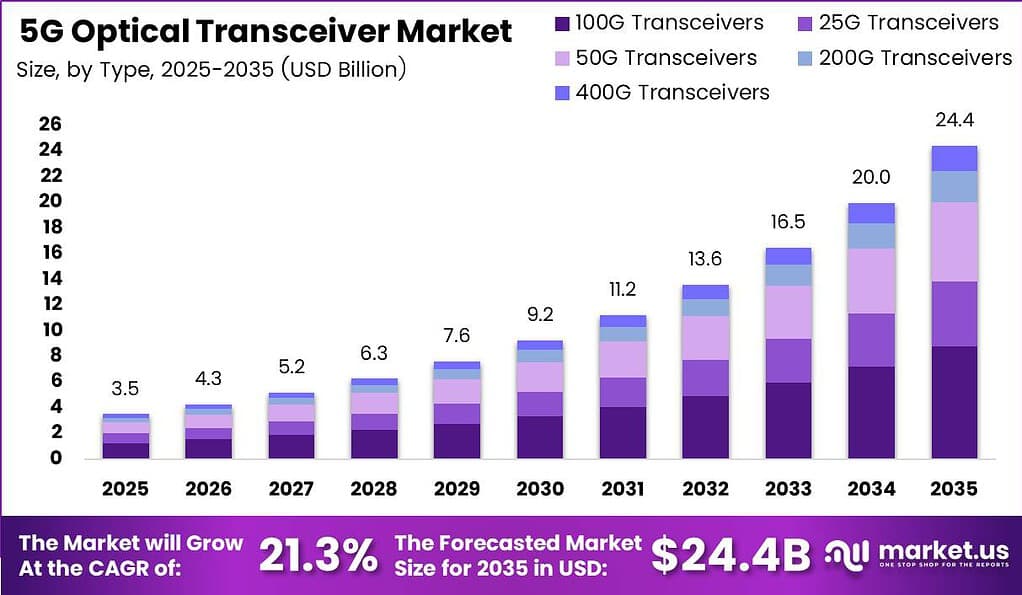
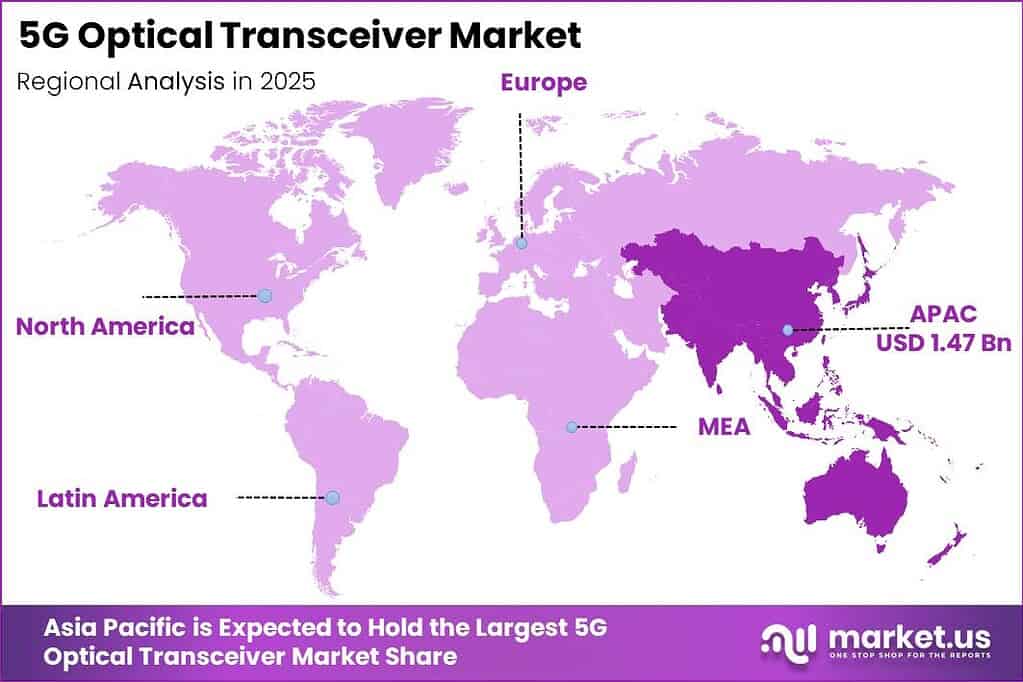
Global 5G Optical Transceiver Market size is expected to be worth around USD 24.4 Billion by 2035 from USD 3.5 Billion in 2025, growing at a CAGR of 21.3% during the forecast period 2026 to 2035. Asia Pacific leads all regions with a 41.9% share, valued at USD 1.47 Billion in 2025, reflecting where 5G infrastructure spending is most concentrated.
The 5G optical transceiver market covers high-speed optical modules that transmit data across 5G fronthaul, midhaul, and backhaul network layers. Products span speed tiers from 25G to 800G and beyond, serving telecom operators, data centers, and enterprise networks. Form factors include QSFP28, SFP28, and SFP56, deployed across short-reach and long-haul fiber links globally.
Key Takeaways
- Market value in 2025: USD 3.5 Billion
- Market forecast for 2035: USD 24.4 Billion
- CAGR (2026 to 2035): 21.3%
- Dominant segment by Type: 100G Transceivers with 35.4% share
- Dominant segment by Form Factor: QSFP28 with 45.5% share
- Dominant segment by Wavelength: 1310 nm band with 55.6% share
- Dominant segment by Distance: 10 to 100 Km with 45.6% share
- Dominant segment by 5G Infrastructure: 5G MidHaul/BackHaul with 61.6% share
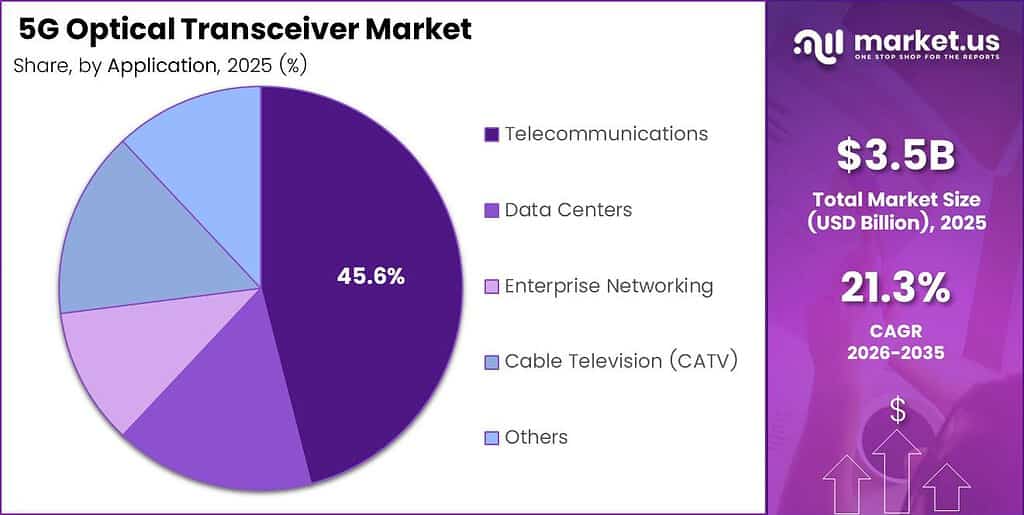
- Dominant segment by Application: Telecommunications with 45.6% share
- Dominant region: Asia Pacific with 41.9% share, valued at USD 1.47 Billion
Government-led broadband and 5G coverage mandates are reshaping optical transport economics worldwide. Europe’s Digital Decade program targets full Gigabit household coverage and universal 5G access across populated areas by 2030. India, Gulf markets, and Southeast Asia are simultaneously pushing fiber deeper into mobile networks, broadening the install base for 10G, 25G, and 100G optical interfaces at cell-site and metro edges.
As reported by telecomgurukul.com, 5G fronthaul traffic per macro site reaches 150 to 200 Gbps in 64T64R massive MIMO configurations using eCPRI Option 8 architecture. This volume forces operators to deploy higher-capacity optical links per site. Vendors positioned in the 100G and 200G transceiver tiers are best placed to capture this demand as massive MIMO deployments scale globally.
Open RAN and Cloud RAN architectures are expanding the number of pluggable optics required per radio domain. This structural shift increases transceiver counts per deployment site beyond what traditional single-vendor RAN required. As a result, transceiver vendors with carrier-grade qualification and multi-vendor interoperability certification hold a direct commercial advantage over those optimized for closed-system deployments.
Type Analysis
100G Transceivers dominates with 35.4% due to widespread metro and backhaul deployment.
In 2025, 100G Transceivers held a dominant market position in the By Type segment of the 5G Optical Transceiver Market, with a 35.4% share. This tier serves as the primary workhorse for 5G backhaul aggregation and metro transport. Operators standardizing on 100G modules benefit from a mature supply chain, lower per-unit costs, and broad interoperability across multi-vendor transport platforms.
25G Transceivers address the fronthaul layer of dense 5G deployments, connecting distributed units to centralized radio access nodes. This speed tier is the dominant choice for massive MIMO cell-site fronthaul, where cost per port is critical. Vendors offering carrier-hardened 25G modules with tight timing synchronization hold a structural advantage in large-scale radio rollout programs.
50G Transceivers represent the next-generation fronthaul upgrade path for operators requiring higher per-site capacity without immediate commitment to 100G economics. This tier is positioned between the cost profile of 25G and the performance headroom of 100G. Operators in dense urban markets with high spectral loading are the primary early adopters of 50G fronthaul solutions.
200G and 400G Transceivers serve high-capacity backhaul corridors and data center interconnect applications where 100G throughput is insufficient. These speed tiers gain traction as 5G-Advanced transport requirements push aggregate capacity demands beyond the 100G ceiling. The remaining share across these tiers collectively reflects the market’s transition toward higher-speed optical infrastructure.
Form Factor Analysis
QSFP28 dominates with 45.5% due to high port density and broad ecosystem support.
In 2025, QSFP28 held a dominant market position in the By Form Factor segment of the 5G Optical Transceiver Market, with a 45.5% share. This form factor supports 100G data rates across a compact, hot-pluggable design that fits standard line-card architectures. Its installed base across telecom and data center platforms makes it the default specification for most 5G transport procurement programs.
SFP28 serves the fronthaul and short-reach access layers of 5G networks, supporting 25G data rates in a smaller single-lane form factor. This module type is the standard choice for connecting radio units to baseband hotels in C-RAN deployments. Telecom operators running high site counts favor SFP28 for its low power draw and proven compatibility with existing line card slots.
SFP56 targets the emerging 50G per-lane fronthaul market and serves as a transitional form factor between SFP28 and QSFP28 in access layer deployments. This format is gaining traction where operators need to double per-port capacity without replacing existing cabling infrastructure. The remaining share falls to other form factors including OSFP and QSFP-DD, which are concentrated in the highest-speed data center interconnect applications.
Wavelength Analysis
1310 nm band dominates with 55.6% due to single-mode fiber compatibility and low chromatic dispersion.
In 2025, 1310 nm band held a dominant market position in the By Wavelength segment of the 5G Optical Transceiver Market, with a 55.6% share. This wavelength operates near the zero-dispersion point of standard single-mode fiber, enabling reliable transmission across metro and access distances without dispersion compensation. Telecom operators standardizing 5G transport on single-mode fiber infrastructure naturally align to the 1310 nm band for fronthaul and midhaul links.
850 nm band modules address short-reach multi-mode fiber applications within data centers and enterprise buildings supporting 5G edge infrastructure. This wavelength suits applications where fiber runs are measured in hundreds of meters rather than kilometers. The remaining wavelength share falls to CWDM, DWDM, and other band configurations used in coherent long-haul and WDM-based metro transport.
Distance Analysis
10 to 100 Km dominates with 45.6% due to metro backhaul and midhaul distance requirements.
In 2025, 10 to 100 Km held a dominant market position in the By Distance segment of the 5G Optical Transceiver Market, with a 45.6% share. This range aligns directly with metro backhaul and midhaul transport requirements where aggregation nodes, regional hubs, and core network points of presence are distributed across urban and suburban geographies. Vendors supplying carrier-grade modules optimized for this distance tier address the broadest share of operator transport procurement budgets.
1 to 10 Km modules serve the fronthaul layer connecting radio units to distributed unit locations within dense urban 5G deployments. This short-reach tier commands high volume due to the large number of 5G small cells and macro sites requiring fronthaul connectivity. The More than 100 Km segment addresses long-haul coherent transport for inter-city and backbone routes, where 400G ZR and ZR+ pluggable modules are increasingly used.
5G Infrastructure Analysis
5G MidHaul/BackHaul dominates with 61.6% due to capacity-intensive aggregation transport requirements.
In 2025, 5G MidHaul/BackHaul held a dominant market position in the By 5G Infrastructure segment of the 5G Optical Transceiver Market, with a 61.6% share. This layer connects distributed units to centralized units and links the core network across metro and regional distances. The high traffic aggregation burden at midhaul and backhaul nodes demands 100G and above optical interfaces, driving sustained transceiver procurement at higher speed tiers with stronger per-unit economics.
5G FrontHaul connects radio units to baseband processing locations and is the highest-volume layer in terms of physical site count. Each macro site and small cell deployment requires dedicated fronthaul optical links, creating consistent demand for 25G and 50G transceivers across large-scale radio rollout programs. As C-RAN and Open RAN architectures expand, fronthaul transceiver counts per operator network will rise materially.
Application Analysis
Telecommunications dominates with 45.6% due to direct alignment with 5G network build-out programs.
In 2025, Telecommunications held a dominant market position in the By Application segment of the 5G Optical Transceiver Market, with a 45.6% share. Telecom operators are the primary buyers of optical transceivers for fronthaul, midhaul, and backhaul layers, with procurement volumes tied directly to national 5G rollout timelines. This segment produces recurring transceiver demand as operators densify networks and upgrade existing links to higher speed tiers.
Data Centers represent the second-largest application, absorbing optical transceivers for AI workload interconnect, cloud traffic aggregation, and DCI links that carry 5G core traffic. Enterprise Networking covers private 5G campuses, smart factories, and high-density Wi-Fi 6E environments requiring fiber-based backbone optical links. Cable Television and other remaining applications collectively hold the balance of share, serving hybrid fiber-coaxial head-end and aggregation point connectivity needs.
Key Market Segments
By Type
- 100G Transceivers
- 25G Transceivers
- 50G Transceivers
- 200G Transceivers
- 400G Transceivers
By Form Factor
- QSFP28
- SFP28
- SFP56
- Others
By Wavelength
- 1310 nm band
- 850 nm band
- Others
By Distance
- 10 to 100 Km
- 1 to 10 Km
- More than 100 Km
By 5G Infrastructure
- 5G MidHaul/BackHaul
- 5G FrontHaul
By Application
- Telecommunications
- Data Centers
- Enterprise Networking
- Cable Television (CATV)
- Others
Drivers
Europe’s Digital Decade program sets hard coverage targets requiring all European households to have Gigabit connectivity and all populated areas to have 5G access by 2030. Each incremental 5G site layer, transport ring, and aggregation node requires higher-capacity optical interfaces. This regulatory commitment translates into sustained transceiver procurement across access, metro, and convergence equipment tiers.
The same fiber densification logic extends into India, Gulf markets, and Southeast Asia, where national broadband programs are pushing optical links deeper into mobile networks. Operators in these markets are increasing the mix of 10G, 25G, and 100G optics at cell-site and metro edges. This creates a broader installed base that generates recurring swap cycles and higher attach rates for packet-optical gear.
| Driver | (~) % Impact on CAGR Forecast | Geographic Relevance | Impact Timeline |
|---|---|---|---|
| AI-linked 800G/1.6T optical scaling lifts adjacent 5G transport demand | +2.4% | North America core, China, Japan, South Korea, selected EU cloud corridors | Short term (≤ 2 years) |
| Fiber-dense 5G backhaul and fronthaul build-out under Digital Decade and national broadband targets | +1.9% | EU, India, Middle East, Southeast Asia, North America suburban/rural fill-in | Medium term (2-4 years) |
| Open RAN and Cloud RAN architectures increase pluggable optics count per radio domain | +1.6% | North America, Japan, India, EU modernization pockets | Medium term (2-4 years) |
| 25G/50G fronthaul migration improves cell-site capacity economics | +1.3% | China, South Korea, Japan, North America urban macro and dense metro | Short term (≤ 2 years) |
| Coherent pluggables and ZR/ZR+ simplify metro and DCI transport for 5G traffic aggregation | +1.1% | North America, EU core metros, Gulf states, inter-metro Asia corridors | Medium term (2-4 years) |
| Security-led vendor replacement and network hardening refresh legacy optical footprints | +0.8% | United States core, allied markets with trusted-vendor policies | Short term (≤ 2 years) |
Restraints
A structural mismatch between demand for higher-speed optical modules and availability of advanced DSPs, silicon photonics capacity, and high-yield packaging lines creates supply friction across the market. AI datacenter demand absorbs much of the same backend ecosystem used by premium optical products. When advanced packaging queues extend by even 8 to 16 weeks, transceiver OEMs face elongated order-to-revenue conversion cycles and lower factory turns.
As per our research, lead times on selected components have extended from a normal 8 to 12 weeks toward 20 weeks or more on advanced modules, with expedite premiums and qualification slippage spreading across contract manufacturers in China, Taiwan, Malaysia, and Thailand. Operators respond by delaying deployment lots rather than accepting partial shipments. Vendors react by rationing supply to anchor accounts, which slows market-wide attach rates and defers revenue recognition across metro, fronthaul, and midhaul optics.
| Restraint | (~) % Impact on CAGR Forecast | Geographic Relevance | Impact Timeline |
|---|---|---|---|
| Tariff-loaded sourcing | -2.3% | North America core, China-linked Asia, EU import channels | Short term (≤ 2 years) |
| DSP/packaging bottlenecks | -1.9% | APAC manufacturing hubs, North America hyperscale, EU systems OEMs | Medium term (2-4 years) |
| Telco CapEx discipline | -1.7% | Europe core, North America carriers, selective APAC | Short term (≤ 2 years) |
| Power-density compliance pressure | -1.4% | EU, North America hyperscale, advanced APAC metros | Medium term (2-4 years) |
| Price erosion and mix risk | -1.6% | China, Southeast Asia, North America cloud supply chain | Medium term (2-4 years) |
| Qualification cycle delays | -1.2% | North America core, EU, Japan, Korea | Long term (≥ 4 years) |
Challenges
As 5G optical transceivers converge with data-center-derived performance expectations, thermal management is becoming a direct growth friction factor. As per our research, 1.6T modules span roughly 15 to 20 W in standard configurations, rising to as much as 33.5 W in higher-power variants. Marvell’s 1.6T optical DSP demonstrated approximately 22 W, confirming that rack thermal budgets increasingly determine deployable density rather than theoretical port count.
Operators face derating of 10% to 20% on dense deployments during early qualification cycles, converting into delayed port utilization and higher site-level capex for cooling retrofits. This forces vendors to co-design with switch OEMs, integrate deeper telemetry at the CMIS layer, and complete thermal validation in customer labs earlier than the traditional qualification timeline. Vendors that cannot meet this co-design requirement risk losing design wins to competitors who embed thermal management earlier in the product development cycle.
| Challenge | (~) % CAGR Friction Drag | Geographic Relevance | Mitigation Horizon |
|---|---|---|---|
| DSP and EML bottlenecks | -1.4% | North America hyperscale links, China manufacturing clusters, APAC export lanes | Medium term (2-4 years) |
| Thermal density escalation | -1.1% | North America core, EU data hubs, Japan/Korea advanced switching markets | Medium term (2-4 years) |
| Packaging yield instability | -0.9% | Taiwan foundry ecosystem, China module assembly bases, US silicon photonics programs | Medium term (2-4 years) |
| Photonics talent scarcity | -0.8% | US design centers, EU regulatory hubs, East Asia process engineering corridors | Long term (≥ 4 years) |
| Standards transition complexity | -0.7% | Global cloud interconnect routes, multi-vendor telecom operators, open network ecosystems | Short term (≤ 2 years) |
| Route and logistics fragility | -0.6% | Red Sea corridors, Europe-Asia routes, India-Middle East traffic paths | Medium term (2-4 years) |
Opportunities
Co-packaged optics integration removes the electrical interconnect between switch ASICs and optical components, reducing energy loss and signal latency at the board level. This architecture is directly relevant to next-generation 5G infrastructure where port density and power efficiency constrain deployment economics. Vendors who qualify co-packaged optics for carrier-grade environments will access a premium product tier with higher ASPs and differentiated margin profiles.
The 5G-Advanced transport upgrade cycle creates a high-value opportunity in 50G and 100G anyhaul module families. As per our research, companies moving early into carrier-qualified 50G/100G transport optics can raise ASPs by an estimated 18% to 28% per upgraded link, with gross margin expansion of 250 to 450 basis points through tighter thermal, power, and synchronization integration. China, South Korea, Japan, Gulf states, and North America represent the markets where 5G-Advanced economics most justify transport overbuilds.
Silicon photonics scaling enables cost-efficient mass production of high-speed optical interconnects by using standard semiconductor fabrication processes. This manufacturing path lowers the cost floor for 400G and above modules over a multi-year production ramp. Vendors that invest in silicon photonics platforms now position themselves for the margin defense required when 800G pricing follows the same erosion curve that 100G experienced over its product lifecycle.
By 2030, 5G SA subscriptions are projected at 3.6 Billion, with dense low-latency use cases expanding across industrial automation, autonomous mobility, and extended reality. This subscriber base creates sustained optical transceiver demand from edge data centers supporting ultra-dense 5G small-cell networks. Early movers who qualify optical solutions for these edge environments will capture a replacement and densification wave that extends well beyond baseline access growth.
| Opportunity | (~) % Potential CAGR Upside | Geographic Relevance | Execution Window |
|---|---|---|---|
| Open RAN fronthaul swap cycle | +1.9% | North America, EU, India, Japan | Short term |
| 5G-Advanced 50G/100G anyhaul | +2.3% | China, South Korea, Japan, Gulf, North America | Medium term |
| Private 5G edge bundles | +1.6% | EU industry belt, North America, APAC manufacturing | Short term |
| RedCap IoT optics layer | +1.2% | China, India, Southeast Asia, LATAM | Medium term |
| API-linked assured connectivity | +1.0% | North America core, EU, APAC developed | Medium term |
| Photonic convergence and CPO bridge | +2.7% | US hyperscale, Japan, South Korea, Taiwan | Long term |
Regional Analysis
Asia Pacific Dominates the 5G Optical Transceiver Market with a Market Share of 41.9%, Valued at USD 1.47 Billion
Asia Pacific commands 41.9% of the global 5G Optical Transceiver Market, valued at USD 1.47 Billion in 2025. China, Japan, and South Korea are executing the most advanced 5G densification programs globally, requiring high volumes of fronthaul and backhaul optical transceivers. This concentration of active 5G infrastructure spending makes Asia Pacific the single most commercially important region for transceiver vendors through 2035.
North America is the second-largest region, driven by major carrier 5G mid-band deployments and hyperscale data center expansion that consumes optical transceivers across both telecom and cloud segments. Security-led vendor replacement programs in the United States are creating additional refresh cycles in the optical transport layer, benefiting suppliers with trusted-vendor certification. This policy dynamic creates procurement windows unavailable in other regional markets.
Europe’s Digital Decade framework mandates full Gigabit household coverage and universal 5G availability across populated areas by 2030. This regulatory commitment converts into sustained transceiver procurement across national operator networks upgrading access, metro, and aggregation infrastructure. Open RAN modernization pilots in Germany, the UK, and France further expand per-site optical module counts beyond traditional single-vendor RAN configurations.
Latin America is building out 5G transport infrastructure at a slower pace, constrained by spectrum availability timelines and operator capital discipline. Brazil and Mexico represent the primary transceiver demand centers in the region, with deployments concentrated in major urban corridors. The Middle East and Africa region is advancing rapidly in Gulf states, where national 5G-Advanced programs in Saudi Arabia and the UAE are increasing demand for high-capacity backhaul optical solutions.
Key Regions and Countries
North America
- US
- Canada
Europe
- Germany
- France
- The UK
- Spain
- Italy
- Rest of Europe
Asia Pacific
- China
- Japan
- South Korea
- India
- Australia
- Rest of APAC
Latin America
- Brazil
- Mexico
- Rest of Latin America
Middle East and Africa
- GCC
- South Africa
- Rest of MEA
Key Company Insights
II-VI Coherent Corp. holds a broad optical transceiver portfolio spanning fronthaul, midhaul, and data center interconnect applications. This multi-tier product coverage allows the company to serve telecom and hyperscale customers from a single vendor relationship. However, competing simultaneously across speed tiers from 100G to 800G requires sustained R&D investment that exposes margin if any tier faces accelerated price erosion.
HiSilicon Optoelectronics Co., Ltd. continued development of integrated optical communication chips for coherent optical transmission systems in December 2025, targeting telecom backbone and 5G transport networks. This internal chipset development reduces dependency on third-party DSP suppliers. Vertical integration at the silicon layer gives HiSilicon a structural cost advantage in high-volume fronthaul module production where DSP cost is the dominant bill-of-materials line item.
Key Players
- II-VI Coherent Corp.
- INNOLIGHT
- HiSilicon Optoelectronics Co., Ltd.
- Cisco Acacia Communications, Inc.
- Hisense Broadband, Inc.
- Broadcom
- Source Photonics
- Juniper Networks, Inc.
- Eoptolink Technology Inc.
- Molex, LLC
- Accelink Technology Co. Ltd
- Fujitsu Optical Components Limited
- Other Key Players
Recent Developments
- February 2025 – Nokia completed its USD 2.3 Billion acquisition of Infinera, strengthening its coherent optical transport and 400G/800G optical transceiver portfolio for telecom and data center networks.
- March 2025 – Coherent Corp announced new 400G, 800G, and early 1.6T pluggable optical transceiver solutions targeting AI-driven data center interconnect and high-capacity telecom optical transport systems.
Report Scope
| Report Features | Description |
|---|---|
| Market Value (2025) | USD 3.5 Billion |
| Forecast Revenue (2035) | USD 24.4 Billion |
| CAGR (2026-2035) | 21.3% |
| Base Year for Estimation | 2025 |
| Historic Period | 2020-2024 |
| Forecast Period | 2026-2035 |
| Report Coverage | Revenue Forecast, Market Dynamics, Market Opportunity Analysis, Technology and Innovation Landscape, Competitive Landscape, Recent Developments |
| Segments Covered | By Type (100G Transceivers, 25G Transceivers, 50G Transceivers, 200G Transceivers, 400G Transceivers), By Form Factor (QSFP28, SFP28, SFP56, Others), By Wavelength (1310 nm band, 850 nm band, Others), By Distance (10 to 100 Km, 1 to 10 Km, More than 100 Km), By 5G Infrastructure (5G MidHaul/BackHaul, 5G FrontHaul), By Application (Telecommunications, Data Centers, Enterprise Networking, Cable Television (CATV), Others) |
| Regional Analysis | North America (US and Canada), Europe (Germany, France, The UK, Spain, Italy, and Rest of Europe), Asia Pacific (China, Japan, South Korea, India, Australia, and Rest of APAC), Latin America (Brazil, Mexico, and Rest of Latin America), Middle East and Africa (GCC, South Africa, and Rest of MEA) |
| Competitive Landscape | II-VI Coherent Corp., INNOLIGHT, HiSilicon Optoelectronics Co., Ltd., Cisco Acacia Communications, Inc., Hisense Broadband, Inc., Broadcom, Source Photonics, Juniper Networks, Inc., Eoptolink Technology Inc., Molex, LLC, Accelink Technology Co. Ltd, Fujitsu Optical Components Limited, Other Key Players |
| Customization Scope | Customization for segments, region/country-level will be provided. Additional customization can be done based on requirements. |
| Purchase Options | We have three licenses to opt for: Single User License, Multi-User License (Up to 5 Users), Corporate Use License (Unlimited User and Printable PDF) |





































