


Report Overview
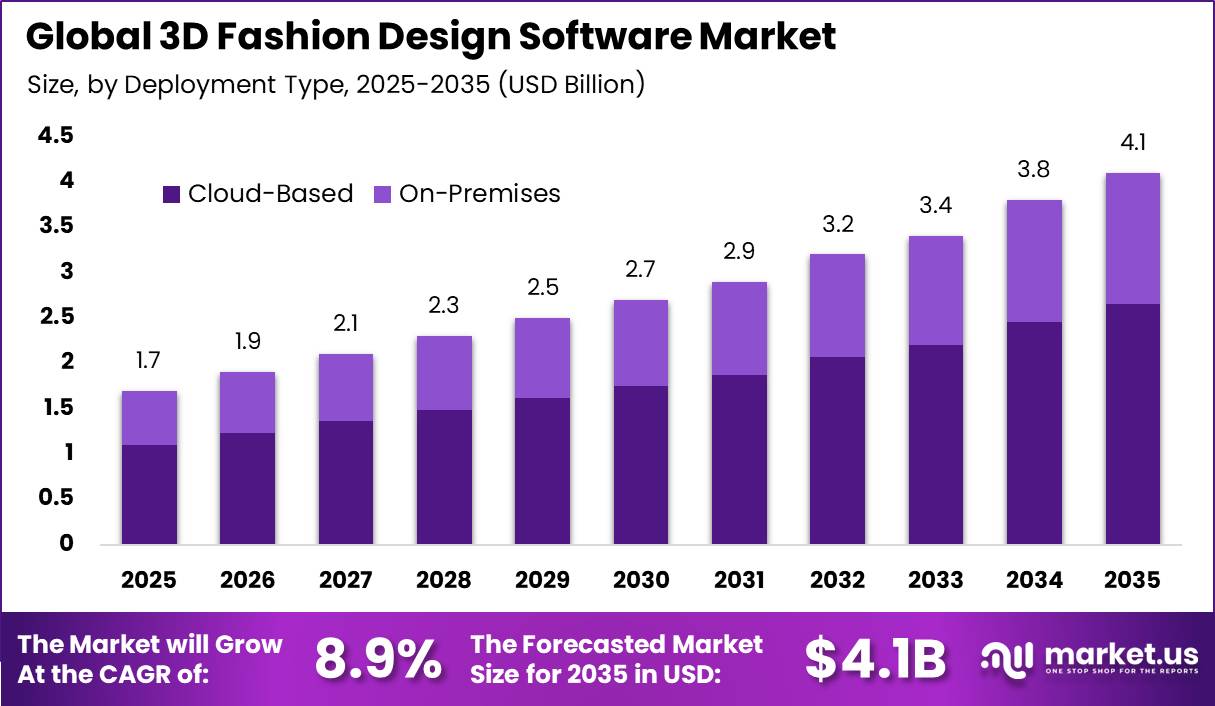
In 2025, the Global 3D Fashion Design Software Market was valued at USD 1.7 billion. The market is projected to grow at a CAGR of 8.9% during 2026–2035, reaching approximately USD 4.1 billion by 2035. North America dominated the global market in 2025, accounting for more than 37.6% of the total market share and generating approximately USD 0.6 billion in revenue.
Growth is supported by the large apparel and textile industry, where brands are increasingly adopting digital tools to reduce product-development time, lower physical sampling costs, and manage more styles and sizes. The European Environment Agency reported that the EU textile and clothing industry generated about EUR 170 billion in turnover in 2023, employing nearly 1.3 million people across approximately 197,000 companies.
The EU produced around 7.6 million tonnes of finished textile products valued at EUR 81 billion. This large production base is increasing demand for 3D platforms that support virtual garment creation, fit checking, fabric visualization, and digital collection approvals. Regional demand is supported by a large apparel retail industry and strong adoption of digital design technologies. U.S. clothing and clothing accessories store sales reached about USD 303.7 billion in 2024.
U.S. textile and apparel imports also reached 76.9 billion square-meter equivalents during January–September 2024, increasing 8.8% from the same period in 2023. Growing product volumes and shorter fashion cycles are encouraging brands to use 3D software for virtual prototyping, remote approvals, fewer physical samples, and faster creation of e-commerce visuals.
Key Takeaway
- The 3D Fashion Design Software Market was valued at USD 1.7 billion in 2025 and is forecast to reach USD 4.1 billion by 2035, growing at a CAGR of 8.9%.
- The cloud-based deployment segment held a leading 64.7% share, driven by growing collaboration needs across global design and sourcing teams.
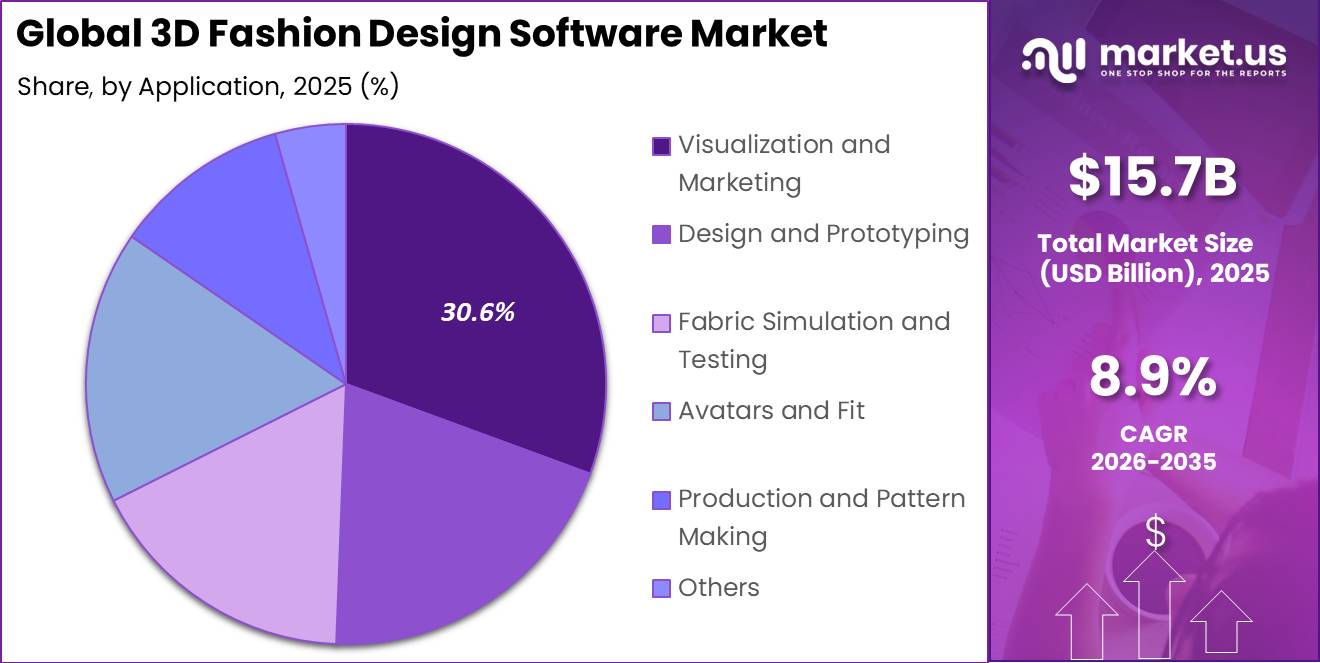
- Visualization and marketing led application use cases with a 30.6% share, supported by rapid e-commerce growth.
- Windows led the platform segment with a 68.3% share, while large enterprises accounted for 60.4% of demand.
- Fashion houses were the leading end-user segment, holding a 52.2% share of the market.
- North America led the market in 2025 with a 37.6% share and about USD 0.6 billion in revenue.
Market Statistics and Data Insights
- The European textile and clothing industry generated approximately EUR 167 billion in turnover in 2023, with around 192,000 enterprises and 1.3 million employees. This provides a large addressable base for 3D garment design, patternmaking, PLM, and virtual-sampling software.
- The wider EU textiles, clothing, leather, and footwear ecosystem employs approximately 2.2 million people, while 99.5% of companies operating in the ecosystem are SMEs. The high SME share also highlights the opportunity for lower-cost SaaS and cloud-based 3D design packages.
- U.S. textile and apparel imports reached 8,572.2 million square-meter equivalents in January 2025, increasing 27.9% from January 2024. Apparel alone represented 2,351.4 million SME, up 18.5%. These volumes indicate the scale of product development and supplier coordination across apparel sourcing networks.
- In a 2026 Style3D customer case, Mengdi Group reduced a fashion-development workflow from 3 days to 10 minutes after introducing AI and 3D digital-product-development tools.
- Mengdi’s 3D team’s monthly output increased from about 100–200 sample renderings to more than 700–800 after combining Style3D with AI-generated model imagery in 2026.
- In 2025, 52.7% of EU enterprises purchased paid cloud-computing services, up 7.4 percentage points from 2023 and far above 17.8% in 2014. Cloud adoption provides infrastructure for browser-based 3D design, shared material libraries, digital approvals, and remote collaboration.
- Around 53% of EU enterprises used specialized ERP, CRM, or business-intelligence applications in 2025. ERP adoption ranged from 41% among small businesses to 89% among large enterprises, while BI usage ranged from 11% to 69%. These figures support integration opportunities between 3D fashion platforms and enterprise systems.
- U.S. retail e-commerce sales reached USD 340.2 billion in Q2 2026, increasing 12.2% from Q2 2025. E-commerce represented 17.1% of total U.S. retail sales. This is the latest official Census figure and replaces the earlier 16.6% figure used in the draft.
- Zalando reached 62 million active customers in 2025 and processed 278.6 million orders. Customers placed an average of 4.8 orders per year, with an average basket size of EUR 62.8. These figures show the scale at which fashion platforms require product imagery, personalization, digital assets, and fit information.
- EU textile waste reached approximately 6.94 million tonnes in 2022, equal to about 16 kg per person. Around 11.1 kg per person was not separately collected, compared with only 4.6 kg collected separately.
- Amazon’s AI-supported apparel visualization system allows shoppers to see garments on models ranging from XS to 4XL and offers a gallery of up to 40 real models for eligible styles. This provides direct evidence of 3D/AI visualization moving into mainstream fashion e-commerce.
- In 2025, JiangSu Zhuri Textile reported 40% shorter design cycles, a 25% reduction in sampling costs, and 40% fewer physical samples using Browzwear’s digital-product-development platform.
By Deployment Type
The Cloud-based segment held a leading 64.7% share of the 3D fashion design software market, supported by the growing need for faster collaboration across designers, brands, factories, material suppliers, and retail teams. Cloud platforms allow users to access, edit, store, and approve digital garment files through an internet connection without relying on expensive local servers.
The wider adoption of cloud technology also supports segment growth. According to Eurostat, 52.7% of EU enterprises used paid cloud computing services in 2025, increasing by 7.4 percentage points from 2023. Adoption reached 84.7% among large enterprises, while 49.3% of small businesses used paid cloud services.
Around 47% of EU businesses also used intermediate or advanced cloud services, including hosted databases, enterprise resource planning, and application-development platforms. For 3D fashion companies, cloud systems help multiple teams work from the same updated garment file, reducing version errors, improving fit approvals, supporting remote collaboration, and speeding up the creation of digital product visuals.
By Application
The Visualization and Marketing segment held a leading 30.6% share of the 3D fashion design software market, driven by the growing need for high-quality digital product images before physical garments reach stores.
This reduces dependence on physical samples, studio photography, models, and repeated product shoots, especially when products are offered in multiple colours and sizes. Strong growth in online retail further supports this segment. The U.S. Census Bureau reported seasonally adjusted retail e-commerce sales of USD 316.1 billion in the fourth quarter of 2025, representing 16.6% of total U.S. retail sales.
E-commerce sales increased 5.3% year over year, compared with 2.7% growth in total retail sales. In the second quarter of 2026, U.S. retail e-commerce sales reached USD 340.2 billion, rising 6.2% from the same quarter of 2025. This growth increases demand for scalable and easily updated 3D product visuals.
By Platform
The Windows segment leads the 3D fashion design software market with a 68.3% share, supported by its strong presence across desktop workstations used for apparel design, pattern development, 3D rendering, and production planning. According to StatCounter GlobalStats, Windows represented 70.2% of worldwide desktop operating-system usage in May 2025, based on more than 5 billion monthly page views.
This large installed base makes Windows a preferred platform for fashion brands, design studios, and suppliers using high-performance computers for detailed garment visualization. Windows systems also support powerful graphics cards and high-memory workstations required for fabric simulation, garment draping, texture rendering, and high-resolution marketing visuals.
By Organization Size
Large Enterprises lead the 3D fashion design software market with a 60.4% share, supported by their complex global design, sourcing, production, retail, and e-commerce operations. These companies manage high product volumes and large supplier networks, making physical sampling, repeated fit approvals, and manual file sharing expensive and time-consuming.
Nike reported fiscal 2025 revenue of USD 46.3 billion and employed approximately 77,800 people worldwide. Its NIKE Direct business generated USD 18.8 billion, while wholesale remained an important part of its global distribution network. Ralph Lauren operated through more than 9,400 wholesale doors worldwide and sourced around 96% of its products outside the United States in fiscal 2025.
By End-user
Fashion Houses lead the 3D fashion design software market with a 52.2% share, as they control the full design process and need to convert creative ideas into consistent collections for retail, wholesale, and digital channels. Their design teams must review silhouette, fit, colour, fabric drape, trims, and overall brand presentation before approving physical samples and production.
This makes 3D fashion software an important tool for faster design decisions, virtual sampling, and collection planning. The large global presence of major fashion houses further supports adoption. Levi Strauss & Co. reported that its products were sold in about 120 countries and 50,000 retail locations worldwide in fiscal 2024, including approximately 3,400 brand-dedicated stores and shop-in-shops.
The company also operated 1,276 stores across 39 countries and generated USD 5.7 billion in annual net revenue. Tapestry, which owns Coach, Kate Spade New York, and Stuart Weitzman, recorded USD 7.0 billion in fiscal 2025 net sales. Such large operations require efficient sharing of product visuals and technical files, supporting wider use of 3D software for faster approvals, consistent branding, and fewer production errors.
Key Market Segments
By Deployment Type
- Cloud-Based
- On-Premises
By Application
- Visualization and Marketing
- Design and Prototyping
- Fabric Simulation and Testing
- Avatars and Fit
- Production and Pattern Making
- Others
By Platform
- Windows
- macOS
- Linux
By Organization Size
- Large Enterprises
- SMEs
By End-user
- Fashion Designers
- Fashion Houses
Geopolitical Impact Analysis
Geopolitical disruption affects the 3D fashion design software market mainly through changes in global apparel supply chains. Trade tensions, higher tariffs, and supplier relocation increase sourcing costs and encourage fashion brands to make design decisions earlier. This strengthens the need for digital tools that can reduce dependence on repeated physical sampling and support faster sourcing decisions.
Hong Kong’s Trade and Industry Department reported that the United States imposed an additional 10% ad valorem duty on China-origin goods from February 2025, while a separate 10% reciprocal tariff remained in effect during the temporary suspension of higher tariff rates. Such measures can increase the landed cost of fabrics, trims, garments, and accessories sourced internationally.
In response, fashion brands can use 3D software for virtual garments, digital fit reviews, and remote material approvals. These tools help companies compare design options before production, reduce unnecessary physical samples, and shift more quickly to alternative suppliers when trade conditions change. This can lower the financial risk linked to late product changes and changing tariff structures.
Energy and shipping disruptions also support demand for digital workflows. The World Bank projected average energy prices to increase 24% in 2026, with Brent crude averaging USD 86 per barrel, compared with USD 69 per barrel in 2025. The Strait of Hormuz handles about 35% of global seaborne crude-oil trade. Higher fuel and transport costs encourage brands to reduce sample shipments, use remote approvals, create digital showroom content, and shorten product-development cycles.
Regional Analysis
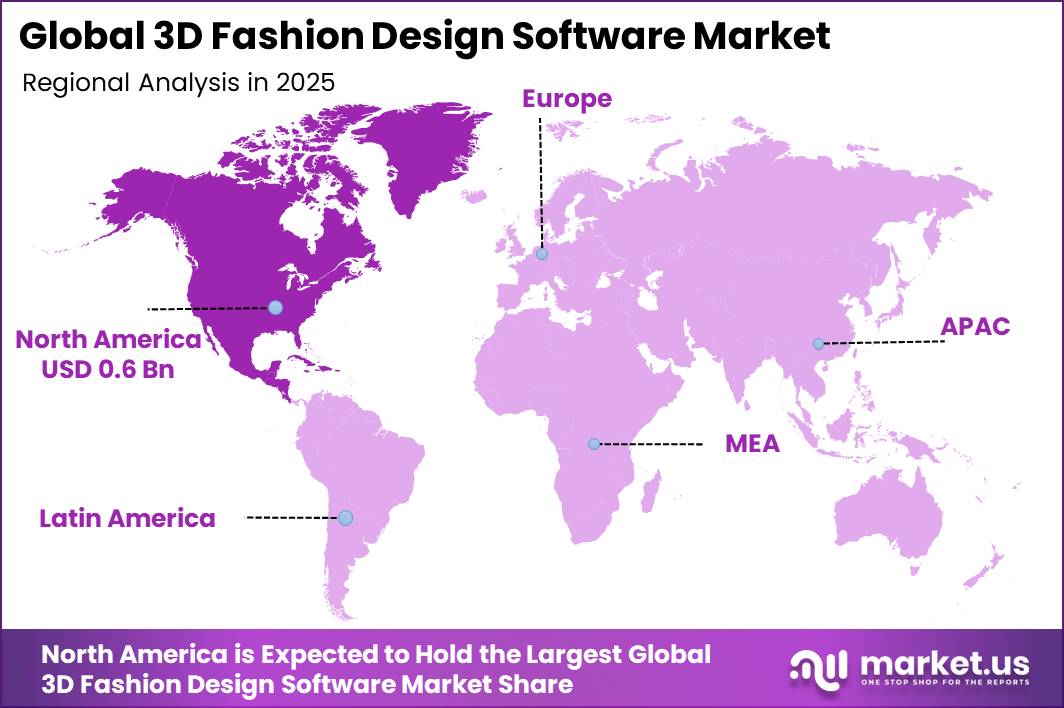
North America held the leading 37.6% share of the global 3D fashion design software market in 2025, generating approximately USD 0.6 billion in revenue. Regional leadership is supported by a strong presence of apparel brands, fashion houses, retailers, design agencies, and technology companies with the budgets and digital infrastructure needed to adopt advanced 3D design tools.
The strong growth of online retail also supports regional demand. According to the U.S. Census Bureau, U.S. retail e-commerce sales reached USD 340.2 billion in the second quarter of 2026, representing 16.6% of total retail sales and increasing 6.2% year over year. This large digital retail market creates higher demand for accurate product visuals, colour representation, and consistent garment presentation.
Asia Pacific is expected to be the fastest-growing regional market, supported by its large apparel manufacturing base and expanding digital infrastructure. The World Bank estimates that East Asia and Pacific has around 1.5 billion active internet users, representing more than 70% of the population.
Mobile-broadband subscriptions increased from 437 million in 2013 to 2 billion in 2021. The region also accounted for 60% of global ICT-manufacturing value added and 75% of ICT-manufacturing employment in 2022. These capabilities support wider adoption of cloud platforms, digital design systems, and 3D fashion tools across major apparel production hubs.
Key Regions and Countries
North America
- US
- Canada
Europe
- Germany
- France
- The UK
- Spain
- Italy
- Rest of Europe
Asia Pacific
- China
- Japan
- South Korea
- India
- Australia
- Rest of APAC
Latin America
- Brazil
- Mexico
- Rest of Latin America
Middle East & Africa
- GCC
- South Africa
- Rest of MEA
Market Dynamics
Drivers
| Driver | (~) % CAGR | Geographic Relevance | Impact Timeline |
|---|---|---|---|
| Virtual sampling adoption | +2.1% | Global apparel brands | Short term (2 years or less) |
| Cloud workflow migration | +1.7% | North America and Europe | Short term (2 years or less) |
| E-commerce visual demand | +1.3% | North America and Asia Pacific | Medium term (2 to 4 years) |
| Supplier collaboration digitisation | +1.0% | Asia Pacific sourcing hubs | Medium term (2 to 4 years) |
| AI-assisted design tools | +0.8% | Global | Medium term (2 to 4 years) |
Virtual Sampling Adoption
Virtual sampling is a major market driver because fashion companies can test garment shape, grading, fabric drape, colourways, trims, and fit before producing physical samples. EU households consumed about 19 kilograms of textiles per person in 2022, while discarded textiles reached nearly 16 kilograms per person, increasing the need to reduce unnecessary sampling and material waste.
Digital retail and cloud adoption further support virtual sampling. U.S. e-commerce represented 16.6% of total retail sales in the second quarter of 2026, while 52.7% of EU enterprises used paid cloud services in 2025. These trends support remote 3D garment reviews, faster product visualization, and shared design workflows, contributing an estimated +2.1% incremental upside to the baseline CAGR.
Restraints
| Restraint | (~) % CAGR | Geographic Relevance | Impact Timeline |
|---|---|---|---|
| Apparel margin pressure | -1.6% | Global export markets | Short term (2 years or less) |
| Software budget constraints | -1.1% | Small and mid-sized brands | Short term (2 years or less) |
| High implementation cost | -0.9% | Emerging manufacturing economies | Medium term (2 to 4 years) |
| Currency volatility | -0.6% | Asia Pacific and Latin America | Short term (2 years or less) |
| Tariff-led sourcing uncertainty | -0.5% | United States-linked supply chains | Medium term (2 to 4 years) |
Apparel Margin Pressure
Apparel margin pressure remains a key restraint, as 3D software competes with inventory, labour, freight, and compliance costs for limited technology budgets. The World Bank projected average energy prices to increase by 24% in 2026, which can raise costs for synthetic fibres, factory power, ocean freight, and airfreight.
The U.S. Department of Commerce reported textile and apparel imports exceeding 10 billion square-metre equivalents during individual high-volume months in 2024, showing the scale of sourcing-cost exposure. When margins are under pressure, brands may delay software licences, workstation upgrades, implementation services, and long-term contracts, creating an estimated -1.6% drag on market growth.
Challenges
| Challenge | (~) % CAGR | Geographic Relevance | Mitigation Horizon |
|---|---|---|---|
| Digital material data gaps | -1.4% | Global sourcing networks | Medium term (2 to 4 years) |
| Specialist talent shortage | -1.1% | Global | Medium term (2 to 4 years) |
| Interoperability complexity | -0.9% | Large enterprises | Long term (4 years or more) |
| Fit accuracy validation | -0.8% | Apparel and footwear manufacturing | Medium term (2 to 4 years) |
| Cybersecurity governance | -0.6% | Cloud-enabled enterprises | Long term (4 years or more) |
Digital Material Data Gaps
Digital material data gaps remain a major challenge because accurate 3D garment simulation depends on reliable information for fabric weight, stretch, bending, thickness, shrinkage, colour, texture, and surface reflectance. The EU Ecodesign for Sustainable Products Regulation entered into force on 18 July 2024, while its first working plan in April 2025 identified textiles as a priority product group.
Textile-specific Digital Product Passport requirements are expected from 2027, and the EU Digital Product Passport Registry became operational in July 2026. However, incomplete material data across thousands of mills can reduce simulation accuracy and increase manual data-cleaning work. Software vendors therefore need to invest in material libraries, testing standards, and data connectors, creating an estimated -1.4% friction drag until data quality and interoperability improve.
Opportunities
| Opportunity | (~) % CAGR | Geographic Relevance | Execution Window |
|---|---|---|---|
| Digital product passport integration | +2.0% | Europe and export suppliers | Medium term (2 to 4 years) |
| SME subscription expansion | +1.5% | Asia Pacific and Latin America | Medium term (2 to 4 years) |
| Virtual commerce assets | +1.2% | Global consumer brands | Short term (2 years or less) |
| Footwear and accessories | +1.0% | Global | Medium term (2 to 4 years) |
| Supplier network platforms | +0.8% | Asia Pacific manufacturing hubs | Long term (4 years or more) |
Digital Product Passport Integration
Digital Product Passport integration represents a future opportunity for 3D fashion design software vendors, as textile-specific requirements are expected from 2027. The European Commission requires the passport to be available when a covered product enters the EU market, increasing the value of design-stage data on materials, composition, circularity, and sustainability.
Eurostat reported that 52.7% of EU enterprises used paid cloud services in 2025, providing a strong base for connected design-to-passport workflows. Vendors combining 3D design, bill-of-materials, traceability, and passport-export functions could reduce manual compliance work by an estimated 30%–50% and potentially generate up to +2.0% CAGR upside through higher-value subscription services.
Key Players Analysis
The 3D fashion design software market is led by fashion-specialist platforms and large enterprise software providers. Tier-1 fashion specialists, including Lectra, CLO Virtual Fashion, Browzwear, Optitex/EFI Optitex, Gerber Technology, and Style3D, are estimated to control around 55–65% of dedicated 3D fashion software spending.
These companies focus on digital patternmaking, fabric drape simulation, grading, fit validation, virtual sampling, and production data transfer. Lectra reported 2024 revenue of EUR 526.7 million, up 10%, while EBITDA before non-recurring items increased 15% to EUR 91.1 million. In January 2024, Lectra acquired 50.3% of Launchmetrics for about USD 85 million, and Launchmetrics contributed EUR 41.2 million in 2024 revenue.
Tier-1 adjacent enterprise vendors, including Adobe, Autodesk, and Dassault Systèmes, compete through 3D visualization, simulation, CAD, cloud collaboration, and PLM capabilities. Adobe generated USD 23.77 billion in fiscal 2025 revenue, up 11%, and spent USD 4.29 billion, or 18.1% of revenue, on R&D. Autodesk generated USD 6.1 billion and invested USD 1.49 billion, or 24.2%, in R&D during fiscal 2025, rising to USD 1.64 billion in fiscal 2026. Dassault Systèmes spent EUR 1.3 billion on R&D in fiscal 2025.
Tier-2 challengers, including BlueCherry, DigitalFashionPro.com, Corel, Maxon, Vizoo, and Wild Ginger Software, compete through lower-cost subscriptions and specialized tools for rendering, fabric visualization, pattern development, and technical design. They mainly target smaller brands and independent designers, although Adobe’s USD 4.29 billion and Autodesk’s USD 1.49 billion R&D budgets create a major competitive barrier.
Top Key Players in the Market
- Adobe
- Autodesk Inc.
- Bluecherry
- Browzwear
- CLO Virtual Fashion LLC.
- Corel Corporation.
- DigitalFashionPro.com
- MAXON COMPUTER GMBH.
- Optitex
- Wild Ginger Software, Inc.
- Lectra
- EFI Optitex
- Gerber Technology
- Dassault Systèmes
- Vizoo
- Style3D
Recent Developments
- In 2026, Autodesk agreed to acquire MaintainX for approximately USD 3.6 billion in an all-cash transaction. Autodesk also reported first-quarter fiscal 2027 revenue of USD 1.93 billion, increasing 18% year over year, showing the financial scale available for continued development of its broader 3D and digital-design ecosystem.
- In 2026, Lectra accelerated the rollout of its Valia digital-fashion and manufacturing platform. Valia had already been adopted by nearly 70 customers, while more than 700 customers were using related Digital Cutting Platform, Flex, and Quick solutions. Lectra also reported more than 9,000 connected cutting systems, alongside 5,000 older systems that represent potential migration opportunities. Its SaaS revenue reached EUR 89 million, equal to 18% of total revenue.
Report Scope
| Report Features | Description |
|---|---|
| Market Value (2025) | USD 1.7 Billion |
| Forecast Revenue (2035) | USD 4.1 Billion |
| CAGR (2026-2035) | 8.9% |
| Base Year for Estimation | 2025 |
| Historic Period | 2020-2024 |
| Forecast Period | 2026-2035 |
| Report Coverage | Revenue Forecast, Market Dynamics, Competitive Landscape, Recent Developments |
| Segments Covered | By Deployment Type (Cloud-Based, On-Premises); By Application (Visualization and Marketing, Design and Prototyping, Fabric Simulation and Testing, Avatars and Fit, Production and Pattern Making, Others); By Platform (Windows, macOS, Linux); By Organization Size (Large Enterprises, SMEs); By End-user (Fashion Designers, Fashion Houses) |
| Regional Analysis | North America – US, Canada; Europe – Germany, France, The UK, Spain, Italy, Rest of Europe; Asia Pacific – China, Japan, South Korea, India, Australia, Singapore, Rest of APAC; Latin America – Brazil, Mexico, Rest of Latin America; Middle East & Africa – GCC, South Africa, Rest of MEA |
| Competitive Landscape | Adobe, Autodesk Inc., Bluecherry, Browzwear, CLO Virtual Fashion LLC., Corel Corporation., DigitalFashionPro.com, MAXON COMPUTER GMBH., Optitex, Wild Ginger Software, Inc., Lectra, EFI Optitex, Gerber Technology, Dassault Systèmes, Vizoo, Style3D |
| Customization Scope | Customization for segments, region/country-level will be provided. Moreover, additional customization can be done based on the requirements. |
| Purchase Options | We have three licenses to opt for: Single User License, Multi-User License (Up to 5 Users), Corporate Use License (Unlimited Users and Printable PDF) |





























