


Market Overview
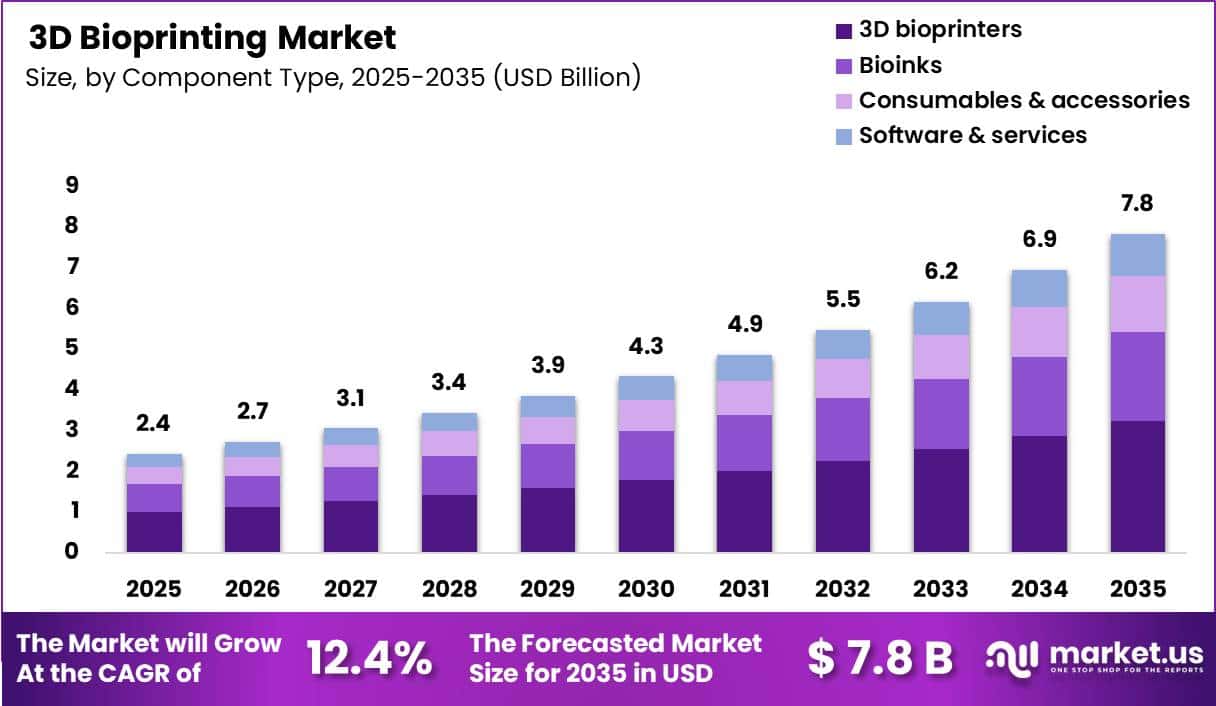
Global 3D Bioprinting Market size is expected to be worth around US$ 7.8 Billion by 2035 from US$ 2.4 Billion in 2025, growing at a CAGR of 12.4% during the forecast period from 2026 to 2035. In 2025, North America led the market, achieving over 31.8% share with a revenue of US$ 0.8 Billion.
Three-dimensional (3D) bioprinting is gaining importance as healthcare systems seek innovative solutions for tissue engineering, regenerative medicine, and organ replacement. The technology combines living cells, biomaterials, and bioinks to create tissue-like structures that can support medical research, drug development, and future therapeutic applications.
According to the Health Resources and Services Administration, more than 100,000 people in the United States are currently on the national transplant waiting list, while over 45,000 organ transplants were performed during 2024. In addition, a new patient is added to the transplant waiting list approximately every 10 minutes, emphasizing the growing need for alternative treatment approaches and engineered tissues.
The U.S. Food and Drug Administration states that additive manufacturing technologies are already being used to produce orthopedic implants, cranial devices, surgical guides, dental restorations, and external prosthetics. The agency has also highlighted that 3D printing applications extend across medical devices, biologics, and pharmaceutical products, supporting the development of patient-specific healthcare solutions.
Bioprinting research is increasingly focused on fabricating skin, cartilage, bone, blood vessels, and other tissue constructs. The FDA notes that these applications remain largely in the research and development phase but are expected to advance regenerative medicine capabilities in the coming years.
Continued investments in biofabrication technologies, stem cell science, and engineered tissues are anticipated to strengthen the future adoption of 3D bioprinting across clinical and biomedical research settings.
Key Takeaways
- Market Size : Global 3D Bioprinting Market size is expected to be worth around US$ 7.8 Billion by 2035 from US$ 2.4 Billion in 2025.
- Market Share : The Market is growing at a CAGR of 12.4% during the forecast period from 2026 to 2035.
- Component Analysis : The 3D bioprinters segment dominated the 3D Bioprinting market in 2025, accounting for 41.4% of the total market share.
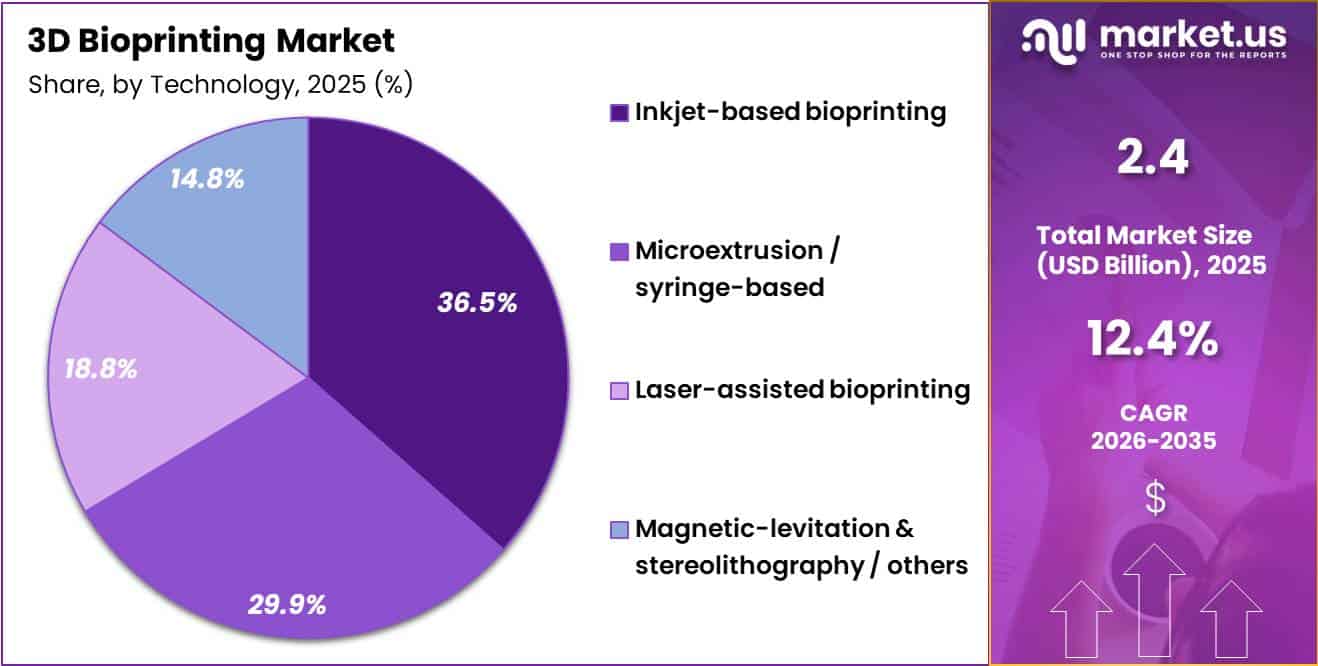
- Technology Analysis : Inkjet-based bioprinting dominated the 3D Bioprinting market in 2025, capturing 36.5% of total market revenue.
- Application Analysis : Research and drug discovery emerged as the largest application segment in the 3D Bioprinting market in 2025, accounting for 44.1% of the overall market share.
- End User Analysis : Research organizations and academia dominated the 3D Bioprinting market in 2025, holding a 44.5% market share.
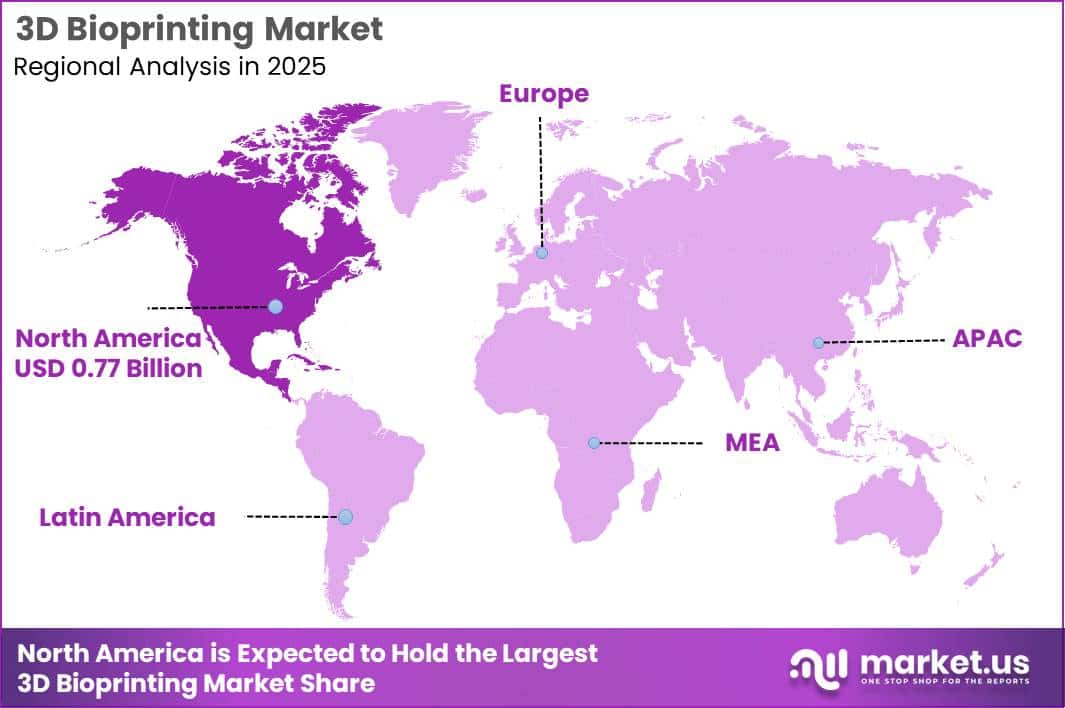
- Regional Analysis : In 2025, North America led the market, achieving over 31.8% share with a revenue of US$ 0.8 Billion.
Component Analysis
The 3D bioprinters segment dominated the 3D Bioprinting market in 2025, accounting for 41.4% of the total market share. The segment’s leading position is attributed to rising demand for advanced printing platforms capable of fabricating complex biological structures with greater precision and reproducibility.
Increased investments in regenerative medicine, tissue engineering, and organ-on-chip research continue to support the adoption of sophisticated bioprinting systems across research institutions and biotechnology companies. Technological advancements such as multi-material printing, automated cell deposition, and improved printing resolution have further strengthened market demand.
Bioinks accounted for 27.9% of the market and remain critical for successful tissue fabrication processes. The growing preference for natural, synthetic, and hybrid bioinks is driving innovation in this segment. Consumables and accessories represented 17.6% of the market, benefiting from recurring demand for cartridges, reagents, culture media, and printing substrates.
Software and services held a 13.1% share, supported by increasing requirements for workflow optimization, digital design tools, process simulation, and technical support. The continued expansion of bioprinting applications is expected to drive sustained growth across all component categories.
Technology Analysis
Inkjet-based bioprinting dominated the 3D Bioprinting market in 2025, capturing 36.5% of total market revenue. The technology has gained widespread acceptance due to its high printing speed, cost efficiency, and ability to deposit cells and biomaterials with considerable precision.
Inkjet systems are extensively used in tissue engineering, drug development, and disease modeling applications, making them an important technology platform within the industry. Continuous improvements in printhead design and droplet control technologies are further enhancing performance capabilities.
Micro-extrusion or syringe-based bioprinting accounted for 29.9% of the market and remains a preferred technology for printing highly viscous biomaterials and larger tissue constructs. Laser-assisted bioprinting represented 18.8% of market share, driven by its superior resolution, high cell viability, and precise positioning capabilities.
Magnetic-levitation, stereolithography, and other emerging technologies collectively accounted for 14.8% of the market. These advanced techniques are increasingly being explored for producing complex tissue architectures and supporting next-generation regenerative medicine applications.
Application Analysis
Research and drug discovery emerged as the largest application segment in the 3D Bioprinting market in 2025, accounting for 44.1% of the overall market share. The segment’s dominance is driven by increasing utilization of bioprinted tissues for toxicity studies, disease modeling, and preclinical drug testing.
Pharmaceutical and biotechnology companies are adopting bioprinting technologies to improve research efficiency, shorten development timelines, and generate more predictive testing models. The technology also offers opportunities to reduce dependence on conventional animal testing methods.
Medical and clinical applications constitute another important segment, supported by growing research activities in tissue regeneration, organ replacement, and personalized medicine. Dental applications, biosensors, and diagnostics are witnessing steady growth due to increasing demand for customized implants, scaffolds, and advanced diagnostic platforms.
Food applications, cosmetic testing, and other experimental uses are also expanding as industries seek innovative solutions for product development and safety assessments. Continuous advancements in biofabrication technologies are expected to create additional opportunities across diverse application areas.
End-user Analysis
Research organizations and academia dominated the 3D Bioprinting market in 2025, holding a 44.5% market share. Strong investments in regenerative medicine, stem cell research, and tissue engineering projects have positioned universities and research institutes as major adopters of bioprinting technologies.
These institutions utilize bioprinting systems to study cellular interactions, develop tissue models, and advance biomedical innovation. Government funding and collaborative research initiatives continue to support growth within this segment.
Biopharmaceutical and biotechnology companies represent a significant end-user category due to increasing adoption of bioprinted tissues in drug discovery, toxicity testing, and personalized medicine research. Hospitals and clinical facilities are gradually integrating bioprinting technologies for regenerative therapies, reconstructive procedures, and patient-specific treatment approaches.
The others segment includes contract research organizations, diagnostic laboratories, and specialized research centers engaged in experimental and commercial applications. Rising investments in biomedical sciences and expanding clinical applications are expected to drive demand across all end-user categories over the forecast period.
Market Segmentations
By Component
- 3D bioprinters
- Bioinks
- Consumables & accessories
- Software & services
By Technology
- Inkjet‑based bioprinting
- Microextrusion / syringe‑based
- Laser‑assisted bioprinting
- Magnetic‑levitation & stereolithography / others
By Application
- Research & drug discovery
- Medical / clinical
- Dental, biosensors, diagnostics
- Food, cosmetic testing & other experimental uses
By End-user
- Research organizations & academia
- Biopharma & biotech companies
- Hospitals & clinical
- Others
Driver
Organ Shortage and Transplant Access Gap in Regenerative Medicine and Bioprinting
The most fundamental demand driver for bioprinting and regenerative medicine is the persistent mismatch between transplant demand and donor organ supply. This structural gap keeps attention focused on technologies that can expand tissue and organ availability beyond the limits of deceased and living donors.
According to the Global Observatory on Donation and Transplantation, 173,727 solid organ transplants were performed globally in 2024, reflecting only about 2 % year on year growth, despite rising end stage organ failure cases.
WHO has also reinforced in 2024 that transplantation remains the best or only option for many patients with organ failure and has promoted stronger national transplant systems under Resolution 77.4. However, access remains highly uneven across regions.
This shortage supports long term demand for bioprinted tissues and regenerative constructs, particularly in early adoption areas such as kidney support structures, liver patches, cartilage repair, corneal substitutes, and skin grafting applications, where partial tissue replacement is more feasible than full organ fabrication.
Commercially, growth is driven by staged adoption rather than immediate whole organ replacement. Early revenue comes from tissue engineering for surgical planning, disease modeling, and transplant adjacent regenerative products.
The broader organ scarcity narrative also helps attract public funding, academic partnerships, and long horizon institutional investment into platform technologies. Overall, this structural imbalance between supply and demand contributes an estimated 2.4 % points of CAGR upside, particularly across high income regions investing heavily in regenerative medicine infrastructure and advanced therapeutic platforms.
| Driver | (~) % Impact on CAGR Forecast | Geographic Relevance | Impact Timeline |
|---|---|---|---|
| Organ shortage and transplant access gap | +2.4% | North America core, EU, Japan, South Korea, Gulf | Long term (≥ 4 years) |
| Diabetes, chronic wounds, and skin repair demand | +2.0% | U.S. core, EU5, China, India, GCC | Short term (≤ 2 years) |
| FDA NAMs shift lifting bioprinted test models | +1.8% | U.S. core, EU spill-over, UK, APAC pharma hubs | Medium term (2-4 years) |
| Regenerative medicine regulatory formalization | +1.6% | U.S., EU, UK, Japan | Medium term (2-4 years) |
| NIH and translational funding for tissue platforms | +1.4% | U.S. core, EU research clusters, Singapore | Short term (≤ 2 years) |
| Cell therapy payment innovation and hospital adoption pull | +1.2% | U.S. core, select EU systems, South Korea | Medium term (2-4 years) |
Challenge
Bioink Scalability and Quality Variance in 3D Bioprinting Systems
Bioink scalability and batch to batch consistency remain key operational constraints in 3D bioprinting, limiting the transition from research scale systems to industrial production. Most advanced bioinks such as decellularized extracellular matrix dECM, hybrid hydrogels, and high cell density formulations are still produced in fragmented supply chains optimized for laboratory use rather than large scale manufacturing.
In practice, these materials show significant variability in rheological properties, with viscosity ranges often spanning 10² to 10⁴ Pa s and inconsistent crosslinking behavior between batches. This forces repeated recalibration of printing parameters such as extrusion pressure, nozzle diameter, and deposition speed, increasing optimization time by 20 to 40 % per product iteration and adding substantial engineering overhead.
Cell laden bioinks also face viability challenges, with 5 to 15 % point drops in cell survival depending on shear stress and printing technique. dECM based formulations introduce additional bottlenecks because tissue sourcing, decellularization, and processing steps can take several days per batch, limiting production throughput to relatively low volumes per facility.
From a regulatory standpoint, each batch must meet strict characterization and reproducibility standards, increasing documentation and quality control burdens. This raises non recurring engineering costs and slows multi indication expansion.
Collectively, these constraints reduce scalability, increase per unit cost, and limit clinical translation speed, contributing an estimated 1.3 % point drag on CAGR. Addressing this requires industrial scale bioink manufacturing, standardized rheology controls, automated in line quality testing, and more stable supplier ecosystems for hydrogel and cell source inputs.
| Challenge | (~) % CAGR Friction Drag | Geographic Relevance | Mitigation Horizon |
|---|---|---|---|
| Clinical-grade tissue maturity gap | -1.8% | North America, EU, East Asia | Long term (≥ 4 years) |
| Bioink scalability & quality variance | -1.3% | North America, EU, APAC corridors | Medium term (2-4 years) |
| Fragmented regulatory classification | -1.1% | North America, EU regulatory hubs | Long term (≥ 4 years) |
| Limited vascularization resolution | -1.5% | Global advanced research clusters | Long term (≥ 4 years) |
| GMP bioprinting workforce deficit | -0.9% | North America core, EU, Japan | Medium term (2-4 years) |
| Multi-step process validation burden | -1.0% | North America, EU, high-income APAC | Medium term (2-4 years) |
Restraints
Bioink, Cell Sourcing and Material Standardization Constraints
Bioink formulation, cell sourcing, and material standardization remain major constraints in scaling 3D bioprinting from research to clinical grade manufacturing. Achieving consistent mechanical strength, cell viability, and tissue like functionality while meeting regulatory expectations continues to be technically demanding.
During bioprinting, cell viability can drop by 20 to 40 %, especially for shear sensitive stem cells in high resolution extrusion or inkjet processes. Post print constructs often require 7 to 21 days of maturation to restore functional behavior, extending production timelines and increasing inventory and quality control burdens.
Material variability further complicates scale up. Natural ECM based bioinks such as collagen and decellularized matrix show batch to batch inconsistency in viscosity and composition, while synthetic or hybrid hydrogels require careful balancing of crosslinking density and nutrient diffusion.
Each new tissue application can require extensive optimization, often involving dozens of formulation and parameter iterations, pushing single program R and D costs to roughly USD 0.5 to 1.0 million in complex cases.Cell sourcing introduces additional bottlenecks.
Primary and stem cell procurement requires strict donor screening, traceability, sterility testing, and potency validation. These processes add substantial recurring costs and depend on a limited number of qualified cell banks, increasing supply chain concentration risk.
Together, these limitations reduce interoperability across platforms, slow regulatory acceptance of standardized manufacturing claims, and restrict scalable commercialization. As a result, they are estimated to reduce achievable market CAGR by approximately 1.9 % points, primarily through higher costs, slower throughput, and constrained clinical translation of bioprinted therapies.
| Restraint | (~) % Impact on CAGR Forecast | Geographic Relevance | Impact Timeline |
|---|---|---|---|
| High CapEx & OpEx for bioprinting platforms | -2.2% | North America, EU core, APAC research hubs | Medium term (2–4 years) |
| Bioink, cell sourcing & material standardization constraints | -1.9% | North America core, EU, APAC corridors | Medium term (2–4 years) |
| Fragmented, high-burden regenerative & device regulatory pathways | -2.5% | US, EU, Japan, emerging Asia | Long term (≥ 4 years) |
| Slow clinical translation & reimbursement uncertainty | -1.8% | North America core, EU, developed APAC | Long term (≥ 4 years) |
| Manufacturing scalability, GMP compliance & quality-systems gaps | -2.1% | Global, with higher friction in EU & APAC | Medium–Long term (2–5+ years) |
| Ethical, safety and data-governance concerns in advanced constructs | -1.4% | Global, more acute in EU & high-income markets | Long term (≥ 4 years) |
Opportunity
Chronic Disease Microtissue Services in Bioprinting Based Drug Discovery and Diagnostics
A key emerging opportunity in bioprinting is the development of chronic disease microtissue services, where bioprinted constructs are used as commercial research and decision support tools for high burden conditions such as diabetes, cardiovascular disease, and non alcoholic fatty liver disease. These diseases affect hundreds of millions globally and generate substantial healthcare costs, yet current in vitro models often fail to replicate human like tissue complexity.
Bioprinted microtissues such as pancreatic islets, adipose tissue, and liver constructs can provide more physiologically relevant platforms for drug testing, biomarker validation, and therapy optimization. This enables pharmaceutical, biotech, and medtech companies to evaluate interventions in weeks rather than months, improving R and D efficiency.
A service based model could price individual microtissue panels at approximately USD 2,000 to 5,000, with mid sized clients running 50 to 150 panels annually and larger organizations reaching 200 to 400 panels, generating USD 0.3 to 1.5 million in annual revenue per client.
At scale, operating margins of 25 to 35 % are achievable due to automation and higher lab utilization.If even 5 to 10 % of chronic disease R and D programs adopt such platforms by 2030, the serviceable addressable market could reach USD 2 to 4 billion, largely outside traditional device focused bioprinting estimates.
These platforms effectively shift bioprinting from one off experimental constructs to recurring subscription like virtual cohort services, such as simulated 1,000 patient response panels for drug screening. This transition supports a more predictable revenue base and could add an estimated 2 to 3 % points of CAGR upside by expanding usage beyond hardware into recurring analytical and disease modeling services.
| Opportunity | (~) % Potential CAGR Upside | Geographic Relevance | Execution Window |
|---|---|---|---|
| Drug discovery NAM platforms | +3.5% | North America, EU, Japan | Short–Medium term |
| Chronic disease microtissue services | +2.8% | North America, EU, APAC urban | Medium term |
| Hospital-based bioprinting hubs | +2.2% | North America core, EU, GCC | Medium–Long term |
| Bioink IP and licensing ecosystems | +1.9% | Global, APAC emerging | Medium term |
| Regenerative implants and grafts | +3.0% | North America, EU, China | Long term |
| Cross-border clinical and data consortia | +1.5% | North America–EU–APAC | Short–Medium term |
Regional Analysis
North America dominated the 3D Bioprinting market in 2025, accounting for over 31.8% of the global market and generating revenue of approximately US$ 0.8 billion. The region’s leadership is supported by a well-established biotechnology ecosystem, strong research capabilities, and significant investments in regenerative medicine and tissue engineering.
The presence of leading universities, research institutions, and bioprinting companies has accelerated the development and commercialization of advanced bioprinting technologies. The United States remains the primary contributor to regional growth due to increasing funding for biomedical research, expanding applications in drug discovery, and rising interest in personalized medicine.
Government agencies and healthcare organizations continue to support research initiatives related to tissue engineering, organ regeneration, and advanced manufacturing technologies. In addition, collaborations between academic centers, biotechnology companies, and pharmaceutical manufacturers are fostering innovation in biofabrication and cell-based therapies.
Europe represents another important market driven by growing investments in life sciences research, supportive regulatory frameworks, and increasing adoption of bioprinting technologies in healthcare applications.
Meanwhile, the Asia-Pacific region is expected to witness substantial growth due to expanding biotechnology industries, rising healthcare expenditures, and increasing research activities in countries such as China, Japan, South Korea, and India. Growing awareness of regenerative medicine is also expected to create new opportunities across emerging markets in Latin America and the Middle East.
Key Regions and Countries
North America
- The US
- Canada
Europe
- Germany
- France
- The U.K.
- Italy
- Spain
- Russia & CIS
- Rest of Europe
Asia Pacific
- China
- India
- Japan
- South Korea
- ASEAN
- Australia & New Zealand
- Rest of Asia Pacific
Middle East & Africa
- GCC
- South Africa
- Rest of Middle East & Africa
Latin America
- Brazil
- Mexico
- Rest of Latin America
Key Player Analysis
The 3D Bioprinting market is characterized by strong innovation and continuous advancements in bioprinting platforms, bioinks, and tissue engineering technologies. Companies are focusing on expanding their product portfolios, improving printing precision, and developing solutions for regenerative medicine, drug discovery, and personalized healthcare applications.
Strategic collaborations with research institutes, biotechnology firms, and pharmaceutical companies remain an important growth strategy in this industry.
BICO Group AB through its CELLINK brand has established a strong presence with a broad portfolio of bioprinters, bioinks, and laboratory solutions designed for academic and commercial research applications. Organovo Holdings Inc. is recognized for its expertise in developing functional human tissues for disease modeling and preclinical drug testing.
3D Systems Corporation and EnvisionTEC/ETEC continue to strengthen their capabilities in advanced bioprinting systems and tissue engineering technologies. Allevi Inc. focuses on user-friendly bioprinting platforms that support rapid research and innovation.
Aspect Biosystems Ltd., RegenHU, Poietis, and CollPlant Biotechnologies Ltd. are investing in next-generation biofabrication technologies, tissue constructs, and biomaterials, contributing to the advancement of regenerative medicine and expanding the commercial potential of the 3D bioprinting industry.
Top Key Players
- BICO Group AB / CELLINK
- Organovo Holdings Inc.
- 3D Systems Corporation
- EnvisionTEC / ETEC
- Allevi Inc.
- Aspect Biosystems Ltd.
- RegenHU
- Poietis
- CollPlant Biotechnologies Ltd.
- Cyfuse Biomedical K.K.
- Rokit Healthcare Inc.
- REGEMAT 3D S.L.
- Nanoscribe GmbH & Co. KG
- Stratasys Ltd.
- Merck KGaA
- Others
Recent Developments
- In April 2026, Aspect Biosystems Ltd. announced a US$280 million multi-year project with the Government of Canada, supported by a US$79 million federal investment, to strengthen clinical development, expand biomanufacturing infrastructure and accelerate commercialization of bioengineered cellular medicines in Canada.
- In February 2026, CollPlant Biotechnologies Ltd. launched BioFlex™, a ready-to-print recombinant human collagen bioink platform designed for Digital Light Processing (DLP) bioprinting applications, enabling researchers to rapidly formulate tunable bioinks for tissue engineering and regenerative medicine applications.
- In March 2025, BICO Group AB / CELLINK hosted an international scientific initiative focused on integrating artificial intelligence with 3D bioprinting for personalized tissue fabrication, in collaboration with researchers from the National University of Singapore, highlighting growing adoption of AI-enabled biofabrication technologies in Asia-Pacific.
Report Scope
| Report Features | Description |
|---|---|
| Market Value (2025) | US$ 2.4 Billion |
| Forecast Revenue (2035) | US$ 7.8 Billion |
| CAGR (2026-2035) | 12.4% |
| Base Year for Estimation | 2025 |
| Historic Period | 2020-2024 |
| Forecast Period | 2026-2035 |
| Report Coverage | Revenue Forecast, Market Dynamics, Competitive Landscape, Recent Developments |
| Segments Covered | By Component (3D bioprinters, Bioinks, Consumables & accessories, Software & services), By Technology (Inkjet‑based bioprinting, Micro-extrusion / syringe‑based, Laser‑assisted bioprinting, Magnetic‑levitation & stereolithography / others), By Application (Research & drug discovery , Medical / clinical , Dental, biosensors, diagnostics, Food, cosmetic testing & other experimental uses), By End-user (Research organizations & academia, Biopharma & biotech companies, Hospitals & clinical , Others) |
| Regional Analysis | North America – The US, Canada; Europe – Germany, France, U.K., Italy, Spain, Russia & CIS, Rest of Europe; Asia Pacific – China, India, Japan, South Korea, ASEAN, Australia & New Zealand, Rest of Asia Pacific; Middle East & Africa – GCC, South Africa, Rest of Middle East & Africa; Latin America – Brazil, Mexico, Rest of Latin America |
| Competitive Landscape | BICO Group AB / CELLINK, Organovo Holdings Inc., 3D Systems Corporation, EnvisionTEC / ETEC, Allevi Inc., Aspect Biosystems Ltd., RegenHU, Poietis, CollPlant Biotechnologies Ltd., Cyfuse Biomedical K.K., Rokit Healthcare Inc., REGEMAT 3D S.L., Nanoscribe GmbH & Co. KG, Stratasys Ltd., Merck KGaA, Others |
| Customization Scope | Customization for segments, region/country-level will be provided. Moreover, additional customization can be done based on the requirements. |
| Purchase Options | We have three licenses to opt for: Single User License, Multi-User License (Up to 5 Users), Corporate Use License (Unlimited User and Printable PDF) |





































