


Quick Navigation
- Report Overview
- Key Takeaways
- By Raw Material Type Analysis
- By Technology Analysis
- By Application Analysis
- By End Use Analysis
- Key Market Segments
- Regional Analysis
- Key Regions and Countries
- Market Dynamics
- Drivers
- Restraints
- Challenges
- Opportunities
- Key Company Insights
- Recent Developments
- Geopolitical Impact Analysis
- Report Scope
Report Overview
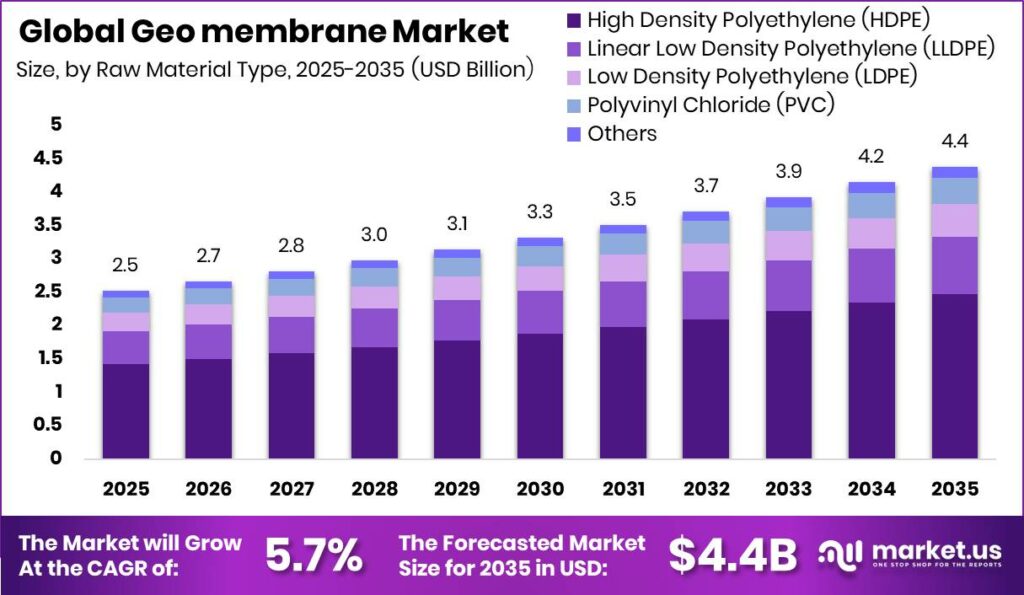
Global Geomembrane Market size is expected to be worth around USD 4.40 Billion by 2035 from USD 2.50 Billion in 2025, growing at a CAGR of 5.7% during the forecast period 2026 to 2035. This market supplies engineered impermeable barriers across containment and infrastructure projects. Steady demand ties directly to environmental compliance spending, giving suppliers a durable revenue base tied to long asset cycles.
Geomembranes are synthetic polymer sheets that block liquid and gas movement across a lined surface. This structure spans raw material type, manufacturing technology, application, and end use, forming a layered market. Therefore, buyers select liners by chemical exposure and project life, which lets specialized producers defend margins on high specification jobs rather than compete only on price.
Key Takeaways
- Global market reaches USD 4.40 Billion by 2035 from USD 2.50 Billion in 2025 at a CAGR of 5.7%.
- High Density Polyethylene (HDPE) leads raw materials with a 56.4% share.
- Extrusion dominates the technology segment with a 68.6% share.
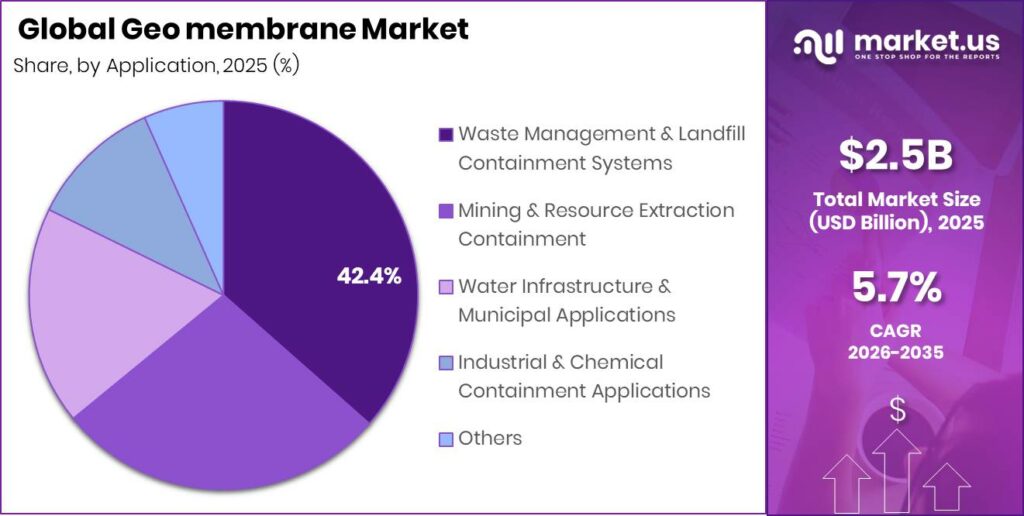
- Waste Management and Landfill Containment Systems lead applications with a 42.4% share.
- Environmental Services and Waste Management Industry leads end use with a 37.0% share.
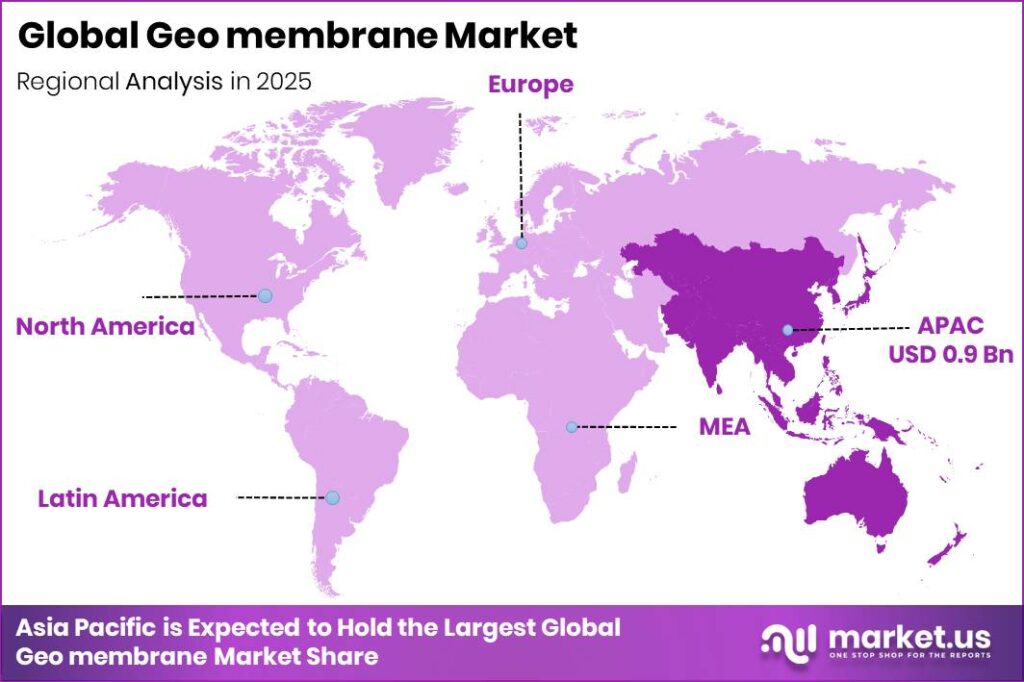
- Asia-Pacific dominates with a 34.7% share, valued at USD 0.90 Billion.
Geosynthetics regulation now shapes procurement, as GRI-GM42 (Revision 2, November 2025) raised the minimum Stress Crack Resistance for HP-HDPE liners to 1,500 hours from 1,000 hours, a 50% jump. This tighter standard rewards producers with advanced antioxidant formulations. As a result, compliant manufacturers gain a defensible edge on extreme condition projects where cheaper liners fail qualification.
Environmental performance data now supports specification decisions across landfill projects. A peer reviewed study found an HDPE geomembrane cover cut atmospheric H₂S by 36.76% and PM₁₀ by 24.18% versus baseline. This measured air quality gain strengthens the regulatory case for lined caps. Consequently, operators can justify liner budgets to authorities, expanding recurring demand for capping systems.
By Raw Material Type Analysis
High Density Polyethylene (HDPE) dominates with 56.4% due to superior chemical and puncture resistance.
In 2025, High Density Polyethylene (HDPE) held a dominant market position in the By Raw Material Type segment of Geomembrane Market, with a 56.4% share. Global HDPE production reached roughly 52 million tonnes in 2024, giving liner makers deep, low cost feedstock supply. This scale lets HDPE producers price competitively while meeting strict specifications, securing volume across landfill and mining jobs.
Linear Low Density Polyethylene (LLDPE) serves projects that need higher flexibility and better conformance to uneven subgrades. Installed LLDPE liner costs run about $0.60 to $2.60 per square foot, close to HDPE ranges. This narrow price gap lets LLDPE win on complex terrain, so suppliers target sites where movement tolerance matters more than raw strength.
Low Density Polyethylene (LDPE) and Polyvinyl Chloride (PVC) fill niche roles where softness or weldability drives selection. PVC canal lining cut seepage by 87.5%, from 40 to 5 liters per second per 1,000 meters in field reviews. This proven water saving keeps PVC relevant in irrigation, protecting a stable niche for flexible liner producers. Others hold the remaining share collectively.
By Technology Analysis
Extrusion dominates with 68.6% due to continuous high volume flat sheet output.
In 2025, Extrusion held a dominant market position in the By Technology segment of Geomembrane Market, with a 68.6% share. Extrusion welding installs at $0.35 to $0.95 per square foot, and teams process up to 120 meters of seam per day at 450 to 550°C. This speed lowers installed cost, so extrusion stays the default for large area containment.
Calendaring produces flexible sheets favored for PVC and specialty liners needing tight thickness control. Each 0.1 mm thickness increment raises material cost by 5 to 8%, so precise gauge control protects margins. This cost sensitivity keeps calendaring valuable for premium flexible products where dimensional accuracy commands a price premium.
Other technologies cover blown film and coating routes used in smaller or custom runs. Enhanced quality programs sample seams at 1 per 150 linear feet, over three times the standard 1 per 500 feet. This testing intensity favors experienced fabricators, letting niche technology providers win specialized, quality critical contracts. Others hold the remaining share collectively.
By Application Analysis
Waste Management and Landfill Containment dominates with 36.5% due to strict leachate barrier mandates.
In 2025, Waste Management and Landfill Containment Systems held a dominant market position in the By Application segment of Geomembrane Market, with a 42.4% share. The United States operates over 1,250 active municipal solid waste landfills, each requiring engineered liners. This large installed base drives recurring liner and cap replacement demand, giving suppliers steady multi decade project pipelines.
Mining and Resource Extraction Containment uses liners for heap leach pads and tailings ponds under harsh chemical loads. HDPE hydraulic conductivity of 10⁻¹³ to 10⁻¹⁰ m/s far outperforms clay at 10⁻⁹ to 10⁻⁷ m/s. This barrier advantage makes geomembranes essential in mining, locking in demand across resource rich regions.
Water Infrastructure and Municipal Applications and Industrial and Chemical Containment round out demand. Lined irrigation canals reach water use efficiency of 85 to 95% versus 50 to 70% unlined. This efficiency gain pushes water agencies toward lined systems, opening a growth channel for suppliers. Others hold the remaining share collectively.
By End Use Analysis
Environmental Services and Waste Management dominates with 37.0% due to mandated containment across waste sites.
In 2025, Environmental Services and Waste Management Industry held a dominant market position in the By End Use segment of Geomembrane Market, with a 37.0% share. GRI-GM42 requires liners to retain at least 55% Standard OIT after aging at 85°C for 350 hours. This durability rule forces waste operators toward certified liners, expanding demand for compliant environmental grade products.
Mining and Natural Resources Industry buyers prioritize puncture strength under heavy loads and sharp ore. Smooth HP-HDPE at 2.0 mm must resist 640 N puncture per ASTM D4833. This strict threshold favors premium liner makers, letting them command higher prices on mining contracts where failure costs are severe.
Water Utilities and Treatment Facilities rank as the fastest growing end use, alongside Municipal and Government Infrastructure and Industrial Manufacturing. Chlorine aging tests require 80% High Pressure OIT retention after 350 hours in 10 PPM solution. This qualification opens treatment plant demand, giving suppliers a clear entry into water utility spending. Others hold the remaining share collectively.
Key Market Segments
By Raw Material Type
- High Density Polyethylene (HDPE)
- Linear Low Density Polyethylene (LLDPE)
- Low Density Polyethylene (LDPE)
- Polyvinyl Chloride (PVC)
- Others
By Technology
- Extrusion
- Calendaring
- Others
By Application
- Waste Management & Landfill Containment Systems
- Mining & Resource Extraction Containment
- Water Infrastructure & Municipal Applications
- Industrial & Chemical Containment Applications
- Others
By End Use
- Environmental Services & Waste Management Industry
- Mining & Natural Resources Industry
- Water Utilities & Treatment Facilities
- Municipal & Government Infrastructure
- Industrial Manufacturing & Chemical Processing
- Others
Regional Analysis
Asia-Pacific Dominates the Geomembrane Market with a Market Share of 34.7%, Valued at USD 0.90 Billion
Asia-Pacific leads the geomembrane market with a 34.7% share worth USD 0.90 Billion in 2025. Rapid mining and water infrastructure buildout across the region drives liner demand. This concentration of active projects gives regional suppliers scale advantages, letting them serve large containment contracts at competitive delivered cost.
Latin America and Africa show the fastest expansion, led by mining and industrial containment growth. Rising resource extraction projects require durable tailings and heap leach liners. As a result, suppliers entering these regions early can lock in long term project relationships before competition intensifies across new mining developments.
North America and Europe together anchor regulated demand through landfill and composite liner mandates. Strict waste containment rules sustain steady replacement and new build volumes. This regulatory floor protects supplier revenue, making both regions reliable markets even when commodity driven demand elsewhere softens.
Key Regions and Countries
North America
- US
- Canada
Europe
- Germany
- France
- The UK
- Spain
- Italy
- Rest of Europe
Asia Pacific
- China
- Japan
- South Korea
- India
- Australia
- Rest of APAC
Latin America
- Brazil
- Mexico
- Rest of Latin America
Middle East and Africa
- GCC
- South Africa
- Rest of MEA
Market Dynamics
Market Opportunity Analysis - Underused liner types, fast growing water end use, and emerging regions open entry points for new players
Water Utilities and Treatment Facilities rank as the fastest growing end use, yet remain smaller than the 37.0% Environmental Services leader. This gap signals a segment where demand outpaces current supplier focus. Therefore, new entrants can build early relationships with water agencies before established liner producers redirect capacity toward this expanding channel.
Polyvinyl Chloride (PVC) and Low Density Polyethylene (LDPE) sit well below the 56.4% HDPE share, leaving flexible liner niches underserved. Irrigation and canal projects favor these materials for conformance. This means specialized producers can own the flexible liner niche, avoiding direct price competition with dominant HDPE volume suppliers.
Latin America and Africa grow fastest yet trail the Asia-Pacific 34.7% regional lead. Mining and industrial containment demand rises there without deep incumbent coverage. Consequently, suppliers entering these regions early can secure long project pipelines and local partnerships before competition intensifies across new resource developments.
Calendaring holds a small slice against the Extrusion 68.6% technology share, leaving precision flexible sheet supply thin. Premium PVC and specialty products need this route. This creates room for focused fabricators to serve accuracy driven jobs, capturing higher margins that high volume extrusion players rarely prioritize.
Technology and Innovation Landscape - Tighter standards, leak detection, and welding precision reshape competitive edges
GRI-GM42 (November 2025) raised HP-HDPE Stress Crack Resistance to 1,500 hours and set formulated density at 0.945 g/cc across 1.5 mm to 3.0 mm sheets. This tighter standard rewards advanced resin formulation. As a result, producers investing in antioxidant chemistry gain qualification advantages on extreme condition projects that reject weaker liners.
Electric leak location technology now detects around 98% of seam defects at 10,000 to 30,000 volts, while vacuum tests catch about 95% of double track seam leaks. This detection capability turns liners into monitored systems. Therefore, suppliers bundling detection services can charge premiums and reduce warranty exposure on high risk installations.
Dual fusion seaming requires 210 kPa air pressure, with any loss above 28 kPa over 5 minutes marking a failed seam. Extrusion teams weld up to 120 meters per day at 450 to 550°C. This precision defines installer quality. Consequently, fabricators with trained crews and strict testing win contracts where seam integrity is non negotiable.
Enhanced quality assurance samples seams at 1 per 150 linear feet, more than three times the 1 per 500 standard, catching localized weld defects. This testing rigor raises reliability. This means producers offering documented QA programs differentiate on trust, an edge that matters most on regulated, high liability containment work.
Drivers
Waste management regulations across North America and Europe now require engineered barrier systems for municipal and hazardous waste sites, with geomembranes forming the primary impermeable layer. Caps and basal liners cut leachate generation by double digit percentages against unlined sites. This regulatory push means operators must specify HDPE liners, expanding recurring demand for both new construction and replacement cycles.
Waste management applications now account for more than a third of global geomembrane use in some datasets, supporting steady liner and cap replacement alongside new cells. This expansion adds roughly 2.0% to the baseline 5.7% CAGR. Therefore, suppliers with certified waste grade liners capture predictable, compliance driven revenue that resists broader economic swings.
| Driver | (~) % Impact on CAGR Forecast | Geographic Relevance | Impact Timeline |
|---|---|---|---|
| Regulatory push for landfill and waste containment lining | +2.0% | North America, Europe | Medium term (2–4 years) |
| Expansion of mining and industrial containment applications | +1.4% | Latin America, Asia Pacific, Africa | Medium term (2–4 years) |
| Water resource management and reservoir lining projects | +1.1% | Global | Medium term (2–4 years) |
| Improved geomembrane durability and service life | +0.7% | Global | Long term (≥ 4 years) |
Restraints
HDPE geomembranes deliver near impermeable performance, with proper installation reaching up to 99% impermeability, yet poor subgrade prep, weak seam welding, or contamination can cut effectiveness by up to 50%. Debris left in the subgrade can halve performance, while subgrade contact below 98% and compaction under 90% Proctor density raise puncture risk. This means installation quality, not product quality, often decides project success.
Seam contamination or wrong welding temperatures can cut weld strength by about 20% versus parent material and push leak rates above design. Because regulators track these failures, poor outcomes delay repeat projects and raise remediation costs. Consequently, this constraint subtracts an estimated 1.6% from the 5.7% baseline CAGR by limiting realized performance.
| Restraint | (~) % Impact on CAGR Forecast | Geographic Relevance | Impact Timeline |
|---|---|---|---|
| High sensitivity of liner performance to installation quality | -1.6% | Global | Short term (≤ 2 years) |
| Volatility in polymer resin input costs | -1.0% | Global | Short term (≤ 2 years) |
| Limited adoption in small-scale projects due to perceived cost | -0.7% | Global | Medium term (2–4 years) |
Challenges
Scientific assessments show HDPE geomembrane service life ranges from under 10 years in aggressive conditions to over 100 years in benign ones, depending on resin, antioxidants, UV, and temperature. This wide span forces designers to adopt conservative assumptions and pair liners with clay layers or leak monitoring. This means projects carry added complexity and cost that cap achievable growth.
Multi level quality control, periodic inspection, and decades long repair protocols add operational friction and liability. These demands limit how fast operators can scale without breaching risk tolerances. Therefore, this challenge applies an estimated 1.1% drag on the baseline rate, while overall market growth stays positive and durable.
| Challenge | (~) % CAGR Friction Drag | Geographic Relevance | Mitigation Horizon |
|---|---|---|---|
| Ensuring long-term service life under varied field conditions | -1.1% | Global | Long term (≥ 4 years) |
| Managing leakage rates through composite liner and QA systems | -0.9% | Global | Medium term (2–4 years) |
| Wrinkle formation and panel handling on large-area installations | -0.7% | Global | Medium term (2–4 years) |
Opportunities
Conductive geomembranes and electric leak location surveys stay underused outside critical projects, even though spark testing at 10,000 to 30,000 volts detects around 98% of seam defects, and vacuum chamber tests catch about 95% of double track seam leaks. Combining these with monitoring cuts long term leakage and repair costs by 10% or more. This means suppliers can sell premium performance systems, not just liners.
Because many projects still treat leak location as optional, sizable untapped potential exists to sell monitoring services and conductive products. This shift improves premium project margins by mid single digit percentages. Therefore, deliberate adoption supports an incremental upside of roughly 1.6% above the 5.7% baseline CAGR for early movers.
| Opportunity | (~) % Potential CAGR Upside | Geographic Relevance | Execution Window |
|---|---|---|---|
| Leak-location conductive liners and advanced monitoring systems | +1.6% | Global | Medium term (2–4 years) |
| Composite liner systems combining geomembranes with clay or GCL | +1.2% | North America, Europe | Medium term (2–4 years) |
| Expansion into high-altitude and extreme-environment containment | +0.9% | Asia Pacific, Latin America | Long term (≥ 4 years) |
Key Company Insights
Agru America Inc. positions itself around high specification HDPE liner manufacturing for demanding containment work. Its focus on Landfill Liners and mining grade sheets aligns with the segments holding the largest application shares. This specialization creates a defensible advantage on certified projects. However, a narrow premium focus risks lost volume if buyers favor lower cost commodity liners on routine jobs.
Atarfil SL pursues a distribution led strategy, expanding commercial operations across North America and the Middle East in December 2025 to support mining and wastewater projects. This wider footprint lets Atarfil win large regional contracts and offer local engineering support. This creates an advantage in service intensive markets. Yet rapid expansion strains support capacity if project demand outpaces trained field teams.
Key Players
- Agru America Inc.
- Atarfil SL
- Carlisle SynTec Systems
- Colorado Lining International Inc.
- Firestone Building Products Company LLC
- Global Synthetics
- Istanbul Teknik
- Juta Ltd
- NAUE GmbH & Co. KG
- Officine Maccaferri Spa
- Plastika Kritis S.A.
- Seaman Corporation
- Shanghai Yingfan Engineering Material Co., Ltd
- SOLMAX
Recent Developments
- December 2025: Atarfil expanded its commercial operations across North America and the Middle East, supporting large mining, wastewater treatment, and environmental containment projects while increasing engineering support and customer training activities.
- December 2025: Atarfil supplied high performance HDPE geomembranes for long term wastewater containment at the Zamora Wastewater Treatment Plant in Mexico, part of the Duero River sanitation project.
Geopolitical Impact Analysis
According to UNCTAD, global maritime freight rates spiked sharply in 2024 as Red Sea diversions forced vessels around the Cape of Good Hope, adding roughly 10 to 14 days transit and lifting container costs by over 100% on some routes. Geomembrane producers rely on polyethylene resin and finished roll shipments across these lanes. As a result, longer transit and higher freight raise delivered liner costs and squeeze margins on export led projects.
Based on World Bank commodity data, energy price volatility through 2023 and 2024 pushed petrochemical feedstock costs up before easing, with crude oil averaging near 80 USD per barrel. Polyethylene resin, the core input for HDPE liners, tracks these swings closely. Therefore, resin price instability forces producers to hedge supply contracts, protecting project budgets against sudden input cost shocks that erode fixed price liner deals.
Report Scope
| Report Features | Description |
|---|---|
| Market Value (2025) | USD 2.50 Billion |
| Forecast Revenue (2035) | USD 4.40 Billion |
| CAGR (2026-2035) | 5.7% |
| Base Year for Estimation | 2025 |
| Historic Period | 2020-2024 |
| Forecast Period | 2026-2035 |
| Report Coverage | Revenue Forecast, Market Dynamics, Market Opportunity Analysis, Technology and Innovation Landscape, Competitive Landscape, Recent Developments |
| Segments Covered | By Raw Material Type (High Density Polyethylene (HDPE), Linear Low Density Polyethylene (LLDPE), Low Density Polyethylene (LDPE), Polyvinyl Chloride (PVC), Others), By Technology (Extrusion, Calendaring, Others), By Application (Waste Management & Landfill Containment Systems, Mining & Resource Extraction Containment, Water Infrastructure & Municipal Applications, Industrial & Chemical Containment Applications, Others), By End Use (Environmental Services & Waste Management Industry, Mining & Natural Resources Industry, Water Utilities & Treatment Facilities, Municipal & Government Infrastructure, Industrial Manufacturing & Chemical Processing, Others) |
| Regional Analysis | North America (US and Canada), Europe (Germany, France, The UK, Spain, Italy, and Rest of Europe), Asia Pacific (China, Japan, South Korea, India, Australia, and Rest of APAC), Latin America (Brazil, Mexico, and Rest of Latin America), Middle East and Africa (GCC, South Africa, and Rest of MEA) |
| Competitive Landscape | Agru America Inc., Atarfil SL, Carlisle SynTec Systems, Colorado Lining International Inc., Firestone Building Products Company LLC, Global Synthetics, Istanbul Teknik, Juta Ltd, NAUE GmbH & Co. KG, Officine Maccaferri Spa, Plastika Kritis S.A., Seaman Corporation, Shanghai Yingfan Engineering Material Co., Ltd, SOLMAX |
| Customization Scope | Customization for segments, region / country-level will be provided. Additional customization can be done based on requirements. |
| Purchase Options | We have three licenses to opt for: Single User License | Multi-User License (Up to 5 Users) | Corporate Use License (Unlimited User and Printable PDF) |





































