Report Overview
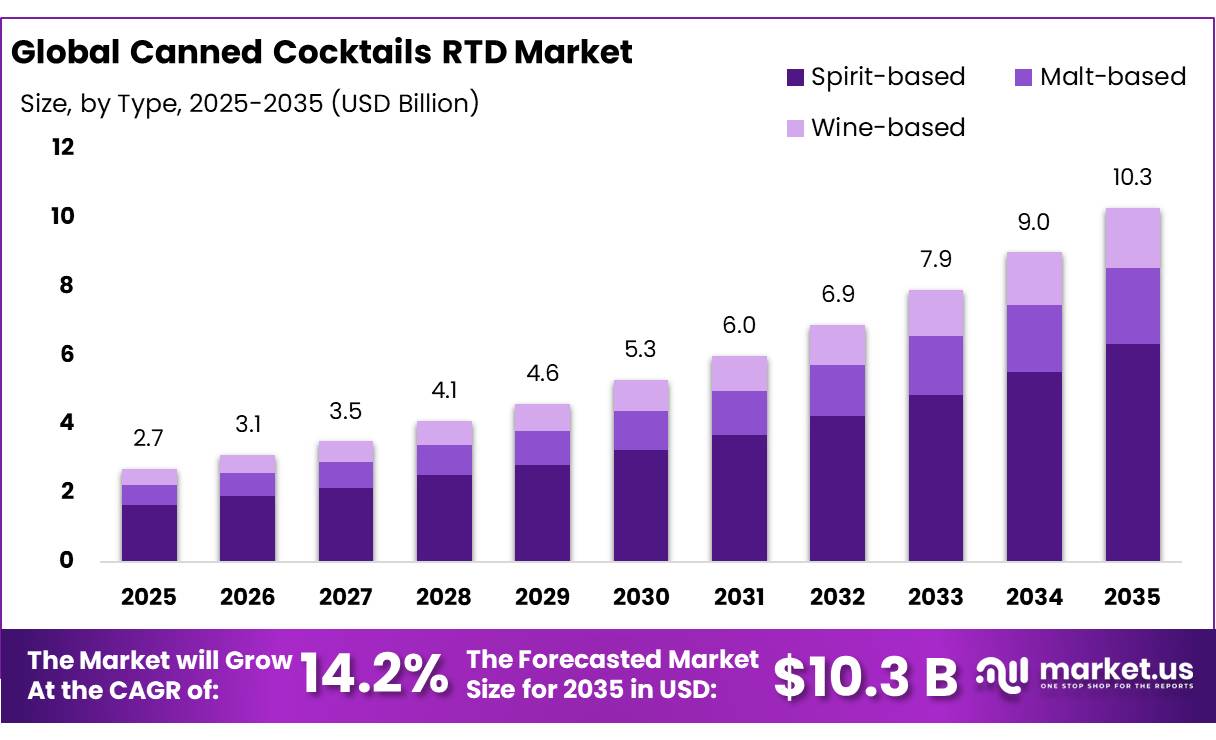
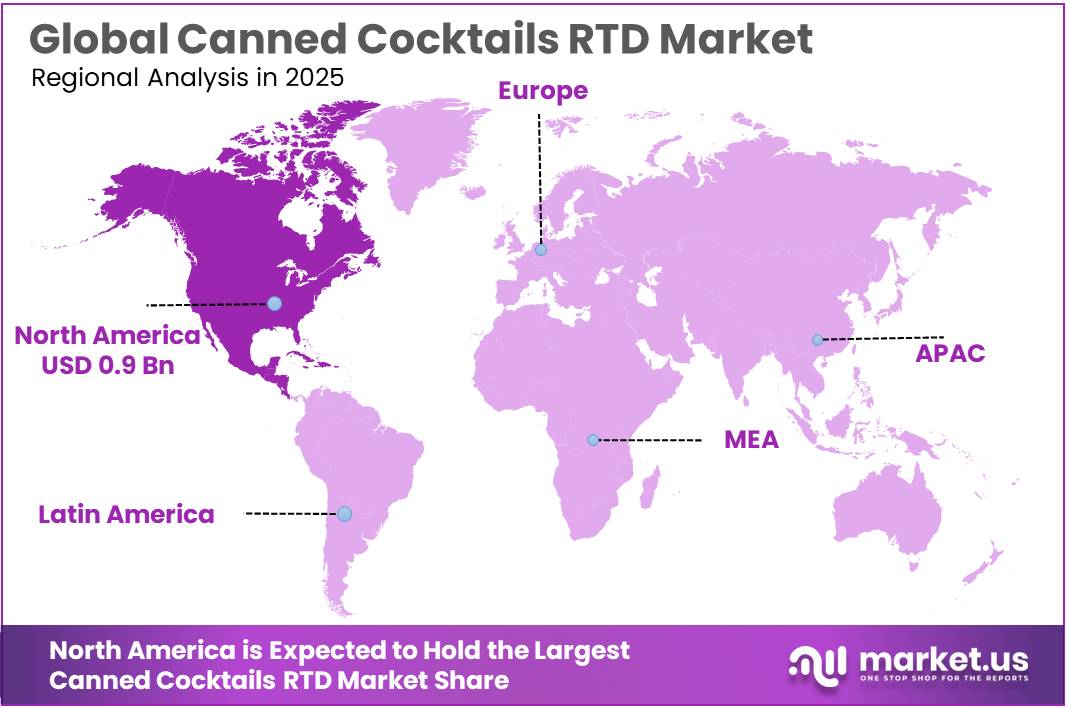
The Global Canned Cocktails RTD Market size is expected to be worth around USD 10.3 Billion by 2035, from USD 2.7 Billion in 2025, growing at a CAGR of 14.2% during the forecast period from 2026 to 2035. In 2025, North America held a dominant market position, capturing more than a 34.21% share, holding USD 0.9 Billion revenue.
The Canned Cocktails Ready-to-Drink (RTD) market is gaining importance in the global alcoholic beverage industry as consumers increasingly prefer convenient, portable and ready-to-consume alcoholic drinks. Canned cocktails are pre-mixed alcoholic beverages generally prepared using distilled spirits, including vodka, rum, gin, tequila and whiskey, combined with fruit flavours, carbonated water, sweeteners and other ingredients. These products offer the taste of traditional cocktails without requiring additional preparation, making them suitable for social gatherings, outdoor events, restaurants, bars and home consumption.
- According to the Distilled Spirits Council of the United States (DISCUS), sales of premixed cocktails, including spirits-based RTDs, reached USD 3.8 billion in 2025, registering 16.4% year-on-year growth. The category increased from approximately USD 540 million in the earlier reported period, highlighting the growing commercial importance of convenient alcoholic beverages. Furthermore, the overall US spirits industry recorded supplier sales of USD 36.4 billion in 2025, while spirits-based RTDs emerged as one of its strongest-performing categories.
Consumer preference for convenience, premium alcoholic beverages and innovative flavours represents a major driving factor for the Canned Cocktails RTD industry. Younger adult consumers and established cocktail drinkers are increasingly attracted to products that provide consistent taste, convenient serving sizes and easy transportation. Single-serving cans also allow manufacturers to offer different flavours and alcohol strengths without requiring consumers to purchase full-sized bottles.
According to DISCUS, spirits-based RTDs more than doubled their market share between 2021 and 2025, demonstrating the category’s increasing importance within the US spirits industry. Manufacturers are responding through new product launches featuring tropical fruits, citrus blends, tequila-based margaritas, vodka sodas, sparkling cocktails and lower-alcohol formulations. Premium ingredients, natural flavouring and reduced-sugar alternatives are also creating opportunities for product differentiation.
Packaging innovation and manufacturing developments are also influencing industrial growth. Aluminium cans offer portability, convenient storage, light weight and protection from light exposure, making them suitable for ready-to-drink alcoholic beverages. The Can Manufacturers Institute provides industry shipment statistics covering US metal can manufacturing, with its historical reporting based on information from manufacturers representing more than 98% of US metal can manufacturing.
In addition, the Aluminum Association and Can Manufacturers Institute reported that 43% of aluminium beverage cans shipped in the United States were recycled in 2023, compared with 39.6% for glass bottles and 20% for plastic PET bottles. These figures highlight the importance of recyclable packaging and sustainable material selection.
Government regulations and product-quality requirements remain important considerations for manufacturers. In the United States, the Alcohol and Tobacco Tax and Trade Bureau (TTB) regulates the formulation, classification and labelling of distilled spirits-based cocktails. Certain flavoured spirits and distilled spirits specialty products require formula approval before label approval. The TTB also requires alcoholic strength to be displayed as a percentage of alcohol by volume on distilled spirits labels. These requirements encourage manufacturers to maintain ingredient transparency, product consistency and regulatory compliance.
Key Takeaways
- Canned Cocktails RTD Market size is expected to be worth around USD 10.3 Billion by 2035, from USD 2.7 Billion in 2025, growing at a CAGR of 14.2%.
- Spirit-based held a dominant market position, capturing more than a 61.45% share.
- Working Professionals held a dominant market position, capturing more than a 47.89% share.
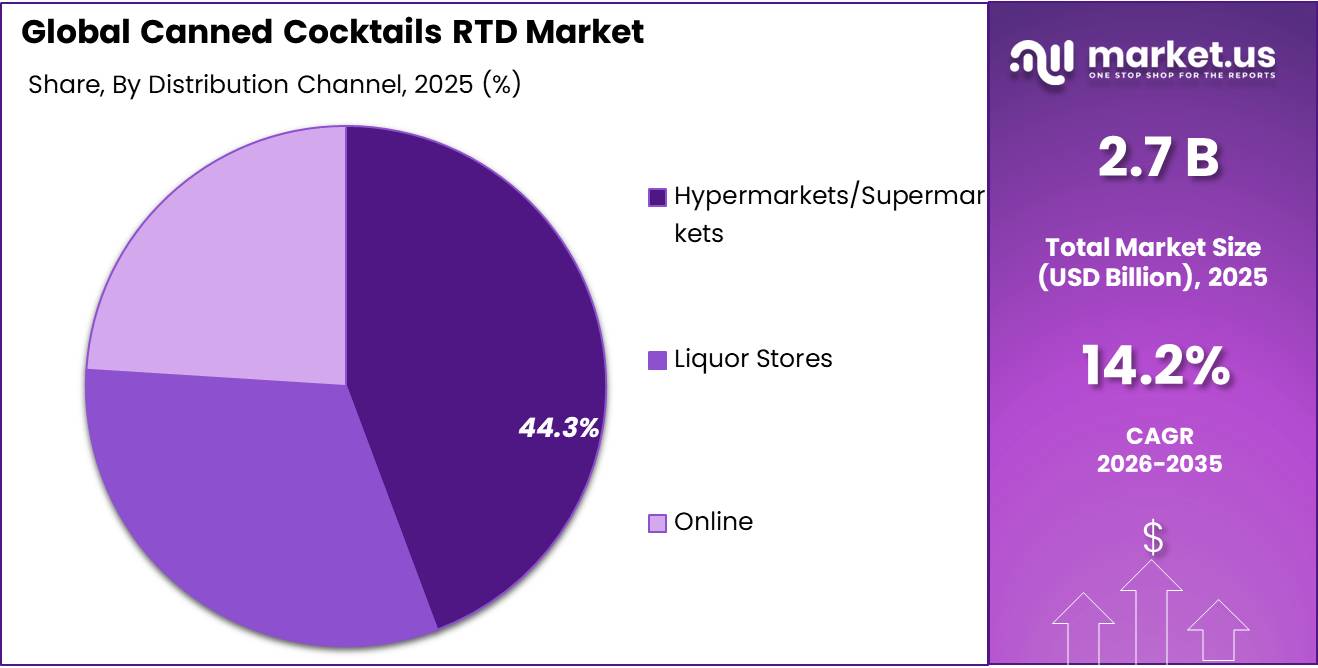
- Hypermarkets/Supermarkets held a dominant market position, capturing more than a 44.34% share.
- North America held the leading position in the Canned Cocktails RTD market in 2025, accounting for 34.21% of the global market, valued at approximately USD 0.9 billion.
By Type Analysis
Spirit-based cocktails dominate with a 61.45% share due to strong consumer preference for traditional cocktail flavours and premium alcoholic beverages.
In 2025, “Spirit-based” held a dominant market position, capturing more than a 61.45% share. This segment benefits from the established popularity of vodka, rum, gin, tequila and whiskey-based ready-to-drink cocktails. Consumers increasingly prefer spirit-based canned cocktails because they offer familiar cocktail flavours, consistent alcohol content and convenient consumption without additional preparation.
In 2025, the US spirits industry recorded USD 36.4 billion in supplier sales, reflecting the established position of distilled spirits in the alcoholic beverage industry. The growing availability of canned margaritas, mojitos, vodka sodas and gin-based cocktails further supports this segment. Premium formulations, fruit-based flavours and convenient aluminium packaging are also helping manufacturers strengthen their product portfolios.
Malt-based canned cocktails represent an important segment of the Canned Cocktails RTD market, supported by established malt beverage production facilities and broad retail distribution networks. These beverages generally use fermented malt bases combined with fruit flavours, sweeteners and other ingredients to create convenient alcoholic drinks. In 2025, the segment benefited from consumer interest in flavoured malt beverages, portable packaging and refreshing alcoholic drink options.
According to the US Alcohol and Tobacco Tax and Trade Bureau (TTB), malt beverages are subject to federal production, classification and labelling requirements. The US Department of the Treasury reported that the federal excise tax rate for qualifying beer production of up to 60,000 barrels annually can be reduced to USD 3.50 per barrel for eligible domestic producers. This taxation structure supports smaller beverage producers and creates opportunities for malt-based RTD product development.
By Consumer Type Analysis
Working professionals dominate with a 47.89% share, supported by demand for convenient and ready-to-consume alcoholic beverages.
In 2025, “Working Professionals” held a dominant market position, capturing more than a 47.89% share. This segment is supported by demand for convenient alcoholic beverages among consumers with busy work schedules and active social lifestyles. Canned cocktails offer an easy drinking option for after-work gatherings, weekend activities, social events and home entertainment without requiring cocktail preparation.
In 2025, the US spirits industry recorded USD 36.4 billion in supplier sales, demonstrating the established consumer demand for distilled alcoholic beverages. The growing availability of premium canned margaritas, vodka sodas and gin-based cocktails further supports this consumer group. Product innovation, convenient packaging and wider retail availability are expected to strengthen demand among working professionals.
Millennials represent an important consumer group in the Canned Cocktails RTD market, supported by their preference for convenient beverages, innovative flavours and social drinking occasions. This generation shows interest in products such as canned margaritas, mojitos, vodka sodas and fruit-based cocktails that offer familiar flavours without requiring preparation.
In 2025, the US Substance Abuse and Mental Health Services Administration (SAMHSA) reported that 48.4% of adults aged 26 years and older, representing approximately 110.9 million people, consumed alcohol in the past month. This age category includes a substantial part of the millennial population, although the government data does not separately identify millennials. The growing availability of premium cocktail formulations, lower-sugar options, portable cans and different spirit combinations provides manufacturers with opportunities to attract millennial consumers.
By Distribution Channel Analysis
Hypermarkets/Supermarkets dominate with a 44.34% share due to their wide product availability, convenient shopping experience and strong retail distribution networks.
In 2025, “Hypermarkets/Supermarkets” held a dominant market position, capturing more than a 44.34% share. This segment benefits from its extensive retail presence, allowing consumers to compare different canned cocktail brands, flavours, alcohol strengths and prices at a single location. Supermarkets and hypermarkets provide manufacturers with opportunities to improve product visibility through promotional displays, seasonal offers and dedicated alcoholic beverage sections.
In 2025, the US spirits industry recorded USD 36.4 billion in supplier sales, reflecting the importance of established alcoholic beverage distribution networks. Wider shelf availability, product promotions and the introduction of new spirit-based RTD flavours are expected to support this channel’s position.
Liquor Stores represent an important distribution channel in the Canned Cocktails RTD market, supported by their specialised product selection and established relationships with alcoholic beverage manufacturers and distributors. These stores offer consumers access to different spirit-based cocktails, including vodka sodas, canned margaritas, mojitos and premium mixed drinks. In 2025, the channel benefited from growing consumer interest in premium alcoholic beverages and the availability of multiple brands, flavours and alcohol strengths.
According to the US Census Bureau, the United States had approximately 44,000 beer, wine and liquor retail establishments in 2022, highlighting the established retail infrastructure supporting alcoholic beverage sales. Specialised retail stores also provide opportunities for manufacturers to introduce new products, improve brand visibility and target consumers seeking specific cocktail varieties. Premium product availability, personalised recommendations and wider distribution agreements are expected to support this channel’s development.
Key Market Segments
By Type
- Malt-based
- Spirit-based
- Wine-based
By Consumer Type
- Millennials
- Gen Z
- Working Professionals
- Health-Conscious Consumers
By Distribution Channel
- Hypermarkets/Supermarkets
- Online
- Liquor Stores
Driver Analysis
Packaged Cocktail Occasion Migration
Canned cocktails convert selected drinking occasions from separately purchased spirits and mixers or point-of-service preparation into standardized, immediately consumable products, allowing manufacturers to capture blending, portioning and packaging value. Category momentum is observable: DISCUS reported US premixed cocktails, including spirits-based RTDs, at approximately USD 3.8 billion in 2025, up 16.4% year over year, while the wider spirits market faced weaker revenue performance. That category is broader than canned cocktails and cannot be treated as the global market’s size or forecast growth rate.
In an illustrative producer portfolio, 100,000 legal-drinking-age households making six additional annual purchases of four-can packs create 2.4 million cans; at USD 1.25 manufacturer realization per can, gross incremental revenue is USD 3 million. If 30% merely replaces other in-scope canned cocktails, net category expansion falls to USD 2.1 million. For a hypothetical retailer, a USD 12 four-pack represents USD 3 per can, but the relevant consumer comparison depends on portion size and alcohol strength—not simply the price of a bar cocktail: a 355-mL can at 5% ABV contains approximately 17.8 mL of pure alcohol, whereas the same volume at 10% contains approximately 35.5 mL.
Suppliers gain recurring per-serving revenue but must fund packaging and distribution that a full-size spirits bottle spreads across more servings. The +1.2 pp contribution assumes 30% revenue exposure grows 4.0 percentage points faster through additional packaged-cocktail occasions, excluding brand switching and retail-access effects allocated below.
Drivers Impact Analysis
| Driver | (~) % Impact on CAGR Forecast | Geographic Relevance | Impact Timeline |
|---|---|---|---|
| Packaged cocktail occasion migration | +1.2 pp | US, UK, Germany, Australia | Short term (≤ 2 years) |
| Established-brand consumer conversion | +1.0 pp | US, UK, EU, Mexico | Short term (≤ 2 years) |
| Enacted retail-access expansion | +0.8 pp | US, particularly Pennsylvania | Short term (≤ 2 years) |
| Noncarbonated format recruitment | +0.8 pp | US, Canada, UK | Short term (≤ 2 years) |
| Localized international distribution | +0.7 pp | Mexico, UK, selected EU markets | Medium term (2–4 years) |
Restraint Analysis
Alcohol-Related Occasion Reduction
Reduced participation in alcohol consumption limits the pool of occasions that canned cocktails can capture, even when the category gains share from beer, wine or separately mixed spirits. Gallup’s July 2026 survey found that 54% of US adults reported drinking alcohol, unchanged from 2025 but below 58% in 2024 and 62% in 2023; 51% considered one or two daily alcoholic drinks unhealthy, compared with 53% in 2025.
Importantly, these surveys cover adults aged 18 and older, not exclusively the US legal-drinking-age population, and they do not measure canned-cocktail purchasing or prove that health concerns caused the participation decline. The 2026 plateau also argues against mechanically extrapolating another four-percentage-point annual fall.
In an illustrative portfolio of 500,000 legal-age customers buying 24 cans annually, a health-related reduction of two cans per customer removes one million cans, or USD 1.20 million at an assumed USD 1.20 manufacturer realization. If half those purchases are recovered through another in-scope alcoholic canned cocktail, net category exposure falls to USD 600,000; switching to alcohol-free products remains outside this market.
Lower sugar, fewer calories or smaller packaging does not remove alcohol-related risk, so manufacturers cannot assume that nutritional positioning offsets fewer drinking occasions. The −0.6 pp contribution assumes 20% revenue exposure grows 3.0 percentage points more slowly through residual occasion reduction beyond the underlying forecast, excluding price-driven abstention and avoiding a direct conversion of general-population survey percentages into market-volume losses.
Restraint Impact Analysis
| Restraint | (~) % Impact on CAGR Forecast | Geographic Relevance | Impact Timeline |
|---|---|---|---|
| Alcohol-related occasion reduction | −0.6 pp | US | Medium term (2–4 years) |
| Restricted retail eligibility | −0.5 pp | US restricted-license states | Medium term (2–4 years) |
| Excise-driven price disadvantage | −0.4 pp | UK | Short term (≤ 2 years) |
| Premium-price purchase rejection | −0.3 pp | US, UK, Germany, Australia | Short term (≤ 2 years) |
| Uneconomic shelf-space allocation | −0.3 pp | US, UK, Germany | Short term (≤ 2 years) |
Opportunity Analysis
Contracted Travel-Service Programs
Airlines, airport lounges and selected travel-hospitality accounts offer opportunities for purpose-designed canned-cocktail contracts that replace separately assembled drinks, rather than merely adding another retail listing. Commercial precedent is explicit: Crafthouse announced a March 2025 United Airlines program covering selected domestic flights of at least 300 miles, with additional cocktails on continental-US–Hawaii routes; the drinks were offered complimentary in designated premium cabins and for USD 12 in economy. That USD 12 is the airline’s selling price—not manufacturer revenue—and the existing contract belongs in the baseline, not the proposed upside.
The incremental opportunity is winning additional operators or previously unserved routes with specifications for can size, service time, storage, replenishment and waste. In an illustrative portfolio covering 15 million eligible annual passenger journeys, a 3% purchase or complimentary-service rate creates 450,000 cans; at an assumed USD 1.60 manufacturer realization, annual supplier revenue is USD 720,000. If 40% replaces existing in-scope canned cocktails, net category expansion is USD 432,000.
A USD 0.45 contribution per supplied can generates USD 202,500 before account-specific fixed expenditure; USD 100,000 of annual product adaptation, logistics coordination and account support reduces that to USD 102,500. The +0.40 pp coefficient assumes 8% revenue exposure grows 5.0 percentage points faster through new contracted travel programs, excluding existing airline placements, ordinary retail purchases and any implied increase in alcohol consumption per passenger.
Opportunity Impact Analysis
| Opportunity | (~) % Potential CAGR Upside | Geographic Relevance | Execution Window |
|---|---|---|---|
| Contracted travel-service programs | +0.40 pp | US, UK, Germany, France | Short term (≤ 2 years) |
| Sub-3.5% cocktail portfolios | +0.35 pp | UK | Short term (≤ 2 years) |
| Retailer-exclusive cocktail platforms | +0.30 pp | US, UK, Germany, Netherlands | Medium term (2–4 years) |
| Licensed signature-cocktail ranges | +0.25 pp | US, UK, Japan, Australia | Medium term (2–4 years) |
| Acquisition-led distribution expansion | +0.20 pp | US, UK, selected EU markets | Medium term (2–4 years) |
Challenges Analysis
Formula and Shelf-Life Consistency
Scaling cocktails from bench recipes into repeatable commercial batches requires simultaneous control of alcohol strength, acidity, sweetness, flavor dispersion, oxygen pickup and any carbonation, with the interactions changing across spirits, tea, juice and botanical systems. Ingredion’s 2026 formulation guidance emphasizes emulsification, suspension and pH management for shelf-life performance, while flavor suppliers identify alcohol-dependent sensory shifts and the need to test under actual processing and storage conditions.
In an illustrative 20,000-L batch targeted at 5% ABV, a measured strength of 5.1% represents approximately 20 additional litres of pure alcohol relative to target; correcting it by dilution alone would require approximately 400 L of additional final volume, assuming ideal volume additivity and no alcohol loss. That 2% volume adjustment would also dilute sugar, acids and flavor, illustrating why strength correction cannot be isolated from the complete recipe.
Separately, reducing dissolved oxygen from an assumed 0.8 to 0.2 mg/L removes 12 g of oxygen across that batch, but the resulting shelf-life benefit remains formula-specific; beverage technical guidance supports controlling oxygen during blending and filling rather than assigning a universal acceptable threshold.
The −0.35 pp contribution assumes 17.5% revenue exposure grows 2.0 percentage points more slowly through additional trials, recoverable off-spec batches and conservative release decisions. Manufacturers need validated batch instructions, ingredient specifications and real-time stability programs; can corrosion and consumer rejection of correctly manufactured products are excluded from this allocation.
Challenges Impact Analysis
| Challenge | (~) % CAGR Friction Drag | Geographic Relevance | Mitigation Horizon |
|---|---|---|---|
| Formula and shelf-life consistency | −0.35 pp | US, UK, EU, Japan, Australia | Medium term (2–4 years) |
| Can-liner compatibility management | −0.30 pp | US, EU, UK, Mexico | Medium term (2–4 years) |
| Multi-format production scheduling | −0.30 pp | US, UK, Germany, Netherlands | Medium term (2–4 years) |
| Forecast and inventory coordination | −0.25 pp | US, UK, Germany, Australia | Medium term (2–4 years) |
| Formula-label change coordination | −0.20 pp | US; UK and EU exporters to US | Short term (≤ 2 years) |
Geopolitical Impact Analysis
Geopolitical Impact of the Middle East War on the Canned Cocktails RTD Market
The ongoing Middle East conflict in 2026 is creating supply chain and cost pressures for the global Canned Cocktails RTD market. Disruptions around the Strait of Hormuz and Bab al-Mandab have affected commercial shipping, energy supplies and international transportation. According to the United Nations, the International Maritime Organization recorded 134 confirmed maritime incidents in the Strait of Hormuz and wider Middle East maritime region as of November 11, 2026. These disruptions have increased shipping uncertainty, insurance expenses and transportation costs for beverage manufacturers.
The conflict is also affecting aluminium availability, which is important for canned cocktail packaging. According to the US Geological Survey, the United States depended on imports for approximately 60% of its aluminium consumption in 2025. Higher aluminium prices and transportation expenses can increase packaging and production costs for beverage companies.
The World Bank projected a 32% increase in global energy prices in 2026, adding further pressure on manufacturing, refrigeration and distribution expenses. Consequently, manufacturers may face tighter profit margins and higher retail prices. However, these challenges are encouraging investment in recycled aluminium, diversified suppliers, local sourcing and efficient packaging technologies, creating opportunities for companies to strengthen supply chain resilience.
Regional Insights
North America – Dominating Region
North America held the leading position in the Canned Cocktails RTD market in 2025, accounting for 34.21% of the global market, valued at approximately USD 0.9 billion. The region’s dominance is supported by established alcoholic beverage consumption, strong retail distribution networks and increasing consumer preference for convenient ready-to-drink cocktails.
The United States represents a major contributor due to the presence of established spirits manufacturers, premium beverage brands and widespread availability of canned margaritas, vodka sodas and other spirit-based beverages. The region also benefits from product innovation, flavour diversification and investments in attractive aluminium packaging. The strong presence of supermarkets, hypermarkets and specialised liquor retailers further improves product accessibility.
Asia-Pacific represents an important emerging opportunity for the Canned Cocktails RTD market, supported by changing consumer preferences, expanding modern retail infrastructure and increasing interest in convenient alcoholic beverages. Japan, South Korea and Australia offer opportunities for manufacturers through established ready-to-drink beverage consumption and growing flavour innovation.
The region’s potential is supported by demand for fruit-flavoured cocktails, premium beverage options and convenient single-serving packaging. Manufacturers can expand through partnerships with local distributors, new product launches and wider supermarket availability. However, comparable government statistics confirming Asia-Pacific as the fastest-growing region specifically for canned cocktails are not available, so this classification requires further market-level verification.
Key Regions and Countries Insights
- North America
- US
- Canada
- Europe
- Germany
- France
- The UK
- Spain
- Italy
- Rest of Europe
- Asia Pacific
- China
- Japan
- South Korea
- India
- Australia
- Rest of APAC
- Latin America
- Brazil
- Mexico
- Rest of Latin America
- Middle East & Africa
- GCC
- South Africa
- Rest of MEA
Key Players Analysis
Diageo maintains a strong position in the Canned Cocktails RTD market through brands such as Smirnoff Ice and Casamigos Margarita RTD. In fiscal 2025, the company recorded USD 20.245 billion in net sales, while its RTD category generated USD 989 million. Its RTD portfolio accounted for approximately 4% of category sales in fiscal 2026. The company continues to invest in flavour innovation, convenient packaging and premium cocktail offerings to expand its global RTD presence.
AB InBev strengthens its position in the Canned Cocktails RTD market through its Beyond Beer portfolio, particularly Cutwater and NÜTRL. These brands address consumer demand for spirit-based cocktails, flavoured beverages and convenient packaging. In 2025, the company reported total revenue of USD 59.3 billion, with total sales volume reaching 561.1 million hectolitres. Its established production capabilities, international distribution network and product development investments support its expansion in the ready-to-drink alcoholic beverage category.
Constellation Brands participates in the Canned Cocktails RTD market through its Austin Cocktails portfolio and broader premium alcoholic beverage business. The company focuses on premium product positioning, flavour innovation and expanding consumer access through established distribution channels. In fiscal 2025, its wine and spirits segment generated USD 1.669 billion in net sales, including USD 218.8 million from spirits. Its premium brand portfolio and product development capabilities provide opportunities to strengthen its presence in the expanding canned cocktail category.
Top Key Players Outlook
- Diageo
- AB InBev
- Constellation Brands
- Pernod Ricard
- Suntory Holdings Limited
- BACARDÍ
- The Coca-Cola Company
- Molson Coors Beverage Company
- Heineken
- Campari Group
- Other Key Players
Recent Developments
- In February 2026, Pernod Ricard its first-half FY2026 results reported 12% growth in RTDs, reflecting continued demand for convenient alcoholic beverages.
- In January 2026, Suntory Holdings Limited appointed Davin Nugent as President of Global RTD. He brought more than 25 years of beverage industry experience and was assigned responsibility for expanding global RTD operations.
Report Scope
| Report Features | Description |
|---|---|
| Market Value (2025) | USD 2.7 Bn |
| Forecast Revenue (2035) | USD 10.3 Bn |
| CAGR (2026-2035) | 14.2% |
| Base Year for Estimation | 2025 |
| Historic Period | 2020-2024 |
| Forecast Period | 2026-2035 |
| Report Coverage | Revenue Forecast, Market Dynamics, Competitive Landscape, Recent Developments |
| Segments Covered | By Type (Malt-based, Spirit-based, Wine-based), By Consumer Type (Millennials, Gen Z, Working Professionals, Health-Conscious Consumers), By Distribution Channel (Hypermarkets/Supermarkets, Online, Liquor Stores) |
| Regional Analysis | North America – US, Canada; Europe – Germany, France, The UK, Spain, Italy, Rest of Europe; Asia Pacific – China, Japan, South Korea, India, Australia, Singapore, Rest of APAC; Latin America – Brazil, Mexico, Rest of Latin America; Middle East & Africa – GCC, South Africa, Rest of MEA |
| Competitive Landscape | Diageo, AB InBev, Constellation Brands, Pernod Ricard, Suntory Holdings Limited, BACARDÍ, The Coca-Cola Company, Molson Coors Beverage Company, Heineken, Campari Group, Other Key Players |
| Customization Scope | Customization for segments, region/country-level will be provided. Moreover, additional customization can be done based on the requirements. |
| Purchase Options | We have three licenses to opt for: Single User License, Multi-User License (Up to 5 Users), Corporate Use License (Unlimited User and Printable PDF) |