Report Overview
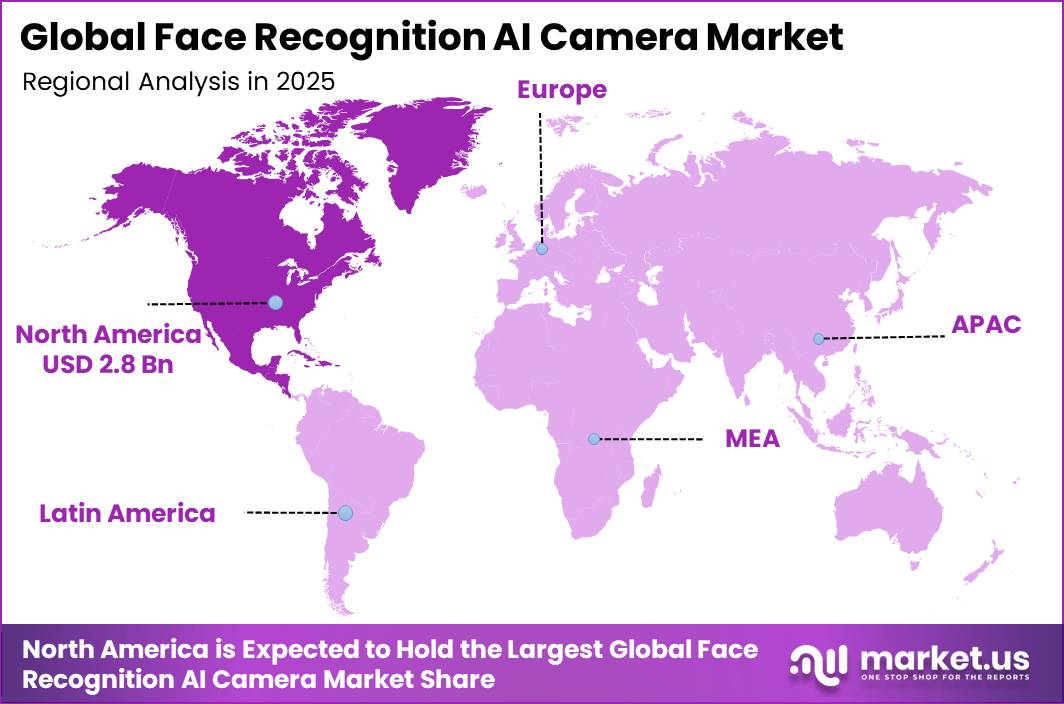
In 2025, the Global Face Recognition AI Camera Market was valued at USD 6.4 billion. The market is projected to grow at a CAGR of 22.4% during 2026–2035, reaching approximately USD 48.0 billion by 2035. North America dominated the global market in 2025, accounting for more than 44.5% of the total market share and generating approximately USD 2.8 billion in revenue.
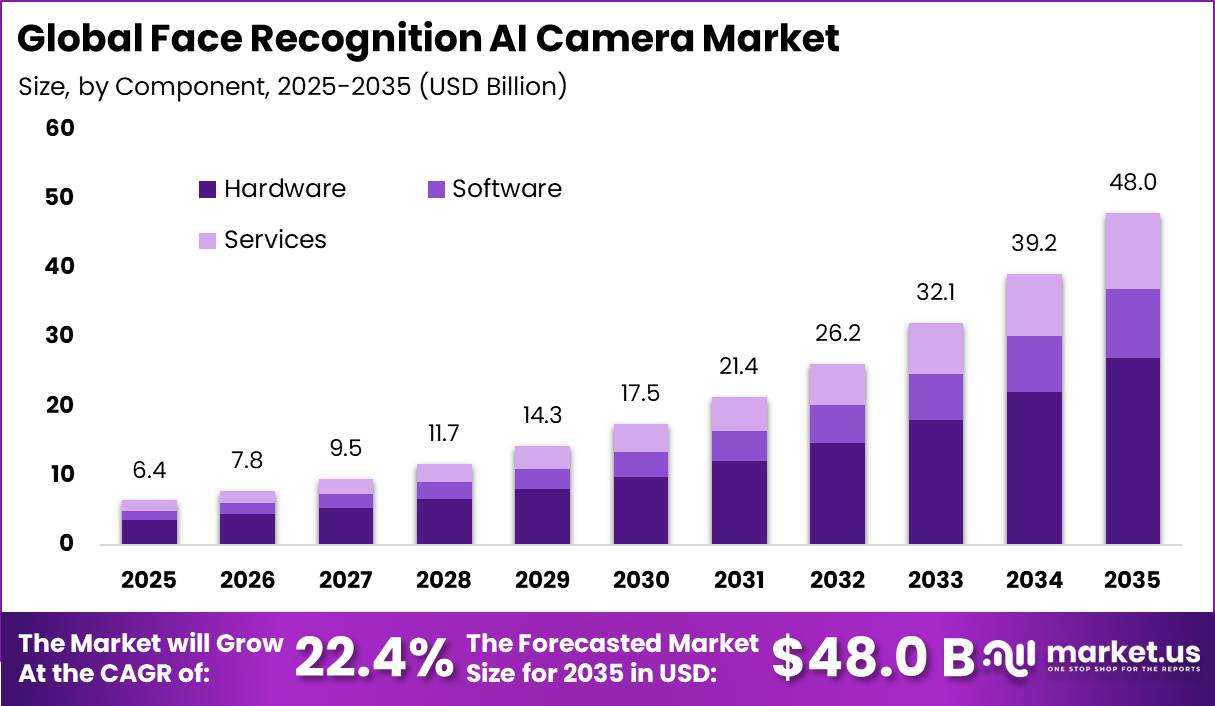
This means the market could grow by nearly 7.5 times over the forecast period. Demand is increasing as airports, metro systems, offices, retail stores, factories, hospitals, and public facilities adopt automated security, identity verification, access control, and real-time video monitoring. Face-recognition AI cameras can identify authorized users, detect restricted-area entry, and reduce manual video-review work.
Hong Kong International Airport handled 61 million passenger trips in 2025, up 15% year on year, while Singapore Changi Airport recorded 69.98 million passenger movements and 374,000 flights, showing the growing need for automated surveillance. East Asia and the Pacific had around 1.5 billion urban residents, equal to 63.7% of its population.
Delhi Metro recorded 2.3 billion passenger journeys in 2025, averaging 6.46 million journeys per day. Asia-Oceania also produced 59.2 million vehicles in 2025, representing over 61% of global output, including around 34.53 million vehicles in China, supporting camera demand across factories, logistics yards, parking systems, and vehicle-access applications.
Key Takeaway
- The Face Recognition AI Camera Market was valued at USD 6.4 billion in 2025 and is projected to reach USD 48.0 billion by 2035, growing at a CAGR of 22.4%.
- Hardware dominated with a 56.3% share, driven by strong demand for AI cameras, sensors, processors, storage, and access-control devices.
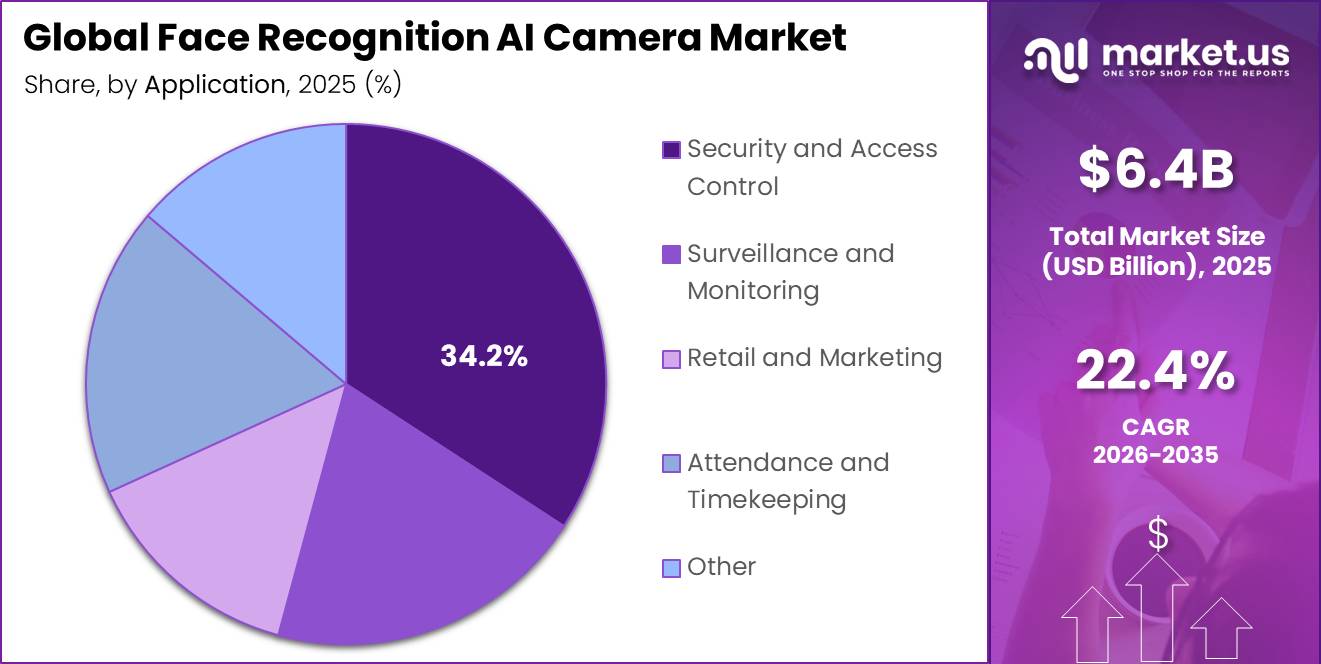
- Security and access control led with a 34.2% share, supported by rising adoption of automated identity verification and restricted-entry systems.
- Government and public sector accounted for 45.4%, driven by large-scale biometric surveillance, border security, and public-safety deployments.
- North America led the market in 2025 with more than 44.5% share and around USD 2.8 billion in revenue.
Market Statistics and Data Insights
- U.S. Customs and Border Protection had processed more than 807 million travelers using biometric facial comparison by September 2025 and prevented more than 2,225 impostors from entering the U.S. Facial biometrics were operating for entry at all international airports, exit at 57 airports, and at 39 seaports.
- The European Entry/Exit System registered more than 45 million border crossings between its launch on 12 October 2025 and March 2026. It also recorded more than 24,000 refusals of entry and operates across 29 European countries.
- Between September 2024 and September 2025, Metropolitan Police live facial recognition deployments resulted in 962 arrests. More than 25% of those arrests were linked to violence-against-women-and-girls offences.
- The IATA 2025 Global Passenger Survey found that 50% of passengers had used biometrics during an airport journey, up from 46% in 2024. Among biometric users, 85% said they were satisfied with the experience.
- About 74% of passengers said they would share biometric information if it allowed them to avoid repeatedly presenting passports or boarding passes. Among passengers unwilling to share biometrics, 42% said they would reconsider if data privacy were assured. The survey collected more than 10,000 responses from over 200 countries.
- Privacy and security remain important adoption barriers: 68% of UK survey respondents were concerned facial recognition could be misused or hacked, 49% were concerned about false identification, and 46% were concerned about lack of control over collected data.
- Consumer acceptance changes sharply with the deployment environment. In high-crime areas, 45% considered live facial recognition always acceptable and 34% usually acceptable. In low-crime areas, only 14% considered it always acceptable and 22% usually acceptable.
- FaceMe SDK 7.2 increased anti-spoofing accuracy by up to 67% and processing speed by 2.3 times. Its anti-spoofing system achieved a 100% true-rejection rate, while deepfake detection reached 95.5% and genuine-video acceptance reached 99%.
- Milestone Systems’ privacy-compliant video library uses more than 300,000 categorizations. Security-specific model training improved flow-and-direction correctness by 19.4% and alert-verification accuracy by 4.4% compared with base foundation models.
- Axis introduced next-generation AI cameras with resolution of up to 8 MP and infrared surveillance ranges of up to 50 meters. Its ARTPEC-9 cameras support edge analytics and FIPS 140-3 Level 3 secure key storage.
- Global 5G coverage reached 55% of the population in 2025. Coverage reached 74% in Europe, 70% in Asia-Pacific, and 60% in the Americas, while global 4G coverage remained 93%. This provides a larger connectivity base for cloud-connected and edge AI surveillance cameras.
- The FBI estimated 5,986,400 property crimes in the U.S. in 2024, equal to 1,760.1 offenses per 100,000 people, while approximately 910,654 property-crime arrests were made. These figures support continued requirements for building, retail, parking, and asset-security systems.
- In 2026, CyberLink’s FaceMe SDK 7.8 improved IR+RGB anti-spoofing accuracy by 35% and increased high-precision processing performance by 15%, showing measurable gains for camera-based biometric authentication.
- During a 6-hour Live Facial Recognition operation in Ipswich in February 2025, Suffolk Police scanned 47,056 faces, generated 5 positive alerts, made 5 arrests, and recorded a 0% incorrect-alert rate against a 303-person watchlist.
By Component
The Hardware segment accounted for 56.3% of the Face Recognition AI Camera Market, as every installation requires physical components such as AI cameras, image sensors, processors, lenses, network video recorders, storage systems, and access-control terminals.
Expanding electronics manufacturing is also improving component availability and supporting faster deployment of AI camera systems. India’s domestic electronics production increased from INR 5.54 lakh crore in FY 2020–21 to INR 9.52 lakh crore in FY 2023–24, recording a CAGR of 19.78%.
Mobile-phone manufacturing also reached INR 4.2 lakh crore in FY 2023–24, reflecting the growing production capacity for camera modules, sensors, processors, circuit boards, and related components. Greater component availability supports wider AI camera deployment across office entrances, factories, retail stores, campuses, and public-security locations.
By Application
The Security and Access Control segment held the largest 34.2% share of the Face Recognition AI Camera Market, as these systems help verify a person’s identity before allowing entry into restricted areas. Face-recognition cameras are increasingly used alongside or instead of access cards, PINs, and manual security checks across offices, factories, data centers, residential buildings, public facilities, airports, and border checkpoints.
Their importance is higher in locations with heavy visitor traffic and greater risk of identity misuse. U.S. Customs and Border Protection reported that biometric facial-comparison technology had processed more than 193 million travelers and identified over 1,500 people using false or assumed identities. This shows how facial recognition can improve identity verification while supporting faster passenger processing.
The U.S. Federal Bureau of Investigation also estimated around 5.99 million property crimes in 2024, including burglary, theft, and motor-vehicle theft. Rising security concerns are encouraging organizations to use face-recognition cameras at entry and exit points to protect people, assets, sensitive data, and restricted facilities, supporting the segment’s leading market position.
By End-User
The Government and Public Sector segment accounted for 45.4% of the Face Recognition AI Camera Market, supported by large-scale deployment across borders, police facilities, government offices, courts, public streets, welfare centers, ports, and transport terminals. Public authorities use these systems to verify identity, detect document fraud, control access, and improve security response with fewer manual checks.
The European Union’s Entry/Exit System highlights this growing demand. The system is being introduced across 29 European countries and records facial images and fingerprints of non-EU short-stay travelers. By March 2026, it had registered more than 45 million border crossings and recorded over 24,000 refusals of entry.
Key Market Segments
By Component
- Hardware
- Cameras
- Processors
- Software
- Facial Recognition Algorithms
- Platforms and Analytics
- Services
- Installation and Integration
- Consulting and Maintenance
By Application
- Security and Access Control
- Surveillance and Monitoring
- Retail and Marketing
- Attendance and Timekeeping
- Other
By End-User
- Government and Public Sector
- B2B/Enterprises
- Retail
- BFSI
- Healthcare
- Corporate Offices
- Transportation and Logistics
Geopolitical Impact Analysis
Geopolitical tensions are increasing supply-chain costs and production risks in the Face Recognition AI Camera Market because manufacturers depend on globally sourced semiconductors, CMOS image sensors, AI processors, memory chips, printed circuit boards, lenses, aluminum housings, copper cables, and networking equipment.
U.S.–China trade measures are creating additional pressure, as the United States maintains an extra 50% Section 301 tariff on Chinese semiconductors. This can increase component costs for AI cameras and access-control terminals, especially in entry-level and mid-range products where electronics represent a large part of total manufacturing cost.
Shipping disruptions are also affecting delivery schedules. UNCTAD reported that diversions around the Cape of Good Hope added about 12 sailing days to the Shanghai–Rotterdam route, increasing transit time by around 30% and reducing effective global container-shipping capacity by approximately 9%. By mid-2024, Suez Canal transits were 70% lower, Gulf of Aden vessel tonnage declined 76%, and Cape of Good Hope arrivals increased 89%.
These conditions can delay cameras, sensors, recorders, and replacement parts while increasing freight, insurance, and warehousing expenses. Energy costs create another challenge, with the World Bank projecting global energy prices to rise 24% in 2026 and Brent crude to average USD 86 per barrel, which is USD 26 above its January forecast.
Regional Analysis
North America was the dominant region in the Face Recognition AI Camera Market in 2025, accounting for 44.5% of global revenue and generating around USD 2.8 billion. Growth is supported by large public-security programs, dense urban areas, strong electronics manufacturing, and wider use of biometric systems across transport, government, retail, industrial, and residential locations.
These systems achieved a traveler match rate above 98%, against a required true-acceptance rate of at least 97% and false-acceptance rate below 0.1%. TSA also screened about 906.7 million passengers in 2025, averaging 2.48 million people per day, along with around 500 million checked bags and more than 2 billion carry-on items.
Asia Pacific is expected to be the fastest-growing region, supported by biometric-security adoption across airports, borders, government facilities, data centers, hospitals, universities, and logistics sites. China Customs and Border Protection processed more than 193 million travelers through facial-comparison technology by February 2025 and identified over 1,500 individuals using false or assumed identities.
India’s electronics production also reached about INR 11.3 lakh crore in FY 2024–25, rising nearly six times from INR 1.9 lakh crore in FY 2014–15, strengthening the regional supply base for camera and networking components.
Key Regions and Countries
North America
- US
- Canada
Europe
- Germany
- France
- The UK
- Spain
- Italy
- Rest of Europe
Asia Pacific
- China
- Japan
- South Korea
- India
- Australia
- Rest of APAC
Latin America
- Brazil
- Mexico
- Rest of Latin America
Middle East & Africa
- GCC
- South Africa
- Rest of MEA
Market Dynamics
Drivers
| Driver | (~) % CAGR | Geographic Relevance | Impact Timeline |
|---|---|---|---|
| Biometric Border Modernization | +2.8% | North America and Europe | Short term (2 years or less) |
| Enterprise Access Automation | +2.2% | Global | Short term (2 years or less) |
| Smart-City Security Rollouts | +2.0% | Asia Pacific and Middle East | Medium term (2 to 4 years) |
| Edge-AI Hardware Adoption | +1.7% | Global | Medium term (2 to 4 years) |
| Critical Infrastructure Protection | +1.4% | North America, Europe and Asia Pacific | Medium term (2 to 4 years) |
Biometric Border Modernization
Biometric border modernization is a major growth driver because it turns facial recognition into a large, multi-year infrastructure investment covering cameras, edge processors, secure networks, storage, identity matching, and maintenance.
U.S. Customs and Border Protection reported that facial-comparison systems had processed more than 193 million travelers and identified over 1,500 people using false or assumed identities by February 2025. The European Commission began rolling out the Entry/Exit System across 29 European countries, replacing manual passport stamping with biometric entry and exit records.
The U.S. Transportation Security Administration also screened about 906.7 million passengers in 2025, equal to nearly 2.484 million passengers per day. These large deployments support recurring integration, software, and service revenue and could add around +2.8% to the market’s 22.4% baseline CAGR.
Restraints
| Restraint | (~) % CAGR | Geographic Relevance | Impact Timeline |
|---|---|---|---|
| Public Biometric Use Limits | -2.6% | European Union | Short term (2 years or less) |
| Data Localization Requirements | -1.8% | Asia Pacific, Europe and Middle East | Medium term (2 to 4 years) |
| Procurement Approval Delays | -1.5% | Global public sector | Short term (2 years or less) |
| High Compliance Costs | -1.3% | Europe and North America | Medium term (2 to 4 years) |
| Restricted Technology Imports | -1.1% | United States and China | Medium term (2 to 4 years) |
Public Biometric Use Limits
Regulation is a direct market restraint where it limits permitted applications of face-recognition technology. The EU AI Act’s prohibited practices became applicable on 2 February 2025 and include 9 prohibited practices, covering real-time remote biometric identification by law enforcement in public spaces except under limited conditions.
The European Commission allows only 3 broad exceptions, including searches for specific victims or missing persons, prevention of an imminent threat or terrorist attack, and identification of suspects linked to serious crimes.
These restrictions can reduce public-surveillance opportunities and extend legal reviews, tender approvals, privacy assessments, and human-oversight requirements. Vendors may need to focus more on consent-based enterprise access, closed-site security, and auditable private deployments. As a result, regulatory limits could create an estimated -2.6% drag on the market’s 22.4% baseline CAGR.
Challenges
| Challenge | (~) % CAGR | Geographic Relevance | Mitigation Horizon |
|---|---|---|---|
| Algorithm Accuracy Assurance | -2.1% | Global | Medium term (2 to 4 years) |
| Chip Supply Volatility | -1.7% | Global | Medium term (2 to 4 years) |
| Interoperability Across Systems | -1.4% | Global | Medium term (2 to 4 years) |
| Cybersecurity Lifecycle Management | -1.2% | Global | Long term (4 years or more) |
| Skilled Deployment Capacity | -0.9% | Emerging markets | Medium term (2 to 4 years) |
Algorithm Accuracy Assurance
Algorithm accuracy remains a major challenge because performance can change with lighting, camera angle, image quality, occlusion, demographics, and matching thresholds. NIST reports that false non-match rates across tested algorithms can range from nearly 0.1% to above 10%, depending on the system and test conditions.
In border-image testing, leading systems failed to authenticate around 0.2% of genuine users while limiting false acceptance to no more than 1 in 100,000 impostor comparisons. Face masks can further increase false non-match rates, creating additional pressure on vendors to improve capture quality, local AI processing, dataset management, threshold tuning, audit logs, and human review.
These requirements increase integration costs and can slow adoption in low-light, high-traffic, and diverse-user environments. As a result, algorithm-performance limitations could create an estimated -2.1% friction drag on the market’s achievable CAGR ceiling.
Opportunities
| Opportunity | (~) % CAGR | Geographic Relevance | Execution Window |
|---|---|---|---|
| Privacy-Preserving Video Analytics | +2.5% | Europe and North America | Medium term (2 to 4 years) |
| Identity-as-a-Service Platforms | +2.0% | Global enterprise markets | Medium term (2 to 4 years) |
| Retrofit Camera Analytics | +1.7% | Global installed base | Short term (2 years or less) |
| Industrial Worker Safety | +1.4% | Asia Pacific and North America | Medium term (2 to 4 years) |
| Secure Edge Processing | +1.2% | Global | Long term (4 years or more) |
Privacy-Preserving Video Analytics
Privacy-preserving analytics remains an untapped opportunity as suppliers adapt face-recognition systems to stricter data-protection rules. The EU AI Act prohibits untargeted scraping of facial images from the internet or CCTV footage to build facial-recognition databases, effective from 2 February 2025.
The EU Entry/Exit System processes facial images and fingerprints across 29 countries, showing that regulated biometric systems can still operate at scale. NIST findings indicate that leading systems can achieve a false-match rate of no more than 1 in 100,000 impostor comparisons.
By using on-device matching, encrypted biometric templates, and camera-level anonymization, suppliers can lower cloud storage, bandwidth, and manual review costs. These improvements could raise project gross margins by around 3% to 6% and potentially add about +2.5% upside to the market’s 22.4% baseline CAGR.
Key Players Analysis
The Face Recognition AI Camera Market is led by a group of Tier-1 companies, including Huawei, Axis Communications, Honeywell, Cisco, and Verint, supported by strong capabilities in security hardware, networking, cloud, and AI. Their total corporate revenue, however, should not be considered face-recognition camera revenue alone.
Huawei reported 2025 revenue of CNY 880.9 billion (USD 126.0 billion) and R&D spending of CNY 192.3 billion, equal to 21.8% of revenue. Its ICT infrastructure business generated around CNY 375.0 billion. Cisco recorded fiscal 2025 revenue of USD 56.65 billion and R&D spending of USD 9.30 billion, or about 16.4% of revenue.
Its Security product revenue increased 59% to USD 8.09 billion. Honeywell’s Building Automation segment generated USD 7.37 billion in 2025 sales, up 13%, with a 26.5% profit margin, while Building Solutions contributed USD 4.48 billion. Specialized players such as Avigilon, Milestone Systems, Eagle Eye Networks, IntelliVision, Agent Video Intelligence, AllGoVision, i2v Systems, and Intuvision strengthen competition.
The Tier-1 group is estimated to hold around 45–55% of global revenue, while Tier-2 firms compete for the remaining 45–55%. Gorilla Technology reported 2025 revenue of USD 101.4 million, up 35.7% from USD 74.7 million in 2024, adjusted EBITDA of USD 19.1 million, a 54.4% decline in operating expenses, and year-end cash of USD 104.8 million.
Top Key Players in the Market
- AllGoVision Technologies Pvt. Ltd.
- Axis Communications AB
- Cisco Systems, Inc.
- Honeywell International, Inc.
- IBM Corporation
- IntelliVision
- Verint Systems, Inc.
- Huawei Technologies Co., Ltd.
- Gorilla Technology Group, Inc.
- i2v Systems Pvt. Ltd.
- ADT, Inc.
- Agent Video Intelligence Ltd.
- Intuvision, Inc.
- Avigilon Corporation
- Stanley Convergent Security Solutions, Inc.
- Eagle Eye Networks
- Milestone Systems A/S
Recent Developments
- In 2025, Milestone Systems acquired Germany-based brighter AI in April, with the transaction becoming effective. Milestone reported 2024 net revenue of DKK 2.0 billion, up 18.7%, while earlier acquisitions increased its workforce by 20%. The deal strengthens privacy and compliance capabilities for AI-based video surveillance.
- In 2026, Honeywell partnered with Rhombus in March to integrate its access-control platforms with Rhombus’ AI-powered cloud video surveillance and analytics. Honeywell’s Building Automation business generated USD 7.367 billion in 2025 revenue, up 13% from USD 6.54 billion in 2024, with USD 1.95 billion in segment profit.
Report Scope
| Report Features | Description |
|---|---|
| Market Value (2025) | USD 6.4 Billion |
| Forecast Revenue (2035) | USD 48.0 Billion |
| CAGR (2026-2035) | 22.4% |
| Base Year for Estimation | 2025 |
| Historic Period | 2020-2024 |
| Forecast Period | 2026-2035 |
| Report Coverage | Revenue Forecast, Market Dynamics, Competitive Landscape, Recent Developments |
| Segments Covered | By Component (Hardware – Cameras, Processors; Software – Facial Recognition Algorithms, Platforms and Analytics; Services – Installation and Integration, Consulting and Maintenance); By Application (Security and Access Control, Surveillance and Monitoring, Retail and Marketing, Attendance and Timekeeping, Other); By End-User (Government and Public Sector, B2B/Enterprises, Retail, BFSI, Healthcare, Corporate Offices, Transportation and Logistics) |
| Regional Analysis | North America – US, Canada; Europe – Germany, France, The UK, Spain, Italy, Rest of Europe; Asia Pacific – China, Japan, South Korea, India, Australia, Singapore, Rest of APAC; Latin America – Brazil, Mexico, Rest of Latin America; Middle East & Africa – GCC, South Africa, Rest of MEA |
| Competitive Landscape | AllGoVision Technologies Pvt. Ltd., Axis Communications AB, Cisco Systems, Inc., Honeywell International, Inc., IBM Corporation, IntelliVision, Verint Systems, Inc., Huawei Technologies Co., Ltd., Gorilla Technology Group, Inc., i2v Systems Pvt. Ltd., ADT, Inc., Agent Video Intelligence Ltd., Intuvision, Inc., Avigilon Corporation, Stanley Convergent Security Solutions, Inc., Eagle Eye Networks, Milestone Systems A/S |
| Customization Scope | Customization for segments and region/country-level will be provided. Moreover, additional customization can be done based on the requirements. |
| Purchase Options | We have three licenses to opt for: Single User License, Multi-User License (Up to 5 Users), Corporate Use License (Unlimited Users and Printable PDF) |