Report Overview
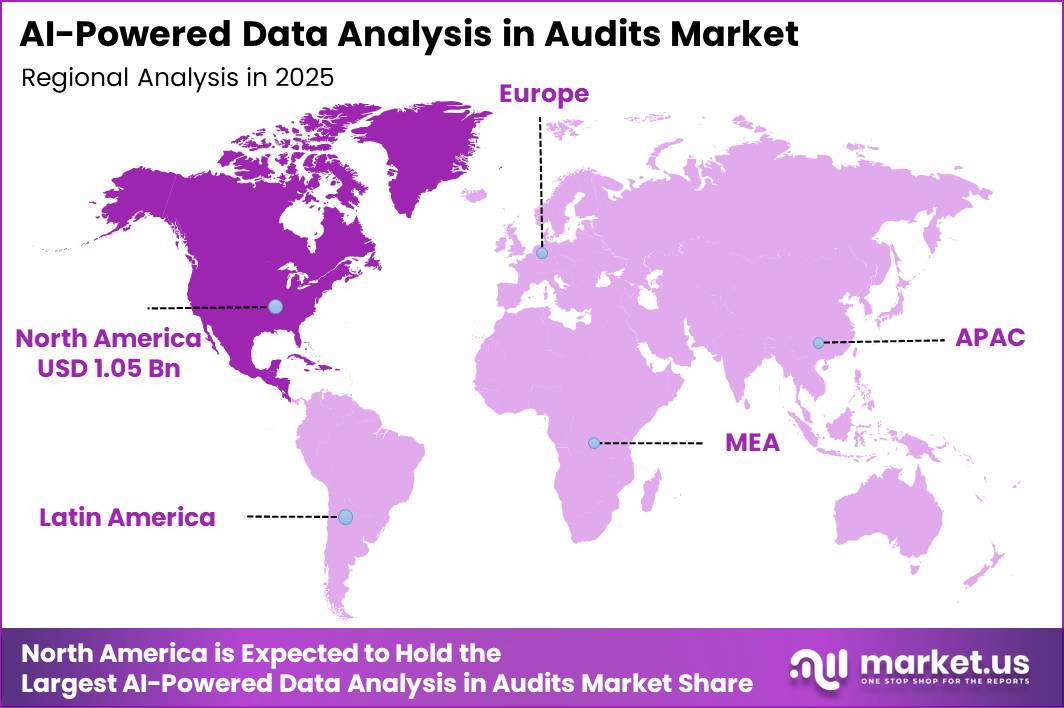
In 2025, the Global AI-Powered Data Analysis in Audits Market was valued at USD 2.9 billion. The market is projected to grow at a CAGR of 21.5% during 2026–2035, reaching approximately USD 20.1 billion by 2035. North America dominated the global market in 2025, accounting for more than 36.33% of the total market share and generating approximately USD 1.05 billion in revenue.
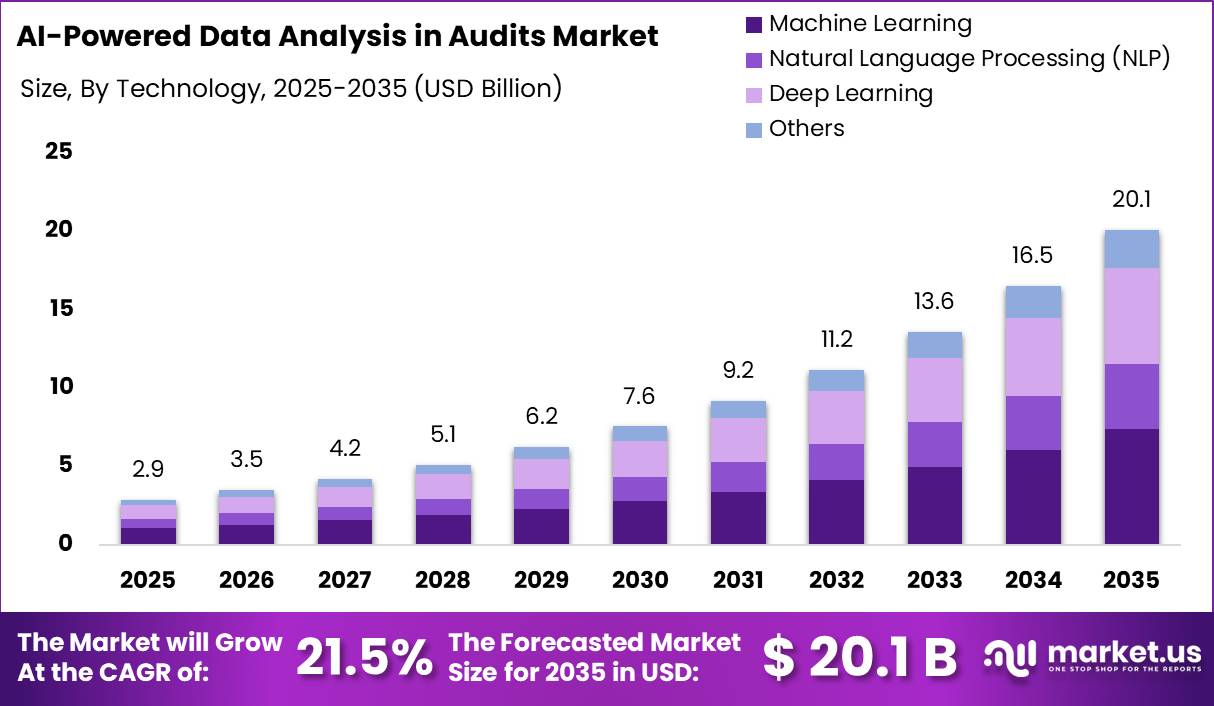
Growth is being supported by increasing AI investment, stricter regulations, and rising demand for continuous audit monitoring. According to the World Bank’s Digital Progress and Trends Report 2025, global AI spending was projected to rise by 60% in 2025 to nearly USD 360 billion. This investment is encouraging organizations to adopt audit systems that can verify AI-generated decisions and identify operational risks.
The OECD AI Policy Observatory recorded over 1,000 AI policies across more than 70 jurisdictions, while over 50 national AI strategies had been adopted by 2024. The EU AI Act, which entered into force in August 2024, introduced conformity assessments and documentation requirements for high-risk AI systems. Around 5,000 to 6,000 high-risk applications in the EU are expected to require third-party audits.
Financial institutions remain major users of these platforms. The IMF reported in April 2024 that cyberattacks on financial firms had more than doubled since the pandemic, causing USD 12 billion in losses over two decades. Extreme losses quadrupled from 2017 to USD 2.5 billion, while banks and insurers represented nearly one-fifth of global cyberattack targets. In 2026, the OECD found that 87% of 15 audit institutions across 14 countries and the EU had deployed AI tools, while 80% had formal guidelines.
Key Takeaway
- The Global AI-powered data analysis in audits market was valued at USD 2.9 billion in 2025 and is projected to reach USD 20.1 billion by 2035, growing at a 21.5% CAGR.
- The Solution segment dominated with a 72.56% share, supported by rising demand for automated data review, anomaly detection, compliance checks, and audit trails.
- The Machine Learning segment held a leading 36.78% share due to its growing use in fraud detection and transaction monitoring.
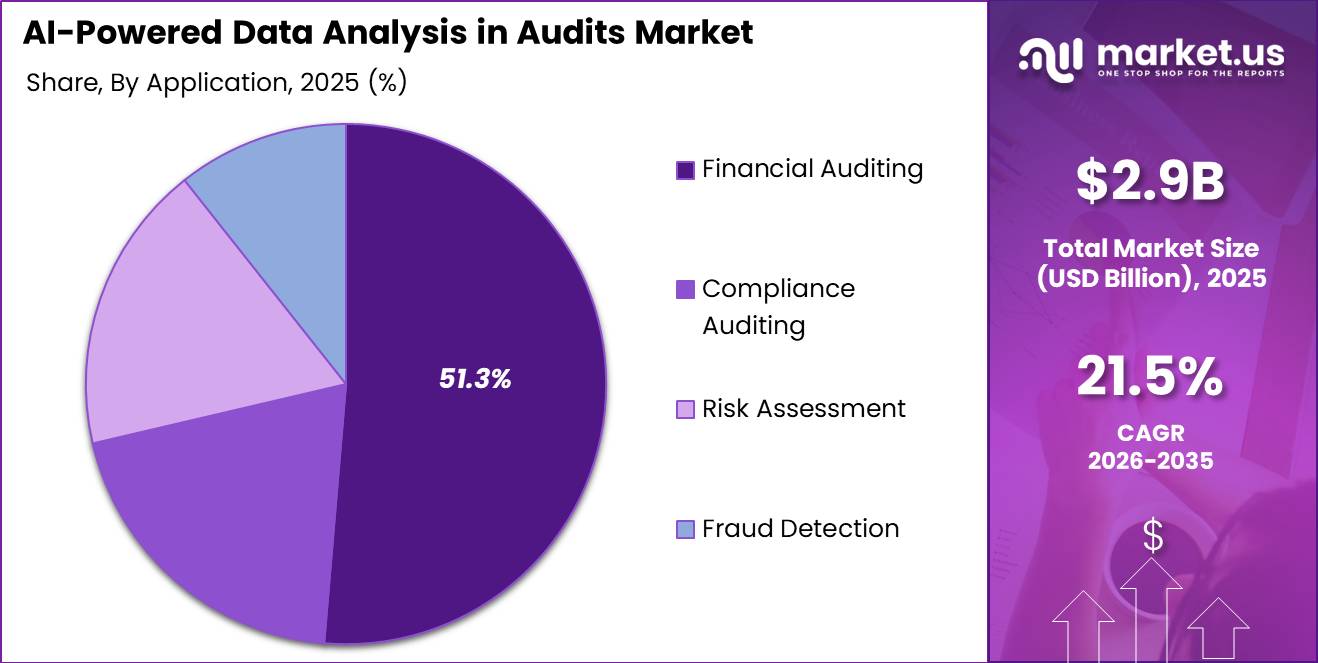
- Financial Auditing accounted for the largest application share at 51.34%, driven by the need to monitor increasingly complex financial systems.
- Banking and Finance held a dominant 34.78% share and was the fastest-growing end-use segment, driven by high transaction volumes and strict compliance requirements.
- North America led the market in 2025 with a 36.33% share, worth approximately USD 1.05 billion.
By Component
In 2025, the Solution segment held a dominant 72.56% share of the AI-Powered Data Analysis in Audits Market. Its leadership is supported by the growing use of integrated software platforms that automate data review, anomaly detection, compliance checks, and audit-trail creation. According to the OECD, enterprise AI adoption increased from 8.7% in 2023 to 20.2% in 2025.
Adoption was particularly high among large companies, reaching 52%, compared with 17.4% among smaller firms. This gap indicates that large enterprises, the primary users of audit-grade AI systems, increasingly require scalable, continuously licensed solutions.
The 2025 IIF-EY Annual Survey on AI in Financial Services also found that 77% of financial institutions were using third-party AI tools, while 36% of Global Systemically Important Banks planned to double their AI spending within 12 months.
The IIF-EY survey reported that 80% of financial institutions considered data quality and access their main AI deployment challenge, while 80% of firms were actively working on Agentic AI. Although 77% used third-party AI models, only 32% could independently validate them against internal controls.
By Technology
In 2025, the Machine Learning segment held a dominant 36.78% share of the technology market. Its leadership is supported by the growing use of ML algorithms to detect fraud patterns, unusual transactions, duplicate payments, inflated invoices, and irregular approval activities. The ACFE Occupational Fraud 2024 report analyzed 1,921 fraud cases across 138 countries and estimated that organizations lose around 5% of annual revenue to fraud.
The reviewed cases generated combined losses of more than USD 3.1 billion. Asset misappropriation accounted for 89% of cases, while corruption was involved in 48%. These fraud types usually create measurable transaction patterns that ML systems can identify faster than manual or rule-based auditing methods. The ACFE also found that proactive data analysis was among 4 major controls linked to reductions of 50% or more in both fraud losses and fraud duration.
Deep Learning is expected to expand at the fastest rate due to its ability to examine complex fraud patterns and unstructured information. Financial statement fraud represented only 5% of cases but caused the highest median loss of USD 766,000 per case, compared with USD 120,000 for asset misappropriation.
By Application
In 2025, the Financial Auditing segment held a dominant 51.34% share of the AI-Powered Data Analysis in Audits Market. Its leadership is supported by the large size and growing complexity of the global financial system, which requires continuous and automated monitoring.
According to the Financial Stability Board, the global non-bank financial intermediation sector reached USD 256.8 trillion across 29 jurisdictions in 2024. Reviewing such a large asset base through manual processes is difficult, increasing demand for AI-based financial audit platforms.
The FSB’s 2025 monitoring report, covering 150 financial authorities and 290 systemically important institutions across 42 jurisdictions, recorded a 34% annual increase in AI applications for credit scoring, fraud analysis, and market surveillance. Around 78% of surveyed financial entities had already adopted machine learning for core risk assessments.
The Risk Assessment segment is expected to expand rapidly as financial institutions face stronger requirements to test and govern AI models. The FSB reported in October 2025 that 61% of surveyed institutions considered model complexity a growing operational risk. Institutions without transparent AI validation systems experienced 22% deeper volatility-adjusted drawdowns during stress scenarios.
By End User
In 2025, the Banking and Finance segment held a dominant 34.78% share of the AI-Powered Data Analysis in Audits Market and was also the fastest-growing end-use segment. Its strong position is supported by high transaction volumes, strict compliance requirements, and the growing use of complex AI models across financial institutions.
According to the Bank for International Settlements, global cross-border bank credit reached USD 37 trillion in Q2 2025, increasing by USD 917 billion within a single quarter. This large credit exposure requires continuous monitoring of credit risk, counterparties, collateral values, and financial transactions, creating strong demand for AI-powered audit platforms.
Regulatory penalties are also encouraging banks to improve automated compliance systems. The Fenergo Global AML Research Report stated that cumulative anti-money laundering and know-your-customer fines imposed on financial institutions exceeded USD 69 billion between 2007 and 2024.
Global penalties reached USD 4.6 billion in 2024, while fines related to transaction-monitoring failures increased by 100% year over year to more than USD 3.3 billion. These financial risks are pushing banks to use AI audit tools for reviewing suspicious transactions, customer records, compliance alerts, and reporting activities in real time.
Key Market Segments
By Component
- Solution
- Services
By Technology
- Machine Learning
- Natural Language Processing (NLP)
- Deep Learning
- Others
By Application
- Financial Auditing
- Compliance Auditing
- Risk Assessment
- Fraud Detection
By End User
- Banking and Finance
- Healthcare
- Manufacturing
- Retail
- Others
Geopolitical Impact Analysis
Geopolitical tensions are increasing infrastructure costs and supply risks for the AI-Powered Data Analysis in Audits Market. In April 2025, U.S. tariffs on Chinese imports reached 145% before being reduced to a baseline rate of 30%. However, export controls on advanced AI chips, including Nvidia H100 GPUs, continued to restrict access to computing hardware used for AI audit workloads.
In December 2024, China also banned exports of gallium, germanium, and antimony. Following the announcement, gallium and germanium spot prices increased by 36% and 42%, respectively, within 2 weeks. These restrictions can raise the cost of GPU clusters, servers, and cloud infrastructure.
UNCTAD reported that global trade reached USD 35 trillion in 2025, although supply chains increasingly shifted through Southeast Asia and Mexico. The WTO projected in April 2025 that global merchandise trade volume could decline by 0.2%, around 3 percentage points below the low-tariff baseline. North America was expected to reduce global trade growth by 1.7 percentage points. These conditions may increase procurement delays, logistics expenses, and hardware shortages for AI audit platform providers.
Energy demand creates another geopolitical and operating challenge. According to the IEA, global data-centre electricity consumption reached 415 TWh in 2024, growing by nearly 12% annually, and could exceed 945 TWh by 2030. AI-focused server demand is expanding by approximately 30% annually. In the United States, data centres could represent 6.7%–12% of electricity use by 2028, while their total energy demand may rise by around 130% by 2030.
Regional Analysis
In 2025, North America held a dominant 36.33% share of the AI-Powered Data Analysis in Audits Market, generating approximately USD 1.05 billion. The region’s leadership is supported by strong government investment, strict financial regulations, advanced cloud infrastructure, and the early adoption of enterprise AI solutions.
The U.S. federal government allocated more than USD 3 billion under its FY2025 budget for the responsible development, testing, and procurement of AI systems. Combined AI research and development funding for agencies such as NSF, DARPA, NIH, and the Department of Defense reached USD 3.316 billion in FY2025.
This spending supports demand for audit platforms that assess whether government AI systems follow frameworks such as the NIST AI RMF. Regulatory enforcement is another major growth factor. In 2024, North America accounted for approximately 95% of global financial regulatory penalties, which totalled USD 4.6 billion.
Asia-Pacific is expected to record the fastest growth due to rapid digital finance expansion and stronger AI governance requirements. Southeast Asia’s digital economy exceeded USD 300 billion in gross merchandise value in 2025, increasing by 15% year over year. Consumer interest in AI was around 3 times higher than the global average. The number of AI-focused fintech companies across Asia was projected to reach 7,271 in 2025, compared with 1,289 in 2015.
Key Regions and Countries
North America
- US
- Canada
Europe
- Germany
- France
- The UK
- Spain
- Italy
- Rest of Europe
Asia Pacific
- China
- Japan
- South Korea
- India
- Australia
- Rest of APAC
Latin America
- Brazil
- Mexico
- Rest of Latin America
Middle East & Africa
- GCC
- South Africa
- Rest of MEA
Market Dynamics
Drivers
| Driver | (~) % CAGR | Geographic Relevance | Impact Timeline |
|---|---|---|---|
| AI-centric audit regulation compliance pull | +4.0% | EU, US, UK, selective APAC | Short term (≤ 2 years) |
| Productivity gains in data-heavy audits | +3.2% | Global large enterprises | Short term (≤ 2 years) |
| Shift to continuous assurance models | +2.8% | Financial services, public sector | Medium term (2 to 4 years) |
| Standardization of AI audit governance | +2.5% | OECD economies | Medium term (2 to 4 years) |
| Cloud native audit data platforms | +2.0% | Global | Short term (≤ 2 years) |
| Adoption in India and emerging markets | +1.8% | India, ASEAN, LATAM | Medium term (2 to 4 years) |
AI-centric audit regulation compliance pull
Regulation aimed at high-risk and generative AI systems is forcing institutions to embed AI-powered data analysis in audits to evidence risk management, traceability, and human oversight, especially under the EU AI Act obligations that phase in between 2024 and 2028 and similar supervisory expectations in major financial centres.
This driver operates quantitatively by converting compliance mandates into recurring software and data analytics spend, with large banks and public institutions reconfiguring audit workflows so that at least 30 to 40% of transactional testing and log review is machine-led, cutting test cycle times by roughly 20 to 35% and supporting the baseline CAGR uplift of about +4.0% versus a non-AI status quo.
Strategically, this is altering business models from hourly audit billing toward subscription-based AI assurance platforms, where margin expansion comes from moving manual sampling often at sub-20 % gross margins into high automation analytics layers that can reach gross margins in the mid 40%.
Restraints
| Restraint | (~) % CAGR | Geographic Relevance | Impact Timeline |
|---|---|---|---|
| Regulatory uncertainty on AI audit tools | -3.5% | EU, US, cross-border groups | Short term (≤ 2 years) |
| Conservative adoption by audit regulators | -2.8% | Global | Medium term (2 to 4 years) |
| High upfront integration and validation costs | -2.5% | Mid market and public sector | Short term (≤ 2 years) |
| Model risk and liability concerns | -2.3% | Financial services | Medium term (2 to 4 years) |
| Data residency and sovereignty limits | -2.0% | EU, India, Middle East | Long term (≥ 4 years) |
| Capital expenditure constraints at small firms | -1.8% | SME audit practices | Short term (≤ 2 years) |
Regulatory uncertainty on AI audit tools
The evolving enforcement of AI-focused regulations, including staged application of EU AI Act rules from 2025 through at least 2028, creates uncertainty about which AI-powered analytics configurations will be acceptable in statutory audits, causing firms to freeze or defer deployments.
Quantitatively, this manifests as delayed procurement cycles often extended by 6 to 12 months and incremental compliance overhead, with implementation budgets reallocated into legal review and documentation that can absorb an extra 10 to 15% of planned project spend, thereby depressing effective growth by an estimated -3.5% against the nominal baseline CAGR.
Challenges
| Challenge | (~) % CAGR | Geographic Relevance | Mitigation Horizon |
|---|---|---|---|
| Shortage of AI-literate auditors | -3.0% | Global | Long term (≥ 4 years) |
| Complex multijurisdiction AI governance | -2.7% | EU, US, Asia | Medium term (2 to 4 years) |
| Data quality and lineage limitations | -2.5% | Global enterprises | Medium term (2 to 4 years) |
| Legacy systems interoperability gaps | -2.3% | Mid market and public sector | Long term (≥ 4 years) |
| Cybersecurity risk in audit pipelines | -2.2% | Financial services, government | Medium term (2 to 4 years) |
| Organizational resistance to AI-led testing | -2.0% | Traditional audit practices | Short term (≤ 2 years) |
Shortage of AI-literate auditors
There is a structural gap between the rapid deployment of AI analytics in audits and the availability of auditors with both domain expertise and AI literacy, as industry bodies and public sector programs have only recently begun scaling curricula covering model risk, data governance, and AI-enabled testing.
Quantitatively, this shortage leads to underutilization of deployed tools; often only 50 to 60% of licensed analytic capabilities are actively used, and forces firms to pay compensation premiums of roughly 20 to 30% for hybrid audit and data science profiles, which collectively drags achievable growth by around -3.0% relative to the theoretical CAGR implied by full automation.
Opportunities
| Opportunity | (~) % CAGR | Geographic Relevance | Execution Window |
|---|---|---|---|
| AI native continuous audit platforms | +3.8% | Global regulated sectors | Medium term (2 to 4 years) |
| Specialized AI audit for AI systems | +3.5% | EU, US, advanced digital economies | Long term (≥ 4 years) |
| Verticalized audit analytics sector-specific | +3.0% | Financial, healthcare, public sector | Medium term (2 to 4 years) |
| Outcome-based pricing and risk sharing | +2.5% | Global | Short term (≤ 2 years) |
| Expansion into emerging regulatory regimes | +2.3% | India, ASEAN, Africa | Long term (≥ 4 years) |
| M&A roll-ups of niche AI audit vendors | +2.0% | Global | Medium term (2 to 4 years) |
AI native continuous audit platforms
This opportunity remains largely untapped because most institutions still operate on periodic audit cycles, while regulations and supervisory expectations around AI and data governance are increasingly amenable to continuous machine-driven monitoring provided that traceability, documentation, and human oversight standards are met.
Quantitatively, AI native continuous audit platforms can reduce manual sampling workloads by more than 50%, cut exception resolution times from weeks to days, and shift audit economics from project-based fees into recurring per-entity or per-transaction models, offering a potential CAGR upside of roughly +3.8% via higher client retention and expanded share of analytic spend.
Strategically, these platforms enable margin expansion by automating low-value evidence collection, where current gross margins often hover in the low 20%s, and reallocating skilled audit labour into judgement and complex issue resolution, which can sustain margins in the mid to high 40%s, while also strengthening unit economics through lower cost per audited data record and differentiated compliance positioning in sectors facing heightened AI governance scrutiny.
Key Players Analysis
The competitive landscape is led by the Big Four, supported by large client networks, strong audit experience, and major technology investments. PwC reported USD 56.9 billion in FY2025 revenue, including USD 19.8 billion from Assurance and USD 24.3 billion from Advisory. It invested nearly USD 1.5 billion in AI capabilities and another USD 1 billion in its Next Generation Audit platform, which completed pilots with 5 clients before its planned global rollout in 2026.
EY generated USD 53.2 billion in FY2025 revenue, while AI consulting revenue increased by 30%. The firm invests over USD 1 billion annually in AI platforms, has deployed more than 1,000 AI agents, and involved over 15,000 employees in AI-led projects. KPMG’s revenue grew by 5.4% to USD 39.8 billion, with Audit revenue rising by 6%, supported by a USD 4.2 billion technology, AI, and ESG investment commitment.
It also achieved ISO 42001 certification for its Trusted AI framework. Thomson Reuters recorded USD 7.48 billion in FY2025 revenue and 7% organic growth. Generative AI represented 24% of contract value, while its Tax, Audit and Accounting segment grew by 11%. The company also completed USD 843 million in AI-related acquisitions, including SafeSend and Additive.
AuditBoard exceeded USD 300 million in ARR in October 2025 and targets Fortune 1000 companies. Alteryx was acquired for USD 4.4 billion in 2024. MindBridge AI, ThetaRay, Trullion, Linkurious, Grant Thornton, and Kanini compete across anomaly detection, AML, consulting, and compliance areas, including ASC 842 and IFRS 16 auditing.
Top Key Players in the Market
- AuditBoard, Inc.
- Alteryx, Inc.
- MindBridge Ai
- Thomson Reuters Corporation
- Grant Thornton LLP
- Trullion, Inc.
- KPMG International Cooperative
- PricewaterhouseCoopers International Limited (PwC)
- Ernst & Young Global Limited (EY)
- Kanini, Inc.
- Impact Analytics, Inc
- Linkurious
- ThetaRay
Recent Developments
- In April 2026, EY launched its enterprise-scale agentic AI platform across the global Assurance business. The platform uses autonomous AI agents to perform multi-step audit activities, including risk identification, evidence collection, controls testing, and financial statement analysis. The initiative builds on EY’s USD 1 billion Assurance technology investment and supports its USD 17.8 billion Assurance business, which was the firm’s largest service line in FY2025.
- In January 2025, Thomson Reuters completed the all-cash acquisition of cPaperless, LLC, operating as SafeSend, for USD 600 million. SafeSend had approximately 235 employees, expected USD 60 million in 2025 revenue, and served 70% of the top 500 U.S. accounting firms. The deal strengthened Thomson Reuters’ AI-powered tax and audit automation portfolio and formed part of its USD 843 million in AI-focused acquisitions during FY2025.
- In April 2025, KPMG introduced AI agents into its Clara smart audit platform for more than 95,000 auditors across 143 countries. The tools support expense vouching, unrecorded liability searches, and disclosure-checklist preparation. KPMG also launched its Financial Report Analyzer as part of its USD 4.2 billion investment in technology, AI, and ESG.
Report Scope
| Report Features | Description |
|---|---|
| Market Value (2025) | USD 2.9 Billion |
| Forecast Revenue (2035) | USD 20.1 Billion |
| CAGR (2026-2035) | 21.5% |
| Base Year for Estimation | 2025 |
| Historic Period | 2020-2024 |
| Forecast Period | 2026-2035 |
| Report Coverage | Revenue Forecast, Market Dynamics, Competitive Landscape, Recent Developments |
| Segments Covered | By Component (Solution, Services); By Technology (Machine Learning, Natural Language Processing (NLP), Deep Learning, Others); By Application (Financial Auditing, Compliance Auditing, Risk Assessment, Fraud Detection); By End User (Banking and Finance, Healthcare, Manufacturing, Retail, Others) |
| Regional Analysis | North America – US, Canada; Europe – Germany, France, The UK, Spain, Italy, Rest of Europe; Asia Pacific – China, Japan, South Korea, India, Australia, Singapore, Rest of APAC; Latin America – Brazil, Mexico, Rest of Latin America; Middle East & Africa – GCC, South Africa, Rest of MEA |
| Competitive Landscape | AuditBoard, Alteryx, MindBridge AI, Thomson Reuters, Grant Thornton, Trullion, KPMG, PwC, EY, Kanini, Impact Analytics, Linkurious, ThetaRay |
| Customization Scope | Customization for segments and region/country-level will be provided. Moreover, customization can be tailored to the requirements. |
| Purchase Options | We have three licenses to opt for: Single User License, Multi-User License (Up to 5 Users), Corporate Use License (Unlimited Users and Printable PDF) |