Report Overview
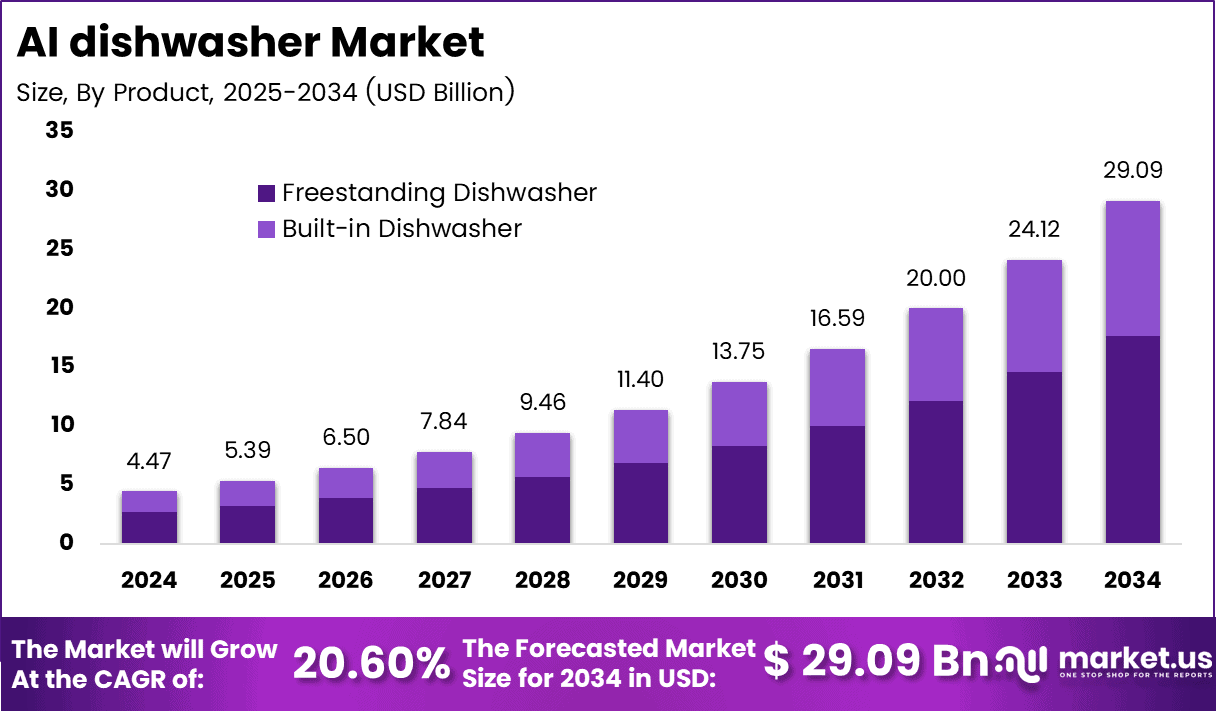
The Global AI Dishwasher Market generated USD 4.47 billion in 2024 and is projected to reach approximately USD 29.09 billion by 2034, expanding at a CAGR of 20.6% during 2025–2034. This represents nearly 6.5 times growth from the 2024 level. North America dominated the global market in 2025, generating approximately USD 1.58 billion in revenue.
Energy efficiency is an important factor supporting AI dishwasher adoption. ENERGY STAR requires standard certified dishwashers to consume no more than 240 kWh of electricity annually and 3.2 gallons of water per cycle, based on approximately 215 cycles per year. AI-based soil sensors and automatic cycle controls can help manufacturers meet these efficiency requirements while maintaining cleaning performance.
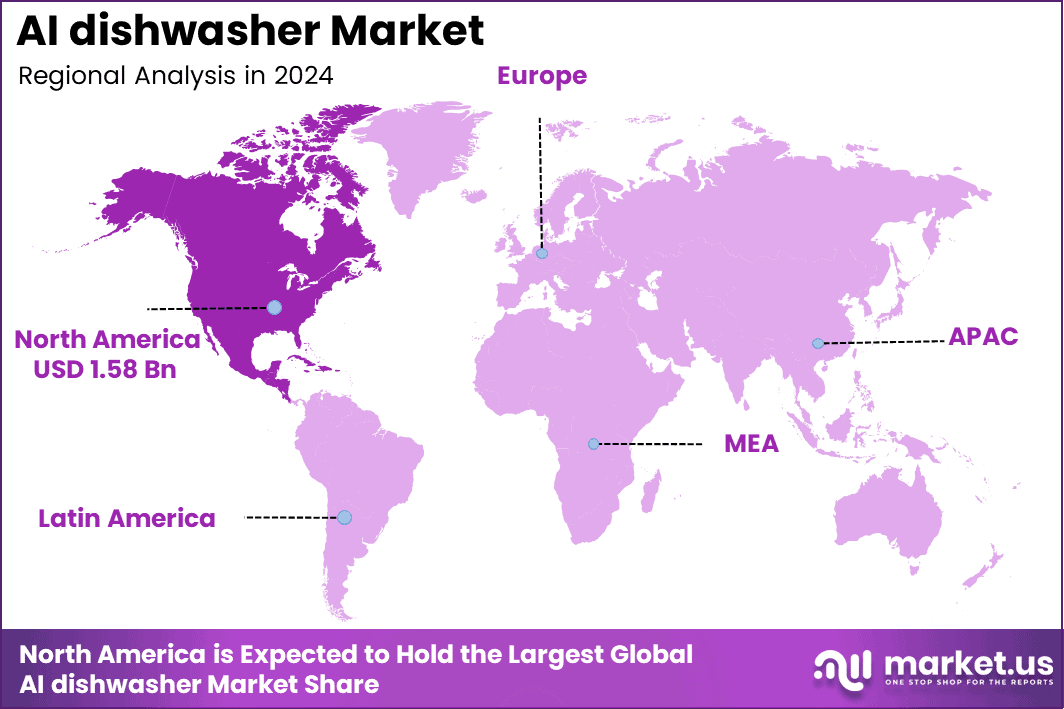
ENERGY STAR also estimates that certified dishwashers can save approximately 5,800 gallons of water over their operating life. North America generated approximately USD 1.58 billion in 2024, accounting for around 35.3% of the global AI dishwasher market. The region benefits from a large appliance replacement base, widespread internet access, and established energy-efficiency regulations.
U.S. Department of Energy data indicate that approximately 8.09 million dishwashers were shipped in 2019, with ENERGY STAR-certified models representing nearly 91% of total shipments. Strong household connectivity further supports the adoption of AI-enabled features such as remote monitoring, mobile alerts, usage tracking, and software updates.
Approximately 90% of U.S. households had broadband subscriptions in 2021, while 96.4% of Canadian households had access to high-speed broadband in 2024. New U.S. dishwasher efficiency standards will require compliance from 2027, and the Department of Energy estimates that these standards could save consumers nearly USD 3.2 billion over 30 years of product shipments, encouraging wider adoption of energy-efficient and AI-enabled dishwasher models.
Key Takeaways
- The Global AI dishwasher market reached USD 4.47billion in 2024 and is projected to expand to USD 29.09 billion by 2034, growing at a CAGR of 20.6% from 2025 to 2034.
- Freestanding dishwashers held the dominant share of 60.7% in 2024, favored for their flexible installation, mobility, and widespread adoption in urban households.
- Deep learning technology accounted for the largest share of 40.2%, enabling intelligent load detection, water optimization, and adaptive cleaning cycles.
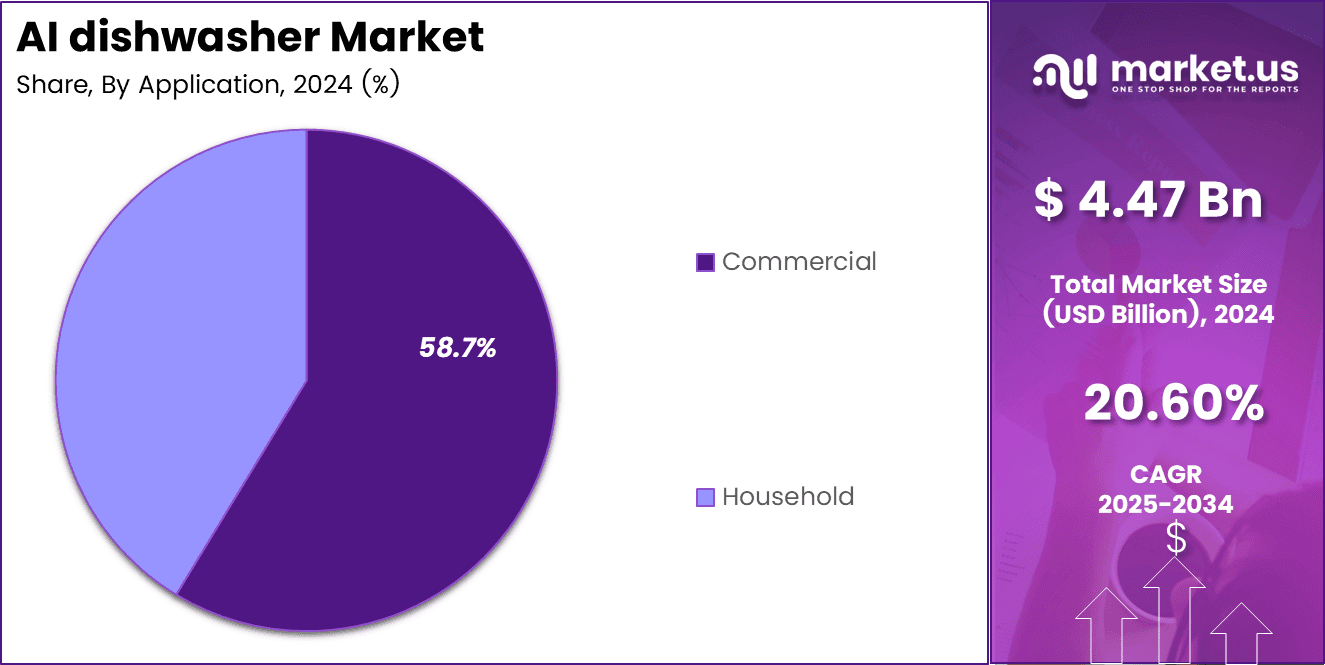
- Commercial applications represented 58.7% of the total market, driven by strong demand from hotels, restaurants, and institutional kitchens adopting AI-integrated cleaning systems for efficiency and hygiene.
- The offline distribution channel captured 65.7% of the market, supported by the consumer preference for physical appliance stores, product demonstrations, and after-sales services.
- North America led the global market with a valuation of USD 1.58 billion in 2024, owing to advanced smart home adoption and high disposable incomes.
Analysts’ Viewpoint
Analysts view the global AI dishwasher market as a rapidly advancing segment of the smart appliance industry, expected to grow at a strong CAGR of 20.6% from 2025 to 2034. The surge is primarily driven by the growing preference for automated, energy-efficient, and connected home solutions. Freestanding dishwashers, holding 60.7% of the market, dominate due to their flexibility and convenience in urban households, while built-in models are increasingly favored in premium kitchens.
Deep learning technology, with a 40.2% share, is transforming dishwashers into intelligent systems capable of optimizing wash cycles, detecting load levels, and conserving resources. Commercial applications, accounting for a 58.7% share, continue to expand in the hospitality and foodservice sectors.
Role of Generative AI
Generative AI is playing an increasingly transformative role in the AI dishwasher market by enabling higher levels of personalization, automation, and system intelligence. Through predictive modeling, generative AI allows dishwashers to analyze user habits, load patterns, and water conditions to automatically generate optimized wash cycles tailored to each use. This capability not only enhances cleaning efficiency but also minimizes energy and water consumption.
Manufacturers are leveraging generative AI to simulate product performance, design new energy-saving wash algorithms, and predict maintenance requirements before failures occur. Additionally, it supports natural language interfaces, allowing seamless communication through voice assistants.
In commercial environments, generative AI integrates with IoT platforms to forecast high-volume washing needs and schedule operations accordingly. Overall, its integration is expected to redefine product innovation, sustainability, and user convenience, positioning AI dishwashers as intelligent, self-learning systems within connected home and commercial ecosystems.
By Product
Freestanding dishwashers accounted for 60.7% of the global AI dishwasher market share in 2024. Their dominance is attributed to easy installation, portability, and adaptability to various kitchen layouts, making them ideal for both rental and urban households. These models integrate AI features such as soil sensing, energy optimization, and voice-controlled operations, providing convenience and efficiency.
Built-in dishwashers, while growing rapidly, appeal primarily to premium residential and commercial setups where aesthetics and space utilization are key. Manufacturers are focusing on connectivity features, predictive maintenance, and integration with smart home systems to further enhance user experience.
By Technology
Deep learning technology dominated the market with a 40.2% share in 2024. It enables advanced functionalities such as adaptive washing cycles, load recognition, and efficient water usage by analyzing vast data inputs from sensors.
Machine learning and NLP allow seamless voice interactions with virtual assistants like Alexa or Google Assistant. Machine vision improves dish detection and wash customization. Generative AI is emerging in predictive diagnostics and usage pattern optimization. These technologies collectively enhance the intelligence, energy efficiency, and performance reliability of modern AI dishwashers.
By Application
The Commercial segment led the market with a 58.7% share in 2024, driven by the hospitality and foodservice sectors adopting AI dishwashers for operational efficiency and hygiene compliance. Smart automation and predictive maintenance reduce downtime and water consumption, optimizing cleaning operations for large-scale kitchens.
The household segment is rapidly expanding as urban consumers embrace AI-based dishwashers for convenience, time-saving benefits, and sustainable energy use. Increasing smart home adoption, along with Energy Star-certified models, is propelling household segment growth across developed and emerging economies.
By Distribution Channel
Offline distribution channels accounted for 65.7% of total sales in 2024, owing to consumer preference for in-store experience, product demonstrations, and after-sales service assurance. Major electronics retailers and appliance showrooms play a key role in promoting premium AI dishwashers through brand partnerships. However, online sales are increasing rapidly due to rising digitalization, discounts, and doorstep installation services. E-commerce platforms such as Amazon and brand-specific portals are enhancing visibility and customer engagement with interactive virtual demos and AI-based product recommendations.
Key Market Segment
By Product
- Freestanding Dishwasher
- Built-in Dishwasher
By Technology
- Deep Learning
- Machine Learning
- Natural Language Processing (NLP)
- Machine Vision
- Generative AI
By Application
- Household
- Commercial
By Distribution Channel:
- Offline
- Online
Regional Analysis
North America dominates the global AI dishwasher market, valued at USD 1.58 billion in 2024, owing to widespread smart home adoption, strong purchasing power, and rapid integration of AI and IoT technologies. The US leads the region, supported by consumers seeking energy-efficient, connected appliances with features like predictive maintenance and voice control.
Europe follows closely, driven by stringent energy regulations, sustainability goals, and high awareness of eco-friendly kitchen systems in countries such as Germany, France, and the UK. The Asia-Pacific region is projected to experience the fastest growth, fueled by urbanization, increasing disposable incomes, and expanding manufacturing capabilities in China, Japan, and South Korea.
Asia Pacific (APAC) is expected to record the fastest growth rate due to expanding semiconductor manufacturing bases in China, Japan, and South Korea, coupled with government incentives for chip innovation. Latin America is gradually adopting 3D XPoint in data-intensive sectors such as BFSI and telecommunications, while the Middle East and Africa (MEA) region is witnessing growth in digital transformation and AI-driven infrastructure.
US Market Size
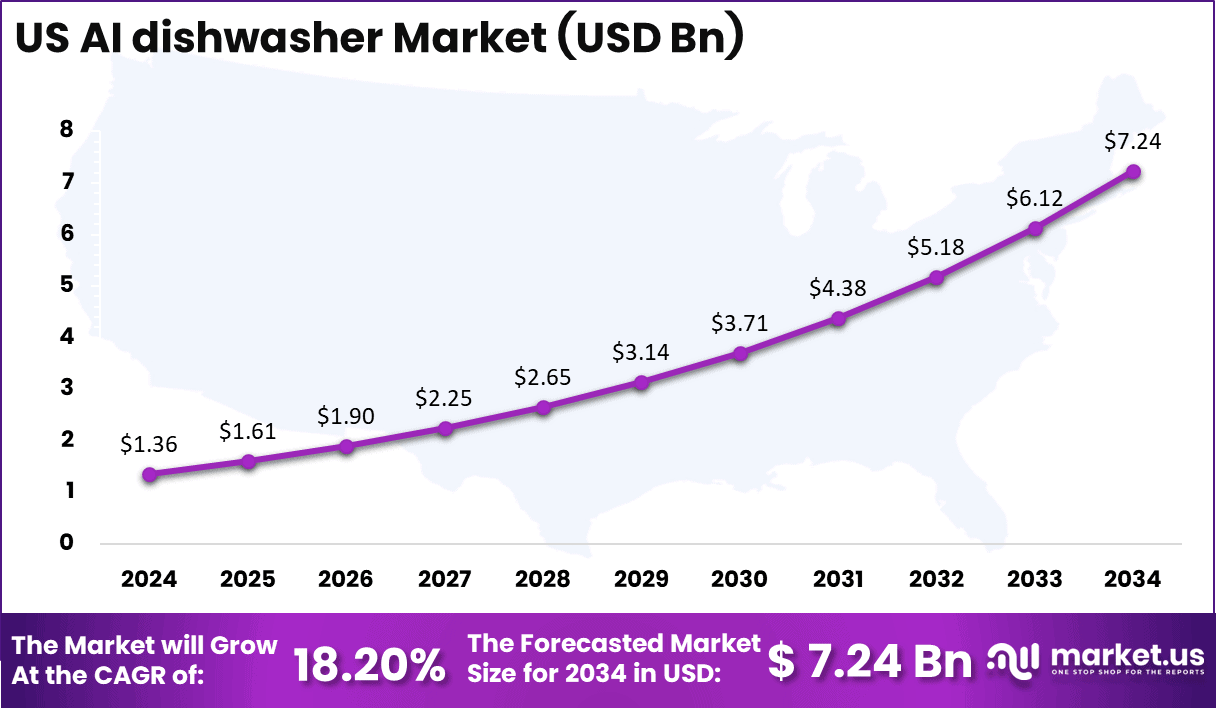
The US AI dishwasher market was valued at USD 1.36 billion in 2024 and is projected to reach USD 7.24 billion by 2034, expanding at a CAGR of 18.2% during the forecast period. This steady growth is driven by increasing adoption of smart home appliances, rising consumer preference for automated cleaning solutions, and advancements in AI-driven load detection and water optimization technologies.
The AI dishwasher market growth trajectory indicates strong demand across both residential and commercial applications, supported by growing disposable incomes and eco-conscious consumers investing in intelligent dishwashing systems that offer enhanced performance, connectivity, and long-term cost efficiency across the United States.
Key Regions and Countries
- North America
- US
- Canada
- Europe
- Germany
- France
- The UK
- Spain
- Italy
- Rest of Europe
- Asia Pacific
- China
- Japan
- South Korea
- India
- Australia
- Singapore
- Rest of Asia Pacific
- Latin America
- Brazil
- Mexico
- Rest of Latin America
- Middle East & Africa
- South Africa
- Saudi Arabia
- UAE
- Rest of MEA
Key Players Analysis
The global dishwasher market is led by a concentrated Tier-1 group consisting of BSH, Haier, LG, Samsung, Electrolux, and Whirlpool. BSH is estimated to hold around 15–20% of the market on a shipment/value basis, supported by its strong premium positioning. In FY2025, BSH generated €15.0 billion in turnover and invested €847 million in R&D, equal to 5.6% of sales, along with €463 million in future-focused investments.
Haier Smart Home remains a major scale-based competitor with a broad multi-brand portfolio. In FY2025, the company generated revenue of RMB 302.35 billion, representing growth of 5.71%. R&D expenditure reached RMB 10.72 billion, or 3.54% of revenue, supporting connected and localized appliances across Haier, Candy, Hoover, GE Appliances, and Fisher & Paykel.
LG and Samsung compete strongly through AI, connectivity, and broader smart-home ecosystems. LG’s Home Appliance Solution business reported revenue of KRW 26.13 trillion and operating profit of KRW 1.28 trillion in 2025.
Samsung generated FY2025 revenue of KRW 333.6 trillion and invested a record KRW 37.7 trillion in R&D. Electrolux also recorded sales of SEK 131 billion in 2025, including nearly SEK 45 billion from North America, representing approximately 34% of group sales.
Whirlpool, Miele, and Arçelik/Beko further strengthen competitive intensity through manufacturing investments and premium positioning. Whirlpool announced a USD 300 million U.S. laundry investment and highlighted nearly USD 6 billion of U.S. spending on CapEx, R&D, and product development over 10 years. Miele generated approximately €5.16 billion in FY2024/25 revenue, while Arçelik reported TRY 523.9 billion in 2025 turnover and planned approximately €250 million in capital expenditure.
Top Key Players
- Robert Bosch GmbH
- LG Electronics
- SAMSUNG
- Haier Group
- Electrolux
- Whirlpool Corporation
- Miele & Cie. KG
- Panasonic Corporation
- Arçelik
- Smeg
- Other Major Players
Recent Developments
- In April 2026, Electrolux and Midea formed a long-term North American manufacturing and commercial partnership, including three joint ventures: Midea acquired a 65% stake in Electrolux’s Juárez, Mexico refrigeration plant, while Electrolux will retain 55% of a planned Anderson, South Carolina laundry venture. The partners committed approximately $119 million in capital expenditure over three years for the Juárez upgrade and Anderson retrofit.
- In June 2025, BSH Home Appliances committed more than $11 million to expand its New Bern, North Carolina site into a U.S. centre for cooking and dishwashing R&D, manufacturing, distribution and customer support. The Bosch division plans to add 199 positions, supported by a $500,000 performance-based One North Carolina Fund grant; projected annual payroll impact exceeds $12 million.
Report Scope
| Report Features | Description |
|---|---|
| Market Value (2024) | USD 4.47 Bn |
| Forecast Revenue (2034) | USD 29.09 Bn |
| CAGR(2025-2034) | 20.60% |
| Base Year for Estimation | 2024 |
| Historic Period | 2020-2023 |
| Forecast Period | 2025-2034 |
| Report Coverage | Revenue forecast, AI impact on Market trends, Share Insights, Company ranking, competitive landscape, Recent Developments, Market Dynamics, nd Emerging Trends |
| Segments Covered | By Product (Freestanding Dishwasher, Built-in Dishwasher), By Technology (Deep Learning, Machine Learning, Natural Language Processing (NLP), Machine Vision), Generative AI, By Application (Household, Commercial), By Distribution Channel (Offline, Online) |
| Regional Analysis | North America – US, Canada; Europe – Germany, France, The UK, Spain, Italy, Russia, Netherlands, Rest of Europe; Asia Pacific – China, Japan, South Korea, India, New Zealand, Singapore, Thailand, Vietnam, Rest of Latin America; Latin America – Brazil, Mexico, Rest of Latin America; Middle East & Africa – South Africa, Saudi Arabia, UAE, Rest of MEA |
| Competitive Landscape | Robert Bosch GmbH, LG Electronics, SAMSUNG, Haier Group, Electrolux, Whirlpool Corporation, Miele & Cie. KG, Panasonic Corporation, Arçelik, Smeg, Other Major Players |
| Customization Scope | Customization for segments, region/country-level will be provided. Additional customization can be done based on requirements. |
| Purchase Options | We have three licenses to choose from: Single User License, Multi-User License (Up to 5 Users), Corporate Use License (Unlimited Users, Printable PDF) |