Quick Navigation
- Introduction
- Editor’s Choice
- Historical Facts
- General Internet Statistics and Facts
- Internet Usage Statistics
- Mobile Internet Statistics
- eCommerce Internet Statistics:
- Internet Statistics Worldwide
- Statistics of Internet Technology
- Internet Users by Country
- Web Hosting Statistics
- Internet Fun Facts
- Recent Developments
- Internet Future Predictions
- Conclusion
Introduction
Internet Statistics: The Internet represents a worldwide system of linked computers and devices that enables users to retrieve and disseminate information, thus promoting communication and the exchange of data. It offers a range of services to users, including online applications, websites, social media, emails, and cloud storage. As of late 2025, approximately 5.52 billion people are using the internet, which accounts for 67.1% of the worldwide population, with the average individual spending more than 6.5 hours online daily.
China, India, and the United States are the countries with the highest number of internet users, while mobile phones are the predominant means of accessing the internet, utilized by 95.9% of users. There are notable disparities in internet access, with urban areas showing significantly higher penetration rates compared to rural regions, and a larger proportion of men using the internet than women.
Editor’s Choice
- January 1, 1983, is recognised as the official “birthday” of the Internet.
- As of January 2020, there were 4.4 billion users of the internet globally.
- 90% of internet users engage in online video viewing.
- There are 3.9 billion distinct mobile internet users.
- 91% of internet users browse an online store.
- China boasts 854 million internet users.
- VPN services are predominantly utilized in Asia and the Middle East.
- The initial web server was the CERN HTTPd, developed by Tim Berners-Lee.
Historical Facts
- The origins of the Internet can be traced back to the initiatives of scientists and engineers who aimed to create and connect computer networks.
- The inception of the internet occurred during the 1960s with the advancement of packet switching and the establishment of the US military’s ARPANET network.
- The Advanced Research Projects Agency Network (ARPANET), developed by the United States Military, was the inaugural network of interconnected computers, which was launched in 1969.
- January 1, 1983, is recognised as the official “birthday” of the Internet.
- In 1989, Tim Berners-Lee created the World Wide Web, along with the first web browser and server.
- By 1995, the internet had been fully commercialised in the United States, leading to the emergence of online services such as Amazon and Yahoo!.
- The history of the World Wide Web up until approximately 2004 has been retrospectively referred to as “Web 1.0” by some.
- The phrase “Web 2.0” refers to websites that prioritise user-generated content, including interactions between users, usability, and interoperability.
- The first Internet connection to low Earth orbit was established on January 22, 2010, when astronaut T. J. Creamer made the first unassisted update to his Twitter account from the International Space Station, signifying the Internet’s expansion into space.
General Internet Statistics and Facts
- As of January 2020, there were 4.4 billion users of the internet globally.
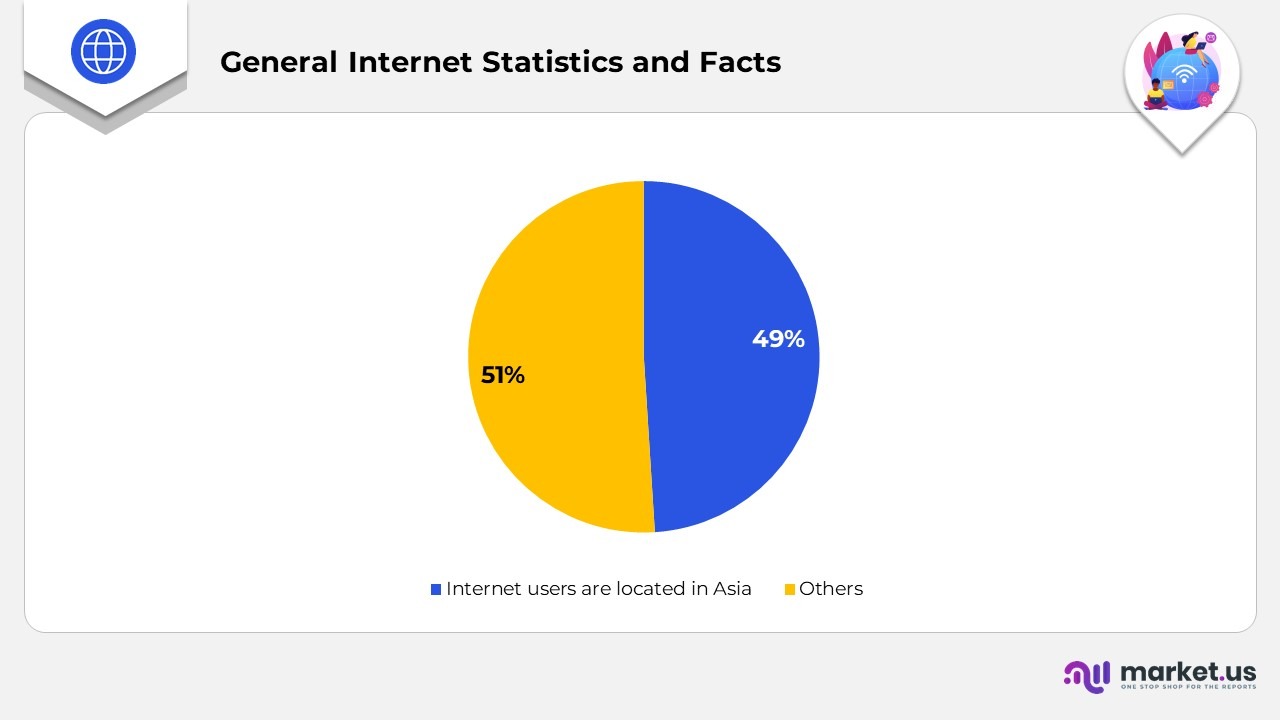
- 49% of these internet users are located in Asia.
- Europe represents 16.8% of the total internet user base.
- In North America, 88.1% of the population utilises the internet.
- By January 2020, the number of websites exceeded 1.74 billion.
- Globally, there are approximately 7 billion Google searches conducted each day.
- Automated source searches account for 56% of all internet traffic.
- As of the third quarter of 2019, nearly 360 million domain names had been registered.
- Only 48.2% of internet traffic is generated by human users; the remainder is attributed to bots.
- Worldwide, internet penetration is estimated to be around 56%.
Internet Usage Statistics
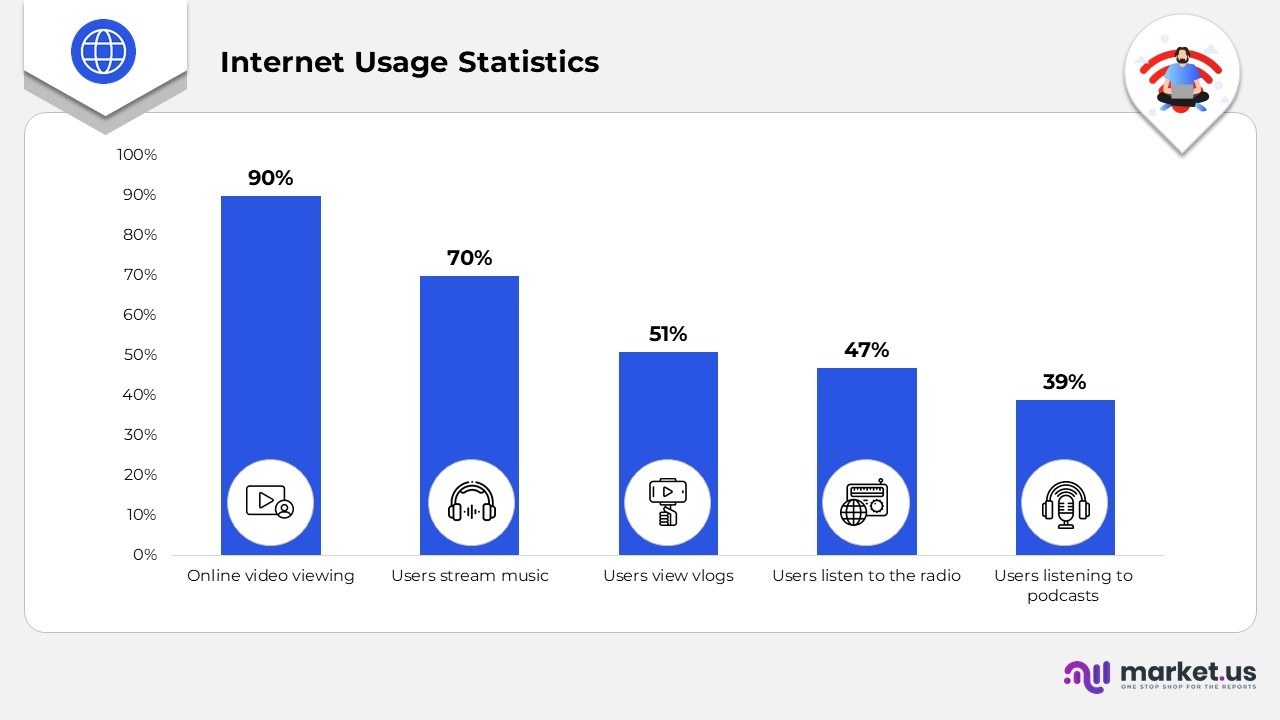
- 90% of internet users engage in online video viewing.
- 70% of internet users stream music.
- 51% of individuals utilize the internet to view vlogs.
- 47% of the global population accesses the internet to listen to the radio.
- 39% of individuals listen to podcasts through the internet.
- By the year 2000, three hundred 61 million people had internet access worldwide.
- Currently, 57.3% of the global population has internet access.
- Africa is experiencing the most rapid growth in its online population.
- On average, users spend 6 hours and 30 minutes online each day.
- Google Chrome commands a 62% share of the internet browser market.
Mobile Internet Statistics
- There are 3.9 billion distinct mobile internet users.
- Approximately 5.1 billion individuals possess a mobile phone, indicating that 75% of mobile users are utilising the internet.
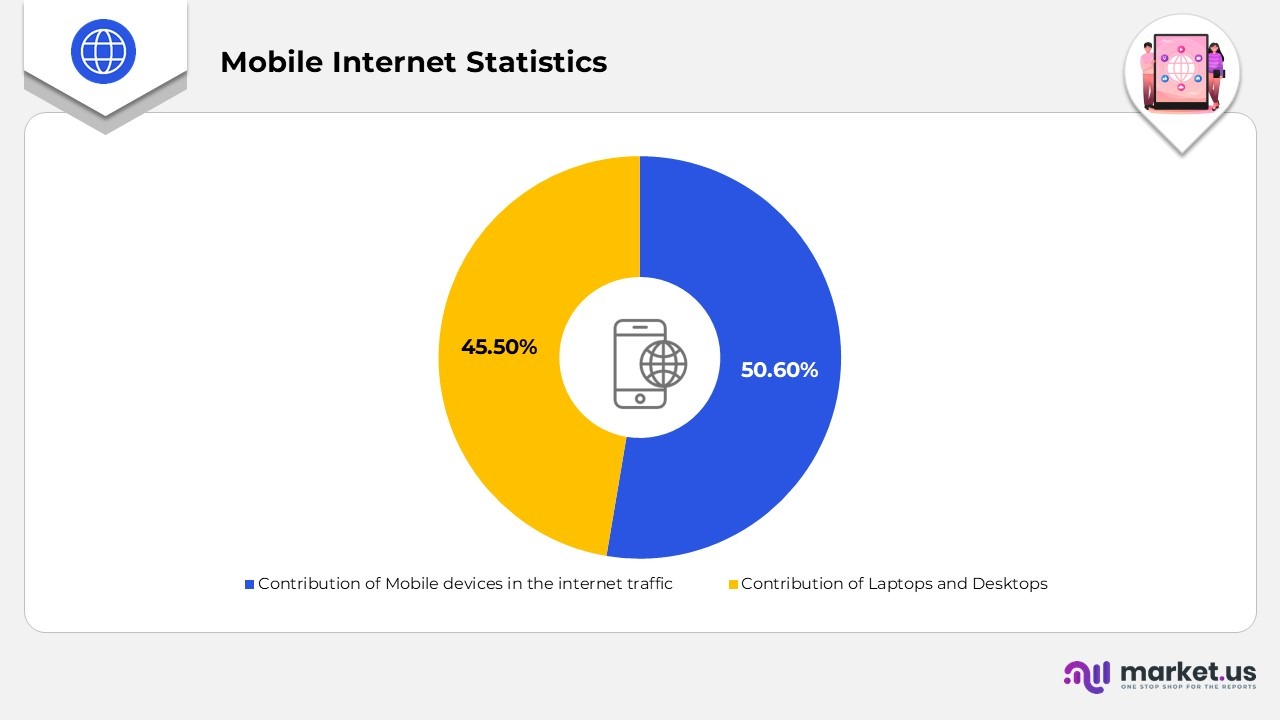
- Mobile devices contribute to 50.6% of internet traffic.
- Laptops and desktop computers represent about 45.5% of internet users.
- Between 2018 and 2019, mobile internet connection speeds experienced a 19% increase.
- Over 60% of users favour WiFi over mobile internet.
- 80% of internet users have a smartphone.
- On average, a mobile internet user spends 2.8 hours online each day.
- 88% of Facebook users access the platform through the smartphone application.
- 80% of the total time spent on social media occurs on smartphones.
- 75% of smartphone owners in the United States check their emails on their devices.
eCommerce Internet Statistics:
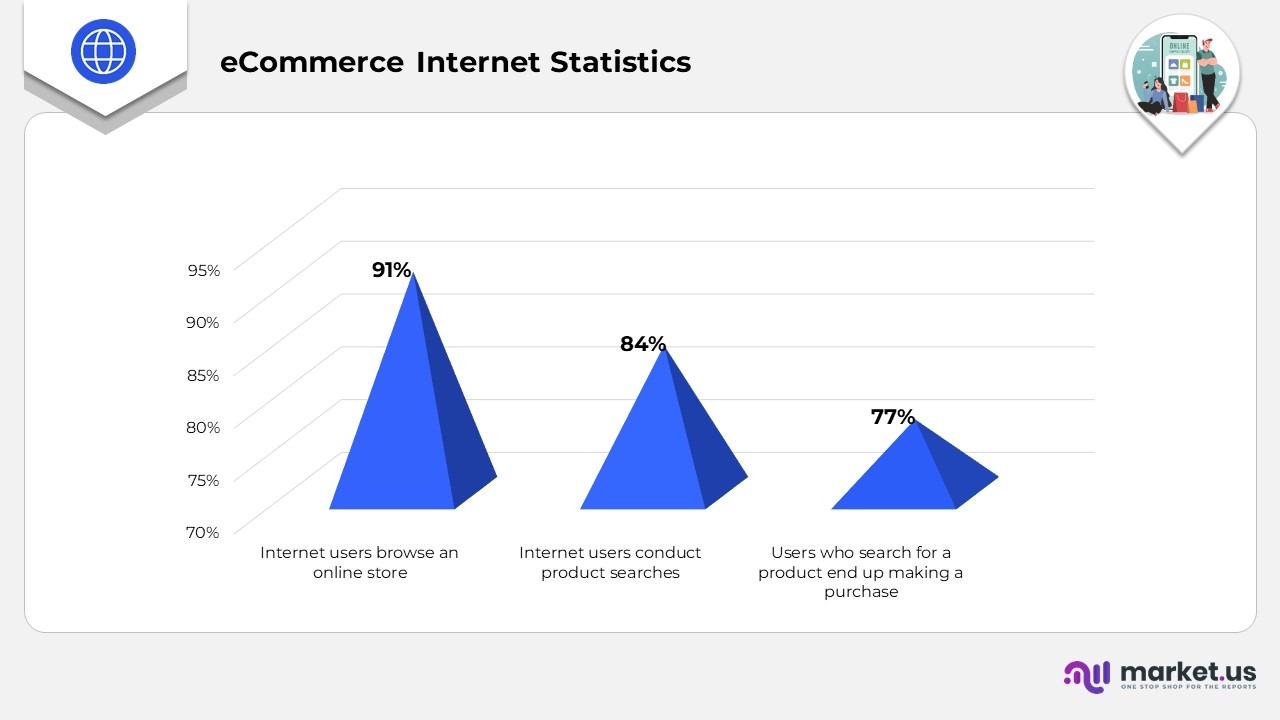
- 91% of internet users browse an online store.
- 84% of internet users conduct product searches.
- 77% of users who search for a product end up making a purchase.
- The typical internet user spends more than two hours daily on social media.
- E-Commerce retail revenues were anticipated to reach £3.33 trillion in 2020.
- China is projected to generate £1.54 trillion in eCommerce sales this year.
- 50% of mobile ad clicks occur by accident.
- 70% of individuals show a dislike for mobile advertisements.
- 32% of internet users indicate they would share a native advertisement.
- 18% of total retail eCommerce sales originate from the UK.
Internet Statistics Worldwide
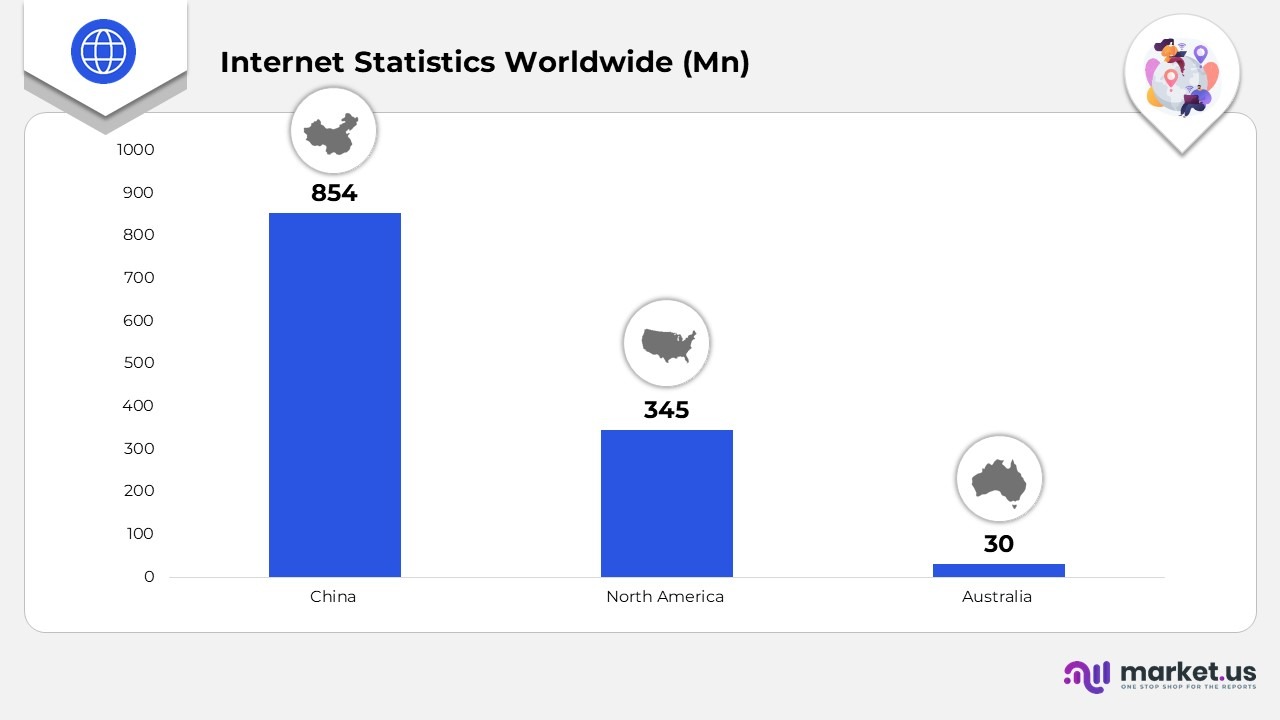
- China boasts 854 million internet users.
- An impressive 99.1% of these users access the internet through mobile devices.
- In the United States, 81% of adults are online daily.
- Fewer than 8% of the U.S. population does not browse the internet on a daily basis.
- A significant 86% of Americans connect to the internet using mobile devices.
- North America is home to 345 million internet users.
- Almost half of American adults aged 18-29 go online every day.
- Australia has nearly 30 million internet users.
- In Norway, 96% of the population has used the internet in the past three months.
Statistics of Internet Technology
- VPN services are predominantly utilized in Asia and the Middle East.
- Each day, 30,000 websites fall victim to hacking.
- Certain hacking incidents can occur in under 5 seconds.
- Half of the individuals aged 14 to 15 are dependent on the internet.
Internet Users by Country
- Among the 7.77 billion individuals globally, approximately 4.54 billion possess an active internet connection. This indicates that roughly 58.4% of the global population has internet access.
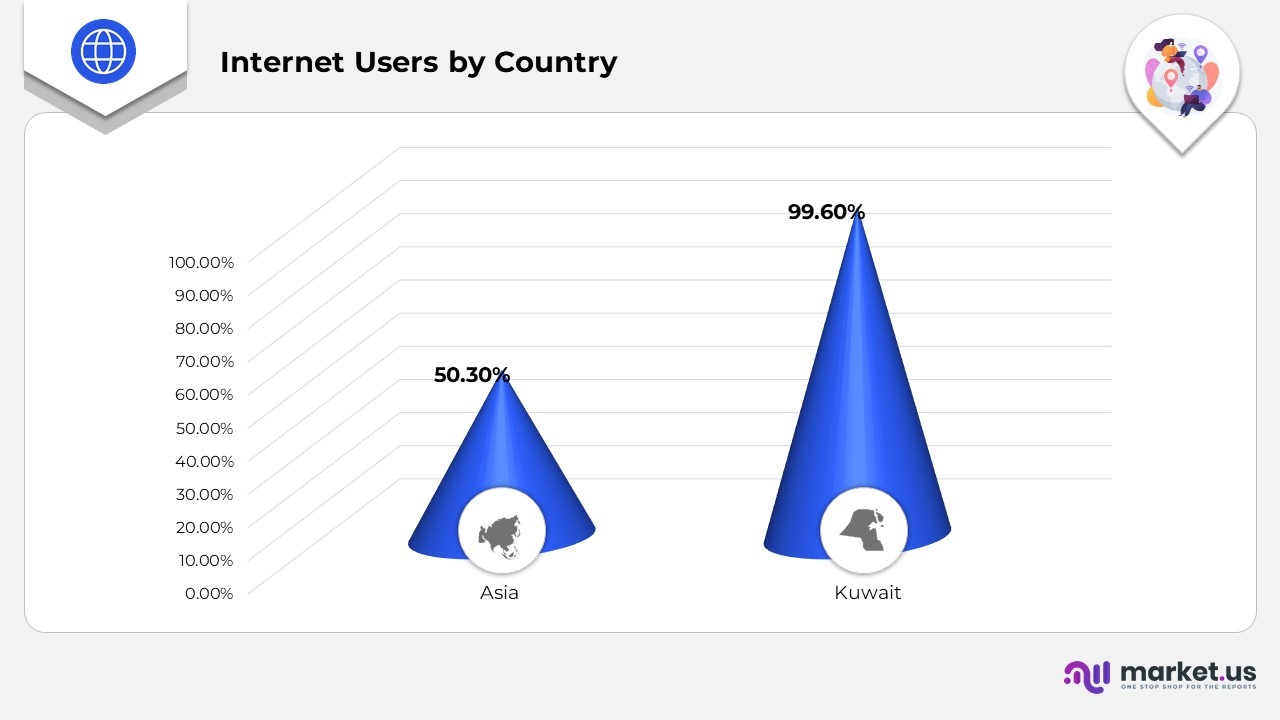
- Asia represents the largest segment of internet users worldwide, with 50.3% of its total population enjoying internet connectivity.
- Kuwait leads the world in internet user penetration, boasting a remarkable 99.6%.
- In the United States, there are 293 million internet users.
- In the US, nearly all age groups have access to the internet. Nevertheless, the younger demographic tends to spend more time online.
Web Hosting Statistics
- The initial web server was the CERN HTTPd, developed by Tim Berners-Lee.
- Among the leading 10 hosting providers in India, GoDaddy stands out as the most favoured web hosting service, followed by Amazon, and subsequently the Endurance Group, which is the parent organisation of HostGator, Bluehost, and several others.
- In the United States, 42.8% of all web servers are located.
- There exists a total of 1.75 billion websites.
- Currently, only 59.9% of all websites are utilising HTTPS, while the remainder continues to operate on HTTP/2.
- English is the predominant language found on 59.3% of all websites, followed by Russian at 8.4% and Spanish at 4.2%.
- On average, the transfer size for a website is 1957.8 KB for desktop versions and 1791.9 KB for mobile versions.
- A mobile page typically requires 9.3 seconds to load on average.
Internet Fun Facts
- ARPANET was founded in 1969 and served as the precursor to the Internet.
- The inaugural website was launched on April 6, 1991.
- The internet was included in USA Today’s compilation of the New Seven Wonders.
- In 2010, over 5 million Terabytes of data were recorded on the internet.
- Libya possesses the slowest internet connection globally.
- Every hour, 5,000 new domain names are registered.
- Each day, 100,000 internet domains are removed.
- The highest valuation for internet domains is estimated at £2.4 billion.
Recent Developments
- In 2024, 68% of the global population, equating to 5.5 billion individuals, were connected online, a trend propelled by ongoing growth in nations such as India, where rural internet users, especially women, significantly contribute to this expansion.
- More than 50% of adult internet users engaged with a QR code in 2024, with the highest usage rates observed in Asia and Latin America; however, older age groups (35-54) were more inclined to utilize them compared to their younger counterparts.
- A record-breaking 296 internet shutdowns were recorded across 54 countries in 2024, exceeding the total from the previous year.
Internet Future Predictions
- By the year 2030, it is forecasted that artificial intelligence will add more than $15.7 trillion to the worldwide economy. Automation and predictive analytics are expected to transform industries from healthcare to manufacturing.
- Additionally, the online education sector is set for considerable expansion, with estimates indicating it may attain a value of $1,124.79 billion by 2030.
Conclusion
The analysis of internet statistics indicates that global internet usage is on the rise, with more than 5.3 billion users recorded in early 2024, representing 66.2% of the global population, predominantly accessed through mobile devices. However, despite this increase, notable disparities in internet penetration remain, influenced by factors such as geography, gender, age, and income levels. The influence of the internet is profound, linking billions of individuals, facilitating communication, and propelling the digital economy, while simultaneously raising issues related to cybersecurity and the need for responsible usage.