


Report Overview
Global Smart Parking Systems Market size is expected to be worth around USD 66.42 Billion by 2035 from USD 10.44 Billion in 2025, growing at a CAGR of 20.30% during the forecast period 2026 to 2035. Operators and cities treat parking as a connected infrastructure layer rather than a passive real-estate asset. Therefore, capital shifts toward sensors, guidance software, and managed services that convert occupancy data into recurring revenue.
Smart parking systems combine hardware sensors, cameras, meters, analytics software, and engineering services that detect occupancy and guide drivers in real time. The stack covers off-street lots, on-street bays, garages, and multi-use commercial sites. Buyers span commercial facility owners, municipalities, transit hubs, and residential complexes that need lower search time and higher bay utilization.
Key Takeaways
- The market reaches USD 10.44 Billion in 2025 and USD 66.42 Billion by 2035 at a CAGR of 20.30%.
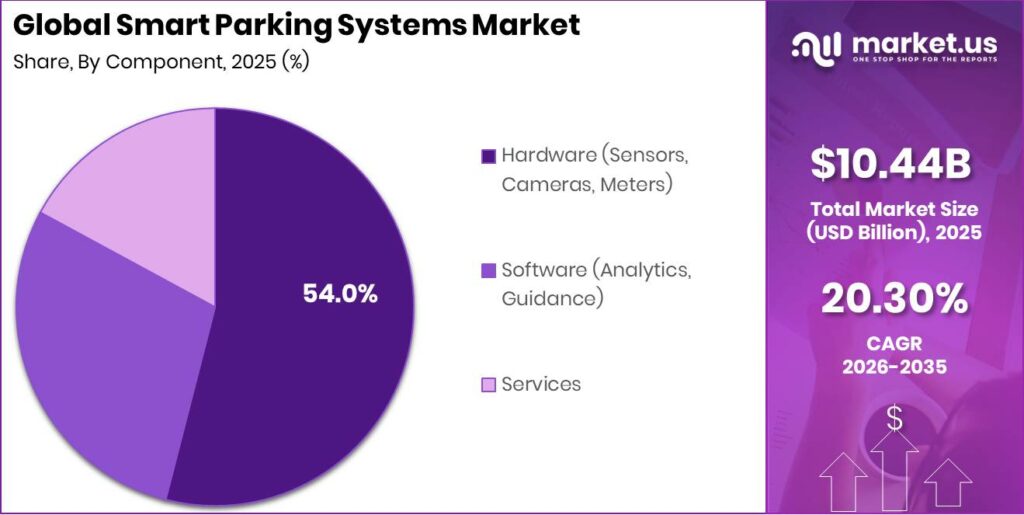
- Hardware leads By Component with a 54.00% share, while software grows fastest.
- Smart Meters lead By Hardware with a 42.00% share; Cameras and LPRs grow fastest.
- Parking Guidance System leads By Software with a 77.10% share; Analytics Solutions grow fastest.
- Engineering Service leads By Service with a 60.50% share; Mobile App Parking Service grows fastest.
- Off-Street leads By Type with a 57.85% share; On-Street grows fastest.
- Commercial Facilities lead By Application with a 43.50% share; Government and Municipalities grow fastest.
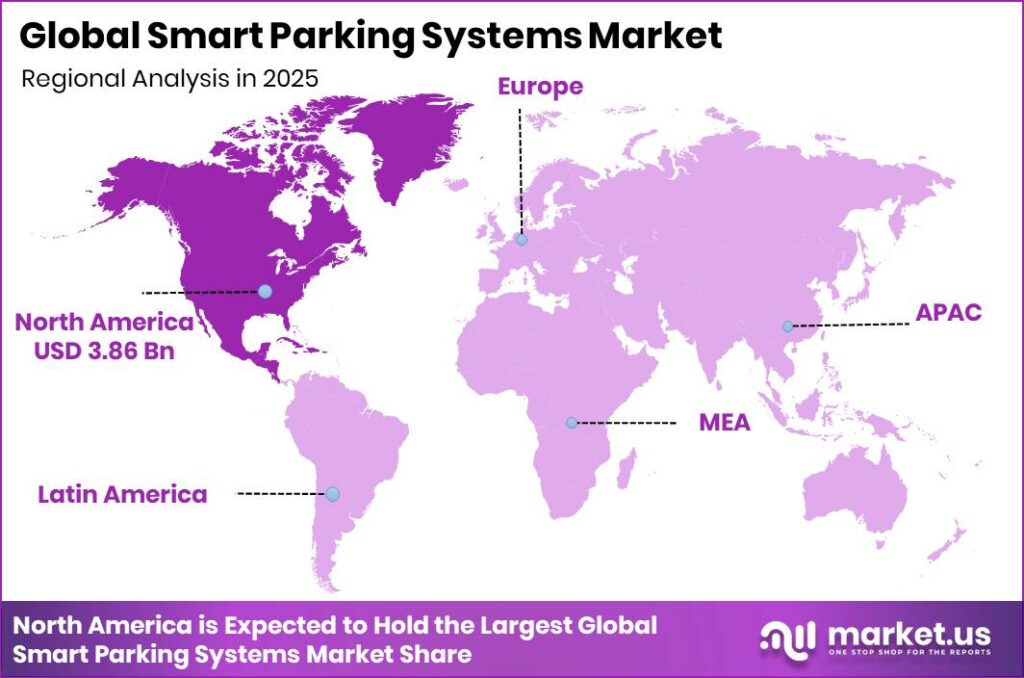
- North America leads with a 37.00% share valued at USD 3.86 Billion.
Government smart-city budgets convert parking from one-off hardware buys into multi-year software and service contracts. India’s PM e-Bus Sewa framework and September 2024 EV charging rules push instrumented bays at public hubs. This means vendors win city-scale deals instead of lot-by-lot sales. End-use growth in municipal mobility programs directly lifts demand for sensors and guidance platforms that cut cruising time.
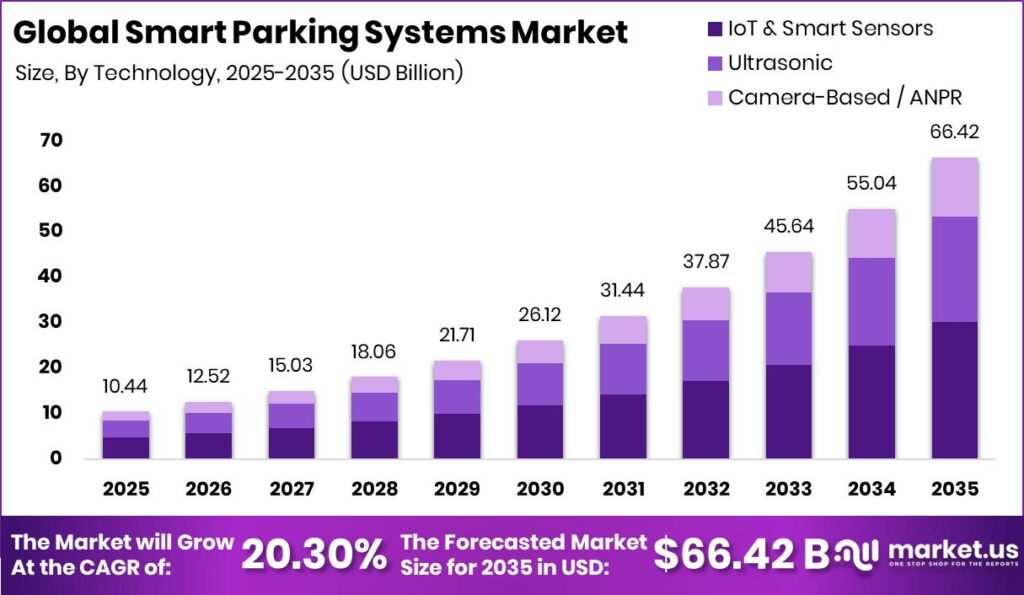
As per our research, a 2025 parking-management study reported a 29% cut in vehicle waiting time after system rollout. This reduction frees curb capacity and supports higher throughput without new concrete. Operators that prove wait-time cuts win budget renewals faster than pure hardware suppliers. Consequently, software and analytics attach rates rise inside the same procurement cycle.
Data from the same 2025 study shows vehicle idle time fell by nearly 30% after deployment. Lower idle time cuts emissions and strengthens the political case for more CapEx. December 2025 saw GoParkEasy introduce its web platform for digital discovery, booking, and payment. This signals that digital payment and booking layers now travel with core sensing in new city pilots.
Component Analysis
Hardware (Sensors, Cameras, Meters) dominates with 54.00% due to bay-level physical sensing needs.
In 2025, Hardware (Sensors, Cameras, Meters) held a dominant market position in the By Component segment of Smart Parking Systems Market, with a 54.00% share. Cities still must instrument each bay before software can monetize occupancy. GSMA data shows global IoT connections in transportation surpassed 500 million active endpoints in 2024. Vendors that bundle durable sensors with multi-year maintenance lock in high-margin service renewals after the first install.
Software (Analytics, Guidance) is the fastest-growing component because operators need dynamic pricing and real-time bay assignment after sensors are live. Industry tracking points to more than 600 million transportation IoT endpoints by 2027, giving software a denser data feed. This creates room for subscription analytics that lift revenue per bay without new civil works. Buyers favor vendors who open APIs to navigation and payment apps.
Services cover engineering, integration, and ongoing support that turn hardware and software into working city systems. Municipal buyers rarely staff deep IoT teams, so external engineering closes the skills gap. Barcelona’s 2024 rollout of 6,500 U-SPOT wireless sensors shows how large service-heavy deployments scale once funding clears. Firms that own commissioning and SLA delivery protect margins when hardware prices fall.
Hardware Analysis
Smart Meters dominates with 42.00% due to payment capture at the curb.
In 2025, Smart Meters held a dominant market position in the By Hardware segment of Smart Parking Systems Market, with a 42.00% share. Meters remain the primary cash and compliance node for on-street revenue collection. Contactless and app-linked meters cut cash handling cost for cities under fiscal pressure. Suppliers that add remote tariff updates win multi-year municipal framework contracts.
Cameras and LPRs grow fastest because vision systems cover multiple bays per unit and support enforcement without per-bay magnets. July 2025 saw Parkomate launch an AI smart parking ecosystem with vision cameras and wireless sensors. Peer-reviewed 2025 prototypes reached 95% license-plate recognition accuracy in daylight conditions. This means camera-led stacks can lower per-bay CapEx while feeding both guidance and fine collection.
Pucks, or wireless sensors, embed in the pavement and stream occupancy over LPWAN links for dense on-street grids. They avoid trenching costs that block wired installs in older streets. Operators use pucks where visual occlusion limits pure camera coverage. Vendors that extend battery life and range reduce truck-roll frequency and protect service margins.
Signage and parking gates close the hardware stack by directing drivers and controlling access at lot entries. Dynamic LED signs convert backend occupancy data into curb-level instructions drivers follow. Gates remain essential in paid garages where ticketless entry raises throughput. Signage, gates, and remaining hardware lines hold the residual share collectively as cities complete full-stack rollouts.
Software Analysis
Parking Guidance System dominates with 77.10% due to real-time bay direction value.
In 2025, Parking Guidance System held a dominant market position in the By Software segment of Smart Parking Systems Market, with a 77.10% share. Guidance apps and lot displays cut search loops that waste fuel and staff time. A 2025 Madrid high-fidelity simulation cut mean parking-search time to 6.69 minutes with coordinated assignment versus 19.98 minutes without an app. Platforms that prove search-time cuts become the default layer cities buy first.
Analytics Solutions grow fastest because operators want pricing, utilization, and enforcement insights from the same sensor feed. Analytics turn raw occupancy into dynamic tariffs and forecast occupancy for event days. Cities use these outputs to defend rate changes with transparent utilization proof. Vendors that productize analytics as SaaS raise recurring revenue faster than one-time guidance licenses.
Service Analysis
Engineering Service dominates with 60.50% due to complex multi-vendor integration work.
In 2025, Engineering Service held a dominant market position in the By Service segment of Smart Parking Systems Market, with a 60.50% share. Deployments mix sensors, cameras, gates, networks, and payment rails that need certified integration. Municipal RFPs often score engineering depth as heavily as unit price. Firms that own design-build and commissioning capture multi-year change-order revenue after go-live.
Mobile App Parking Service grows fastest as drivers expect discovery, booking, and payment inside one phone flow. December 2025 platform launches show digital booking is now a baseline city expectation. Apps also feed anonymized demand data back into pricing engines. Operators that own the consumer app reduce dependence on third-party aggregators and keep session fees in-house.
Consulting Service helps cities design pricing, enforcement, and data-governance models before large CapEx lands. World Bank urban transport guidance stresses demand analysis, time-of-day assignment, pricing, and enforcement as four linked steps. Consultants who embed those steps into RFPs shape vendor shortlists early. Consulting plus residual service lines hold the remaining share as programs mature past first install.
Type Analysis
Off-Street dominates with 57.85% due to controlled lot and garage environments.
In 2025, Off-Street held a dominant market position in the By Type segment of Smart Parking Systems Market, with a 57.85% share. Closed lots and structures allow denser camera coverage and simpler power runs than open curbs. Commercial owners fund upgrades when utilization gains offset sensor CapEx within a few years. Vendors that specialize in garage guidance and ticketless entry win chain-level rollouts across malls and offices.
On-Street is the fastest-growing type because cities target curb congestion where search traffic is most visible to voters. Wireless pucks and LPR cameras avoid full street reconstruction. A 2025 study linked smart parking management to a 34% drop in queue lengths on critical corridors. Curbside programs that publish those flow gains unlock the next wave of smart-city grants.
Garage Parking focuses on multi-level structures that need level-by-level occupancy and indoor wayfinding. Lot Parking covers surface facilities at retail and campuses with lower structural complexity. Both remain important for private operators who already control access gates. Garage Parking and Lot Parking hold the residual share collectively inside the broader off-street and hybrid footprints.
Application Analysis
Commercial Facilities dominates with 43.50% due to mall and office revenue pressure.
In 2025, Commercial Facilities held a dominant market position in the By Application segment of Smart Parking Systems Market, with a 43.50% share. Retail and office owners treat parking as a customer experience lever that affects dwell time and lease appeal. Guidance and app payment reduce entry queues that drive shoppers away. Portfolio owners standardize one vendor stack to cut multi-site operating cost.
Government and Municipalities grow fastest as smart-city capital funds curb sensors, enforcement cameras, and open data portals. Centralized city procurement lowers vendor CAC versus private lot-by-lot sales. Public programs also mandate EV-ready instrumented bays under recent power ministry rules. Suppliers aligned to municipal standards capture long framework agreements with predictable renewal cash flow.
Transport Transit Hubs need high-turnover bay management tied to rail and bus schedules. Residential Complexes adopt shared visitor parking apps and ANPR entry for gated communities. Both applications expand as mixed-use districts densify. Transport Transit Hubs and Residential Complexes hold the remaining share collectively as cities and developers complete multi-use mobility plans.
Key Market Segments
By Component
- Hardware (Sensors, Cameras, Meters)
- Software (Analytics, Guidance)
- Services
By Hardware
- Smart Meters
- Cameras & LPRs
- Pucks (Wireless Sensors)
- Signage
- Parking Gates
By Software
- Parking Guidance System
- Analytics Solutions
By Service
- Engineering Service
- Mobile App Parking Service
- Consulting Service
By Type
- Off-Street
- On-Street
- Garage Parking
- Lot Parking
By Application
- Commercial Facilities
- Government & Municipalities
- Transport Transit Hubs
- Residential Complexes
Regional Analysis
North America Dominates the Smart Parking Systems Market with a Market Share of 37.00%, Valued at USD 3.86 Billion
North America leads on federal and municipal smart-city grants that fund sensors, LPR enforcement, and app payment at scale. Dense metro congestion makes wait-time and utilization KPIs easy to sell to city councils. Private garage chains also standardize guidance software across multi-state portfolios. Vendors with US and Canadian service desks convert pilots into multi-year managed contracts faster than import-only rivals.
Asia Pacific is the fastest-growing region as India and other urban markets embed instrumented bays into national mobility and EV rules. Large city CapEx pipelines favor hardware-plus-service bundles over pure software imports. Local manufacturing of sensors and cameras also shortens delivery cycles. Suppliers that localize payment rails and language support win municipal RFPs against global brands that stay cloud-only.
Europe advances under privacy-aware camera rules and strong off-street commercial demand in major hubs. Latin America and Middle East and Africa add projects where new smart-city districts fund curb and lot systems from scratch. In 2026, CYSEN expanded sensor platforms for curbside counting, enforcement, and stadium operations. This creates fresh demand pockets for real-time vehicle data capture outside the two largest regions.
Key Regions and Countries
North America
- US
- Canada
Europe
- Germany
- France
- The UK
- Spain
- Italy
- Rest of Europe
Asia Pacific
- China
- Japan
- South Korea
- India
- Australia
- Rest of APAC
Latin America
- Brazil
- Mexico
- Rest of Latin America
Middle East and Africa
- GCC
- South Africa
- Rest of MEA
Market Dynamics
Market Opportunity Analysis - On-street coordination, underused bays, and research density open clear entry points
On-Street remains the fastest type yet still under-automated relative to closed lots. Coordinated assignment in a 2025 Madrid simulation cut successful drivers’ mean search time to 6.69 minutes from 19.98 minutes, a 66.5% reduction. New entrants that sell allocation software atop existing sensors can win without owning full hardware. This path suits app-first firms that partner with meter incumbents.
Commercial Facilities already lead applications, but many secondary retail lots still lack utilization analytics. A 2025 study recorded a 21% gain in parking-space utilization after system deployment. Operators who publish utilization lifts justify higher session fees and landlord shared-savings deals. Regional specialists can target mid-size mall portfolios ignored by global full-stack vendors.
Government and Municipalities grow fastest, yet Tier-2 and Tier-3 cities lag capital-city rollouts. Queue lengths fell 34% on evaluated corridors after smart parking management, a KPI smaller cities can copy. Modular puck-plus-app packages priced for smaller budgets fit these white spaces. Early movers who localize payment and language lock multi-year municipal frameworks before nationals arrive.
Research intensity signals a deep vendor pipeline for niche algorithms. A 2026 peer-reviewed review assessed 124 academic papers on smart-parking technologies. Startups that productize validated detection models can license into hardware OEMs rather than fight city RFPs alone. Investors should track software attach rates in on-street and municipal deals where hardware is already funded.
Technology and Innovation Landscape - Computer vision and edge AI redefine occupancy accuracy and cost
Computer-vision occupancy models now reach production-grade accuracy for empty and occupied bays. A 2025 AI parking system achieved 92.5% overall accuracy on space status. High accuracy lets operators replace some per-bay magnet sensors with multi-bay cameras. Manufacturers that ship vision kits with proven field accuracy cut civil-works CapEx for buyers.
Precision and recall metrics show classification quality that enforcement teams can trust. The same 2025 system reached 94.3% precision and 91.0% recall on parking-space conditions. Reliable positive calls reduce false occupancy that frustrates drivers and staff. Software vendors who publish these metrics win RFPs that score detection quality explicitly.
Real-time throughput matters for live guidance and LPR gates. The 2025 system processed video at 28 frames per second for continuous monitoring. Edge devices that sustain that rate avoid cloud lag in busy garages. Hardware partners that certify camera-plus-edge bundles shorten integration cycles for city IT teams.
Optimized deep-learning detectors further raise edge performance on automotive-class boards. A 2025 model hit 33.7 frames per second on an NVIDIA Jetson AGX Xavier with TensorRT. Higher edge FPS supports denser camera grids without larger data-center spend. Investors should favor roadmaps that pair model gains with lower power and simpler dual-source chips.
Drivers
Municipal smart-city budgets are the strongest near-term push because they turn parking into a funded multi-year procurement pipeline. National urban-mobility programs anchor demand even when private CapEx slows. India’s Ministry of Housing and Urban Affairs directs cities under the 2023 PM e-Bus Sewa framework to embed sensor-managed bays. The Ministry of Power’s September 2024 EV charging rules require instrumented parking at workplaces and public hubs.
This pipeline supports expansion near a 20.30% compound rate, with North America near 35.7% of 2025 activity on federal smart-city grants. Centralized city buying cuts vendor customer-acquisition cost versus lot-by-lot deals. Revenue mix tilts toward software and analytics subscriptions with higher margins. Sensor pilots that cut cruising time by up to 30% keep political support for fresh CapEx alive.
| Driver | (~) % Impact on CAGR Forecast | Geographic Relevance | Impact Timeline |
|---|---|---|---|
| Government smart-city capital deployment | +3.9% | Asia-Pacific, North America, Middle East | Short term (2 years or less) |
| IoT sensor cost decline & LPWAN densification | +3.1% | Global | Short term (2 years or less) |
| AI-driven dynamic pricing monetization | +2.6% | North America, Western Europe | Medium term (2 to 4 years) |
| Rising urban vehicle density & congestion cost | +2.4% | Asia-Pacific, Latin America | Short term (2 years or less) |
| Contactless digital payment penetration | +2.0% | Global | Short term (2 years or less) |
| Mobile app & navigation ecosystem integration | +1.7% | Global | Medium term (2 to 4 years) |
Restraints
High upfront install and retrofit CapEx is the hardest brake because per-bay sensors, gateways, and civil works freeze many legacy lots. Full stacks need magnetic or camera sensors, LPWAN backhaul, and cloud setup that scale cost non-linearly. Operators without centralized funding delay conversion of older facilities. Configuration complexity remains a primary structural barrier to faster adoption.
Tight monetary conditions through 2025 kept municipal and private borrowing costly and stretched payback windows. Off-street operators expanding near a 9.6% pace feel depreciation before subscription revenue matures. As a result, rollouts slip or margins compress against the 20.30% baseline. Modular lower-cost sensors and easier finance terms are required before this drag eases.
| Restraint | (~) % Impact on CAGR Forecast | Geographic Relevance | Impact Timeline |
|---|---|---|---|
| High upfront installation & retrofit CapEx | -3.4% | Global, acute in emerging markets | Short term (2 years or less) |
| Elevated interest rates constraining municipal financing | -2.5% | North America, Europe | Short term (2 years or less) |
| Fragmented municipal procurement & approval delays | -1.9% | Asia-Pacific, Latin America | Medium term (2 to 4 years) |
| Data-privacy & surveillance regulatory bans | -1.6% | European Union | Medium term (2 to 4 years) |
| Low willingness-to-pay in price-sensitive regions | -1.3% | South Asia, Africa | Medium term (2 to 4 years) |
Challenges
Sensor component supply-chain fragility caps how fast the market can scale even when demand is strong. Magnetic, ultrasonic, and camera modules concentrate in Asia-Pacific plants tied to automotive-grade chips. Delivery delays of roughly 6 months hit major parking-sensor inputs across 2024 and 2025. Project timelines slip and landed unit costs rise for city contractors.
Corporate response requires dual-sourcing, buffer stock, and simpler chipset designs that carry working-capital cost. Those steps modestly dilute hardware margins but protect recurring software revenue from single-source shocks. Legacy integration, cybersecurity, talent gaps, and dense-urban RF noise add further friction. Firms that solve interoperability and secure data paths open new managed-service revenue while others stall at pilot stage.
| Challenge | (~) % CAGR Friction Drag | Geographic Relevance | Mitigation Horizon |
|---|---|---|---|
| Sensor component supply-chain fragility | -2.2% | Global, sourced from Asia-Pacific | Medium term (2 to 4 years) |
| Legacy-system integration & interoperability | -2.0% | Global | Long term (4 years or more) |
| Cybersecurity & data-breach exposure | -1.7% | North America, Europe | Long term (4 years or more) |
| Skilled IoT & data-engineering talent deficit | -1.4% | Emerging markets, Asia-Pacific | Medium term (2 to 4 years) |
| Network reliability in dense urban RF environments | -1.1% | Global | Medium term (2 to 4 years) |
Opportunities
EV-charging bay integration is the highest-value white space because sensing plus metered energy remains largely unbundled. September 2024 power ministry rules made instrumented charging bays and open OCPP or OCPI links a clearer requirement. Each converted bay can add per-kWh margin and demand-response income on top of the parking fee. Early movers who fuse reservation, sensing, and energy into one contract defend lifetime revenue per bay.
IEA tracking shows more than 1.3 million public charging points were added worldwide in 2024, over 30% year growth. That charger wave needs occupancy-aware parking software at the same sites. Dynamic pricing and data sales to insurers or retailers add further upside above the 20.30% baseline. Tier-2 city white space, V2I reservation layers, and operator roll-ups widen the same platform opportunity for first movers.
| Opportunity | (~) % Potential CAGR Upside | Geographic Relevance | Execution Window |
|---|---|---|---|
| EV-charging bay integration & energy monetization | +3.2% | India, Europe, North America | Medium term (2 to 4 years) |
| Parking-data monetization to insurers & retailers | +2.4% | North America, Western Europe | Medium term (2 to 4 years) |
| Tier-2 & Tier-3 city white-space penetration | +2.1% | Asia-Pacific, Latin America, Africa | Long term (4 years or more) |
| V2I & autonomous-vehicle reservation layer | +1.9% | North America, East Asia | Long term (4 years or more) |
| Fragmented-operator M&A roll-up consolidation | +1.6% | Europe, North America | Medium term (2 to 4 years) |
Key Company Insights
Deteq Solutions positions around integrated detection and guidance stacks that cities can deploy without multi-vendor glue work. A 2025 study found average vehicle speed in critical corridors rose 17% after smart parking management went live. Firms that document corridor-speed gains strengthen municipal ROI cases. This approach favors full-stack suppliers over pure sensor resellers in competitive RFPs.
Flowbird Group leans on meters, payments, and curb management where cities already trust its installed base. A 2025 vision-plus-sensor prototype hit 95% daylight LPR accuracy, 90% in low light, and 93% at a 45-degree plate angle. Payment-plus-enforcement accuracy reduces leakage that erodes municipal parking income. Deep meter networks create a distribution edge smaller camera-only entrants struggle to match.
Key Players
- Deteq Solutions
- Flowbird Group
- INDECT Electronics & Distribution GmbH
- Kapsch TrafficCom AG
- Libelium Comunicaciones Distribuidas S.L.
- Meter Feeder, Inc.
- Mindteck
- Municipal Parking Services, Inc.
- Nedap N.V.
- Park Assist
- ParkHelp Technologies
- ParkJockey
- ParkMe Inc.
- Robert Bosch GmbH
- Siemens AG
- SKIDATA AG
- Smart Parking Ltd.
- SpotHero, Inc.
- SWARCO AG
- Urbiotica, S.L.
- Cisco Systems, Inc.
- Amano McGann, Inc.
- ParkMobile, LLC
- ABB Ltd.
- Aisin Corporation
- Amano Corporation
- CivicSmart, Inc.
- Cleverciti Systems GmbH
- Conduent Incorporated
- Continental AG
- Cubic Corporation
- Delphi Technologies
- Digiteum LLC
- Happiest Minds Technologies Limited
- hIOTron
- Honeywell International Inc.
- Huawei Technologies Co., Ltd.
- IEM SA
- INRIX, Inc.
- Intercomp S.p.A.
- International Business Machines Corporation
- IPS Group, Inc.
- JustPark Parking Limited
- Klaus Multiparking GmbH
- Larsen & Toubro Limited
- LeddarTech Inc.
- Oracle Corporation
- Parklio
- EasyPark AB
- Qualcomm Technologies, Inc.
- Robotic Parking Systems, Inc.
- SmartParkZone, S.L.
- Stanley Robotics SAS
- Streetline
- Thales Group
- TKH Group N.V.
- Total Parking Solutions Ltd.
- UKCPS Ltd.
- Wohr Parking Systems Pvt. Ltd.
- Zhejiang Dahua Technology Co., Ltd.
- ZKTeco Co., Ltd.
Recent Developments
- May 2025: Fybr launched the 4th-generation FybrPuck wireless parking sensor with improved occupancy detection accuracy, extended connectivity range, and enhanced real-time analytics for smart city and parking operator applications.
- July 2025: Smart Parking Group established Smart Parking AG in Switzerland to expand European operations across ANPR parking management, smart sensors, mobile payment applications, and cloud parking platforms.
- November 2025: GoParkEasy Mobility Pvt. Ltd. was incorporated and moved toward pilot deployment of its digital parking platform combining discovery, availability tracking, booking, and digital payment.
Geopolitical Impact Analysis
Figures from UNCTAD show seaborne trade growth slowing to about 0.5% in 2025 while container trade rises near 1.4%. Suez traffic sat roughly 70% below 2023 levels by May 2025 as ships rerouted around the Cape. Longer routes raise landed cost and lead time for Asian-made parking sensors, cameras, and meter modules. City projects that lack dual-source bills of materials face schedule risk and higher CapEx bids.
Based on trade and policy analysis, the United States applied an average tariff near 2.88% on semiconductor imports in 2024, with broader tariff uncertainty into 2025. IoT sensor and camera boards depend on those chips, so duty swings feed directly into per-bay hardware price. Therefore, vendors with regional assembly or buffer inventory protect municipal delivery SLAs better than pure import models. Buyers should score supply resilience beside unit price in multi-year smart parking awards.
Report Scope
| Report Features | Description |
|---|---|
| Market Value (2025) | USD 10.44 Billion |
| Forecast Revenue (2035) | USD 66.42 Billion |
| CAGR (2026-2035) | 20.30% |
| Base Year for Estimation | 2025 |
| Historic Period | 2020-2024 |
| Forecast Period | 2026-2035 |
| Report Coverage | Revenue Forecast, Market Dynamics, Market Opportunity Analysis, Technology and Innovation Landscape, Competitive Landscape, Recent Developments |
| Segments Covered | By Component (Hardware (Sensors, Cameras, Meters), Software (Analytics, Guidance), Services), By Hardware (Smart Meters, Cameras & LPRs, Pucks (Wireless Sensors), Signage, Parking Gates), By Software (Parking Guidance System, Analytics Solutions), By Service (Engineering Service, Mobile App Parking Service, Consulting Service), By Type (Off-Street, On-Street, Garage Parking, Lot Parking), By Application (Commercial Facilities, Government & Municipalities, Transport Transit Hubs, Residential Complexes) |
| Regional Analysis | North America (US and Canada), Europe (Germany, France, The UK, Spain, Italy, and Rest of Europe), Asia Pacific (China, Japan, South Korea, India, Australia, and Rest of APAC), Latin America (Brazil, Mexico, and Rest of Latin America), Middle East and Africa (GCC, South Africa, and Rest of MEA) |
| Competitive Landscape | Deteq Solutions, Flowbird Group, INDECT Electronics & Distribution GmbH, Kapsch TrafficCom AG, Libelium Comunicaciones Distribuidas S.L., Meter Feeder, Inc., Mindteck, Municipal Parking Services, Inc., Nedap N.V., Park Assist, ParkHelp Technologies, ParkJockey, ParkMe Inc., Robert Bosch GmbH, Siemens AG, SKIDATA AG, Smart Parking Ltd., SpotHero, Inc., SWARCO AG, Urbiotica, S.L., Cisco Systems, Inc., Amano McGann, Inc., ParkMobile, LLC, ABB Ltd., Aisin Corporation, Amano Corporation, CivicSmart, Inc., Cleverciti Systems GmbH, Conduent Incorporated, Continental AG, Cubic Corporation, Delphi Technologies, Digiteum LLC, Happiest Minds Technologies Limited, hIOTron, Honeywell International Inc., Huawei Technologies Co., Ltd., IEM SA, INRIX, Inc., Intercomp S.p.A., International Business Machines Corporation, IPS Group, Inc., JustPark Parking Limited, Klaus Multiparking GmbH, Larsen & Toubro Limited, LeddarTech Inc., Oracle Corporation, Parklio, EasyPark AB, Qualcomm Technologies, Inc., Robotic Parking Systems, Inc., SmartParkZone, S.L., Stanley Robotics SAS, Streetline, Thales Group, TKH Group N.V., Total Parking Solutions Ltd., UKCPS Ltd., Wohr Parking Systems Pvt. Ltd., Zhejiang Dahua Technology Co., Ltd., ZKTeco Co., Ltd. |
| Customization Scope | Customization for segments, region / country-level will be provided. Additional customization can be done based on requirements. |
| Purchase Options | We have three licenses to opt for: Single User License | Multi-User License (Up to 5 Users) | Corporate Use License (Unlimited User and Printable PDF) |





































