Report Overview
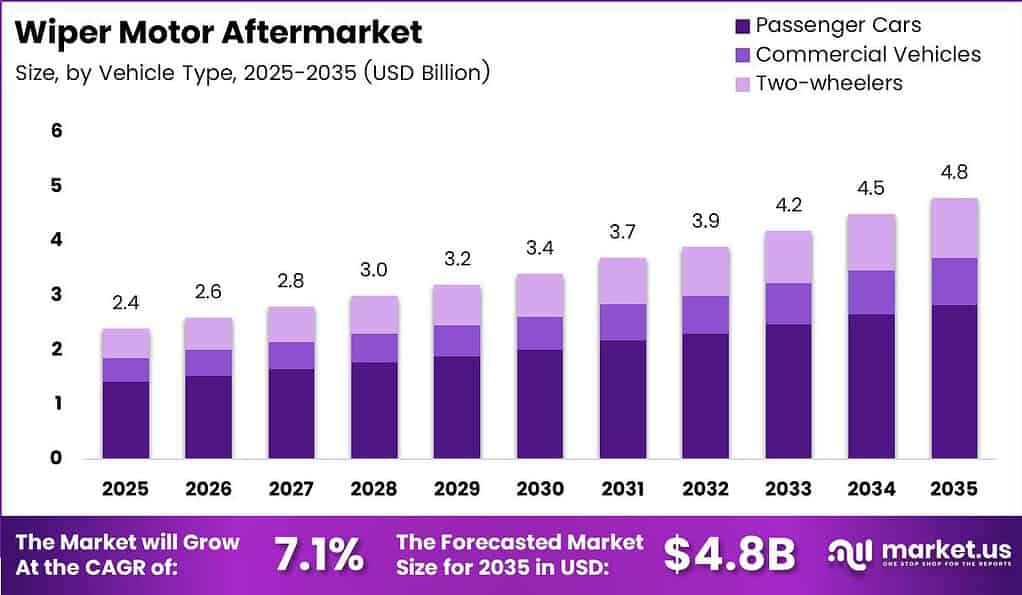
Global Wiper Motor Aftermarket Market size is expected to be worth around USD 4.8 Billion by 2035 from USD 2.4 Billion in 2025, growing at a CAGR of 7.1% during the forecast period 2026 to 2035.
The wiper motor aftermarket covers replacement and remanufactured wiper motor assemblies sold outside the original equipment supply chain. This market serves passenger cars, commercial vehicles, and two-wheelers across authorized dealer networks, independent workshops, online retail platforms, and service centers. Products span brushed and brushless DC motor variants and support both front and rear wiper systems across 12V, 24V, and higher voltage architectures.
As per our research, global vehicle production rose from 92.7 million units in 2024 to 96.4 million units in 2025, a gain of 3.9%. This expanding vehicle parc directly widens the serviceable population for wiper motor replacements. Suppliers with broad vehicle coverage and fast fulfillment will capture the largest share of this growing replacement cycle.
Key Takeaways
- The global wiper motor aftermarket is valued at USD 2.4 Billion in 2025 and is forecast to reach USD 4.8 Billion by 2035 at a CAGR of 7.1%.
- Passenger Cars dominate the Vehicle Type segment with a 58.30% share in 2025.
- Front Wiper Motors lead the Application segment with a 71.20% share in 2025.
- Brushed DC Motors dominate the Motor Type segment with an 82.00% share in 2025.
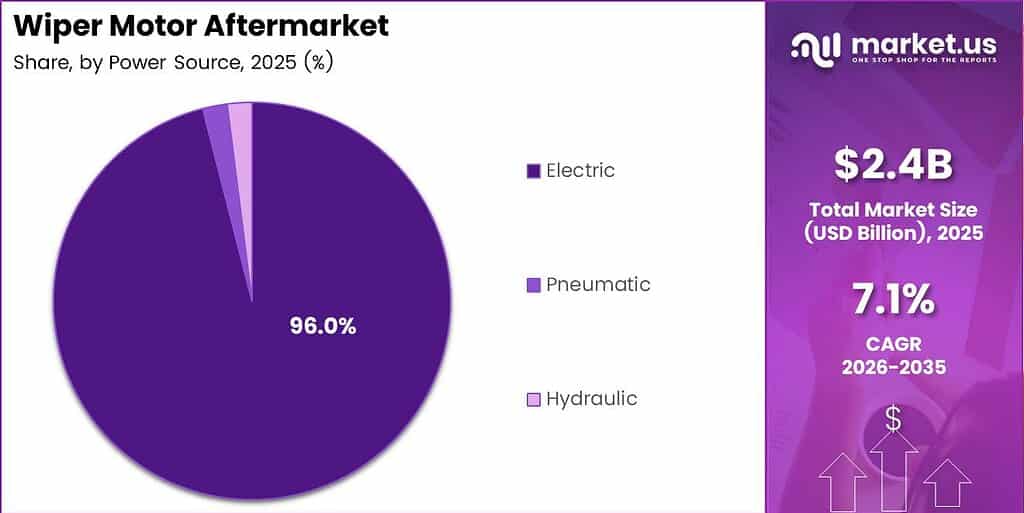
- Electric power source dominates with a 96.00% share in 2025.
- 12V voltage category leads with a 71.80% share in 2025.
- Independent Aftermarket holds a 36.00% share of the Distribution Channel segment in 2025.
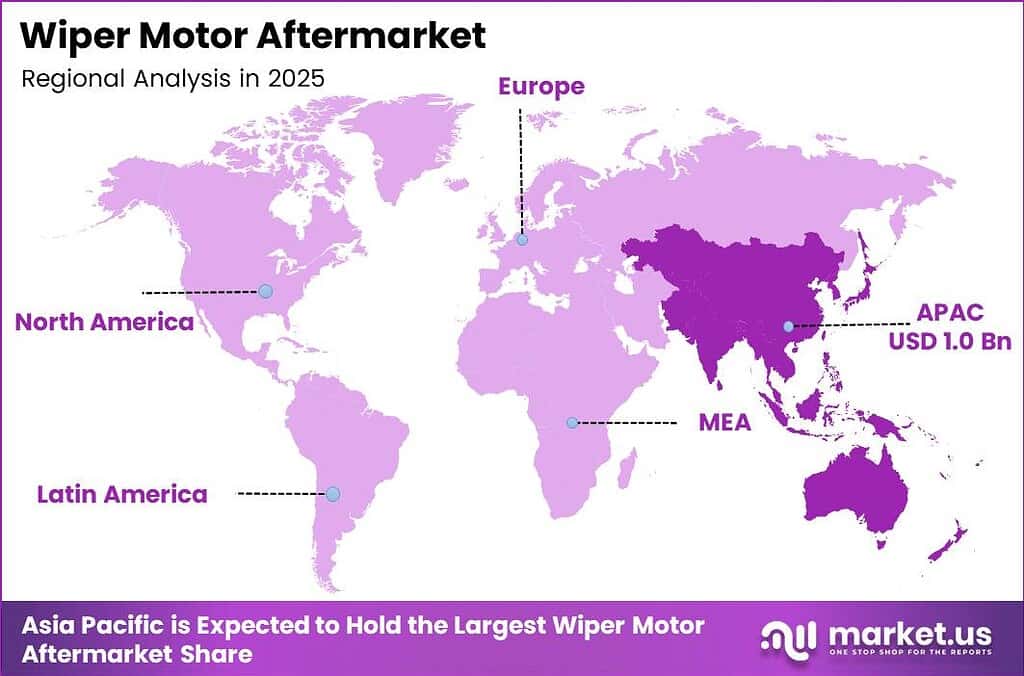
- Asia Pacific is the dominant region with a 40.80% market share, valued at USD 1.00 Billion in 2025.
- Europe is the fastest-growing regional market during the forecast period.
Global vehicle sales rose from 95.3 million units in 2024 to 99.8 million units in 2025, an increase of 4.7%. Higher volumes entering the fleet today become aftermarket demand within 5 to 10 years. This pipeline effect gives distributors and suppliers a clear forward demand signal. World merchandise-trade volume growth is forecast to slow from 4.6% in 2025 to 1.9% in 2026, which signals tighter global logistics conditions that could pressure parts availability and lead times for aftermarket suppliers.
Valeo placed €500 million of green bonds carrying a 4.625% coupon maturing in 2032, signaling that major suppliers are accessing capital markets to fund technology transitions. ZF’s PowerLine transmission production forms part of a $200 million US investment ramping toward 200,000 annual units, reinforcing the shift toward electrified drivetrains. These investments confirm that the supplier base is repositioning capital ahead of electrification-driven demand shifts across commercial and passenger segments.
As per our research, global economic growth is forecast to slow from 2.9% in 2025 to 2.5% in 2026. This deceleration reduces household and fleet spending capacity, which affects deferral rates on non-critical repairs including wiper system replacements. Suppliers that offer competitively priced, high-coverage product lines will be best positioned to hold volume during this slower-growth period.
Type Analysis
Passenger Cars dominates with 58.30% due to largest global vehicle parc and replacement frequency.
In 2025, Passenger Cars held a dominant market position in the By Vehicle Type segment of the Wiper Motor Aftermarket Market, with a 58.30% share. According to the European Automobile Manufacturers Association, the EU passenger-car fleet reached nearly 256 million vehicles in 2024, increasing 1.4% from 2023. This expanding fleet directly extends the replacement addressable market for wiper motors across all age cohorts.
Commercial Vehicles represent a structurally distinct demand layer driven by fleet operators who require reliable wiper performance under extended duty cycles. New EU van registrations reached 742,759 units in the first half of 2026, increasing 1.9%. As reported by the European Automobile Manufacturers Association, approximately 31.1 million vans and 6.2 million trucks were operating on EU roads, each adding to the serviceable aftermarket population for commercial wiper assemblies.
Two-wheelers represent a high-growth sub-segment within the vehicle type breakdown, driven by rapid motorization across South and Southeast Asia. Data from the Society of Indian Automobile Manufacturers shows Indian two-wheeler sales reached 21.7 million units in FY2025-26, increasing 10.7%. This volume growth directly expands the replacement cycle population for two-wheeler wiper systems in one of the world’s largest motorization markets.
Application Analysis
Front Wiper Motors dominates with 71.20% due to universal fitment across all vehicle categories.
In 2025, Front Wiper Motors held a dominant market position in the By Application segment of the Wiper Motor Aftermarket Market, with a 71.20% share. Front wiper systems are legally mandated safety components on every passenger car, van, truck, and bus globally. This regulatory requirement creates a non-discretionary replacement cycle that sustains demand even during periods of broader economic pressure.
Rear Wiper Motors serve a narrower but growing fitment base concentrated in SUVs, crossovers, and hatchbacks. The ongoing SUV and crossover mix shift across North America, Europe, and Asia Pacific gradually expands the rear wiper motor replacement population. Valeo opened its Daegu ADAS-sensor plant following a $56 million investment, reflecting supplier commitment to vehicle platforms where rear wiper systems are standard fitment.
Motor Type Analysis
Brushed DC Motors dominates with 82.00% due to low cost, broad fitment coverage, and workshop familiarity.
In 2025, Brushed DC Motors held a dominant market position in the By Motor Type segment of the Wiper Motor Aftermarket Market, with an 82.00% share. Brushed DC motors remain the standard fitment across the large post-warranty vehicle parc. Their low unit cost, simple electrical interface, and wide availability through independent channels make them the default replacement choice for price-sensitive workshop customers.
Brushless DC Motors hold the remaining share and represent a structurally growing sub-segment as newer vehicle platforms enter the aftermarket cycle. ContiTech committed more than $85 million to its Mount Pleasant, Iowa facility, creating approximately 50 jobs, reflecting investment in component manufacturing aligned with higher-complexity motor architectures. As newer vehicles age out of warranty, brushless motor replacements will represent a growing share of aftermarket demand.
Power Source Analysis
Electric dominates with 96.00% due to universal adoption in modern vehicle electrical architectures.
In 2025, Electric power source held a dominant market position in the By Power Source segment of the Wiper Motor Aftermarket Market, with a 96.00% share. As per our research, a conventional 12-volt vehicle battery powers accessories and controls high-voltage contactors in electrified vehicles, confirming that electric wiper motor operation spans both conventional and electrified drivetrains. This cross-platform compatibility reinforces electric motor dominance across the entire aftermarket replacement cycle.
Pneumatic and Hydraulic power sources collectively hold the remaining 4% share, concentrated in heavy commercial vehicles and off-highway equipment operating in specialized environments. These sub-segments generate lower replacement volumes but command higher unit prices due to application specificity. Suppliers serving these niches benefit from reduced price competition and more predictable fleet-level ordering patterns from commercial operators.
Voltage Analysis
12V dominates with 71.80% due to standard architecture across the dominant passenger car parc.
In 2025, 12V held a dominant market position in the By Voltage segment of the Wiper Motor Aftermarket Market, with a 71.80% share. The 12-volt architecture is the established standard across the global passenger car parc and light commercial vehicle fleet. This near-universal fitment makes 12V wiper motors the highest-volume SKU category for aftermarket distributors and independent workshops globally.
The 24V sub-segment serves the heavy commercial vehicle parc, where higher electrical loads demand a more capable architecture. Based on SAE data, Volvo’s D13 VGT heavy-duty engine uses a 24-volt electrical architecture, illustrating that 24V systems are a structural requirement for high-torque commercial platforms. This creates a distinct and specialized aftermarket sub-segment with separate fitment coverage requirements from 12V products.
The Above 24V sub-segment reflects emerging electrified and off-highway platform requirements. A US Department of Energy off-road vehicle project evaluated two 48-volt systems with peak power near 15 kW, indicating that higher-voltage architectures are entering non-passenger vehicle categories. Suppliers that develop 48V-compatible wiper motor assemblies early will access this technically demanding and margin-accretive sub-segment before competitive saturation occurs.
Distribution Channel Analysis
Independent Aftermarket holds 36.00% due to broad workshop access and competitive pricing advantage.
In 2025, Independent Aftermarket held a significant position in the By Distribution Channel segment of the Wiper Motor Aftermarket Market, with a 36.00% share. Independent workshops and fitment specialists serve the largest share of the post-warranty vehicle parc, where consumers prioritize price and availability over brand alignment. Suppliers with deep catalog coverage and rapid fulfillment to independent channels are best positioned to capture this replacement demand.
Authorized Dealers, Online Retailers, and Workshops and Service Centers collectively hold the remaining distribution share. Online retail is a structurally growing channel as digital parts-search and purchase behavior accelerates across urban markets. Workshops and Service Centers increasingly function as a direct fulfillment point where motor replacement decisions are made at the point of diagnosis, making technical catalog support and fast-delivery capability a competitive priority for suppliers serving this channel.
Key Market Segments
By Vehicle Type
- Passenger Cars
- Commercial Vehicles
- Two-wheelers
By Application
- Front Wiper Motors
- Rear Wiper Motors
By Motor Type
- Brushed DC Motors
- Brushless DC Motors
By Power Source
- Electric
- Pneumatic
- Hydraulic
By Voltage
- 12V
- 24V
- Above 24V
By Distribution Channel
- Authorized Dealers
- Independent Aftermarket
- Online Retailers
- Workshops and Service Centers
Regional Analysis
Asia Pacific Dominates the Wiper Motor Aftermarket Market with a Market Share of 40.80%, Valued at USD 1.00 Billion
Asia Pacific holds a 40.80% share of the global wiper motor aftermarket, valued at USD 1.00 Billion in 2025. As per our research, Asia-Oceania produced 54.9 million motor vehicles in 2024, establishing the region as the world’s dominant vehicle production hub. This production concentration creates a large and growing domestic aftermarket base across passenger cars, commercial vehicles, and two-wheelers. Valeo committed more than €200 million to India and targets approximately €700 million in Indian sales by 2028, confirming that major suppliers are prioritizing Asia Pacific as a forward growth market.
Europe is the fastest-growing regional market during the forecast period. Continental inaugurated a more-than-€300 million Rayong expansion in Thailand adding annual capacity for 3 million tires and creating 600 jobs, signaling sustained investment in Asia-adjacent production infrastructure. This regional manufacturing buildout reinforces supply chain resilience for European-origin aftermarket brands serving Asia Pacific distribution networks. The aging EU vehicle fleet, where cars average 12.3 years and trucks 13.9 years, creates consistent replacement demand that sustains European aftermarket growth independently of new-vehicle sales cycles.
Key Regions and Countries
North America
- US
- Canada
Europe
- Germany
- France
- The UK
- Spain
- Italy
- Rest of Europe
Asia Pacific
- China
- Japan
- South Korea
- India
- Australia
- Rest of APAC
Latin America
- Brazil
- Mexico
- Rest of Latin America
Middle East and Africa
- GCC
- South Africa
- Rest of MEA
Market Dynamics
Market Opportunity Analysis - Underserved voltage tiers, regional distributor gaps, and two-wheeler growth markets offer entry points for focused aftermarket suppliers
The Above 24V voltage sub-segment remains underpenetrated by established aftermarket suppliers, who have concentrated catalog development on 12V and 24V architectures. Off-highway and electrified commercial vehicle operators in Asia Pacific, North America, and Europe represent early demand that existing distribution networks are not yet structured to serve efficiently. Suppliers that build 48V-compatible wiper motor coverage ahead of the competitive field will access a technically demanding sub-segment with limited current competition.
The Two-wheeler sub-segment within Asia Pacific represents a distinct expansion opportunity separate from the passenger car replacement cycle. Indian two-wheeler sales reached 21.7 million units in FY2025-26, building a replacement population that aftermarket channels have not yet fully addressed with dedicated fitment coverage and localized pricing. Distributors that establish structured two-wheeler wiper motor programs in India and Southeast Asia before consolidation occurs will benefit from first-mover catalog positioning.
Regional distributor fragmentation across Asia Pacific and Latin America creates a structural roll-up opportunity for suppliers capable of integrating independent local distributors under unified catalog, pricing, and logistics systems. This means that capital-backed players with established brand recognition in North America or Europe can enter fragmented emerging markets through acquisition rather than organic channel development. Execution speed is the primary competitive advantage in markets where distributor loyalty is still forming.
Technology and Innovation Landscape - Electrification, ADAS integration, and voltage architecture shifts redefine product requirements across wiper motor categories
Global electric-car production reached nearly 22 million units in 2025, more than 25% above 2024 output. Global EV sales reached 21 million units in 2025, increasing more than 20% and representing one in four cars sold. This electrification rate compresses the timeline for aftermarket suppliers to develop EV-compatible wiper motor assemblies, as today’s EV production becomes tomorrow’s replacement demand.
According to World Bank research, more than 80% of automotive parts sales in Thailand could continue to serve electric vehicles, with 58% unaffected and 19% requiring only limited modification. This indicates that the majority of existing wiper motor aftermarket inventory and tooling remains commercially viable across the EV transition. Suppliers that identify and certify the 19% requiring modification early will avoid costly catalog gaps as EV penetration accelerates in Southeast Asia and comparable markets.
Bosch and Qualcomm expanded their partnership to ADAS solutions after delivering more than 10 million cockpit computers, signaling that wiper motor control is increasingly embedded within broader sensor-management and safety architectures. This means that standalone wiper motor replacement is evolving toward integrated system compatibility requirements. Aftermarket suppliers that develop ADAS-compatible, low-EMI wiper motor assemblies will protect catalog relevance on newer vehicle platforms as ADAS penetration deepens across all vehicle segments.
Drivers
An aging global vehicle parc is the primary structural driver of wiper motor replacement demand. In 2024, European passenger cars averaged 12.7 years, light commercial vehicles 12.9 years, and trucks 14.0 years. By 2025, the average US light vehicle reached 12.8 years and passenger cars 14.5 years. Older vehicles carry higher cumulative exposure to brush wear, gearbox deterioration, corrosion, and linkage failure, all of which generate motor replacement events.
This aging parc shifts replacement volume away from dealerships toward independent workshops, fitment specialists, and online parts channels. Suppliers that maintain deep catalog coverage for vehicles older than 10 years and that price competitively for independent channel customers are structurally positioned to capture the highest-volume replacement tier. The aging vehicle parc contributes an estimated +0.90 percentage points to the 7.1% baseline CAGR.
| Driver | (~) % Impact on CAGR Forecast | Geographic Relevance | Impact Timeline |
|---|---|---|---|
| Aging Vehicle Parc | +0.90% | Global; strongest in North America and Europe | Short term (≤ 2 years) |
| Emerging-Market Parc Expansion | +0.55% | Asia-Pacific, Latin America and Africa | Medium term (2–4 years) |
| SUV and Crossover Mix Shift | +0.45% | North America, Europe and Asia-Pacific | Short term (≤ 2 years) |
| Digital Independent Repair Channels | +0.40% | Global urban markets | Short term (≤ 2 years) |
| Rainfall and Climate Volatility | +0.35% | South Asia, Southeast Asia, Europe and coastal markets | Medium term (2–4 years) |
Restraints
Repair affordability pressure is compressing aftermarket revenue growth across North America and Europe. US motor-vehicle maintenance and repair inflation reached 7.7% year over year in September 2025, compared with 3.0% for overall consumer inflation. Vehicle-repair inflation reached 11.5% and reported parts-price increases accelerated from 4.4% in March through May to 6.6% in July. This cost escalation pushes motorists toward deferred repairs, linkage-only fixes, or uncertified lower-priced assemblies.
Distributors face slower inventory turns and greater discounting pressure as a result. Manufacturers absorb margin compression when copper, electronics, freight, and warranty costs cannot be fully passed through to end buyers. This dynamic produces an estimated -0.55-percentage-point deduction from the 7.1% baseline CAGR, with the sharpest impact felt in the near term across price-sensitive consumer and fleet segments.
| Restraint | (~) % Impact on CAGR Forecast | Geographic Relevance | Impact Timeline |
|---|---|---|---|
| Repair Affordability Pressure | -0.55% | North America, Europe and price-sensitive emerging markets | Short term (≤ 2 years) |
| OEM Software and Pairing Locks | -0.35% | North America, Europe, Japan and South Korea | Medium term (2–4 years) |
| Counterfeit and Gray-Market Undercutting | -0.30% | Asia-Pacific, Africa, Latin America and Eastern Europe | Short term (≤ 2 years) |
| Tariff and Localization Barriers | -0.20% | North America, Europe, India and Southeast Asia | Short term (≤ 2 years) |
| Recall-Funded Replacement Substitution | -0.15% | North America, Europe and mature Asian markets | Short term (≤ 2 years) |
Challenges
Moisture-sealing reliability is a structural quality challenge that creates disproportionate financial risk relative to the wiper motor’s unit value. A 2024 US safety filing covered 37,371 vehicles, estimated a 5% defect rate, and identified 3,603 vehicles as potentially carrying suspect wiper motors, with water intrusion linked to missing sealer. Field failures at this scale trigger warranty returns, distributor chargebacks, and reputational damage that far exceed the cost of the motor itself.
Long-term mitigation requires tighter seal-process control, accelerated humidity and thermal-cycle validation, and 100% end-of-line current-draw testing. These quality investments raise near-term manufacturing costs but reduce multi-year warranty leakage. Suppliers that build traceable, validated sealing processes create a defensible quality position that protects distributor relationships and supports premium pricing in high-scrutiny markets. This challenge contributes an estimated -0.40-percentage-point friction drag on attainable CAGR.
| Challenge | (~) % CAGR Friction Drag | Geographic Relevance | Mitigation Horizon |
|---|---|---|---|
| Moisture-Sealing Reliability | -0.40% | Global; elevated in humid and high-rainfall markets | Medium term (2–4 years) |
| SKU and Fitment Proliferation | -0.30% | Global multi-brand aftermarket | Long term (≥ 4 years) |
| Electronic-Input Supply Volatility | -0.25% | Global; concentrated in import-dependent production hubs | Medium term (2–4 years) |
| Diagnostic Technician Capability Gaps | -0.20% | Emerging markets and independent workshop networks | Long term (≥ 4 years) |
| Seasonal Inventory Imbalance | -0.10% | Monsoon, hurricane and winter-weather regions | Short term (≤ 2 years) |
Opportunities
Remanufactured wiper motor ecosystems represent an underdeveloped revenue stream with measurable margin and sustainability advantages. The European circularity agreement reached in 2025 sets recycled-plastic thresholds of 15% within 6 years and 25% within 10 years and introduces producer-responsibility obligations after 3 years. Remanufacturing research indicates potential process savings of approximately 80% in energy, 88% in water, 92% in chemicals, and 70% in waste generation, creating a compelling environmental and cost case for scaled programs.
A disciplined exchange-program model could add approximately +0.55 percentage points above the 7.1% baseline CAGR. Customer pricing roughly 15 to 25% below an equivalent new assembly supports volume, while a modeled 3 to 5-percentage-point gross-margin improvement rewards the supplier. Execution requires core-recovery rates above 70% and warranty returns below 3%, making organized core collection and serialized warranty infrastructure the critical capability gap to close first.
| Opportunity | (~) % Potential CAGR Upside | Geographic Relevance | Execution Window |
|---|---|---|---|
| Remanufactured Motor Ecosystems | +0.55% | Europe and North America; scalable globally | Medium term (2–4 years) |
| Sensor-Based Predictive Replacement | +0.35% | North America, Europe, Japan and South Korea | Long term (≥ 4 years) |
| ADAS-Compatible Low-EMI Designs | +0.30% | Global advanced-vehicle platforms | Medium term (2–4 years) |
| Off-Highway Application Expansion | +0.25% | Asia-Pacific, North America, Europe and resource economies | Medium term (2–4 years) |
| Regional Distributor Roll-Ups | +0.20% | Fragmented markets across Asia-Pacific and Latin America | Medium term (2–4 years) |
Key Company Insights
Robert Bosch GmbH generated €91 billion in sales in 2025, with North American sales increasing 5% to €16 billion in 2024. This revenue scale enables Bosch to absorb quality-assurance and catalog-coverage investments that smaller aftermarket suppliers cannot replicate. Bosch and Qualcomm expanded their partnership to ADAS solutions after delivering more than 10 million cockpit computers, positioning Bosch at the intersection of wiper motor control and advanced driver-assistance integration.
Valeo S.A. generated €20.9 billion in sales in 2025 and partnered with NATIX using data from more than 265,000 drivers and over 220 million kilometres to build a multi-camera-model platform. This data-scale partnership strengthens Valeo’s position on ADAS-equipped vehicle platforms where wiper motor integration with sensor-cleaning systems creates differentiated product value. As per our research, Dorman Products marketed approximately 129,000 distinct aftermarket parts at the end of 2022, compared with approximately 118,000 in 2021, illustrating how catalog breadth is a primary competitive lever across independent aftermarket channels. DENSO generated ¥7,540.0 billion in revenue and ¥552.5 billion in operating profit in FY2026, confirming the financial scale that top-tier suppliers bring to aftermarket component development and distribution.
Key Players
- Robert Bosch GmbH
- Valeo S.A.
- DENSO Corporation
- Mitsuba Corporation
- Johnson Electric Holdings Limited
- DOGA S.A.
- WAI Global
- CARDONE Industries
- Dorman Products, Inc.
- Lucas TVS Limited
- Marelli Holdings Co., Ltd.
- DY Corporation
- Trico Products Corporation
- OSLV Italia S.r.l.
- B. Hepworth and Company Limited
Recent Developments
- April 28, 2026 – Bosch announced an investment of approximately €200 million in Bosch Business Innovations over five years.
- January 15, 2026 – DENSO announced a $69 million, 280,000-square-foot logistics center in Lebanon, Tennessee, retaining 100 jobs.
- March 24, 2026 – Valeo broke ground on a $225 million, 337,000-square-foot plant in McAllen, Texas, expected to create up to 500 jobs.
- July 4, 2026 – Continental signed an agreement to sell ContiTech to Lone Star Funds for €4.0 billion, plus potential performance payments of up to €250 million.
- May 8, 2025 – Bosch launched a venture-capital fund worth approximately €250 million.
- September 9, 2024 – DENSO announced an approximately ¥69 billion Zenmyo plant covering about 56,000 square metres.
- July 29, 2025 – Marelli obtained access to an additional $130 million from its $1.1 billion debtor-in-possession financing facility.
- January 26, 2024 – Continental announced an approximately $90 million hydraulic-hose plant in Aguascalientes, Mexico, expected to create more than 200 jobs.
- 2026 – Ford’s windshield-wiper-motor recall potentially affected 67,842 vehicles. A separate Ford wiper-motor defect involved a 32-kilobyte programming setting applied to a 16-kilobyte semiconductor chip.
- 2024 – Ford’s windshield-wiper-motor recall covered 85,822 vehicles in the United States, with an initial recall population of 36,652 vehicles.
Report Scope
| Report Features | Description |
|---|---|
| Market Value (2025) | USD 2.4 Billion |
| Forecast Revenue (2035) | USD 4.8 Billion |
| CAGR (2026-2035) | 7.1% |
| Base Year for Estimation | 2025 |
| Historic Period | 2020-2024 |
| Forecast Period | 2026-2035 |
| Report Coverage | Revenue Forecast, Market Dynamics, Market Opportunity Analysis, Technology and Innovation Landscape, Competitive Landscape, Recent Developments |
| Segments Covered | By Vehicle Type (Passenger Cars, Commercial Vehicles, Two-wheelers), By Application (Front Wiper Motors, Rear Wiper Motors), By Motor Type (Brushed DC Motors, Brushless DC Motors), By Power Source (Electric, Pneumatic, Hydraulic), By Voltage (12V, 24V, Above 24V), By Distribution Channel (Authorized Dealers, Independent Aftermarket, Online Retailers, Workshops and Service Centers) |
| Regional Analysis | North America (US and Canada), Europe (Germany, France, The UK, Spain, Italy, and Rest of Europe), Asia Pacific (China, Japan, South Korea, India, Australia, and Rest of APAC), Latin America (Brazil, Mexico, and Rest of Latin America), Middle East and Africa (GCC, South Africa, and Rest of MEA) |
| Competitive Landscape | Robert Bosch GmbH, Valeo S.A., DENSO Corporation, Mitsuba Corporation, Johnson Electric Holdings Limited, DOGA S.A., WAI Global, CARDONE Industries, Dorman Products Inc., Lucas TVS Limited, Marelli Holdings Co. Ltd., DY Corporation, Trico Products Corporation, OSLV Italia S.r.l., B. Hepworth and Company Limited |
| Customization Scope | Customization for segments, region/country-level will be provided. Additional customization can be done based on requirements. |
| Purchase Options | We have three licenses to opt for: Single User License, Multi-User License (Up to 5 Users), Corporate Use License (Unlimited User and Printable PDF) |