Global Window Management Software Market Size, Share, Growth Analysis By Component (Software [On-Premises, Cloud-Based], Services [Professional Services, Managed Services]), By Organization Size (Large Enterprises, Small and Medium Enterprises (SMEs)), By Application (Residential/Personal Use, Commercial Use, Industrial Use), By Region and Companies - Industry Segment Outlook, Market Assessment, Competition Scenario, Statistics, Trends and Forecast 2025-2035
- Published date: Mar 2026
- Report ID: 181409
- Number of Pages: 253
- Format:
-
keyboard_arrow_up
Quick Navigation
- Report Overview
- Core Key Insights
- Future Predictions
- Market Outlook
- Key Market Segments
- Research-Based Segments
- By Component: Software: 61.7%
- By Organization Size: Large Enterprises: 73.4%
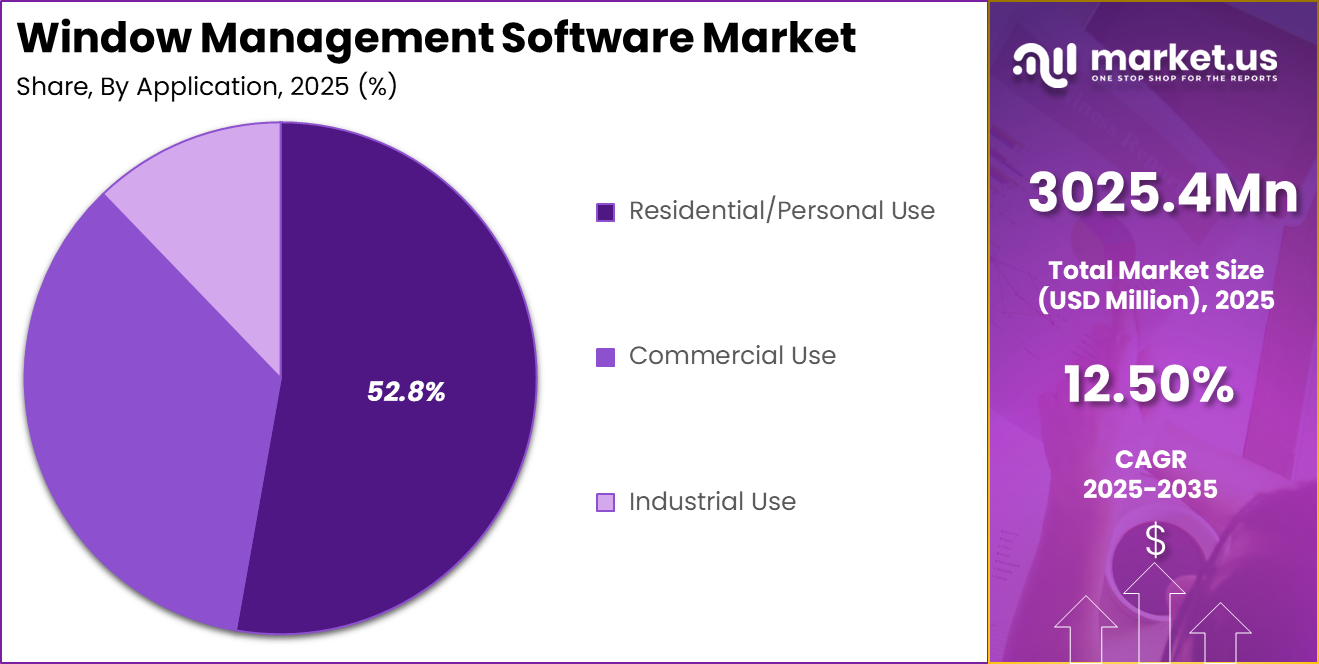
- By Application: Residential/Personal Use: 52.8%
- Regional Analysis
- US Market Size
- Driving Factors
- Restraint Factors
- Growth Opportunities
- Trending Factors
- Competitive Analysis
- Recent Developments
- Report Scope
Report Overview
The Window Management Software Market is expanding steadily as businesses and individual users increasingly rely on multitasking digital environments. Window management software helps users organize, resize, and control multiple application windows on a computer screen, improving productivity and workflow efficiency.
These tools are widely used by professionals working with multiple programs simultaneously, such as software developers, designers, financial analysts, and content creators. As hybrid work models and remote work environments continue to grow, organizations are investing in software solutions that enhance workspace organization and improve user productivity across operating systems and devices.
In 2025, the global Window Management Software Market is valued at approximately USD 3,025.4 million. The market is projected to grow at a compound annual growth rate of 12.50% during the forecast period, reaching an estimated value of around USD 9,824.4 million by 2035. This growth is supported by the increasing adoption of productivity software, the expansion of digital workplaces, and the growing use of multi-monitor setups in professional environments.
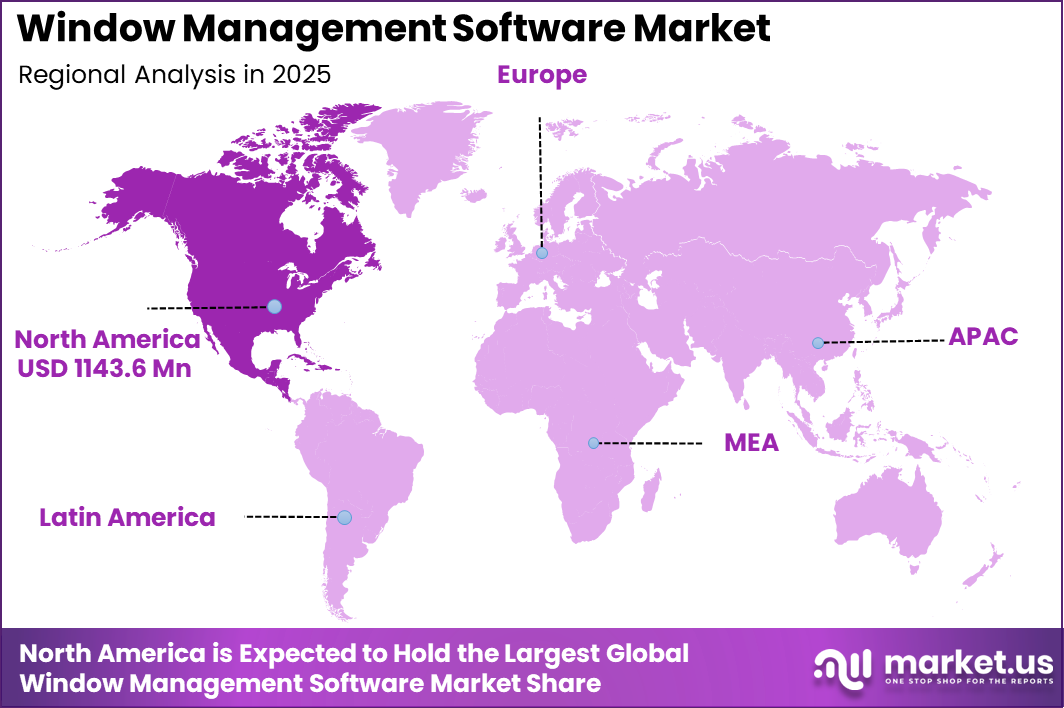
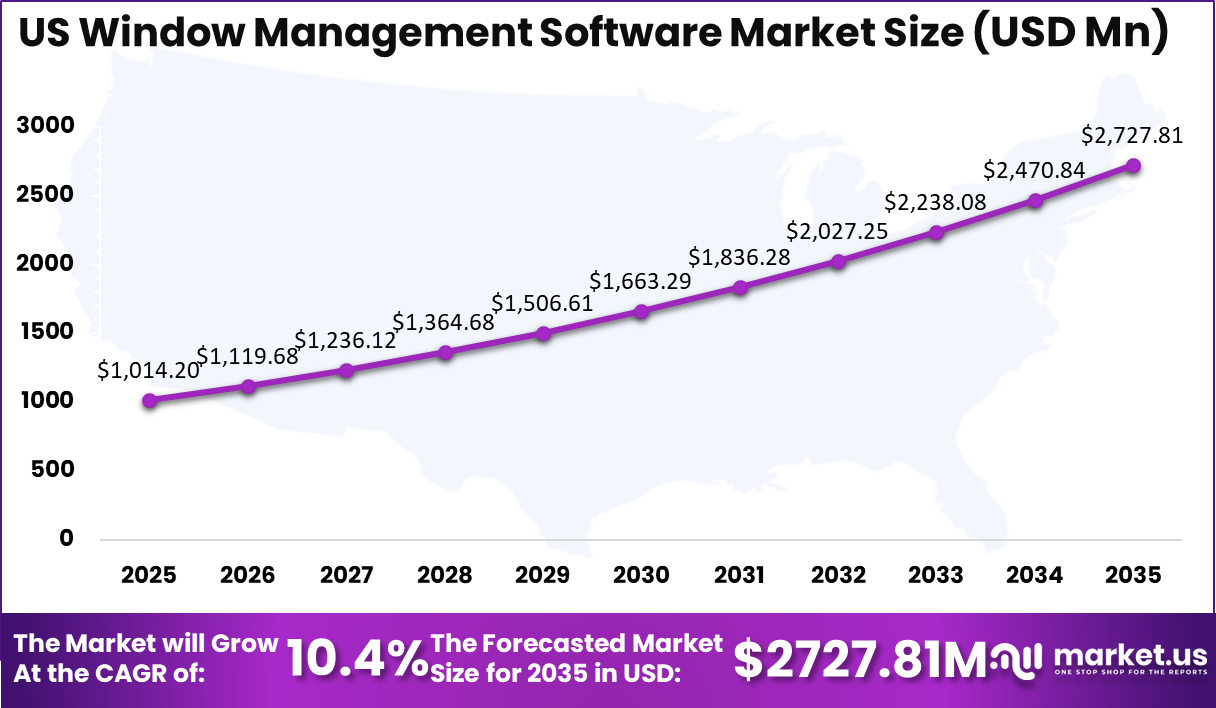
North America currently leads the market with a 37.8% share, generating about USD 1,143.6 million in revenue in 2025. The United States represents the largest market within the region, accounting for approximately USD 1,014.2 million in the same year. The US market is expected to reach nearly USD 2,727.81 million by 2035, growing at a CAGR of 10.4%, driven by strong adoption of productivity software across corporate and technology sectors.

The demand for window management software is closely linked to the rapid expansion of digital work environments and the increasing use of multiple applications during daily tasks. According to the International Data Corporation, global shipments of personal computers reached about 252 million units in 2023, reflecting the continued importance of desktop and laptop devices in professional and personal productivity.
Many professionals rely on several software tools simultaneously, including communication platforms, development environments, analytics dashboards, and design tools. Managing multiple open windows efficiently has become an important requirement for maintaining productivity.
Multi-monitor setups are also becoming more common in modern workplaces. Research indicates that more than 150 million computer monitors are shipped each year globally, with a significant portion used in multi-display configurations for professional tasks. Studies from the University of Utah also show that using multiple monitors can increase productivity by nearly 20 to 30 percent in certain work environments.
In addition, remote work trends continue to influence digital workspace management. Data from the US Bureau of Labor Statistics shows that millions of employees regularly work from home, which encourages the use of productivity tools that help organize digital workspaces and manage multiple applications more effectively.
Core Key Insights
- The Window Management Software Market reached a value of USD 3,025.4 million in 2025, reflecting growing demand for productivity and workspace organization tools.
- The market is expected to expand at a CAGR of 12.50% during the forecast period.
- By 2035, the global market value is projected to reach USD 9,824.4 million.
- North America accounted for the leading regional share of 37.8% in 2025.
- The regional market size in North America reached USD 1,143.6 million in 2025.
- The United States generated approximately USD 1,014.2 million in market revenue in 2025.
- The US market is projected to reach USD 2,727.81 million by 2035.
- The United States market is expected to grow at a CAGR of 10.4% during the forecast period.
- By component, software solutions accounted for 61.7% of the market.
- By organization size, large enterprises held a dominant share of 73.4%.
- By application, residential and personal use accounted for 52.8% of the market demand.
Future Predictions
The future of the Window Management Software Market is expected to be shaped by the continued expansion of digital workplaces and the growing need for efficient multitasking tools. As professionals increasingly work with multiple applications, browsers, and communication platforms simultaneously, managing on-screen windows efficiently has become an essential part of daily workflows.
Future software solutions are likely to focus on improving automation, allowing users to organize windows automatically based on tasks, screen layouts, or project requirements. This will help users save time and reduce distractions when switching between applications.
Advancements in artificial intelligence and machine learning are also expected to influence the development of next-generation window management tools. These technologies may allow software to learn user behavior and automatically arrange windows based on working patterns.
For example, development environments, design tools, and analytics dashboards could be grouped together automatically depending on the user’s routine. This type of intelligent workspace management is expected to improve productivity for professionals who handle complex digital workflows.
Another key factor influencing the future of this market is the increasing use of multi-monitor setups and high-resolution displays. As workplaces continue adopting larger and multiple screens, window management tools will play an important role in organizing digital workspaces effectively. These developments are expected to support long-term growth in the market.
Market Outlook
The outlook for the Window Management Software Market remains positive as digital work environments continue to expand across businesses, educational institutions, and individual users. As professionals increasingly rely on multiple applications simultaneously for communication, data analysis, development, and content creation, the need for tools that efficiently organize and manage on-screen windows has become more important.
Window management software helps users arrange, resize, and switch between applications quickly, improving workflow efficiency and reducing time spent navigating cluttered desktops. This capability is especially valuable for users working with multi-monitor setups or high-resolution displays where several applications are open at the same time.
Another factor supporting the market outlook is the continued growth of remote work and hybrid work models. Many employees now perform tasks from home offices or flexible work environments where efficient digital workspace management plays a critical role in productivity. Window management tools allow users to create customized layouts for different tasks, helping them maintain organized workspaces even when switching between multiple projects or devices.
In addition, the growing popularity of productivity software ecosystems is encouraging software developers to integrate window management features directly into operating systems and professional tools. As organizations focus more on employee efficiency and digital workspace optimization, window management software is expected to remain an important component of modern computing environments.
Key Market Segments
The Window Management Software Market is segmented by component, organization size, and application, each reflecting how different users adopt these productivity tools to manage digital workspaces more effectively. These segments highlight the growing importance of software solutions that help users organize multiple applications and improve workflow efficiency.
By component, software holds the dominant share at 61.7%. This segment includes dedicated window management applications and integrated productivity tools that allow users to arrange, resize, and control open windows on their screens.
Software solutions are widely adopted because they offer flexible customization options such as window snapping, automated layouts, workspace profiles, and keyboard shortcuts. Many technology companies and independent developers continue to release advanced window management tools designed to improve multitasking across different operating systems and devices.
By organization size, large enterprises account for the largest share at 73.4%. Large organizations often require employees to work with multiple applications simultaneously, including project management tools, communication platforms, and analytics software.
Window management software helps employees maintain organized workspaces and switch between tasks efficiently. By application, residential and personal use leads with 52.8%, as many individual users adopt these tools to improve productivity when managing personal projects, creative work, or remote work environments.
Research-Based Segments
By Component
- Software
- On-Premises
- Cloud-Based
- Services
- Professional Services
- Managed Services
By Organization Size
- Large Enterprises
- Small and Medium Enterprises (SMEs)
By Application
- Residential/Personal Use
- Commercial Use
- Industrial Use
By Component: Software: 61.7%
The component segment of the Window Management Software Market includes software and services that support the deployment, customization, and management of digital workspace tools. Among these, software accounts for the largest share at 61.7%. Software solutions dominate because they directly provide the core functionality required to organize and control multiple windows across computer screens.
These tools help users arrange applications, create workspace layouts, automate window positioning, and manage multiple monitors more efficiently. Businesses and individual users widely adopt window management software to improve multitasking and reduce time spent switching between applications.
Within the software segment, both on-premises and cloud-based solutions are available. On-premises software is commonly used by organizations that prefer to maintain full control over system configuration and internal IT environments. These solutions are installed directly on enterprise devices and integrated with existing operating systems and productivity tools.
Cloud-based software is becoming increasingly popular as it allows users to synchronize workspace layouts across multiple devices and locations. The services segment includes professional services and managed services that support implementation, training, and ongoing maintenance. These services help organizations deploy window management tools effectively while ensuring smooth integration with existing workplace technologies.
By Organization Size: Large Enterprises: 73.4%
The organization size segment of the Window Management Software Market includes large enterprises and small and medium enterprises. Large enterprises hold the dominant share at 73.4%. These organizations typically operate complex digital environments where employees work with multiple software applications simultaneously.
Departments such as software development, finance, design, data analytics, and customer service often require several windows to remain open at the same time. Window management software helps employees organize these applications efficiently, improving workflow productivity and reducing time spent switching between tasks.
Large enterprises also invest more in productivity and workspace optimization tools to support large workforces and multi-monitor setups. Many organizations provide employees with advanced workstation configurations that include high-resolution displays and multiple screens. Window management software allows users to create structured layouts, automate window placement, and manage applications across multiple monitors.
Small and medium enterprises are also adopting these tools as digital work environments expand. SMEs often seek affordable productivity solutions that help employees manage tasks more efficiently, especially in remote or hybrid work settings. As SMEs continue to digitize operations and rely more on software applications, their adoption of window management solutions is expected to grow steadily.
By Application: Residential/Personal Use: 52.8%
The application segment of the Window Management Software Market includes residential or personal use, commercial use, and industrial use. Among these, residential and personal use account for the largest share at 52.8%. This segment leads because many individual users rely on window management tools to improve productivity while working on personal computers.
Freelancers, remote workers, students, and digital creators often work with multiple applications, such as browsers, design tools, communication platforms, and content editing software at the same time. Window management software helps them organize these applications efficiently, allowing smoother multitasking and better screen utilization.
Commercial use also represents an important part of the market. Businesses across sectors such as technology services, finance, consulting, and media use window management software to support employee productivity. These tools help staff manage complex workflows that involve several programs and dashboards open simultaneously.
Industrial use is smaller but steadily growing as engineering teams, industrial designers, and technical professionals increasingly work with specialized software systems that require multiple windows for monitoring data, simulations, or system controls. As digital workspaces continue to expand across industries, the adoption of window management tools in different application environments is expected to increase.
Regional Analysis
North America represents a major region in the Window Management Software Market, accounting for approximately 37.8% of the global share. The regional market reached around USD 1,143.6 million in 2025, reflecting strong demand for productivity software and digital workspace management tools.
Organizations and individual users across the region rely heavily on computers for daily operations, which increases the need for software that can efficiently organize multiple application windows. Window management tools help users improve multitasking, reduce screen clutter, and manage applications across single or multiple monitors.
The growth of the market in North America is supported by the strong presence of technology companies, software developers, and digital service providers. Many businesses operate in highly digital work environments where employees handle large volumes of data, communication tools, and business applications simultaneously.
Window management software allows these organizations to optimize screen space and improve workflow efficiency. The increasing adoption of remote and hybrid work models in the region also contributes to market demand, as employees seek tools that help them manage digital workspaces effectively from home or flexible work environments.
In addition, high adoption of advanced workstation setups, including multi-monitor configurations and high-resolution displays, further supports the use of window management solutions across North America.
US Market Size
The United States Window Management Software Market generated approximately USD 1,014.2 million in revenue and represents the largest national market within North America. The strong demand in the US is driven by the widespread use of computers across businesses, educational institutions, and individual users who rely on digital tools for daily work.
Many professionals work with multiple applications simultaneously, including communication platforms, productivity software, analytics tools, and development environments. Window management software helps users organize these applications efficiently, improving multitasking and reducing time spent navigating between open windows.
The market in the United States is expected to expand steadily and reach about USD 2,727.81 million by 2035, growing at a compound annual growth rate of 10.4%. This growth is supported by the presence of a large number of technology companies, software developers, and digital service providers that focus on improving workplace productivity. Businesses across sectors such as information technology, finance, media, and consulting are increasingly adopting workspace optimization tools to improve employee efficiency.
In addition, the growing popularity of multi-monitor setups and high-resolution displays in offices and home workspaces continues to increase the need for window management software. As digital work environments continue to expand, the adoption of these productivity tools across the United States is expected to remain strong.
Regional Analysis and Coverage
- North America
- US
- Canada
- Europe
- Germany
- France
- The UK
- Spain
- Italy
- Russia
- Netherlands
- Rest of Europe
- Asia Pacific
- China
- Japan
- South Korea
- India
- Australia
- Singapore
- Thailand
- Vietnam
- Rest of Latin America
- Latin America
- Brazil
- Mexico
- Rest of Latin America
- Middle East & Africa
- South Africa
- Saudi Arabia
- UAE
- Rest of MEA
Driving Factors
One of the main driving factors for the Window Management Software Market is the increasing need for productivity tools in modern digital work environments. Professionals across industries often work with multiple applications simultaneously, including communication platforms, development tools, spreadsheets, and data analytics software.
Managing these applications efficiently on a single screen or across multiple monitors can be challenging without proper tools. Window management software helps users organize, resize, and position open windows quickly, allowing them to switch between tasks more efficiently and maintain a structured digital workspace.
Another important factor supporting market growth is the expansion of remote and hybrid work models. Many employees now work from home or flexible workspaces where they rely heavily on personal computers and digital collaboration platforms. In such environments, window management tools help users maintain organized screen layouts and improve multitasking.
The increasing use of multi-monitor setups and high-resolution displays in offices and home workstations also contributes to the demand for these tools, as they allow users to control multiple windows and applications more effectively.
Restraint Factors
Despite its growing demand, the Window Management Software Market faces certain restraints that may limit its adoption in some environments. One key challenge is that many operating systems already include basic window management features such as window snapping and screen splitting.
These built-in functions may reduce the immediate need for dedicated window management software among casual users who only require simple workspace organization tools. As a result, some users may not feel the need to invest in additional productivity software.
Another restraint involves limited awareness among non-technical users about the benefits of advanced window management tools. Many individuals are unfamiliar with the full capabilities offered by specialized software that can automate window layouts, manage multiple monitors, and create custom workspace profiles.
Without a clear understanding of these features, some users continue relying on traditional manual window organization methods. In addition, organizations that prioritize cost control may hesitate to adopt new software tools if they believe existing productivity systems are sufficient for daily operations.
Growth Opportunities
The Window Management Software Market offers several growth opportunities as digital workplaces continue to evolve. One major opportunity lies in the increasing adoption of multi-monitor and ultra-wide display setups across offices and home workstations.
Professionals in fields such as software development, finance, design, and data analysis frequently use multiple screens to handle complex tasks. Window management software helps organize applications across these displays, improving efficiency and reducing workspace clutter.
Another important opportunity is the integration of window management features with broader productivity and collaboration platforms. Software developers are exploring ways to combine window organization tools with project management systems, communication platforms, and cloud-based work environments.
This integration allows users to create task-specific workspace layouts that automatically arrange applications according to workflow requirements. As organizations invest more in digital productivity solutions and workspace optimization tools, window management software providers have an opportunity to expand their offerings and reach a broader professional user base.
Trending Factors
Several trends are shaping the development of the Window Management Software Market. One notable trend is the increasing demand for customizable digital workspaces. Users want greater control over how their applications are arranged on screen so that they can create layouts suited to different tasks, such as coding, design, research, or communication.
Window management tools are evolving to offer flexible layout templates and keyboard shortcuts that help users switch between workspace configurations quickly. Another important trend is the growing integration of automation features within productivity software. Some window management solutions are beginning to incorporate intelligent automation that automatically arranges windows based on user behavior or task type.
For example, a user opening a development environment may automatically see coding tools, documentation, and communication applications arranged across the screen. This type of automation improves workflow efficiency and reduces manual adjustments. As digital work environments become more complex and multitasking continues to increase, these intelligent window organization tools are expected to gain greater attention among professional users.
Competitive Analysis
The competitive landscape of the Windows Management Software Market is moderately fragmented, with a mix of operating system developers, independent software vendors, and productivity tool providers competing to improve digital workspace efficiency.
Major technology companies such as Microsoft, Apple, and Google influence the market by integrating window management capabilities directly into their operating systems and productivity ecosystems. For example, Microsoft offers the PowerToys utility suite, which includes the FancyZones feature that allows users to organize windows into custom layouts to improve multitasking and workflow efficiency.
Alongside large technology firms, several specialized software providers focus exclusively on advanced window management and multi-monitor productivity tools. Companies such as DisplayFusion, Actual Tools, and UltraMon provide software designed to manage multiple displays, customize window layouts, and improve workspace organization for professional users.
These tools are widely used in environments where multiple applications run simultaneously, such as software development, finance, and data analytics. Competition in the market is driven by feature innovation, user interface simplicity, and cross-platform compatibility. Many developers are introducing features such as automated window snapping, customizable workspace templates, keyboard-driven navigation, and multi-monitor synchronization.
In addition, open-source and lightweight window managers such as Rectangle, AquaSnap, and WindowTop are gaining attention among power users seeking flexible and customizable desktop environments. As digital workspaces become more complex and multitasking requirements increase, companies in the market are focusing on improving automation, performance, and seamless integration with productivity platforms.
Top Key Players in the Market
- Microsoft Corporation
- IBM Corporation
- Oracle Corporation
- SAP SE
- Honeywell International Inc.
- Johnson Controls International plc
- Siemens AG
- Schneider Electric SE
- View, Inc.
- Yardi Systems, Inc.
- Planon Corporation
- Trimble Inc.
- Accruent LLC
- Others
Recent Developments
- In 2026, Microsoft released PowerToys version 0.97.2, adding several productivity utilities and improvements for Windows users. The toolkit now includes more than 25 utilities, such as FancyZones for advanced window layouts and PowerToys Run for fast application launching.
- In 2025, Microsoft enhanced the FancyZones window manager within PowerToys, enabling users to create custom desktop zones and automatically snap application windows into predefined layouts for improved multitasking efficiency.
- In 2025, Microsoft introduced an updated PowerToys Command Palette with faster search capabilities and improved workflow navigation, reducing startup memory usage and improving performance for productivity tools.
Report Scope
Report Features Description Market Value (2025) USD 3,025.4 Million Forecast Revenue (2035) USD 9,824.4 Million CAGR(2025-2035) 12.50% Base Year for Estimation 2024 Historic Period 2020-2024 Forecast Period 2025-2035 Report Coverage Revenue forecast, AI impact on Market trends, Share Insights, Company ranking, competitive landscape, Recent Developments, Market Dynamics, and Emerging Trends Segments Covered By Component (Software [On-Premises, Cloud-Based], Services [Professional Services, Managed Services]), By Organization Size (Large Enterprises, Small and Medium Enterprises (SMEs)), By Application (Residential/Personal Use, Commercial Use, Industrial Use) Regional Analysis North America – US, Canada; Europe – Germany, France, The UK, Spain, Italy, Russia, Netherlands, Rest of Europe; Asia Pacific – China, Japan, South Korea, India, New Zealand, Singapore, Thailand, Vietnam, Rest of Latin America; Latin America – Brazil, Mexico, Rest of Latin America; Middle East & Africa – South Africa, Saudi Arabia, UAE, Rest of MEA Competitive Landscape Microsoft Corporation, IBM Corporation, Oracle Corporation, SAP SE, Honeywell International Inc., Johnson Controls International plc, Siemens AG, Schneider Electric SE, View, Inc., Yardi Systems, Inc., Planon Corporation, Trimble Inc., Accruent LLC, Others Customization Scope Customization for segments, region/country-level will be provided. Moreover, additional customization can be done based on the requirements. Purchase Options We have three licenses to opt for: Single User License, Multi-User License (Up to 5 Users), Corporate Use License (Unlimited Users and Printable PDF)  Window Management Software MarketPublished date: Mar 2026add_shopping_cartBuy Now get_appDownload Sample
 -
-
- Microsoft Corporation
- IBM Corporation
- Oracle Corporation
- SAP SE
- Honeywell International Inc.
- Johnson Controls International plc
- Siemens AG
- Schneider Electric SE
- View, Inc.
- Yardi Systems, Inc.
- Planon Corporation
- Trimble Inc.
- Accruent LLC
- Others
Our Clients

- 181409
- Mar 2026