


Global Water And Wastewater Treatment Chemicals Market Size, Share Analysis Report By Chemical Type (Coagulants And Flocculants, Corrosion And scale inhibitors, Biocides And Disinfectants, pH Adjusters And Stabilizers, Anti-Foaming agents, Chelating agents, Others), By Form (Liquid, Powder, Granules), By Type (Synthetic Chemicals, Natural Chemicals), By End-user (Municipal Water and Water Treatment, Chemical And Petrochemical, Food And Beverages, Oil And Gas, Healthcare, Others) , By Region and Companies - Industry Segment Outlook, Market Assessment, Competition Scenario, Trends, and Forecast 2025-2034
- Published date: July 2025
- Report ID: 153439
- Number of Pages: 329
- Format:
-
keyboard_arrow_up
Quick Navigation
Report Overview
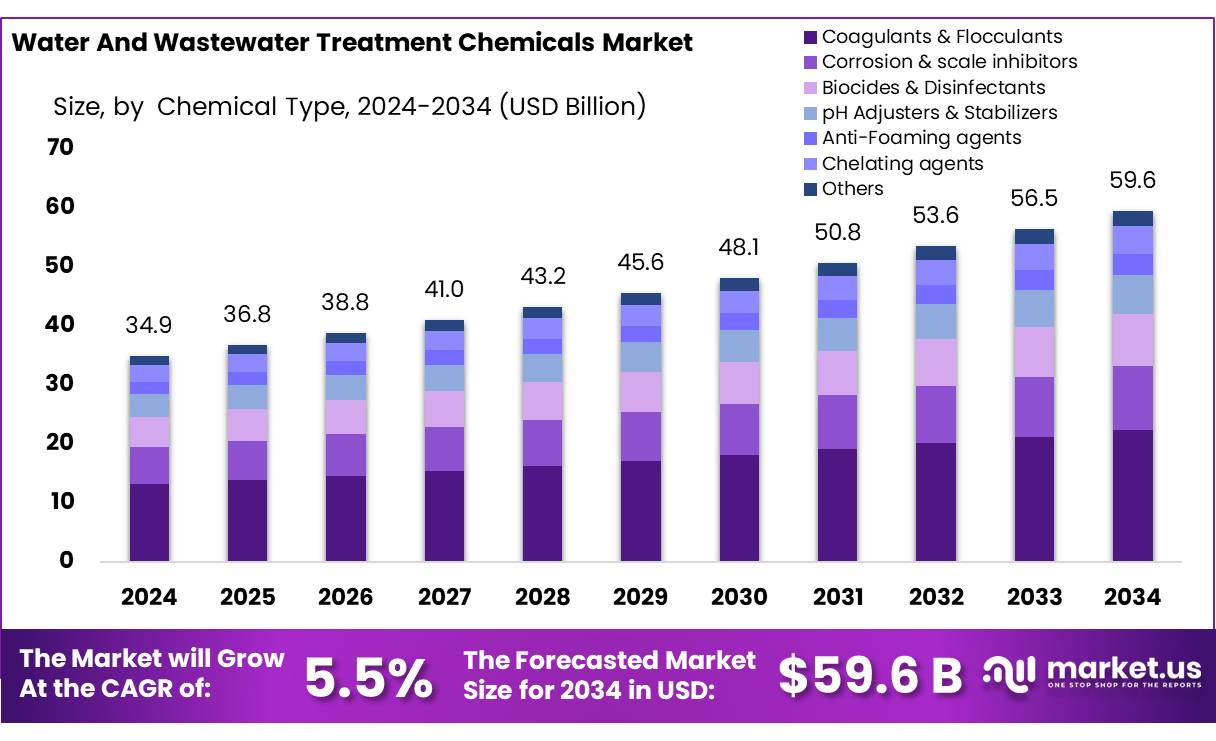
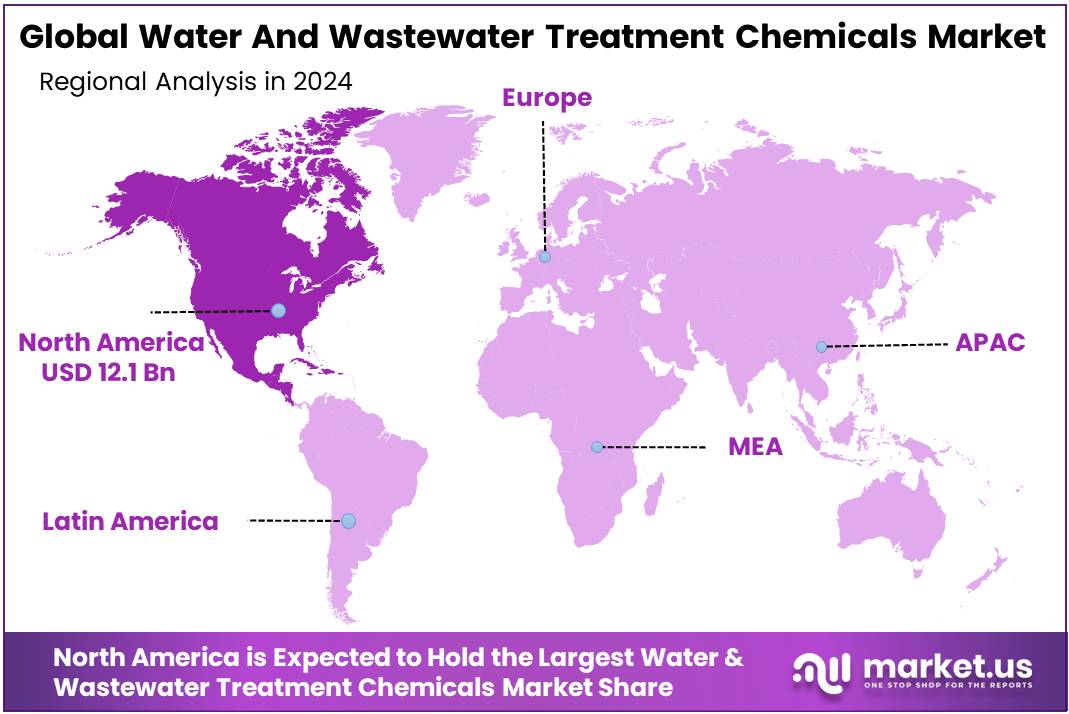
The Global Water And Wastewater Treatment Chemicals Market size is expected to be worth around USD 59.6 Billion by 2034, from USD 34.9 Billion in 2024, growing at a CAGR of 5.5% during the forecast period from 2025 to 2034. In 2024, North America held a dominant market position, capturing more than a 34.8% share, holding USD 12.1 Billion revenue.
The water and wastewater treatment chemicals industry can be defined by specialized chemical products—such as coagulants, flocculants, biocides, scale inhibitors, corrosion inhibitors, pH adjusters—used to remove contaminants, pathogens, and emerging pollutants from industrial effluents and municipal wastewater. These chemicals support primary, secondary, and tertiary treatment stages to ensure compliance with discharge standards and to enable water reuse.
A key driver of this growth is the government’s commitment to enhancing water infrastructure. Under the Atal Mission for Rejuvenation and Urban Transformation (AMRUT) 2.0, the central government allocated ₹800 crore to Delhi for expanding sewage infrastructure, including the installation of 2.5 lakh new sewer connections and the recycling of 50 million liters of water daily. Similarly, the Jal Jeevan Mission aims to provide tap water connections to every rural household by 2024, with an investment of ₹3.60 lakh crore, of which ₹2.08 lakh crore is the central government’s share.
Several government initiatives and regulatory frameworks reinforce demand. In the United States, the Clean Water State Revolving Fund (CWSRF) has provided over USD 153.6 billion in low-interest loans since 1988 to modernize municipal wastewater facilities. Meanwhile, United Nations Sustainable Development Goal 6 seeks to halve the proportion of untreated wastewater and significantly increase recycling and safe reuse by 2030—backed by USD 9 billion in ODA for the water sector in 2018. UN-Water reports that, as of 2022, although 76% of wastewater received some treatment, only 60% achieved at least secondary (safe) treatment; industrial flows were treated only 38%, and safely treated at 27% among 22 reporting countries.
In the European Union, the Urban Waste Water Treatment Directive (91/271/EEC) mandates treatment for agglomerations with populations over 2,000–10,000, with revisions including energy-neutral targets by 2040 and stricter limits on nitrogen, phosphorus, and micropollutants. The wastewater sector currently accounts for approximately 0.8–1% of global energy consumption; by 2040, this may rise by 60% without efficiency improvements.
Key Takeaways
- The global water and wastewater treatment chemicals market is projected to reach USD 59.6 billion by 2034, up from USD 34.9 billion in 2024, reflecting a CAGR of 5.5% during the forecast period.
- In 2024, Coagulants & Flocculants emerged as the leading chemical type, accounting for over 37.6% of the total market share.
- Liquid form chemicals held the dominant position by form, contributing to more than 68.9% of the market share in 2024, driven by their ease of use and dosing efficiency.
- Synthetic chemicals captured a substantial 85.1% share in 2024, making them the most widely used type due to their consistent performance and industrial compatibility.
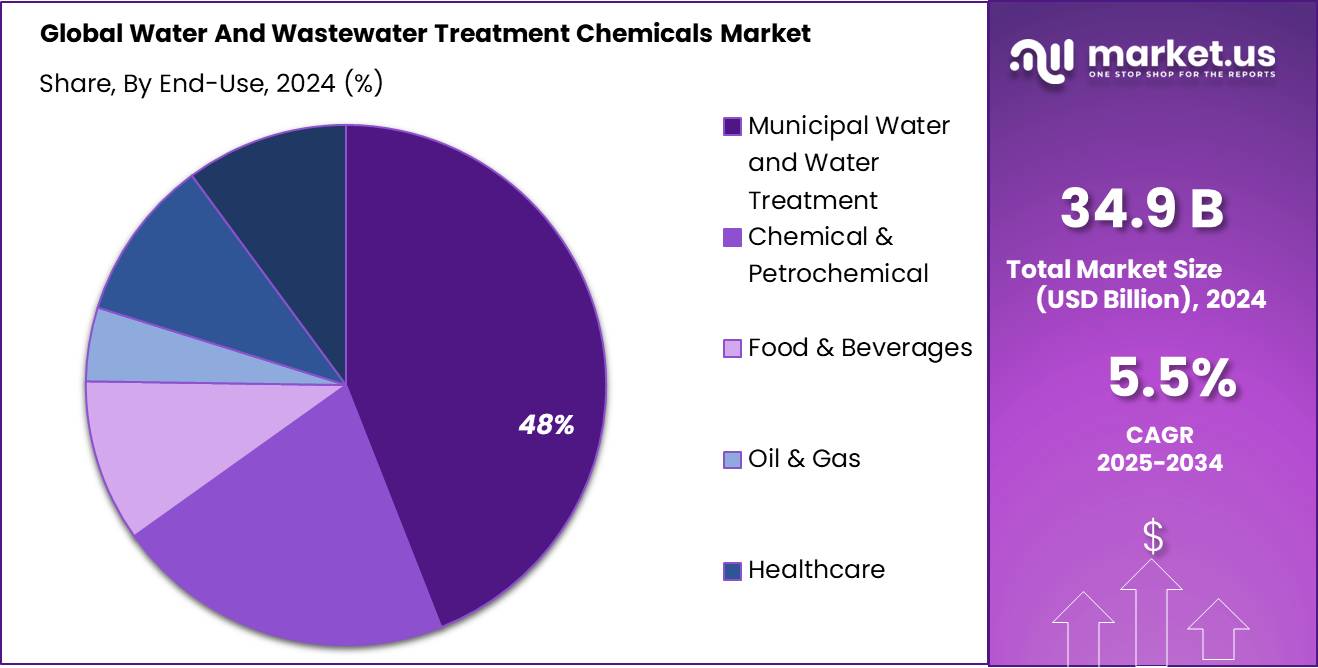
- Based on end-user analysis, Municipal Water and Water Treatment led the market with over 48.2% share in 2024, supported by increasing urban sanitation needs and public water infrastructure.
- Regionally, North America commanded a significant 34.8% share, which is valued at approximately USD 12.1 billion in 2024, underpinned by strong regulatory enforcement and industrial demand.
By Chemical Type Analysis
Coagulants & Flocculants dominate with 37.6% share due to strong demand in municipal and industrial sectors
In 2024, Coagulants & Flocculants held a dominant market position, capturing more than a 37.6% share of the global water and wastewater treatment chemicals market. These chemicals are essential in the primary treatment phase, where they help in aggregating suspended particles and facilitating their removal through sedimentation or filtration. Their widespread use across municipal wastewater treatment plants and a variety of industrial applications—such as in food processing, pulp and paper, textiles, and oil refining—has driven consistent demand.
The year 2024 witnessed heightened usage of these chemicals as stricter environmental rules pushed municipalities and industries to improve the quality of discharged effluents. Growing urban populations and aging infrastructure in developing regions have also encouraged more chemical-based treatments to manage high organic loads and turbidity. Particularly in densely populated countries, where the pressure on freshwater resources is high, coagulants and flocculants serve as cost-effective solutions to reclaim and recycle water.
By Form Analysis
Liquid chemicals lead with 68.9% share, driven by easy handling and wide usage in municipal wastewater
In 2024, Liquid held a dominant market position, capturing more than a 68.9% share in the global water and wastewater treatment chemicals market by form. The preference for liquid formulations is largely due to their ease of storage, dosing flexibility, and faster reaction times in large-scale treatment systems. These attributes make them especially suitable for municipal wastewater treatment facilities, which require continuous and efficient chemical dosing to manage fluctuating influent volumes and pollutant loads.
Municipal operators often choose liquid chemicals for their compatibility with automated dosing systems and for reducing operational complexities. In many urban areas, aging sewer infrastructure and rising water demand have led to increased volumes of wastewater, further reinforcing the need for efficient treatment using reliable and scalable solutions like liquid coagulants, flocculants, disinfectants, and pH regulators.
By Type Analysis
Synthetic Chemicals dominate with 85.1% share, supported by strong performance, consistency, and large-scale industrial use
In 2024, Synthetic Chemicals held a dominant market position, capturing more than an 85.1% share in the global water and wastewater treatment chemicals market by type. Their high share is mainly due to their consistent quality, controlled chemical composition, and ability to deliver reliable results across a wide range of treatment conditions. These chemicals are widely used in both municipal and industrial setups because they can be manufactured in large volumes and tailored to meet specific treatment goals—such as removing heavy metals, organic waste, or pathogens from water.
The use of synthetic coagulants, flocculants, biocides, and anti-scalants has become standard practice in many countries, especially where treated water quality is strictly regulated. Their availability and long shelf life further make them a preferred choice for large treatment plants that operate continuously and require stable chemical inputs.
By End-user Analysis
Municipal Water and Water Treatment leads with 48.2% share due to rising urban demand and public sanitation efforts
In 2024, Municipal Water and Water Treatment held a dominant market position, capturing more than a 48.2% share in the global water and wastewater treatment chemicals market by end-user. This strong position is mainly due to increasing urban populations, rising household water consumption, and growing public awareness about safe drinking water and sanitation. Municipalities across the globe are under constant pressure to supply clean water and manage sewage responsibly, especially in developing countries where infrastructure is still catching up with rapid urbanization.
During 2024, many cities expanded their treatment capacities, and governments invested heavily in public water systems to meet environmental regulations and protect public health. These projects rely on a steady supply of treatment chemicals—such as coagulants, disinfectants, and corrosion inhibitors—to ensure the treated water meets safety standards before distribution or discharge. In densely populated areas, municipal plants face higher pollutant loads and require efficient chemical processes to handle the volume and complexity of incoming wastewater.
Key Market Segments
By Chemical Type
- Coagulants & Flocculants
- Corrosion & scale inhibitors
- Biocides & Disinfectants
- pH Adjusters & Stabilizers
- Anti-Foaming agents
- Chelating agents
- Others
By Form
- Liquid
- Powder
- Granules
By Type
- Synthetic Chemicals
- Natural Chemicals
By End-user
- Municipal Water and Water Treatment
- Chemical & Petrochemical
- Food & Beverages
- Oil & Gas
- Healthcare
- Others
Emerging Trends
Sustainable Water Treatment in the Food & Beverage Sector
The food and beverage industry is increasingly adopting sustainable water and wastewater treatment practices, driven by environmental concerns and regulatory pressures. A notable trend is the implementation of advanced treatment technologies such as membrane filtration, reverse osmosis, and bio-based remediation methods. These technologies not only enhance water quality but also support water reuse and recycling initiatives.
Governments worldwide are supporting these initiatives through various programs. In India, the National Mission for Clean Ganga (Namami Gange) Project has been instrumental in improving water quality and promoting wastewater treatment. For example, the Uttar Pradesh Pollution Control Board reported a 68.8% improvement in water quality across rivers and reservoirs in the state, attributed to sustained initiatives and strict monitoring.
These advancements are not only improving environmental outcomes but also offering economic benefits. Research indicates that companies can achieve a 20-30% reduction in operational costs by implementing water recycling and resource recovery practices, primarily due to decreased expenditures on water procurement and wastewater disposal.
Drivers
Increasing Demand for Water Purification and Safety Standards
The increasing need for clean and safe water is one of the most significant driving factors for the growth of the water and wastewater treatment chemicals market. As populations grow, especially in emerging economies, the demand for high-quality drinking water continues to rise. At the same time, water contamination due to industrial and agricultural activities has prompted governments and industries to implement stricter regulations on water treatment processes.
- According to the World Health Organization (WHO), around 2 billion people globally still lack access to safely managed drinking water. This statistic emphasizes the critical need for robust water treatment solutions to safeguard public health.
Governments across the globe are recognizing the importance of water treatment in maintaining public health, and this has led to an increase in regulations around water quality. For instance, in the United States, the Environmental Protection Agency (EPA) has set national drinking water standards, requiring municipalities to meet stringent water quality requirements. These regulations have driven significant investments in water treatment technologies and chemicals, with the U.S. Environmental Protection Agency allocating over US$ 12 billion annually for water infrastructure improvements.
Industries are also feeling the pressure to adopt more efficient and environmentally friendly wastewater treatment solutions. In sectors like food and beverage manufacturing, the treatment of wastewater is crucial to meet regulatory standards and reduce environmental impact. According to the U.S. Food and Drug Administration (FDA), the food industry is one of the largest consumers of water in the U.S., and strict wastewater treatment guidelines must be followed to ensure the water is safe for discharge into the environment.
Restraints
High Costs of Water Treatment Chemicals
One major restraining factor for the growth of the water and wastewater treatment chemicals market is the high cost associated with these chemicals and the infrastructure needed to apply them effectively. The production and usage of water treatment chemicals can be expensive, especially for industries that need to treat large volumes of water. For example, in the food and beverage industry, water treatment chemicals are essential to meet stringent sanitation and water quality standards. However, the cost of chemicals such as chlorine, coagulants, and flocculants can significantly raise operational expenses.
The Food and Agriculture Organization (FAO) reports that water scarcity and water pollution are major challenges in the food industry. Industries like agriculture and food processing depend heavily on water, and the treatment of wastewater is an expensive process. According to the FAO, over 70% of global freshwater is used for agriculture, making it one of the largest consumers of water resources. However, many of these industries are struggling with rising chemical treatment costs, especially in regions where water scarcity is exacerbated by pollution.
Additionally, government regulations to ensure water safety and protect the environment place a financial burden on industries, particularly small and medium-sized enterprises (SMEs). For example, the U.S. EPA has introduced the Clean Water State Revolving Fund (CWSRF), which offers financial assistance for water treatment projects. However, despite this initiative, the costs of implementing effective treatment systems remain high, particularly for wastewater, and many businesses struggle to access the necessary funds.
Opportunity
Increasing Adoption of Sustainable Water Treatment Solutions
One significant growth opportunity for the water and wastewater treatment chemicals market lies in the increasing adoption of sustainable and eco-friendly treatment solutions. As environmental concerns continue to rise, both consumers and governments are pushing industries toward adopting green technologies that minimize the environmental impact of water treatment. In particular, food and beverage industries, which are major water consumers, are facing growing pressure to reduce their water usage and adopt environmentally friendly practices.
For example, the U.S. Food and Drug Administration (FDA) and the Environmental Protection Agency (EPA) have placed increasing emphasis on sustainable practices in wastewater management, encouraging companies to adopt chemical-free or low-chemical water treatment methods. Many industries are now exploring biological treatments, such as bio-based coagulants and flocculants, which can offer the same effectiveness as traditional chemicals while being more eco-friendly. This shift is expected to open up new opportunities for suppliers of environmentally friendly chemicals.
Additionally, government initiatives like the EU’s Water Framework Directive and the U.S. Clean Water State Revolving Fund (CWSRF) are providing financial support to businesses that implement green solutions. These initiatives aim to improve water quality, and they prioritize sustainable water treatment technologies, creating an attractive market for companies to invest in eco-friendly alternatives. The U.S. EPA has also been pushing for the development of water reuse technologies, which are becoming increasingly popular in industries like agriculture and food processing.
Regional Insights
North America leads with 34.8% share and USD 12.1 billion market size in 2024
In 2024, North America held a commanding position in the water and wastewater treatment chemicals market, accounting for 34.8% of the global share, equivalent to approximately USD 12.1 billion. This leading role has been sustained by a combination of rigorous regulatory frameworks, extensive industrial infrastructure, and strong investment in public utilities.
Stringent standards under the United States Clean Water Act (1972) and its continuous updates have driven municipal and industrial users to adopt advanced treatment chemicals—such as coagulants, biocides, corrosion inhibitors, and pH adjusters—to meet permissible discharge levels. Private sector compliance efforts and federal funding for infrastructure modernization have supported steady chemical usage in water and wastewater plants nationwide. In 2024 alone, the U.S. market was valued at around USD 5 billion, contributing a significant portion of the regional market.
Industrial demand in North America remains high due to extensive operations in power generation, petrochemicals, food processing, and pharmaceuticals. These industries rely heavily on chemicals for cooling water systems, boiler water treatment, and membrane processes. It is estimated that nearly half of the water treatment chemicals sold in the region serve industrial applications, largely driven by the need to maintain equipment efficiency and prevent scaling and corrosion.
Key Regions and Countries Insights
- North America
- US
- Canada
- Europe
- Germany
- France
- The UK
- Spain
- Italy
- Rest of Europe
- Asia Pacific
- China
- Japan
- South Korea
- India
- Australia
- Rest of APAC
- Latin America
- Brazil
- Mexico
- Rest of Latin America
- Middle East & Africa
- GCC
- South Africa
- Rest of MEA
Key Players Analysis
Baker Hughes plays a significant role in the water and wastewater treatment chemicals market through its advanced chemical solutions tailored for industrial water systems. The company offers scale inhibitors, corrosion control additives, and biocides widely used in oil & gas, power, and process industries. Its focus on digital water monitoring and sustainability has strengthened its presence, especially in high-demand sectors. Baker Hughes continues to support clients with smart water management to improve efficiency and reduce environmental impact.
BioMicrobics, Inc specializes in decentralized wastewater treatment systems and chemical additives for small-scale and rural applications. Its offerings include biological and chemical-based solutions designed for residential, commercial, and marine sectors. The company is known for integrating treatment chemicals within compact modular systems that support water recycling. BioMicrobics promotes sustainable water use through innovative technologies and has built a strong reputation in water-stressed regions where centralized infrastructure is limited or unavailable.
Cortec Corporation is recognized for its corrosion inhibitors used in water treatment applications, particularly for boiler systems, pipelines, and closed-loop water circuits. Its environmentally safe chemistry solutions help extend equipment life and maintain system integrity. Cortec emphasizes eco-friendly formulations and compliance with global water quality standards. The company also supports customers with on-site system evaluations and technical training, reinforcing its reputation as a trusted name in water system preservation and chemical efficiency.
Top Key Players Outlook
- Baker Hughes
- BASF SE
- BioMicrobics, Inc
- Cortec Corporation
- DuPont
- Ecolab
- Xylem
- Gradiant Corporation
- Green Water Treatment Solutions
- Johnson Matthey
- Kemira Oyj
- Kurita Europe GmbH
- Nouryon
- Pentair
- Solvay S.A.
Recent Industry Developments
In 2024, BASF SE reported total sales of approximately €65.3 billion, with the core Chemicals segment contributing €10.84 billion, including key products such as coagulants, flocculants, and membrane-enhancing polymers used in water and wastewater treatment.
In 2024, BioMicrobics, Inc. continued its commitment to sustainable, small-to-mid-scale wastewater treatment by delivering pre-engineered systems capable of handling 150 to 2,000,000 gallons per day.
Report Scope
Report Features Description Market Value (2024) USD 34.9 Bn Forecast Revenue (2034) USD 59.6 Bn CAGR (2025-2034) 5.5% Base Year for Estimation 2024 Historic Period 2020-2023 Forecast Period 2025-2034 Report Coverage Revenue Forecast, Market Dynamics, Competitive Landscape, Recent Developments Segments Covered By Chemical Type (Coagulants And Flocculants, Corrosion And scale inhibitors, Biocides And Disinfectants, pH Adjusters And Stabilizers, Anti-Foaming agents, Chelating agents, Others), By Form (Liquid, Powder, Granules), By Type (Synthetic Chemicals, Natural Chemicals), By End-user (Municipal Water and Water Treatment, Chemical And Petrochemical, Food And Beverages, Oil And Gas, Healthcare, Others) Regional Analysis North America – US, Canada; Europe – Germany, France, The UK, Spain, Italy, Rest of Europe; Asia Pacific – China, Japan, South Korea, India, Australia, Singapore, Rest of APAC; Latin America – Brazil, Mexico, Rest of Latin America; Middle East & Africa – GCC, South Africa, Rest of MEA Competitive Landscape Baker Hughes, BASF SE, BioMicrobics, Inc, Cortec Corporation, DuPont, Ecolab, Xylem, Gradiant Corporation, Green Water Treatment Solutions, Johnson Matthey, Kemira Oyj, Kurita Europe GmbH, Nouryon, Pentair, Solvay S.A. Customization Scope Customization for segments, region/country-level will be provided. Moreover, additional customization can be done based on the requirements. Purchase Options We have three licenses to opt for: Single User License, Multi-User License (Up to 5 Users), Corporate Use License (Unlimited User and Printable PDF)  Water And Wastewater Treatment Chemicals MarketPublished date: July 2025add_shopping_cartBuy Now get_appDownload Sample
 -
-
- Baker Hughes
- BASF SE
- BioMicrobics, Inc
- Cortec Corporation
- DuPont
- Ecolab
- Xylem
- Gradiant Corporation
- Green Water Treatment Solutions
- Johnson Matthey
- Kemira Oyj
- Kurita Europe GmbH
- Nouryon
- Pentair
- Solvay S.A.
Our Clients

- 153439
- July 2025






