Report Overview
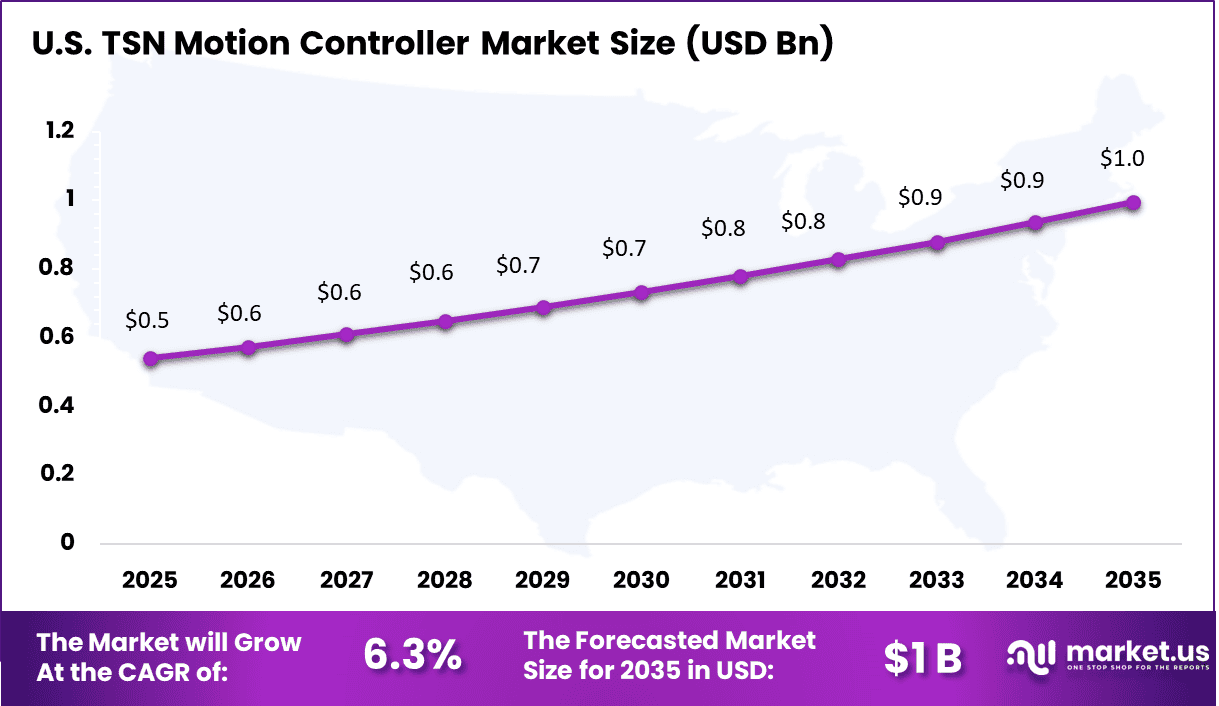
The Global TSN Motion Controller Market generated USD 1.9 billion in 2025 and is predicted to register growth from USD 2 billion in 2026 to about USD 4.2 billion by 2035, recording a CAGR of 8.50% throughout the forecast span. In 2025, North America held a dominant market position, capturing more than a 34.3% share, holding USD 0.64 Billion revenue.
Top Market Takeaways
- Component Hardware accounts for 56.7% of the TSN Motion Controller market, as most deployments rely on dedicated control devices for real-time, deterministic motion control.
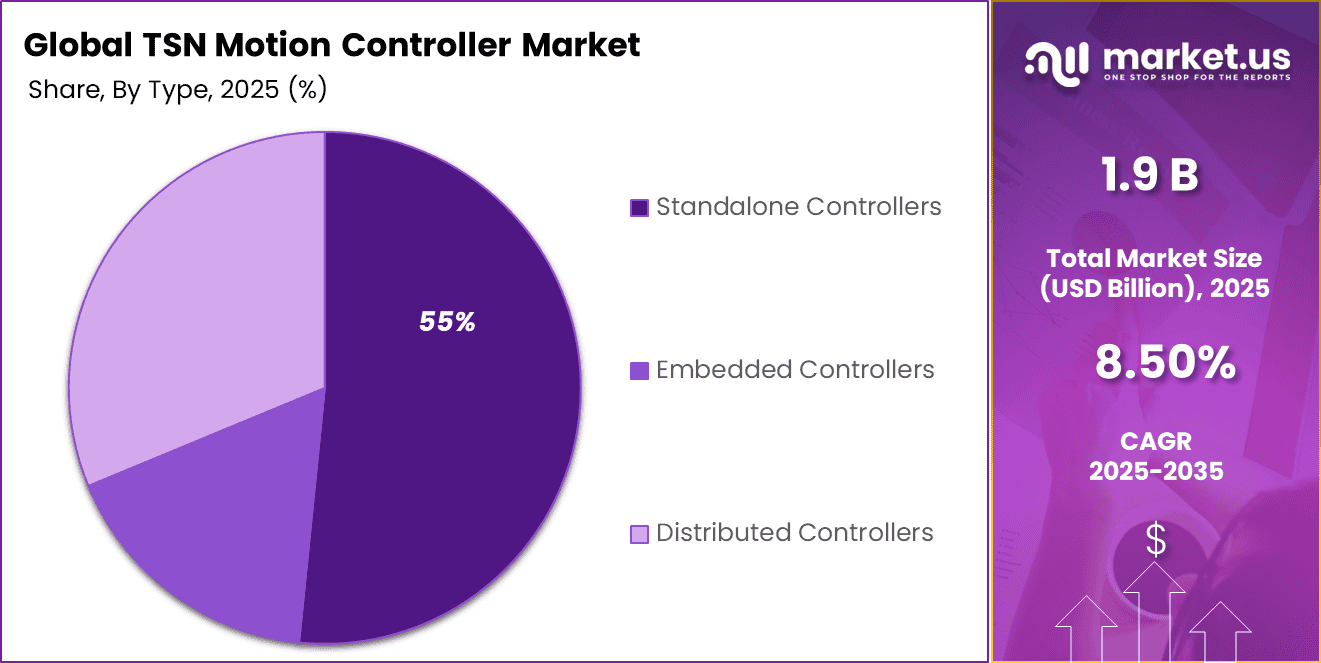
- Type Standalone controllers hold 54.5% of the market, because many users prefer independent controllers that can manage motion tasks without depending heavily on external systems.
- Application Robotics represents 36.8% of demand, reflecting the growing use of TSN-based motion control in industrial robots, collaborative robots, and automated production lines.
- Industry Vertical The automotive sector accounts for 38.2%, driven by high adoption of advanced automation, robotic assembly, and precise motion control in vehicle manufacturing.
- Network Protocol Ethernet/IP holds 39.4% of the market, as it is a widely used industrial Ethernet standard that benefits from TSN features for time-sensitive and synchronized motion applications.
- Region North America represents 34.3% of the global market, supported by strong investments in industrial automation and smart manufacturing.
- Country The US market is valued at USD 0.54 billion and is expected to grow at a CAGR of 6.3%, as manufacturers continue to modernize factories with TSN-enabled motion control systems.
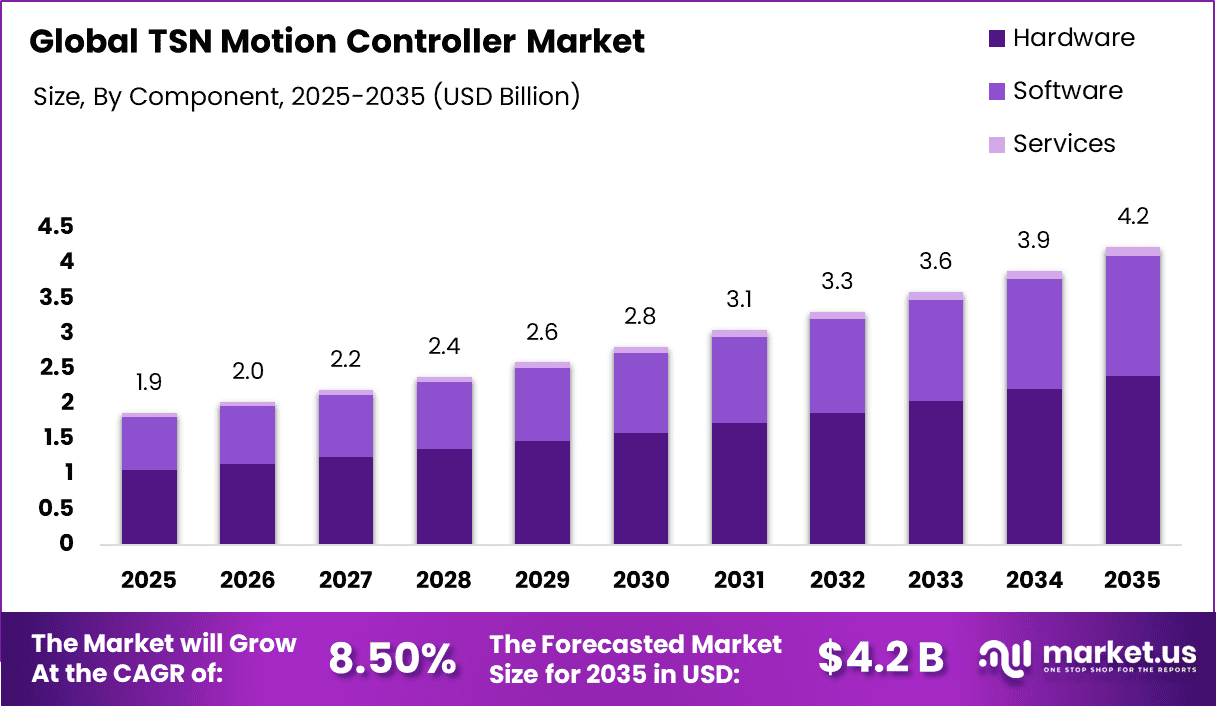
TSN motion controllers are advanced industrial control systems that use time sensitive networking technology to manage precise motion tasks across machines and automated production lines. They coordinate motors, drives, robots, and sensors with highly accurate timing over Ethernet based networks.
Unlike traditional control systems that often rely on separate communication protocols, TSN enables synchronized and deterministic data exchange through a unified network. As factories move toward smarter and more connected operations, TSN motion controllers are becoming an important part of next generation industrial automation.
One of the main driving factors is the increasing demand for high speed and precise automation in manufacturing. Industries such as automotive, electronics, packaging, and semiconductors require motion systems that can coordinate multiple axes with minimal delay.
In addition, the shift toward smart factories is encouraging adoption of open and interoperable network technologies that can connect many devices on one platform. TSN supports this need by improving synchronization, reducing communication bottlenecks, and simplifying network architecture. The growing use of robotics and flexible production lines is also supporting demand for controllers that can adapt quickly to changing workflows.
Demand for TSN motion controllers is rising as manufacturers seek better performance, scalability, and easier system integration. There is a strong preference for solutions that offer real time control, stable communication, and compatibility with existing industrial equipment.
Companies are also looking for controllers that can support predictive maintenance, remote diagnostics, and data driven optimization. The demand is particularly strong in advanced manufacturing environments where uptime, precision, and productivity are critical. As industrial networks continue to modernize, the need for intelligent and reliable TSN based motion control solutions is expected to grow steadily.
Drivers Impact Analysis
| Key Driver | Impact on CAGR Forecast (~%) | Geographic Relevance | Impact Timeline | Additional Insight |
|---|---|---|---|---|
| Rising adoption of Industry 4.0 and smart factories | +2.9% | North America, Europe, Asia Pacific | Medium to long term | Smart factories need precise motion control |
| Growing demand for real-time deterministic Ethernet networks | +2.6% | Global | Medium term | TSN improves synchronized communication |
| Increasing automation in automotive and electronics manufacturing | +2.4% | Developed markets | Medium to long term | Automated lines boost controller demand |
| Expansion of robotics and collaborative robot deployment | +2.1% | Global | Medium term | Robots require accurate motion timing |
| Need for reduced latency and higher machine productivity | +1.9% | Global | Short to medium term | Faster response improves output efficiency |
Restraints Impact Analysis
| Key Restraint | Impact on CAGR Forecast (~%) | Geographic Relevance | Impact Timeline | Additional Insight |
|---|---|---|---|---|
| High initial deployment and upgrade costs | -2.4% | Emerging markets | Short to medium term | Costs slow adoption |
| Complexity in integrating legacy industrial systems | -2.1% | Global | Medium term | Older systems delay migration |
| Limited awareness of TSN benefits among SMEs | -1.8% | Developing regions | Medium term | Smaller firms adopt slowly |
| Shortage of skilled industrial networking professionals | -1.5% | Global | Medium to long term | Skill gaps affect implementation |
| Cybersecurity concerns in connected factories | -1.3% | Global | Long term | Security risks impact confidence |
By Component Analysis
The hardware segment accounted for 56.7% of the market share, reflecting its strong role in delivering real-time motion control and deterministic communication performance. This dominance is supported by the growing demand for controllers, processors, drives, and interface modules that can manage precise industrial movements with high reliability. Hardware remains essential for ensuring stable execution in automation environments.
Another factor driving this segment is the increasing adoption of smart manufacturing systems that require low-latency and synchronized operations. Advanced hardware improves responsiveness, accuracy, and system durability, making it a preferred investment across industrial automation applications.
By Type Analysis
The standalone controllers segment held 55% share, driven by their flexibility, independent operation, and ease of deployment in various machine setups. These controllers are widely used because they can manage motion functions without relying heavily on larger centralized systems. This makes them suitable for both new installations and retrofit projects.
In addition, manufacturers prefer standalone controllers for applications requiring dedicated performance and simpler maintenance. Their ability to support customized configurations and reduce system complexity has strengthened adoption across industrial facilities.
By Application Analysis
The robotics segment captured 36.8% of the market, reflecting the growing use of precise motion systems in automated production environments. Robots require accurate control of speed, position, and synchronized movement, making TSN motion controllers highly valuable. These systems help improve efficiency, repeatability, and operational safety.
Furthermore, rising investment in industrial automation and intelligent manufacturing has increased robotic deployments across multiple sectors. Motion controllers enable smoother machine coordination and faster cycle times, reinforcing strong demand in robotics applications.
By Industry Vertical Analysis
The automotive segment accounted for 38.2% of the market share, driven by the sector’s extensive use of automation in assembly, welding, painting, and material handling processes. Automotive manufacturers rely on motion control systems to maintain precision, productivity, and consistent quality across production lines.
Moreover, increasing demand for advanced vehicles and efficient manufacturing operations has encouraged greater investment in smart factory technologies. TSN motion controllers support synchronized operations and reduced downtime, strengthening their adoption in the automotive industry.
By Network Protocol Analysis
The ethernet/ip segment held 39.4% share, driven by its widespread acceptance in industrial communication environments and compatibility with automation equipment. This protocol supports real-time data exchange and efficient integration between controllers, drives, sensors, and machines. Its familiarity across manufacturing facilities has supported strong market demand.
In addition, businesses prefer Ethernet/IP for scalable network architectures and easier interoperability with existing systems. As factories modernize communication infrastructure, this protocol continues to play a leading role in TSN motion controller deployments.
Investor Type Impact Analysis
| Investor Type | Growth Sensitivity | Risk Exposure | Geographic Focus | Investment Outlook |
|---|---|---|---|---|
| Venture capital firms | Moderate | High | US, Europe | Investing in industrial automation startups |
| Private equity firms | Moderate to high | Moderate | North America and Europe | Scaling factory technology providers |
| Corporate investors | High | Moderate | Global | Strategic investments in smart manufacturing |
| Institutional investors | Moderate | Low to moderate | Developed markets | Prefer stable industrial technology firms |
| Government and public funding bodies | Moderate to high | Low | Global | Supporting manufacturing modernization |
Technology Enablement Analysis
| Technology | Impact on CAGR Forecast (~%) | Geographic Relevance | Impact Timeline | Additional Insight |
|---|---|---|---|---|
| Time-Sensitive Networking Ethernet standards | +3.1% | Global | Medium to long term | Enables deterministic communication |
| AI-based motion control optimization | +2.7% | US, Europe, Asia Pacific | Medium term | Improves machine efficiency |
| Integration with industrial IoT platforms | +2.4% | Global | Medium term | Connects machines and analytics |
| Edge computing for real-time control | +2.2% | Global | Medium to long term | Reduces latency in operations |
| Advanced servo and drive synchronization systems | +2.0% | Developed markets | Long term | Enhances precision movement |
Key Challenges
- High cost of advanced TSN motion controller systems.
- Complex integration with existing industrial automation equipment.
- Limited awareness among small manufacturers about TSN benefits.
- Need for skilled professionals for setup and operation.
- Compatibility issues with legacy machines and protocols.
- Cybersecurity risks in connected industrial networks.
- High maintenance and upgrade requirements.
- Difficulty in achieving real-time performance across mixed systems.
- Long replacement cycles in industrial facilities slow adoption.
- Lack of common standards across some vendors and devices.
Emerging Trends
The TSN motion controller market is evolving toward more connected and deterministic automation systems that support precise real time machine control. One of the key emerging trends is the integration of Time Sensitive Networking with industrial Ethernet environments, allowing motion controllers to manage synchronized communication and control traffic over a common network. This reduces complexity and improves interoperability across machines and devices.
Another important trend is the growing adoption of software defined control architectures, where motion functions can be configured and updated more flexibly through centralized platforms. There is also increasing focus on multi axis control capabilities that support advanced robotics, packaging lines, and semiconductor equipment requiring high precision movement. In addition, edge analytics and condition monitoring are being added to motion controllers, helping operators detect performance issues early and improve uptime. The shift toward modular machine design is also encouraging demand for scalable TSN enabled control systems.
Growth Factors
The growth of this market is driven by the rising adoption of smart manufacturing and the need for faster, more accurate production systems. As factories automate more processes, there is growing demand for controllers that can deliver reliable synchronization between motors, sensors, and machines. The expansion of robotics and autonomous production equipment is also supporting market demand, as these applications require deterministic low latency communication.
Another major factor is the need to simplify industrial networks by combining data and control traffic on a unified infrastructure. Manufacturers are also focusing on reducing downtime, improving throughput, and enabling predictive maintenance, which supports investment in advanced motion control platforms. Furthermore, the transition toward Industry 4.0 and digitally connected plants is increasing the importance of TSN based controllers that can integrate seamlessly with broader automation ecosystems.
Key Market Segments
By Component
- Hardware
- Software
- Services
By Type
- Standalone Controllers
- Embedded Controllers
- Distributed Controllers
By Application
- Robotics
- Packaging
- Material Handling
- CNC Machines
- Assembly Lines
- Others
By Industry Vertical
- Automotive
- Electronics & Semiconductor
- Food & Beverage
- Pharmaceuticals
- Oil & Gas
- Others
By Network Protocol
- Ethernet/IP
- PROFINET
- EtherCAT
- Sercos III
Regional Analysis
North America accounted for 34.3% of the TSN Motion Controller market, supported by strong adoption of industrial automation and smart manufacturing technologies. The region has a well-developed manufacturing base where factories are increasingly investing in precise and synchronized motion control systems to improve productivity and reduce downtime.
Time Sensitive Networking enables real-time communication between machines, sensors, and controllers, making it highly valuable for advanced production lines. In addition, rising demand for connected factories and efficient machine performance is strengthening the need for TSN-enabled motion control solutions across the region.
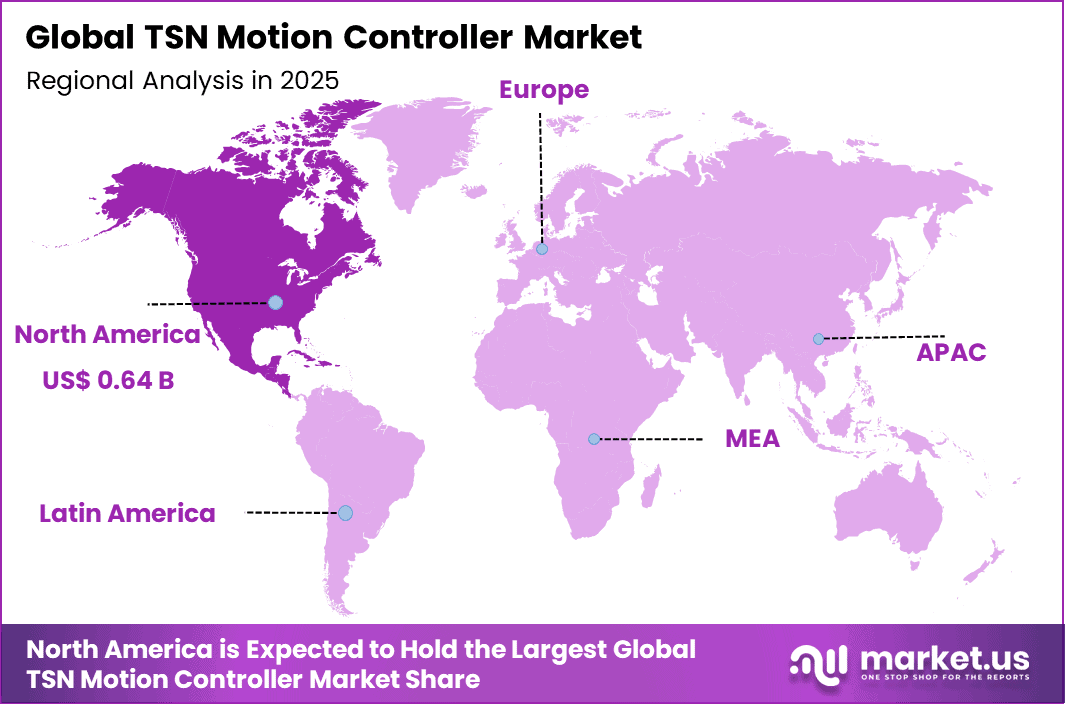
The U.S. market reached USD 0.54 Billion and is projected to grow at a CAGR of 6.3%, driven by ongoing modernization of industrial facilities and growing use of robotics in manufacturing operations. Companies are adopting TSN motion controllers to achieve accurate machine coordination, faster response times, and better system reliability.
The expansion of automotive, electronics, packaging, and semiconductor production is also increasing demand for high-performance control systems. In addition, continued investment in Industry 4.0 strategies and intelligent automation is expected to support steady growth of the market in the US over the coming years.
Key Regions and Countries
- North America
- US
- Canada
- Europe
- Germany
- France
- The UK
- Spain
- Italy
- Russia
- Netherlands
- Rest of Europe
- Asia Pacific
- China
- Japan
- South Korea
- India
- Australia
- Singapore
- Thailand
- Vietnam
- Rest of APAC
- Latin America
- Brazil
- Mexico
- Rest of Latin America
- Middle East & Africa
- South Africa
- Saudi Arabia
- UAE
- Rest of MEA
Competitive Analysis
The competitive landscape of the TSN Motion Controller Market is led by global industrial automation companies with strong expertise in motion control and smart manufacturing systems. Companies such as Siemens AG, Rockwell Automation, Beckhoff Automation, Schneider Electric, ABB Ltd., Bosch Rexroth AG, Omron Corporation, and Mitsubishi Electric Corporation focus on advanced controllers that support real-time communication, synchronized motion, and high-speed machine performance.
These players integrate TSN capabilities into broader automation platforms, helping manufacturers improve precision, flexibility, and factory connectivity. Their strong engineering capabilities and global industrial presence help them maintain a leading position in the market.
At the same time, companies such as Yaskawa Electric Corporation, Panasonic Corporation, B&R Industrial Automation, Advantech Co., Ltd., Delta Electronics, Inc., National Instruments (NI), HMS Networks, Moxa Inc., Lenze SE, KUKA AG, Fuji Electric Co., Ltd., and SICK AG compete by offering specialized motion control, industrial networking, and machine automation solutions.
These players focus on modular designs, easy integration, and support for robotics and high-performance machinery. Competition in this market is driven by demand for Industry 4.0 systems, precise multi-axis control, low-latency networking, and the ability to connect machines seamlessly across production environments.
Top Key Players in the Market
- Siemens AG
- Rockwell Automation
- Beckhoff Automation
- Schneider Electric
- ABB Ltd.
- Bosch Rexroth AG
- Omron Corporation
- Mitsubishi Electric Corporation
- Yaskawa Electric Corporation
- Panasonic Corporation
- B&R Industrial Automation
- Advantech Co., Ltd.
- Delta Electronics, Inc.
- National Instruments (NI)
- HMS Networks
- Moxa Inc.
- Lenze SE
- KUKA AG
- Fuji Electric Co., Ltd.
- SICK AG
- Others
Future Outlook
The future outlook for the TSN Motion Controller Market looks strong as industries continue to adopt smart manufacturing and high-speed automation systems. The market is expected to grow with increasing demand for precise, synchronized, and low-latency motion control in robotics, packaging, electronics, and automotive production lines. Manufacturers are anticipated to use TSN-based controllers to improve communication between machines and reduce downtime. In the coming years, growth in Industry 4.0, industrial IoT, and connected factory systems is expected to increase adoption, making TSN motion controllers an important part of next-generation industrial automation.
Recent Developments
- March, 2026 – Siemens AG updates its SIMATIC/ SINAMICS portfolio with TSN‑enabled motion controllers for high‑speed packaging and robot cells, allowing multiple axes to stay synchronized over standard Ethernet instead of dedicated fieldbuses.
- March, 2026 – Rockwell Automation expands its Allen‑Bradley Logix motion platform with TSN‑ready Ethernet modules, so OEMs can mix safety, I/O, and multi‑axis motion on one converged network.
Report Scope
| Report Features | Description |
|---|---|
| Market Value (2025) | USD 1.9 Billion |
| Forecast Revenue (2035) | USD 4.2 Billion |
| CAGR(2025-2035) | 8.50% |
| Base Year for Estimation | 2024 |
| Historic Period | 2020-2024 |
| Forecast Period | 2025-2035 |
| Report Coverage | Revenue forecast, AI impact on Market trends, Share Insights, Company ranking, competitive landscape, Recent Developments, Market Dynamics and Emerging Trends |
| Segments Covered | By Component (Hardware, Software, Services), By Type (Standalone Controllers, Embedded Controllers, Distributed Controllers), By Application (Robotics, Packaging, Material Handling, Others), By Industry Vertical (Automotive, Electronics & Semiconductor, Others), By Network Protocol (Ethernet/IP, PROFINET, Others) |
| Regional Analysis | North America – US, Canada; Europe – Germany, France, The UK, Spain, Italy, Russia, Netherlands, Rest of Europe; Asia Pacific – China, Japan, South Korea, India, New Zealand, Singapore, Thailand, Vietnam, Rest of Latin America; Latin America – Brazil, Mexico, Rest of Latin America; Middle East & Africa – South Africa, Saudi Arabia, UAE, Rest of MEA |
| Competitive Landscape | Siemens AG, Rockwell Automation, Beckhoff Automation, Schneider Electric, ABB Ltd., Bosch Rexroth AG, Omron Corporation, Mitsubishi Electric Corporation, Yaskawa Electric Corporation, Panasonic Corporation, B&R Industrial Automation, Advantech Co., Ltd., Delta Electronics, Inc., National Instruments (NI), HMS Networks, Moxa Inc., Lenze SE, KUKA AG, Fuji Electric Co., Ltd., SICK AG, Others |
| Customization Scope | Customization for segments, region/country-level will be provided. Moreover, additional customization can be done based on the requirements. |
| Purchase Options | We have three license to opt for: Single User License, Multi-User License (Up to 5 Users), Corporate Use License (Unlimited User and Printable PDF) |